
by James Scott Bell
@jamesscottbell
 Many writers are not content merely to write a good story. They want to “say something.” This is not a bad impulse. We are awash in a culture of the trivial, the trite, and the downright stupid. It is part of the writer’s calling to stand against all that.
I can’t recall who it was, but one novelist said, “A writer should have something on his mind.”
That something is the theme, or meaning, of a story. It is the moral message that comes through at the end. The noted writing teacher William Foster-Harris believed that all worthy stories can be explained as an exercise in “moral arithmetic.” In The Basic Formulas of Fiction he expressed it thus:
Value 1 vs. Value 2 = Outcome
For example, Love vs. Ambition = Love. In other words, the value of love overcomes in the struggle against ambition. If one were writing a tragedy, the outcome would be the opposite, with ambition winning out at the cost of love.
This is true even if you write without a fleeting thought about theme. Your story will have one, whether you’re conscious of it or not.
Each story has only one primary theme, which can also be stated as “Value X leads to Outcome Y.” James N. Frey says in How to Write a Damn Good Novel: “In fiction, the premise [or theme] is the conclusion of a fictive argument. You cannot prove two different premises in a nonfiction argument; the same is true for a fictive argument. Say the character ends up dead. How did it happen? He ended up dead because he tried to rob the bank. He tried to rob the bank because he needed money. He needed money because he wanted to elope. He wanted to elope because he was madly in love. Therefore, his being madly in love is what got him killed.”
So, “mad love leads to death” is the theme.
It is crucial, however, to realize that theme is played out through the characters in the story. In high school my son was tasked with a book report. He read (at my suggestion) Shane, the classic Western by Jack Schaeffer. One of the questions on his report sheet was to state the theme. He asked me for help, because he had never thought about books this deeply before.
With a little prodding, he was able to see that the homesteaders represented civilization, while the ranchers who hire gunmen represent brutality and lawlessness. Shane, of course, is the enigmatic figure who helps this moral equation become: “Civilization (a community of shared values) can overcome the forces of lawlessness.”
Look to the characters and what they are fighting for, and you will find the theme of your story.
But there is a common problem writers face when they have “something on their minds.” And that is simply that they often begin with a theme and try to force a story into it. This can result in a host of issues, among them:
- Cardboard, one-dimensional characters
- A preachy tone
- Lack of subtlety
- Story clichés
The way to avoid these is to remember: Characters in competition come before theme.
Always.
Develop your characters first—your hero, your villain, your supporting cast—and set them in a story world where their values, aims, and agendas will be in conflict. Create scenes where the struggles is vivid on the page.
Yes, you can have a theme in mind, but make it as wispy as a butterfly wing, and subject to change without notice. If you write truly about the characters, following the wants, needs, and desires, you’ll begin see the theme of your story emerge. At first it may be like the faint glow of a miner’s lamp deep in a dark cave. You may not have full illumination until the end, but it will be there.
So give your characters full, complex humanity, and then a passionate commitment to their own set of values. Even the villain. No, especially the villain. All villains (or antagonists) think they are right, and they are the drivers of the plot.
Sometimes, the theme may surprise you. That’s when writing becomes a wondrous act of self-revelation. Your story is revealing who you are and what you really care about.
Do you think about theme when you write? Or after you write? Or at any time? Have you ever been surprised at yourself when you finish a story and find a meaning you hadn’t anticipated?



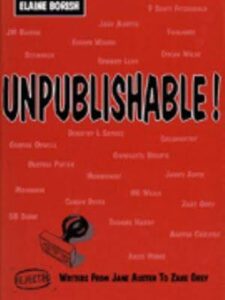
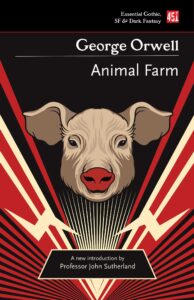 George Orwell had his masterpiece, “Animal Farm,” turned down by no less than T. S. Eliot, a big deal at UK publishers Faber and Faber. Like many in the upper echelons of publishing, Eliot missed the point when he rejected Orwell: “Your pigs are far more intelligent than the other animals, and therefore the best qualified to run the farm . . . What was needed (someone might argue) was not more communism but more public-spirited pigs.”
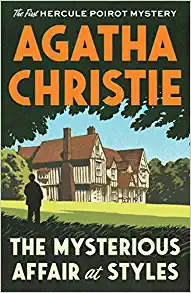
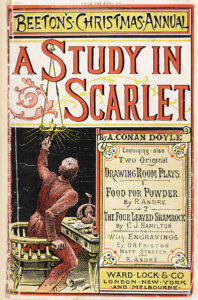 Publishers outdid themselves with boneheaded reasons to reject bestsellers. Conan Doyle’s first Sherlock Holmes novel, “A Study in Scarlet,” was turned down by the prestigious Cornhill magazine because it was too much like the other “shilling shockers” already on the market. The editor said it was too long “and would require an entire issue” – but it was “too short for a single story.” Another publisher sent the manuscript back unread. A third bought the rights for a measly twenty-five pounds, and let it sit around for year. It was published in 1887, and then brought out as a book, but Conan Doyle didn’t get any money from that because he’d sold the rights. Worse, the book was pirated in the U.S. Doyle wrote a couple of historical fiction works. Then an American editor, looking for UK talent, had dinner with Doyle and Oscar Wilde and signed them both up. Wilde wrote “The Picture of Dorian Gray” and Doyle did “The Sign of the Four.”
 The other day, I saw a Facebook post from my friend Joseph Finder. I like Joe a lot. We’ve been on panels together. He writes good books that sell really well. He’s a really nice guy. But this photo at left that he posted the other day made me want to…heck, I don’t know what. This is Joe’s writing office. It’s perfect. How would someone NOT get inspired sitting in a place like that? Why can’t I have a writing house like that? Maybe I’ll go up to Cape Cod and TP his…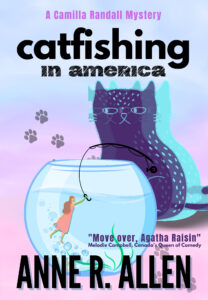
 Anne R. Allen is a popular blogger and the author of the bestselling Camilla Randall Mysteries as well as the Boomer Women Trilogy and the anthology Why Grandma Bought that Car (Kotu Beach Press.) Her most recent mystery is Catfishing in America (Thalia Press) a comic look at romance scams. Her mystery The Gatsby Game is being published in French at the end of this month. Anne’s nonfiction guide, The Author Blog: Easy Blogging for Busy Authors, is an Amazon #1 bestseller that was named one of the 101 Best Blogging Books of All Time by Book Authority. She’s also the co-author, with Catherine Ryan Hyde, of the writer’s guide How to Be a Writer in the E-Age. She blogs with NYT million-copy seller, Ruth Harris, at “Anne R. Allen’s Blog…with Ruth Harris.” You can find them at
  We’re over halfway through the year (ack!), so it seems an apt time to catch up on a few publishing business items. Here are five that recently caught my eye. Additions and prognostications are welcome in the comments.