Emphasized Words in Fiction

Many new writers struggle with how to emphasize words in fiction. It’s tempting to stick a word in ALL CAPS.

Please resist that urge. Yes, all-caps draws the reader’s attention, but not in a good way. All-caps become annoying after a while.

In fact, a 1955 study found that all-caps slowed reading speed by 9.5% over a five-minute period.

For example:

“I AM NOT HYSTERICAL!”

Notice how all the letters blend together in all-caps? It’s difficult to read. Imagine an entire novel littered with all-caps? In dialogue, it’s even more exhausting and amateurish.

If your character is shouting, use one exclamation point—not three!!!—or show us with a body cue.

“I am not hysterical!”

Or…

She slammed her fist on the table. “I am not hysterical!”

The combination of body cue, italicizing not, and the exclamation mark show the reader she is hysterical.

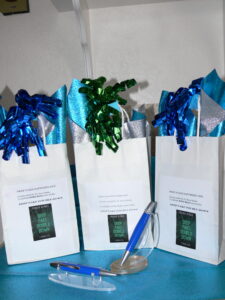
To the best of my recollection, I only used all-caps once in nineteen books. In my latest psychological thriller that releases at the end of this month (Yay!), the MC finds an engraved invitation, and I used italicized all-caps to show the heading across the front. Because all-caps is so offensive and jarring, I took special care to break up the text with an em dash, spacing above and below it, and double-tabbed to set it apart from the narrative. Offensive and jarring was exactly what I was going for, so all-caps worked in this case.

If you can think of another exception, please share in the comments.

What about changing the font to indicate emphasis?

I know it’s easy to change fonts these days, but the end result doesn’t enhance the reading experience. If anything, it pulls the reader out of the story. Please, stop. Let the writing speak for itself. If it can’t, then the problem is the writing, not the font.

What about bold to emphasize a word?

The short answer is no. The reading experience isn’t enhanced by bold, either. Both bold and all-caps look like the author’s screaming for attention.

What are we left with?

Italics. Yes, but don’t overdo it. Italics work best for emphasis when used sparingly. Like all-caps and bold, if used too much the eye passes right over the words we want emphasized.

We do have one other trick.

Em dashes. I love the little suckers. Maybe too much. 😉 At least I’m in good company. Jim professed his love for the em dash on Valentine’s Day last year.

“It is a crisp, efficient dash used to set off a word or clause for emphasis or additional information.”

Couldn’t say it any better. It’s a beloved, versatile punctuation mark.

Hope he doesn’t mind if I steal his example from Romeo’s Hammer:

So what about the lack of clothing? A love scene gone bad? Someone who had been with her while she was drinking—or drugging—herself? Her condition when I found her was such that she had to have come from one of the beach houses. Access to the sand is cut off all along PCH. She didn’t wander down from the street.

See how drugging stands right out? The em dashes draw the eye right to it. They tell us to pay attention. They pique interest. They emphasize.

With italics and em dashes, we have all the tools we need to emphasize words. Now, go forth and finish that novel.

For fun, share a sentence from your WIP, published work, or a book you’re reading that shows how a word–or words–are emphasized. Don’t forget to include the title!

Killer Deadlines

By Elaine Viets

Throughout my writing career, I’ve lived by deadlines. I started as a newspaper reporter and then became a columnist, where I often had four deadlines a week – with no time off. When the holidays rolled around, I had to write my columns ahead of time. That meant six or even eight deadlines a week.
As a mystery writer, I still have deadlines, but the pace seemed easier. Newspapers moved swiftly, like a cold through a kindergarten. Publishing seemed slower than a Manhattan traffic jam.
At first, I wrote two novels a year. Now I’ve cut back to one a year.


No problem with deadlines, right?
Wrong. No matter how much time I have to write a novel, the last week is always jammed up.
This August 31, I turned in my new Angela Richman, death investigator mystery to my London publisher, Severn House. This time, I spent that final stretch writing twelve-hour days, trying to finish. As I read through the book, a straggling subplot had to be cut. Its crabgrass-like tendrils were deep in the book. I dug them out.
Errors popped up – difficult characters deliberately changed their hair color and didn’t tell me. One nasty customer gave himself two different names. Typos appeared out of nowhere.
As I struggled to finish on deadline, I wrestled with my recalcitrant manuscript. I could feel it squirming. It refused to settle neatly in place.
I read and reread it until my eyes were blurry. Finally, I pressed the button and emailed it off to London, hoping all was well. I couldn’t read the book one more time.
Exhausted, I slept for two days.
Then I waited and worried, my head buzzing with questions:
Would my editor like the new book? Would she want a rewrite? What if she rejected it?
Finally, I got a brief note two weeks later – that’s lightning speed for publishing. My editor was reading the manuscript and “enjoying it hugely.”
Whew. I felt so much better. What was I going to do while I waited?
I could write a short story. Clean off my desk. Answer my emails. Plot my next book.
I could do that, but I didn’t. I couldn’t get up the energy.
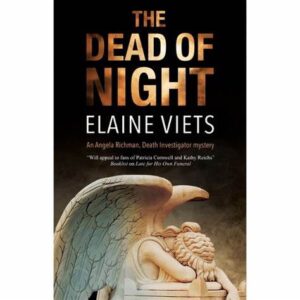
My editor didn’t like the working title, so I came up with a new one – “The Dead of Night.”
I didn’t do much else. I just need to lie fallow, I told myself. I was so fallow I was turning into a puddle of goo. I moped around my home. I’ll get my energy back soon, I thought.
Soon.
I got it back this Tuesday. My editor emailed me the copyedited manuscript. It needs some tweaking and a small rewrite. And I have one week to finish. It’s due next Tuesday.
Suddenly I was awake. Galvanized. Ready to work. I quit moping. I had a purpose.
Better yet, I had a deadline.

What about you, writers? Do you need deadlines?

PS: I’m also working under another deadline. Hurricane Nicole is heading this way, and I’m going to drag in the plants on the balcony. Wish us luck.

8888888888888888888888888888888888888888888888888888888888
I’m celebrating! My short story, “We Are the People Our Parents Warned Us About,” in the anthology, “The Great Filling Station Holdup: crime fiction inspired by the songs of Jimmy Buffet,” edited by Josh Pachter, won Silver at the Royal Palm Literary Award.
Buy the anthology here: https://tinyurl.com/4nr7a9pm

Dream Hacking

By Debbie Burke

@burke_writer

The paranoid hairs on the back of my neck stood up when I read several articles by scientists from MIT, Harvard, and University of Montreal about emerging techniques for manipulating dreams.

Search engines are already scary-smart at reading our minds and predicting our behavior. Type a few letters into the search bar and instantly the rest of the word or phrase appears. Google is like a long-time spouse who finishes sentences for you.

Soon, similar mind reading may be extended into your dreams as you sleep.

Disturbing? Yup.

According to an article by Rob Pegoraro in Forbes.com, as a 2021 Superbowl promotion, Coors Beer offered people free beer in exchange for their participation in a study of “targeted dream incubation,” billed as “The World’s Largest Dream Study.” Subjects were shown Coors’s videos of snowy mountain views and crystal streams several times then fell asleep to the soundtrack of those ads.

https://youtu.be/tU_0jU0mMLw

Upon waking, the subjects reported dreams of waterfalls and being in snow. The most telling—and chilling—reaction of all came from one woman: “I think it was… something to do with… Coors.”

Subliminal advertising in commercials first became a hot topic way back in 1957. Marketer James Vicary claimed sales of popcorn and Coca Cola increased because of messages inserted into ads. The messages supposedly flashed so quickly the eye could not see them. He later admitted his study was a gimmick not supported by evidence.

According to Chron.com, consumer concerns prompted the FCC to issue a statement:

The FCC stated that all broadcasting licensees should not use subliminal advertising techniques because the techniques are deceptive, which runs counter to the purpose of the FCC. The statement is still on the FCC’s website as its stance on subliminal marketing.

Nevertheless, the concept caught on. This article from Business Insider cites examples.

Aboriginal cave painting-Jabiru dreaming
Photo credit: Wikimedia.com CCA SA-4.0

Dream manipulation is nothing new. Ancient peoples as far back as 5000 years and perhaps longer recognized the enormous power of dreams.

Cultures around the world, from Babylonia, Egypt, Greece, Rome, and even remote isolated islands, developed practices to guide dreams toward a specific goal. Some goals included:

  1. Connection with a deity;
  2. Seeking solutions to problems;
  3. Overcoming traumatic events;
  4. Predicting the future.

To attain these goals, different rituals included:

  1. Rubbing ashes or paint-like substances on a person’s face;
  2. Eating raw flesh of a particular animal before sleeping;
  3. Inflicting pain, e.g. Native American Vision Quests;
  4. Going to sacred locations to sleep.

Today, many conditions, including anxiety, PTSD, poor school or work performance, eating disorders, etc., are commonly treated by using suggestions during sleep.

Here at TKZ, we frequently talk about how authors can solve story problems by using prompts before they go to sleep. Writers often dream their way through roadblocks.

Watch tracker
Photo credit: Wikimedia.com CC A-2.0

Technology already tracks our physical activity, heart rate, exercise, location, proximity to stores, and far more. Some years ago, while shopping for a new smartphone, I was shocked to find an app that monitored vaginal secretions. Whoa, guys, that is way too intrusive.

When such monitoring goes beyond the physical body and digs into the deepest recesses of the mind, the slope gets downright slippery.

What if a person’s dreams can be manipulated so businesses can profit from them?

With marketers now seeking high-tech ways to manipulate consumers in their sleep, concerned scientists are sounding ethical alarm bells.

In open letter signed by more than 40 scientists in June, 2021, Robert StickgoldAntonio Zadra, and AJH Haar wrote:

TDI [targeted dream incubation]-advertising is not some fun gimmick, but a slippery slope with real consequences. Planting dreams in people’s minds for the purpose of selling products, not to mention addictive substances, raises important ethical questions. The moral line dividing companies selling relaxing rain soundtracks to help people sleep from those embedding targeted dreams to influence consumer behavior is admittedly unclear at the moment.

Futurism.com says:

…it’s only a matter of time before tech companies that make watches, wearables, apps and other technology that monitor our sleep start to sell that data for profit, or use those tools to hack our dreams while we slumber.

Our dreams might turn into nightmares we can’t wake up from.

This technology opens a vast plot playground for authors of sci-fi, crime, and thriller writers to explore nefarious uses for dream hacking.

TKZers, please name books or films where dream manipulation is used.

How would you incorporate dream hacking into a plot?

Do you give yourself pre-sleep suggestions?

~~~


Debbie Burke’s books won’t hack your dreams but many reviewers say they keep them awake at night. Please check out Tawny Lindholm Thrillers with Passion, for sale at this link

Social Media, Blogging, and SEO Redux

Since I am on deadline and preparing to fly to Atlanta to film three episodes of a true crime series, I’m sharing my very first post on the Kill Zone from 2017. Has it been five years already? Seems like yesterday. Anyway, I hope you enjoy it. I’ll try to pop into the comment section at some point today. Please be patient! In the meantime, chat among yourselves.

Social Media, Blogging, and SEO Tips

Social Media, Blogging, and SEO tipsTo prepare for my first post as a TKZ member (yay!), I read all the social media posts on the Kill Zone (my little research addiction rearing its head :-)). Back as far as 2009, Joe Moore wrote Social Networking Showdown, which explored MySpace vs. Facebook, Shelfari vs. Goodreads, Crimespace, Gather, Bebo, LinkedIn, and the all-important email list. Even though some of these sites are nonexistent today, Joe’s advice still applies. And in 2011, he shared his perspective on using manners online. Which is critical these days.

The way we conduct ourselves on social media matters. Hence, why Jim made social media easy and why, I presume, Jodie Renner invited Anne Allen to give us 15 Do’s and Don’ts of social media as only Anne could, with her fantastic wit.

One year later, in 2016, Clare shared what’s acceptable for authors on social media and what isn’t. Jim showed us the dangers of social media, and how it can consume us if we’re not careful.

Through the years the Kill Zone authors have tried to keep us from falling into the honey trap of social media. Which brings me to the burning question Kathryn posed this past June: Writers on Social Media: Does it Even Make a Difference?

In my opinion, the correct answer is yes.

Working writers in the digital age need to have a social media presence. Fans expect to find a way to connect with their favorite author. How many of you have finished reading a thriller that blew you away, and immediately went online to find out more about the author? I know I have. It’s only natural to become curious about the authors whose books we love. Give your fans a way to find you — the first step in building an audience.

I’ve seen authors who don’t even have a website, never mind an updated blog. This is a huge mistake, IMO. It’s imperative to have a home base. Without one, we’re limiting our ability to grow.

BLOGGING

There are two types of blogging: those who blog about their daily routine and those who offer valuable content. Although both ways technically “engage” our audience, the latter is a more effective way to build and nurture a fan base.

When I first started blogging I had no idea what to do. I got in contact with a web design company (just like web design company Nashville) to help me get set up, and away I went! I’ve always loved to research, so I used my blog as a way to share the interesting tidbits I’d learned along the way. For me, it was a no-brainer. I’d already done the research. Writing about what I’d learned helped me to remember what I needed for my WIP while offering valuable content to writers who despise research (Gasp!). Over time my Murder Blog grew into a crime resource blog.

Running a resource blog has its advantages and disadvantages. Be sure to look into the pros and cons before choosing this route. When I first scored a publishing deal, I realized most of my audience was made up of other writers. The question then became, how could I attract non-writers without losing what I’d built?

My solution was to widen my scope to things readers would also enjoy, like flash fiction and true crime stories. Who doesn’t like a good mystery?

With a resource blog it’s also difficult to support the writing community. Book promos go over about as well as a two-ton elephant on a rubber raft. If you decide to run a resource blog, find another way to support your fellow writers. When one of us succeeds, the literary angels rejoice.

There’s one exception to the “no book promos” rule for resource blogs, and that is research. It’s always fun to read about other writers’ experiences. Subtly place their book covers somewhere in post (with buy link). That way it benefits both your audience and the author.

The one thing we can count on is that how-to blog changes with the times. A few months ago, my publisher shared a link to an article about blogging in 2018. Because she shared the article via our private group, I’m reluctant to share the link. The gist of article is, come 2018 bloggers who don’t offer some sort of video content will be left in the dust. Only time will tell if this advice holds true, but it makes sense. The younger generation loves YouTube. By adding a video series or a Facebook Live event we could expand our audience.

It’s time-consuming to create each video episode. Hence why I had several months in between the first two episodes of Serial Killer Corner. Our first priority must be writing that next book. However, consistency is key. Weekly, monthly, bi-monthly? Choose a plan that works for you and stick with it. There are many internet marketing experts who can help make your blog become successful.

SEO MATTERS

SEO — Search Engine Optimization — drives traffic to your website/blog. Without making this post 10K words long, I’m sharing a few SEO tips with added tips to expand our reach. In the future I could devote an entire post to how to maximize SEO. Would that interest you?

Tips

  • every post should have at least one inbound link and two outbound links; we highly recommend speaking to a digital marketing agency such as OutreachPete.com to get guidance on how to build these links.
  • send legacy blogs a pingback when linking to their site;
  • never link the same words as the post title or you’ll lessen the previous posts’ SEO (note how I linked to previous TKZ posts in the 1st paragraph);
  • use long-tail keywords rather than short-tail (less competition equals better traffic);
  • using Yoast SEO plug-in is one of the easiest ways to optimize a blog’s SEO;
  • self-hosted sites allow full control of SEO, free sites don’t;
  • remove stop words in the post slug (for example, see the permalink for this post); I’d also recommend removing the date, but that’s a personal preference;
  • drip marketing campaigns drive traffic to your site;
  • slow blogging drives more traffic than daily blogging (for a single author site);
  • consistency is key — if you post every Saturday, keep that schedule;
  • use spaces before and after an em dash in blog posts (not books);
  • use alt tags on every image (I use the post title, which should include the keyword); if someone pins an image, the post title travels with it;
  • link images to post and book covers to buy link;
  • white space is your friend; use subheadings, bullet points, and/or lists;
  • longer posts (800 – 1, 000 words min.) get better SEO than than shorter ones;
  • using two hashtags on Twitter garners more engagement than three or more;
  • protect your site with SSL encryption (as of this month, Google warns potential visitors if your site isn’t protected; imagine how much traffic you could lose?);
  • post a “SSL Protected” badge on your site; it aids in email sign-ups;
  • via scroll bar or pop-up, capitalize on that traffic by asking visitors to join your community, which helps build your email list;

THE 80/20 RULE

Most of us are familiar with the 80/20 rule. 80% non-book-related content; 20% books. My average leans more toward 90/10, but that may be a personal preference.

What should we share 80% of the time? The easiest thing to do is to share what we’re passionate about. When I say post about passion I don’t mean writing. Sure, we’re all passionate about writing, but I’m sure that’s not the only thing you’re passionate about. How about animals, nature, cooking, gardening, or sports?

One of the best examples of sharing one’s passion comes from a writer pal of mine, Diana Cosby, who loves photography. Every Saturday on Facebook, she holds the Mad Bird Competition. During the week she takes photos of birds who have a penetrating glare and/or fighting stance. On Saturdays, she posts two side-by-side photos and asks her audience to vote for their favorite “mad bird.” Much like boxing, the champion from that round goes up against a new bird the following week.

On Fridays, she posts formal rejection letters to birds who didn’t make the cut. With her permission, here’s an example:

Dear Mr. House Sparrow,

I regret to inform you that though your ‘fierce look’ holds merit, it far from meets the requirements for entry into the Mad Bird Competition. Please practice your mad looks and resubmit.

Sincerely,
M.R. Grackle
1st inductee into the Mad Bird Hall of Fame


It’s a blast! I look forward to these posts every week. As such, I’m curious about her books. See how that works?

My own social media tends to run a bit darker … murder & serial killers top the list, but I also share stories about Poe & Edgar, my pet crows who live free, as well as my love for nature and anything with fur or feathers. The key is to be real. Don’t try to fake being genuine. People see right through a false facade. Also, please don’t rant about book reviews, rejection letters, or anything else. Social media is not the place to share your frustrations.

As for soft marketing on social media, I like to make my own memes. It only takes a few minutes and it’s a great way to keep your fans updated on what you’re working on. In the following example I wrote: #amwriting Book 3, Grafton Series. I also linked to the series. Don’t forget to include a link to your website. The more the meme is shared, the more people see your name. Keep it small and unobtrusive. See mine in the lower-right corner?

Social Media, Blogging, and SEO Tips

In the next example, I asked, “What’s everyone doing this weekend? No words, only gifs.” Have fun on social media. The point is to engage your audience.

Folks love to be included. Plus, I genuinely want to get to know the people who follow/friend me. Don’t you? It doesn’t take much effort to make your fans feel special. Take a few moments to mingle with them. It’s five or ten minutes out of your busy schedule, yet it may be the only thing that brightens someone’s day. In a world with so much negatively and hatred, be better, be more than, be the best person you can be … in life and on social media.

Over to you TKZers. How do you approach social media?

Creative Marketing: Beyond the Bookstore

Today I’m delighted to introduce a guest post by mystery/suspense author Leslie Budewitz (also writing as Alicia Beckman). Leslie offers ideas about unconventional places to sell books.

Welcome, Leslie!

~~~

Marketing and promotion, it turns out, can require as much creativity as writing itself. One example: launching and selling books through non-traditional outlets, that is, businesses that aren’t primarily bookstores. These outlets are critical for those of us without easy access to bookstores.

When my first novel came out in 2013, the owners of an art gallery in Bigfork, Montana, where I live, approached me with an invitation I could never have imagined, even if I’d written it myself: What about an exhibit called “Bigfork in Paint and Print,” featuring area artists’ visions of the community and a book launch on opening night?

I still remember carrying a box of books into the gallery and finding people waiting for me. People I didn’t know. People who bought multiple copies, for gifts. I sold every book I’d brought and sent my husband home for more. We sold 60 books that night, and another 180 at the local art festival that weekend.

And the gallery? After telling me openings don’t sell paintings so don’t get my hopes up for books, the owners were astonished: They sold nine of eleven paintings that night and a tenth the next week.

Now it helped that I knew the owners, the local paper previewed the event, and the book, Death al Dente, first in my Food Lovers’ Village cozy mysteries, is set in a fictional version of our town. A special case. The exhibit continued for several years and openings were successful, but not at the same level—fewer friends-and-family purchases, more opportunities to buy the books in other places, and a little less excitement.

But this experience showed me the value of non-bookstore outlets.

Does your book have a specific angle that ties in to a local business?

I live in a small tourist town in the northern Rockies. One of the downtown anchor businesses is a kitchen shop. My two cozy mystery series are both set in food-related retail shops, one here and one in Seattle’s Pike Place Market. It’s been a natural combination, and the kitchen shop sells dozens of my books every year to both locals and visitors. To my surprise, it’s also sold more than 100 copies of my first suspense novel, Bitterroot Lake, a hardcover without a single cupcake on the cover. Why? My guess: The bitterroot is the state flower and the word is echoed in landmarks throughout the area, giving it a strong regional appeal.

You might find a similar connection with an outdoor gear and clothing shop for your books featuring a park ranger or a fishing guide who solves mysteries. Your amateur sleuth runs a coffee cart? I can see the books displayed in the local coffee shop. A café, a brewery, a business built on a local theme—natural connections.

In general, people are not likely to buy a thing in a place where they don’t expect to see it. You probably wouldn’t buy earrings in a convenience store. On the other hand, you might buy a cute pair by a local artist nicely displayed near the cash register. We all love surprises and souvenirs. That’s the whole purpose of gift shops in art centers and historical museums. I’m one of several local authors who sell books through the airport gift shop, an option for those of us who live in smaller cities where airport retail is locally owned and operated.

A few tips: Forge a relationship with the business owner or manager. Show why your book fits their mission and will appeal to their customers. Retailers want new products that will excite their customers.

Offer to accept payment after sales rather than requiring an investment up front. Both the kitchen shop and airport gift shop started by paying me on sales, and quickly moved to buying the books outright.

Personalize an advance copy for the staff to pass around.

Work with the shop on displays. Your book won’t do well where people don’t see it. In the kitchen shop, my books are among the first things visitors see. After my launch at the local art center, I take the small stand-up poster to the kitchen shop and add it to their display. I’ve created a list of books in order, identifying me as a local author and Agatha Award winner. I leave bookmarks. I check in often and fluff the display. I’ve gotten to know the salesclerks, so they talk up my books. And you know that getting other people to talk about your books is more important than anything you can say.

When you make a delivery, find a spot to sit or stand and sign the books you’re leaving. You’ll strike up conversations with customers and staff and sell books while you’re there. Odd as it sounds, sales will go up that day, even after you leave. Every shop and gallery owner I’ve worked with swears it’s true.

Working out the sales percentage may be tricky. Retailers are likely to accept 75/25 because they are used to working on small margins. Nonprofits may be less flexible. If you’re traditionally published and can’t accept 60/40, be prepared to explain why and justify a 75/25 split. Twice recently I’ve heard “We have to treat everyone fairly,” that is, apply the same percentage to all artists. Treating people fairly doesn’t always mean treating them the same, because people aren’t all in the same situation. The only solution I’ve found is to suggest increasing the retail price. I hesitated, thinking an $8 paperback wouldn’t sell at $10, but it has. Remember, gift shop sales are often spur-of-the-moment purchases. You’re not competing with Amazon or B&N; a tourist will see the book as a souvenir, and a local as a special find.

If a shop can do better buying directly, tell them. Some gift shops and used bookstores that carry a few new titles have accounts with Ingram. That’s a better deal for them and easier for you. Stop in regularly to sign books and leave bookmarks.

One-night stands: Even without a regular sales relationship, you can participate in special events at local businesses. Does your book fit with Pioneer Days or other local celebrations? Holiday open houses and “ladies night” events are big opportunities. And if other artists or authors are participating, even better. The “shop and buy” vibe rises exponentially.

Montana authors Mark Leichliter, Christine Cargo, Leslie Budewitz, and Debbie Burke

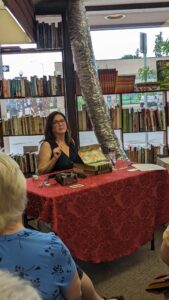
Finally, though it doesn’t quite fit my theme, I want to mention another option. Create your own event and make it A Thing. When Kill Zone blogger Debbie Burke and her friend Dorothy Donahoe, a retired librarian, took a “get out of Dodge” drive in the summer of 2020, they stopped for lunch at a Bigfork bakery with an outdoor stage and bar and a lovely view. Dorothy suggested Debbie recruit other local authors for a joint event. It’s become an annual event featuring four mystery authors from across the valley.

Find and nurture local connections. People love the idea of promoting local authors; make it easy for them and fun for you. Let your creativity flow beyond the page.

~~~

Thanks, Leslie, for visiting The Kill Zone and sharing these great out-of-the-box ideas. And congratulations on tomorrow’s launch of Blind Faith!

~~~

BLIND FAITH (written as Alicia Beckman), is out October 11 from Crooked Lane Books, in hardcover, ebook, and audio.

Long-buried secrets come back with a vengeance in a cold case gone red-hot in Agatha Award-winning author Alicia Beckman’s second novel, perfect for fans of Laura Lippman and Greer Hendricks.

A photograph. A memory. A murdered priest.

A passion for justice.

A vow never to return.

Two women whose paths crossed in Montana years ago discover they share keys to a deadly secret that exposes a killer—and changes everything they thought they knew about themselves.

Amazon
Barnes and Noble
Books-A-Million
Bookshop.org
Indie Bound
And your local booksellers!

~~~

Leslie Budewitz is a three-time Agatha Award winner and the best-selling author of the Spice Shop mysteries, set in Seattle, and Food Lovers’ Village mysteries, inspired by Bigfork, Montana, where she lives. The newest: Peppermint Barked, the 6th Spice Shop mystery (July 2022). As Alicia Beckman, she writes moody suspense, beginning with Bitterroot Lake and continuing with Blind Faith (October 2022). Leslie is a board member of Mystery Writers of America and a past president of Sisters in Crime.


Good News! Amazon Changes Ebook Return Policy

by Debbie Burke

@burke_writer


Remember The Book Thief by Markus Zusak? It was the story of a young German girl during World War II who steals books to comfort her during her family’s travails.

Unfortunately, about a year ago, a new breed of book thieves came on the scene when some slimy social media influencers promoted abuse of Amazon’s ebook return policy.

An ebook can be returned seven days after purchase in the US or 14 days after purchase in other countries, even after it’s been read.

When you read on a Kindle, Amazon knows exactly where you stopped and takes you to that same spot when you open your Kindle for a new session. When you switch from a Kindle to reading on a different device, it takes you directly to the correct location.

Amazon knows when you finish a book because you immediately receive a message asking you to rate it.

Amazon knows everything. Really.

Viral social media publicized this loophole. The practice of “buying” an ebook, reading it, and returning it for a full refund ran rampant.

Indie-published authors were quick to sound the alarm over sudden upticks in returns. That’s because Kindle Direct Publishing (KDP) gives access to nearly-instant sales reports, whereas royalty reports from traditional publishers lag months behind.

Series authors reported that book 1 was purchased and returned a week later. Same happened with book 2. Then 3, 4, 5, 12, and 19. Obviously thieves had to read the entire series before they decided they didn’t like it.

Book thieves quickly learned Amazon could be used as a library, reading as many books as they could consume…FOR FREE! All they had to do was return them within seven days. Why pay a $10 monthly fee for a Kindle Unlimited subscription?

Clearly, Amazon could track this new trend but did nothing.

Incomes went down for many authors.

Another Amazon policy allows them to penalize authors if too many books are returned. They may even pull your books from being sold, citing poor quality as the reason for returns. What is poor quality? How many is too many? Who makes those decisions? Only the algorithm knows.

Book thieves may have justified their actions because they figured they were sticking it to Amazon.

Wrong! 

In reality, thieves were sticking it to authors who work hard to write quality books. Their work and investment in cover art, editing, proofreading, etc., were being stolen the same as if books were shoplifted from a store.

A petition protesting the policy gathered more than 70,000 signatures. The Authors Guild and the Society of Authors (UK) took evidence of abuses to Amazon.

Good news!

On September 22, 2022, the Authors Guild made this welcome announcement:

Amazon informed us of its plans to change its ebook return policy to restrict automatic returns to purchases where no more than 10 percent of the book has been read.

The planned change will go into effect by the end of the year. Any customer who wishes to return an ebook after reading more than 10 percent will need to send in a customer service request, which will be reviewed by a representative to ensure that the return request is genuine and complies with Amazon’s policies against abuse. This process will create a strong deterrent against buying, reading, and returning ebooks within seven days, and readers who attempt to abuse the return policy will be penalized under Amazon’s policies.


A big thank you to CEO Mary Rasenberger and the conscientious staff of the Authors Guild for protecting authors’ interests and income.

~~~

TKZers: Do you believe you were targeted by book thieves? Did you experience an uptick in ebook returns?

On the Other Side of the Microphone

By Elaine Viets

I’ll admit it. Being interviewed terrifies me. I was a reporter for more than twenty-five years. When I have to sit on the other side of the notebook, or the microphone, my palms sweat, my throat is dryer than Death Valley and my knees go weak.
Recently, I had a TV interview in St. Louis that was painless. The reporter did her research, and she read my books – most interviewers don’t do that.
We talked about books, writing, research and more and it became a conversation. I hope you’ll enjoy this as much as I did.

Today, I’m traveling to the Bouchercon World Mystery Convention in Minneapolis. If you’re going to Bcon, please stop by my panel on 4:15 Saturday, September 10. It’s called “House of Cards: Power and Privilege: Power is everything . . . or is it? Like a house of cards, one false move causes everything to come crumbling down.”
You’ll see many of your favorite authors, including moderator Jason Allen, Joseph Finder, Vera Kurian, Rick Mofina, Hannah Morrissey. Oh, yeah, and me.

To Pay or Not To Pay – Book Reviews For Sale

By Debbie Burke

@burke_writer


“Fly-by-Night Book Reviews says, for $100, they’ll give me twenty guaranteed reviews. Should I try that?”

“I paid $500 to Pie-in-the-Sky Reviews. My book didn’t receive a single review.”

“You don’t dare pay for reviews—that violates Amazon’s terms and conditions. You’ll be banished.”

“Kirkus Reviews are the gold standard.”

“Ever since Kirkus started selling reviews, they lost all credibility.”

~~~

That’s a sample of the spirited responses and contradictory opinions on a recent Authors Guild discussion thread about whether or not to pay for book reviews.

I wound up thoroughly confused, pondering the following questions:

How much do reviews really matter?

Are there still “legitimate” book reviews? What defines “legitimate”?

Have reviews merely become another profit opportunity for vendors peddling them?

Do customers really believe Amazon reviews?

Do reviews increase sales?

Author Maggie Lynch

Multi-genre author Maggie Lynch participates frequently in AG discussions. Over years of reading her contributions, I’ve come to trust her knowledge, judgment, and analysis. Her data is carefully researched. She looks at publishing history from the long view and puts so-called new trends in perspective.

During this ongoing, weeks-long debate about book reviews, one day Maggie wrote: “Warning, I’m going on a bit of a rant.”

What followed was her essay that offered a fresh perspective and updated information about reviews that all authors can benefit from.

I asked if I could share her “rant” at TKZ and she kindly agreed.

Here’s what Maggie has to say:

Paid reviews have always been around, long before the advent of the Internet. Who do you think paid for placement in magazines, journals, and newspapers?

When a publisher buys an end cap display in a bookstore and provides potential review quotes for the store to post, isn’t that paid? If your book is featured on the front page of a major genre magazine, it gets attention. The magazine is going to do a review because you paid $2-$5K to be there.

All advertising is, in effect, paid reviews.

The only difference now is that there are more books, more online venues, and more authors willing to pay for ads, reviews, and all kinds of placement.

Once Amazon entered the online market, it became the focus of most authors. Not because it is the only distributor, but because it is the only distributor using sophisticated algorithms that are somewhat transparent. A number of analysts and programmers focus on Amazon algorithms and then share that information via their own book publications.

Whether you love or hate Amazon, it’s a great search engine. They understand data. They understand how to present the most likely options for getting a sale from a customer. IMO there is no other bookseller with programming that sophisticated.

If other major booksellers–Apple, Kobo, Google, the Big 5—had that same search and analysis capability, they would get more customers as well.

For myself, I have many reasons not to like Amazon. Yet, I give them props when they do well. If I want to find a book or learn more about an author, I’ll look it up on Amazon first because I know it will be quick with lots of information–including other books in the same genre, series, similar authors, etc.

I will likely end up buying the book somewhere else to support a local bookstore or another vendor, but I go to Amazon first.

Many people stay on Amazon because of that ease of use. Authors often believe (mistakenly in my opinion) that they only need to be on Amazon.

But…book sales are NOT Amazon’s primary business.

Only 10% of Amazon’s overall revenue is book sales.

Unfortunately, far too many people think they can game the system. I know hundreds of authors who spend more time trying to figure out how to get higher ranking on Amazon than they do writing books. It’s crazy.

Review factories have always been a part of the online book environment. When I first entered indie publishing in 2011, there were entire “review factories” in Asia where one could buy 100 reviews from “sock puppet” accounts. They were pretty obvious back then, poorly written, using similar phrases.

A couple of times, Amazon has cracked down on these practices–usually when it becomes obvious and egregious. But they usually do it through programming changes.

In the process, some books with legitimate reviews get caught in the net. When crackdowns happened in 2014 and 2018, many authors lost hundreds of reviews and waited months to have them reinstated.

[Note from Debbie: I know authors who simply gave up fighting and started from scratch all over again. Sad.]

Whenever Amazon makes a programming change to search out and punish fake reviews, those who make money on reviewing simply find a more sophisticated way not to get caught.

Algorithm watchers believe that instead of looking for and stopping these reviewers, Amazon is proactively changing the algorithm to counteract the sway of review farms.

Now reviews are weighted significantly less in the algorithm than they have been in the past.

Of course, no one knows how much less or what the criteria are, but it is something to consider. Because of that, authors who are focused on reviews simply pay more.

Authors consistently worry/believe that a high number of reviews (particularly on Amazon) means a high number of sales. That is not necessarily the case.

It is more likely that a high number of sales means a high number of reviews, UNLESS reviews have been supplied primarily by non-purchasers.

To evaluate this, look at the Top 100 bestsellers in Amazon. Many have ZERO reviews. Why? Because the book hasn’t been released and is selling on pre-order. What is creating those sales? Many factors that have nothing to do with reviews such as:

  • Advanced audience definition;
  • Pre-press ads, word of mouth, news, reaching out to fans;
  • Building anticipation for the book followed by a launch blitz that delivers on the promise;
  • ARCs to media and other reviewers (NetGalley, Edelweiss).

It may also be that Amazon never shows a lot of reviews for a particular book because the primary sales are on other sites, NOT Amazon. Many print books sell in bookstores, libraries, or direct from the publisher.

Reviews are not the answer to low sales. Do they help? Good ones do, those that provide information and key ideas to appeal to the audience you want. But the number of reviews does not necessarily correlate to sales.

The last good analysis I read about Amazon indicated there were more than 300 data points that are weighted in the sales and ranking algorithms.

THREE HUNDRED!

Where do reviews stand in that weighting? Not at the top. Probably not even the top 10.

The reality is the #1 weight is actual sales.

You have direct control of many other factors that guarantee more sales such as:

  • Create a fan base;
  • Write more books;
  • Identify your audience;
  • Deliver to their expectations with a consistent brand.

Of course, these take work and time. They can’t happen overnight.

But many authors want a fix right now, an easy button to push.

People always want an easy answer as to why their book isn’t selling better. They don’t want to accept the more likely reasons it’s not selling better.

The reality is the majority of the book reading public has fairly narrow interests.

 My fantasy fans rarely cross into SF. My SF fans almost never cross into romance. My Women’s Fiction fans don’t like anything else in fiction. My nonfiction readers rarely read fiction.

That’s just from my list of fans–a small number of 12K people. But the sample size is enough to extrapolate statistically.

Identifying the audience and creating a package that appeals to them on many levels is key. That package includes:

  • Excellent blurb that makes the reader want to learn more;
  • Great cover;
  • Appropriate pricing for the genre;
  • Look Inside/Preview pages that draw the reader in;
  • Advance praise from ARC readers that tells the reader what to expect and why they loved it.

Indie authors particularly get uptight about reviews—they can see the numbers go up and believe they can control that. Then they start paying for reviews because they believe more reviews equals more sales. But that is a false sense of control.

Where do you stop paying? Is 50 enough? How about 100?

I now see books with over 100K ratings. Are you kidding me?

 The get-more-reviews game is one you can’t win because:

  • You likely don’t have the budget for big PR or marketing campaigns;
  • You can’t compete against contacts that big publishing houses have.

Amazon’s own imprints publish roughly 1,000 books a year, making it as large as the Big 5 publishers.

Amazon controls all the data and knows the sales information. They can certainly tweak the metadata as needed to drive sales within their algorithm. Other publishers can do this too, if they know how and employ people to do it. Most don’t, not even the Big 5.

What can the average author do to compete?

First, do not accept Amazon as the arbiter of books or literature.

They are not. Don’t become one of those authors–and some small publishers– who have bought into the Amazon way of book sales–low pricing, multiple promotions, exclusivity.

Small publishers and indie authors have given Amazon all this power yet selling books is less than 10% of Amazon’s revenue. 

Second, you can shout and bring bad practices to the fore.

Point it out and most of all DO NOT PARTICIPATE in the bad practices yourself.

We can’t let our avarice, our immediate desire for an easy-button solution, give us permission to game the system, pay for reviews, tell lies, or buy hundreds of print books to try to make the bestseller list.

If few authors engage then it will become evident that no one can make good money off of these deals. 

Third, expend your energy in engaging with actual readers.

Build your mailing list, blog or use some other social media that you like to keep your readers informed.

Outside of your next book, the biggest asset is YOUR readers—people who have already voted with their dollars and their time to buy and read your book. Once they already read and like your book, they want more—more about you, more about upcoming books.

  • They will tell their friends
  • They will write reviews;
  • They will volunteer to read ARCs in the future;
  • They will post to social media;
  • They will talk to libraries about carrying your book.

Your readers are your biggest asset.

 ~~~

Thank you, Maggie, for sharing your perspective and wisdom with TKZ!

Maggie reaffirmed my belief that time is best spent writing more books.

However, that doesn’t lessen my gratitude to readers who make the extra effort to write reviews!

~~~

Learn more about Maggie Lynch and her 26 books at her author website.

Check out her free video course about Why Books Don’t Sell. It covers the basics of putting together a good package for your book and buy pages with vendors.

On that same POV Author Services site she has many blogs just for writers about both business and technology, as well as mental health and philosophical writing concerns.

~~~

TKZers: What is your experience with reviews? Have you ever paid for reviews? Do you think they helped your sales?

Telepathy and Writing

Deep down each of us have a strong but underused connection to the world around us.

Consider the time when you sensed someone watching you, even if you couldn’t see them. Or the gut feeling, telling you something significant was about to happen. Or the intuitive, instinctive feeling that gave you the name of the person on the other end of the line before checking the caller ID.

If we learn how to tap into this sixth sense, we begin to notice when someone—dead or alive—is thinking about us, even when we’re physically apart.

Telepathic communication explains why, when you randomly thought of a friend and she texted you the next day. Or that time when you spontaneously called your third cousin, and he said, “Oh em gee, I was just thinking about you!”

Writers are especially attuned to the “little voice” inside us.

Some are more intuitive than others, but we all have an underutilized sixth sense. Once we learn its power and how to use it, new doorways open up, doorways that enhance our writing.

The more we open up to the possibility of telepathy, the more we’ll start to notice the messages from our spirit guides and ancestors, and the synchronicities or coincidences that have always been present in our lives.

The Natural World thrives on telepathic communication.

An animal’s survival depends on it. If you’ve ever wondered how one species warns another about potential threats, telepathy answers this question. And humans — as members of the Natural World — can tap into that same energy.

The notion of telepathic communication first intrigued me as a way to chat with animals, wild and domestic. Because when we watch and listen to animals, they help us reach our full potential. Animals enrich the mind, body, and soul. They’re sentient, intuitive beings who communicate with us in many ways. Body language, vocals, and telepathy, whether we’re cognizant of it or not.

Think about this: Most animals know more about their environment than you or I ever will.

An intuitive exchange with any animal — cats, dogs, guinea pigs, crows — begins the same way. First, with physical body cues. Then with the silent language of love.

So, how can we telepathically communicate with animals?

Step 1: Rest your hands over your heart and practice deep breathing exercises.

Step 2: Once you’re relaxed, pay attention to your heart, to your soul, and feel the gravity of your love for the animal.

Step 3: Express your love for that animal by visualizing a soft beam of light, a tether connecting the two of you.

Step 4: Silently or vocally ask the animal for permission to telepathically communicate with them.

Step 5: If you don’t sense any reluctance, express how you’re open to receiving messages in return. Keep it light in the beginning and progress deeper once you build trust, confidence, and strengthen your bond.

Keep in mind, animals live in the moment. They’re not distracted by the phone, the to-do list, or regret. And so, you must also be in the present moment to connect with them.

The only obstacle is you.

Trust the flow, the energetic pulse of life. Align with, not against, this flow. By blocking out all distractions, the energy exchanges between you and animals will occur effortlessly. You are in the present, anchored by love and grace, and coming from a place of neutrality. You are part of the Natural World, connected across space and time.

The same principals apply to human-to-human telepathic communication. Both parties must be willing participants. Don’t use this life skill for evil (unless you’re targeting fictional characters).

Remember These Three Simple Truths

  1. We are all part of divine consciousness.
  2. Love creates alignment with all creation.
  3. We all have the ability to listen with our heart.

When we refocus on lowering the frequency of emotions — fear, self-doubt, anxiety — we raise our cognition, enhance the vibration of our energy, we align with nature. Animals are drawn to bright inner lights, and therefore will be enthusiastic about communicating with you.

That’s all well and good, Sue, but how does that help our writing?

Glad you asked. 😉

In On Writing, Stephen King provides the perfect example of telepathy and writing.

“Telepathy, of course. It’s amusing when you stop to think about it—for years people have argued about whether or not such a thing exists—and all the time it’s been right there, lying out in the open like Mr. Poe’s The Purloined Letter. All the arts depend on telepathy to some degree, but I believe that writing offers the purest distillation.”

What does the quote mean?

The best way to think about writing is the process of transferring a mental image from your mind to the mind of a reader. As writers, we envision scenes, settings, characters, etc. Our job is to transfer that mental image to the page for the reader to experience later.

Sounds a lot like telepathy, doesn’t it? Because it is!

Hence why writing coaches tell us to envision our ideal reader, carrying that image with us while writing. The trick is learning what images to include and what to leave out. Hint: Less is more.

Want to hear something bizarre?

While writing this post in Word, the document kept disappearing. One second it’d be on my screen, gone the next. And I had three other documents open at the time. The other two stayed on the screen. Coincidence? You tell me.

Releases tomorrow! Preorder on Amazon for $1.49 before my publisher raises the price.

She may be paranoid, but is she right?

A string of gruesome murders rocks the small town of Alexandria, New Hampshire, with all the victims staged to resemble dead angels, and strange red and pink balloons appearing out of nowhere.

All the clues point to the Romeo Killer’s return. Except one: he died eight years ago.

Paranoid and on edge, Sage’s theory makes no sense. Dead serial killers don’t rise from the grave. Yet she swears he’s here, hungering for the only angel to slip through his grasp—Sage.

With only hours left to live, how can Sage convince her Sheriff husband before the sand in her hourglass runs out?


Everyone’s Got Rules

Everyone’s Got Rules
Terry Odell

Red book saying The Rule Book with a pair of black glasses

Cruising Undercover is “finished” and waiting for release day, August 23rd. Early reviews have been positive, and it’s time to move on to the next project. In a rare moment of office “housekeeping” I came across an unmarked folder. Inside I found a page titled “Barbara Wright’s Rules of Writing.”

Because I have handwritten notes on the page, I must have attended a workshop where this was a handout. I had no memory of Barbara Wright, but she was smart enough to include her website in the footer. Looking at her picture on the site, I still had no memory of either her or the workshop, but the “Rules” she gave were interesting and, of course, I thought they’d make good discussion fodder here at TKZ.

  1. Keep it concrete
  2. Familiarize yourself with the best writing. Dismantle it and ask yourself what makes it work
  3. Create the conditions you need in order to write
  4. Everything is material
  5. Anyone can be a writer
  6. Don’t take rejection personally
  7. Keep your eyes open (my notes added ‘ears’ here)
  8. There’s no such thing as failure. The only way you can fail is to quit.
  9. Don’t show off. All details must be in service of the story
  10. Pretty good is not good enough
  11. You don’t find ideas; ideas find you
  12. Take risks (my notes say ‘forces you to be better than you are’)

Her last “rule” was the familiar quote: There are three rules for writing a novel. Unfortunately, nobody knows what they are. (Somerset Maugham)

All right, TKZers. Do any of these resonate with you? Any you’ve tried and given up on? Any you don’t think are worth trying?

For me, when I was starting, #6 was a tough one to develop. Currently, I’d say my top three are 5, 9 and 10.

And one final note: On Saturday, August 27th, I’ve been invited to speak at the Speed City Sisters in Crime chapter’s meeting. I would really love to “see” some of you (or at least your names, because they turn off video for the audience). The Title is “How I Became a Writer by Mistake” and it’ll be mostly Q&A. Time: noon EDT, 9 Pacific. You have to register, but it’s free. Details here.


Cruising Undercover by Terry OdellNow Available for Pre-Order: Cruising Undercover.

Not accepting the assignment could cost him his job. Accepting it could cost him his life.


Terry Odell is an award-winning author of Mystery and Romantic Suspense, although she prefers to think of them all as “Mysteries with Relationships.”