TKZ Celebrates 12 Years!

The Kill Zone blog makes its debut on 08/08/08. We’re an exciting group of thriller and mystery authors. Stay tuned!

By Joe Moore

That announcement was made 12 years ago by a small group of professional writers with the mission to share our knowledge and talents with others. The goal was to help make everyone that visited TKZ a better storyteller and reader. The original group included its founder Kathryn Lilley along with Michelle Gagnon, John Gilstrap, John Ramsey Miller, Clare Langley-Hawthorne, and myself. Not bad for a starting team!

Twelve years is a long time for a niche blog to exist on the Internet. Twelve months is a bit more like it. Group-writer blogs have been formed by many authors; most eventually running out of things to say and falling by the wayside. But TKZ is alive and well, garnishing numerous awards including the coveted Writer’s Digest 101 Best Websites for Writers 6 times.

How has TKZ prevailed? Of course, great writing tips and advice from successful authors are givens. Lots of blogs to that. We took it a step further by offering original ideas.

In 2012, we came up with the concept of First Page Critiques. Anyone can submit the first page of their manuscript anonymously. In return, they get an in-depth critique by a top-shelf author and additional feedback in the comments section of the post. And unlike other critique services, our First Page Critiques are free. You can review all the FPC at First Page Critiques.

We featured “Killer Sunday”, hosting some of the best mystery and thriller guest authors to be found including Alafair Burke, David Hewson, Cara Black, Michael Palmer, Tosca Lee, Hallie Ephron, Robin Burcell, Steve Berry, Sandra Brown, and so many other generous writers who shared their talent with our visitors.

If you’re looking for help with a particular issue, there’s TKZ Library covering topics such as Indie Publishing, Revision & Editing, and Developing Author Voice among many others.

Our list of emeritus bloggers that have been a part of TKZ team over the years is beyond impressive: John Ramsey Miller, Kathleen Pickering, Michelle Gagnon, Boyd Morrison, Jodie Renner, Nancy Cohen, Larry Brooks, Robert Gregory Browne, and Jordan Dane.

Bottom line: TKZ is the Fort Knox of writer’s information. No matter where you are in your career as a novelist, you’ll always come away with a little more knowledge than before. TKZ is a value-added resource that has been here for 12 years. Take advantage of it. And raise a toast to at least 12 more years of sharing the art of writing.

Writing Hacks: Keyboard Shortcuts

Picture this. You’re in the zone rockin’ the WIP, the words flowing from your fingertips faster than you can type. And then . . . splat. You’ve hit a brick wall. That special character or symbol isn’t on your keyboard.

Sound familiar?

So now, you need to stop, go to Insert, then to Advanced Symbols and scroll through the list to find that pain-in-the-butt character. You could leave yourself a note in the manuscript to deal with it later and continue on, but wouldn’t a keyboard shortcut make life easier?

With that in mind, I offer the following . . .

SYMBOLS & SPECIAL CHARACTERS 

Please note: these shortcuts can be used on the web or in Word by using the numbers on the top row of your keyboard. If you use your numbers keypad, you may get different results.

ALT + 1 = ¡

ALT + 2 = ™

ALT + 3 = £

ALT + 4 = ¢

ALT + 5 = ∞

ALT + 6 = §

ALT + 7 = ¶

ALT + 8 = •

ALT + 9 = ª

ALT + q = œ

ALT + SHFT + Q = Œ

ALT + w = ∑

ALT + SHFT + W = „

ALT + e = ´

ALT + r = ®

ALT + SHFT + R = ‰

ALT + t = †

ALT + SHFT + T = ˇ

ALT + y = ¥

ALT + SHFT + Y = Á

ALT + u = ¨

ALT + i = ˆ

ALT + o = ø

ALT + SHFT + O = Ø

ALT + p = π

ALT + SHFT + P = ∏

ALT + a = å

ALT + SHFT + A = Å

ALT + s = ß

ALT + SHFT + S = Í

ALT + d = ∂

ALT + SHFT + D = Î

ALT + f = ƒ

ALT + SHFT + F = Ï

ALT + g = ©

ALT + SHFT + G = ˝

ALT + h = ˙

ALT + SHFT + H = Ó

ALT + j = ∆

ALT + SHFT + J = Ô

ALT + k = ˚ (degree)

ALT + SHFT + K = Ó

ALT + l = ¬

ALT + SHFT + L = Ò

ALT + ; = … (to create ellipsis you can also press CTRL + ALT + .)

ALT + SHFT + : = Ú

ALT + “ = Æ

ALT + ‘ = æ

ALT + z = Ω

ALT + SHFT + Z = ¸

ALT + x = ≈

ALT + SHFT + X = ˛

ALT + c = ç

ALT + SHFT + C = Ç

ALT + v = √ (square root)

ALT + SHFT + V = ◊

ALT + b = ∫

ALT + SHFT + B = ı

ALT + n = ˜

ALT + m = µ

ALT + SHFT + M = Â

ALT + , = ≤

ALT + SHFT + < = ¯

ALT + . = ≥

ALT + SHFT + > = ˘

ALT + / = ÷

ALT + SHFT + ? = ¿

COMMON SHORTCUTS

On my keyboard “Command” equals the “WIN” key—I use a Windows keyboard on a Mac—but yours might be CTRL or COMMAND (Mac users) depending on the keyboard type.

<Command> + C = Copy

<Command> + X = Cut

<Command> + V = Paste

<Command> + Q = Quit

<Command> + W = Close File or Window

<Command> + N = Open New file

<Command> + O = Open Existing file

<Command> + S = Save

<Command> + P = Print

<Command> + F = Find a word or phrase­­­ on web pages or in Word. If the word or phrase appears more than once, press ENTER to move to the next instance.

<Command> + Z = Undo Action (To redo the action, press <Command> + Y)

<Command> + A = Select All

<Command> + B = Bold (To stop bold, repeat command)

<Command> + I = Italics (To stop italics, repeat command)

<Command> + U = Underline (To stop underline, repeat command)

<Command> + T = Open New Browser

<Command> + D = Bookmark Page

<Command> + B = View Bookmarks

WORDPRESS SHORTCUTS

Most of the above commands also work on WordPress. Here’s a few extras exclusive to WordPress …

<Command> + 1 = Heading 1

<Command> + 2 = Heading 2

<Command> + 3 = Heading 3

<Command> + 4 = Heading 4

<Command> + 5 = Heading 5

<Command> + 6 = Heading 6

<Command> + 9 = Address

ALT + SHFT + n = Check Spelling

ALT + SHFT + j = Justify Text

ALT + SHFT + d = Strikethrough

ALT + SHFT + u = Bullet List

ALT + SHFT + o = Numbered List

ALT + SHFT + q = Quote

ALT + SHFT + w = Distraction Free Writing Mode

ALT + SHFT + p = Insert Page Break Tag

ALT + SHFT + l = Align Left

ALT + SHFT + c = Align Center

ALT + SHFT + r = Align Right

ALT + SHFT + a = Insert Link

ALT + SHFT + s = Remove Link

ALT + SHFT + m = Insert Image

ALT + SHFT + t = Insert More Tag

ALT + SHFT + h = Help

Most social media sites offer their own shortcuts in the help menu. YouTube, however, offers several cool hacks to save time.  

YOUTUBE SHORTCUTS

Press 1 = jump ahead 10% through the video.

Press 3 = jump ahead 30%

Press 4 = jump ahead 40%

Press 5 = jump ahead 50%

And so on.

Press 0 = restarts the video

Spacebar = pause/un-pause video

← Go back 5 seconds

→ Go forward 5 seconds

↑ Raise volume

↓ Decrease volume

F = Fullscreen

ESC = Exit Fullscreen

MISC.

CTRL+ALT+DEL = Quit Frozen Application. This command opens the Task Manager. Select the application that stopped working and press END TASK.

Do you have a favorite shortcut that you use regularly? Please share!

Want to have a little fun? Include a special character in your comment. ♠♣♥♦ If it’s not listed above, be sure to tell us how you created it. 

True Crime Thursday – Scams That Target Writers

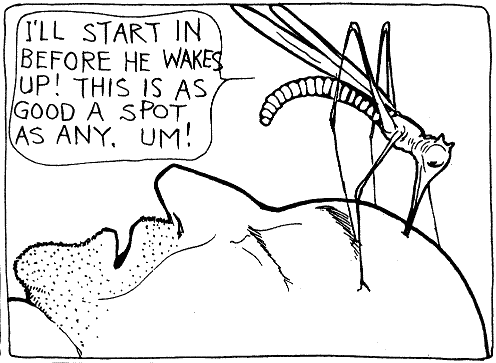
Public domain, Winsor McCay, Dream of the Rarebit Fiend, 1909

By Debbie Burke

@burke_writer


Like mosquitos in summer, scammers keep buzzing in with new tricks to suck the blood from writers. Here are three that recently hit my radar:

Scam #1 – We Pay You to Write!

A couple of months ago, several members of the Authors Guild received emails from individuals claiming to need articles or workbooks written for an upcoming seminar. The bait is a substantial fee and a promise of wider recognition through their organization. They may claim to have a disability, with the inference that if you write for them, you also enjoy the satisfaction of helping. Or…if you don’t write for their worthy cause, you should feel guilty. Con artists are masters at manipulation.

Here’s a sample invitation from “Paula Smith”:

Hello, My name is Paula, an academic consultant. I have a speech distorting condition called Apraxia. I got your contact details online and I need your service. Can you write an article on a specific topic for an upcoming workshop? The article is to be given as a handbook to the attendees of the workshop. I have a title for the article and have drafted an outline to guide you. Please get back to me for more information

(442) 278-5255

Paula

Fortunately, the author who received the solicitation investigated a little deeper and discovered “Paula’s” phone number had numerous complaints against it for fraud. A helpful resource to check out questionable phone numbers is callername.com.

More writers added their suspicions to the Authors Guild discussion group but weren’t sure how the scam worked.

Then AG member and travel writer Lan Sluder offered the following enlightening explanation:

This is a scam that is well known in the hospitality (lodging) industry. The target is usually smaller inns, hotels and B&Bs. Someone makes what seems a legitimate reservation, often for several rooms, and pays by check or credit card. There are various versions, but typically the inn owner is overpaid or part of the reservation is cancelled or changed and the scammer wants a refund. Much later, the original credit or check payment is found to be invalid, and the inn owner is out hundreds or thousands of dollars. Some of these scammers are pretty clever, and it’s not always easy to tell an authentic reservation from a fake one. Occasionally, hotel owners or reservations offices are fooled into thinking it is an actual guest reservation.

I’ve written a number of travel guides and other travel books that review hotels so I get a lot of these scam emails due to mistakes by the less sophisticated scammers.

A similar scam exists targeting attorneys, CPAs and small businesses of all kinds. I guess now the scammers are starting to target writers.

——————————
Lan Sluder
——————————

Another AG poster who’s a member of the American Translators Association added that their members have also been targeted and shared the story of one victim. The scammer “overpaid” then asked the translator to wire money for the refund. Unfortunately, she did, shortly before the scam check bounced and she was out $2000.

Ouch!

Scam #2 – Fake Marketing Offers

These scammers keep reinventing themselves with different aliases and websites. Be wary of anyone who calls out of the blue or sends an email with wording similar to this:

Dear Author,

Our expert book scouts discovered your fabulous novel and we are excited to offer you an amazing opportunity. Because we believe so strongly in the bestseller potential of your book, we want to invest [fill in outrageous amount of money] in your marketing and publicity at absolutely no cost to you. We will reserve a place of honor for your book at the upcoming [fill in prestigious book fair or festival]. Your success will be our reward.

Sincerely,

A Company That Believes in Your Fantastic Talent (smirking)

After a few more flattering emails, they swoop in for the kill shot:

We reaffirm you do not have to pay one penny for our fabulous marketing package because our faith in you is so strong. To be fair, we know you’ll want to contribute your part by paying the bargain registration fee of only [fill in hundreds to thousands of dollars].

Here’s a post from YA author Khristina Chess who was contacted by Readers Magnet. Interestingly, they claim to be accredited by the Better Business Bureau as of 2019. However this BBB link shows multiple complaints against them.

Here’s a list of companies that engage in practices that may technically be within the law but slide into slimy.


Before you engage any writing-related services, check them out on Writer Beware  whose mission is:  “Shining a bright light into the dark corners of the shadow-world of literary scams, schemes, and pitfalls.”

A big thank you to Writer Beware for watching out for writers!

Scam #3 – Impersonating Agents and Editors

Earlier this year, intrepid Victoria Strauss covered cases of scammers who assume the identity of legitimate agents or editors then contact unsuspecting authors. Of course, struggling writers are understandably thrilled to have a big-name agent contact them. Just be sure the person is who they claim to be. Here’s Victoria’s post.

On July 16, agent Victoria Marini @LitAgentMarini tweeted the following warning after learning someone had co-opted her name:

“It has come to my attention that someone is impersonating me online, likely in an attempt to scam writers. I am not associated with WritersDesk LLC, nor do I sell videos, materials, editorial work, or any other good or service. Many thanks to @victoriastrauss.”


Protect yourself from true crimes against writers. Always verify the source.

 ~~~

TKZers: Have you been solicited by questionable people or companies regarding your writing? Please share your experience and outcome.

 ~~~


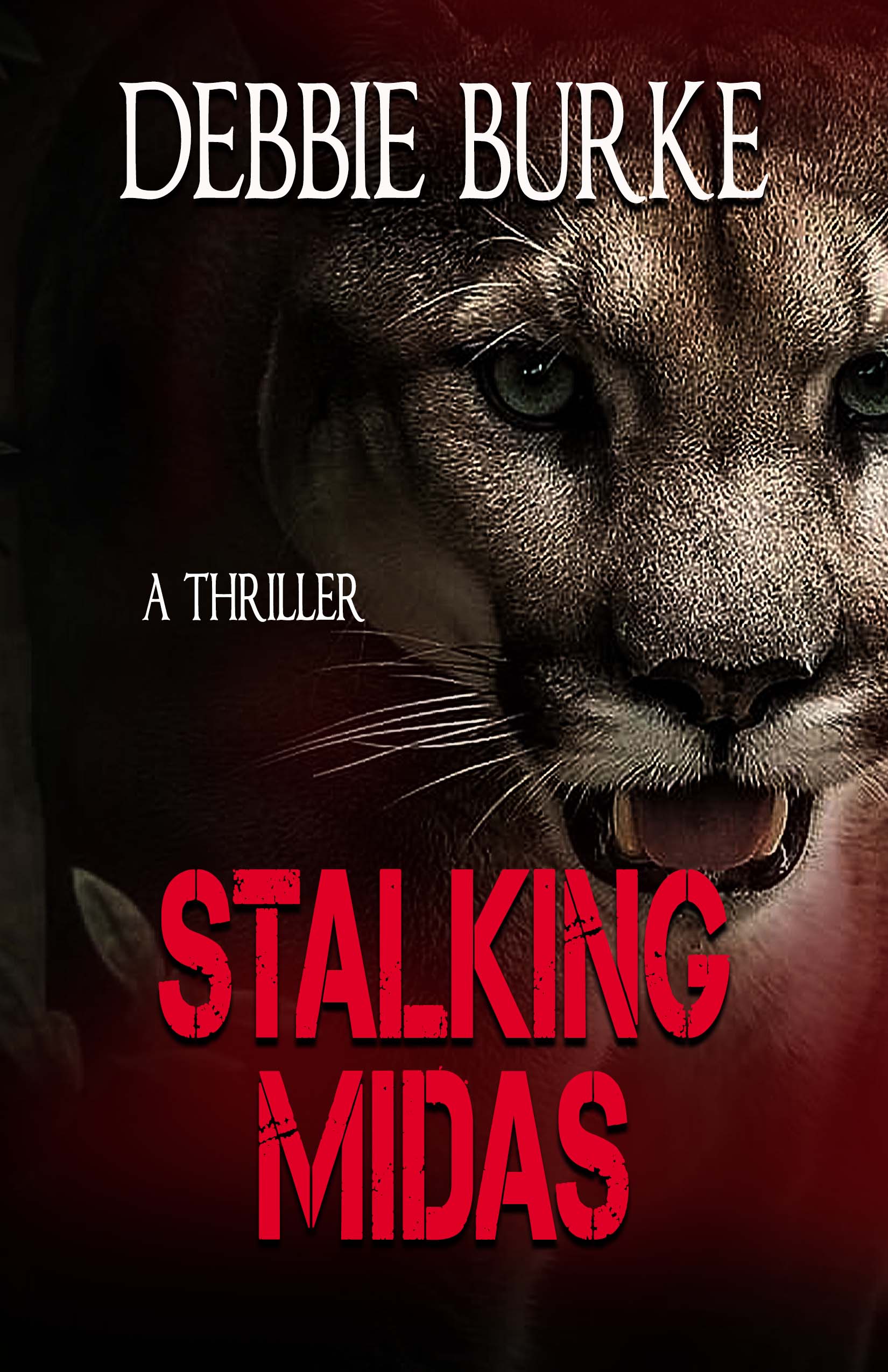
Check out a devious scam with a unique twist in Debbie Burke’s thriller, Stalking Midas, available at this link.

The Writing Math: Craft… plus Art… equals Performance

By Larry Brooks

Allow me to share the story of a writer you may have heard of, and if you haven’t you either aren’t a mystery/thriller fan (you’re here on Kill Zone, I’ll assume you are) or you aren’t paying attention. His name is Robert Dugoni, the author of 18 novels across three series and one literary novel that just sold to Hollywood, as have several of those novels. He is a multiple New York Times bestseller, with enough other lists and awards and credits to fill up an entire Kill Zone post.

This month we celebrate that an author of mystery and thrillers (legal thrillers, murder mysteries and spy stories) is on the cover of Writers Digest Magazine. (Never mind that WD has labeled this their travel writing issue, the monthly interview here is all about writing novels.) He is one of us, and he has something to say to all of us who ply this craft.

There is an amazing bottom line to this author’s journey, which he describes with perfect focus and humility from a teaching perspective. We’re all on that path, seeking a summit, as he has over twenty years of searching for that intersection between craft and art.

He’ll tell you he’s still climbing and learning, too.

He started out with his skill (his “art”) as a writer—honed through a background in journalism and as a defense attorney—with the risky yet common belief that the story-craft side of things was a no brainer. He’d been a reader of quality novels since childhood, so of course he knew in his gut how a novel came together and what makes it tick.

He believed that’s how successful writers do it. Some of them actually claim it as their experience. They just take a chair and start typing, letting the story flow out of them. It would take him years to realize that such advice is toxic, if not an outright lie.

Those years commenced when he left the practice of law after 13 years to pursue his dream of writing fiction. Full time, cold turkey. What he didn’t know was that it would take six years to arrive at that magic moment when craft and art finally embrace, with a brief time-out to write a non-fiction book that become a 2004 Washington post Book of the year (The Cyanide Canary). After that he went back to his dream and his WIP, which was a legal thriller titled The Jury Master.

Here’s a little more math for you: over those six years, he submitted The Jury Master to 42 agents. A lot of us would have hung it up after such a string of rejections. Sometimes he would go back and tweak the story, but he received very little input that he could use to raise the bar. He was on his own, as most of us have felt at some point in our journey.

In the meantime life continued, and he found himself frequenting a neighborhood bookstore… where he happened upon a shelf he’d never paid much attention to before: the place where the writing craft books were displayed. Mind you, this was the early 2000s decade, and there wasn’t a James Scott Bell or a Donald Maass or a Larry Brooks writing craft books yet. No, in 2004-07 we’re talking Al Zuckerman, Christopher Vogler and Sol Stein, to name a few of that era.

That’s when an epiphany blew up his life. In a good way. He realized he really didn’t know what he was doing as a novelist. Even after all that reading, his “gut” wasn’t getting the job done.

So Dugoni took over a year off to absorb as many craft books as he could, searching out teachers of fiction craft, applying the principles he discovered to the now dog-eared manuscript of The Jury Master, assembling more than few binder full of notes. Finally this lead to what was, in sum, a total rewrite of the novel.

He thought he knew. But he realized—and was humble and hungry enough to admit it—that he didn’t. That he didn’t even know what he didn’t know.

The storybook outcome of this launch phase of Robert Dugoni’s career, the fruition of all that study, was that The Jury Master landed an agent forthwith, and the book became his first New York Times bestseller, and the first of a five-title series featuring hero David Sloan. Who was, of course, an ace attorney with a mysterious past.

Anyone who tells you writing cannot be taught is thus proven wrong.

Or at least, confused. Sure, Robert Dugoni was a Phi Beta Kappa from Stanford, but that doesn’t mean the knowledge isn’t accessible to anyone with the discipline to seek it out.

What is hard to teach is how to land on a worthy story idea/concept/premisethat requires a learning curve and a keen sense of dramatic and thematic potential, as well as commercial viability. I’m not saying the craft essential to actually writing an idea as a novel is easily or quickly taught—Brother Bell will second me on that one, I’m sure—just that the information and framing of what you need to understand is out there, relevant and more than ready to change your writing life.

Cut to 2020, and this July cover article/interview with Writers Digest Magazine.

By now Robert Dugoni has sold over six million copies of his 18 novels, including the bestsellers My Sister’s Grave (which launched the 7-title Tracy Crosswhite series), and The Extraordinary Life of Sam Hell (his literary novel), as well as the new Charles Jenkins spy series, with the second title due out end of September.

The author of that July 2020 Writers Digest article/interview was, well, me.

I’ve known Bob for years after hanging out at writing conferences and discovering that, despite him being a pantser and me an outliner, we shared a strikingly similar outlook on the craft. Ultimately he would go on to blurb one of my novels (Deadly Faux) and my 2017 craft book (Story Fix). More recently, he wrote the Foreword to my new craft book (Great Stories Don’t Write Themselves), published last fall.

Having written for Writers Digest many times, I pitched the editors on the interview, and they didn’t hesitate. The transcript was over 7000 words, and if you’ve ever edited and assembled an interview toward a coherent through-line narrative, you know how long it takes to get it down to 2500 words. WD loved what he had to say, and asked for an additional 800 words. The interview not only covers the timeline of his career, it also delivers abundant take-aways and learning that will be well worth a hungry writer’s time.

In this interview Robert Dugoni has given us a master class on how to avoid the most common mistake and pitfall that explains the 96 percent failure rate of manuscripts submitted to agents for representation (this via The Huffington Post; rejection is almost always a combination of less-than-compelling or original story ideas—which is indeed hard to teach—alongside a flawed sense of structure, character, flow, or simply the writing itself… all of which reside at the very teachable heart and soul of craft).

Which brings me back to today’s title. It’s that word: performance.

Robert threw it in at the end of the interview, and it was something I’ve never heard a writer say before. It froze me with introspection. He says that when a writer has internalized and assimilated and worked with the core principles of storytelling craft—to the point that she or he can see it just below the surface in the books they read, and within their vision for the stories they want write—only then can they truly and effectively sit before the blank page and actually perform. And when that happens, when the writer truly knows how a story should work, it becomes a blissful experience.

This is true regardless of one’s writing process preference, pantser and planner alike. Craft empowers both, the lack of it compromises both.

We perform, in the same context that any professional puts themselves in front of an audience to present their art, relying instinctually on the compounded sum of their years of study and practice of their craft. Singers. Actors. Editors. Athletes. Doctors and nurses and their medical peers. Therapists. Shrinks. Mechanics. Pilots. Designers. They are all artists. But before their art can work at a professional level, a level where people pay money to experience their art, they needed to build a foundation of craft, of the knowledge of their chosen field of work.

Writers who struggle for many drafts over what is often many years are, in fact, searching for and struggling with their handling of those core craft principles. Some aren’t even aware of what they’re missing. All of us know that feeling, just as Dugoni did for those six early years and those 42 rejected drafts.

But he’s a testament as to what can happen when you truly submit to the truth that it is craft will set you free, and allow you to set sail in pursuit of your writing dream.

As a footnote, Robert Dugoni continues to teach at conferences and runs his own annual retreat. Not because he needs to—before the virus and with his prodigious output, he was traveling to book signings nearly every weekend—but because he truly wants to give back, so that we don’t burn six years or more of our life, as he did, chasing something that can outrun us if we aren’t sure what we’re chasing.

Larry Brooks

Larry Brooks is a former Kill Zone blogger who has maintained his own website, Storyfix.com, since 2010. He is the USA Today bestselling author of six thrillers and four books about writing fiction, including Story Engineering.

His latest, Great Stories Don’t Write Themselves,” was published last November from Writers Digest books, a division of Penguin Random House.


How To Get Away With Murder

Murder. It’s forever been the stuff of books, movies, poems and plays. Everyone from Shakespeare to Agatha Christie told foul-play murder stories. That’s because, for gruesome reasons, murder cases fascinate people.

I think murder is the great taboo. It’s also the great fear of most people except, maybe, for public speaking. Jerry Seinfeld quipped, “At a funeral, the majority of people would rather be in the casket than giving the eulogy.”

Yes, murder is the ultimate crime. In mystery books and Netflix shows, murder cases are solved and neatly wrapped up in the end. This leaves the reader or audience with the satisfaction of knowing who done it and probably why.

That’s not always the truth in real life. Many murders go unsolved for a long time. Some go cold and are never resolved. Statistics vary according to region, but probably a quarter of murders never get cleared.

Thankfully, most murders are easy to solve. They’re “smoking guns” where the killer and victim knew each other, the killer left a plethora of evidence at the scene or took it with him, witnesses saw the murder take place, or the bad guy confessed to the crime. That’s really all there is to getting caught for committing a murder.

So, why do roughly twenty-five percent of people get away with murder? It’s because they don’t make one of these four fatal mistakes. Let’s look at each in detail and how you can get away with murder.

Leaving Evidence at the Scene

Did you ever hear of Locard’s Exchange Principle? It’s Murder Investigation 101. Dr. Edmond Locard was a pioneer in forensic science. Dr. Locard held that at every crime scene the bad guy would leave evidence behind that would connect them to the offense. Locard summed it up this way:

“Wherever he steps, whatever he touches, whatever he leaves, even unconsciously, will serve as a silent witness against him. Not only his fingerprints or his footprints, but his hair, the fibers from his clothes, the glass he breaks, the tool mark he leaves, the paint he scratches, the blood or semen he deposits or collects. All of these, and more, bear mute witness against him. This is evidence that does not forget. It is not confused by the excitement of the moment. It is not absent because human witnesses are. It is factual evidence. Physical evidence cannot be wrong, it cannot perjure itself, it cannot be wholly absent. Only human failure to find it, study and understand it, can diminish its value.”

Dr. Locard was absolutely right—most of the time. That quote was from the early 1900s. It was long before the sophistication of DNA profiling and amplifying light to find invisible fingerprints. Today, trace evidence shows up at the micro level, and there’re ingenious inventions used to find it. But… not always.

I’m familiar with a high-profile and unsolved murder case from 2008 where two killers enticed a female realtor to a house and savagely stabbed her to death. It’s a long story. A complicated story. And, so far, they’ve got away with the murder.

The victim was totally innocent. She was set-up as a sacrifice to protect someone else who was a police informant. The police know full well who the killers are—a Mexican man and woman from the Sinaloa drug cartel—but they’ve never been charged. It’s because they left no evidence of their identity at the scene. They’ve also never broken the other three murderer-catching rules.

There’s more to scene evidence than DNA and fingerprints. There are dozens of evidentiary possibilities including hairs, fibers, footwear impressions, chemical signatures, organic compounds, match heads, cigarette butts, expended shell casings, spit chewing gum, a bloody glove or a wallet with the killer’s ID in it. (Yes, that happened.)

Removing Evidence from the Scene

The flip side of Locard’s Exchange Principle is the perpetrator removing evidence from the scene that ties them back to it. This can be just as fatal to the get-away-with-it plan as left-behind evidence. And, it happens all the time.

Going back to the unsolved realtor murder, there’s no doubt the killers left with the victim’s blood on their hands, feet and clothing. This innocent lady was repeatedly shived. The coroner report states her cause of death was exsanguination which is the medical term for bleeding out.

For sure, her killers had blood on them. But, they made a clean escape and would have disposed of their blood-stained clothes. That goes for the knife, as well. Further, the killers did not rob the victim. They didn’t steal her purse, her identification, her bank cards or even the keys to her new BMW parked outside.

The killers also didn’t exchange digital evidence to be traced. They used a disposable or “burner” phone to contact the victim to set up the house showing. It was only activated under a fake name for this one purpose and was never used again. The phone likely went the same place as the bloody clothes and knife.

Being Seen by Witnesses

I once heard a judge say, “There’s nothing more unreliable than an eyewitness.” I’d say that judge was right, at least for human eyewitnesses.

Today’s technology makes it hard not to be seen entering or exiting a murder scene. There’s video surveillance galore. Pretty much everywhere you go in an urban setting, electronic eyes are on you. You’re on CCTV at the gas station, the supermarket, the bank, in libraries, government buildings, transit buses, subways and on the plane.

In bygone lore, the killer often wore a disguise. That might have fooled human surveillance, but it’s hard to trick cameras that record evidence like get-away vehicles with readable plates. It’s also hard to disguise a disguise that can be enlarged on film to reveal uniquely identifiable minute characteristics.

Back to the unsolved realtor slaying again. The killers were seen by two independent witnesses when they met their victim in the driveway outside the show home. One witness gave the police a detailed description of the female suspect and worked with an artist to develop a sketch. It’s an eerie likeness to the Mexican woman who is a prime person-of-interest along with her brother—a high-ranking member of the El Chapo organization.

Unfortunately, there’s just not enough evidence to charge the Mexicans. They left no identifiable trace evidence behind at the crime scene. Whatever evidence they might have taken from the scene hasn’t been found. There was no video captured and the eye-witnesses can’t be one hundred percent positive of visual identity.

There’s also the fourth missing piece to the puzzle.

Confessing to the Murder

Murderers are often convicted because they confessed to the crime. Sometimes, they confess to the police during a structured interrogation. Sometimes, they confess to a police undercover operator or paid agent during a sting operation. Sometimes, their loose lips sink their ship by telling an acquaintance about doing the murder. And sometimes, they’re caught bragging about the murder on electronic surveillance like in a wiretap or through a planted audio listening device—a bug.

Police also arrest and convict murderers after an accomplice turns on them and decides to cooperate with the investigation in exchange for a lesser sentence. Then, there are the revenge situations. The murderer has confessed to an intimate partner who they thought they could trust and couldn’t.

That has yet to happen in the unsolved female realtor murder. There is no doubt—no doubt—that a group of people know what happened in her murder. It’s known, with probable certainty, who the Mexican pair are. It’s also known, with probable certainty, who the real police informant was and who conspired to protect them by offering the innocent victim as a sacrificial slaughter to appease the Sinaloa cartel’s “No-Rat” policy.

This murder case can be solved once someone in the group decides to reveal evidence implicating the killers. That likely won’t be anything in the Locard arena or in the eye-witness region. It’ll be an exposed confession that will solve this case.

Someone will eventually talk. The current problem is that everyone in the conspiracy circle is connected by being blood relatives, being a member of the Hispanic community and being involved in organized crime. Their motive to talk is far outweighed by their motive to stay silent.

Takeaway for The Kill Zone Gang

If you’re a mystery/thriller/crime writer, always consider these four crime detection principles when working your plot. No matter how simple or complex your plot may be, the solution will come down to one or more of these points. If it doesn’t, then your antagonist is going to get away with murder.

———

Garry Rodgers is a retired homicide detective and forensic coroner, now an investigative crime writer and successful indie author. Garry also hosts a popular blog at his website DyingWords.net and is a regular contributor to the HuffPost.

Garry Rodgers lives on Vancouver Island in British Columbia at Canada’s west coast. He’s a certified 60-Tonne Marine Captain and spends a lot of time around the saltwater. Follow Garry on Facebook, Twitter and BookBub. He has stuff on Amazon, Kobo and Nook, too.


When, Where, Why, and How To Use Block Quotes and Ellipses

By SUE COLETTA

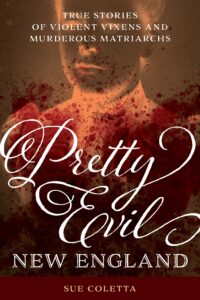
An interesting discussion arose while working on copy edits for Pretty Evil New England. The conversation dealt with using block quotes—when, where, why, and how I used them in the (nonfiction) manuscript.
If at all possible, I tend to use quoted material as dialogue to create scenes. But there were times where I chose to block quote the text instead. For example, if the quote was mainly backstory and not part of the actual scene but still important for the reader to understand, then I used block quotes. You’ll see what I mean in one of the examples below.

Block quotes can’t be avoided at times. They can even enhance the scene, thereby adding to the overall reading experience. In fiction, two examples of where to use block quotes would be a diary entry or a note/letter/message. Please excuse my using one of my thrillers; it’s easier than searching through a gazillion books on my Kindle.

In Silent Mayhem, the antagonist and hero communicate through an Onion site (untraceable) on the deep web. Because these messages are neither dialogue, nor narrative, using block quotes set them apart.

Example:

Dearest Cautious Cat,

If we shut our eyes to dangers beyond our comprehension, we become powerless to fight. My offer still stands. Should you choose not to accept it, remember this . . .

When it’s your time to die, be not like those whose hearts are filled with the fear of death, so that when their time comes, they weep and pray for a little more time to live their lives over again in a different way. Sing your death song and die like a hero going home.

Hugs & kisses,
Mr. M

Block quotes also break up the text and enhance white space. We’ve discussed white space many times on TKZ. For more on why white space is a good thing, check out this post or this one.

BLOCK QUOTES IN WORD

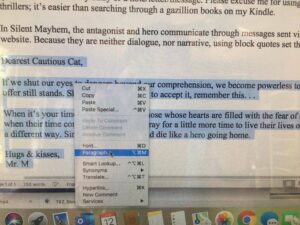
To include block quotes in Word, highlight the text and right click. This screen will pop up…
Choose “paragraph” and this screen will pop up…
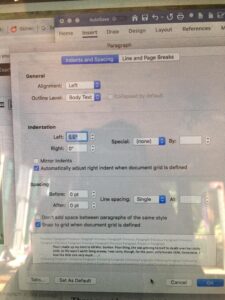
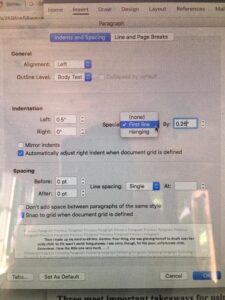
Reset your left margin to .5 and click OK. Leave the right margin alone.

Quick note about margins.

A good rule of thumb for block quotes is to not indent the first paragraph. If your passage contains more than one paragraph, check with the publisher. Most supply a style guide. For instance, my thriller publisher keeps all paragraphs justified. My true crime publisher prefers that the first paragraph be justified and subsequent paragraphs be indented.

To do that, the easiest thing is to click “Special” then “first line” (as indicated in pic below) and set it to .25. Then simply backspace to erase the indent on the first paragraph.

If you’re self-publishing, then obviously it’s your call on whether to indent or not to indent subsequent paragraphs.

BLOGGING BLOCK QUOTE

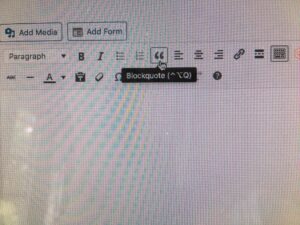
Bloggers who include passages from a resource, whether that be a book or wording from a reputable source, use block quotes to signal the reader that the passage is a direct quote (most commonly, all justified margins). You could style the post in Word, then copy/paste, but sometimes the style doesn’t paste over. Simple fix. Highlight the text and click this symbol…
And that’s it. Easy peasy, right?

ELLIPSIS

An ellipsis consists of either three or four dots. A single dot is called an ellipsis point. Some writers may find using ellipses a little tricky, but once you know the definitions of where, why, and how to use them, determining the right ellipses is fairly straightforward.

According to the Chicago Manual of Style, never use ellipses at the beginning or end of a block quote. CMOS also recommends using equal spacing between dots. Some style guides say to use three equally spaced periods rather than creating an ellipsis in Word, which you can do by pressing CTRL + ALT + Period. Always go by the style guide furnished by the publisher (or editor, if self-publishing).

WHERE AND WHY TO USE ELLIPSES

There are many reasons why you might want to use an ellipsis. An ellipsis can indicate omitted words within the middle of a quote, or faltering dialogue, or an unfinished sentence or thought where the speaker’s words trail off.

For faltering dialogue, you have two choices, depending on your style guide.

Style #1: Equally spaced dots with one space before and after ellipsis.
Style #2: Unspaced dots with one space before and after ellipsis.

Example #1 (uses three periods): “I . . . I . . . would never break the law.”
Example #2 (uses ellipsis created with Word shortcut): “I … I … would never break the law.”

For words that trail off, insert punctuation at end of ellipses. If the dialogue continues to another sentence, leave a space.

Example #1: “Why would he . . .? I mean, I can’t believe he got caught with that bimbo.”
Alternate style (Word shortcut): “Why would he …? I mean, I can’t believe he got caught with that bimbo.”

Example #2: “My weight? I’m about one hundred and . . . So, how ’bout them Bears. Did you watch the game?”

Alternate style (Word shortcut): “My weight? I’m about one hundred and … So, how ’bout them Bears. Did you watch the game?”

THREE DOTS VERSE FOUR

Here’s where some writers may find ellipses a little tricky.

Sometimes we need to omit words from the end of one sentence but still continue the quoted passage. This type of ellipsis is called a terminal ellipsis. In this instance, the CMOS recommends using four dots, or periods. The fourth dot indicates the period at the end of the sentence that we haven’t quoted in its entirety. By including that fourth dot it lets the reader know that the quotation borrows from more than one sentence of the original text.

Example from Pretty Evil New England:

Then I made up my mind to kill Mrs. Gordon. Poor thing, she was grieving herself to death over her sickly child. So life wasn’t worth living anyway. I was sorry, though, for the poor, unfortunate child, Genevieve. I love the little one very much. . . . I thought with Mrs. Gordon out of the way I could be a mother to her child and get [her husband] Harry Gordon to marry me.

Notice how I didn’t omit any necessary words? That’s key. We have a responsibility to other writers—in this case, the female serial killer—to not mislead the reader by leaving out words that change the meaning of the quote.

Three most important takeaways for ellipses in dialogue.

  • Avoid ellipses overload—too many can diminish their impact.
  • Reserve ellipses for middle and end of dialogue. If the character fumbles around to spit out their first word, use a body cue or other description instead.
  • Maintain consistent ellipses spacing throughout the manuscript.

Now, like most things in writing, there are exceptions to these rules. Always follow the publisher or editor’s recommendations. If you don’t have any recommendations to follow, feel free to use this post as a guide.

For discussion: Do you use block quotes in your writing? If so, why did you choose to do that? Care to share one of the exceptions to any of these guidelines?

First Page Critique: A Hike
That Might Be A Journey?

The trail head at St. Bees Head on the Irish Sea

By PJ Parrish

I don’t know about you, but I am really ready for a good writer to take me away from it all. And I am always up for a bracing hike. So today, come along on our First Page Critique, as our submitting writer takes us to the wilds of northern England across the Coast to Coast Trail. I hope we’re in for some good mischief along the way.

A Lethal Walk in Lakeland 

Chapter One

I settled myself on a weathered oak bench and began securing the laces of my leather walking boots. This was the start of a long-anticipated week’s walk in England’s fabled Lake District, but I was apprehensive. Before me angry waves were hammering the shore, each shaking the ground as if a bomb had exploded. Strong gusts of wind from the north were slashing against us.

“We’re supposed to walk into that?” said the woman beside me, a small grey-haired wisp of a creature named Billie, as she surveyed the roiling waters of the Irish Sea. She should have been wearing a waterproof jacket, but instead had on one of her thick self-knitted sweaters displaying a pattern of squirrels and acorns. The outfit had been fine when we were in the town center–protected from the wind by cliffs to the north–but no longer. It was hard to believe that a few hundred yards could make such a difference.

“We just have to stick in our boots in the water,” I said. “If we do it quickly enough we should be all right.”

Around us our fellow walkers, eight of them, were also eyeing the sea with the trepidation. Yet this ‘christening of the boots’ was a time-honored ritual for anyone about to tackle England’s famed Coast to Coast path, which traverses the Lake District, Yorkshire Dales and North York Moors to Robin Hood’s Bay on the North Sea.

“Everyone ready?” asked Charlie Cross, our white-haired tour guide. Beaming a broad grin, he didn’t seem fazed by the heavy surf. The group followed him down to the water.

“Are you sure it’s safe?” asked Fiona, a beautiful brown-haired woman whom, I learned, was one of the six members of the Upton family from Texas in our group.

______________________

I wish I were going along. I’ve hiked in a couple foreign countries, and one of my dreams has been to hike the Appalachian Trail. I hadn’t heard of the Lake Country’s Coast to Coast path. Something new to put on my bucket list. So, as you can guess, I am predisposed to liking this submission on the location alone. But as much as setting is vital to a good story, it isn’t enough. Does the story itself hold up?

I think this is a pretty darn good start. The writer has chosen to put us literally at the beginning of the action. I love the tradition of dipping the boots into the sea before venturing out. I almost wish the writer had given us just a few more graphs so we could see if this ritual works as a foreshadowing of something dire to come. (I hope it is!)

I like that the writer didn’t start earlier, say with the group meeting in the village with a clearing-the-throat introduction of the whole party getting acquainted. (The writer chose instead to just reference the village in passing). We should learn about the hikers (possible suspects?) as we meander on, not in a group-grope info-dump.

I suspect we are working in a cozy genre here, but I could be wrong. The tone registers on the lighter side, which is fine. As I understand it, the hike takes about a week which is plenty of time for something nefarious to happen.

I don’t know if this was the writer’s intent, but we are almost in the classic Agatha Christie “closed parlor room” genre here: A group of strangers is about to be cloistered on an adventure and I would guess someone will die and whoever our protagonist is will be charged with solving the on-the-road crime. Perhaps the murder takes place in hostel out in the wilds.

Likewise, it is good that the writer mentions only a couple named characters. I trust the writer will find a graceful way to tell us the name (and a little background) of our first-person point-of-view narrator soon.

Notes on craft: The writer is on solid ground here, I think. The dialogue is handled correctly, the paragraphing and syntax fine. But with such an assured hand, I’d like to see the writer work a little harder. I’m always a little tougher on the better submissions,

For starters, I’d like to see the writer work harder at more original description. This is such a stunning setting; it deserves more eloquence than surf that “explodes like a bomb.”  That’s a cliche, dear writer, it doesn’t come from you.  Find something more bracing. Likewise, don’t rely on lazy words like “beautiful” for Fiona. Ditto for Charlie. “White-haired” isn’t vivid enough.

Description is hard. You have to dig deep into your own experience to find the right words or metaphors and then filter it through your protag’s consciousness. I like what you did, for example, with Billie — by telling me, in one line, that she chose to wear an acorn/squirrel sweater instead of something more practical, you sketched an immediately sharp portrait of her.

But in general, I enjoyed this. It is a measured, leisurely beginning and that is okay. Just be aware, writer, that we need some injection of tension in your first chapter, a hint of bad things to come.  Even with a soft opening like this you have to have a portent of ominous things on the path ahead — the literal one the hikers will travel, and the metaphoric one you take your reader on.

Let’s do some line editing:

I settled myself on a weathered oak bench and began securing the laces of my leather walking boots. This was the start of a long-anticipated week’s walk in England’s fabled Lake District, but I was apprehensive. Not a bad first graph but this is an example of telling instead of showing. Instead of telling us she is apprehensive, find a way to showing it via her thoughts or dialogue or actions. Just an example here:

I finished lacing my walking boots and looked up at the roiling green sea. With each crash of the waves, I could feel the wooden bench shake beneath me. I pulled in a deep breath and blew onto my cold hands. A sharp wind was surging in from the north, penetrating the nylon of my coat.

I should have worn gloves, I thought. I should have packed that extra sweater. I should have told someone where I was going. But I hadn’t wanted anyone to know. For once in my life, I wanted to be alone. And I wanted to be brave.

That is corny, but I am trying to make the point that you need to find ways to inject drama and something personal about your protag’s METAPHORIC JOURNEY as early in the story as you can. Make us care about her and attach to her (or is it a him?) as quickly as you can.  And never let a chance go by to layer in her personality.

Before me angry waves were hammering the shore, each shaking the ground as if a bomb had exploded. Strong gusts of wind from the north were slashing against us. Nice verb there. But you could be more active: The angry waves hammered; the wind slashed. 

“We’re supposed to walk into that?” said the woman beside me, a small grey-haired wisp of a creature I rather like that named Billie, as she surveyed the roiling waters of the Irish Sea. Good way to slip in the geography She should have been wearing a waterproof jacket, but instead had on one of her thick self-knitted sweaters displaying a pattern of squirrels and acorns. The outfit had been fine when we were in the town center–protected from the wind by cliffs to the north–but no longer. It was hard to believe that a few hundred yards could make such a difference.

“We just have to stick in our boots in the water,” I said. “If we do it quickly enough we should be all right.”

Around us our fellow walkers, eight of them, were also eyeing the sea with the trepidation. Yet this ‘christening of the boots’ was a time-honored ritual for anyone about to tackle England’s famed Coast to Coast path, which traverses the Lake District, Yorkshire Dales and North York Moors to Robin Hood’s Bay on the North Sea. This sounds a little dry. I know you need to convey this info, but find away to make it sound like it comes from your protag and not Fodors. You can also use it, again, to tell us something about your protag. Example:

I wasn’t from this area of northern England. I had been born and raised in London so a long hike for me was to the tube station. But I had always wanted to do this week-long trip that stretched from the the whatever, crossed the whaterever, and ended wherever.

See what that does? It makes the info personal and lets the reader get to know your protag.

“Everyone ready?” asked Charlie Cross, our white-haired tour guide. Beaming a broad grin, he didn’t seem fazed by the heavy surf. The group followed him down to the water.

“Are you sure it’s safe?” asked Fiona, a beautiful brown-haired woman whom, I learned, was one of the six members of the Upton family from Texas in our group. Would be a nice place to slip in a thought from your protag. How does she feel about the make-up of her group? I went on a hiking trip in Provence once, and the first day I met my motley group — the people I would live with for the next two weeks — I was intensely curious about where they had come from. This is important if someone in this group will be murdered AND if someone is the killer.  Start laying your bread-crumb trail of clues as early as possible.

As I said, I think we’re off to a grand start here, but I know this writer has the chops to dig deeper and do better. Oh, speaking of which, as you go on your writing journey, dear submitter, be on the lookout for a better title. (Good titles often don’t reveal themselves until you’re done with the book). I don’t think this one does your setting and set-up justice. For starters, Americans like me will think of Lakeland, Florida. And “A Lethal Walk” is a touch too spot-on.  Look for something more metaphoric that captures the wild scenery and says something about the journey. One of my favorite quotes about hiking is from the naturalist John Muir: “In every walk with nature, one receives more than he seeks.”  Maybe that’s what your protagonist is after? Find something that speaks to the soul of your story.

Thanks for the submission and letting us share it.


First Page Critique – The Lies of Murder

by Debbie Burke

@burke_writer

PublicDomainPicures-Pixabay

Today we welcome another brave anonymous author with a first page entitled:

The Lies of Murder

Merli Whitmore hadn’t stepped foot in her childhood home in ten years. She expected tension entering unannounced. Tension with her step-mother, not the heart-pounded tension of a bloody chef’s knife stabbed into the wood cutting board. Someone had left her a note on lined white paper dotted with drops of blood.

NO BETTER WAY TO START YOUR RETURN TO HAVEN HILL THAN FOR ME TO KILL HER FOR YOU. WELCOME HOME, MERLI.

From behind, Merli heard a familiar voice. “Hands up and turn around slowly.”

She obeyed the command, turning to face two police officers pointing guns in her direction. “Hello, Ian. Been a long time.”

“Merli?” She was the last person he imagined seeing. “What are you doing here?”

“You know her?” Officer Urbane asked.

“Cuff her.”

While Officer Urbane spouted the Miranda warning and cuffed her hands behind her back, Ian read the note under the bloody knife. Merli sat on a kitchen chair.

Ian pulled out a second chair and sat three feet away. “You didn’t answer my question. What are you doing here?”

Because I always follow my premonition dreams is what she wanted to say. Only her father and Aunt Cordelia knew about her dreams. “I haven’t been able to reach my father in three days. I finally jumped on a plane to find out why.”

“What did Vivian tell you?”

“My feelings toward Vivian haven’t changed.”

“What’s that supposed to mean?” Officer Urbane took a step forward, hands placed on his hips.

“You look familiar. What’s your name?”

“You’re not in a position to ask questions.”

Ian chimed in. “Zane Urbane. Xander’s younger brother.”

“She knows my brother?”

“Merli grew up in this house. Xander was in our class. Vivian’s her step-mom. Why don’t you find out what’s happening at the other scene?”

“Yeah, sure.”

Once Officer Urbane left the house, Ian returned his focus to Merli. “When was the last time you spoke to Vivian?”

“I don’t know. Probably a couple weeks ago. She has an unpleasant habit of interjecting herself when I’m face-timing with my dad.”

“And you came home because you couldn’t reach your dad?”

“He always returns my calls within a couple hours. I even tried texts and emails and no response for three days. If you know something, tell me.”

Ian leaned forward. “Where were you between six and nine this evening?”

~~~

This submission races out of the gate. Congratulations to the Brave Author for starting with action and a major crime. Merli Whitmore enters her childhood home for the first time in years and immediately finds a blood-spattered note fastened to a wood cutting board with a bloody knife. The message is a real punch in the gut—the note writer claims to have killed an unnamed woman for Merli. That’s some homecoming!

Then two cops pull guns on her and she knows one of them.

Merli has obvious, ongoing conflict with her step-mother and there’s a strong suggestion Vivian has been murdered, making Merli a suspect. Additionally, Merli’s premonition dream hints that her father is also at risk.

This page definitely grabs the reader’s attention early and piles lots of complications on the main character. Well done!

There is also potentially interesting backstory between Merli and Ian who know each other from school days. The author gives intriguing hints without an information dump. Her old classmate orders his partner to immediately handcuff her. Whoa! The reader wonders why–she’s cooperating and is not armed or combative. The author establishes things have already gone terribly wrong for Merli and only promise to get worse. Excellent!

Several plausibility problems jump out but are easily fixable.

  1. The cops appear only a few seconds after Merli enters the house and finds the note. If they were that close, wouldn’t she have seen their car before she goes into the house? Or hear sirens as they arrive?
  2. If a murder had already been reported, the house would be a cordoned-off crime scene and Merli couldn’t just walk in.
  3. As Jim Bell often reminds us, police do not immediately deliver Miranda rights. They gather background and hope the suspect will reveal information before requesting an attorney.
  4. Although putting Merli in handcuffs right away is an attention grabber, it seems excessive if the author wants to portray police procedure realistically. After all, they didn’t catch her standing over the body with a bloody knife in her hand.

However, if, as part of the plot, you want to establish these officers are overly aggressive or Ian is paying back an old grudge, then it does work to slap the cuffs on her as an intimidation tactic.

Merli’s character seems cool and confident, especially with guns pointed at her. She gives short, coherent answers but also shoots questions back at the cops. The reader roots for her because she doesn’t cave in to their heavy-handed tactics.

She has premonition dreams that predict the future—her dreams can be her curse but also her power. That makes for a complex, interesting character the reader wants to learn more about. Well done.

Some small suggestions:

Merli Whitmore hadn’t stepped foot in her childhood home in ten years. She expected tension entering unannounced. Tension with her step-mother, not the heart-pounded tension of a bloody chef’s knife stabbed into the wood cutting board.

Short, simple sentences might work better to convey the startling event.

Merli Whitmore hadn’t stepped foot in her childhood home in ten years. She expected tension for entering unannounced. She expected tension from her stepmother Vivian.

She didn’t expect the sight that made her heart pound: a bloody chef’s knife stabbed into the wood cutting board.


She was the last person he imagined seeing. This is a point of view inconsistency because it briefly goes inside Ian’s head:

Maybe instead: His startled expression said she was the last person he imagined seeing.


Weak gerunds: there are three verbs that end in -ing in three lines—turning, pointing, seeing. For stronger verbs, here are a couple of suggestions:

turning to see two police officers who pointed guns at her.

the last person he expected to see.


“You know her?” Officer Urbane asked. How does Merli know his name? Does she see a nametag? A few paragraphs later, she asks his name even though it has been used several times.


Attributions: Even though there aren’t many attributions, the dialog generally makes it clear who is talking. However, this passage was a little confusing:

“You look familiar. What’s your name?”

“You’re not in a position to ask questions.”

Ian chimed in. “Zane Urbane. Xander’s younger brother.”

“She knows my brother?”

Clarify who’s talking with a few action tags:

Merli faced the cop who’d cuffed her. “You look familiar. What’s your name?”

“You’re not in a position to ask questions.”

Ian chimed in, “Zane Urbane. Xander’s younger brother.”

Urbane’s face screwed into a frown. “She knows my brother?”


The author does a quick, efficient job of explaining the relationships without an info dump: “Merli grew up in this house. Xander was in our class. Vivian’s her step-mom.”


Ian leaned forward. “Where were you between six and nine this evening?”

Obviously, a crime happened between six and nine this evening. But would a responding officer ask about her whereabouts/alibi? That sounds more like an interrogation by a detective.

Also, where did the crime occur? There’s a reference to the other scene,” perhaps where the bloody knife was used. However, if the murder weapon is found inside this house, it would also be cordoned off. Ian would not disturb a crime scene by sitting and having Merli sit. He would take her outside and call for officers to secure the scene.

If the crime happened elsewhere, what caused the police to respond to this location?

I’m raising these questions because they will occur to a reader and will need to be answered within a few pages.

There is virtually no description or scene setting in this first page. The Brave Author might consider slowing down to include a few words to establish what the kitchen looks like (aside from the chopping block and bloody knife, which are great!) as well as the physical appearance of the officers, especially Ian since he appears to be an important character.

The time is this evening sometime after nine p.m., meaning it’s dark outside. Maybe include that detail: She expected tension entering unannounced at ten-thirty at night.

Merli displays almost no reaction to startling events that would normally provoke strong emotional responses—a bloody knife, a note confessing to a murder, cops who pull guns on her, being cuffed. While I admire her cool confidence, maybe include more reaction from her—the shock of cold, hard metal biting her wrists, a brief worry that her premonition dream about her dad is coming true. Let the reader inside Merli’s head to bond with her as she faces these frightening circumstances.

This submission features action, conflict, strong writing, and effective dialog that keeps the story barreling forward. The main character has a gift/curse of dream premonitions that offers great potential for present and future complications. Excellent work, Brave Author.

~~~

TKZers: Would you turn the page? What suggestions or comments can you offer this Brave Author?

~~~


Debbie Burke’s new thriller, Dead Man’s Bluff, is now available for pre-order at this link. If you order now, the special price is $.99. Dead Man’s Bluff will be delivered to your device on June 23.

When Corvids Go Rogue

By SUE COLETTA

The following is a true story. While reading, take note of the bracketed MRUs [Motivation-Reaction Units in red] and scene/sequel structure in parenthesis (in blue), and my unrest can double as a TKZ lesson. 🙂 We’ve talked about these subjects before. Industry professionals write with the MRU (also called action/reaction) construction without conscious thought. For a new writer, learning this rhythm and flow can be a game changer.

For the last five days I’ve been in the middle of a crow verse raven war. I love both species, but I also understand why they’re fighting. Doesn’t mean I have to like it.

It all started last Wednesday when a vicious red-tailed hawk chased Shakespeare — the runt of my beloved crow family — past the dome window in my living room [Motivation].

Big mistake. No way could I not get involved (Scene Goal).

So, I bolted outside to help [Reaction]. Allan, Shakespeare’s older brother, was with her. Both seemed exhausted [Motivation] (Scene Conflict).

I called for Poe, their mother [Reaction]. She called back, but she wasn’t nearby [Motivation]. I called again and again, each time panic rising in my tone [Reaction].

Poe soared into the yard, landed on “her” tree branch, and gazed down at me [Motivation]. I pointed over to the left and screamed, “Hawk! The babies are in danger!” [Reaction] (Scene Disaster)

And Poe took off in that direction. Seconds later, a chorus of caws erupted in the treetops. It’s not smart to anger a mother crow — any crows, for that matter. Perched atop the tallest conifer, Poe called for the rest of her murder.

The hawk froze, like, “What the heck’s going on? Did that human call for backup?”

Within moments, the rest of Poe’s family soared in from all directions and attacked. [Motivation] I stood motionless, awestruck by the intelligence of my black beauties and the bond we’ve developed [Reaction] (Scene Reaction). For any hawk lovers out there, s/he’s alive. At least, I assume so. Angry caws trailed into the distance as the crows escorted the hawk out of their territory. If you’re wondering, Shakespeare and Allan flew away unscathed. 🙂

Later that same day, my husband and I had just finished lunch when a second commotion exploded outside [Motivation].

I had no idea my day would take such an ominous turn.

When we rushed into the yard [Reaction], I found a raven with an injured wing [Motivation]. My heartstrings snapped in two [Reaction]. On one hand, I refused to sit by and let that raven die. On the other, I couldn’t blame Poe and Edgar for protecting their chicks. Ravens tend to target a crow’s nest for an easy meal.

How could I be angry over the corvids acting on instinct? If an intruder was sniffing around my home, nothing could stop me from defending my family.

Even so, I couldn’t let the raven die. I’m just not built that way.

After four hours(!) of trekking through the woods after “Rave,” I came to the conclusion that I’d never catch her (Scene Dilemma). But I had to do something (Scene Decision).

I called New Hampshire Fish & Game (Scene Goal). A large part of their job is to help wounded animals, right? Well, not exactly. Much to my dismay, their “rules” don’t apply to corvids [Motivation].

The officer’s response infuriated me [Reaction].

“Since we’re talking about corvids,” he said, “it’s best to let nature take its course. We don’t respond to these types of calls because crows and ravens aren’t endangered. Besides, there’s plenty of them in the state.” (Scene Conflict) [Motivation]

“There’s plenty of people in the state, too, but I’d still try to save a human life.” [Reaction] #BlackFeatheredLivesMatter!

Needless to say, the phone call rolled downhill from there. I was on my own (Scene Disaster). My biggest problem? How to sneak food to Rave without upsetting Poe. Which is a lot more difficult than it sounds.

I waited for Poe and the gang to make their daily rounds in search of intruders within their domain. In a country setting, a crow’s territory stretches for several acres.

Once caws trailed into the distance [Motivation], I bustled up the walkway—my gaze scanning the sky—headed toward the woods where the raven was hiding out [Reaction]. As soon as I’d hustled halfway across the dirt road, Poe rocketed out of a nearby tree [Motivation].

I tried this all damn day. And every single time she busted me. I flung up my hands and tried to reason with her (Scene Reaction) [Reaction for MRU, too]. “Listen, Poe. The raven’s no longer a threat. Can’t you please — please — leave her alone long enough for the wing to heal?”

That didn’t go over well (Scene Dilemma) [Motivation].

I tried again (Scene Decision). “Tell ya what. If you let the raven heal, I’ll reward you with a juicy steak.” [Reaction]

Better, but a little more convincing was in order. [Motivation] (Scene Goal)

“Hey, how ’bout you two come to an understanding? You’ll leave her alone if she promises not to go after the chicks once she’s airborne.” [Reaction]

Poe cocked her head, as if to say, “You can’t be serious. That’s not how this game is played.” [Motivation] (Scene Conflict)

“Fine! Then you’re just gonna have to get comfortable with me feeding her. I refuse to abide by your stupid rules.” (Scene Decision) And I stormed off. [Reaction]

Not my finest moment. Whatever. The neighbors already call me “that crazy crow lady,” so if anyone saw me arguing with Poe it wouldn’t even faze ’em.

As darkness rolled in, I lost track of the raven. There wasn’t any more I could do but pray she survived the night.

First thing Thursday morning, guess who’s waiting for breakfast? [Motivation] I brought out the leftovers from a roasted chicken [Reaction] (Scene Goal). The raven grabbed the carcass by the spine and hopped toward the woods. A few feet away she must’ve thought better of it. Stealing the whole thing could paint an even bigger bullseye on her back. Rave tore the chicken down the middle, stuffed one half in her beak, and left the rest on Poe’s rock.

I didn’t see Rave the rest of the day. (Scene Conflict)

On Friday night a tornado-like storm hit our area, complete with 50 mph winds, downpours, and lightning strikes. [Motivation] (Scene Disaster) If the raven survived, it’d be a miracle.

Eagle-eyed on the woods the next morning, I waited for hours as sunbeams speared across the grass. My beloved crows arrived on time. But no raven. Did Rave perish in the storm? In front of the window I wore a path in the hardwood floors. (Scene Reaction) [Reaction for MRU, too]

Time slogged. [Motivation]

About 10 a.m. I peeked out the window one last time before hitting the keyboard [Reaction]. And there stood Rave, well-rested, hungry, and disappointed to find the rock empty [Motivation]. The millisecond I stepped on the deck with a fresh plate of raw bacon [Reaction], Poe and the gang emerged from surrounding trees [Motivation] (Scene Dilemma).

Uh-oh, now what? [Reaction]

While I weighed my options, the crows scolded the raven from all directions. They dared not attack her, though. I have a strict “no fighting” policy, and they know it.

Thick tension engulfed the yard. [Motivation]

To create a diversion, I tossed half the bacon in the woods and half on Poe’s rock [Reaction] (Scene Decision). Which seemed to satisfy everyone. The saga, however, continues…

Evolution of a Book Title and Cover

by Debbie Burke

@burke_writer

A good title and cover can make a book. A bad title and cover can break a book.

That’s a lot of pressure. No wonder authors struggle so hard to get it right.

If you’re with a traditional press, those decisions are usually made by the publisher.

But, if you’re an indie author, the task of both title and cover fall on YOU.

Are you cracking under the weight of those responsibilities? I know I am so I checked the TKZ Library for guidance.

Several TKZers have posts about revamping covers after getting their rights back from the original publisher. Please check out the excellent information shared by Jordan Dane, P.J. Parrish, and Laura Benedict.

TKZ emeritus Nancy J. Cohen explores how to use covers to establish a brand.

Jim Bell offers invaluable advice on choosing a title.

With my fourth book coming out this summer, right now I’m deep into working on title choice and cover creation. I want to share the steps I’ve taken, not because I’m an expert, but because they demonstrate the mysterious, murky process of creative evolution.

My first book in the series, Instrument of the Devil, was traditionally published. They retained my title but nixed my cover idea. They offered several redesigns and, with my approval, decided on this:

I wasn’t in love with it but, hey, they paid me so they’re the boss.

Then, six months after publication, they shut down operations and I became an orphan.

I decided to go indie and published the second book, Stalking Midas, in August, 2019, and the third, Eyes in the Sky, in January, 2020.


Publishing those two books taught me a lot but there were more lessons to be learned while wrestling with the unruly gorilla that was book #4.

Here’s a quick story summary:

Investigator Tawny Lindholm’s plans for a romantic Florida vacation with attorney Tillman Rosenbaum vanish when they’re caught up in Hurricane Irma. Tillman’s beloved high school coach, Smoky Lido, disappears into the storm, along with a priceless baseball card. Is he dead or on the run from a shady sports memorabilia dealer with a murderous grudge? During a desperate search in snake-infested floodwaters, Tawny becomes the bargaining chip in a high-stakes gamble. The winner lives, the loser dies.

Here are the realizations and steps along the twisty paths I followed to find a title and cover:

#1: I can’t do it alone.

The author is too close to the story, too enmeshed with the subplots, relationships, and minute details. Objectivity and distance are close to impossible to achieve.

Fortunately, I’m surrounded by a smart, supportive community of writers. They provide that much-needed objectivity and distance.

First, I asked the gang for title ideas.

The working title was Lost in Irma, because the story is set in Florida during the 2017 hurricane that knocked out power to millions of people.

Lost in Irma was lame so I tried variations like Flight into Irma, Escape from Irma. Finally, a member of my critique group pointed out an obvious reason that “Irma” would never work for a thriller—it brings to mind the legendary humorist, Erma Bombeck. Well, duh, why didn’t I realize that? Because I lacked objectivity.

A title needs to convey the genre, main plot, subplots, and themes, all in a few select words. Pretty overwhelming, right? Let’s break the elements down, piece by piece, and see if any of them trigger ideas.

The genre is thriller. The main plot is the search for the missing man, Smoky. Subplots include difficulties caused by the hurricane, including power outages and cell phones that don’t work; gambling addiction; baseball; the troubled relationship between Tawny and Tillman; a teenager trying to teach her rambunctious pup how to be a search dog. The themes are friendship, loyalty and betrayal.

Now, how to combine them into a title?

Another critique buddy, an attorney, specializes in laser focus. She said: “Somehow you should convey there is a mystery to be solved and it happens in the middle of a hurricane.”

#2: Get out of the corner.

A five-day-long power outage underscored much of the story, resulting in these title ideas: The Long Darkness, Flight into Darkness, Time of Darkness.

Sometimes the mind gets stuck, fixated on a single idea, even if it’s a bad idea. I felt like a Roomba, trapped in a corner, bouncing off the same two walls, getting nowhere.

Another critique pal pointed out, while darkness is important to the story, it’s not relevant enough to include in the title.

She kicked my mental Roomba out of that corner and sent me in new directions.

More tries: Presumed Dead, Gamble in Paradise, No Escape. Still not there.

The McGuffin is a valuable stolen baseball card and another suggestion was to use the baseball motif: Foul Pitch, Curveball, Pinch Hitter. Still not there.

Another suggested using pivotal plot events, like the discovery of Smoky’s deserted, wrecked boat and the gruesome evidence the dog finds in the swamp. Those ideas didn’t yield good titles but merited consideration for cover art, described in #5 and #6 below.

#3: Many Brains are Better Than One.

Creativity feeds off imagination. The more imaginations at work, the more creativity thrives. It’s like shaking a bottle of carbonated beverage. Open that cap and watch what bubbles up.

My smart friends stimulated my imagination with their varied ideas. At last, a title bubbled up that says thriller and suggests the root of Smoky’s problems—gambling.

Dead Man’s Bluff

For now, I’m pleased with that unless something better comes along.

~~~

Finding the right cover image is every bit as hard as finding the right title.

Many authors hire a professional designer and that is often the wisest path. My experience with pros has been expensive and unsatisfying but that isn’t always the case. If I find an artist who’s the right match, great. For now, it’s DIY.

#4: The Author Can’t See the Obvious


I searched for images of Hurricane Irma. Here’s an early choice I sent to my critique group:

Several immediately shot back: “That looks like a breast with a nipple.” Just shows how blind an author can be, even when it’s right in front of her nose!


#5: Don’t Be Afraid to Experiment


There’s a lot of trial and error in this creative process. You need to learn what doesn’t work before you can recognize what does. Most experiments aren’t great.

Tried a color version here.

A bright, eye-catching picture but it did nothing to draw reader into the story. It was also too busy and hard to read.


Next, I searched for images with people or objects tied to important plot developments.

After Smoky disappears, Tawny and Tillman find his wrecked boat, indicating he might have drowned while trying to make a getaway by sea. This photo seemed promising.


#6: People are Happy to Help

A subplot involves a Lab pup in training to be a search dog. He eagerly plunges into the swamp to search for the missing Smoky. Although he finds crucial evidence, he also screws it up, adding more complications to the story.

The dog angle became another avenue to explore. A friend put out a call to Search and Rescue (SAR) colleagues for photos of a dog working in water. SAR responded with many great pictures. These good folks were happy to help out a complete stranger. They didn’t even want payment. If I used their photos, their only request was acknowledgement of the SAR group, the dog, and the handler.

Photo courtesy of Sean Carroll, Clackamas County Sheriff Search and Rescue, OR


Here are a few dog samples:

Photo courtesy of Steve Deutsch, Search One Rescue Team, Lewisville, TX

#7: Don’t Let Your Cover Mislead the Reader

I drafted several covers with dogs and sent them to the group. One woman made the astute observation that having a dog on the cover sent the message that it’s a dog story. She was dead on—while the subplot is important, it isn’t the main focus.

A cover shouldn’t mislead readers. If you raise their expectations for one type of book but it turns out to be another, they rightfully feel cheated.

Fortunately, that same woman sent a hurricane photo that caused bells to ring in my mind. More on that in a minute.

#8: Ask an Artist

Another writer pal is a gifted watercolor artist with an excellent eye. I sent her three samples. She patiently explained what worked and what didn’t and why.


The colorful wave and boat: “An image directly in the center of the frame is not as appealing as one off center; the imbalance creates a sense of movement or dynamics that a centered image does not.”


Photo courtesy of Kerrie Garges, Alpha K9 SAR, Bucks County, PA


She liked the offset title of the dog cover. However, the dog wasn’t a good choice as discussed in #7 above.


The windswept beach: “A Left to Right orientation appeals to me better than the R to L orientation on the shore design.”


So, I flipped the photo to a mirror image of the original. Now the palm trees blew to the right. That required cropping a different area of the photo and rearranging the lettering. Yet, one subtle change of orientation made a big difference.


Then I remembered a different artist had made a similar suggestion about my third book, Eyes in the Sky. In the original photo, the cliff was to the left. She suggested flipping the image to put the cliff on the right to make it consistent with the design of the second book, Stalking Midas. Again, the objective outsider’s view looked past the author’s tunnel vision for a better solution.

Artists notice small details like photo orientation that authors may not. That might make the difference between a reader choosing your book or passing it by.

#9: Enlist a Focus Group

Once you have three or four polished contenders for cover finalists, it’s time to attract cold readers. How do you capture the interest of someone browsing in a bookstore (hope they reopen soon!) or scanning thumbnails of covers online?

Find a focus group. But how?

Seek out reading groups on social media. Become active and contribute to discussions in your genre. Then politely ask for their help. Post several sample covers and take a vote. Even better, connect the voting to a drawing for a free book when it’s published.

Locate avid readers among your friends, coworkers, neighbors, acquaintances from the gym, clubs, churches or temples, librarians, your kids’ teachers—anyone who loves to read.

Book clubs have been great supporters of my previous three books and are an ideal focus group. I sent emails to more than forty people with a brief plot summary and three sample covers–the boat, the dog, and the windswept beach–and asked them to vote for their favorite.

Votes came in overwhelmingly for the wind-swept palm trees on the beach—the same photo that had set off bells in my head. Their opinions confirmed my intuition that this hurricane photo captured the right mood and tone that accurately depicted the book.

An added benefit: the book club folks enjoyed being part of the creative process. “I love voting on the choices,” wrote one. Another said, “This is fun.” Several asked to be notified which cover won. I benefited from their valuable feedback and they’re eagerly anticipating the next book in the series. Win-win.

When people play a part in the mysterious, creative process of building a book, they become invested in the outcome.

Interested, engaged readers are treasures to an author.

#10: Embrace New Ideas. At this point, I’m satisfied the title and cover do a good job of conveying the genre, mood, and plot. But better ideas might still come along…maybe even from TKZers’ comments!

During the creative process, an author should remain open to suggestions, especially from readers. You don’t have to take them but always listen.

Control and autonomy are two major benefits of self-publishing. An indie author isn’t locked into anything until s/he hits the “Publish” button.

~~~

This sums up my process through the evolution of title and cover. When Dead Man’s Bluff is published this summer, readers will have the final vote.

The creative process is mysterious and highly individual. What I find helpful, you might find useless. There are no right or wrong ways, only ways that work for you.

Ultimately, it doesn’t matter how you start the evolution as long as you start it.

Get ideas flowing, no matter where they come from. What starts as a trickle may turn into a torrent that carries you to your goal.

~~~

TKZers: What makes a book cover appeal to you?

Do you have a system for choosing titles and/or cover designs?

~~~


To read a sneak preview of Dead Man’s Bluff, visit this link.