Choose Your Weapon

By John Gilstrap

In the comments section of my most recent gun porn post, our own Jordan Dane gave me the idea of doing a post on how a character–particularly a female character–would go about choosing which handgun to carry.  Way to tee one up for the Johnster!

Caliber (and caliber snobs)

As I’ve discussed here before, “caliber” refers to the diameter of a bullet at its widest point, measured in inches or millimeters.  (Note: in the parlance of people who know guns, the word caliber is exclusively used in reference to measurement in inches.  One would never say “nine millimeter caliber,” but one would say “.38 caliber.”)

If you hang out at some of the corners of the Internet that I visit from time to time, you’ll learn that there’s a very vocal element out there that states without equivocation that any caliber that doesn’t start with a 4 or larger isn’t worth carrying.  They’ll talk about “stopping power” and “lethality” and hold in contempt anyone who is not willing to strap a two-pound hand cannon to their belt.  I call these bloviators caliber snobs, and believe their claims to fall within the broad category known as Bravo Sierra.

I’ve previously posted on how bullets do their damage.  You’re sending a hunk of metal through vulnerable parts of your target’s anatomy.  If it hits the appropriate anatomy, the result is reasonably predictable.  In almost all cases, a poorly aimed mini-cannonball does far less damage than a well-placed .22.  Have your character choose a weapon s/he can reasonably control.

Ultimately, selection comes down to manageability.  This leads us to…

My friend Isaac Newton

Newton’s three laws of motion are:

1. An object at rest tends to stay at rest.

2. The acceleration of an object is affected by two factors: the force applied; and the object’s mass.

3. Every action has an equal and opposite reaction.

Sooo . . . Heavier bullets need more force to get them out of the barrel and on their way.  Greater force creates greater recoil.  For any given caliber of firearm, the heavier the gun, the less recoil felt by the shooter.  The greater the felt recoil, the more likely the shot will be off-target.  There are lots of reasons for this, but for our purposes here, it boils down to the shooter getting what I call the yips.  They anticipate the punch to the hand and they screw up their aim.
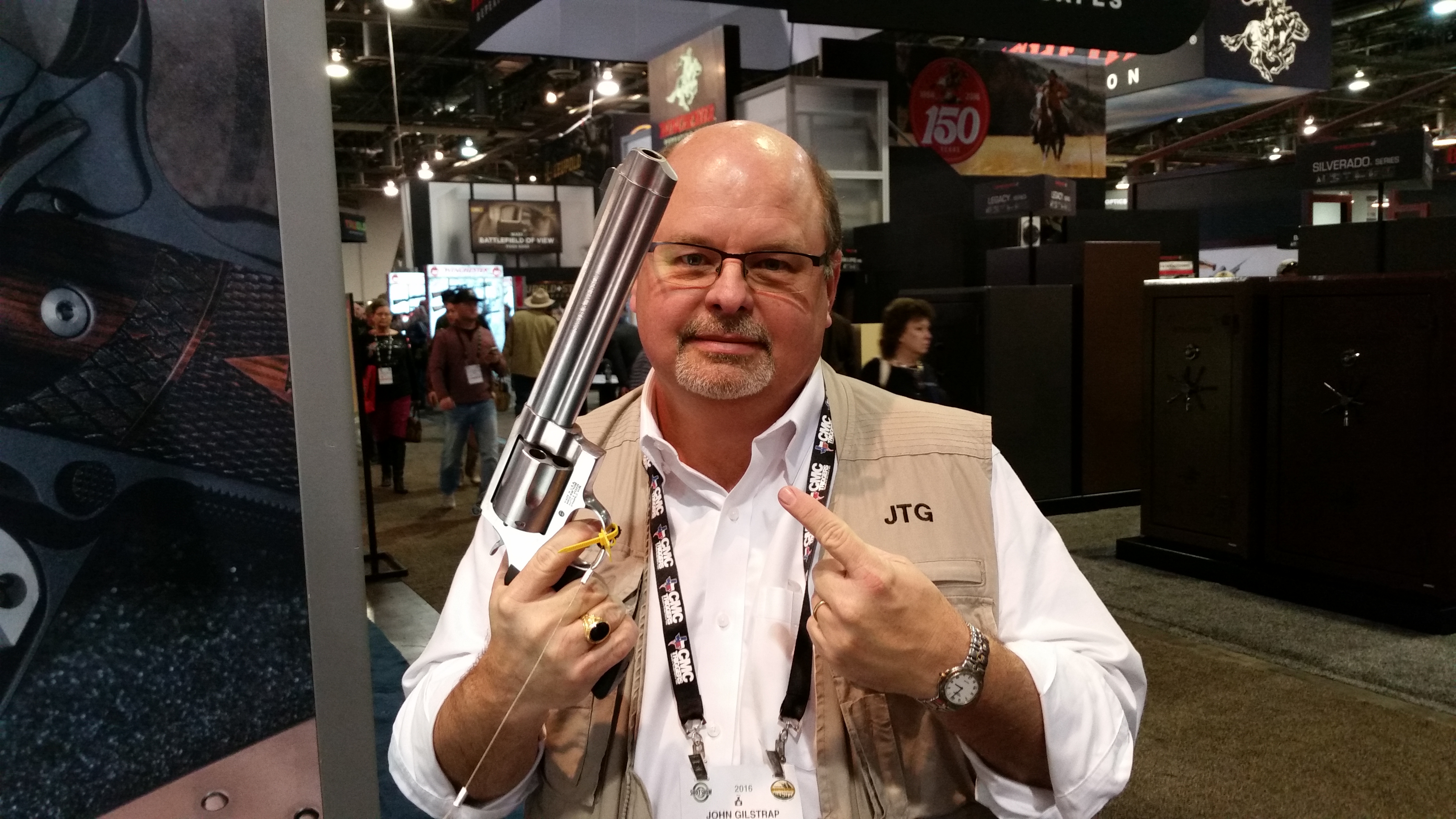
There’s such a thing as a Smith & Wesson .500 magnum.  Pictured here from the SHOT Show in Las Vegas, this four-pound smoke wagon fires bullets at over 1,800 feet per second (FPS) and, according to the manufacturer, will drop an elephant.  I’ve shot this beast.  While it’s the kind of pistol that a new Dirty Harry might be drawn to (“the most powerful handgun in the world and can blow your head clean off–while you’re hiding behind the refrigerator in your neighbor’s house“), there’s no practical use for it in the hands of your private detective.

Barrel length matters.

A firearm is a pressure chamber, the sole purpose of which is to contain the pressure of the exploding gunpowder long enough to send a projectile on to its target.  As the bullet proceeds down the barrel, the lands and grooves of the rifling impart a spin that stabilizes the bullet in flight.  The more time the pressure has to push the bullet, the longer the bullet has time to stabilize from the lands and grooves.  Thus, all else being equal, longer barrels equal greater accuracy at greater distances.

So, what kind of gunfight does your character anticipate?  Most gunfights play out in less than five seconds at distances of less than ten feet.  If that’s most likely your character’s world, then shorter barrels will do.

NOTE: There’s such a thing as the “21-foot rule,” which proclaims that any shot fired at a person from a range of greater than 21 feet–seven yards–is not considered self defense against any threat that is not another firearm.  If a bad guy is running at your good guy with a baseball bat or a knife, many jurisdictions will say that threat is not lethal until the bad guy closes to within 21 feet.

Single-stack or double-stack?
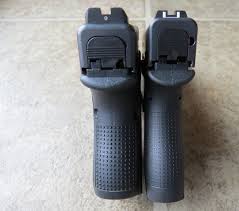
Guns for everyday carry (EDC) are getting smaller, but there remains a need for ammunition to feed them.  As you probably know, ammo magazines for pistols typically reside in the weapon’s grip.  A “single-stack” magazine stacks the bullets directly on top of each other, while a “double-stack” mag staggers the bullets side-by side, with the effect of making the grip thicker and harder to hold for a shooter with a smaller hand.  The pistols shown side-by-side in the picture are the Glock 26 on the left, and the Glock 43 on the right.  Both are called “baby Glocks”, with barrel lengths within a couple hundredths of 3.4 inches.  They’re called compact 9mm pistols.  The one on the left (G26) is fed by a double-stack magazine and holds 10 rounds, plus one in the chamber, while the one on the right (the G43) uses a single-stack mag and holds 6 rounds plus one in the pipe.  You need to ask yourself what your character’s priorities are.  Those four extra rounds cost you a lot in terms of grip size and concealability.  (Full disclosure: having spoken to many people who’ve been involved in gunfights, I’ve never heard one complain about having too much ammunition.)

Dress for the day.

How likely is it that your character will get involved in a gunfight?  Military personnel in a war zone, and police officers on duty carry full-size pistols because there’s a reasonably high likelihood that they will find themselves in a gunfight.  They make no effort to conceal their firearm, so bigger is better.  The bigger, heavier platform is less punishing to shoot, and as a result, accuracy tends to be better.  But it’s not exactly the right weapon to strap to your tuxedo or evening gown on the way to the opera.
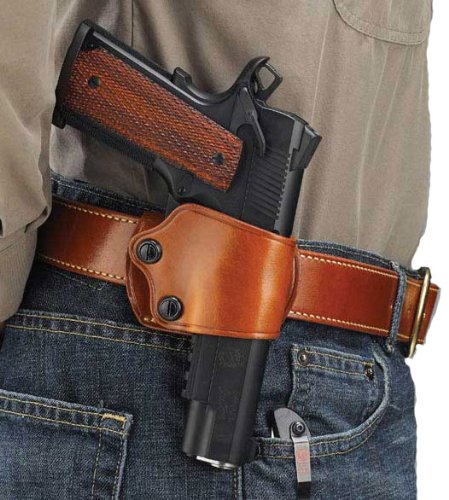
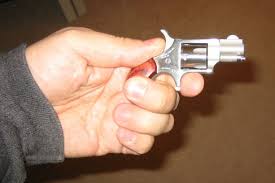
North American Arms Mini-Revolver chambered in .22 short. The effective range is maybe 4 or 5 feet, but fired into the brain pan, it’s as deadly as a sniper shot.

For those highly concealed applications, the firearm manufacturing industry offers lots of options.  Just remember that for any given caliber, the smaller and lighter the weapon–the easier it is to carry and conceal–the more punishing it is to shoot.  Also, smaller guns mean a shorter effective range.
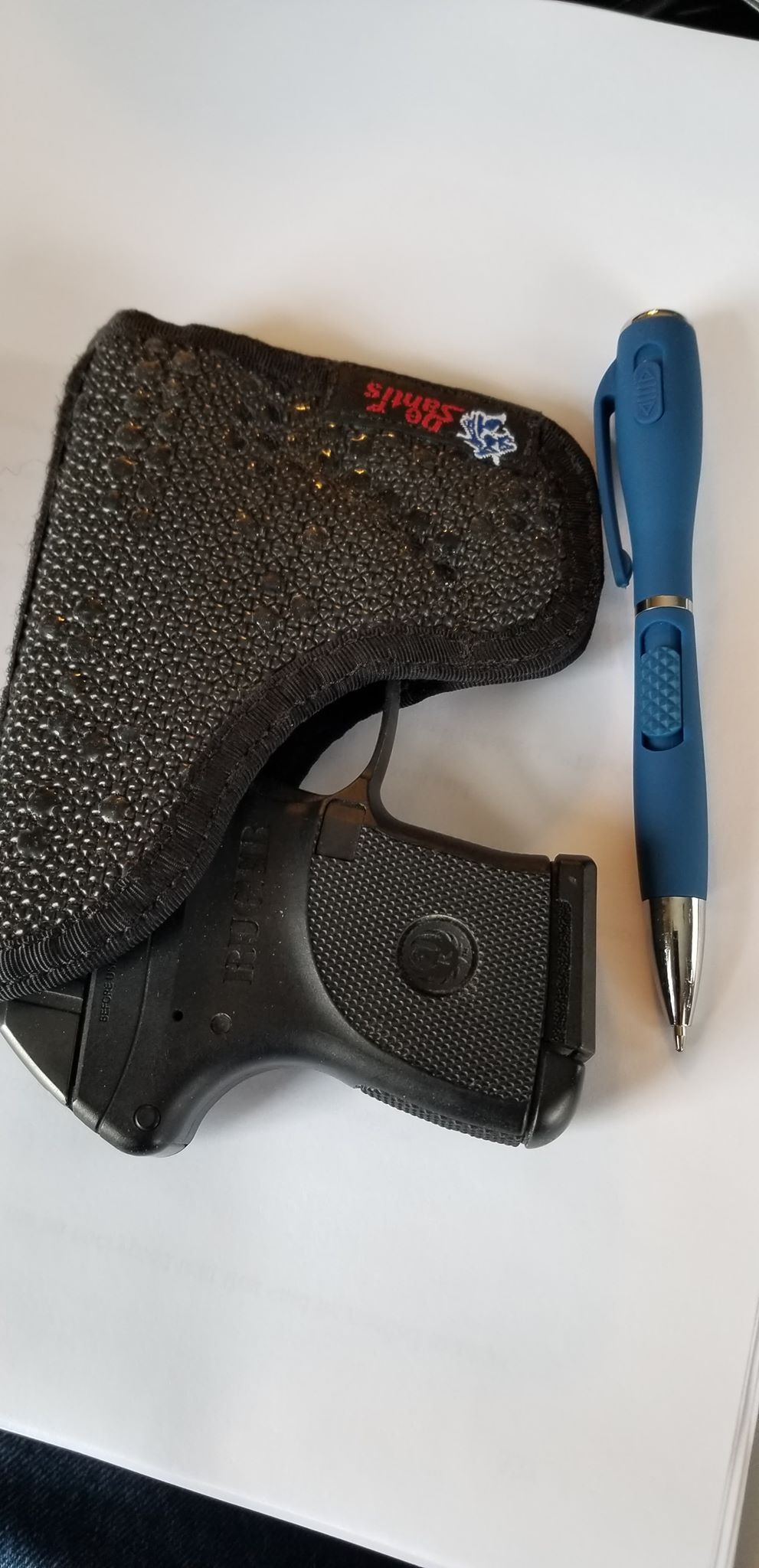
One of the most popular EDC guns on the market these days is the Ruger LCP (Lightweight Compact Pistol), chambered in .380, shown here in the picture next to the ballpoint pen to give it scale.  As presented, the pistol is in a pocket holster, which is exactly what it sounds like–a holster that slides easily into a pocket or a purse.  Because of its tiny size–there’s only room for two fingers on the grip–and its very heavy trigger pull, this is a difficult gun to learn to shoot, but once you get the hang of it, it’s pretty effective.  Virtually every gun manufacturer makes a similar weapon, and all of them are hand-breakers till you learn the right grip.

Okay, TKZers, how do you want to arm your good guys?  How about your bad guys?  What other questions do you have?

How to Write a Great
Story…in 18 Holes

By PJ Parrish

Read a heck of a story this weekend. It featured a flawed hero on a classic journey. He started out young with the world at his feet, but then he lost it all. The story had villains, a dysfunctional family, a bad love affair, a sordid scandal, and physical hardship.  The hero, I feared, was doomed. But then, against all odds, defying the naysayers, he climbed out of the abyss and triumphed.

Okay, I didn’t really read it. I watched it.  But it had all the human drama and suspense of a great book.

I watched Tiger Woods win the Fed-Ex Cup tournament. It was his first win in five years.  As one of the golf commentators said, “What a great story.”

Maybe you don’t follow golf. I don’t, normally. But the story of Tiger Woods, who had it all, lost it all, and climbed back up again, is the same stuff that makes for compelling fiction.

Great stories…

Let’s stay with the sports metaphor for a second. Let’s talk about pro football — it’s my go-to sport. Pro football’s ratings are way down. There are lots of theories why — the players’ protests and the President’s tweet-poking; bad play from big market teams like the Cowboys and Bears; too many dog games on Monday Night Football; fewer folks (mainly young) watching TV and choosing to cut the cable cord all together and play with their phones.

I’ll add my own theory: Pro football doesn’t have any great stories anymore. Like…

Joe Namath leading the hapless Jets to the Super Bowl win.

The Patriots’ season going to hell when Drew Bledsoe went down. Until some sixth-rounder nobody named Tom Brady stepped in to save the day.

The 1972 Dolphins losing their starting QB but going on to the only perfect season.

The 1985 rock-star Bears march to another perfect season, only to be blocked in game 13 by the 8-4 Miami Dolphins, hell-bent on preserving the old record.

Some guy named Marino breaking every record but never winning the Big One. Kurt Warner, the grocery store clerk who became a three-time MVP. And guys like Michael Oher, the homeless kid whose rise to Titan tackle was told in the Sandra Bullock movie The Blind Side.

We’re all suckers for great stories. Cinderella tales. Redemption roads. Inspiring comebacks. Underdogs who triumph. It’s the essence of good fiction. I got to thinking about this today after reading James’s Sunday blog about “pretty writing” as Tiger played in the background on TV.

You want to be a success in this business? Just learn to tell a good story.

Ha! Easier said than done. Let’s break it down into digestible bites. A while back, I wrote a blog about Pixar’s 20 Rules of Great Storytelling.  Pixar knows how to tell great stories. They’ve won 13 Academy Awards, 9 Golden Globes, and 11 Grammys. Pixar movies always involve a deep understanding of human emotion. They know how to move an audience. Here are just a couple of their “rules.”

Great stories are always universal. Take the basic ingredients of human life — birth, love, death, conflict, growth, spirituality — and make it appeal to everyone. Or as Pixar director Pete Docter puts it:

“You write about an event in your life that made you feel some particular way. And what you’re trying to do, when you tell a story, is to get the audience to have that same feeling.”

Great stories always have someone to root for. It can be a classic underdog tale. Or a rags-to-riches saga. The hero may not succeed, but often we love their attempt alone. It’s more about their journey than the destination.

Great stories always have structure. One of Pixar’s tips is to use “The Story Spine,” a formula created by professional playwright Kenn Adams. It goes:

Once upon a time there was [blank]. Every day, [blank]. One day [blank]. Because of that, [blank]. Until finally [blank].

Can you see the beautiful simplicity of it? You have a hero, who does this every day. But then something happens until finally he triumphs. Or as we at TKZ preach often: Something is disturbed in your hero’s world and he fixes it. (Or sometimes doesn’t).

Great stories are never dull. Again, go back and read James’s Sunday post for more on this. Great stories are surprising, unexpected. If you can dream up a story that challenges the reader’s usual perceptions of reality, you are on to something good. This is especially true in genre fiction, where stale old formulas are too often the norm. A tip from Pixar: If you’re stuck on coming up with something truly unique, get rid of the 1st thing that comes to mind — and then the 2nd, 3rd, 4th, and 5th.

Well, it’s just after six p.m. on this Sunday as I write this. Tiger Woods just won.  But not without some last-minute drama.  Going into the last round today, he was up five on his nearest competitor, Justin Rose. Tiger’s drives were straight and true, one going the length of three-and-a-half football fields. His putting game was surreal.  But then…

On the back nine, he shanked a couple into the rough. He missed easy putts. He bogied the fifteen and sixteen holes. Justin Rose crept closer, the lead shrinking to two. But Tiger parred the last two holes to win.  So here’s what we have: Tiger Woods, a deeply flawed protagonist, had it all and lost it all. He spent five years wandering in the wilderness. One year ago, Woods had endured three back surgeries and could barely walk, let alone swing a club. One year ago, he was ranked 1,199 in the world. Today he clawed back to win his first tournament in five years and maybe move up into the top ten.

He’s being interviewed right now. The crowd is going nuts. Tiger is tearing up. So am I.

What a great story.

________________________________________________________

THE DAMAGE DONE, the 13th installment in the Louis Kincaid series, now available.

“Louis Kincaid is wearing a badge again—as part of an elite homicide squad. But his return to his Michigan home comes at the bidding of a man who once set out to destroy him. When the cold case deaths of two little boys collides with the white-hot murder of a mega-church minister, Louis finds himself fighting to unearth the secret past of his police captain—and the demons of his own childhood. The past and present come into stunning focus in this brilliantly crafted thriller. Relentlessly plotted yet filled with poignant family emotion, it will grip you from start to finish.”
—Jeffery Deaver.


Could a Feather Send You to Jail?

By SUE COLETTA

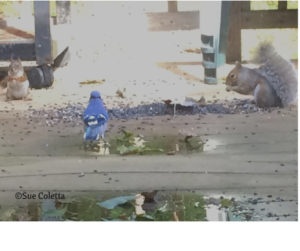
Raymond Reddington (left), Monny (right), Stretch (center)

While conducting research for my WIP, I stumbled across a law that blew my mind. As many of you know, I’m a huge animal lover. I would no more harm an animal than a member of my family. However, according to this statute, I may have inadvertently broken the law. And you might be guilty, too!

Years ago, I developed a fascination with eagles while writing Wings of Mayhem. When I wrote Blessed Mayhem, I became enamored with crows and ravens, as well. For those who aren’t familiar with Blessed Mayhem, Mr. Mayhem (the antagonist) has three pet crows. So, as the author, I had to know as much about crows as he did to portray him in a realistic manner. For months I studied their mannerisms, favorite foods, habitat, reproductive life, rituals, complex communication skills, body language, etc. And later, befriended a mating couple in my yard. You might remember my post about wildlife.

Some Native Americans believe that when a feather drops from the sky it carries the power of the bird, that crows live in two parallel universes, with one talon in a spiritual realm and one in the physical world, that they’re fore-tellers of change and messengers of the spirit world. When a crow visits, s/he expects to find our authentic self.

In writing, our character’s “authentic self” or “true character” is the 3rd Dimension of Character, the person only those closest to him truly know. The antagonist, especially a killer, will want to portray a false facade in public (1st Dimension of Character) to evade detection.

For my Mayhem Series, I take note of how my body reacts in the presence of crows, and then I transfer that emotion to the page to show Mr. Mayhem’s soft side.

Poe showing Shakespeare how to eat fries.

When my beloved murder of nine glides into the yard — awe-inspiring wings in perfect harmony with members of their tribe — my breath quickens, the world falls away.

As my stiff shoulders ease, I marvel at these incredible birds. I consider it an honor that they’ve let me share in the joyfulness of newborn chicks and the devastation of loss. I’ve reveled in their teachings of how to fly without smashing into a sibling’s wings, the intricacies of how best to crack peanut shells, and the unwavering belief that leftover French fries taste amazing first thing in the morning.

It’s probably no surprise then that when Poe leaves me a feather, I treasure her generous gift. But now, darn it, I found that pesky law …

Authorities created the North American Migratory Bird Treaty Act in 1918 when folks killed too many birds for the sole purpose of adorning their hats with feathered bling. It’s a broad-brush law intended to protect birds. Which is fabulous. The downside is, the law doesn’t recognize the difference between plucked feathers, shed feathers, or bird pieces. None of it is allowed in our possession. The Act lists over 800 birds. Crow feathers top that list, along with eagles, owls, ravens, hawks, and even blue jays.

In order to keep a feather collection, we need to visit our local Fish & Game headquarters and pull a permit. Maybe one of our TKZ legal minds could weigh in on any stipulations of obtaining said permit? I can’t bear to toss the feathers back in the yard, as the law requires. Poe and Edgar might consider it a slap across the beak.

Did you know it was illegal to pick up a feather? According to this law, not only are we required to figure out the exact species of bird who dropped the feather, but we need to cross-check the list to see if the feather is protected under federal law. The harmless act of collecting a feather from your yard could wind up costing you a hefty fine and even a misdemeanor conviction!

This discovery sent shock waves through my writer brain. Perhaps I could use this law in my WIP. We’re always searching for an interesting new angle, aren’t we?

Some of the ways I considered using this law are …

  • What if the detective uses the Migration Bird Act as “probable cause” to obtain a search warrant?
  • What if the confiscated feathers linked a suspect to the victim?
  • What if the detective witnesses a strange man pocketing a protected feather off the beach (yes, sea gulls are also on that watch-list) and he follows him to a killing lair?

None of those worked for my story, though. Too easy. I may have to abandon the idea.

How might you use the Migration Bird Act to heat up the investigation? Were you aware of this law?


Sue Coletta is on a path. She earned her ticket into the crowded arena of dark thriller contenders with her previous novel (“Marred”), and in “Wings of Mayhem” she announces her arrival with the wail of approaching sirens and the quiet horror of a blade swinging at your throat in the dark. Don’t miss this one. A star is born.” ~ Larry Brooks

Look inside Wings of Mayhem HERE.


How Beautiful Should Your Sentences Be?

by James Scott Bell
@jamesscottbell

Mickey Spillane

“Those big-shot writers could never dig the fact that there are more salted peanuts consumed than caviar.”

So said one of the all-time bestselling writers, Mickey Spillane. He was always getting bad-mouthed by literary writers (most famously Hemingway) for succeeding in the sweatshop of mass market paperback fiction. Many “big-shot writers” who wrote beautiful sentences did not take it well that this hardboiled typist was outselling them ten thousand to one.

I thought about that quote recently as I listened to an agent and editor on a panel discussing “up-market fiction.” That seems to be what “everyone is looking for” in the traditional publishing world. But what the heck is it?

A few years ago, Chuck Sambuchino, of Writer’s Digest, defined “up-market” this way:

Simply put, it’s fiction that blends the line between commercial and literary. To further examine this, let’s break down those two terms. Commercial fiction, essentially, refers to novels that fall into a typical genre (thriller, let’s say). Commercial fiction can sell very well because it usually has a tight premise/logline (“Someone is trying to kill the president!”) and people like reading a category like thrillers because it’s exciting. Literary fiction refers to novels that don’t fit into any standard genre classification – romance, mystery, sci-fi, for example. Literary fiction requires the highest command of the language. Not pretentious, over-the-top purple prose – just simply excellent writing. Literary fiction has a harder time selling because it’s not easily defined, and sometimes the premise is not easily explained (or just isn’t that exciting).

So that brings us to “upmarket.” EVERYONE is looking for this genre. “But why, Chuck?” Well, think about it. It’s literary fiction, so it’s pretty damn good writing, but it has commercial potential. It has the ability to infiltrate lots of book clubs and start discussions and take off as a product. It’s a win-win for everyone. I’ve heard a lot of agents say that they are looking for “literary fiction with a commercial appeal,” or something like that. Well, one word that does the job of those six is “upmarket,” and that’s why you hear it so much.


The article went on to quote agent Kristin Nelson, who said, “Really, editors are looking for literary writers who can tackle the more commercial themes in a way that’s fresh and well constructed.”

The agent on the panel said that literary fiction is “all about the sentences” and commercial fiction is “all about the plot.” Up-market fiction occupies “the space in between.” It has “more beautiful sentences” than raw commercial fiction.

I guess I understand. But let me say, first of all, I don’t believe a collection of “beautiful sentences” necessarily adds up to a quality literary novel. If you’d like to find out why, read the famous (or infamous, depending on your point of view) essay called A Reader’s Manifesto.

On the other hand, lovely prose in service to story can indeed elevate the fictive dream. I give you, e.g., White Oleander by Janet Fitch.

It’s an interesting balance to consider. My approach is to start with plot and then consider my sentences, rather than start with style and root around for a plot. Therefore I counsel: Don’t write to impress your readers; write to distress your characters.

When I write a sentence I don’t want it to pull the reader out of the story by being either a) clunky; or b) purple. If there’s to be some “poetry” in the prose, I want it to be, as John D. MacDonald put it, “unobtrusive.”

To bring things back to Mr. Spillane, his writing was favorably contrasted to Thomas Wolfe’s in an essay by, of all people, Ayn Rand. And it seems to me she was right. Wolfe’s sentences often get in my way (I wrote about that here). But Spillane’s pull me into the story world. Read the opening of One Lonely Night sometime.

So just to be clear, I really do love a bit of caviar now and then. But I’ll take a bag of salted peanuts anytime—and will likely finish the whole darn thing.

So what repast do you prefer—caviar or peanuts? Do you think about writing “up market”?

The Bare Bones of a Story: SKELETON, a First Page Critique

Photo courtesy Max Bender from unsplash.com

Hello, Anon, and thank you for submitting the beginning of Skeleton, your work in progress, to us at The Kill Zone for our First Page Critique. Let us begin:

I slammed to the ground. A boltof pain cracked through my body then slid away. A dull throb took its place.The bust-up was the right arm. Between elbow and wrist. I looked at my arm and flexed it. A jagged edge of bone stretched the skin up. A dagger of horror seized my brain. My core instinct said not to move. But I had to get home.

I staggered to sloppy feet, heldthe damaged wing close to my body and stumbled down the sidewalk. As long as I didn’t move the arm, pain was secondary to fear, the ‘my mother will been raged’ type fear. What were you doing swinging from limbs of that pine tree in the first place? I could hear the shrill voice echo those words. But how mad could she get? I mean today was my tenth birthday and how mad could a mother be at her only daughter’s tenth birthday party? And why was I thinking about that now, twenty-five years later as I sat in a chair, high, wing back, cloth I thought. I couldn’t move. I could turn my head, but nothing below the shoulders worked. Maybe that was the connection. I couldn’t move the broken arm then and I couldn’t move anything now.

The room was gold and red with a hint of incense in the cold air. It was something out of an Agatha Christi novel. I swallowed, took a deep breath, scanned the room with my eyes. Floor to ceiling heavy draperies. A gold statue of a ten-inch Buddha in the corner. Thick tapestries hung on walls depicting combat with horses, spears and doomed men. I wasn’t stressed. My practice of daily meditation born of my Buddhist belief kicked in. I remained calm, focused.

A solid door, painted deep gold with carvings of dragons creaked open and he walked in. He was maybe five feet five inches, stocky build poured into a three-piece suit, vest and all the trimmings.  

He carried a single manila folder, walked in front of me and sat in the edge of a leather topped captains’ desk. His eyes were set close to a narrow nose; the only hair on his head was a tight goatee, closely groomed. He dropped the folder on the desk, crossed his arms and a small puff of air expelled through soft nostrils. He was Vietnamese. Some of that blood ran through me. I knew his essence.

“There has been a mistake,” he said in a voice that sounded like he was telling me a bed-time story.

“I must apologize,” he continued.” This is embarrassing at the least and inexcusable at best. This is not how I operate. Pressure applied from the client should not influence how results are obtained. However, to be human is to err human. And that misfortune is what has brought us together.”


Thank you for submitting, Anon. Please permit me to be blunt.  The bad outweighs the good here. I had a lot of trouble with the first couple of paragraphs of Skeleton because they are confusing, poorly written, and full of typographical errors. It gets better further down the page. Most editors, assistants, and agents (not to mention readers) wouldn’t have gotten that far, however. They would have read the first paragraph or two and told you that they weren’t interested if they told you anything at all.


First: please proofread. You have words running into each other, you misspell “Agatha Christie” as “Agatha Christi” — oh, the humanity! — and use a hyphen (“bed-time”) where you shouldn’t. Also please format. Lynne, the wonderful person who, among many other tasks, sorts these First Page Critiques out and sends them to us at The Kill Zone, mentioned to me that when she originally received Skeleton it had not been formatted. Putting it into Google Drive improved it but if your prospective agent or editor wants your manuscript in Word they’re going to be unhappy if you don’t format according to their specifications. Get you indentations, headers, footers and spacing all together and consistent. Yes, sometimes one or more of these things jump for some reason. Send it to yourself first and make sure it looks like you want it to. If it doesn’t, find out what is wrong and fix it.

Second: It’s fine if you want to jump from the past to the present, but give your reader a chance to get the thread of the story first. One minute your protagonist is ten years old, the next she is thirty-five. If you want to start off with the past, fine, but let us know as soon as possible that we’re in the narrator’s past. Try something like this:

I broke my arm on my tenth birthday. I was swinging from a tree limb and let go either too soon or too late. I’m still not sure which, a quarter-century after the fact.  I had been looking forward to my party in one moment and in the next I was falling and then screaming as I fell. I hit the ground hard and a bolt of pain cracked through my body. It was quickly replaced by a dull throb in my right arm, between the elbow and wrist, where a jagged piece of bone now stretched the skin upward where it never should have been. I was horrified. I just wanted to lay there but I had to get home. My pain was secondary to fear. I was afraid of my mother’s reaction, even though it was her only daughter’s birthday, or maybe because of it. I could hear her shrill voice in my head before I even got home. “WHAT were you DOING swinging from the pine tree in the FIRST place?!” I was good at predicting how people, whether families and strangers, would react, even back then.

That takes care of the past, Anon, and we know it’s the past. Now let’s transition to the present:

I couldn’t move my broken arm back then. Flash forward to the adult me, sitting in a high, winged back chair. I couldn’t move at all. Oh, I could turn my head, but nothing below my shoulders worked. The range of vision which I had wasn’t much. Maybe that’s why I was thinking about that immobile broken arm now. I didn’t appreciate how good I had it as a kid.

Three: I kind of like how you describe the man, but I’m not sure if your protagonist knows who or what he is. Let’s fix that up. And while we’re doing that, tell us a bit about your narrator:

The range of vision which I had wasn’t much, but I could see enough to know that I was in trouble. There was a solid door, painted deep gold with carvings of dragons, in the wall in front of me. It creaked open and a stranger — maybe five feet five inches, with a stocky build poured into a three-piece suit, vest and all the trimmings — walked in. He looked Vietnamese, a little like me. I nicknamed him “Diem” in my head. He walked over to the captain’s desk just inside my right field of vision and sat down, dropping the manila folder he carried on a desk blotter. “I’m sorry, Miss Tree,” Diem said. Oh, so he knows me, I thought. “There has been a mistake.” He crossed his arms and a small puff of air expelled through the soft-looking nostrils in his narrow nose, framed by his close-set eyes. ”This is embarrassing at the least and inexcusable at best. It is not how I operate. Pressure applied from the client should not influence how results are obtained. However, to be human is to err human. And that misfortune is what has brought us together.” The ceiling lights reflected off of Diem’s bald head, an expanse that was uniform and undisturbed until it reached his tight, closely groomed goatee. I thought of a crude joke about beards that my ex-husband used to make, a joke that I hated when we were married. Now, sitting in that room with a stranger in front of me and all but unable to move, I had to force myself to stop laughing.

I hope that helps, Anon. Your concept reminds me just a little of the Sax Rohmer books which I absolutely adored in my youth (and which I still do, actually). There’s promise here. You have a story, but you don’t have a book or even a first page just yet. Check out the books which my fellow TKZers have for sale about the craft of writing, get one with the basics, study it closely, and go for it. Good luck.

I will now attempt to remain uncharacteristically quiet while our wonderful readers, visitors, and contributors make their own comments. Thank you for submitting to us, Anon, and keep trying.


First Page Critique – “New to the Neighborhood”

Jordan Dane
@JordanDane

By Jeffrey Beall – Own work, CC BY-SA 3.0, https://commons.wikimedia.org/w/index.php?curid=21002061

For your reading enjoyment is another brave author open to feedback. My comments will follow. Feel free to share your constructive criticism in your comments. Let’s nurture this author, TKZers.

***

The words, sprayed in red, dripped like blood down the white siding of the ranch house on the corner. “They could have at least gotten the spelling right,” I called from the curb, loud enough for the woman in the yard, scattering grass seed from a coffee can, to hear.

Maggie looked up. She stood – a scarecrow with choppy, flaxen hair under a straw hat, worn jeans, and flannel shirt rolled to the elbow – and we looked at each other. She called toward the backyard: “June. We have company.”

A second woman approached along the slate flagstones that curved between a pansy-and-petunia border. Knee-length shorts and a Hawaiian shirt showed dimpled limbs and rose quartz skin. A halo of gray-flecked, light brown curls accented the cherub face. The tight line of her mouth loosened into something like a smile. Then her lips began to tremble and her eyelids flutter. She wrapped me in an airtight hug, which I returned with less vigor.

Maggie pressed June’s elbow. “June, get us some chairs. Can you sit a while, Kelly?”

They’d arrived two months before, in March, setting the block’s antenna twitching. Two single women, the wrong ages for mother and daughter, no men in sight. Sue Hoycheck said they seemed nice enough, but Sue was a kind-hearted grandmother who thought everyone seemed nice enough. They told Edie Isom they’d moved from St. Paul. One or the other –Edie couldn’t remember – had been hired to manage the art mall opening in the old Amtrak station downtown. When Olin Frey murmured that he’d seen just one bed – queen-size – come off the moving van, all the pieces fit together.

“It’s no big deal,” Lynn Franklin insisted. I’d come to Franklin’s Hardware to order specialty paints, coffee bean brown and French olive green, for a dining room trim. “As long as they return the rototiller they rented from us, who they sleep with is their own business.”

I smiled with mischief. “And if they don’t return the rototiller, who they sleep with is . . .?”

She frowned. “It may seem funny to you. You probably met a lot of them in New York. But around here . . .”

“I don’t know how many I met,” I said. “I’ll bet you don’t either.”

***

FEEDBACK

Overview: There is a lot for me to like in this intro. The inciting incident is a disturbance established with graffiti. It’s the first image the author draws our attention to. The idyllic setting is marred by red paint on the white siding of a ranch house. I particularly enjoyed the descriptions of the women. Very visual and easy to imagine. I also appreciated the underlying emotion in this scene when the visitor & the narrator console with a hug.

After I read and reread this intro, I noticed things that I would edit if this was my work. I had questions on POV and the characters as I read on. I sincerely enjoyed reading this intro. The talent of this author is very apparent, but some housekeeping is in order.

ESTABLISH GENDER: Since this is in first person, the gender of the narrator would be important as soon as possible from the start. This is minor, but add a word to this line:

I called from the curb, loud enough for the OTHER woman in the yard,…

Good call for the author to establish June’s name by having Maggie call out to her.

SENTENCE CLARITY: This is me, being nit picky. The sentence below might flow a little better:

BEFORE: “…loud enough for the woman in the yard, scattering grass seed from a coffee can, to hear.”

AFTER: “…loud enough for the other woman in the yard to hear as she scattered grass seed from a coffee can.”

STICK WITH ONE POV – If this scene is told from June’s singular POV, the intro should consistently be seen through her eyes. In the second paragraph, when Maggie looks up at June, this line follows”

and we looked at each other

I would suggest that the author stay in June’s head and try to imagine what she might see in Maggie’s eyes – worry, fatigue, hurt, concern, wariness? Or simply change the line to: “When my eyes fixed on Maggie’s, something passed between us.”

Another line switches the POV from June to Maggie: Maggie pressed June’s elbow. If this is truly meant for June’s POV, this line would read: Maggie pressed my elbow.

In paragraph 5, that begins with “They’d arrived two months before…”, the author switches from June’s POV to telling a “THEY” story. The POV should be consistent throughout this intro scene, so that line might read “I had moved with Maggie two months ago…”

But from this writing, maybe June and Maggie aren’t the “they” the author is writing about. Perhaps the author is writing about Kelly and her significant other. It’s not explained who Kelly is or why June is reticent to embrace her. By the time I got down to reading Lynn Franklin’s lines, I realized the hardware store owner was talking to June, as if June was an insider to the town. Some clarity is definitely needed.

If June and Maggie are the newcomers, other lines should be fixed for POV as follows:

BEFORE: Two single women, the wrong ages for mother and daughter, no men in sight. Sue Hoycheck said they seemed nice enough, but Sue was a kind-hearted grandmother who thought everyone seemed nice enough. They told Edie Isom they’d moved from St. Paul. One or the other –Edie couldn’t remember – had been hired to manage the art mall opening in the old Amtrak station downtown. When Olin Frey murmured that he’d seen just one bed – queen-size – come off the moving van, all the pieces fit together.

AFTER: We were two single women, the wrong ages for mother and daughter, no men in sight. Sue Hoycheck told others that we seemed nice enough, but Sue was a kind-hearted grandmother who thought everyone seemed nice enough. Word spread through town busy body, Edie Isom. It didn’t take long for folks to know Maggie and I hailed from St. Paul. Edie didn’t remember which one of us had been hired to manage the art mall opening in the old Amtrak station downtown, but I guess that didn’t matter much. But what set the town on fire came when Olin Frey murmured that he’d seen just one bed – queen-size – come off the moving van. That’s when all the pieces fit together for folks with small minds.

But if the “they” is Kelly and her partner or wife if they are married (unsure of the time period of this piece), then “they” should be explained with names.

EMBEDDED DIALOGUE – I would recommend to draw out dialogue lines so they are not embedded within a paragraph. It allows the reader to follow more easily and keep track of who is speaking.

The words, sprayed in red, dripped like blood down the white siding of the ranch house on the corner.

“They could have at least gotten the spelling right,” I called from the curb, loud enough for the woman in the yard to hear as she scattered grass seed from a coffee can.

Maggie looked up. She stood – a scarecrow with choppy, flaxen hair under a straw hat, worn jeans, and flannel shirt rolled to the elbow. When my eyes fixed on hers, something passed between us. She nudged her head and called toward the backyard.

“June. We have company.”

TIGHTEN SENTENCES WHERE NECESSARY: In the BEFORE line below, if the visitor’s lips are “beginning to tremble”, they are already trembling. A cleaner sentence would be:

BEFORE: Then her lips began to tremble and her eyelids flutter.

AFTER: Her lips trembled and her eyelids fluttered.

SHOW TIME LAPSE: When the dialogue line “It’s no big deal…” comes up, time has passed and June has left Maggie & Kelly or it’s another day or a memory. It would be nice to clarify this and I changed the flow a little in the AFTER example.

BEFORE: “It’s no big deal,” Lynn Franklin insisted. I’d come to Franklin’s Hardware to order specialty paints, coffee bean brown and French olive green, for a dining room trim. “As long as they return the rototiller they rented from us, who they sleep with is their own business.”

I smiled with mischief. “And if they don’t return the rototiller, who they sleep with is . . .?”

She frowned. “It may seem funny to you. You probably met a lot of them in New York. But around here . . .”

AFTER: Two hours later, I stared at the weary face of Lynn Franklin, owner of the local hardware store in town. I’d come to Franklin’s Hardware to order specialty paints, coffee bean brown and French olive green, for a dining room trim.

“It’s no big deal,” Lynn Franklin insisted. “As long as they return the rototiller they rented from us, who they sleep with is their own business.”

I smiled with mischief. “And if they don’t return the rototiller, who they sleep with is . . .?”

She frowned.

“It may seem funny to you. You probably met a lot of them in New York. But around here . . .”

“I don’t know how many I met,” I said. “I’ll bet you don’t either.”

SUMMARY: I really like how this ends. If the author adds clarity on the areas I brought up, the conflict is apparent, but I’m wondering where this will go and if it’s enough for a whole novel. The characters intrigue me. I would read on.

DISCUSSION:

1.) What changes would you recommend, TKZers? Would you read on?

2.) What possible plot twists can you see stemming from this introduction?

Just Write the Story


Have you ever felt like every idea you currently have your finger on totally…sucks? That you may never have another good story idea?

I’ve been struggling with a short story for weeks and weeks. Not struggling with a single, specific story, but with FOUR beginnings of stories as I try to distill one. This isn’t a situation I’m used to, or particularly like. (I’m sure that I’m the only one this has happened to, right?) As those beginnings rolled around in my head, I’d stop to type out a page. Then stop. The idea never quite made it past another couple paragraphs.

This may be the absolute worst part of being a writer. Or at least being a writer under deadline.

I decided to get help from my resident writer guy/bedfellow. (Paraphrasing ahead because in real life conversation is rarely linear–something to remember as you write fiction. Think of the following as a kind of passion play. On writing.)

Me: I need to talk about something. [Trying not to sound too dire, yet going for serious. Because I am.]

Husband: Sure. [Isn’t he nice?!]

Me: So I’ve been trying to work on this story for a long time now. I just feel like–I don’t know–like I’ll never be able to write another short story again. Like I’ll never have another good idea. They’re just gone. [Confession: I know it’s a bit of a whine. A cry for help because what writer wants to EVER feel this way?]

Husband: Yeah, that sounds tough. You sound like you feel pretty bad. [I love empathy, don’t you? Yes, we’ve both had plenty of practice with, um, professional listeners.]

Me: *sigh* It’s a horrible feeling. What if I never have another decent idea?

Husband: That’s unlikely. But you could always get a job at Dairy Queen. [We are both big DQ fans.] Somebody–I don’t remember who, maybe someone we interviewed–mentioned they teach your Bug Man story in their writing classes all the time.

Me: That story just came to me all at once, you know? In one big piece. It was a giant gift from the sky. I don’t think I really had much to do with it. And then a couple of my stories got nominated for prizes. How can I write another story and have it not be as good? [This is a real feeling, y’all.]

Husband: So what if it’s not as good? [You can see who the Devil’s Advocate is in our house.] You just have to write a story.

Me: It just feels like the end of everything. [Apocalyptic scenarios are my specialty.][Intentionally ignoring the suggestion that my next story might not be as good as my former best. My currently fragile ego obviously can’t take it.]

Husband: You think you’ll spend the rest of your life not writing? [Why doesn’t he sound more alarmed, I want to know.}

Me: If I don’t have any ideas, I can’t write. Short stories, anyway. [Note to editor and agent: the current novel is going FINE] I don’t think I’ve ever felt this way before. It’s scary.

Husband: Yeah, that’s not really true. [What? Is he kidding? Calling me a liar? Them’s fightin’ words.]

Me: What do you mean? [Trying not to sound indignant because that would only refocus the discussion on a non-issue and listening would quickly cease on both sides. That’s what a professional listener might say, anyway.]

Husband: I hesitate to tell you this, but you say this every time. Short stories, novels, whatever. Especially if you have a deadline. [I am speechless for a long moment.] Sorry, but it’s true.

Me: Really? [I’m experiencing a glimmer of familiarity, to my surprise. But it’s…uncomfortable.] Seriously?

Husband: Yep. Every time. [Similar scenes from the past threaten to overwhelm me, making my brain spin like a spiral cartoon graphic from old Batman or The Monkees shows. (Yes, I’m that old, and if you don’t remember them I pity your loss!)]

Me: Maybe…I guess. [I’m awesome at poker. You never know what I’m thinking.]

Husband: You should probably go write the story.

Me: You think I can? What if it sucks? [Please don’t say it could suck.]

Husband: It could definitely suck, but I don’t think it will. I’m sure they’ll take it. [!!!!!]

Me: They’re not going to want it if it sucks, though. [Logic is surely on my side, right?]

Husband: You don’t get to be the judge. You just have to write the story. You usually think your work is no good until someone else likes it. Or publishes it. Go write the story. [He’s repeating himself. Could it all really be this simple? Hope fills my head, displacing the cartoon chaos. I’m finally remembering…] So what’s for dinner?

Yes, Husband was perfectly correct. I do go through similar throes sometime during every project. It’s a crisis of confidence that appears to be part of my process. It can come right at the beginning, and/or sometimes when I’m about 3/4 in. I wanted to share this little drama with you to let you know you’re not the only one. I know there are writers among us–TKZers on both sides of the screen [cue creepy image of ALL the TKZ contributors stuffed into the back part of my Mac, typing away diligently]–who NEVER have a crisis of confidence. And more power to them! The rest of us have to wrestle with our work and stories until they become clear in our vision.

You won’t ever run out of ideas. I promise.

Oh, I found my story the next morning. It’s a synthesis of two of my story ideas, plus an added murder. [Of course there’s a murder–maybe two!]

So, dear TKZers, tell us a story about your crises of confidence. Do you have predictable panicked moments? Or do tell us how you’ve managed to avoid them!


Heil Safari – First Page Critique

Today let’s welcome another Brave Anonymous Author who offers the first page of Heil Safari.

Title:  Heil Safari

Captain Martin Beyer wondered in alarm how he could save his friend’s life. His friend, Second Lieutenant Hans Fritz, was in danger of being shot. He had stepped to the caution line and put one foot on the other side. The caution line, marked with wooden stakes and a strand of wire across the top, warned the prisoners of war from getting too close to the wire fence fifteen feet beyond. On the fence going around the entire prison camp there were signs in English and German that read:

ATTENTION!

Forbidden to Move Inside

Restricted Area

Violators Will be Shot

The American guard in the corner watchtower shouted, “You there! On the deadline! Git back!” The guard raised a rifle to his shoulder. “I said git back!”

But Fritz didn’t move.

“You damn Nazi,” the guard yelled at Fritz. “Git back or I shoot!”

Fritz still didn’t move, apparently not taking the threat seriously. Or caring. But Beyer took it seriously. He cared.

Returning to his barracks after doing his morning toilet, Beyer now stood still, uneasy. Then he heard the click of a breech bolt coming from the guard tower at the other corner of the compound. In horror he saw a guard hunkered behind a machine gun. He was covering the south end of the compound as if at any moment there might be a general uprising. The nearby prisoners, however, remained still and only stared.

But Beyer had to do something other than stare to see how the crisis would turn out. He couldn’t afford to lose Fritz. The only mining engineer in the Officers Compound, Fritz was essential to the success of Hermes. Beyer was desperate for Hermes to succeed. Being too long cooped in the densely packed prisoners and buildings of the enclosure, Beyer, much like Fritz, was becoming unnerved. Beyer frequently broke out in night sweats, his breathing rapid and shallow, and sigh a low, agonizing moan.

Considering that Fritz might be shot, a shiver of fear raced through Beyer at the prospect of a catastrophe. Without Fritz there may not be a tunnel completion, no one would get out, all the hard work done up to now remaining unfulfilled.

“Damn you! Stop!” the guard with the rifle shouted.

The shout startled Beyer, then he noticed Fritz beginning to take mincing steps, his short height straddling the wire in his crotch.


Okay, let’s get to work.

Usually first pages arrive naked and unadorned at TKZ, without genre or background information. Page One must stand entirely on its own. That’s good because a strong first page is critical to whether or not a reader buys your book.

However, this submission included a synopsis. And the synopsis was intriguing. For that reason, I’m going to handle this critique a little differently than normal.

Most writers would rather endure an IRS audit than write a synopsis because it’s damn hard to do well.

In the summary, Anon explained the novel was based on a true but largely-unknown incident during World War II at Camp Trinidad in Colorado. I Googled it and found this article. Essentially, The Great Escape got turned on its head with German prisoners of war trying to escape American captors.

Show, don’t tell is oft-repeated advice for fiction. However in a synopsis, telling is permissible because it’s the most efficient way to introduce characters, lay out the story problem/conflict, and set up what’s at stake.

Anon handled that summary very well. German prisoners plot to escape a POW camp in Colorado because they are going mad from wire enclosure fever. A main character, Beyer, would rather die than endure another day in captivity. But there is dissent among prisoners, some of whom are die-hard Nazis while others are not. There are additional complications because Beyer’s friend Fritz, the chief engineer in charge of building the escape tunnel, is teetering on the brink of insanity. Anon sets up external conflict between German prisoners and American captors and among the POWs themselves, internal conflict with severe psychological stress, and a ticking clock with a race to see if the tunnel can be finished before the engineer completely loses it.

Lots of great potential for a historical thriller. Congratulations on a clear, competent synopsis, Anon.

Unfortunately, on this first page, Anon is mostly telling when s/he should be showing.

The POV character Beyer observes the events unfolding not only from a physical distance but also an emotional distance. Anon tells us he’s concerned but the reader doesn’t feel his apprehension, his helplessness, his panic that Fritz’s actions may not only lead to his death but also ruin the escape plan that can’t proceed without him.

The stakes couldn’t be higher–life or death–which is a great way to kick off a first page.

But the problem is: the reader doesn’t care.

Because we’re not inside Beyer’s skin. We don’t feel his guts churning, smell the nervous sweat under his armpits, taste the bile rising in his throat. We don’t see what he sees—the madness in the wild eyes of his friend Fritz who’s trying to commit suicide. We don’t hear the angry bark of the guard with his twitchy finger on the trigger.

We don’t feel the urgency driving both men to risk death because they can’t endure another day in captivity.

Showing is more than visual—it must be visceral and emotional.

The synopsis used the term “wire enclosure fever.” Unfortunately there is no sense of  fever in this first page.

A few suggestions to consider as you rewrite:

Lead off with a simple dateline that immediately sets the date and location. The reader right away understands this is historical fiction set in a military environment. For example:

Camp Trinity, Colorado, 1943

Next, climb inside Beyer’s skin and stay there. Use sensory detail to bring action to life. Actions trigger Beyer’s thoughts and feelings.

As Jim Bell often recommends, “Act first, explain later.” Give the reader just enough information to set the scene and prevent confusion.

A lot of repetition can be cut and condensed. Consider the first two sentences:

Captain Martin Beyer wondered in alarm how he could save his friend’s life. His friend, Second Lieutenant Hans Fritz, was in danger of being shot.

These two sentences essentially repeat the same information that could be combined into a single sentence with much more punch. Again, it’s telling rather than showing. Instead of having Beyer “wonder” how to save Fritz, he should act. His action may help the situation or it may make it worse. But either way, it moves the story forward.

Every scene needs to accomplish at least five tasks:

  1. Set the scene;
  2. Reveal character;
  3. Introduce a problem or goal;
  4. Demonstrate the stakes if the problem is not solved or the goal is not met;
  5. Propel the action forward.

How do you build a compelling scene? By stringing together groups of sentences that accomplish these tasks.

How do you build a compelling book? By stringing together compelling scenes.

In a fast-paced thriller, each sentence must build on the previous one to push the plot forward. Treat each sentence as a springboard that induces the reader to jump to the next sentence to learn what’s going to happen.

Below is one possible way to rewrite this first page, using additional details gleaned from the linked article.

Captain Martin Beyer fastened the last button of the drab uniform shirt that shamed him every day with its PW insignia: “prisoner of war.” He stomped his feet on the wood steps of the officers barracks to knock the fine silt off his once-shiny Luftwaffe boots. Barbed wire surrounded this desolate, barren patch of dirt named Camp Trinity. On the fence, signs in German and English warned that anyone would be shot if they crossed the caution line, the restricted buffer zone that was fifteen feet inside the compound fence.

“Hey, Nazi, git back!”

The shout from the watchtower caught Beyer’s attention. He turned to see an American guard aiming a rifle at Beyer’s closest friend in the camp, Hans Fritz. The young second lieutenant had stepped beyond a wire stretched taut between wooden posts.

One foot over the caution line into the restricted zone.

Beyer’s gut cramped as he prayed his friend would heed the guard’s warning. Lately, he never knew if Fritz taunted the Americans for sport or if he truly sought death rather than endure another day inside the prison.

There was a wild gleam in Fritz’s wide blue eyes as he teetered on the line, one boot in life, the other in hell.

The metallic click of a breech bolt sounded from the opposite watchtower where another guard hunkered behind a machine gun. “Git back or I’ll shoot!”

“Don’t do it, Fritz,” Beyer muttered. If Fritz died, the escape tunnel plan died with him.


The above is about 230 words and conveys most of the same information more concisely plus gives a deeper glimpse into the POV character.

Work on sensory detail that draws the reader in. Let the reader see, hear, smell, taste, and touch the story world you’ve built.

Work on showing emotion and feelings in the POV character. It’s not enough to say he felt alarmed—show his alarm with his sensory reactions.

Examine each sentence. Ask yourself if it repeats information previously stated. If so, choose the strongest version and delete the weaker. Or combine two sentences into one.

Count how many of the five elements listed above are included in each sentence. I try to pack sentences with at least two elements, preferably more. When you compose a sentence, choose an action that reveals character as well as demonstrates the stakes. The consequences of that action either solve the problem or make it worse.

One last point: the title Heil Safari is vague and doesn’t hint at the meat of the story. “Heil” made me think of the Nazi salute so I deduced it took place during World War II. But how does that connect to “Safari”? Maybe refer to the escape tunnel to freedom. Or perhaps the perils that lie beyond the tunnel if they escape successfully. You can find a better title to convince a potential reader to click the “buy now” button.

Don’t be discouraged, Brave Author. You have a compelling storyline based on historical events that are not widely known. World War II history buffs will find this interesting. A strong foundation in fact serves as a solid platform on which to build your fictionalized version. Work on your craft and you should have a good book.

Over to you, TKZers. Suggestions and comments for our Brave Anonymous Author?


If you’re a member of Amazon Prime, you can read Debbie Burke’s bestselling thriller Instrument of the Devil for free. Here’s the link.


First Page Critique: Heir of Death

It seems like a while since I’ve done a first page critique and I’m looking forward to today’s discussion surrounding what I think is a great example of the beginning of a new fantasy novel. My comments follow.

Title: Heir of Death

______

There was a girl amongst the grass. Alone in the moonlight and darkness.

The wind tugged at her cloak, tearing golden strands from her braid. She stood tall, blade weighing heavily at her side and watched the stars sparkle and fade.

Shadows danced across her knuckles and wreathed their way up her arms, curling around a patchwork of scars, around skin inked with the names of the dead.

They moved and swelled with her sadness, with her pride and hate – with the knowledge of what she was about to become.

So the girl stood on the bluff overlooking the city as the wind whispered her name, silhouetted by its twinkling lights. It spread out before her, a glittering mosaic of stone and wood and metal, of blood and bones and breath.

She stood cloaked in shadows and in darkness – and she waited.

And it was there, that Death came to her in the form of a man.

He was a dangerous man, arrogant and proud. Tall and powerfully built with a tangle of white blonde hair beneath his hood and eyes like soot stained ground. He wore a black cape and the blade at his side flashed in the moonlight.

Beside him he carried a crown of twisted metal. Of tiny daggers and drifting leaves, of gold and steel woven together to a thing of monstrous beauty. It floated on an invisible wind. Green eyes met charcoal, gold hair and blonde, beaten and broken and evil – daughter and father. She walked out to meet him, with an arrogant swagger, slowly, with the tension of fear only he would recognise. The shadows increased their pace, swirling around her arms. Darker and darker. Faster and faster. Tumbling to a crescendo as Death himself spoke her name.

The world disappeared then in darkness and night. The stars snuffed out, faded by nightmares. They swelled around the girl, snatching at her cloak, tearing her hair free from its cage, ripping the grass from its roots. The wind howled with her song and the earth shook with her magic. The bluff and the world disappeared.

And then it exploded.

It surged toward the man, toward him, a torrent of nightmares and pain. It surged toward him that raw unbridled power – and shattered against an invisible wall.

Shards of nightmares scattered into the sky, tumbling into the dirt and grass, into the city beyond. And the king of death smiled.

Green and charcoal met again across that ruined landscape, defiant and amused, and spoke in a silence only they could understand. Threats and nightmares and deals with the devil. Her hand itched toward her blade, toward the ornately carved knife at her side and her arm ached to bury it in his chest. But she knew she could not beat him, her deal with the devil, not even with her shadows.

Not now.

Not yet.

So the girl knelt before him and took his crown. Gold and steel and darkness above a snow white braid.

And under that black abyss of twinkling stars, on the ground between two worlds, she spoke Death’s name and became his heir.

My Comments:

Overall

As a lover of fantasy novels, I really enjoyed reading this first page. It certainly succeeded in raising my interest and in foreshadowing what I assume will be the battle to come. That being said, this reads like a prologue – setting the scene and written in abstract, descriptive terms that can sometimes feel a little too ponderous or deliberately ‘weighty’. So I just caution the author that even in fantasy – where these kind of prologues are more common – it’s important to tread lightly, lest the weight of the writing drag down the action/tension and slow the forward momentum of the actual story.  Overall, however, I liked what I read and think there’s some strong potential for this fantasy novel.

Specific Comments

Weight of Exposition

Up until the paragraph ending “Death himself spoke her name’, I was fully engaged in this first page. The next few paragraphs, however, started to feel a little overwritten for my taste and I started to get more confused about what was really happening in the scene. In the first paragraph we got an image of the daughter of death waiting for her father, waiting to be crowned perhaps with the crown of twisted metal he was holding. After that things got a little murkier. I wasn’t sure how the stars could get snuffed out ‘faded by nightmares’. Likewise was it the nightmares that swelled around her or the darkness and the night? I assumed that she was using her magic to send a surge of nightmares and pain towards him (her father, Death) and that this onslaught failed, but the way these next few paragraphs read was a little confusing – especially as we have no real sense of her motivation for trying to defeat him – except (as I read the final few lines) because she didn’t want to be crowned as Death’s heir.

My advice to the author is to perhaps step back from the exposition and add some dialogue into this scene to clarify matters. Dialogue could be a great vehicle to explain the relationship between father and daughter and also explain what is meant by her ‘deal with the devil’ (which in the context could be metaphorical or actual). This would also help lift the scene from being weighed down by exposition alone.

Use of ‘Death’

I’m not a huge fan of having Death as a character (I didn’t even like it in the well known novel The Book Thief). It can seem oblique as well as grandiose to have the personification of capital ‘D’ Death in your novel – especially if we don’t really understand what Death  is in the context (The grim reaper? A God like being like in Greek and Roman mythology?). If the character is a fantasy construct/personification that is going to be an actual character, then I think we need some hints of the mythology underpinning the novel right from the get go. I love the idea of the daughter of death as the heroine in a fantasy novel but I’d like to see more clarification in the latter paragraphs of this first page so I can really believe in them as actual characters in the novel.

Conclusion

In conclusion, I think there are some great elements to this first page – it prefaces an intriguing battle between Death and his daughter in a fanstastical landscape. I would just recommend inserting some dialogue to lighten the exposition, caution the author not to get too ponderous, and ask for some clarifications so the reader doesn’t get lost in all the foreshadowing of what is to come. TKZers, I look forward to seeing you comments and advice for our brave submitter.