 Congratulations! Big shot producer turned your writing life into a game show.
What’s the title of the new show?
Who’s the host?
What about your reading life as a game show?
What’s the title? Who’s the host?

Attitude. It’s the one thing you have total control over. Your own mental attitude.
That’s your attitude toward your writing. Your attitude toward your writing community. Your attitude toward society at large. And your attitude toward life overall.
This post is short. Recently, I was told I write encyclopedic posts (not mentioning names, Steve) but that was meant in a positive way, just like I try to keep my attitude – positive.
I’m a life-long Napoleon Hill student. If you don’t know of Napoleon Hill and his classic self-development treasure Think and Grow Rich, go read it. The core of Napoleon Hill’s Science of Personal Achievement is “Whatever the mind can conceive and believe, it can achieve with positive mental attitude.” PMA, for short. Here’s a clip from T&GR:
“Your own mental attitude is your real boss. While your time and your labor may be subject to the demands of your employer and others, your mind is the one thing that cannot be controlled by anyone but you. The thoughts you think, your attitude toward your job, and what you are willing to give in exchange for the compensation you are paid are entirely up to you. It is up to you to determine whether you will be a slave to a negative attitude or the master of a positive one. Your attitude, your only master in life, is entirely within your control. When you control your attitude toward events, you control the eventual implication of those events.”
Attitude. You can have a negative mental attitude. Or, you can decide to have a positive mental attitude. I won’t go into all the pros and cons of good vs bad mental attitudes because I don’t want to write an encyclopedic post. So, I’ll keep this short at 382 words.
Attitude. The word is eight letters long. Our English alphabet has 26 letters, and each has a numeric value as they progress along the alphabetic table.
Attitude
A = 1
T = 20
T = 20
I = 9
T = 20
U = 21
D = 4
E = 5
100
Kill Zoners? On a scale of 1 to 100, from negative to positive, how’s your attitude today? Mine usually runs in the 90s, and I have a safety net built into the system if it drops below 80. That’s my positive wife of 38 years, Rita, who keeps me in check and makes my life wonderful.
Another Dark and Stormy Night
Terry Odell
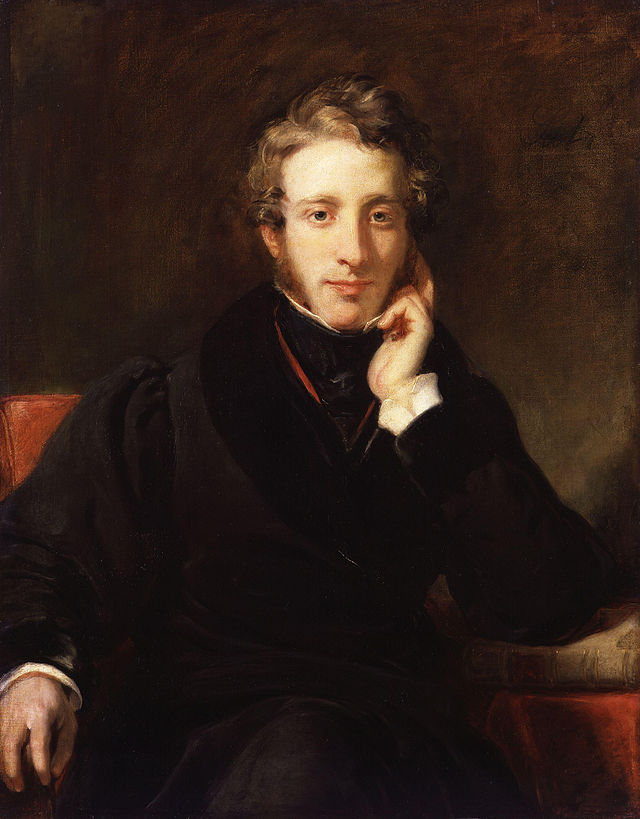 It’s time for a fun break. I look forward to the annual announcement of winners and dishonorable mentions of the Bulwer-Lytton Fiction Contest. For those who might be unfamiliar with it, here’s the skinny from their website.
Since 1982 the Bulwer Lytton Fiction Contest has challenged participants to write an atrocious opening sentence to the worst novel never written. The whimsical literary competition honors Sir Edward George Bulwer-Lytton, whose 1830 novel Paul Clifford begins with “It was a dark and stormy night.”
The contest receives thousands of entries each year, and every summer our Panel of Undistinguished Judges convenes to select winners and dishonorable mentions for such categories as Purpose Prose and Vile Puns.
Last year, PJ Parrish did an in-depth analysis of several entries. But, as I said, I’m posting this as a fun break. For those who want to work, feel free to look at these openings as if they were submitted for First Page Critiques here at TKZ. Do they meet the criteria? Start with action? Identify the protagonist? Establish setting? Make you want to keep reading?
The 2021 Grand Prize goes to Stu Duval of Auckland, New Zealand.
“A lecherous sunrise flaunted itself over a flatulent sea, ripping the obsidian bodice of night asunder with its rapacious fingers of gold, thus exposing her dusky bosom to the dawn’s ogling stare.”
More winners in other categories
Grand Panjandrum’s Special Award
“Victor Frankenstein admired his masterpiece stretched out on the lab slab; it was almost human, OK, no conscience or social awareness, and not too bright, but a little plastic surgery to hide the scars and bolts, maybe a spray tan and a hairdo, and this guy could run for President!” David Hynes, Bromma, Sweden
Adventure
“When I asked our novice Safari guide Guy Pommeroy to identify what that roaring sound was he replied (and these were his last words), “It sounds to me like someone with a bad case of bronchitis; I’ll check and be right back.” Greg Homer, San Vito, Costa Rica
Crime & Detective
“The Big Joe Palooka murder wasn’t just another killing, another homicide, another manslaughter, another slaying, another hit, another whack, another rubbing-out, another bumping-off, another assassination, another liquidation, another extermination, another execution—but it was nothing new for Johnny Synonymous, Obsessive-Compulsive Crime Fighter.” Paul Scheeler, Buffalo, NY
Dark & Stormy
“It was a dark and stormy . . . morning, Gotcha! — this is just the first of innumerable twists and turns that you, dear Reader, will struggle to keep abreast of as I unfold my tale of adventure as second plumber aboard the hapless SS Hotdog during that fateful summer of 1974.” Louise Taylor, Paris, France
Historical Fiction
“Choking back his frustration at his parents, Marcus Licinius Junius Dextus Sextus Gnaeus Castor Ligantor Germanicus barked his name *again* at the boatman holding the list, certain that the man was toying with him, whilst in the background Mount Vesuvius rumbled like a pregnant woman with severe morning sickness.” Dave Hurt, Harrogate, England
Romance
“Their eyes had met and they’d had coffee, but now Miss latte-mocha-with-a-chai-twist bid a wistful adieu to Mr. black-cup-of-Joe-strong-enough-to-walk-over-and-beat-up-the-cheese-Danish, and they parted.” CP Marsh, Urbana, IL
Science Fiction
“Believe it or not Ripley refrained from firing her laser at the alien creature lurking in the starship’s ceiling above the crew’s happy hour gathering, its dripping secretions burning through the titanium floor like it was made of cheap wet toilet paper, when she discovered by sheer accident that just one drop of the oozing substance reacted with the contents of her cocktail glass to produce a martini so perfect that 007 himself would have betrayed Queen and country for just one sip, as long as it was shaken and not stirred.” Reinhold Friebertshauser, Chagrin Falls, OH
Western
“After commandeering the Black Dog Saloon for a day and a half to lay out every map, zoning ordinance, and land deed in the Territory, and after checking and rechecking their cartographic calculations, Tumbleweed Mulligan and Johnny “Trigger” McAllister were forced to admit that there might just be room in this town for the both of them.” Ben Connor, Wilmington, Delaware
Vile Puns
“One time at the hoagie shop the actress Ms. O’Hara asked what the tiny pimiento-stuffed thing in my cheddar-bread sandwich was and I had to respond: “Wee olive in a yellow sub, Maureen.” Fr. Jerry Kopacek, Elma, IA
Purple Prose
“She had a deep, throaty laugh, like the sound a dog makes right before it throws up.” Janie Doohan, Walla Walla, WA
See the complete list, including the “Dishonorable Mentions.”
What say you, TKZers. Want to tackle critiquing any of these?
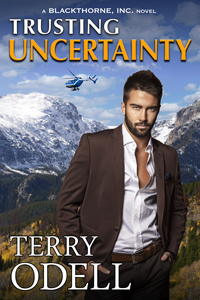 Available Now Trusting Uncertainty, Book 10 in the Blackthorne, Inc. series.
You can’t go back and fix the past. Moving on means moving forward.
Terry Odell is an award-winning author of Mystery and Romantic Suspense, although she prefers to think of them all as “Mysteries with Relationships.” Follow her on Facebook and Twitter.
We are pleased to have a guest blog today by one of our regular participants, KAY DIBIANCA. Please check the bottom of this post for Kay’s background and links. Thanks, Kay, for agreeing to present this article.
BOBBY FISCHER AND THE HERO’S JOURNEY
KAY DIBIANCA, AUGUST 2021
Recently I re-watched the movie Searching for Bobby Fischer. Although the story is based on the early life of a young American chess prodigy named Josh Waitzkin, the undercurrent is all about Bobby Fischer.
Fischer’s life was worthy of a Greek tragedy. Raised by a single mother, he received a chess set as a gift when he was six years old and the journey began. Fischer was amazing. Talented and obsessed with the game, he became the youngest ever U.S. Junior Chess Champion at thirteen and the youngest ever U.S. Chess Champion at fourteen. At age fifteen, he became the world’s youngest person to ever achieve the rank of international grandmaster.
One example of his extraordinary skill was a game he played in 1956, in which he scored a remarkable victory over a leading American chess master, Donald Byrne, in what came to be known as The Game of the Century. Writing in Chess Review magazine, Hans Kmoch called it, “… a stunning masterpiece of combination play … “ Fischer was thirteen years old.
But like many great protagonists, Fischer had a personality of extremes. With an IQ measured at around 180, he had all the mental acuity of a genius – and all the charm of a horned toad. The world simply did not conform to Bobby Fischer’s standards, and he insisted on pointing it out. He railed against the Russians who had dominated the chess world for decades, accusing them of rigging the competitions by playing each other to easy draws so that they could reserve precious energy to play people from other countries. (He was right.) But his fury extended far beyond the chess board. He was rabidly antisemitic even though he was himself Jewish (through his mother), and he left a long trail of broken relationships and burned-out bridges behind him.
However, despite his many flaws, Fischer was so talented and hard-working that most people in the American chess world longed to see him compete for the world championship. As he was reaching his prime in the late 1960’s, it seemed the 1972 world championship would be perfect timing.
But the road to the 1972 World Chess Championship for an American started at the 1969 U.S. Championship. The top three finishers there would move on to the interzonal competitions, and the winner of those contests would compete for the title. However, because of disagreements with the organizing body, Fischer sat out the 1969 U.S. Championship making him ineligible for the later tournaments.
Then a miracle occurred.
In a culture not known for the humility of its participants, one of the U.S. Championship finalists, Pal Benko, stepped aside to give his hard-won spot to Bobby Fischer because he knew Fischer was the American with the best chance to beat the Russian superstar Boris Spassky.
Like Achilles returning to the field of battle, Fischer took Benko’s place and raged through the qualifying rounds, destroying all opponents. The extent of his winning streak was unprecedented, and he earned a higher rating than any player in history up to that time. More importantly, he won the right to meet Spassky in Iceland for the World Championship. The stage was set. It would be a classic cold war battle between the lone American and the Russian machine. Cue the drum roll.
But with the world eagerly awaiting The Match of the Century, Fischer balked. He wasn’t happy with the conditions in Iceland and he threatened to stay away, prompting Secretary of State Henry Kissinger to call and appeal to his sense of patriotism. Finally, after additional histrionics that rattled the chess establishment, Bobby Fischer sat down at the chessboard in Reykjavik and won the tournament by an impressive 12 ½ to 8 ½ score. He returned to the United States a conquering hero and was given a ticker tape parade in Manhattan. He was invited on television nighttime talk shows and feted by celebrities and politicians. Bobby Fischer had arrived.
But a flawed character cannot frolic in the rarified atmosphere of celebrity for long, and Bobby Fischer didn’t disappoint. He disappeared. Having lived so much of his life on sixty-four squares, he seemed unwilling or unable to move to a larger stage. Always reclusive and erratic, his behavior deteriorated and he refused to defend his title in 1975.
He did come out of hiding in 1992 and announced he would play an unofficial rematch against Spassky. But that match was to take place in Yugoslavia, a country on which the United States had imposed sanctions, and Fischer was advised by the U.S. that he would be breaking the law if he proceeded. Unsurprisingly, Fischer ignored the warnings, played the match, and won. Then the U.S. government, which had so lovingly welcomed him home twenty years before, issued a warrant for his arrest.
He never returned to America, but continued living abroad and dispensing his characteristic diatribes. In 2004 he was detained in a Japanese airport for using an illegal passport and jailed for several months. Iceland’s parliament stepped in and offered Fischer citizenship. He moved there in 2005 and died of kidney failure in Reykjavik in 2008.
If Bobby Fischer had been a polite, genteel man, he would still have been remembered as arguably the greatest chess player who ever lived. But would he have captured the imagination of the entire world if he hadn’t carried so much baggage? Would people have invested part of themselves in him if he had just quietly made his mark? I think not.
We are attracted to heroes who are complicated. They may thrill, shock, or disappoint, but they never bore us. They connect with life in a profound and mysterious way, and we’re like voyeurs, watching as they crest the ridge or wrestle the dragon. We applaud their triumphs, weep at their failures, mourn their loss, and in the end, we acknowledge and value the impact they have had on us.
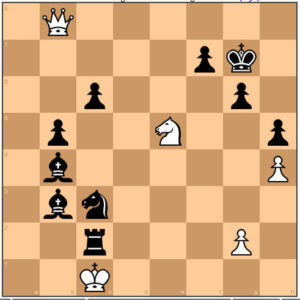
“What is chess, do you think? Those who play for fun or not at all dismiss it as a game. The ones who devote their lives to it for the most part insist that it’s a science. It’s neither. Bobby Fischer got underneath it like no one before and found at its center, art.” Ben Kingsley in the role of Bruce Pandolfini in “Searching for Bobby Fischer.”
So TKZers. What flaws does your protagonist have? Will he/she conquer them, succumb to them, or just manage to get through and live to fight another day?
***
I am deeply grateful to Steve Hooley for inviting me to guest post, and to all the TKZ community for the information and inspiration I have found on this site over the years.
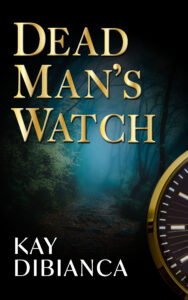
Kay DiBianca is a former software developer and IT manager who loves to create literary puzzles in the mystery genre for thoughtful readers to solve. Her debut novel, The Watch on the Fencepost, won a 2019 Illumination Award for General Fiction and a 2019 Eric Hoffer Award for Mystery. Her second novel, Dead Man’s Watch, was released in 2020.
An avid runner, Kay can often be found at a nearby track, on the treadmill, or at a large park near her home. Kay and her husband, Frank, live, run, and write in Memphis, Tennessee.
You can connect with Kay through her website at https://kaydibianca.com.
Conflict is at the heart of almost every great novel. Whether it’s external or internal, conflict provides a key driving force for the narrative and is often instrumental in giving a mystery or thriller it’s page-turning momentum. I raise the issue of conflict today because of some feedback a fellow author recently received on her draft manuscript citing the failure of the manuscript to take advantage of conflict opportunities and when those did arise, resolving that conflict too quickly. Here at TKZ we often talk about the need for dramatic tension when reviewing first pages, and Jim also blogged yesterday about the ‘certain something’ that each individual writer brings to the keyboard. To this I’d like to add that each of us as writers treat conflict very differently and yet we must all make sure we fully realized the potential for conflict in our novels, and resolve all those points of conflict to a reader’s satisfaction.
The way we accomplish this often reflects our individual talents, but conflict never arises in a vacuum and we must ensure that we have also created characters and situations which ensure our readers are invested in the conflict as well as its resolution. I was acutely reminded of this as I watched the movie Beckett on Netflix last night. Not only was the conflict scattered and confused but the lack of character development meant that I was never invested in the resolution of the conflict or the solution to the so called mystery surrounding why the protagonist was being pursued. I won’t say any more about the movie to avoid spoilers, but watching it made me think more about the nature of conflict in effective story-telling. Here are some of my main take aways (from both the movie and from the feedback given to my writer friend):
Anyway, these are just some Monday thoughts on looking at conflict in your novel. TKZers, how do you approach the issue of conflict in your writing? What tips would you add in terms of maximizing the potential opportunity for conflict as well as pacing its resolution in your work…As always, I look forward to hearing your take/thoughts on this!
by James Scott Bell
@jamesscottbell
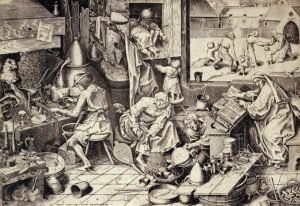
The Alchemist at Work, Pieter Bruegel, 1558
Alchemy was the medieval “science” of transmuting base metals into gold and silver, though its origins can be traced back to the Alexandrian Greeks of the early Christian era. The practice was based on the idea that all substances are composed of one primitive matter—the prima materia. By removing imperfect qualities from a base metal and adding other ingredients, the alchemists hoped to transform the material from rough to precious.
Legend has it that the source of this “knowledge” goes back to the Egyptian god Thoth, whom the ancient Greeks associated with Hermes. That’s why medieval alchemists called their work the “hermetic art.” They would put the “seal of Hermes” on their vessels, which is where we get our phrase “hermetically sealed.”
Of course it never worked, but that didn’t stop fraudulent alchemists from making a pretty ducat from unsuspecting patrons. One ruse involved a forged spike made of half gold and half iron. The alchemist would paint the gold half so it appeared to be iron. Then, in front of his patrons, he would dip the gold half in his brew (paint remover) and take it out, revealing gold! If the patron insisted on having the spike tested by a refiner, it would indeed be proven that there was actual iron and actual gold. How long the alchemist could get away with this before skipping town is a matter of conjecture.
But get this: alchemy lives on! For writers! (Though in a different form.) Let me explain by way of an email I recently received (quoted with permission):
I’m one of your fans. Purchased many of your books. Reading “How to write short stories and use them to further your writing career.” Thank you for writing this.
So, I read and agree that every short story worth reading and worth writing has a “shattering moment.” I know that you can place it in the beginning, middle or the end. I understand that it is a life changing event that happens to the character/s.
What I do not know is how to find out what that event is. I have stories that are more anecdotes because I can not find that shattering moment. Or I have a shattering moment, but do not know how to build a story around it.
Do you have any suggestions on how I can learn more in order to deal with the above problems in my writing?
What this email alludes to is the difference between craft and what I’m calling alchemy. Craft is the nuts and bolts of what works to make fiction better. These are tools and techniques that can be learned and applied. It’s what we spend most of our time here at TKZ talking about.
But then there is the “certain something” that each individual writer brings to the keyboard. Some might call this talent, which cannot be taught. True enough, but what I suggest is that we consider talent our base metal. By removing impurities and adding ingredients, we can actually transform it into fiction gold.
The main impurity is your “inner editor.” That is the judgmental voice that assesses every creative move the moment you try to make it. It loves to reject things. It tells you what not to write. It makes snap decisions at the surface level.
The problem is that there is gold underneath the surface. You’ll never find it if you give the IE sway as you write. (The IE is only welcome in the editing phase.)
The way you turn off that voice is by writing through it. One exercise is the page-long sentence. You write 250 words without stopping and without using a period. If even for a second you start to feel nervous or fearful or embarrassed by what you’re writing, you write the next word and keep going. You only assess things after you’ve written, not before.
Doing this exercise frequently will weaken the inner editor until finally it shuts the heck up whenever you’re creating. (I might cleverly add that IE silence is golden.)
Now, what can we add? The short answer is: you. Your talent, your knowledge, your memories, your feelings…but not at the surface level. We must dig deeper, coaxing the hidden material to the surface.
The way I like to do it is to make brainstorming lists. As is true for most of us, the first thing that usually comes to mind is something familiar, even clichéd. That truck driver you need for the scene, is he wearing jeans, boots and a baseball cap? Go deeper! Make a list of other modes of dress. And a list of ethnicities. And does he even have to be a he? Aha, a whole new direction for brainstorming!
My rule of thumb is a minimum of five items on a list. Why? Because it’s when you get down to 4 and 5 that surprising, original material is sent up from the boys in the basement. Going on to 6 and 7 is a further adventure.
And remember, your inner editor has no business in your brainstorming.
So, to bring this back to the specific question from my emailer about short story writing: If you can’t identify a shattering moment from an anecdote, try this: write a page-long sentence in the voice of a character. Listen to her describe her emotions about the anecdote. Let her tell you how it is shattering. If she doesn’t know, ask her what she’s trying to hide. Keep after her! She’ll eventually confess.
Try the same thing with another character. Even another. You’ll eventually find the right narrator and thus the right story.
If you have a shattering moment but don’t know how to build a story around it, start making lists.
(Remember, make your lists at least five items long.)
We often hear about the “art and craft” of something. That’s what this post has been about. Craft is necessary to shape a story into the best form. Art is the alchemy, the thing that cannot be taught. But it can be coaxed!
So start coaxing.
Over to you. How do you describe the talent part of our craft? How do you like to coax your creativity?
Photo credit: Joshua Hoehnee – Unsplash
By Debbie Burke
Okay, who’s ready for some word play? Not just any word play but a serious world-class competition: the Word Play Masters Invitational.
Here are the rules:
Drumroll for some past winning entries:
~~~
There’s a variation of the contest—take a common word and redefine it. The following entries are past winners:
Want more? Here’s a collection of winners from the past decade.
~~~
Now that you’ve flexed your vocabulary muscles, are you itching to enter the competition yourself? Here’s the 2021 submissions page.

Photo credit: Emmanuel Ikwuegbu – Unsplash
But wait a sec…TKZ has many talented Wordmasters and Wordmistresses. Why not host our own contest?
[Drumroll] The Inaugural Kill Zone Word Play Invitational Tournament
Rules:
Post your entry in the comment section. Limit of three entries/person.
The games will be freestyle, meaning you can either:
Take any word from the dictionary; alter it by adding, subtracting, or changing one letter; supply a new definition.
OR:
Take a common word and redefine it.
Judging:
The winners will be determined by the number of “likes” (to vote, click on the thumbs up icon in the comment box). The entry with the most “likes” wins.
Prizes:
A special trophy was commissioned to commemorate the winning entry.
Presenting THE ZONER

Photo credit: Johnny Briggs – Unsplash
You were expecting cash? A Caribbean cruise? A new laptop?
Uh…sorry. Maybe next year.
Thanks for playing!

By Elaine Viets
Today’s Brave Author gave us an intriguing story with a touch of the supernatural. Take a look, and then I’ll make my comments:
A Delima worth Millions
The man that just walked in the bakery to buy a lotto ticket is destined to win… but die the same day. If he plays. He stood in line. Waiting his turn. Like everyone else, he wished to wake up tomorrow as the mega lotto prize winner of 25 million. On an empty table to his left, a newspaper had a headline that caught his attention: LOTTO WINNER FOUND DEAD with the victim photograph and name-Pascual Montenegro. “That’s me,” he said. The hair on his body bristled as he walked slowly to the table and grabbed the paper. It was him. Short black hair, shaved, blue eyes. “What the hell is this?” he whispered.
A slight chill quivered his chest. The published date was two days from today. He scrutinized every word. According to the article, the police found him dead without a clear cause the same day he won. No further details revealed.

“Do you mind giving me back my paper,” said a voice. Pascual lowered the newspaper. There sat an old man he never seen before, dressed in a black suit with a fedora hat. “Do you mind?” the old man asked again. Pascual slammed it against the table. “Why is my picture here?” He looked at him.
The old man remained unrattled and sneered back with his dark eyes on a stone face. “Can’t you read? That is Sunday’s headline. You play, you win millions, you somehow die and its newsworthy,” he said. Pascual shook his head and pointed his finger at the old man’s face. “I don’t know who think you are. I do not appreciate this joke, scam or whatever bullshit lie you trying to pull with here” he said.
The old man sneered again. Then he leaned forward, the chair squeaked “buy the ticket and you will find out,” he hissed. Pascual shrugged his shoulders and grabbed and crumbled the paper. “Go to hell old man” he said and dropped it in front of him. He returned to the line. The old man smiled as he unwrinkled the paper with thump sounds like a judge gavel. Louder than the cracking sound of eggs being fried in the kitchen. “Go ahead, buy the ticket, you can’t stop what’s coming” he said. Pascual grabbed his cross necklace and kissed the image of Christ, a habit since childhood whenever he shivered in distress.

ELAINE’S CRITIQUE: I saw real possibility in this first page – and an author that needs help with some awkward phrasing and spelling. My changes are in bold. The problems start with the misspelled title:
A Dilemma Worth Millions
The man that just walked in the bakery to buy a lotto ticket is destined to win… but die the same day.
ELAINE: That opening grabbed me, but Brave Author, please use it to tell us where we are. For example: The man that just walked in the San Antonio bakery to buy a lotto ticket is destined to win… but die the same day. If he plays.
BRAVE AUTHOR: He stood in line. Waiting his turn. Like everyone else, he wished to wake up tomorrow as the mega lotto prize winner of 25 million.
ELAINE: Twenty-five million what? Dollars? Pesos? Euros?
BRAVE AUTHOR: On an empty table to his left, a newspaper had a headline that caught his attention: LOTTO WINNER FOUND DEAD. He stared at the victim’s photograph and name – Pascual Montenegro. “That’s me,” he said. The hair on his body bristled as he walked slowly to the table and grabbed the paper.
There was no mistake. It was him. Same short black hair, shaved, blue eyes.
ELAINE: That “shaved” is puzzling. Do you mean “clean-shaven”?
BRAVE AUTHOR: “What the hell is this?” he whispered.
A slight chill quivered in his chest.
ELAINE: “A slight chill”? This is a man who just read that he was dead. He’ll need more reaction than that.
BRAVE AUTHOR: The published date was two days from today. He scrutinized every word. According to the article, the police found him dead without a clear cause the same day he won. No further details were revealed.
“Do you mind giving me back my paper?” said a voice. Pascual lowered the newspaper. There sat an old man he’d never seen before, dressed in a black suit and a fedora hat. He had dark eyes set in a stone face. (This phrase is moved up from below.)
ELAINE: You don’t need that “hat.” We know what a fedora is.
BRAVE AUTHOR: “Do you mind?” the old man asked again.
Pascual slammed the paper against the table. “Why is my picture here?” he demanded. He looked at him.
ELAINE: Cut the line in italics. It adds nothing.
BRAVE AUTHOR: The old man remained unrattled and sneered back: “Can’t you read? That is Sunday’s headline. You play, you win millions, you somehow die and it’s newsworthy.” he said.
ELAINE: Yikes! The dreaded “it’s” contraction was without an apostrophe. This mistake alone will send an editor screaming into the night. Also, you don’t need that “he said.”
BRAVE AUTHOR: Pascual shook his head and pointed his finger at the old man’s face. “I don’t know who you think you are. I do not appreciate this joke, scam or whatever bullshit lie you’re trying to pull with here,” he said.
ELAINE: We don’t need the word “lie” or “with” and the punctuation is wrong for “he said.”
BRAVE AUTHOR: The old man sneered again. Then he leaned forward, and the chair squeaked. “Buy the ticket and you will find out,” he hissed.
Pascual shrugged his shoulders, and grabbed the paper and crumpled it. “Go to hell, old man,” he said and dropped it in front of him. He returned to the ticket line.
ELAINE: Again, there are some punctuation errors and the italicized “and” can be cut.
BRAVE AUTHOR: The old man smiled as he smoothed the wrinkled paper, the sound louder than the crack of a judge’s gavel.
ELAINE: “With thump sounds like a judge gavel” is an interesting image, but it doesn’t quite work. And it should read “with a thump that sounds like a judge’s gavel.” The same goes for “louder than the cracking sound of eggs being fried in the kitchen.” And do you mean “cracking” or “crackling”?
BRAVE AUTHOR: “Go ahead, buy the ticket, you can’t stop what’s coming,” the old man said.
Pascual grabbed his crucifix necklace and kissed the image of Christ, a habit since childhood whenever he was shivered in distress.
ELAINE: Cut “shivered.
ELAINE’S CONCLUSION: I was impressed with this first page. I want to know what happens to Pascual: does he win his fortune and cheat death? Will his faith help save him? And who is this mysterious old man – the Grim Reaper in a fedora? The devil? Or a nameless charlatan?
However, this first page presents a real writing dilemma: numerous misspellings and grammatical mistakes, starting with the title. No editors worth their red pencil will read this novel, and that’s a crying shame.
A writer has to know grammar and spelling. These are the tools of our trade. If we don’t, we’re like builders who can’t use a nail gun or a circular saw.
So what can our Brave Author do?
Take an adult education course in grammar and spelling.
Have someone who understands grammar and spelling read your manuscript.
Hire an editor to correct your grammar and spelling before you send out your manuscript.
I teach English as a second language, and judging by some of these errors, I suspect our Brave Author is not a native speaker. But I believe our Brave Author is a natural storyteller. Keep writing.

This Saturday, August 14, 10 AM to noon, I’m teaching “Dead Write: Forensics for Writers” a Zoom workshop at the Florida Authors Academy.
I passed the Medicolegal Death Investigators Course for forensic professionals at St. Louis University’s School of Medicine. I’ll discuss the proper methods and pitfalls of body identification, and other tips that will give your mysteries authenticity. Handouts are included. Contact Murder on the Beach Bookstore. Registration is required. It’s $25. Call 561-279-7790 or email murdermb@gate.net.
By John Gilstrap (But not really)
A couple of weeks ago, I posted in this space my observations about writing for translation to audio books. Well, wouldn’t you know it? Basil Sands, the voice of Jonathan Grave, my literary alter ego, paid attention and agreed to pen a guest post about an audio guy’s view of audio books.
Basil has been a frequent poster here on TKZ since the beginning, and he’s a crack author in his own right.
As you read this, I will be supervising a team of movers who will be packaging pretty much everything we own for six months’ of storage before we move to the dream house in West Virginia. My inevitable silence will have everything to do with the lack of an internet connection.
And now, ladies and gentlemen, from the great state of Alaska, I bring you Basil Sands:
===
Seanchaidhe – n. – literally “a bearer of old lore”. A Seanchaidhe is a traditional Irish storyteller/historian.
I like to imagine that somewhere in my past there is an Irish ancestor who made his living travelling from village to village telling stories to both teach and entertain. Having been a voracious reader since I was five years old, and according to my parents was a storyteller even longer, having come to the world right off screaming a tale on my first breath after being ripped from the warmth of my mother’s womb.
Okay, maybe I wasn’t acting at quite that young, but not much later I am told.
I have always loved telling stories. My stories. Other people’s stories. The stories the Leprechauns tell me around the fire at night. Factual, fictual, historical or fantastical. I love hearing stories and I love telling stories. And so I believe do you dear reader of this blog.
After John Gilstrap’s article of a couple weeks ago on the topic of writing for audiobooks he invited me to come and talk a bit more on the topic from a different aspect of the gem of storytelling. That of the narrator/producer.
I have been an avid follower of TKZ since not long after its founding. My Leprechauns and I have happily been leaving our marks in the comments below when we can. From a hidden cabin fortress built into the side of a mountain in Anchorage Alaska I have been writing thrillers and recording audiobooks since 2006. John’s books were among the first of my professional step into the world of “books on tape” and I have not looked back.
From what I have seen, creating audiobooks seems to appear relatively simple to a great deal of the population, including a surprisingly large number of writers. This is particularly true when an author balks at the cost of having a pro create one. For a ten-hour novel without tons of research heavy material this can range from $6000+ upon delivery for a ‘per finished hour’ (PFH) contract to zero out of pocket up front with a fifty/fifty split in a ‘royalty share’ (RS) contract. The latter of which can potentially entail the author sharing even more significant dinero if the books sell well. Of course, that share can also be zilch if it doesn’t, the narrator is taking 100% of the actual risk on a RS deal aka 50 hours of labor for no return.
“How hard can it be?” I’ve heard from more than one author, “You just sit in closet and read the book into the microphone. I think I will just save the money and do it myself.”
Following is an excerpt from an actual email an author sent to me when they realized just how much their book was making on a royalty share contract (it was a lot) and thought maybe they didn’t want to share 50% of that kinda money for the whole series, but they also still didn’t want to pay the standard rates for a narrator producer.
“I decided to record book 2 on my own. I’ve always had an ear for voices (or is it a tongue?) and figured I read well enough–It’s turns out I hate it. It’s very much like real work. It will be my last, guaranteed.”
And much like work it is! Very, very much!
Here is a breakdown of the process it takes to make an audiobook:
That is the very basic process right there. Those steps, in some form or another, all must be done for every single audiobook to brought into existence.
How long does it take to make an audiobook?
A general idea of finished length of any audiobook is typically going to be in the range of one finished hour for every 9500 words. Therefore a 60k word book will be about five hours long at the end. A 100k word book comes in at a bit more than ten hours. But those lengths are only the finished product. The time it takes to create that product is variable based upon several factors, some controllable others not. Depending on the experience level of the narrator it takes between two to five hours on mic to create one finished hour of audiobook. And that is just the narrator’s part!
Here are a few of the things that can affect the time it takes to record an audiobook:
Writing your novel with an audiobook version in mind
Several years ago I narrated a dozen or so titles for Sci-Fi author Piers Anthony, his whole backlist of books published before he became famous with his wildly popular Xanth series in the 80s. In his Cluster series, about a Tarzan-like interplanetary hero who takes on the form of whatever species he is sent to help, Anthony has a number of characters with names spelled like #>@<}, and ]**(#), and ^…–~ and so on. I contacted him directly and asked how those were to be pronounced.
He replied, “When I wrote those in the sixties and seventies audiobooks were not a thing. I never even imagined those being pronounced out loud. Feel free to just make something up, I trust you.”
These days audiobooks are a huge industry, and it is expected to continue to rise in popularity for the foreseeable future. Whether or not you as a writer enjoy, or can even withstand, listening to audiobooks you can bet that 30%-40% of your audience does. Many folks, myself included seldom are able to read for pleasure due to busy schedules, but have plenty of time to listen to audiobooks while doing physical tasks or familiar chores that occupy hands and eyes, but not so much the brain. For the last decade or so I only read for pay, and then seldom get to choose the materials but get assigned. I do however ingest several hours of audiobooks most days while working my big boy job.
So for writing your books with the idea of having an audiobook recorded here are a handful of suggestions that will make it not only easier for a narrator to get it right, but will ultimately bless your print readers as well.
Finally, here are a couple of things related to self/small pubbed authors specifically, where the author has more control over the process.
And lastly here is a bit for those intrepid adventurers among you who think you want to narrate your own books for sale.
A Test: The Narrator’s Crucible
If you think you may want to narrate your own books, following in the footsteps of such greats as Neil Gaiman, Carrie Fisher or Oprah Winfrey before you spend your hard earned dollars on a fancy microphone, pre-amp, computer upgrades and software try this test.
There is a lot more detail trying to pour out of my fingertips than I could ever put into a single blog post, but this provides a 15,000 foot view, with a handful treetop skimming dives as a bonus.
If you are interested in learning more about the process, either as an author who wants your piece of the audio market or as a someone interested in becoming a narrator or producer here are some very helpful links that can get you in swimming toward the deep end fairly quickly.
Audiobook creation Exchange (https://www.acx.com/) – Audible’s division for self/small publishers, like KDP for audiobooks. ACX is a marketplace where authors, literary agents, publishers, and other Rights Holders can connect with narrators, engineers, recording studios, and other Producers capable of producing a finished audiobook. The result: More audiobooks will be made.
Narrator’s Roadmap (https://www.narratorsroadmap.com/) – the amazing Karen Commins’ extremely informative website – If you’re new to this career, every resource on this page — articles, books, connections, and videos — answers the question “How can I become an audiobook narrator?” You’ll find invaluable advice from industry pros that you will want to read and absorb. Success leaves tracks!
Audiobook Publishers Association – https://www.audiopub.org/ – APA is a not-for-profit trade association that advocates the common, collective business interests of audio publishers. The APA consists of audio publishing companies and suppliers, distributors, and retailers of spoken word products and allied fields related to the production, distribution, and sale of audiobooks.
Being me and the way I am it seems I have probably already used more than the number of words I should put here, therefore let’s move this thing to the chat below for conversifying and questionizing!
*Weird noises – Do not fart while recording, they might miss it in editing, but the listeners certainly will not. Trust me on this.
**Sexology – that may not be the mathematically correct word for a series of six but is fairly accurate to the storylines
***Pickups – small corrections re-recorded and pasted in, hopefully matching the surrounding original sound. May be done in a bar but only if you’re desperate.
BONUS! BONUS! BONUS! BONUS! BONUS! BONUS! BONUS! BONUS!
If you made it this far in my ramblings you deserve a treat.
I have US & UK Audible coupon codes for several of the books that I have both written and narrated.
THE NEW TESTAMENT, DARBY TRANSLATION
Drop me an email with your title preference and whether you are a US or UK resident and I will send you a code for a free download.
All I ask in return is an honest review on Audible.
Check out more about my narration and voice work at www.sandmanstudiosak.com
 You just landed a starring role in the remake of one of your favorite movies.