A New Trick for an Old Dog

A New Trick for an Old Dog
Guest Post from Joe Hartlaub

As you read this, I was supposed to be somewhere in Antarctica. However, the best laid plans … (Details at the end of this post, if you’re interested.) I’m delighted that Joe Hartlaub had agreed to cover one of my scheduled posts, and I’m not going to cdeprive you of his words of wisdom simply because I’m in town. I hope the arm I twisted to get him to appear has healed by now. To regulars here at TKZ, he needs no introduction. Joe, the stage is yours.
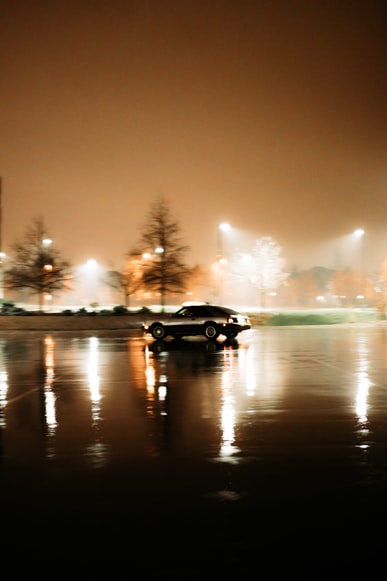
Photo by Jakob Rosen, Unsplash

Good day. I am, thanks to Terry Odell, momentarily back on the side of the TKZ equation that I inhabited for quite some time. Terry graciously asked me to perform the nigh-impossible task of filling in for her while she traverses the Antarctic. I hope you’ll join me in wishing Terry a safe journey and return.

I am writing this during the early days of 2022. My practice when I transition from the end of one year to the beginning of another is to take stock of myself by deciding what the best thing was that I did during the preceding year. It is a subjective call, of course. Sometimes it takes me a while to suss it out, and not always because there are a plethora of choices. 2021 was different.

I have for several years told S., my granddaughter, that if she ever found herself in a bad situation and could not reach her father she should call me 24/7/365. I promised her that I would either do a “one riot, one Ranger” act or send the cavalry if I could not come myself. She called me in 2021, a few minutes after midnight on Sunday, September 12. She had gone to Cincinnati with the family of one of her girlfriends. I won’t go into great detail other than to say that what was supposed to have been a fun weekend at a Dead & Company concert and a night at a downtown hotel went FUBAR. S. instead found herself sitting in a van on a concert facility parking lot after midnight in a city she had never previously been to, about two hours away from home. Her dad was working and couldn’t be reached. She accordingly called me.

I was backing out of my driveway a few minutes after receiving her call. I hadn’t gone to bed after having been up since 5 AM the previous morning taking happy birthday calls and answering good wishes. A quiet internal voice of self-doubt asked me if, having just turned age 70, I was up to the task.    It had been quite a long time — years, decades actually — since I had been pulled an all-nighter for any reason. Another internal voice —this one much louder — quickly reminded me of some wisdom imparted by Brother John Gilstrap in this space several years ago: when failure is not an option, success is guaranteed. The voice of self-doubt slipped away, though it still muttered in the background for a few miles.

A number of scenarios of the “if this, then that/Plan B” sort kept skipping across my imagination as I drove south on I-71. Staying awake and attentive was accordingly not a problem. Keeping to the speed limit was, but I forced myself to utilize cruise control. Traffic on the interstate was almost non-existent and there was little to distract me otherwise.

I arrived at a parking lot at the outskirts of the Queen City — just a few miles from the house where my father was raised in Covington, Kentucky  — two hours and an eternity later.  S., looking all of fourteen going on twenty-seven, was standing under a light looking a bit stunned but okay. I got out of my car and we looked at each other for a moment. I don’t think that anyone in my entire life had ever been happier to see me. I embraced her as she sobbed and said, “You came.” “Of course,”  I said. “I promised I would.” The individual responsible for the situation was standing nearby, wisely out of arms-length. He looked surprised as well. I think he was under the impression that I wasn’t coming.  I learned then that I had finally reached the age where wisdom had taken hold, a new trick for an old dog. Twenty or even ten years ago I might have administered some swift and rough justice. The present me simply glared at him as I held the car door for my granddaughter. A couple of minutes later I started to retrace the trip I had just made, leaving the instigator standing in the lot like the lost soul that he was and is.
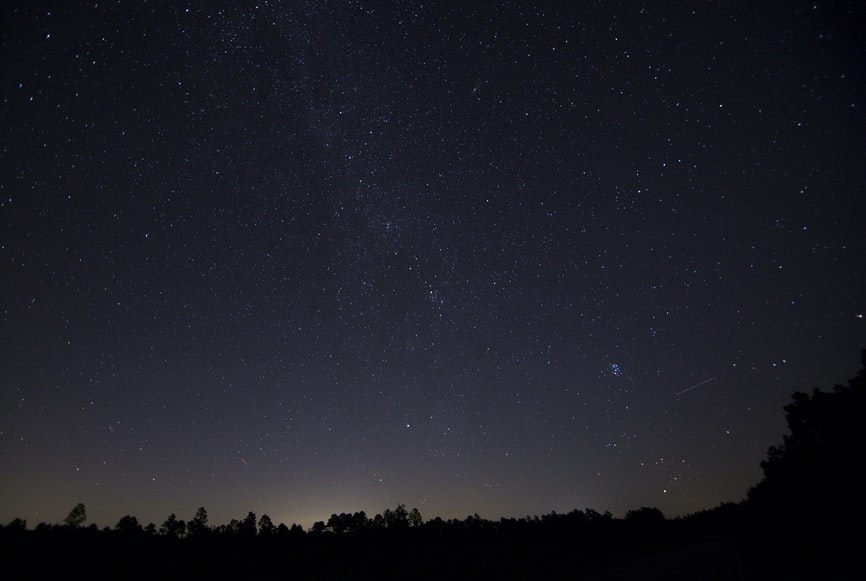
Photo by Adam Mescher, Unsplash

Ohio is almost entirely rural for eighty miles or so between Kings Island Amusement Park north of Cincinnati and the lights of the warehouses and auto malls in suburban south Columbus. We were blessed with a dark but clear night. A sprinkling of stars lit the way through what looked like an endless tunnel. S., a city kid, had never seen a sky tableau that black. I alternated between pointing out some constellations and listening as she told me everything that had happened and what had led to her calling me. It was frightening for her, but the worst of it was some emotional damage inflicted by an adult she had trusted. Her account of the night was soundtracked by Alice in Chains, The Police, Nirvana, and a bit of Slipknot as we repeatedly passed and were passed by a three-car convoy, the drivers eyeing us suspiciously each time we went by each other in the very early morning as the pitch-colored sky ahead became lighter by minute degrees.

I asked S. as we approached the lights of Columbus if she were hungry. “Yes,” she said, “but I can wait until we get home.”
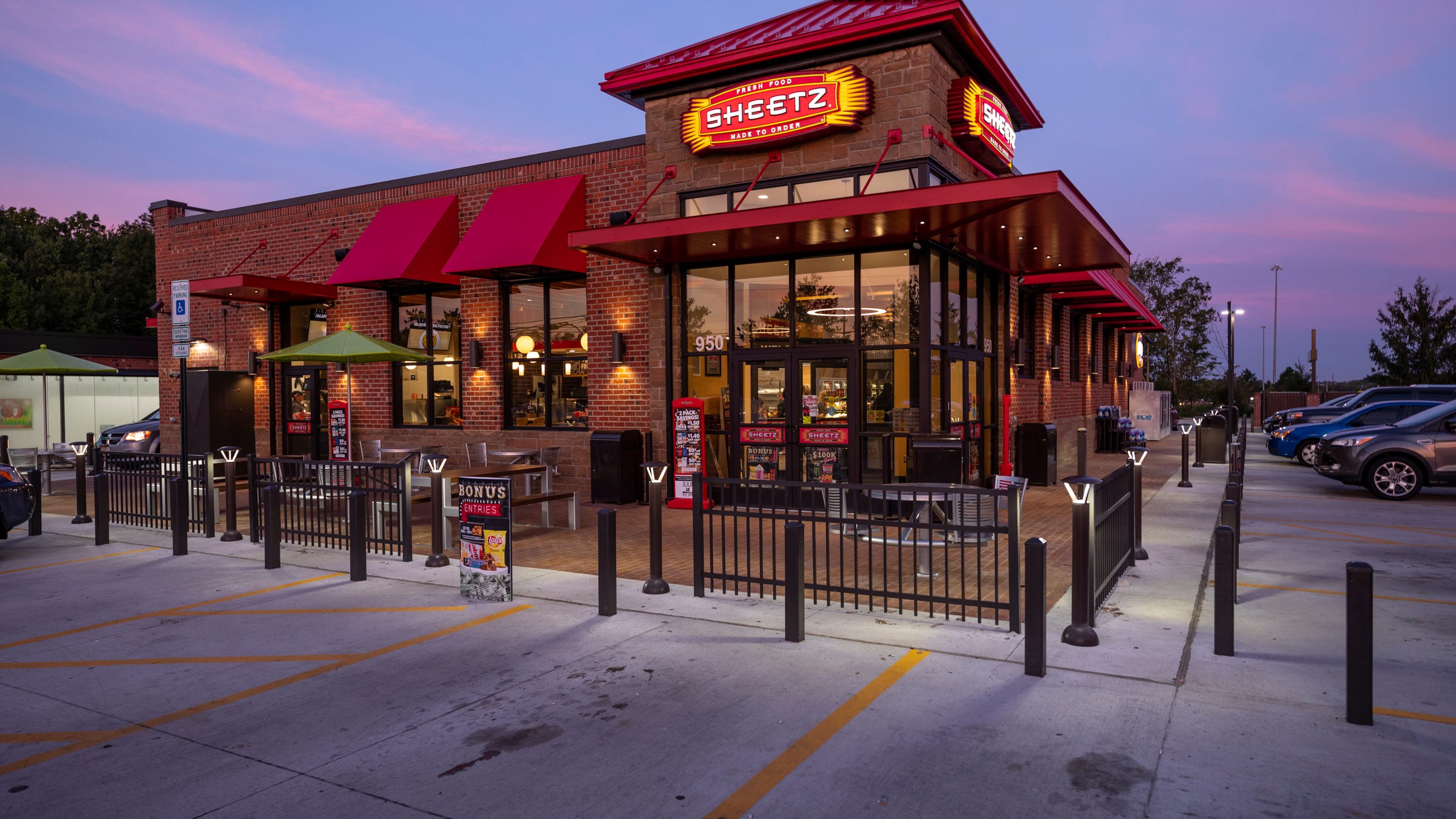
I let a beat go by. “Sheetz (a chain of fast-food restaurants disguised as gas stations) is open.”

“It IS?!” she said. Her excitement was a good sign. We drove to the one closest to my home and spent a half-hour inside before exiting with a large bag full of goodies, none of which will ever be found on a list approved by WW. Sheetz, let it be known, makes everything better. By the time we got home around 6 AM, everything was either good or getting there.

So. I had the opportunity to keep a promise and kept it while stopping a bad situation from possibly coming much worse, perhaps irrevocably so. I was able to exercise good judgment and made a nodding acquaintance with its cousin restraint. S.  learned several lessons, chief among them being that there are people in her life (in addition to her father) who will keep their promises to her, just as she needs to be dependable and keep her own promises to herself and others. She also received a couple of instructions in astronomy. I learned for my part that a promise kept to a loved one is not an obligation, a duty, or a requirement. It’s a privilege. An act of love may not make up for a legion of sins committed over the course of a lifetime but the multitude it covers will make a dent.

Lessons here? Sure. Show up every day, every minute. When you make a promise to write and you don’t do it you are letting yourself down, not to mention whoever would have benefited in however many ways by reading your efforts. You’re never too old to start until it’s too late. It’s not too late today.

Thank you for reading this far and not turning away when you realized that Terry would be absent. In the meanwhile…what is the best thing that you did in 2021 that you care to share?

Why is Terry in Colorado, not Antarctica? Read it here.

Joe Hartlaub is a contributor emeritus to The Kill Zone. He is an attorney, author, actor, consultant, and raconteur with over forty years of experience in causing and solving problems. Joe lives in Westerville, Ohio, where he rattles with purpose around his house.
 

Ten Tips from a Chiropractor for Writers

By Debbie Burke

@burke_writer

Disclaimer: nothing is this article should be construed as medical advice.

Writing can harm the body. Okay, it’s not as bad as logging, or bull riding, or bomb dismantling. But sitting all day hunched over a computer is not a healthy lifestyle.

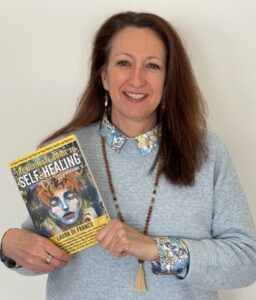
Recently I had an enlightening conversation with a chiropractor, Dr. Erika Putnam, shown here consulting with her office manager, Hartty.



Dr. Erika has unique insight into the particular physical problems that beset our profession because she herself is a writer. In addition to her chiropractic practice and operating a yoga studio, she contributed to the Ultimate Guide to Self-Healing Volumes 1-5. She is also working on her memoir and a how-to manual for yoga instructors.

So…I asked her for tips specifically to help writers.

Her overall approach is to develop a “long-term vision of our health and career path.” She says, “Value your wellbeing and work toward preserving that. Think prevention rather than fixing damage.” She believes for optimal health, humans need fresh air, sunshine, the earth…and time away from staring at electronic devices. 

People who spend long hours sitting at a computer tend to develop tight chests, tight hip flexors, and are weak in the core and the butt.

What can we do about that?

Here are Dr. Erika’s 10 tips:

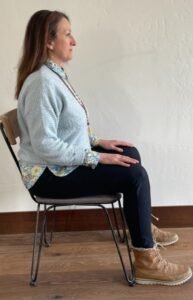
  1. Undo what you do. If you use muscles in the front of the body, you need to counteract by using muscles in the back. Below is a good exercise to undo writer’s slump.


2. Strive for anatomical neutral: This means good posture with shoulders back, head up, chest up, arms at your sides with hands extended. For yoga aficionados, this is similar to mountain pose.

3. Neck care: a head-forward posture is hard on the neck. The farther forward your head is, the more strain on your neck. Sit straight with your head in line with your shoulders and pull your head and chin back. Try the old balance-a-book-on-your-head trick.

4. More Neck Care: At least once an hour, turn your head from side to side, looking over your shoulders.

5. Breathing: When shoulders curl forward, breathing becomes shallow. Take deeper breaths to improve posture. Stretch arms over your head to move/open the ribs to allow deeper breathing. Repeat several times/hour.

6. Neutral spine: When seated, rock your pelvis to find the correct neutral spine posture.

7. Sitting posture: If you sit on the back of the “sit bones,” pressure on the pelvis over time wears out disks in the spine.

Instead, sit up on sit bones. A pillow behind your back may help.


8. Hand care: Typing uses finger flexion which tends to curl hands into claws. To counteract, open your hands, stretch fingers, and press palms together.

9. Get up and move around at least once an hour. Take a walk. Do stretches. Dr. Erika suggests: “Go outside and play with dirt.”

10. I’ll take credit for this tip which came about after my visit with Dr. Erika.

After spending an hour with her, I became much more aware of my posture, standing straighter, shoulders back, chest up, head up. When I got into my car to leave, I noticed the rearview mirror was tilted too low. It had seemed fine while driving to her office. But, after an hour of consciously improving my posture, I realized I now sat a couple of inches taller in the seat. I needed to adjust the mirror upward.

I decided to leave the mirror in the higher position as a reminder to sit up straight.

The more reminders the better.

 One final note: Dr. Erika says she can’t back up the following observation with scientific studies but she has frequently noticed that people with a right-side head tilt often have a great deal of left-brain activity.

Here’s a discussion of right brain/left brain from Medical News Today.

JUST FOR FUN — Here’s a totally unscientific experiment to try:

If you’re having problems with plot organization, see what happens if you tilt your head to the right. Does that activate your left (analytical) brain?

If your story needs more feeling, trying tilting your head to the left. Does that activate your intuition and emotion?

Does head tilting make any difference in your thinking process? Please share your results in the comments.

~~~

TKZers: What helps keep your writer’s body in good condition? Do you have favorite exercises?

A Creative Idea

Creativity – noun – the state or quality of being creative; the ability to transcend traditional ideas, rules, patterns, relationships, or the like, and to create meaningful new ideas, forms, methods, interpretations, etc.

***

As writers, we’re all creative people, or strive to be. The creative process is part of who we are. So, if I could give you one simple thing to enhance your creativity and improve your writing, as well as making you healthier in the long run, would you be interested? I thought so.

Recent studies reveal some surprising findings about the relationship between exercise and creativity.  We’ve all heard of the benefits of aerobic exercise to strengthen our bodies and reduce stress, but there’s more.

According to a 2016 online article in Quartz by neuroscientist Dr. Wendy Suzuki, exercise encourages the growth of cells in the hippocampus area of the brain. This is advantageous no matter how old we are since the hippocampus is one of only two brain areas where new brain cells continue to be generated throughout our lives. And research has shown the hippocampus is important in enhancing long term memory and even possibly – listen to this, writers – creativity. Dr. Suzuki writes that “… this discovery suggests that exercise might be able to improve the imaginative functions of the hippocampus …”

Further evidence appeared in an article in Frontiers in Human Neuroscience in 2013: “Anecdotal literature suggests that creative people sometimes use bodily movement to help overcome mental blocks and to get deeper into a problem.” They even quote the philosopher Henry David Thoreau: “The moment my legs begin to move my thoughts begin to flow – as if I had given vent to the stream at the lower end and consequently new fountains flowed into it at the upper.”

As recently as February 2021, The New York Times published an article about exercise with the subtitle “To spur innovation and ideas, try taking a walk.”

Runner’s World magazine expanded the list of benefits in its August 2018 issue with an article that states, “Studies have shown that running can help prevent obesity, type 2 diabetes, heart disease, high blood pressure, stroke, some cancers, and a host of other unpleasant conditions. What’s more, scientists have shown that running also vastly improves the quality of your emotional and mental life. It even helps you live longer.” More time to write!

Of course, there are many ways to exercise: brisk walking, swimming, biking, jogging, zumba classes, and more. The benefits of aerobic exercise are so enormous, we can’t afford to ignore them. We can live longer, happier, healthier lives and be more creative if we do just one simple thing: exercise to get our brains moving along with our bodies.

Be strong and write long!

TKZers: What exercises do you do to keep in shape? Have you noticed an increase in your creative output after exercising? Have you found a brisk walk or other exercise helps to overcome a mental block in your writing?


“DiBianca’s motif of time, clocks, and watches—evident in her previous novels—is a superb gimmick, and the idea of two teams of smart female detectives working almost in parallel is equally clever.” – Kirkus Reviews

Limited Time Sale – 99¢

Are Rodents Eating Your Fiction?

by James Scott Bell
@jamesscottbell

I hope you’re not munching a donut or toast right at the moment.

You probably saw the story about the closing of 400 Family Dollar Stores due to a rat infestation at one of their distribution centers. After a whistleblower’s report, the FDA went in and found a thousand “dead rats and birds” scattered inside.

Warehouse worker Robert Bradford says he was fired from West Memphis distribution center, Arkansas, after he shared footage last month of rats fighting together on the warehouse floor, scurrying up and down the aisles, and a dead rat that had been caught in a trap.

Kind of makes you want to run right out to a 99¢ store and buy a can of Vienna sausages, doesn’t it? The report also included this little item:

Bradford’s clip also showed an unidentified coworker trying to feed one of the rats a Pringle with his own bare hands.

Hey, the little fellas have to eat, right? And what else should you do with a Pringle anyway?

Family Dollar has since initiated a voluntary recall on certain products from the distribution center, with the comforting words, “We take situations like this very seriously and are committed to providing safe and quality products to our customers.”

Nice to know!

Never one to turn down an apt metaphor, I am now just as concerned about Rodents in the Warehouse operating right next door to the Boys in the Basement.

For review, The Boys in the Basement is Stephen King’s metaphor for the writer’s subconscious mind. Down below the conscious level the imagination always churns and gets ideas. Those ideas are stored in the warehouse part of our brains. There are things we can do to unlock the warehouse—like writing morning pages.

But what about rodents getting into that same warehouse? These are mental pests, and they’re real. If left alone, some of the best and most creative ideas and books will never make it to our mind, let alone the marketplace.

One big fat rat is fear. Fear that your ideas aren’t good enough. Or marketable enough. Or might offend someone. Or might make you seem like a drunken fool. Fear is always lurking around the writer’s mind, and needs to be dispatched forthwith.

One way to do that is by writing a half-page précis of your ideas. Not a synopsis, just your summary of why you think the idea might fly, who might like it, and—most important—why you are jazzed about it.

If you find, after doing this exercise, you’re not that excited after all, you can move on. At least it won’t be out of fear.

But do get a couple of people to give you feedback on it. Are they as interested as you are? If not, again, you can get along to the next idea.

Which leads us to another corpulent rodent—disorganization. If you leave your ideas lying around randomly, you’ll never give them the focused attention they deserve.

The answer is to clean up and organize your warehouse. Don’t leave any idea untended. When you find it, put it on a shelf. I suggest a master document just for ideas. I have one with opening lines, quick concepts (usually starting with What if?), possible characters, possible settings. I go over this from time to time and find the ones that still strike me and develop them further. These go into another file called “Front Burner Concepts.” That’s where I go when I’m ready to choose a new project to write.

Finally, a whole pack of rats like to strike when you experience burnout. If our brain gets tired from overwork, we don’t have anybody watching the warehouse. Lots of good stuff gets gobbled up.

I wrote about this in my book The Mental Game of Writing. Here’s a clip:

The thing to do about burnout is head it off at the pass. And the best way I know is to observe a Writing Sabbath. Just like when God knocked off for the week.

It can be on any day you choose. As I mention in the Discipline chapter, I choose Sunday.

On that day I do not do any writing or even thinking about writing (at least I try not to think about it. It’s the day when the Boys in the Basement get to work out in earnest).

It’s a good day to catch up on my reading.

And my relationship with my wife! We’ll take a trip to the beach, or go up in the hills and look at the view. We’ll watch a movie together, have a nice dinner….

If it’s football season, I’ll watch a game or two.

I try to get out in the sunshine.

What all this means is that the pressure is off.

Though sometimes my mind and my fingers want to write something. It’s sort of like the thoroughbred that is primed to run every day, but one day is just hanging out with a blanket and some hay. The legs tremble. The nose sniffs the air.

At times like that I keep my legs calm and my nose in a book.

What about during your writing week?

Two things if you can manage them: get exercise and get very quiet.

The benefits of even short bursts of exercise are well known. Walk around as much as you can, if that’s the least you can do.

Follow the Pomodoro Method. Write for twenty-five minutes, then take a five-minute break. Do some walking or deep breathing (with your eyes closed).

Also, I’m a big believer in the power nap. That’s a twenty-minute or so stretch of nodding off sometime during the work day. We all have a “zombie time.” For me it’s around 1 or 2 o’clock. My mind turns to jelly.

So I trained myself to get to sleep quickly and wake up twenty minutes later. You can do this, too. It will take you about two months to instill the habit, if you so desire.

In sum, your Boys keep at their work. Your job is to keep the Warehouse clean. Then what you bring to market will not have to be recalled.

Bon appétit!

Do you find any other pests sniffing around up there in your brain? Do you have methods to organize your madness?

An Easy (Easier) Way to Build a Series Bible

Indexing our Fiction

The “One and Done Technique”

The “Hansel and Gretel Magic Breadcrumbs Technique”

by Steve Hooley


Today we are discussing indexing our fiction. That is something that is not often done, so you are probably asking why would anyone want to do that.

Recently, Sue and JSB posted on the importance of a having a series bible if you are writing a series. If you’re like me, you agreed that we need to have one, but you groaned at the thought of all the work involved in creating one.

So, today, we’re going to look at a technique that should make the process of building a series bible quicker and easier.

We will call it the “One and Done Technique.” Or you can call it the “Hansel and Gretel Magic Breadcrumbs Technique.”

And now, you’re probably wondering why there is a picture of a target at the top of the post. The answer: I’m going to lay out a plan that you will think is either hair-brain crazy or worth improving and considering. So, you can shoot it full of holes and sink it (thus the target), or you can help improve the idea into something that works for you.

Why Indexing?

In nonfiction the index links the reader back to the desired subject by the use of page numbers in a physical book or by hyperlinks in an eBook. For our series bible “indexing” we’re going to use an outline of our series bible as the index, and use a code (our “magic breadcrumb”) to link (find) a word, line, or paragraph in our manuscripts via the Find search tool.

It would be nice to hyperlink the two locations (outline and text info), but I don’t think that could be done between two separate Word documents. And, in some cases, we want the code to link to more than one text location. So, in today’s discussion we will use the Find tool.

Hansel and Gretel used breadcrumbs, hoping it would help them find their way back out of the forest. Of course, that didn’t turn out too well. Our magic breadcrumbs are going to contain a code (and a bird repellant) to get us back out of our series bible outline, and to a specific item or fact in the text of our manuscript.

The Process

  1. We will set up our series bible with an outline of all the subjects/facts we want it to contain. And this is where reviewing Sue’s and JSB’s posts will be very helpful.
  2. Each item in the outline will be given an alpha-numeric code that will be case specific.
  3. Next, we print out a copy of the outline and codes.
  4. And then we read through our searchable copy of our manuscript ONCE. With printed outline in hand, we look for any place in our manuscript where there is a fact we want in our series bible. We refer to our outline, and insert the proper code (magic breadcrumb) in front of the fact or data. If we find something we want in our series bible (but is not in the outline or has not been given a code), we add it to the outline and give it a code at that time. Remember, the idea is to go through the manuscript only once.

Once and Done

When we’ve made it through our searchable manuscript once, the hard work is done. We didn’t have to search through our manuscript multiple times for multiple facts. We read it and tagged it once. We wipe our hands together and smile.

Now we have two choices: We can use the codes to pull the answers for a separate document (our series bible), or we can consider our outline and codes to be our series bible and be done. Guess which choice I plan to make.

How do you search for the code in your manuscript?

You use your Find tool. And be certain to check the boxes for “complete word” and “case sensitive,” so that you will get only the code you are looking for. And, note that you may have linked multiple locations in your searchable manuscript to that code.

In Word: The Find tool is on the far right of the top ribbon or tool bar. Click the down arrow, then “advanced find.” At the bottom of the box that opens, click “More.” Then check the boxes “match case” and “find whole words only.” You are then ready to insert your code into the box at the top and find your data in your manuscript.

In Pages (Mac): Under Edit, click Find. Click the down arrow beside the “settings” symbol (which is to the left of the find box). Then check “Whole Words” and “Match Case.” Then fill in your code in the find box, and you’re on your way. By the way, Pages can open Word documents, if you do your editing on Word on a PC, and you write on a Mac laptop (where you want your series bible to be handy.)

In Scrivener: If you’re using Scrivener on a Mac, the process is much the same. You find “Find” under the Edit tab. Click on the “Find…” in the drop-down menu. Underneath the Find and Replace boxes, unclick “ignore case.” Click on the menu choices in the box above “ignore case.” Click on “Whole word.” And you’re ready to search.

If you’re using Scrivener on a PC, ask someone familiar with both. I have an old version of Scrivener on an old laptop with Windows 7. I’m afraid my advice wouldn’t be up to date.

Below is the beginning of an outline and codes (for an example)

CH – characters

     a – main character

     b – secondary characters

     c – allies

     d – antagonists

     e – shape shifters

     f – misc. characters

     g – pets and animals

          1 – name

          2 – description

          3 – age

          4 – birthday/anniversary

          5 – special power/role

          6 – favorite food, etc.

          7 – character arc

So, in the above, the code for a shape shifters’ description would be CHe2.

You can choose to make your outline as detailed or general as you wish. You can choose to join all your manuscripts together into one manuscript, or keep them separate. Make sure to not create a code that is specific for one book if you are searching manuscripts separately as separate documents (so the same code will work for any of your books). If you join all books into one document, you will need to consider whether you want a code to be specific for one book in the series or for all books.

Here’s where those of you who’ve created a series bible can help the rest of us. How did you organize your series bible? Or, did you create an outline of your series bible, and how is that organized?

Conclusion

This process seems so simple, I would not be surprised to learn that someone has already described this approach. I searched the internet and could not find it.

When I searched “Indexing Fiction,” I found Stephen Ullstrom’s blog site and an article he had written on Indexing Fiction: Thoughts and Suggestions.

Ullstrom is an expert on indexing. In his article, he states that indexing fiction is rarely done, but not a new concept. He suggests three areas where it might be useful: creating a joke index in a humous book, creating an index for historical novels that are being studied with a focus on customs, beliefs, objects, and other historical details, and finally, in an extensive series (such as sci fi or fantasy) where it is difficult for the reader to keep track of all the characters, world building, fictional cultures, and geography.

Ullstrom did not mention use of an index system for building a series bible. I contacted him and asked for any thoughts he had on the subject, and invited him to join us today to help direct the discussion. He has commitments today, but may stop by. If you’re reading this, Stephen, welcome to The Kill Zone, a great place to hang out when you add fiction to your writing projects.

For those of you planning a nonfiction project, Ullstrom offers a free 7-day email course on how to index.

Okay, time for discussion:

  1. Do you think this idea is worth pursuing? Or should it sink?
  2. What modifications can you think of to make it better?
  3. Would a “streamlined” approach like this make you more inclined to create that series bible you have been avoiding?

True Crime Thursday – Obituary Piracy

By Debbie Burke

@burke_writer

Photo credit: JR Harris – Unsplash.com

Ole and Lena had been happily married for many years. When Ole died, Lena wrote a long, glowing obituary about him. She took it to the local newspaper office for publication.

The editor said, “Lena, this is a beautiful tribute to Ole. That’ll be $975.

Lena said, “What????”

The editor answered, “We charge by the word for obituaries.”

Flummoxed, Lena thought for a moment. Then she wrote a new version:

Ole died. Boat for Sale.

~~~

Being a writer, I’m often tasked by family and friends to compose obituaries for loved ones. Apparently, I’m pretty good at it, judging from newspaper clippings that, years later, are still attached with magnets to family refrigerators.

But…recently I learned from a funeral director that obituaries aren’t what they used to be.

In previous centuries, they served as notice to a person’s local community that they had passed, listing accomplishments, naming family members, and inviting people to a funeral with a reception to follow.

Sometimes scofflaws show up at such receptions for free food. Sleazy, right? But no big deal.

Worst case, burglars read obituaries to find out funeral times and, while the family was at services, broke into the deceased’s home. Really stinkin’ but fairly rare.

Obituaries have long been an important tool for genealogists because of the wealth of family history in them.

According to the funeral director, the internet revolutionized obituaries. Information is no longer limited to the local community but is instantly accessible to billions of people around the globe.

Some of those people are criminals who found a new avenue for fraud:

Obituary piracy.

Consider the abundant facts in a typical obituary.

Full name (including maiden name);

Dates of birth and death;

Place of birth; place of death;

Full names of parents (including mother’s maiden name), siblings, children, grandchildren, predeceased family members, even pets;

Military service;

Employment history;

Medical information such as cause of death;

Miscellaneous personal tidbits like hobbies, travels, special talents, etc.

In other words, a treasure trove of information that provides unscrupulous data miners ways to profit from tragedy.

When a bank wants to verify the account holder’s identity, what do they ask for?

Yup, your mother’s maiden name.

What are common passwords to online accounts? Often, it’s names of children, grandchildren, and pets.

When you open an account or apply for a loan, what is required? You guessed it—facts that can be found in obits.

Data miners are skilled at extrapolating info gleaned from obituaries. That can lead to identity theft, intrusions into credit accounts and medical records, and child identity theft. 

A death triggers cascades of documentation that must be provided to government and private agencies including county, state, federal, Social Security, Medicare, IRS, property ownership records, banks, investments, pensions, etc., etc., etc.

Death certificates are generally recorded by each state’s department of vital statistics. Family Search offers how-to info by state: https://www.familysearch.org/wiki/en/How_to_Find_United_States_Death_Records

The National Death Index (NDI) is maintained by the Centers for Disease Control and is the database of all deaths in the US.

Because of identity fraud, death certificates that used to be public records now often have limited accessibility (for example, surviving family members).

Obituaries, on the other hand, contain similar information and are widely available to anyone with internet access. 

How many of us receive spoofed calls supposedly from the IRS or FBI or “your bank” or “your credit card company”? Spoofing is when criminals manipulate phone numbers to make calls appear to be coming from a legitimate agency or business.

Spoofed calls threaten dire consequences if we don’t immediately wire money or send gift cards to pay an alleged debt or avoid arrest. Hurry up because officers are on their way to your home this very minute.

Grieving widows and widowers are prime targets for greedy criminals. Bereaved families are vulnerable to such scams because they know death taxes are due and there are often debts to pay.

There are even more ways for scammers to profit from obituaries. Other variations on piracy include lifting obituaries from a legitimate funeral home site and pasting the content on a bogus website. The phony site often ranks higher than the legitimate site due to manipulation of search engine optimization. So, when people Google the deceased, they can easily stumble on a phony site at the top of page one.

Once there, readers are solicited to buy a virtual flower or candle to memorialize a friend or family member. At a buck a flower, thousands of obituaries add up to significant profits. You can even donate hundreds of dollars to plant an entire grove of imaginary trees.

What a meaningful tribute to a loved one.

(Note: legitimate funeral sites offer similar tribute options for additional profit. I’ll leave my opinion about that unsaid.)

Another alternative: the phony site may request donations to help with the family’s expenses. Of course, the family never receives donations because the scammer absconds with the money.

There is no real privacy in the 21st century. Hacking and data breaches are daily occurrences.  You may ask, since so much intimate personal information is readily available on the net, why worry about obituaries?

The answer is the same reason we still lock our doors. Yes, determined robbers can break into our homes.

But we don’t need to make it easier for them, particularly during stressful times of mourning.

Does that mean obituaries shouldn’t be written to honor the deceased?

No.

The funeral director I spoke with suggested limiting the people who receive an obituary by using email and social media groups where access is restricted to family and friends.

He strongly advises that sensitive, personal information be limited to the bare minimum.

Ole died. Boat for Sale.

~~~

TKZers: have you heard of obituary piracy? Do you know bereaved people who have been victimized by scammers?

Today I’ll be away from internet access so my responses to comments will be late.

~~~


If you visit Debbie Burke’s website, you can’t buy a flower or virtual candle. But you can find purchase links to her thrillers that include tons of personal information about her characters. 

Saddling A Rocket

By John Gilstrap

“So, John, what’s new in your life since we last chatted?”

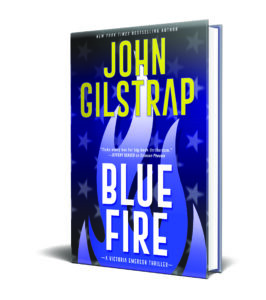
Well, let’s see. Blue Fire launched yesterday. It’s the second book in my Victoria Emerson series, and at the risk of sounding immodest, it’s really friggin’ good.

Two days after my last KZB post, we moved two moving vans worth of worldly goods from the storage bay where its been held for the past 7 months into our brand new shiny home in the woods. A week ago, we moved the worldly goods from the apartment where we’ve been squatting, into the new house as well.

And I started a new company for my writing.

Meet Kimber. She’s a Caviston–Cavalier King Charles Spaniel + Boston Terrier. A 3-pound bundle of love.

And we got a new puppy.

As you read this, we may or may not have an internet connection robust enough to support all the Zoom events attendant to the book launch, so I may be Zooming from an empty apartment.

Nowhere in here should you see even the hint of a complaint. None of these life change units are anything but terrific. In fact, they represent dreams coming true. I’m just a little surprised that they all came true in the same 10-day period. It’s a little like saddling a rocket. It’s an unforgettable experience, but you’d best hold on tight.

A Bit About Writing . . .

I’ve been doing quite a few interviews ahead of the release of Blue FireIn many of these cases, the interviews take the form of written questions to which I write my responses. Some questions are more engaging than others, and one in particular got my attention. It was quite a long interview, and at the end, after I’d talked about my career in general and Blue Fire in particular, I read this:

“Are you proud of your accomplishment? Was it worth the effort?”

Well, of course I am, and of course it was. But the structure of the question bothered me. The interviewer put effort and accomplishment on a collision course, as if outcome is the only measure of hard work. Here’s how I responded:

I’ll answer your question in the opposite order. Was it worth the effort?

TEACHABLE MOMENT ALERT:

The effort itself is the only thing to be proud of. My books have been successful and have made me a lot of money, but that’s never been why I write. I write to entertain, whether it was my mom when I was little, or the fans who read my work now.

I’m proud of the fact that I have stared down the blinking cursor on an empty Page One over two dozen times, and I’ve stayed with each of those stories even when the plot wasn’t working and the words wouldn’t come. Folks, it never gets easier.

I’m proud that time after time, for decades, I scribbled out stories that never had a chance of publication, and never will. Without that effort—without those “wasted” hours (which were anything but wasted)—none of my work would ever have been published.

This is a frustrating endeavor. Rejection is baked deeply into the cake, and success–defined however you wish–is capricious, driven largely by factors over which individual authors have little control.

What we do have control over is our commitment to the craft. If we write solely for the purpose of getting published and making money, we’re doomed because we’re aiming at the wrong target. We write because we love writing–most of the time. We write because we want to make a point or we want to entertain. Maybe we want to entertain by making a point.

The effort is all there is. We should all be proud of it.

The Opening Chapter Reveals a Secret Vow

A novel’s opening chapter makes a promise, a secret vow that says, “This is what you can expect from me.”

The chapters that follow better fulfill that promise, or the author will suffer the consequences with low-ratings, bad reviews, or their name on the Don’t Not Read list.

Yes, the promise is that important. It’s how we build and maintain an audience. It’s how we climb the proverbial ladder of success. It’s how we keep readers hungering for more. This solemn vow can NEVER be broken.

So far this month I’ve read three novels (all 5 stars). I average about one novel per week, along with nonfiction (craft books or true crime). None of my recent reads landed within my preferred genres of psychological thrillers, dark & gritty mysteries, and serial killer thrillers, but I feel it’s important for writers to venture outside their genres from time to time.

For my next read, I wavered between WIN by Harlen Coben or Book 2 of a serial killer thriller series from one of my auto-buy authors. I devoured Book 1 in a couple days, and I’d been dyin’ to read Book 2 for a while now, so I bought the $9.99 ebook. Immediately, the author transported me to a serial killer’s lair with the protagonist bound and helpless. I was enthralled. As I said, I’d been looking forward to this novel for a while and the opener didn’t disappoint.

Without sharing the title, I’ll show you how the writer sucked me into the scene.

Darkness.

It swirled around him deep and thick, eating the light and leaving nothing behind but an inky void. A fog choked his thoughts—the words tried to come together, tried to form a cohesive sentence, to find meaning, but the moment they seemed close, they were swallowed up and gone, replaced by a growing sense of dread, a feeling of heaviness—his body sinking into the murky depths of a long-forgotten body of water.

Moist scent.

Mildew.

Damp.

[Protagonist] wanted to open his eyes.

Had to open his eyes.

They fought him though, held tight.

His head ached, throbbed.

A pulsing pain behind his right ear—at his temple too.

“Try not to move, [Protagonist’s name]. Wouldn’t want you to get sick.”

The voice was distant, muffled, familiar.

[Protagonist] was lying down.

Cold steel beneath the tips of his fingers.

He remembered the shot then. A needle at the base of his neck, a quick stab, cold liquid rushing under his skin into the muscle, then—

Gripping, tense, love the story rhythm, the way he pauses at just the right moment. I could not flip the pages fast enough. Lovin’ every second of it!

And then…

In the next chapter, I find out it was all a dream. Infuriated, I almost whipped my Kindle across the room. One of my auto-buy authors wrote this thriller, and I expected him to fulfill the promise he made to me. Instead, he cheated. I was so disappointed, I refused to keep reading. He’d broken my trust. He let me down.

Sounds harsh, doesn’t it? But that’s exactly how I felt.

The emptiness he inflicted left me hungering for a visceral, gritty, serial killer thriller, one that would fulfill its promise.

I downloaded thriller number two.

Without revealing the title or author, here’s a small sampling of that opener.

            I woke up from a gentle shake. My sister’s face hovered a few inches above mine, her eyes glistening wet. A grinding sound came from her jaw as it moved back and forth.

I shivered.

[Sister] put her fingers against my lips. “SSSH. Nod if you understand,” she whispered.

I nodded.

My room was freezing from the cold wind blowing in through my open window.

“The monsters are coming for us. Be very quiet. We’re escaping,” she whispered.

I nodded again, biting my lip hard to not cry.

Was there a monster in my closet? Behind my closed bedroom door?

My heart thrashed against my ribs like a bird trying to escape its cage. Why were the monsters after us?

We learn the protagonist is a child and her older sister is rescuing her from an imminent threat. Other than a few writing tics, like SSSH instead of Shh…, the author did a terrific job of showing the action. Finally, I could sink into a gripping read. Or so I thought.

The next chapter (Ch. 1) consisted of pages and pages of backstory. No plot, only backstory. The premise still intrigued me, so I kept reading. Then I hit a flashback that dragged on for several pages. The worst part? It added nothing to the main storyline.

Still, because the prologue was so good, I read on. The prologue had raised many, many story questions, and I wanted answers. But in Chapter 2, I read more pages and pages of backstory and another flashback. The next chapter was equally disappointing, with more pages of backstory and a third (fourth?) flashback. I lost count.

Whiplashed from being thrown forward, then backward, I couldn’t take it anymore and closed the book. A good premise will only take you so far. At some point, you need to deliver on the promise you made to the reader.

The third novel I bought—all in same day, I might add—began with a slow burn opener. A girl is emptying a bucket of oil into the dumpster behind Burger King. It doesn’t sound like much on the surface, but the co-authors held my interest. Which, after being burned twice in a matter of hours, wasn’t an easy task.

Here’s the opening of DEAD END GIRL by L.T. Vargus & Tim McBain:

            Corduroy pants swished between Teresa’s thighs as she crossed the parking lot. She had a headache. That drive-thru headset gave her a headache every damn time. The band squeezed her skull like an old man trying to find a ripe cantaloupe in the produce department. Pressing and pressing until her temples throbbed. When the headaches were really bad, she got the aura. And it was gonna be a bad one tonight. She could already tell.

By the time she got home, she’d be nauseous from the skull throb along with the stink of fryer grease clinging to her clothes and hair and skin. Sometimes she swore she could feel it permeating her pores.

She placed a hand under the lid of the dumpster and lifted. The overhead lights in the parking lot glinted on the surface below. It looked like water, but it wasn’t. It was oil. Every night they emptied the fryers, dumping the used oil into this dumpster. It was a disgusting task. Worse than taking out the trash on a 90-degree summer day, when the flies got real thick, and the meat went rancid almost as soon as they put it in the bin.

It was dead out. No traffic. No noise at all but her fiddling with the dumpster and the bucket.

Her skin crawled a little whenever she was out here this late. In the dark. In the quiet. A feeling settled into the flesh on her back and shoulders, a cold feeling, a feeling like after watching one of those scary movies when she was a teenager. It might have been a thrill while she was watching, but later on that night she’d always get spooked. She’d tremble in bed, too terrified to walk down the hall to pee. The house never seemed so ominously still as it did on those nights. Anyhow, she couldn’t stand to watch horror movies anymore. Her weak stomach couldn’t handle the gore.

Bending over the metal cart she’d wheeled along with her, Teresa scooped one of the buckets of used fryer oil and balanced it on the edge of the dumpster. She tipped the bucket and watched as the gallons of brown grease oozed into the dumpster, disrupting the smoothness.

Settled at the bottom of the bucket, there were clumps and chunks. Burned bits of fries and chicken tender crumbs. They splatted and splashed into the pool of liquid that looked black in the night.

That’s when Teresa saw it. Something rising out of the oil, disturbing the otherwise unblemished surface.

Intriguing, right? Most importantly, the authors kept their promise. Elated, I could not flip pages fast enough, savoring favorite passages, the story rhythm and pace pitch-perfect. And now, I have a new favorite series. 🙂

Come morning, I felt bad about dissin’ my auto-buy author. Maybe he had a reason to break the don’t-open-with-a-dream rule. Could the last line of the first paragraph indicate a dream?

…his body sinking into the murky depths of a long-forgotten body of water.

In hindsight, maybe. Probably. But it’s too subtle. Nonetheless, I grabbed my Kindle and kept reading. Sure enough, he used the dream sequence to show the affect it had on the protagonist, who’s been suffering nightmares after a serial killer slipped through his grasp. The dream relates to the plot because that serial killer is back.

Do I agree with the dream opening? No, but I’ll keep reading because I know this author delivers each and every time and his writing speaks to me. But what if I wasn’t a fan? What if I’d chosen the book at random? He would’ve lost me. See what I’m sayin’? It’s a risky move.

We spend a lot of time perfecting our opening pages, polishing them till they shine, but our job doesn’t end there. We must follow through in subsequent chapters by setting up scenes, paying them off, setting up more, paying off more.

Other than that crucial promise, your solemn vow to the reader, a few other takeaways are…

  • Don’t start with a dream sequence unless the reader knows it’s a dream AND you’ve got a damn good reason to do it.
  • Go easy with backstory. Sprinkled it in over time.
  • Avoid flashbacks unless they’re absolutely necessary. Most times they’re not.
  • Don’t tell the reader what happened in the past. Trust us to figure it out on our own.
  • A great premise only works if you deliver on that promise.
  • If a slow burn opener works for your story, use it. Every novel doesn’t need a lightning-fast opener to draw and hold interest.

If you missed Jim’s post yesterday, read it (and the comment section!) for speed bumps that stop the reader.

How many chapters do you read before giving up on a novel?

Limited Time Sale 99c

His name is Paradox and he poses his victims in RED cocktail dresses, RED roses replace the eyes, and their hands hold a riddle wrapped in RED satin. He will kill again if his cryptic clues aren’t solved within 24 hours.

Can Niko and Sage stop him before the clock runs out? Click here to look Inside SCATHED.

Three Things That Bugged Me in a Book

by James Scott Bell
@jamesscottbell

Terry’s recent post observed, “As writers, we don’t read the same way ‘normal’ people do. We have internal editors who insist on reading along with us and shouting their opinions.” That’s because we are attuned to the craft; we know the rules guidelines that should not be broken ignored lest we “pull” the reader out of the story. 

Often these are little things. I call them speed bumps. The more there are along the story road, the less the reader will enjoy the ride. Much of my teaching is devoted to speed bump removal. The downside is that it’s harder for me to read just for pleasure. I can’t help lingering over the bumps I encounter and imagining ways they could have been eliminated. 

This happened recently when I went back to re-read a novel in a popular series. I was only a few pages in when I got majorly bugged by something:

1. An eating scene that defies the laws of physics (and has no conflict)

In the first chapter the series hero sits down to dine with a client. A waitress comes to the table, takes their order and leaves. The two principals chat a bit. The speedy waitress returns with drinks. More chatting (about 30 seconds worth in read-aloud time) and the world’s fastest waitress, apparently working with the world’s fastest chef, came with our filets.

Another chat session (1 minute, 23 seconds) during which one character takes one bite of filet. Then: The waitress came to clear our dishes. We ordered creme brulee for dessert.

There follows two lines of dialogue. Two! Five seconds in real-world time. Then: The waitress came with the creme brulee

Gadzooks! This waitress must be the only human to break the land speed record at the Bonneville Salt Flats…without a car!

Forty-three seconds more of chatting, then: My creme brulee was gone.

Holy Coneheads! These character must eat like this:

I’m sure many a reader would notice the same thing. Maybe not enough to toss the book aside, but it is so unnecessary and so easily fixed! Just a few lines of narrative summary sprinkled throughout would have sufficed. Something like: We lingered over our filets, talking about her past, her ex-husband, and the train she missed in Paris. By the time we were ready to order dessert, I thought I knew her as well as my own sister.

Plus, all the dialogue was friendly and informational. No conflict or tension. Thus, boring. Again, it would have been so easy to add a little argument, a disagreement, a bad vibe. (See my further notes on eating scenes.)

I read on, and got a feeling that bugged me further:

2. Phoning it in

“To phone it in means to make the least effort possible, to do something without enthusiasm. The expression phone it in is American, and seems to have originally been connected to the theater and acting. During the early 1930s, a popular joke among theater actors alluded to having a role that was so small it was possible to call on the phone, rather than appear on the stage in person.”

When a series gets hugely popular, and both author and publisher know that any new book will automatically hit the top of the bestseller list, it becomes a temptation to phone it in. Put in the minimum effort and still rake in the dough. I once sat next to an author of this profile at a book signing event featuring several writers—known (him) and unknown (me). Since he was so prolific, I asked him about his work habits. He told me he writes a one-page outline and sends it to his publisher so they will send the rest of the advance. He then ignores the outline and takes a couple of weeks to dictate a book aboard his yacht. That’s about as close to phoning it in as you can get. And it is noticeable. The later books show it.

Look, there’s nothing illegal about not putting in the effort to write the best book you can, and still make bank. Heck, that may even be somebody’s version of the American dream. But it bugs me.

And so does this:

3. The superfluous said

I admit the following is only a tiny speed bump, but it’s still a bump that doesn’t need to be there. So why have it at all? This is from the same novel, the third chapter, which is yet another eating scene:

The waitress came to our table with a coffee pot. “Coffee?” she said.

Well, who else would have said it? When you have an action beat before or after the dialogue, you don’t need the attribution.

“Take it away!” she said, waving her arms.

Better: “Take it away!” She waved her arms.

Or: She waved her arms. “Take it away!”

Brock plopped in a chair. “Whattaya want with me?” he asked. 

Better: Brock plopped in a chair. “Whattaya want with me?”

Now, I like said. It’s a workhorse that does its job and gets out of the way. It’s just as much a mistake to never use said (only action beats all the time wear a reader out) as it is to use it needlessly.

So don’t do that, or I’ll get bugged.

There. I feel better now.

What little things bug you when you see them in a book?