First Page Critique: Can You Find the Murder Weapon?

By Sue Coletta

Another brave writer submitted their first page for critique. My comments will follow.

The Invisible 

Bette always joked Marge’s baking would be their demise—but not like this. The Schuster sisters came out to their garden this morning in search of tomatoes for their weekly Girl’s-Club brunch, and though their basket was nearly full, Bette insisted they needed one or two more.

“What about those?” Marge said, pointing to a large cluster.

Bette tsked. “I’m sure we can do better. Do you want the girls eating green tomatoes? What if it was—?” She stopped mid-sentence, glanced down, and wiped her boot on a rock. “Oh, my,” she chuckled, shaking her head. “Well, if that’s the worse that happens today, I’m counting my blessings.” She continued her search. “What time did Paige get in last night?”

“Well, it was past 9:00—when we went to bed. She rents a room; she doesn’t answer to us.”

“I know that, Marge.” She moved down the row. “I just worry she’s not getting enough sleep.”

“She’s a student. They aren’t supposed to sleep.”

“Who’s not supposed to sleep?”

They looked up to see their boarder, backpack over shoulder, mug of coffee in hand, cut across the dewy lawn. “We were just saying,” Marge said, “that you don’t get enough sleep, dear.”

She laughed. “Can’t argue with that. But my paper’s due Monday, and I’m nervous about it. By the way, was that apple pie I smelled, or am I still dreaming?”

“Oh, my pies! I almost forgot.” Marge squeezed Paige’s arm. “If you wait a few minutes, you can have a piece.”

“It’s tempting, but I really need to get to the library.” She waved to the sisters as she hurried to her car. “Save me a slice.”

“We will, honey. Now don’t work too hard. Remember, life is short.” They watched her head to campus, after which Marge rushed off to check on the pies, promising to be right back.

Bette continued down the rows, her persistence eventually paying off. As she removed an almost perfect Brandywine tomato from its vine, a high-pitched scream split the air. She snapped her head around in time to spot a red-tailed hawk, something squirming in its beak, swoop below the treetops. Her heart was still pounding when a calloused hand grabbed her ankle, causing her to drop the basket. She jerked free, only to discover the hand was an out of control cucumber vine.

Though the sisters seem sweet, not much happens on this first page … unless you’re a research junkie like me and have studied this particular murder weapon. Which is genius, by the way. Kudos to you, Brave Writer. For those who didn’t catch it, I’ll explain in a minute.

Let’s look at your first line, which I liked.

Bette always joked Marge’s baking would be their demise—but not like this.

Your first line makes a promise to the reader, a promise that must be kept and alluded to early on. Just the suggestion of green tomatoes is not enough.

Now, let’s look at the first paragraph…

The Schuster sisters came out to their garden this morning in search of tomatoes for their weekly Girl’s-Club brunch, and though their basket was nearly full, Bette insisted they needed one or two more.

I assume Brave Writer discovered that tomatoes contain a few different toxins. One of which is called tomatine. Tomatine can cause gastrointestinal problems, liver and heart damage. Its highest concentration is in the leaves, stems, and unripened fruit. Red tomatoes only produce low doses of tomatine, but the levels aren’t high enough to kill.

Like other nightshade plants, tomatoes also produce atropine in extremely low doses. Though atropine is a nasty poison, tomatoes don’t produce enough of it to cause death. The most impressive toxin from green tomatoes is solanine. Which, as Brave Writer may have discovered, can be used as murder weapon. Solanine can be found in any part of the plant, including the leaves, tubers, and fruit, and acts as the plant’s natural defenses. People have died from solanine poisoning. It’s also found in potatoes and eggplant.

If Marge eats, say, potato pancakes along with green tomatoes during that brunch, it’ll increase the solanine and other glycoalkaloid levels coursing through her system. *evil cackle*

The nice part of solanine poisoning from a writer’s perspective is that it can take 8-10 hours before the victim is symptomatic, which gives Brave Writer plenty of time to let her stumble into more trouble to keep the reader guessing how or why she died.

If I were writing this story, I’d study the fatal solanine cases and put my own spin on it.

Hope I’m right about this. If not, my apologies. In any case, the weekly Girl’s Club (no hyphen and only capped if it’s the official title of the club) brunch seems important and so do the tomatoes. What I’d love to see on this first page is why. You don’t need to tell us, but you do need to hint at the reason to hold our interest.

What if Bette plucks the deadly fruit from the vine and notices how strange it looks? You’ll have to research to nail down the minute details of a toxic green tomato, if any differences are visible to the naked eye.

There’s one other problem with this first paragraph. Here it is again:

The Schuster sisters came out to their garden this morning in search of tomatoes for their weekly Girl’s-Club brunch, and though their basket was nearly full, Bette insisted they needed one or two more.

Who’s narrating this story? It isn’t Bette, as your first line indicates. And it isn’t Marge. An omniscient point-of-view is tricky to pull off. Newer writers should focus on one main character and show/tell the story through their eyes. If that character doesn’t hear, see, feel, taste, experience, smell, etc. something, then it must be excluded.

Yes, some writers (me included) use dueling protagonists, alternating scenes between the two, and even include an antagonist POV. But when we’re still honing our craft, especially when we’re learning the ins-and-outs of POV, it’s easiest to concentrate on one main character throughout the story. For more on mastering point-of-view, see this post or type in “point of view” in the search box. We’ve discussed this area of craft many times on TKZ.

As written, my advice is to keep the first line and either delete the rest and find a different starting point (sorry!) or better yet, saturate it in mystery regarding these tomatoes. That way, the reader will fear for your main character while the fruit lay on a bed of lettuce on a serving platter during the Girl’s Club meeting. If you choose this route, one of your goals is to make the reader squirm. “Don’t eat that tomato, Marge!”

What say you, TKZers? Please add your gentle and kind advice for this brave writer.
 

How About Drawing Your Plot?

by James Scott Bell
@jamesscottbell

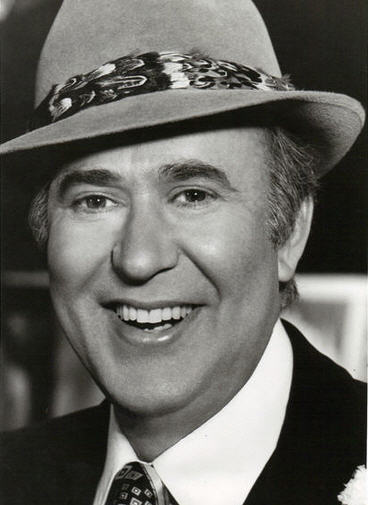
Carl Reiner (1922-2020)

When Carl Reiner died recently at the age of 98, I pondered again my theory about comedians and their brains. It’s not scientific or scholarly or anything other than my personal observation, but it seems to me that comedians who daily exercise their brains by being funny, often on the spot, resist dementia as they age. Ditto trial lawyers.

I’ve written about this before:

What got me noticing this was watching Carl Reiner and Mel Brooks being interviewed together, riffing off each other. Reiner was 92 at the time, and Brooks a sprightly 88. They were both sharp, fast, funny. Which made me think of George Burns, who was cracking people up right up until he died at 100. (When he was 90, Burns was asked by an interviewer what his doctor thought of his cigar and martini habit. Burns replied, “My doctor died.”)

So why should this be? Obviously because comedians are constantly “on.” They’re calling upon their synapses to look for funny connections, word play, and so on. Bob Hope, Groucho Marx (who was only slowed down by a stroke), and many others fit this profile.

And I’ve known of several lawyers who were going to court in their 80s, still kicking the stuffing out of younger opponents. One of them was the legendary Louis Nizer, whom I got to watch try a case when he was 82. I knew about him because I’d read my dad’s copy of My Life in Court (which is better reading than many a legal thriller). Plus, Mr. Nizer had sent me a personal letter in response to one I sent him, asking him for advice on becoming a trial lawyer.

And there he was, coming to court each day with an assistant and boxes filled with exhibits and documents and other evidence. A trial lawyer has to keep a thousand things in mind—witness testimony, jury response, the Rules of Evidence (which have to be cited in a heartbeat when an objection is made), and so on. Might this explain the mental vitality of octogenarian barristers?

There also seems to be an oral component to my theory. Both comedians and trial lawyers have to be verbal and cogent on the spot. Maybe in addition to creativity time, you ought to get yourself into a good, substantive, face-to-face conversation on occasion. At the very least this will be the opposite of Twitter, which may be reason enough to do it.

In that post I offered a few creativity exercises to help writers keep the brain primed and playful. Today I want to add something else to the list.

I recently came across a scholarly article published a couple of years ago which demonstrated the effect that drawing has on memory.

We propose that drawing improves memory by promoting the integration of elaborative, pictorial, and motor codes, facilitating creation of a context-rich representation. Importantly, the simplicity of this strategy means it can be used by people with cognitive impairments to enhance memory, with preliminary findings suggesting measurable gains in performance in both normally aging individuals and patients with dementia.

So how might drawing operate as an aid to plotting your novel or scene?

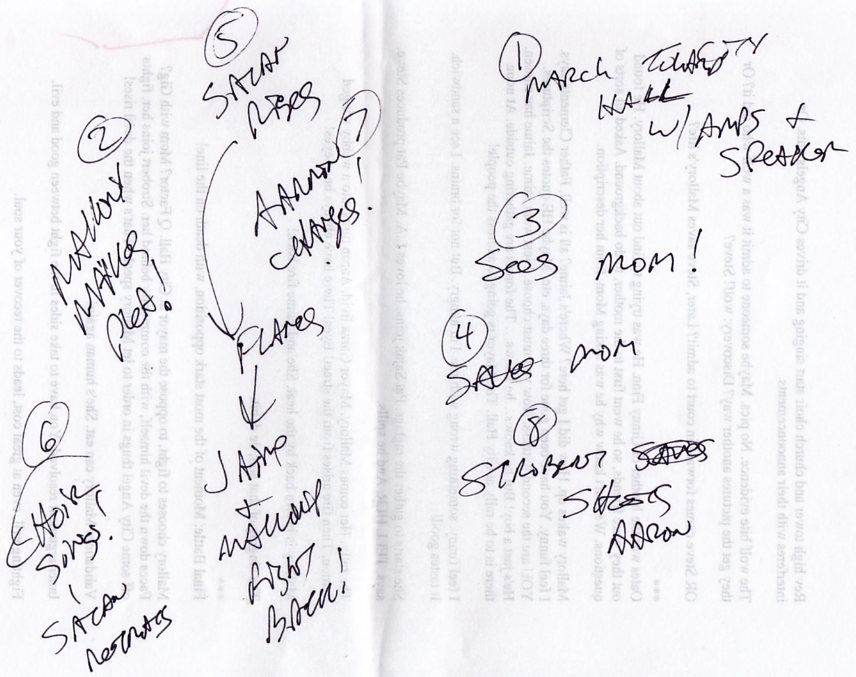
Most of you know about mind mapping. Early in my writing journey I read Writing the Natural Way, which teaches mind mapping as a practice for writers. I use it all the time. For example, I was trying to come up with a great big climax to one of my Mallory Caine, Zombie-at-Law novels. I took a walk to Starbucks, got a double espresso, and sat for awhile. Then I took out some paper and starting jotting ideas as they came to me. Here is that paper (the numbers I added later to give me the order of the scenes):

And that’s the ending that’s in the book.

When pre-plotting, I’ll take a yellow legal pad and turn it lengthwise and start mapping. Now I’m thinking about adding drawing to the mix. I don’t have to be a skilled cartoonist (good thing, for that is not one of the gifts bestowed upon me). But I can doodle, have a little fun, and trigger another part of my brain.

If you’re writing a scene with a closed environment, I can see value in making a map of the place—office, city block, house—and drawing the characters (even stick figures will do) as they negotiate the action. It might stimulate new ideas for the scene you wouldn’t get any other way.

Your friend, the brain. It is quite versatile indeed.

What about you? Do you use any visual techniques for your writing or creativity? (I’m on the road today and will check in when I can. Until then, talk amongst yourselves!)

Gone

My granddaughter S. went missing for a very short time several years ago. 

It happened on a Thursday during the first week of June. S. was a student at a wonderful public elementary school in the Clintonville neighborhood of Columbus. A picnic for the students, teachers, and parents was — and still is — annually held on the school playground during the closing hours of the last day of class. My son J. — her father — took an extended lunch hour from his job and dutifully presented at the time appointed. He was somewhat puzzled when he did not see S. among the students cavorting around the swings. J. approached S.’s teacher and inquired as to her whereabouts. The teacher asked another teacher, who asked another, who asked the school secretary, who asked the principal. Within the course of a few minutes, a hue and cry quietly started up, one that was on the verge of quickly rounding the corner to full-blown hysteria. J., having learned at his father’s knee how to react to an emergency, fought down the tide of his own rising panic and quickly called his neighbor to ask if S. was in sight. The neighbor advised that yes, S.  was on J’s front porch, bearing the look of someone who finds themselves in a situation resulting from an action that wasn’t entirely thought through prior to its execution.  

It was learned a bit later that S., being a somewhat willful child at that time, had concluded that she had experienced enough school for the year and decided to skip the picnic. She didn’t think to tell anyone about her decision, and with the skill of a Ms. Pac-Man circumvented the carefully maintained school security labyrinth which was in place to keep such a thing from occurring. She then walked the few blocks from her school to her home in order to jumpstart her summer vacation by a couple of hours.   

J. told the teachers that S. was at home. Those assembled collectively breathed a sigh of relief. As J. left the school to deal with the wayward S. he heard the name “Kelly Prosser” mentioned as the instructors talked among themselves. He wondered who she was. 

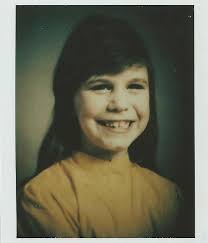
Kelly Ann Prosser in 1982 had been an eight-year-old student at a much-acclaimed alternative school in the same neighborhood as my granddaughter’s. The school year was barely three weeks old when Kelly disappeared while walking home. Her body was found two days later in a cornfield located in a quiet community contiguous to Columbus. She had been beaten, raped, and murdered. 

Several individuals were questioned by Columbus police detectives but no one was ever charged with Kelly Ann’s murder. J., who was four years old at the time, probably wondered why his parents held him and his younger siblings just a little more tightly and watched them just a bit more closely for the next, oh, thirty-eight years or so (and counting). For the teachers at Kelly Ann’s school, and virtually every school in the area., there was an additional nightmare a-borning. Whoever visited the horrors of Kelly Ann’s final hours upon her was, as far as anyone knew, still out there watching and waiting for another opportunity. While the safety of their students was uppermost in the minds of the teachers and administrators, I suspect that no one wanted to bear the burden of having another such act repeated on or after their watch. 

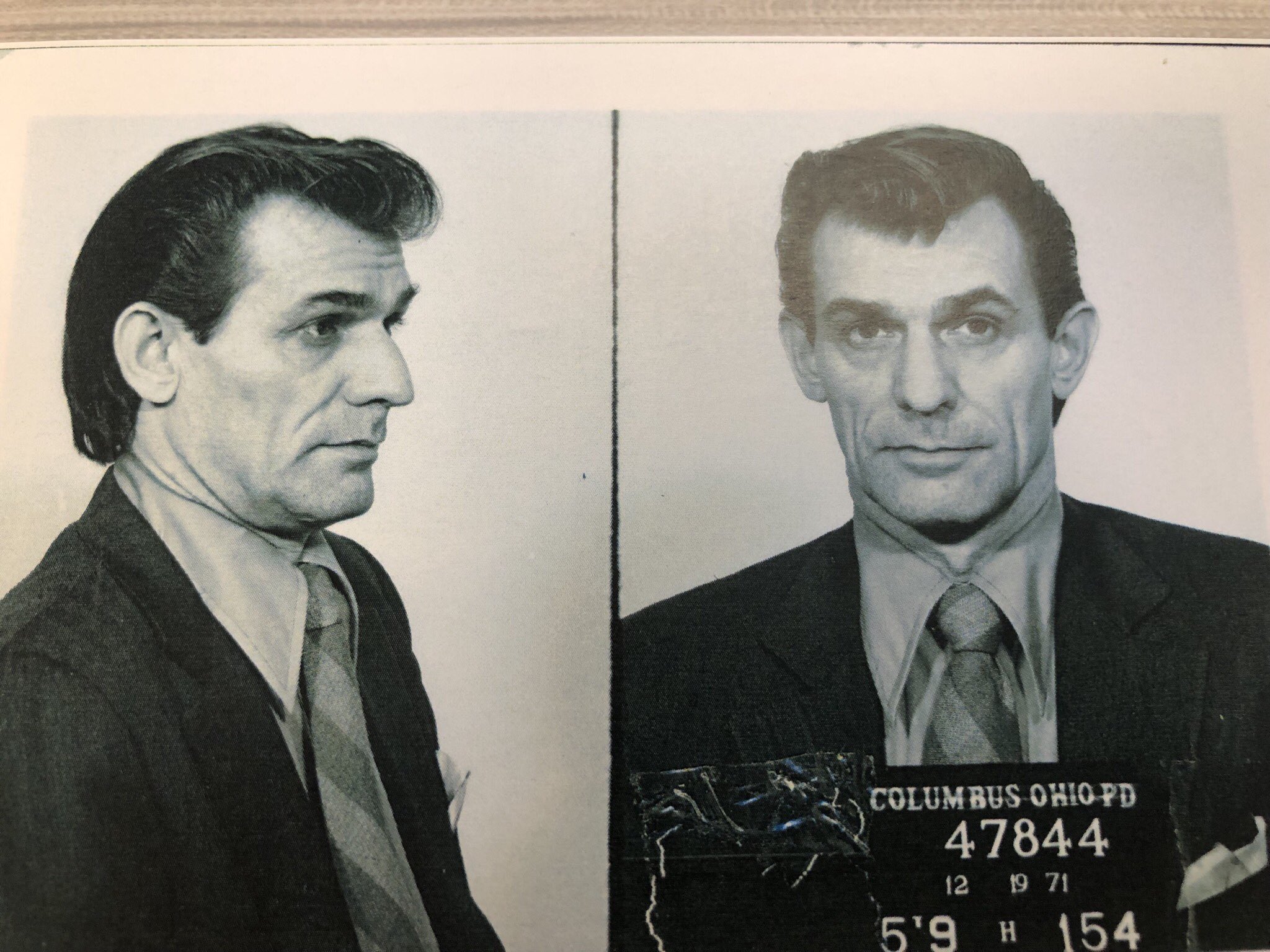
That fear carried over across the decades. The Columbus Police Department, for its part, never gave up on Kelly’s case. Decades passed. Forensic tools were created, improved, and sharpened. The Columbus Police  Cold Case Unit, announced on June 26, 2020, that the case had been closed. A DNA sample obtained from material originally gathered at the crime scene conclusively linked her attack and death to one Harold Warren Jarrell. He was no stranger to the criminal justice system. Jarrell had been arrested, tried, convicted, and incarcerated for abducting a little girl in 1977 from another Columbus neighborhood. He was released from prison after five years and had been walking among the innocent and unknowing for but a short time before Kelly Ann’s path crossed his. Jarrell for whatever reason was not considered a suspect in her murder at the time, and at some subsequent point left Columbus, drifting across the country with stops in Florida and Las Vegas among other places, more often than not attracting the attention of law enforcement before moving on rather quickly and without notice. He met his end at some point — how, where, and why is not immediately clear — and thus cannot face justice for Kelly Ann’s murder and the grief that ripples through time across the lives of her family members to this day. Investigations being conducted in other jurisdictions indicate that Jarrell’s horrible misdeeds continued. One can only hope that his end was slow and excruciating, one where any calls for help which he might have made were unanswered at least and mocked at best. 

It is people such as Jarrell who cause me to prefer the company of dogs and cats to people. That said, the tenaciousness of the personnel of the Columbus Police Cold Case Unit — with a mighty and timely assist from a forensic genealogical service named AdvancedDNA —  restores, at least partially, my faith in humanity.

I am well aware that in the majority of cases of sexual molestation and abuse the victim and the aggressor are known to each other. There is still a sizable group of opportunistic predators who randomly prey upon the innocent. There are tools available to combat them. Most if not all county sheriff departments now provide a sexual offenders’ database on their websites. There is also a smartphone app for iPhones named Offender Locator which I cannot vouch for, but I can for Truthfinder, an Android app that provides sobering information about sex offenders living and working within a given area.  You may want to consult this should you or a family member decide to move to a new neighborhood or take things a step further with that new acquaintance who might seem just a tad too friendly with your child. The writers and authors among you may also — and I am not making light of the problem by suggesting this, not at all — use this app as a means of obtaining inspiration for the truly wretched characters in your latest work in progress. The woods, as they say, are full of them. The lambs walk in sunlight and the wolves wait in darkness for one or more to stray into shadow. 

Be safe. Be well. Be alert. 

Don’t Say It! Words We Love to Hate

By Elaine Viets

You know, some words and phrases are getting on my nerves. Most people would say it is what it is and at the end of the day, let it go. I know, right? But I’ve been doing some online research. There are certain sayings that tick people off. And readers are people, too. You don’t want to turn off your readers with annoying phrases. Just sayin’.
These outstandingly irritating phrases are garnered from various corners of the Web.
Think carefully before you use them in your writing. You may want to save them for your most hateful characters.

Just sayin’. The winner! Nearly everyone hates this redundant phrase. I mean, you’ve already said what you were going to say, right?

Literally. I confess I’ve used this one and thought it was pretty clever – the first time. Then I noticed that word in every novel I picked up – literally.

It is what it is. Arggh! This meaningless phrase is enough to send me screaming into the night. I admit I’m a little touchy these days, with the quarantine and all, but please don’t use it.

At this moment in time. What’s wrong with “now”? Can this pretentious phrase.

Everything happens for a reason. Usually said after some meaningless tragedy, and meant as consolation. If you don’t have that comforting belief system, this phrase triggers an urge to slap that person silly. Also avoid this phrase: Whenever God closes a door, he opens a window. I had a roommate like that. Very annoying.

Honestly. Often a trigger word indicating the person using it is lying. Use it carefully.

My bad. A cutesy way of glossing over a mistake. This phrase says, “I know I did something offensive and I don’t care.”

I want 110 percent. Right, boss. Except your math doesn’t add up.

No worries. Some people find this phrase a little passive-aggressive. In other words, when someone says, “No worries,” they’re really telling you that you should be worried.

At the end of day. As in, “At the end of the day, getting a new CEO won’t make any difference. This company is doomed.” This crutch will cripple any sentence.

With all due respect. The warm-up to an insult. “With all due respect, even in your prime you weren’t that good.”

That’s my list, and it’s pretty good, in IMHO (oops, there’s another one.) Now’s your chance. What tired words and phrases would you like to see retired?

##########################################################

A Star Is Dead, my new Angela Richman death investigator mystery “will satisfy procedural and cozy fans who like a good puzzle,” says Booklist magazine.
Buy it here: https://tinyurl.com/yc6

Roaming Body Parts

Roaming Body Parts

I recently read a blog with a firm stance on how to deal with body parts. I don’t entirely agree. I don’t have trouble with figures of speech, and if I’m reading that a character ‘flew down the block to John’s house’ I don’t see her mid-air. If someone writes “a lump of ice settled in her belly” I’m not seeing actual ice.

How do you react when you read things like this?

Their eyes met from across the room.

His eyes raked her body from head to toe.

There seem to be two schools of thought on this one. I’m on the side that doesn’t mind. I understand that ‘eye’ can be used as a noun or a verb. “He eyed her” is acceptable. “He gave her the eye” is an idiom I have no trouble with. I don’t see him extracting an eyeball and handing it to her. So if a characters eyes move, I don’t get visions of eyeballs floating free. Others would substitute the word “gaze.” I’ll use either.

Which side are you on? Would the following pull you out of the story?

Her blue eyes, enlarged by her wire-rimmed glasses, rambled from Colleen’s head to her toes.

“What’s wrong with my face?” Her fingers flew to her cheeks.

Yet there are those for whom those would be book-tossing offenses. Me, I see the eye movement in the first example, but the eyes remain firmly set in their sockets. In the second, my brain assumes the fingers are still attached to the hand, and I don’t think about body parts floating in space.

If you give someone the eye, are you handing them an eyeball? Or if a character eyes the room as he enters, what’s he doing? Eye is a verb as well as a noun, after all. And as a verb, my Synonym Finder (great reference book, by the way) lists view, see, behold, catch sight of, look at. And what about all those expressions using ‘eye’? In a pig’s eye. Do we put things into the eye of that pig? Or, keep an eye out for. Do we take an eyeball out and hold it until someone comes for it?

Roaming body parts

Image by 272447 from Pixabay

If we took everything we read literally, a lot of the richness of the language would be lost. If his eyes are pools of molten chocolate, do we really think that he’s got Godiva eyeballs? Or just deep brown eyes?

(That’s a metaphor, I think – if his eyes look like pools of molten chocolate, that would be a simile, right?) I’ve never been good at remembering terminology. Metaphors, similes, idioms, hyperbole—they’re things I use, but I don’t worry about what they’re called when I’m writing them.


Terry Odell is an award-winning author of Mystery and Romantic Suspense, although she prefers to think of them all as “Mysteries with Relationships.” Follow her on Facebook and Twitter.

Word Play

Public Domain

By Debbie Burke

@burke_writer

Unfamiliar words always catch my attention. Since words are a writer’s most important tool, I figure we can’t have too many in our toolbox.

Some words are just plain fun, either because of their sound or their meaning. Today, let’s play with several I recently ran across.

Lagniappe

TKZ’s own Joe Hartlaub used this term in a recent comment. What the heck is lagniappe, I wondered.

A quick Wikipedia search revealed the definition of lagniappe as “a small gift given to a customer by a merchant at the time of a purchase” (such as a 13th doughnut on purchase of a dozen), or more broadly, “something given or obtained gratuitously or by way of good measure.”

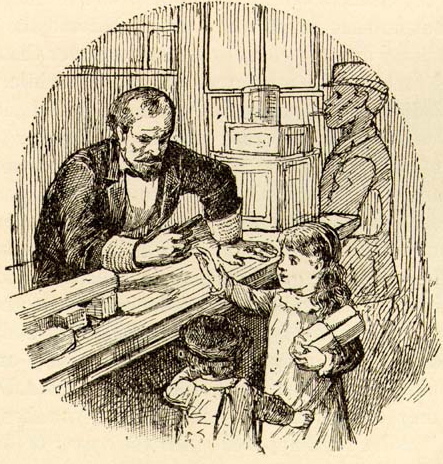
LAGNIAPPE example in Life on the Mississippi by Mark Twain, Public Domain

Mark Twain collected the word as a souvenir during a journey. In Life on the Mississippi he wrote: “We picked up one excellent word – a word worth travelling to New Orleans to get; a nice limber, expressive, handy word – ‘Lagniappe.’ They pronounce it lanny-yap … When a child or a servant buys something in a shop – or even the mayor or governor, for aught I know – he finishes the operation by saying, – ‘Give me something for lagniappe.‘ The shopman always responds; gives the child a bit of liquorice-root.”

According to Wikipedia, the word origin is “from the Louisiana French adapting a Quechua word brought in to New Orleans by the Spanish Creoles.”

The use of unusual words in fiction can be a risk because the writer doesn’t want to pull the reader out of the story to check the dictionary. In olden days, we had find a Merriam-Webster and page through the thick volume. However, with instant internet access, looking up an unfamiliar word is easy. Sometimes, learning a new word is a value-added bonus in the book…like a lagniappe.


Matryoshka dolls – Dennis G. Jarvis, Wikimedia Commons

Matryoshka doll

Have you seen Russian nesting dolls, also known as Matryoshka dolls? Open the first doll to find a smaller second one inside; open the second one to find an even smaller third doll inside; and so on until the last and tiniest doll is revealed. Originally made as children’s toys, they became popular mementos for tourists visiting Russia.

The root of Matryoshka means mother or maternal. According to Legomenan: “the Matryoshka doll’s shape is round and elongated like an egg, a popular symbol of fertility and reproduction since ancient times. Like an egg, out of the Matryoshka stacking doll life emerges in symbolic form. The biggest nesting doll births the smaller ones, just as the grandmother or babushka gives life to the younger generations of her family, symbolized through the full family of stacking dolls of decreasing sizes.”

The Matryoshka doll seems a good analogy for mystery plots. The reader opens the first clue that leads to hidden information that leads to more clues until the most deeply hidden information reveals the ultimate solution to the puzzle.


Mondegreen

This is a mishearing of a phrase, often in song lyrics. Author Sylvia Wright coined the term after she misheard the words of an old Scottish ballad.

Ye Highlands and Ye Lowlands
Oh where hae you been?
They hae slay the Earl of Murray,
And Lady Mondegreen.

There is no Lady Mondegreen. The actual words of the last line are “and laid him on the green.”

Check out this site for a funny collection of Mondegreens from popular song lyrics (some are R-rated).

Led Zeppelin’s Stairway to Heaven

Actual lyric: “and as we wind on down the road, our shadows taller than our souls.”

Mondegreen:and there’s a wino down the road – I should have stolen Oreos.”


Madonna’s Material Girl

Actual lyric: “we are living in a material world, and I am a material girl.”

Mondegreen:we are living in a Cheerio world, and I am a Cheerio girl.”


Crystal Gayle’s Don’t It Make My Brown Eyes Blue.

Mondegreen:Doughnuts make my brown eyes blue.”


Pat Benatar’s Hit Me With Your Best Shot:

Mondegreen: “Hit me with your pet shark.”


Jose Feliciano’s Feliz Navidad:

Mondegreen: “Police have a dog.”


Gazump

Wikimedia Commons

Tracey, a TKZ reader in the UK, introduced me to this term. It is British slang for “when a seller (especially of property) accepts a verbal offer (a promise to purchase) on the property from one potential buyer, but then accepts a higher offer from someone else. It can also refer to the seller raising the asking price or asking for more money at the last minute, after previously verbally agreeing to a lower one.” – Wikipedia.

No one wants to be “gazumped” but it’s sure a fun word to say.

Working with words is a writer’s job but playing with words is our pleasure.

~~~

TKZers: What is your favorite unusual word? If you know the origin, please share that, also.

~~~

Four Books Four Bucks – All four books in Debbie Burke’s thriller series are on sale from July 7 to July 14. Buy one for $.99 or buy all four for the regular price of one book. 


Instrument of the Devil

Stalking Midas

Eyes in the Sky

Dead Man’s Bluff

The Writing Math: Craft… plus Art… equals Performance

By Larry Brooks

Allow me to share the story of a writer you may have heard of, and if you haven’t you either aren’t a mystery/thriller fan (you’re here on Kill Zone, I’ll assume you are) or you aren’t paying attention. His name is Robert Dugoni, the author of 18 novels across three series and one literary novel that just sold to Hollywood, as have several of those novels. He is a multiple New York Times bestseller, with enough other lists and awards and credits to fill up an entire Kill Zone post.

This month we celebrate that an author of mystery and thrillers (legal thrillers, murder mysteries and spy stories) is on the cover of Writers Digest Magazine. (Never mind that WD has labeled this their travel writing issue, the monthly interview here is all about writing novels.) He is one of us, and he has something to say to all of us who ply this craft.

There is an amazing bottom line to this author’s journey, which he describes with perfect focus and humility from a teaching perspective. We’re all on that path, seeking a summit, as he has over twenty years of searching for that intersection between craft and art.

He’ll tell you he’s still climbing and learning, too.

He started out with his skill (his “art”) as a writer—honed through a background in journalism and as a defense attorney—with the risky yet common belief that the story-craft side of things was a no brainer. He’d been a reader of quality novels since childhood, so of course he knew in his gut how a novel came together and what makes it tick.

He believed that’s how successful writers do it. Some of them actually claim it as their experience. They just take a chair and start typing, letting the story flow out of them. It would take him years to realize that such advice is toxic, if not an outright lie.

Those years commenced when he left the practice of law after 13 years to pursue his dream of writing fiction. Full time, cold turkey. What he didn’t know was that it would take six years to arrive at that magic moment when craft and art finally embrace, with a brief time-out to write a non-fiction book that become a 2004 Washington post Book of the year (The Cyanide Canary). After that he went back to his dream and his WIP, which was a legal thriller titled The Jury Master.

Here’s a little more math for you: over those six years, he submitted The Jury Master to 42 agents. A lot of us would have hung it up after such a string of rejections. Sometimes he would go back and tweak the story, but he received very little input that he could use to raise the bar. He was on his own, as most of us have felt at some point in our journey.

In the meantime life continued, and he found himself frequenting a neighborhood bookstore… where he happened upon a shelf he’d never paid much attention to before: the place where the writing craft books were displayed. Mind you, this was the early 2000s decade, and there wasn’t a James Scott Bell or a Donald Maass or a Larry Brooks writing craft books yet. No, in 2004-07 we’re talking Al Zuckerman, Christopher Vogler and Sol Stein, to name a few of that era.

That’s when an epiphany blew up his life. In a good way. He realized he really didn’t know what he was doing as a novelist. Even after all that reading, his “gut” wasn’t getting the job done.

So Dugoni took over a year off to absorb as many craft books as he could, searching out teachers of fiction craft, applying the principles he discovered to the now dog-eared manuscript of The Jury Master, assembling more than few binder full of notes. Finally this lead to what was, in sum, a total rewrite of the novel.

He thought he knew. But he realized—and was humble and hungry enough to admit it—that he didn’t. That he didn’t even know what he didn’t know.

The storybook outcome of this launch phase of Robert Dugoni’s career, the fruition of all that study, was that The Jury Master landed an agent forthwith, and the book became his first New York Times bestseller, and the first of a five-title series featuring hero David Sloan. Who was, of course, an ace attorney with a mysterious past.

Anyone who tells you writing cannot be taught is thus proven wrong.

Or at least, confused. Sure, Robert Dugoni was a Phi Beta Kappa from Stanford, but that doesn’t mean the knowledge isn’t accessible to anyone with the discipline to seek it out.

What is hard to teach is how to land on a worthy story idea/concept/premisethat requires a learning curve and a keen sense of dramatic and thematic potential, as well as commercial viability. I’m not saying the craft essential to actually writing an idea as a novel is easily or quickly taught—Brother Bell will second me on that one, I’m sure—just that the information and framing of what you need to understand is out there, relevant and more than ready to change your writing life.

Cut to 2020, and this July cover article/interview with Writers Digest Magazine.

By now Robert Dugoni has sold over six million copies of his 18 novels, including the bestsellers My Sister’s Grave (which launched the 7-title Tracy Crosswhite series), and The Extraordinary Life of Sam Hell (his literary novel), as well as the new Charles Jenkins spy series, with the second title due out end of September.

The author of that July 2020 Writers Digest article/interview was, well, me.

I’ve known Bob for years after hanging out at writing conferences and discovering that, despite him being a pantser and me an outliner, we shared a strikingly similar outlook on the craft. Ultimately he would go on to blurb one of my novels (Deadly Faux) and my 2017 craft book (Story Fix). More recently, he wrote the Foreword to my new craft book (Great Stories Don’t Write Themselves), published last fall.

Having written for Writers Digest many times, I pitched the editors on the interview, and they didn’t hesitate. The transcript was over 7000 words, and if you’ve ever edited and assembled an interview toward a coherent through-line narrative, you know how long it takes to get it down to 2500 words. WD loved what he had to say, and asked for an additional 800 words. The interview not only covers the timeline of his career, it also delivers abundant take-aways and learning that will be well worth a hungry writer’s time.

In this interview Robert Dugoni has given us a master class on how to avoid the most common mistake and pitfall that explains the 96 percent failure rate of manuscripts submitted to agents for representation (this via The Huffington Post; rejection is almost always a combination of less-than-compelling or original story ideas—which is indeed hard to teach—alongside a flawed sense of structure, character, flow, or simply the writing itself… all of which reside at the very teachable heart and soul of craft).

Which brings me back to today’s title. It’s that word: performance.

Robert threw it in at the end of the interview, and it was something I’ve never heard a writer say before. It froze me with introspection. He says that when a writer has internalized and assimilated and worked with the core principles of storytelling craft—to the point that she or he can see it just below the surface in the books they read, and within their vision for the stories they want write—only then can they truly and effectively sit before the blank page and actually perform. And when that happens, when the writer truly knows how a story should work, it becomes a blissful experience.

This is true regardless of one’s writing process preference, pantser and planner alike. Craft empowers both, the lack of it compromises both.

We perform, in the same context that any professional puts themselves in front of an audience to present their art, relying instinctually on the compounded sum of their years of study and practice of their craft. Singers. Actors. Editors. Athletes. Doctors and nurses and their medical peers. Therapists. Shrinks. Mechanics. Pilots. Designers. They are all artists. But before their art can work at a professional level, a level where people pay money to experience their art, they needed to build a foundation of craft, of the knowledge of their chosen field of work.

Writers who struggle for many drafts over what is often many years are, in fact, searching for and struggling with their handling of those core craft principles. Some aren’t even aware of what they’re missing. All of us know that feeling, just as Dugoni did for those six early years and those 42 rejected drafts.

But he’s a testament as to what can happen when you truly submit to the truth that it is craft will set you free, and allow you to set sail in pursuit of your writing dream.

As a footnote, Robert Dugoni continues to teach at conferences and runs his own annual retreat. Not because he needs to—before the virus and with his prodigious output, he was traveling to book signings nearly every weekend—but because he truly wants to give back, so that we don’t burn six years or more of our life, as he did, chasing something that can outrun us if we aren’t sure what we’re chasing.

Larry Brooks

Larry Brooks is a former Kill Zone blogger who has maintained his own website, Storyfix.com, since 2010. He is the USA Today bestselling author of six thrillers and four books about writing fiction, including Story Engineering.

His latest, Great Stories Don’t Write Themselves,” was published last November from Writers Digest books, a division of Penguin Random House.


Write What is Unreal But True

by James Scott Bell
@jamesscottbell

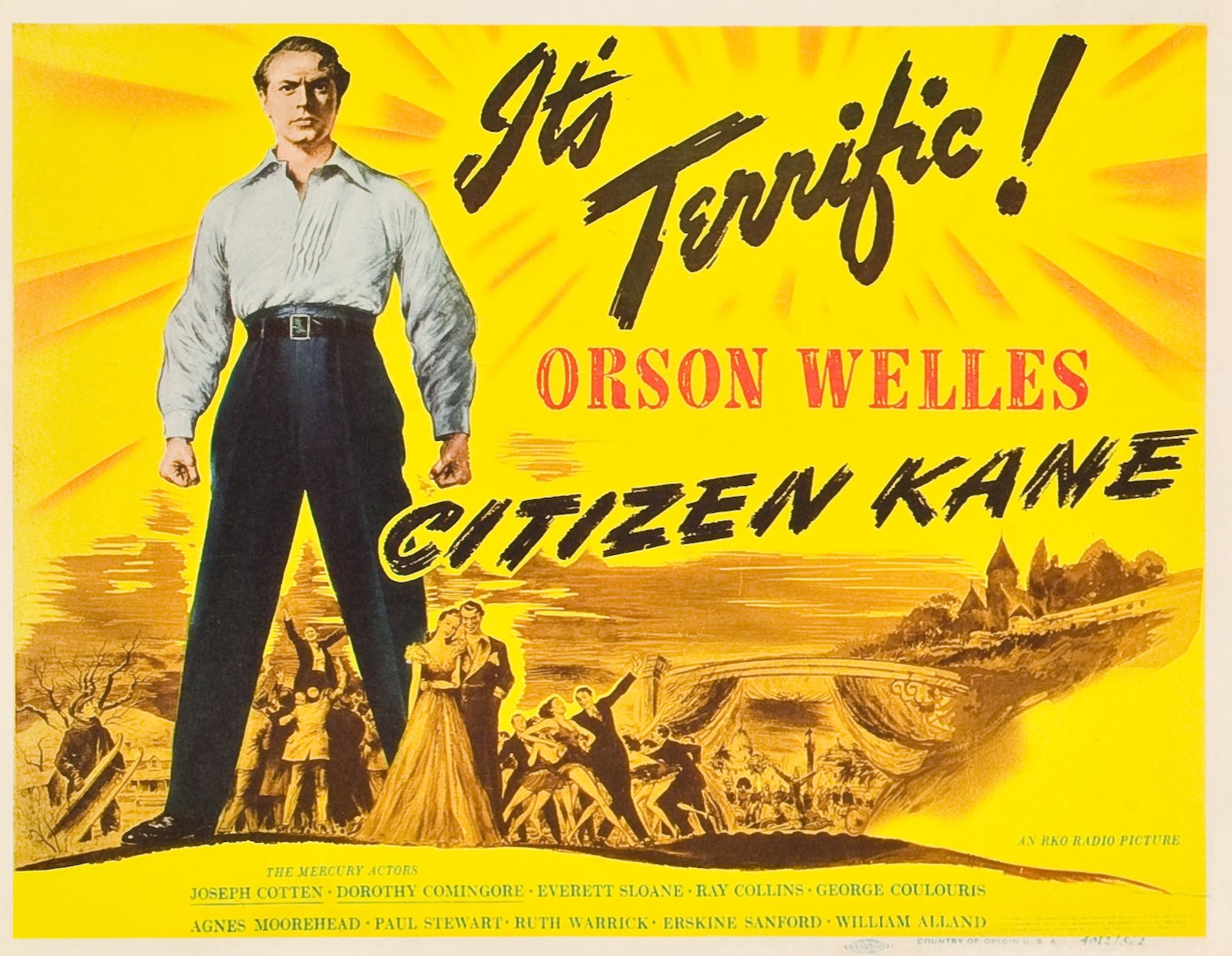
I love Orson Welles. He is one of the few authentic geniuses America has produced in theater and film. At the tender age of 25 he co-wrote and directed what many critics (and your humble scribe) consider the greatest film ever made, Citizen Kane (1941). It was so far ahead of its time that RKO didn’t know how to market it. So they came up with what may be the worst ad line in the history of movies: It’s Terrific!

The movie itself is so good it’s sometimes easy to forget that Welles’s portrayal of the titular character is also one of the great acting performances ever. The guy, in brief, was an amazing talent. Sadly, the studios didn’t get what he was doing and he would have nothing but trouble making films the rest of his life. Still, whenever he did complete a project, it was either a masterpiece or had scenes in it that are unforgettable.

Masterpiece definitely describes Touch of Evil (1958). It was considered by Universal to be a nice little crime movie for Charlton Heston (pre-Ben Hur). No one thought of the material as anything earth shattering. It was based on the novel Badge of Evil by “Whit Masterson,” the pseudonym of crime fiction duo Bob Wade and H. Bill Miller.

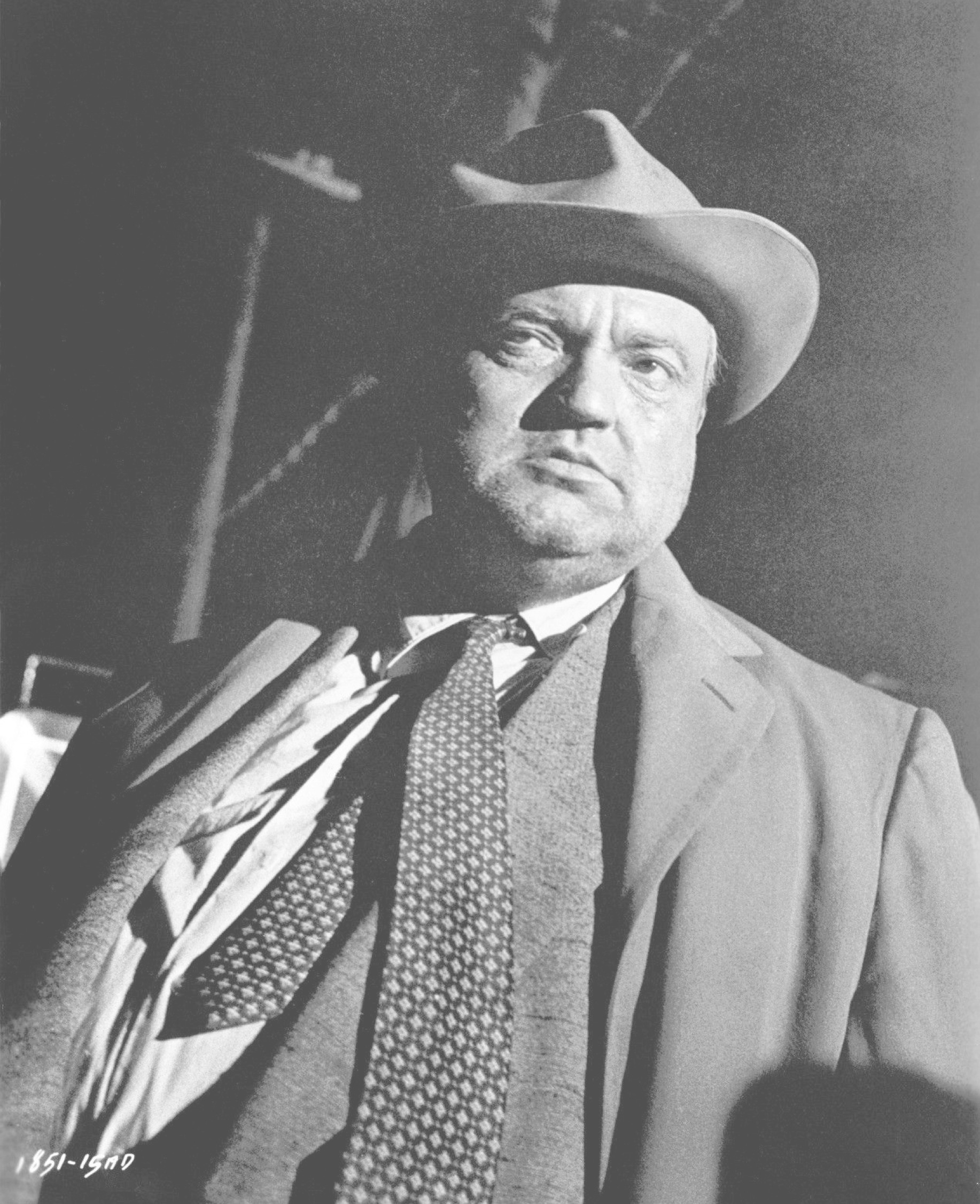
Orson Welles as Police Captain Hank Quinlan in Touch of Evil

Welles was cast as the villain, corrupt police captain Hank Quinlan. This is when the merciful fates of film stepped in. During a phone call between Heston and the producers, Heston suggested that Welles might also direct. Universal asked Welles if he’d like to helm the picture, and Welles said yes, provided he got to re-write the script. Again, considering Welles’s reputation at the time, that Universal acceded to the request makes it seem those movie fates were working overtime.

Touch of Evil, it can be argued, is the last true film noir. But it is so much more. It has the Welles touch all the way through, from the fantastic one-take opening sequence to the shadows and angles Welles did better than anyone. He saw stunning visuals in his prodigious mind and then used whatever camera techniques were available to put them onscreen.

No other director has ever had that singular, Welles imagination.

Then, for some reason, the fates took a coffee break. During the shooting, the studio had seemed very happy with the dailies. But when the rough cut was delivered the honchos got cold feet. Welles was never told why. I suspect that, once again, he was so far ahead of every other filmmaker the studio didn’t how to market the thing. So they took the film away from Welles and did some cutting and re-shooting. Then they ended up releasing it as the B picture on a double bill, with absolutely no advertising. The movie died, and with it any chance that Welles would ever work unhindered in Hollywood again.

But in Europe, especially France, the film was hailed as a triumph. In the 1970s that assessment got to America and now everyone knows it’s a classic.

Throughout his troubled Hollywood existence, Welles somehow kept his youthful ebullience whenever he was interviewed. I encourage you to go on YouTube and search for Welles interviews. They are always smart, funny, charming. Here is one where he talks about Touch of Evil.

In this interview he says something fascinating. Someone remarked to him that Touch of Evil seemed “unreal, yet real.” And Welles replied that he was actually trying to make something that was “unreal, but true.” That, he said, is the highest and best kind of “theatricality.”

What do you think of that? I’ve always said that great fiction is not a depiction of reality. It is a stylized version of reality for a desired effect. And that desired effect is the truth as seen by the writer.

So let’s have at it: What do you think Welles is saying here, and do you agree?