During a book signing event a couple of weeks ago, a gentleman named Don handed me his card and introduced himself as an official with the West Virginia Writers Association, representing the Eastern Panhandle–the slice of heaven where I now live. I have since joined that group, and plan to attend their annual meeting in June.
As a recent emigree to the Mountain State, I’m working hard to establish as many connections as I can as quickly as I can. Don told me that there’s a writing group in Charles Town (nearby city) that meets regularly and he suggested that I give it a try. I reached out to the nice lady who runs the group, and I was invited into the fold.
Not sure what to expect or what I was getting into, I went to the designated spot at the designated time and we were off and running. It’s a small group, and it’s dedicated to workshopping WIPs. (WsIP?) Among the members, the levels of enthusiasm are high but the command of the craft varies widely. About ten minutes in, I realized that I’d entered a potential minefield.
It’s not my group.
The lady who runs the meetings–we’ll call her Dorothy–has worked hard to wrangle participants from disparate backgrounds and abilities into what seems to be a cohesive group–of which I want merely to be a part. The last thing I want to do is steal anyone’s thunder. That said, I have the answers to many of the questions bandied about the members, especially with regard to the book business–stuff like copyright law. As the new guy to any group, my inclination is to sit quietly and get a feel for the room, but when people are guessing at answers, I feel an obligation to set things straight. I realize now that that’s a lot like stealing thunder.
Critique group etiquette is alien to me.
For a quarter of a century now, I have taught writing sessions and seminars in which I am the presumed authority. When those seminars have included workshop sessions, I save my input until everyone else has had their say, and then I express my agreement or disagreement with those opinions and then offer my own. I’m something of a blunt object when it comes to offering critique–never cruel but always direct. I point out what I like and dislike, and I give my reasons why.
The new group brings a different structure. First point out the good, and then lay out the critique smoothly and with light brush strokes. Listen as the writer explains what they meant to say, often couched in the tone of, “It’s all there, how could you not see it?” Apologize if the honest assessment has offended.
The phrase, “In my opinion”, must be stated aloud before a critique can be given.
“It’s only a first draft.”
When the criticism comes, an oft sought safe harbor lies in the act of pointing out that the sample people have dedicated time and effort to read and critique is only a first draft–the implication being that the writer could have done better if they’d cared to make the effort. I want to point out (but haven’t yet) that no, your submission is not a first draft. It is the final draft of the version that you chose to submit for input.
“I don’t care about ever getting published.”
Those were the words of one of the members of the group. She went on to explain that she expresses herself exactly as she likes, and is not all that concerned if it makes sense to others or if they like it. It hurts her feelings when she hears negative feedback, but has no intention of internalizing that feedback or making any changes. Being a writer is who she is, she says. It’s her entire purpose in life. I’m not getting in the middle of that one.
Soon it will be my turn.
If I have seemed a bit snarky in the above paragraphs, please find none in this one. I really do want to sink roots into the local writing community, and while I feel a bit like a fish on the shore with this new group, I enjoy the interaction. I will do my best to live by the rules. And among the rules: you’ve got to pay to play. If I’m going to critique others, then I must submit to critique myself. That’s one hundred percent fair. And it will feel really, really weird.
I will submit my best work on my work-in-progress, and I will receive blunt input from real readers–a live audience to what is usually a recorded performance. I will sit quietly and I will absorb what they have to say. I will learn some things, and maybe they will, too. Or maybe not.
What do you all think about critique groups? What works? What doesn’t? Is it helpful or harmful in a group to have a wide range of writing experience?
 One of the most amazing things about being an author is mingling within the writing community. Writers, as I’m sure you’ll agree, are some of the most generous, supportive, and kind humans on the planet.
 Do you really need to point out a typo in a tweet? We’re all fallible. Smile and move on.
 I admit, when I first joined Twitter, an automated message to greet my new followers seemed like a good idea. Let me set the record straight—they are never a good idea.
 We’ve often discussed here the different approaches to writing a novel. In dualistic terms, we sometimes use the terms “plotters” and “pantsers.” Or, “outliners” and “intuitive (or discovery) writers.” There are some ’tweeners (“plantsers”), too. Doesn’t matter, as long as the author creates a finished work that’s the best he or she can do.



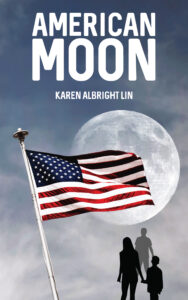
 Karen is the author of

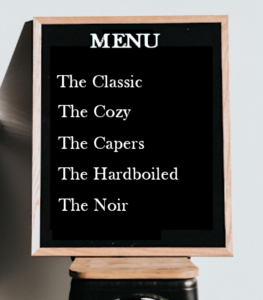 When I was writing my first novel, a friend asked what kind of book it was. I said it was a cozy mystery, but she didn’t know what that was, so I explained, “It’s a mystery with no explicit violence, no explicit sexual content, and usually no profanity. After her cheerful, “I guess you realize there’ll be no audience” response, I pretended to smile. (I get that remark a lot.)
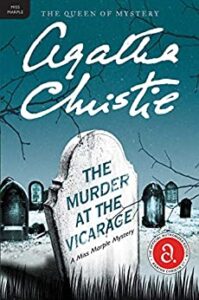 Classic Mysteries can be exemplified by Agatha Christie’s works. There is a crime, usually a murder, and the story is concerned with identifying the killer(s). Classic mysteries, like cozies, generally don’t include any explicit violence or sexual content, and there’s usually no profanity. Some of the notable entries in this category are Agatha Christie’s Miss Marple novels and Sir Arthur Conan Doyle’s Sherlock Holmes stories.