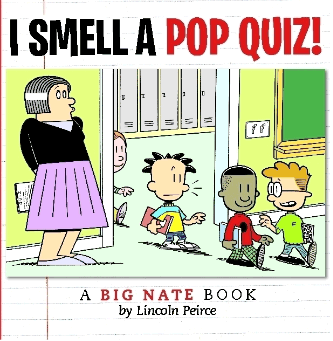
 Time for a pop quiz to test your knowledge of sneaky word traps writers can fall into.
Today let’s talk about homonyms, homographs, and homophones.
Homonyms are words that sound the same but have different meanings.
Example: “write” and “right.”
Homophones are words that sound alike but have different meanings and spellings.
Examples: rein, reign; aisle, isle; suite, sweet.
Homographs are words that are spelled the same but have different meanings and different pronunciation.
Example: desert (a hot dry place, pronounced with an accent on the first syllable) or desert (to leave, accent on the second syllable).
Don’t worry—the above definitions won’t be on the test. Only hardcore grammar Nazis care.
Some words are just plain confusing. They may sound similar but are spelled differently and have different meanings.
But…professional writers should know how to choose the right word in a particular sentence.
We’ve all typed “there” when we mean “their” or “to” when we mean “too.” Those fall more into the category of typos.
I’m talking about out-and-out goofs because of incorrect word choices. When your book is published, some readers are quite happy to point out those errors that you missed. Embarrassing.
Standards of proofreading and copyediting are on a steep decline. The below examples are boo-boos I’ve collected lately from recently published books, news articles, and blog posts.
See if you can make the right choices.
- Juicy gossip (a) peeked (b) peaked (c) piqued her interest.
- The hangman held the rope (a) taut (b) taught.
- The professor (a) honed (b) homed in on the novel’s theme.
- The study (a) sited (b) sighted (c) cited research from the Mayo Clinic.
- A serial rapist is careful to (a) allude (b) elude capture.
- The eyewitness (a) poured (b) pored over the photo lineup of suspects.
- A new zoning ordinance was brought before the city (a) council (b) counsel.
- Floodwaters (a) reeked (b) wreaked (c) wrecked havoc in homes along the river.
- A depressed person can suffer from (a) deep-seeded (b) deep-seated anxiety.
- The state must reduce the budget by (a) paring (b) pairing expenses.
- Skateboarders are getting a bad (a) rap (b) wrap.
- The (a) effect (b) affect of the new court ruling will (c) effect (d) affect millions of people.
How many of you looked up the test answers on Google? Come on, tell the truth.
That’s OK. It’s not cheating–it’s research. The lesson here is it’s always better to double-check before you submit to an agent or editor who might turn you down because of improper use. Or before you hit the “publish” button on your indie book.
Self-published books carry a stigma because many are full of such errors. If you’re an indie author, don’t contribute to the bad reputation with sloppy word choices.
Now that I’ve reached a certain age, I may think I’m sure about proper usage but sometimes find I’m mistaken. When it’s so easy to check on sites like Grammar Girl or Writing Forward there really is no excuse not to.
Answers:
- (c) piqued.
- (a) taut.
- (b) homed. “Honed” means sharpening a blade.
- (c) cited.
- (b) elude. “Allude” means to refer to.
- (b) pored.
- (a) council. “Counsel” refers to advice or legal help, e.g. The judge said, “Let counsel approach the bench.”
- (b) wreaked.
- (b) deep-seated.
- (a) paring.
- (a) rap.
- (a) effect, (d) affect. These two words are constantly mixed up. Effect is a noun (The effect of the ruling). Affect is usually a verb (The ruling will affect millions)…unless it refers to a blank facial expression known as “flat affect.” Then it’s a noun.
Not only that, affect is a homograph (spelled the same but pronounced differently). When used as a verb, the accent is on the second syllable. When used as a noun, the accent is on the first syllable.
No wonder writers get confused. Glad I was born in the USA because I’d never master the vagaries of English if I had to learn it as a second language!
TKZers, how did you do on the quiz?
Which homonyms, homophones, and homographs do you find confusing?
What words do you tend to mix up?
Do you have favorite tricks or tips that remind you of correct usage?
During October, here are two ways to get a cheap thrill:
Debbie Burke’s bestselling thriller Instrument of the Devil is on sale for $1.99; or if you’re a member of Amazon Prime, you can read it for free. Click here.