6 Unusual Forensic Techniques

By Sue Coletta

The forensic community works tirelessly to improve techniques to aid law enforcement, and much of this work is done at body farms across the country. The Texas body farm has conducted some amazing work. I’ve complied my top six forensic advancements, which I think you’ll find fascinating.

Teeth Show Time of Death

When no clues exist to identify a corpse, investigators have a serious problem. The determination of age and sex of the body can be crucial to limit the search for individuals that could possibly match missing persons records. Today, gender can be determined through DNA, as well as the skeleton itself, but believe it or not, it’s not as accurate as testing done on teeth. Age estimation in children and adolescents often depends on radiological examination of skeletal and dental development. In adults, however, age estimation is much less accurate.

Enter: aspartic acid racemization and radiocarbon dating.

At the sprawling 26-acre Freeman Ranch in Texas, over 50 human corpses reside at the body farm. Many of which are checked via drone. Scientists examined 44 teeth from 41 individuals using aspartic acid racemization analysis of tooth crown dentin and radiocarbon dating of enamel. Of those, ten were split and subjected to both radiocarbon and racemization analysis. Combined analysis showed that the two methods combined worked better than relying on one or the other.

Radiocarbon Dating, a forensic tool also done on eyes, is an accurate way to determine environment, date of birth, age of deceased, nutrition, diet, and even date of death. I’ve written about Radiocarbon Dating before (see link above). Briefly, similar to counting rings on a tree to determine its age, same applies to the eyes and teeth. Only with teeth researchers aren’t looking for crystallins.

Twice a year each permanent tooth is anchored to the gums by tiny, distinct fibers. A bright line is laid in the spring or summer, depending on where you live, and a dark line in the fall or winter. The number of bands, as well as the color and width of the outermost ring, help scientists estimate the deceased’s age at death and also narrows the TOD (time of death) window.

Plants and Trees Love Dead Bodies

Human remains act like any other type of fertilizer, producing nitrogen that leeches into the soil. and provides nutrients to plant-life. Trees and plants thrive on this added nutrient, growing taller, fuller, and greener than those not living near the dead. By studying their size compared to other plant-life in the area, experts can determine where and when bodies were buried.

Insects, Rats, and Squirrels Help Determine Date of Death

I’ve written about entomology before, but did you know scavengers — like rats and squirrels, for example — prefer different types of human bones? It’s true. Rats like their bones greasy, and tend to chew on the ends in order to gain access to the marrow. Scientists can then look for these signs to determine how long the body has been in its earthly grave.

Conversely, squirrels prefer drier, more brittle bones that have been fully exposed to the elements. They use the calcium in bone to aid in the breeding of strong litters. By examining the different bite marks and narrowing when the bites occurred and by whom, forensic anthropologists are then able to determine if the body was skeletonized while fully exposed to the elements = squirrel activity. Or if buried in a shallow grave with nibbles on the ends of the bones = rats. Also, they can estimate how long the body has been dead and if the body has remained undisturbed.

Quick fun fact: it takes vultures only a few hours to strip a body down to bare bones — a time frame previously estimated to be weeks.

Mosquitos Can Aid Investigators

In bodies that are badly degraded obtaining DNA becomes a chore, and sometimes isn’t possible at all. Researchers at the body farm, however, have a solution. Mosquitos and other biting insects, believe it or not, preserve portions of the DNA in the bodies they feed on. By trapping and dissecting these insects, DNA could be recovered.

How cool is that? It’s also a bit disturbing to think of mosquitos flying around with our DNA inside them. Or worse, when you smack a mosquito and it leaves a trail of blood, someone else’s DNA could be splattered on your palm. Yuck! I swear, the more I learn, the more paranoid I become. I don’t know about you but these things haunt me. LOL #writerslife

Decomposition Follows a Set Process

The body farm discovered a set pattern to decomposition. One week exposed to open air equals two weeks in the water and eight weeks buried underground. The latter refers to murdered victims, not people who’ve been embalmed or mummified. Environment, temperature, clothing, and weather all have to be taken into account as well, but as a baseline this formula aids investigators a great deal.

Drones Help Find Buried Remains

In bodies not visible to the naked eye, drone flights are part of an ongoing study using near infrared imaging to detect bodies above and below the ground. This technology can also spot locations, where a corpse was previously buried for up to two years after its removal.

“The search for clandestine bodies is a very time-consuming ordeal,” Wescott told the Texas Tribune. “Even then, a lot of times you can walk right by them and not realize that they’re there.”

As corpses decay, they release carbon and nitrogen into the soil, which decreases the amount of light the soil reflects. The influx of chemicals first kills plants, but as it disperses into the soil around the body it morphs into a fertilizer that reflects a ton of light. By using near infrared imaging the drones can detect these reflections. Two extremes show up as black and white on the mostly gray near infrared imagining. Anyone searching for a body doubles their chances of finding it.

Cool, right?

Have you found a fascinating forensic technique in your research? Did you use it in a story?

Wishing all of you a safe and happy 4th of July! Stay cool.
.
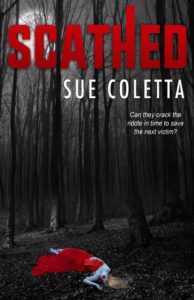
Can they crack the riddles in time to save the next victim?

I’m excited to announce my new release, SCATHED, is now available for pre-order. Only 99c. Yay!!!


Building Characters Layer by Layer

by James Scott Bell
@jamesscottbell

About a month ago Mrs. B noticed a nest starting to form under the eaves outside our front door. We began to keep an eye on things and saw a couple of doves flitting about. We started calling them Mr. and Mrs. Dove, and were happy they’d decided to build a home attached to ours. We thought it a perfect spot, too, out of the reach of our neighbor’s cats.

Then a couple of weeks ago we noticed Mrs. Dove sitting in the nest each time we went out our door. Just sitting there, day after day. Obviously, a happy event (or two or three) is about to hatch.

There was also a stretch of days when we didn’t see Mr. Dove at all. I told Cindy, “I hope he’s not out having a worm with the boys.” I imagined a Far Side-style cartoon of a couple of male doves, with fedoras pushed back on their heads, holding martini glasses with worms in them. I imagined them in a bar called The Wiggle Room.

But I digress (I wish I could draw!)

Then one day I was sitting in my courtyard which offers a view of the pitched roof above the place where the nest is. And I saw Mr. Dove walk across it, one end to the other. He continued to higher ground, the jut of our garage roof, where he could survey all of the territory around the house.

He was protecting his wife and kids. So I took this picture:

Mr. Dove on the lookout

My admiration for Mr. Dove went up a mile. Good man! Good bird!

My view of Mr. Dove changed not by what he felt, but by what he did.

Which is how readers respond to characters. Not by what they feel, but by what they do. When we see a character acting with strength of will in pursuit of a worthy goal, we begin to care, and only then does emotional response deepen the experience.

As the great writing teacher Dwight V. Swain put it in his book Creating Characters, all “traits are abstract and general. Behavior is concrete and specific. ‘What does he or she do?’ that demonstrates any given point is what’s important.”

Over the years, as the teaching of the writing craft became mainstream, two approaches emerged that occupy the same relationship as plotters and pantsers. For our purposes I’ll refer to them as the Dossier Doers and the Discovery Kids.

With a dossier, the writer constructs a thorough background of the character before the actual writing begins. Marcel Proust was this kind of writer. He developed an extensive questionnaire for his characters, with such queries as:

  • What is your idea of perfect happiness?
  • Who is the greatest love of your life?
  • What is your greatest fear?
  • What is your greatest regret?
  • What is your motto?

You can find Proust’s questions, and other character-building questionnaires online. I have nothing against this method if it works for you. The caution I have is that when you do it this way, you pretty much lock in that character to the profile you create. As your story unfolds, the slings and arrows of the plot might operate to an extent that you wish your character had a different background altogether.

With the discovery method, you begin with a certain degree of knowledge, but then let the character react in the various scenes and watch them grow along with the story. Some authors prefer to do a first draft and then, upon rewrite, add layers to the character. “You simply can’t foresee all the facets of a story’s development,” says Swain, “and trying to out-guess every turn and twist may hang you up for longer than you think.”

Personally, I get bored quickly if I have to fill out a long questionnaire, or write a comprehensive biography. I’d rather add things as I go along, in keeping with the needs of the plot.

Which is not to say I start with a blank slate. I do need a few things in place before I get going. At a minimum they are:

A Visual. When I see the face of my character, it automatically starts the cauldron bubbling with possible characteristics. So I immediately figure out my character’s age and then go looking on the internet for a headshot that reaches out and says, “I’m your character.” I want the image to surprise me a bit, too.

A Voice. I begin a voice journal, which is a free-form document of the character talking to me. I may prod them with questions, but I mainly want to keep typing until a distinctive sound begins to appear. As a bonus, what the character tells me about their background may prove useful in the book.

A Want. What is the thing this character, at this point in time (as the story begins), want more than anything in the world? To become a great lawyer? Nun? Piano player?

A Mirror. As TKZ regulars know, I am big into the “mirror moment.” So I begin to brainstorm this early. It’s subject to change, but I’m finding more and more that it operates as my North Star, shining its light on the whole book. Knowing it up front is a tremendous help.

A Secret. I’ve found this to be a useful item to have in your back pocket. What is one thing character knows that he doesn’t want any of the other characters to know?

After my Lead is given this treatment, I move to my other major characters and go through this process again, paying special attention to casting for contrast. I want there to be the possibility of conflict among all the cast members.

Along the way I’ve constructed my signpost scenes, so pretty much have the plot trajectory down.

Now I write, and as I do I allow the characters to help me flesh out the scenes which, in turn, adds layers to characters.

For instance, let’s say I know I’ll have a scene early where my lawyer, a woman, is told by one of her senior partners to quickly settle a case. She doesn’t want to. She thinks it’s a winner. At the end of the scene, the partner has issued her a mild threat—play ball, or your future here is limited.

In my mind, this scene would leave my lawyer angry and maybe a bit afraid. This is supposed to be her dream job. So she goes back to her office and writes an angry email to the partner. Then deletes it.

Then I’ll ask, what if she does something else? What if she quits? Maybe this is just what she needs to do at this point in her life! I could then construct a bit of backstory about how she was afraid to do something as a little girl, how a boy taunted her for that, how she’s never taken a risk. And now she finally does.

Or what if she leaves work and goes to a bar and gets hammered? Hey, maybe she has a drinking problem.

You get the idea. The layers get added. And upon rewrite, they can be deepened and secured.

My wife and I are anxiously awaiting the birth of the little doves. I wonder of Mr. Dove will be puffing out his chest a little bit more when it happens. Hmm, maybe when he was a young dove he had an encounter with a cat, and…

So what is your preferred method for building characters?

First Page Critique: Into the past with DEATH KNELL

Photo: “Tree Tunnel” by Gaurang Alat, courtesy unsplash.com

Good morning, and let’s give a hound-dog howdy to Anon du jour, who has gathered up a seemingly endless supply of courage and submitted the first page of work-in-progress DEATH KNELL for our collective consideration!

Title:  Death Knell

Chapter One: The Visitor

   No one is ever who they appear to be.  Peter Templeton had this thought as he stepped out of his car and looked up into the crimson blanket that covered the evening sky.  It was a gorgeous sunset and cast a glow over his entire neighborhood. Another perfect ending to another perfect day in his now perfect life, he thought.                 

   Across the street, neighborhood children scattered and laughed.  He watched the children play for a minute and smiled. Two years ago, he sat in a small cubicle and knew it would be his grave.   Now, he was living in a world where children played on well-manicured lawns, driveways were lined with vehicles named Cadillac, Lexus and BMW, and people spoke to each other across wooden fences.  He shook his head and smiled again.

   As if on cue, a silver Mercedes drove up the driveway next door.  The driver honked two short bursts and waved as he got out. That was Simon, Peter’s neighbor and financial planner.  Simon sat in a different type of cubicle and helped old people enjoy their final days. By the look on his face, he enjoyed it as much as anyone.

   Peter waved back and thought his life in a different cubicle.  He didn’t enjoy it nearly as much as Simon did. He hated every minute of it.  When he was younger, Peter thought heartbreak and pain were the worst things he would ever experience.  But he was wrong. Boredom, he discovered then, was a whole new kind of hell. It was a living hell where you lived the same day over and over and over again.  A hell where the seconds felt like minutes, the minutes felt like hours, and the hours felt like days. A hell where you prayed for death to end the boredom. But those prayers were never answered.  They didn’t even give you the freedom to kill yourself back then. Time was the only thing he was allowed to kill.

   He looked over the lawns and thought about what a difference a few years can make.  Back then, he just existed. He was a zero then. A nobody. He was a murderer in the eyes of the law and a criminal to everyone else.  He was a loser waiting to die. And he knew the world would be a better place without him.

   Then his salvation came out of nowhere.  It pulled him from his hell and dropped him in the middle of this quiet, calm and gorgeous neighborhood.  It removed all of the failures in his life like a strong tide and cleansed them in a sea of normal society.  Gone were all the wasted dreams, lost loves, and poor decisions. Now, he was really living. He was a winner now.  And God-damn it, he loved every second of it.

   Peter took a deep breath and looked down the street again.  Tree branches made a canopy over the road. For a second, it reminded him of the tropical leaves on the island.  They formed a natural ceiling and made the island feel like a great cathedral. He looked around again and took another deep breath.  There were many funerals in that cathedral and he witnessed too many of them. He didn’t miss that at all.


Anon, you’ve got an interesting setup here. It sounds as if Peter is a guy who has taken the opportunity to reinvent himself and has done so to his satisfaction. You’re hinting just enough to bait the hook in the reader’s interest and sink it. I have the feeling that Peter’s past is going to come knocking on his door and I would love to be there when it does. You’ve got the substance down. Let’s work on the form of your project just a bit to get it ready for publishing.

— Let’s begin with a little housekeeping. The color of the text in your submission went from blue to black about halfway through it.  I’m not sure if the problem was on your end, mine or somewhere in between, but please check that on your manuscript before you send it off an agent. Your text color can be any color you like so long as it is black unless your target tells you otherwise. You also want to proofread a bit more carefully. For one example, you state in the fourth paragraph that  

Peter waved back and thought his life in a different cubicle.

You left out the word “about” or “of” between “thought” and “his.” I do this so often in my own writing when my fingers are flying faster than my brain, that I am embarrassed to the extent that I might have a tee shirt created that states “I BEAT GRAMMARLY!” A proofreader (either you or someone else) will hold you in good stead.

— With that out of the way, let’s look take a look at Peter’s interior monologue. Your story is told in the third person past tense, so we want to have a clear delineation between what Peter is directly thinking and what our omnipresent narrator is telling us. You can do this by setting Peter’s thoughts off in italics when you want to tell us what he is thinking. You can say “he thought” once in a while but if you use it once early on with the thought italicized your readers (particularly TKZ readers, who are among the most intelligent on the planet!) will get the idea. You can remind them every once in a while but using “he thought” too frequently will become as boring as “he said.” Also, please note that if Peter is engaging in an internal monologue he is going to be thinking about “my” rather than “his” now perfect life. Let’s see how that will look in your first paragraph:

No one is ever who they appear to be, Peter Templeton thought as he stepped out of his car and looked up into the crimson blanket that covered the evening sky.  It was a gorgeous sunset and cast a glow over his entire neighborhood. Another perfect ending to another perfect day in my now perfect life.

— I also got a little distracted by your use of tenses. I noted earlier that Death Knell is told in the past tense. That’s all well and good. We understand that all of the events in the book took place in the past. You need, however, to distinguish between the “past,” which is when your primary narrative occurs, and the “remote past,” which occurs before your main narrative. We use the “past perfect” tense for this. The “past perfect” tense is formed by taking the past tense of “to have” (which is “had) and combining it with the past participle of the verb you are using. It’s easier than it sounds. Here is what happens when we utilize it in the fourth paragraph of Death Knell, where Peter begins to really rock ‘n’ roll about the past and about how things are much better today:

Back then, he had just existed. He had been a zero then. 

and…

He had been a murderer in the eyes of the law and a criminal to everyone else.  He had been a loser waiting to die. And he had known the world…

It makes for easier reading, given that the reader doesn’t have to sort out the past and the remote past, as you, the author has already done it for them. Which brings us to the next thing on the list:

— Your writing style is just a bit repetitive in spots, Anon. You have a slight tendency to use the same words in close proximity to each other and to repeat what you have already stated or indicated. You are hardly alone in overwriting. I’m in that very large room with you. So is Charles Dickens. The late Harlan Ellison, in his column The Glass Teat, did a short but hilarious sendup of Dickens and the seemingly endless repetition of Tiny Tim’s classic line “God Bless us, every one!” in A Christmas Carol. To correct this,  read through your work and if you are describing the same thing over and over, or using the same word more than once in a paragraph, get rid of it and use a synonym.

Let’s look at that fourth paragraph again, where with a snip here and a clip there we can move things along just a bit faster by reducing the use of the phrase “He was”:

Back then, he had just existed. He had been a zero then, a murderer in the eyes of the law, a criminal to everyone else, and a loser waiting to die.  He had known the world…

That’s all I got, Anon. In the interest of brevity (…) I tried to focus on the broad picture and give an example or two rather than to go through and pick out each and every potential error. I will now attempt to remain uncharacteristically quiet while I give our wonderful readers a turn at commenting on your work. I sincerely hope, Anon, that you keep plugging away so that we can see the rest of Death Knell at some point in the future. And thank you for submitting to First Page Critique!


Your story is told in the past tense.  All of the events described took place in the past. The problem arises when you have to distinguish between events which took place in the past in your main narrative — and events which took place even further in the past. That’s where the past perfect comes in. It’s easy enough to use


— Peter waved back and thought about his life in a different cubicle.


Book Expo America 2018

MONTANA AUTHOR TAKES A SMALL BITE OUT OF THE BIG APPLE

The population of my Montana home town is around 25,000—about the same number of people I encountered during six days at Book Expo America (BEA) and BookCon in New York City.

BEA is the biggest annual convention of book publishers, booksellers, distributors, librarians, and authors in North America. With 840,000 square feet of exhibit space at the Javits Center and nearly 500 exhibitors, the show is so big that Publishers Weekly covers it with daily tabloid reports of 70-100 pages each.

The event is open to industry professionals, not the public. I was fortunate to be invited to check out the inner workings of the business. What a learning experience it was!

Big names draw big crowds. Celebrities launching new books stayed busy autographing advance reading copies (ARCs). Some wait lines rivaled Splash Mountain at Disney World. This year’s stars included a couple of guys named Patterson and Clinton who co-wrote a thriller, along with Nicholas Sparks, Sally Field, Barbara Kingsolver, Trevor Noah, and more.

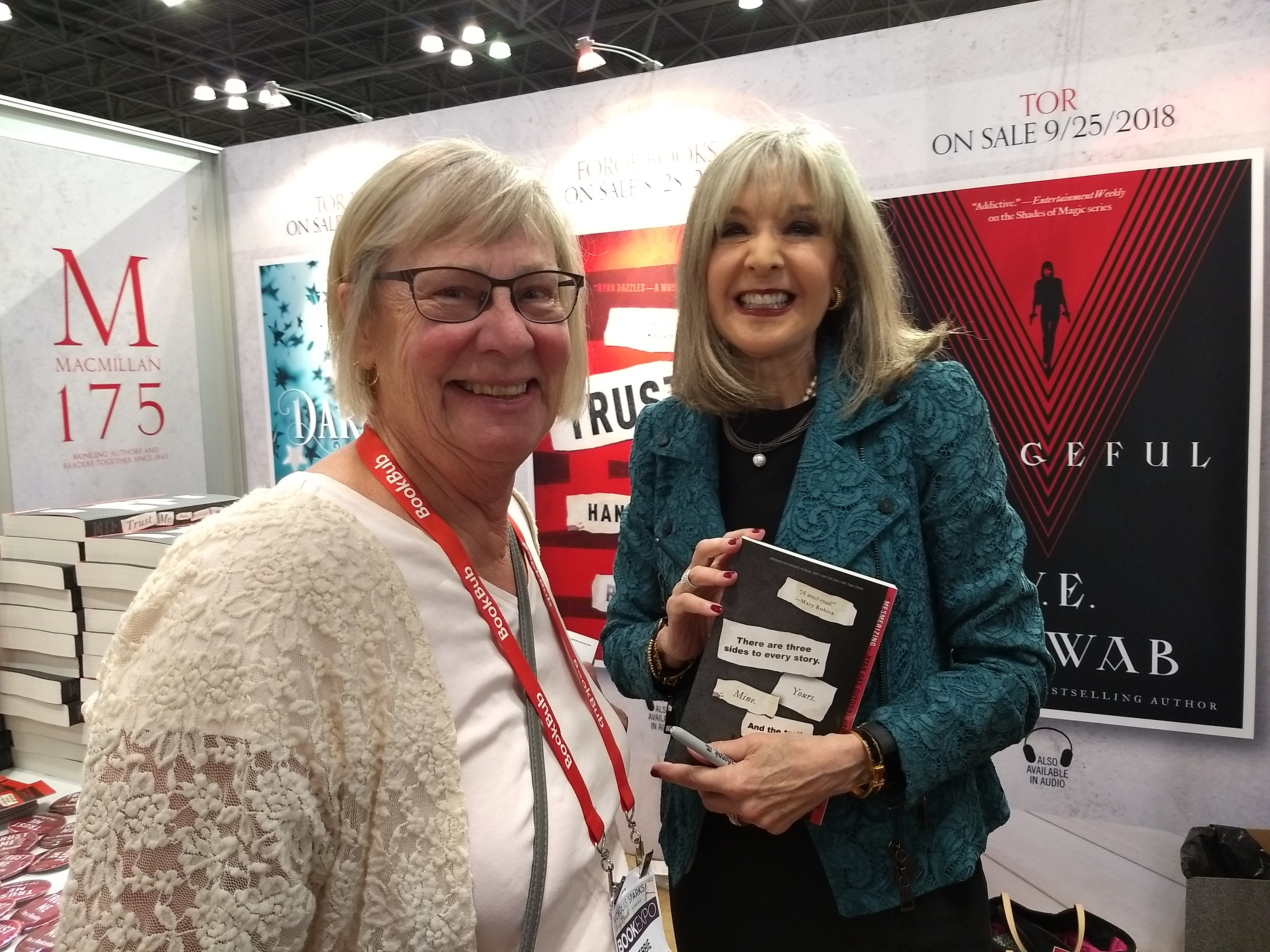
Debbie Burke and Hank Phillippi Ryan


I was delighted to meet the charming Hank Phillippi Ryan at the signing of her new book Trust Me. A few weeks before, I’d watched Hank teach a great online class sponsored by International Thriller Writers (TKZ’s own James Scott Bell also taught a segment of the webinar).

One Librarian’s Bounty


Librarians from all over the country flock to BEA to pick up bagfuls of free ARCs to help them decide what to order for the coming year. Their biggest expense must be the charge for overweight checked baggage!

Important lesson to authors: librarians are your best friends. If librarians get behind your book, their efficient network can put millions of eyes on your work. See, not all librarians are there to ruin your mood! I guess we all had that one librarian who thought they owned the place, but thinking about it now, knowing that they have way more to do than just sitting behind a desk, maybe it’s time to cut them some slack. You may want to do some research into schools like USC Marshall to get a better understanding of what the essential roles are these days of a librarian.


Not surprisingly, Amazon isn’t exactly the most popular kid on the BEA playground. The headline of one daily report read: “Amazon’s Actions Remain a Problem,” a quote by the CEO of the American Booksellers Association. The article talked about the impact of “lost jobs, stores, and uncollected taxes” due to the online giant.

The Big Five (Hachette, HarperCollins, Macmillan, Penguin Random House, Simon & Schuster) had large showy booths on main aisles. In contrast, Amazon’s booth was in a distant corner, far from the entrance.

Since Amazon’s Kindle Press had published my thriller Instrument of the Devil, I trekked all the way to the rear of the exhibit hall to visit them. But when I got there…..

Black curtains surrounded all four sides of the booth. Through the gauzy fabric, I could see people moving inside. But there was no entrance.

Hmmm.

Upon further investigation, I was told Amazon specifically requests a private booth for book publicists to meet with major media to pitch upcoming titles.

Oh.

In addition to the Big Five, scores of indie publishers had booths, representing niche markets for religious, ethnic, political and social issues, health and fitness, food and cooking, short fiction collections. No matter what off-the-wall subject you imagine, chances are someone has published a book about it that shows up at BEA.

Children’s and YA book publishers were out in force, introducing thousands of new products: print books, graphic novels, puzzles, interactive 3D devices, plus tie-in merchandising like costumes, cuddly stuffed characters, sports equipment, etc. There were even quaint retro items like pens and stationary. Could writing actual letters be making a comeback?

Waiting for autographs from their favorite authors


BEA runs from Wednesday through Friday for industry pros. BookCon follows on the weekend and is open to the public. Thousands of readers crowded the Javits Center on Saturday and Sunday. They pored over new releases, waited in line for autographs from favorite authors…

BookCon 2018


…and posed for photos dressed up as popular book characters.

Older folks (like myself) often complain about young people zombie-walking through life with bent necks, mesmerized by their smartphones. Yet at BookCon, I didn’t notice a single example of that disconnection. Kids engaged with each other and were excited about new adventures in reading. Witnessing that gave me hope.


Audio book sales continue to grow by double digits, 30+% increase in the last year alone.

A major BEA sponsor for 2018 was Blackstone Publishing. In 1987, the family-owned independent audio publisher started producing cassettes in a garage in Ashland, Oregon. They tapped into the town’s renowned Shakespeare Festival for narrating talent.

Three decades later, Blackstone has expanded into a full-service publisher of print and e-books in addition to audio, employing more than 200 people. Still headquartered in Ashland, they’ve increased their presence in NYC with acquisitions editors, audio narrators, and a sound studio that’s second to none.

Blackstone also showed me firsthand what a debut author’s dream launch should look like.

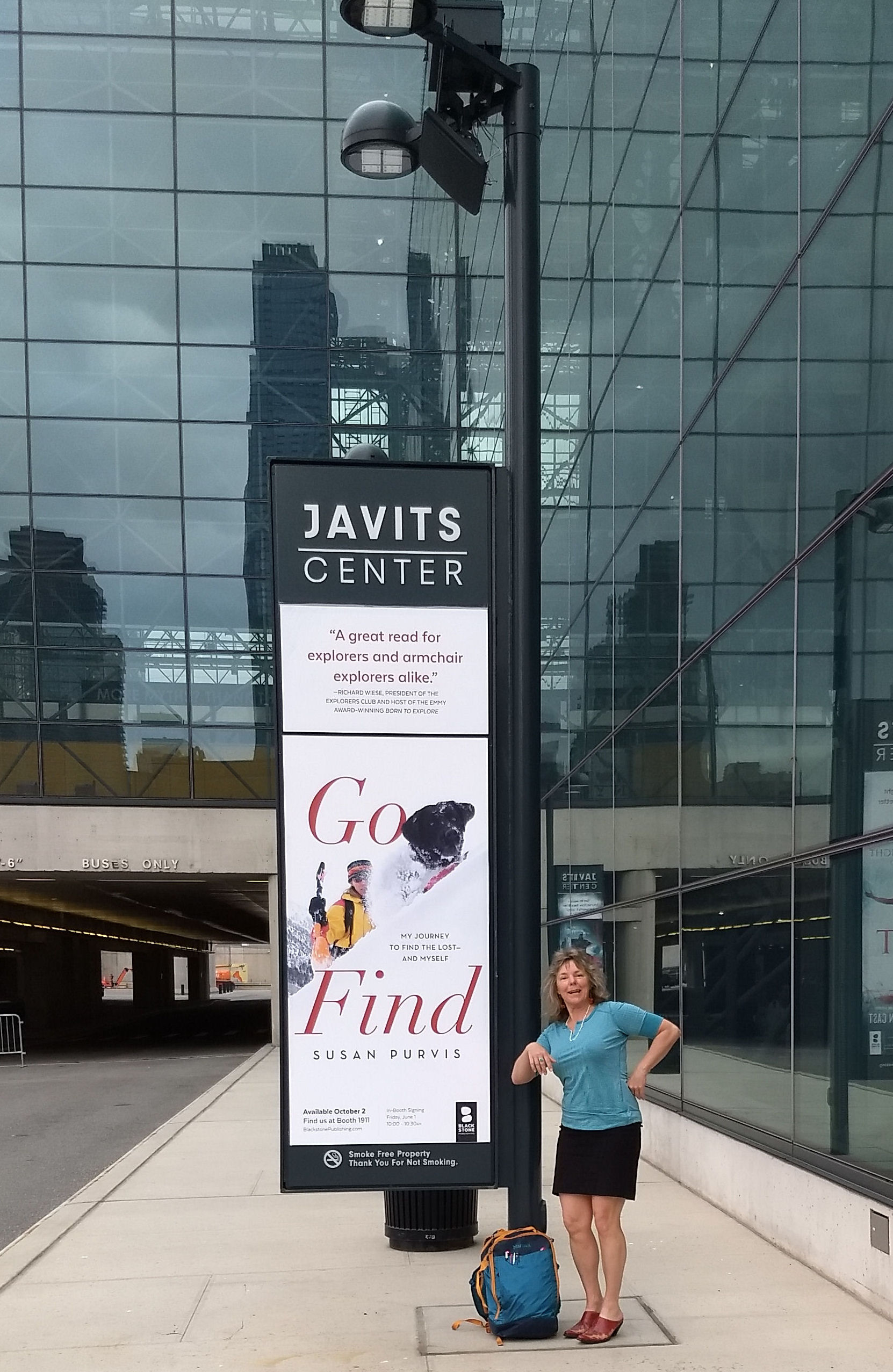
Excited debut author Susan Purvis with the banner of her new book

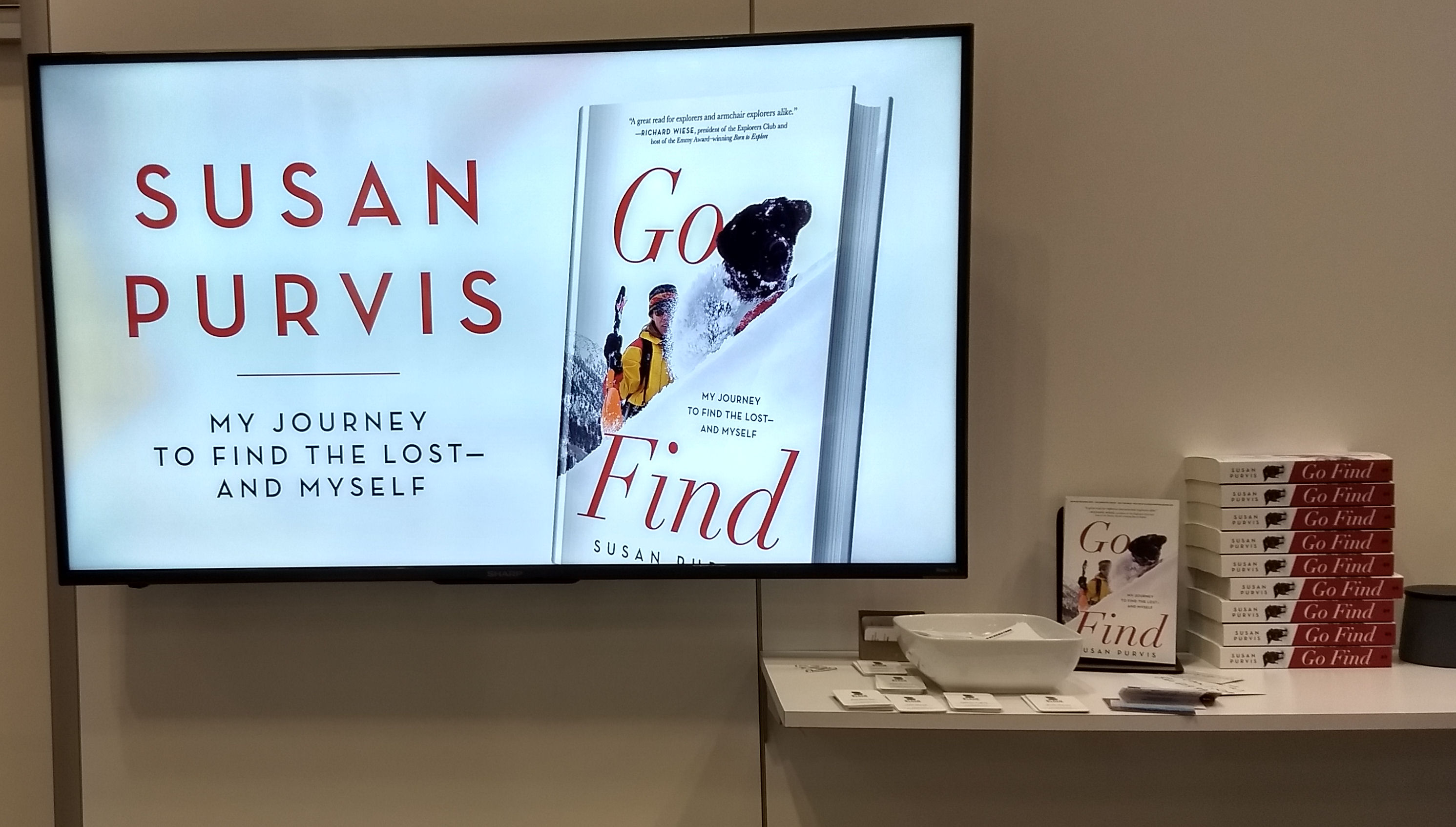
Last April, I wrote about cadaver dogs and mentioned Susan Purvis’s upcoming memoir, Go Find, which Blackstone is publishing. At BEA, they rolled out the red carpet for Susan, including a 10-foot-tall banner at the entrance of the Javits Center.

At their booth, lighted signs showcased new releases. Book covers were displayed on video screens. During signings, representatives guided people through the waiting line, graciously giving out swag including postcards, book bags, and ARCs.

This contrasted sharply with some author signings sponsored by bigger houses where I wondered if cattle prods might be in use!


Blackstone’s good treatment of authors has resulted in them picking up bestsellers like Orson Scott Card, cozy queen M.C. Beaton, and mother-daughter fantasy writers P.C. Cast and Kristin Cast.

Despite BEA’s gargantuan scope, it offered opportunities to make personal contacts.

A couple of hours into the first morning, I sank down at a vacant table, already exhausted, eyes glazing over. A woman with a similar dazed expression sat across from me and we commiserated about feeling overwhelmed. Her name was Bee Kapitan, a designer from Vancouver. She had just received an Independent Publisher Award for her interactive e-book How To Say Cheese. I showed her the proposed cover for my new book, Stalking Midas, and she graciously made suggestions. She introduced me to the burgeoning world of interactive book design. We’ll be keeping in touch.

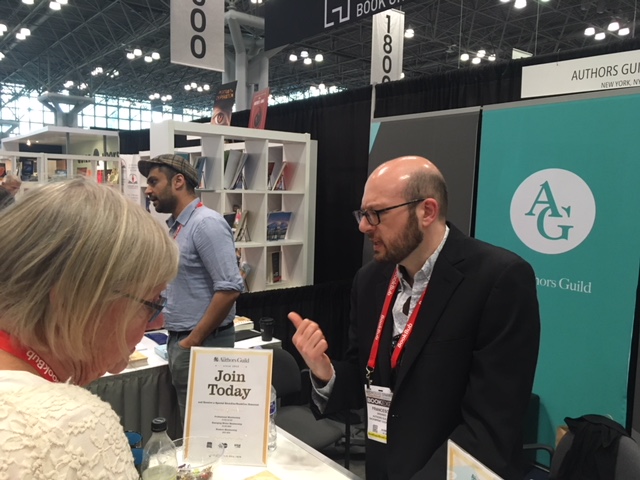
I’m learning from Umair Kazi (l) and Francesco Grisanzio (r)

Another valuable connection occurred with the Authors Guild. I knew of their excellent advocacy for writers but hadn’t gotten around to joining. At their booth, I talked with staff attorney Umair Kazi and digital services coordinator Francesco Grisanzio about rights reversion. Their guidance helped me make a career decision I’d been putting off. Needless to say, after their assistance, I signed up to become a member.

Another service they offer to authors is contract review. Before you sign a publishing contract, AG attorneys will review it and clarify the Byzantine maze of legalese. That alone is worth the $125 annual dues.

Authors Guild has also forged a communication channel into Amazon to register author complaints. Hopefully AG’s advocacy will temper Amazon’s review policies that, to authors, often appear capricious and arbitrary.

BEA gave me amazing insight into the publishing business. If I included all the adventures and interesting people I met in the Big Apple, this post would run into next week!

I’ll stop now and turn it over to TKZers for questions and comments.

A final post script: on the trip home I was privileged to meet a 91-year-old Holocaust survivor. That story is too long to add here but it can be found on my blog.

Thank You. Thank You Very Much.


Book photo by Svetlana Lukienko/Canva

The other day I conducted an informal Facebook poll asking if people read acknowledgement pages in books. Because folks who respond to online polls are self-selecting, I wouldn’t make bank on the results. Still, they rather surprised me.

After a brief intro, my direct question was, “Do you read acknowledgement pages?” (Pretty tricky, huh?) All forty-some commenters said that they do. Some said so quite emphatically. Confidentially, I need to hire a better pollster because it wasn’t the answer I was looking for. I find writing out the acknowledgements for a book terrifying. There are writers who do it elegantly, and writers who don’t do it at all. Mine are never elegant, and I know I always forget someone important. (And anyone who helps even slightly with a book is important.) I was half-hoping I would learn that no one reads acknowledgements and they think they’re a waste paper. That way I could go on with other projects. It took me five days of dithering and starting and stopping before I finally got them finished. I write fiction for a reason. Acknowledgements are reality in a very pure form.

I like thanking people. I really do! I’m a regular thank-you note writer, and have been since the days when my mother stood over me to make sure I did them. For me, saying thank you for something is often easier than asking for help in the first place. But not in the case of writing acknowledgments. There’s something so absolutely final about writing acknowledgements. They’re there on paper forever–well, until it rots or the pixels die or we have a digital apocalypse, anyway. If I do it wrong, everyone will know!

I don’t have a system for writing acknowledgements. There’s a list in every novel’s notebook where I write down the names of people I mean to thank. But before I start writing what will go in the book, I always peruse my bookshelves to see what others have done. There are no existing rules that I know of.

Here are some random examples from my shelf:

Judy Blume, IN THE UNLIKELY EVENT: 3+ pages

Johnny Shaw, FLOODGATE: 1 page

Con LeHane, MURDER IN THE MANUSCRIPT ROOM: 1+ page

Elmore Leonard, BE COOL: A brief paragraph with song attributions and a line to Aerosmith and Steve Davis. Also a line in the dedication. All at the front of the book

Margaret Atwood, THE BLIND ASSASSIN: A paragraph with the names, only, of 50 + people, then copyright content notes

Rhys Bowen, CROWNED AND DANGEROUS: 8 lines thanking several people on the dedication page

IAN RANKIN, SAINTS OF THE SHADOW BIBLE: None

That’s a small spectrum of acknowledgements, but they’re all pretty much different. Is one better than another? I don’t think so. It’s a matter of style. Do I think that a writer who only thanks three people rather than fifty is an ungrateful person? Absolutely not. I doubt readers think so.

I confess that it’s gotten more difficult for me over time. If I had a quarter of as many books as Margaret Atwood, I would probably just starting listing folks as well. One can only extoll the amazing virtues of one’s agent so many ways. At this point I have to go back and make sure I’m not repeating myself.

The FB poll opened my eyes to how important acknowledgements can be to readers, as well as reviewers and bloggers. Acknowledgements give readers a behind-the-scenes glimpse at the writer’s process and the publishing scene. They also give us a glimpse into the personality style of the writer. Or maybe not. I’m not quite decided on that. I never met Elmore Leonard, and I haven’t met Judy Blume or Margaret Atwood, but their acknowledgements styles reflect what I imagine them to be (or to have been) like. And while I don’t know the rest of the writers in my examples well, I know them enough to find their styles compatible with their personalities. And they’re all lovely people.

There are two instances where I’ll go straight to the acknowledgements page. The first is if I know it’s a heavily researched novel. I love to hear about sources. The other is if I know the writer fairly well. There are few things more embarrassing than learning a year after the fact that someone put you in their book.

Writers–How do you approach acknowledgements? I’m dying to know what your process is!

Readers–Do you read acknowledgements? Do you judge the writer by what you read? What do you look for? Please tell us!


The “eLight” League, And Other Commonly Mispronounced Words

The other day I was talking casually with a sports fan acquaintance, and  heard him refer to an “eLight” (EE-light) league. After hearing several more references to this strange-sounding league, I realized he meant to say “elite”.

The fear of mispronouncing a word is one of my secret social anxieties. I grew up in a world where one would be mocked or loftily dismissed for mispronouncing any word in the dictionary. As a child, I loved discovering new words through reading books, but I grew fearful of using them in speech after an unfortunate run in with the word “redolent “. It seemed logical to my 12 year old brain to pronounce it as “re-DOH-lent”. The drubbing I received for that mistake (turns out it’s pronounced “RED-i-lent”) made me phobic about using any fresh word in conversation unless I had looked up the pronunciation in a dictionary first.

My strict pronunciation lookup rule protected me from social humiliation until age I was 37, when I tossed the word “detritus” (pronounced as “de-TREE-tus”) into conversation with a British friend. He gave me a puzzled look.

”Do you mean detritus (dih-TRY-tus)?” he asked.

Immediately I realized my mistake. Fortunately my British friend seemed to interpret my gaffe as one of those across-the-pond linguistic mutations, and we moved on. But I renewed my commitment to my childhood pronunciation lookup rule.

By now of course, someone has written a book, YOU’RE PROBABLY SAYING IT WRONG,  about 150 commonly mispronounced words.

I fared pretty well on the article’s extracted list of commonly mispronounced, probably due to my lifelong lookup rule. It turns out I have been mispronouncing “gif”, however. The guy who invented the gif says it’s pronounced “jif”, not “gif” with a hard “g”. My dictionaries are no help on this one: they provide both pronunciations.

Damn the techie torpedoes; I’m sticking to “gif”, with a hard “g”.

Have you ever felt embarrassed because you mispronounced a word in conversation? What are some words that you tripped over?

Do you have a muse?

“There is a muse, but he’s not going to come fluttering down into your writing room and scatter creative fairy-dust all over your typewriter or computer.”

Stephen King, On Writing.

The Ancient Greeks believed there were goddesses or muses who were the sources of knowledge and inspiration for the creative arts. From Calliope and Errato in poetry to Melpomene (tragedy) and Thalia (comedy), they personified the force of creative inspiration. Even today, many people describe creativity as a capricious power to be harnessed – some even speak of it as a kind of ethereal being, who (when the mood is right) flutters down to bestow inspiration (and possibly genius) on the lucky artist or writer. I don’t hold a great deal of stock in the ides of muses, simply because as a writer I don’t have the luxury of waiting for the muse to appear. For me, inspiration comes with the active practice of writing – a ‘bum in your seat’ kind of inspiration rather than a sprinkling of fairy-dust. Although this week I found, in the midst of some dreadful first draft writing, there was a moment of inspiration – generating a single line that opened up a character and a relationship in a way I hadn’t expected. In that moment, it truly was as if I had a muse on my shoulder but she certainly wouldn’t have been able to visit had I not been typing away in the first place.

As Stephen King describes it, the muse is ‘a basement kind of guy’ and my fellow blogger, James Scott Bell often likes to refer to the ‘basement guys’ when he describes his writing process. I like the analogy, particularly because, as King says, writers still have to do the grunt work regardless – because only in burning the midnight oil can you find the bag of magic in the end. Although sometimes, especially when stuck in the middle of a chapter, I really wish there was some other-worldly goddess who could visit and endow me with talent and inspiration:)

Apart from the concept of the muse as an ethereal visitor, there’s also the real life people  that many called their muses. From Dante’s childhood sweetheart Beatrice to F. Scott Fitzgerald’s wife – these so-called muses inspired and motivated the creation of great works of art. Often times, these muses were lovers, mistresses or wives – I couldn’t find any great example of a husband muse but maybe I didn’t search widely enough! I like Anais Nin’s perspective when she wrote: “For too many centuries women have been being muses to artists. I wanted to be the muse, I wanted to be the wife of the artist, but I was really trying to avoid the final issue — that I had to do the job myself.”

I guess my only real muse is my collie Hamish – he’s my constant companion, lying on the floor by my chair while I’m writing. He’s always willing to listen as I complain or tear my hair out in frustration, and is always happy to misinterpret my triumphs (a completed chapter!) as a request to play tug with a chew toy. He willingly goes for multiple walks a day when I need to clear my head and is always content to lie next to the couch when I resort to watching Masterpiece Theatre as ‘research’.  In honor of him (and my previous collies) I always try to include at least one collie in each novel I write:) As you can see from this photo, he really is the perfect writer’s muse.


As much as I would love to embrace the whole concept of the muse, I think my attitude can be best summed up by a quote from a fellow Australian writer, Kerry Greenwood (of Phryne Fisher fame), when she said. “If I ever saw my muse she would be an old woman with a tight bun and spectacles poking me in the middle of the back and growling, ‘Wake up and write the book!'”.

So TKZers do you have a muse? If so, in what form does your muse visit (real or imagined)? Do you ever feel like you could use one to sprinkle some fairy-dust of inspiration?

Write What You Want To Know

by James Scott Bell
@jamesscottbell

It used to be the standard advice for new writers: Write what you know!

The driving idea behind that sentiment, of course, was that to write authentically, accurately, and with convincing detail you needed to stick with your own experience, for that is obviously what you know best.

Thus, for many decades, writers kept it close to home. Fitzgerald wrote about the Jazz Age as he was living it with Zelda. Hemingway wrote about World War I and its aftermath, then about other things he experienced—fishing, hunting, the Spanish Civil War. James Jones and Norman Mailer burst on the scene with novels about World War II. Harper Lee wrote about her own childhood.

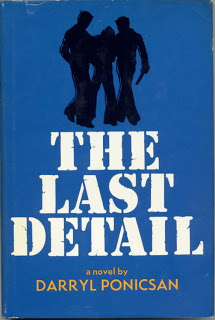
I recall when the movie The Last Detail came out, based on the novel by Darryl Ponicsan. There was a story about Ponicsan in the L.A. Times in which he talked about his decision to join the Navy at the age of 24. He did so because he wanted to expand his experience so he had something to write about.

I was a college student at the time and got a copy of the novel, read it and loved it. So I wrote a “wannabe a writer” letter to Ponicsan, care of his Hollywood agent. Mr. Ponicsan wrote me a nice letter in return, with advice and encouragement and one important caveat. The last line of his letter was, “Be prepared for an apprenticeship of years.” That was 21 years before my first novel came out.

But is Write what you know still sound advice? If you incorporate your special area of expertise in a natural fashion (say, as a lawyer writing legal thrillers), it’s fine. What’s not fine is if it’s taken as Write only what you know. That, it seems to me, destroys one of the great joys of being a writer—the ability to go anywhere, create any character, so long as you do enough research to make it all ring true.

Thus, the better advice, it seems to me, is Write what you WANT to know.

Toni Morrison

I recently came across a 2014 interview with Toni Morrison in which she said:

I may be wrong about this, but it seems as though so much fiction, particularly that by younger people, is very much about themselves. Love and death and stuff, but my love, my death, my this, my that. Everybody else is a light character in that play.

She continues:

When I taught creative writing at Princeton, [my students] had been told all of their lives to write what they knew. I always began the course by saying, “Don’t pay any attention to that.” First, because you don’t know anything and second, because I don’t want to hear about your true love and your mama and your papa and your friends. Think of somebody you don’t know. What about a Mexican waitress in the Rio Grande who can barely speak English? Or what about a Grande Madame in Paris? Things way outside their camp. Imagine it, create it. Don’t record and editorialize on some event that you’ve already lived through. I was always amazed at how effective that was. They were always out of the box when they were given license to imagine something wholly outside their existence.

What a refreshing counterpoint to sticking to “what you know.” Go outside the camp. Be reckless, be an explorer. Imagine it, then create it. Part of the imagining, of course, involved research.

As I look back on my own writing, I notice that at least half the time I’m writing about a woman protagonist.

How on earth did that happen?

Well, first of all, I find women more fascinating than men. I’m a simple creature. My wife is complex. I count our 37 years of marriage as not only an adventure in love, but also an engagement in a ton of research. Which is why Mrs. B is always the first to read my work. I need to get this stuff right.

When I came up with the concept for the Kit Shannon series, the publisher I pitched it to had the idea of teaming me up with one of its top-selling authors, Tracie Peterson. We got along famously. We brainstormed the plots and I wrote the first drafts. Tracie went over the drafts and tweaked and added more of what a woman would have thought, spoken, noticed. By the time we finished the third book, I felt I had inside me the voice we’d developed together. I was then able to go on and do three more of these novels on my own.

Which may have been the most enjoyable part of my career. I loved living through Kit Shannon, even though I have never been a woman living in 1903 Los Angeles. (Not many of us have, I venture to say.)

So follow Toni Morrison’s advice. Don’t be afraid to go outside your camp. It’s one of the great pleasures of writing fiction.

So what do you think of that old chestnut, Write what you know?