A Wannabe Writer Has Some Questions

by James Scott Bell

Good morning, class. You in the back, you’ve had your hand in the air from the moment I walked in. I suppose you have a question or wish to use the bathroom.

I have a question. I think I want to be a writer. Should I go for it?

No.

Wait, what? Isn’t that what this class is about?

If you only “think” you want to be a writer, you’re running a race with ankle weights. The writers who make it in this game know they want to write.

All right. I know I want to write. Now what?

I pass along to you the advice of Mr. Lawrence Block: “If you want to write fiction, the best thing you can do is take two aspirins, lie down in a dark room, and wait for the feeling to pass. If it persists, you probably ought to write a novel.”

I have that feeling! I really, really do. So how do I write something that will sell a lot of copies?

You write something a lot of people want to read.

Does that mean I should look at what’s popular and write a book like that?

That worked for Nicholas Sparks. When he started out, he looked at the market and determined there was room for only two mega best-selling authors in a genre. He found one genre that had only one name: tear-jerking romance by a man. That man was Robert James Waller and his book was The Bridges of Madison County. So Nicholas Sparks jumped in and took over the top spot.

I’m not sure there are any spots like that anymore, unless you drill down into things like steampunk zombie erotica. But that’s a pretty small audience.

Instead, concentrate on finding your own “sweet spot.” That’s the nexus between what you love to write and what readers love to read. When you write in a genre you love, you can give your pages that added juice that raises it above mere workmanlike prose. It’s what gives you “voice.”

So if I find that sweet spot, that will guarantee I’ll sell a lot of copies?

There are no guarantees in the writing life. If you’re looking for a guarantee, buy a refrigerator with a good warranty. The overwhelming majority of writers who continue to sell build a readership over time. Rare is the home run with your first at bat. Keep writing and keep studying your craft.

What’s the best way to market a book?

There is endless advice on this, so let me simplify. The best marketing has always been “word of mouth.” You write a book a lot of people enjoy, and they reflect that in reviews and wherever they talk about the books they’re reading—from social media to the kitchen table.

You can spend a lot of money on fancy ads and trailers, but if the book doesn’t please, that’s money down the water closet.

When I took a cruise to Alaska, we got off in one of those little tourist spots. In the gift shop was a big barrel of keychains with a rubber Alaskan bear. If you squeezed the bear, a little balloon of brown poop came out of its butt.

The Amazon bookstore is awash in pooping-bear books. Your job is to not write one of those.

Should I concentrate more on plot or more on character?

Yes.

I don’t understand.

Plot without characters we care about is flat and uninvolving. Readers turn pages because they worry about the people in the plot. Flat characters don’t make us worry, even if the plot has more twists than a pretzel.

Character without plot is the most boring thing in the world. Would you read 400 pages of Scarlett O’Hara sitting on her front steps flirting and complaining? A little plot complication I call the Civil War moves things along.

Put a character we can root for into a situation that threatens them with death—physical, professional, or psychological—and you’ll be on your way.

Is it better to outline a book before writing it, or just start writing and see where it leads?

Yes.

I don’t understand!

You’ll find plenty of voices out there that champion one view against the other. You have to find what works best for you, and you can’t find that out until you’ve written at least one full-length novel. So write one. See what you learn about yourself. I’ll tell you what I learned when I started out. I wrote without any plan, just wrote, and felt alive, joyous, unstoppable! Until I was stopped. Nobody was as in love with my writing as I was.

So I began to study craft books. I learned about plot and structure. I was already pretty good on character and dialogue. But it was learning about the structure of scenes that really flipped a switch. For my next project, I used index cards to lay out my scenes. I put them on the floor and moved them around until I was happy with the pattern. That’s when I started to sell.

Is it better to write for a traditional publisher, or better to self-publish?

Yes.

Stop doing that!

What I mean is, there are pros and cons to both. Do some research. You’ll find plenty of material out there. For now, I’ll give you a couple of warnings.

If you want to go the trad route, don’t be ignorant about publishing contracts. You can start by reading this and this. A good agent can be a tremendous help. But here’s another warning: beware the schmagent.

If you want to self-publish (“go indie”) my warning is: don’t be in a hurry. If you start throwing up dreck, you’ll get a reputation for dreck. Get some feedback on your work. This site has some great advice on beta readers.

On the other hand, don’t fall into the “paralysis by over-analysis” trap. Please read this.

This all seems awfully complicated. Why can’t I just use Artificial Intelligence to write my novels?

That’s an incoherent question, or at least an incomplete one. AI doesn’t “write” novels; it masticates what’s been written by human beings, detects patterns, and spits out a thing that resembles a novel.

And certainly don’t use the word “my.” In what sense is it yours if it’s done for you by a machine?

I am not a Luddite. I know AI is here to stay, and has benefits. It helps tremendously with research, like Google on steroids. It can help you brainstorm if you hit a creative cul-de-sac. My warning is that over-dependence on AI for creativity doesn’t do your brain any good. In fact, it can lead to atrophy of the most important feature of your writing—you, your voice, your style.

So what’s my next step?

Go home and write something. Class dismissed.
Book Expo America 2018

MONTANA AUTHOR TAKES A SMALL BITE OUT OF THE BIG APPLE

The population of my Montana home town is around 25,000—about the same number of people I encountered during six days at Book Expo America (BEA) and BookCon in New York City.

BEA is the biggest annual convention of book publishers, booksellers, distributors, librarians, and authors in North America. With 840,000 square feet of exhibit space at the Javits Center and nearly 500 exhibitors, the show is so big that Publishers Weekly covers it with daily tabloid reports of 70-100 pages each.

The event is open to industry professionals, not the public. I was fortunate to be invited to check out the inner workings of the business. What a learning experience it was!

Big names draw big crowds. Celebrities launching new books stayed busy autographing advance reading copies (ARCs). Some wait lines rivaled Splash Mountain at Disney World. This year’s stars included a couple of guys named Patterson and Clinton who co-wrote a thriller, along with Nicholas Sparks, Sally Field, Barbara Kingsolver, Trevor Noah, and more.

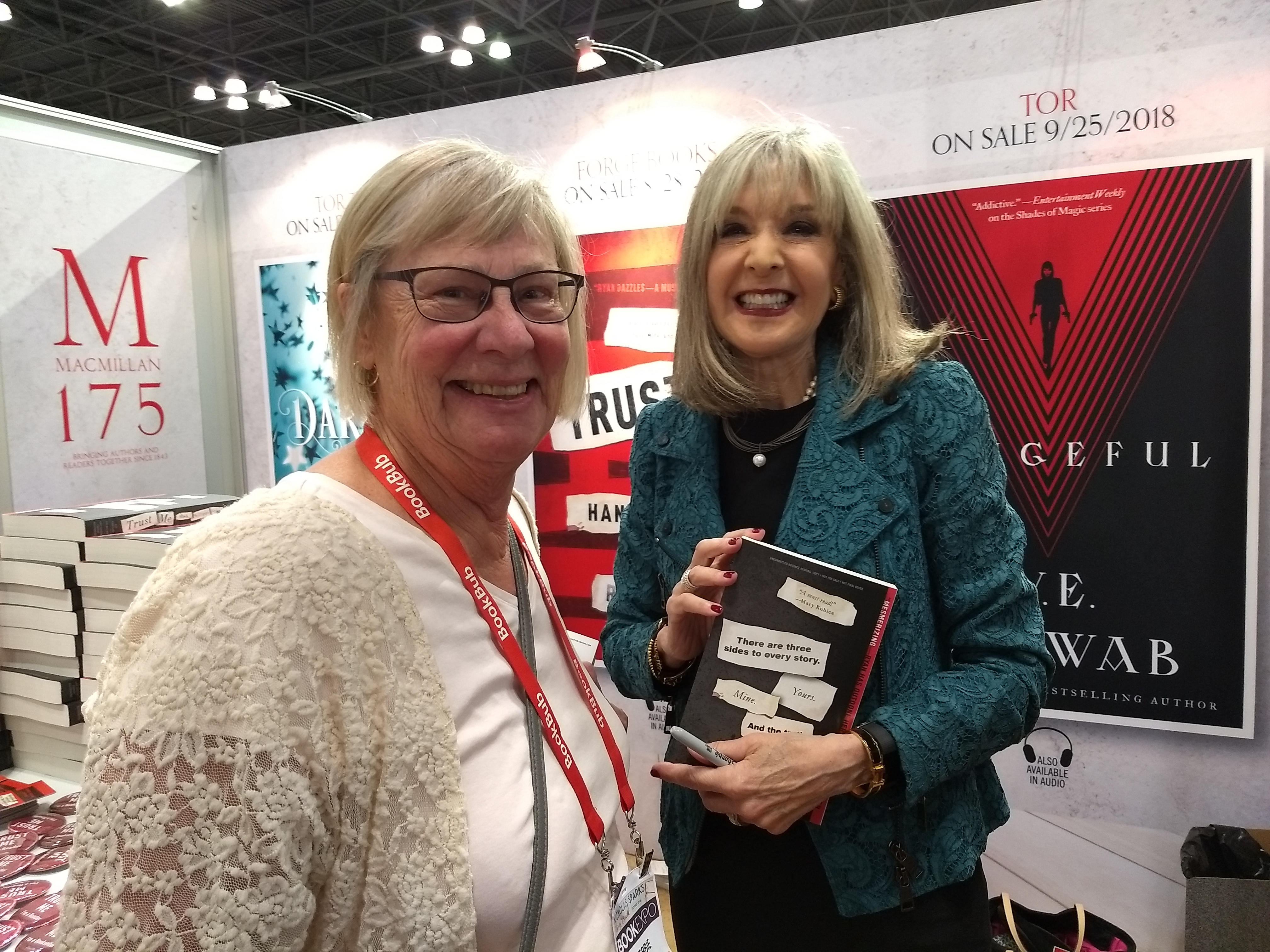
Debbie Burke and Hank Phillippi Ryan


I was delighted to meet the charming Hank Phillippi Ryan at the signing of her new book Trust Me. A few weeks before, I’d watched Hank teach a great online class sponsored by International Thriller Writers (TKZ’s own James Scott Bell also taught a segment of the webinar).

One Librarian’s Bounty


Librarians from all over the country flock to BEA to pick up bagfuls of free ARCs to help them decide what to order for the coming year. Their biggest expense must be the charge for overweight checked baggage!

Important lesson to authors: librarians are your best friends. If librarians get behind your book, their efficient network can put millions of eyes on your work. See, not all librarians are there to ruin your mood! I guess we all had that one librarian who thought they owned the place, but thinking about it now, knowing that they have way more to do than just sitting behind a desk, maybe it’s time to cut them some slack. You may want to do some research into schools like USC Marshall to get a better understanding of what the essential roles are these days of a librarian.


Not surprisingly, Amazon isn’t exactly the most popular kid on the BEA playground. The headline of one daily report read: “Amazon’s Actions Remain a Problem,” a quote by the CEO of the American Booksellers Association. The article talked about the impact of “lost jobs, stores, and uncollected taxes” due to the online giant.

The Big Five (Hachette, HarperCollins, Macmillan, Penguin Random House, Simon & Schuster) had large showy booths on main aisles. In contrast, Amazon’s booth was in a distant corner, far from the entrance.

Since Amazon’s Kindle Press had published my thriller Instrument of the Devil, I trekked all the way to the rear of the exhibit hall to visit them. But when I got there…..

Black curtains surrounded all four sides of the booth. Through the gauzy fabric, I could see people moving inside. But there was no entrance.

Hmmm.

Upon further investigation, I was told Amazon specifically requests a private booth for book publicists to meet with major media to pitch upcoming titles.

Oh.

In addition to the Big Five, scores of indie publishers had booths, representing niche markets for religious, ethnic, political and social issues, health and fitness, food and cooking, short fiction collections. No matter what off-the-wall subject you imagine, chances are someone has published a book about it that shows up at BEA.

Children’s and YA book publishers were out in force, introducing thousands of new products: print books, graphic novels, puzzles, interactive 3D devices, plus tie-in merchandising like costumes, cuddly stuffed characters, sports equipment, etc. There were even quaint retro items like pens and stationary. Could writing actual letters be making a comeback?

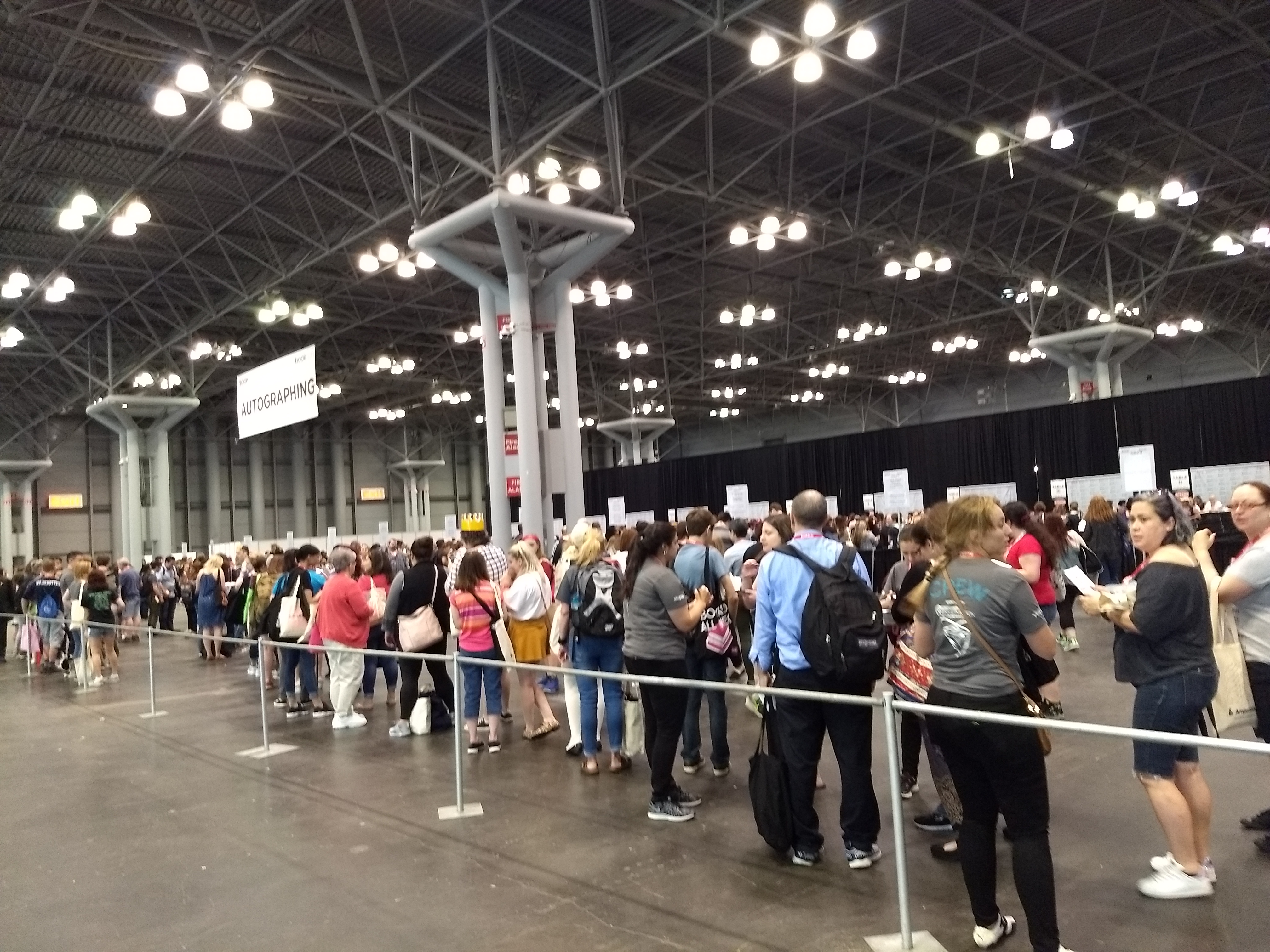
Waiting for autographs from their favorite authors


BEA runs from Wednesday through Friday for industry pros. BookCon follows on the weekend and is open to the public. Thousands of readers crowded the Javits Center on Saturday and Sunday. They pored over new releases, waited in line for autographs from favorite authors…

BookCon 2018


…and posed for photos dressed up as popular book characters.

Older folks (like myself) often complain about young people zombie-walking through life with bent necks, mesmerized by their smartphones. Yet at BookCon, I didn’t notice a single example of that disconnection. Kids engaged with each other and were excited about new adventures in reading. Witnessing that gave me hope.


Audio book sales continue to grow by double digits, 30+% increase in the last year alone.

A major BEA sponsor for 2018 was Blackstone Publishing. In 1987, the family-owned independent audio publisher started producing cassettes in a garage in Ashland, Oregon. They tapped into the town’s renowned Shakespeare Festival for narrating talent.

Three decades later, Blackstone has expanded into a full-service publisher of print and e-books in addition to audio, employing more than 200 people. Still headquartered in Ashland, they’ve increased their presence in NYC with acquisitions editors, audio narrators, and a sound studio that’s second to none.

Blackstone also showed me firsthand what a debut author’s dream launch should look like.

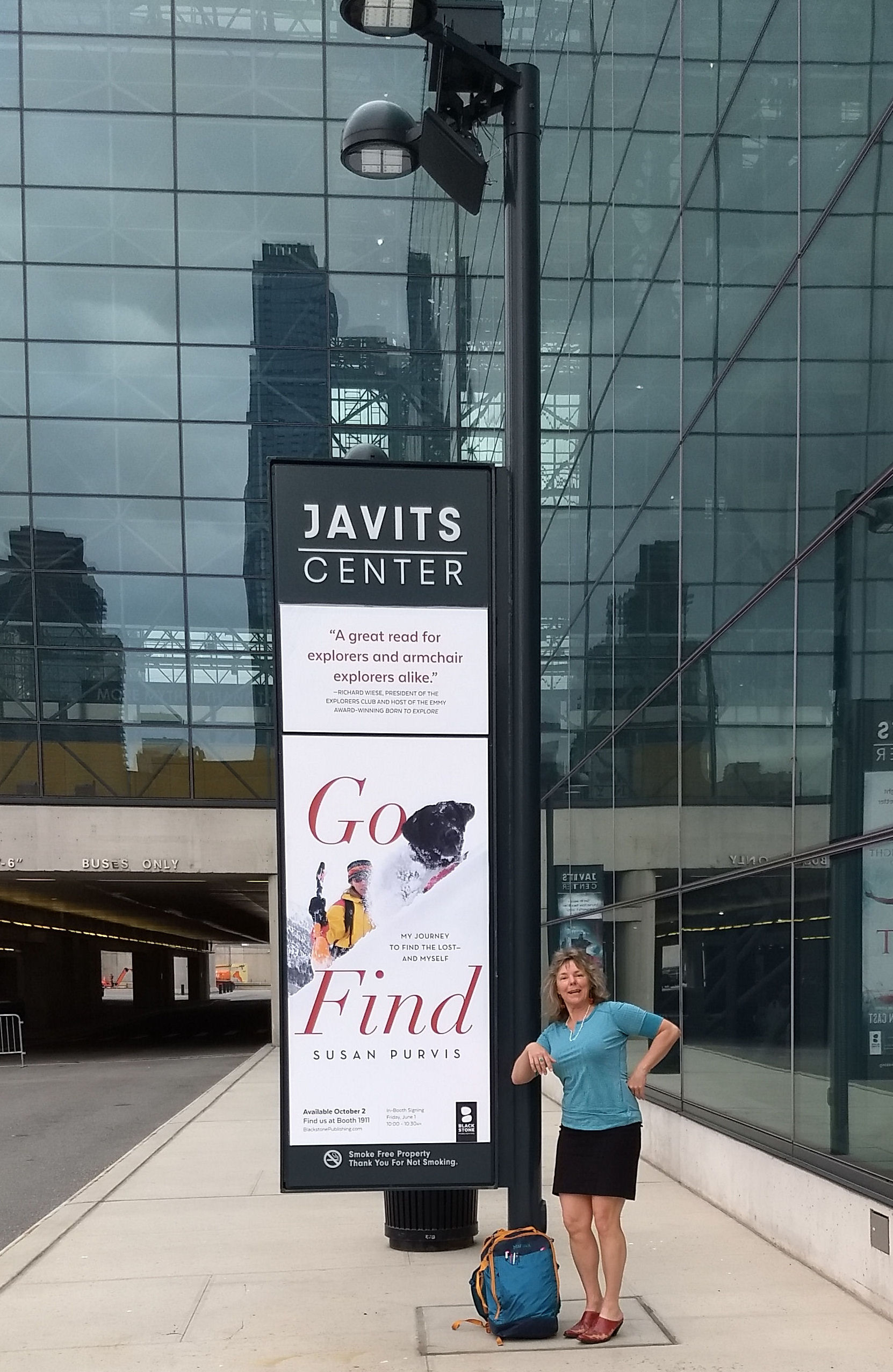
Excited debut author Susan Purvis with the banner of her new book

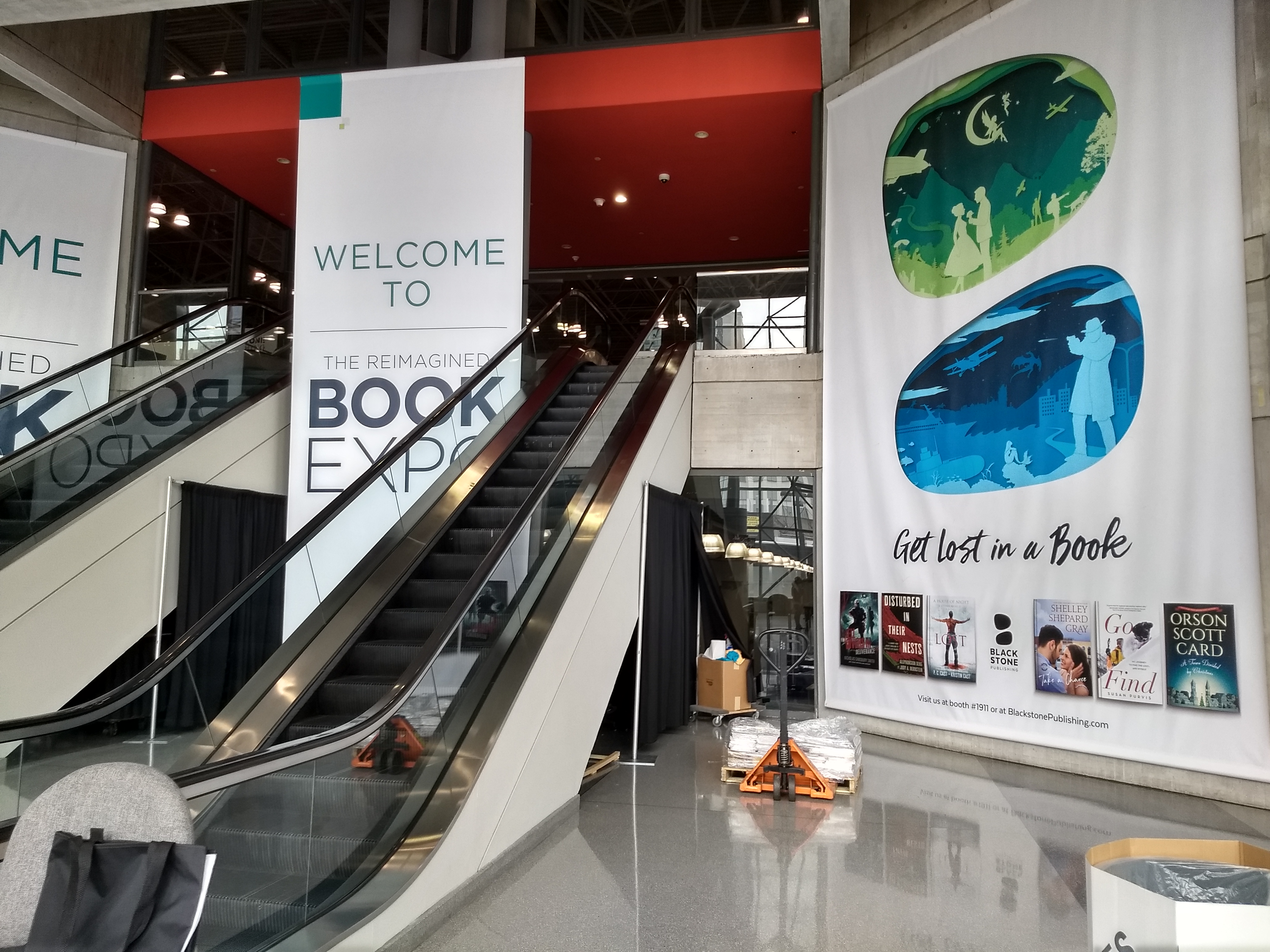
Last April, I wrote about cadaver dogs and mentioned Susan Purvis’s upcoming memoir, Go Find, which Blackstone is publishing. At BEA, they rolled out the red carpet for Susan, including a 10-foot-tall banner at the entrance of the Javits Center.

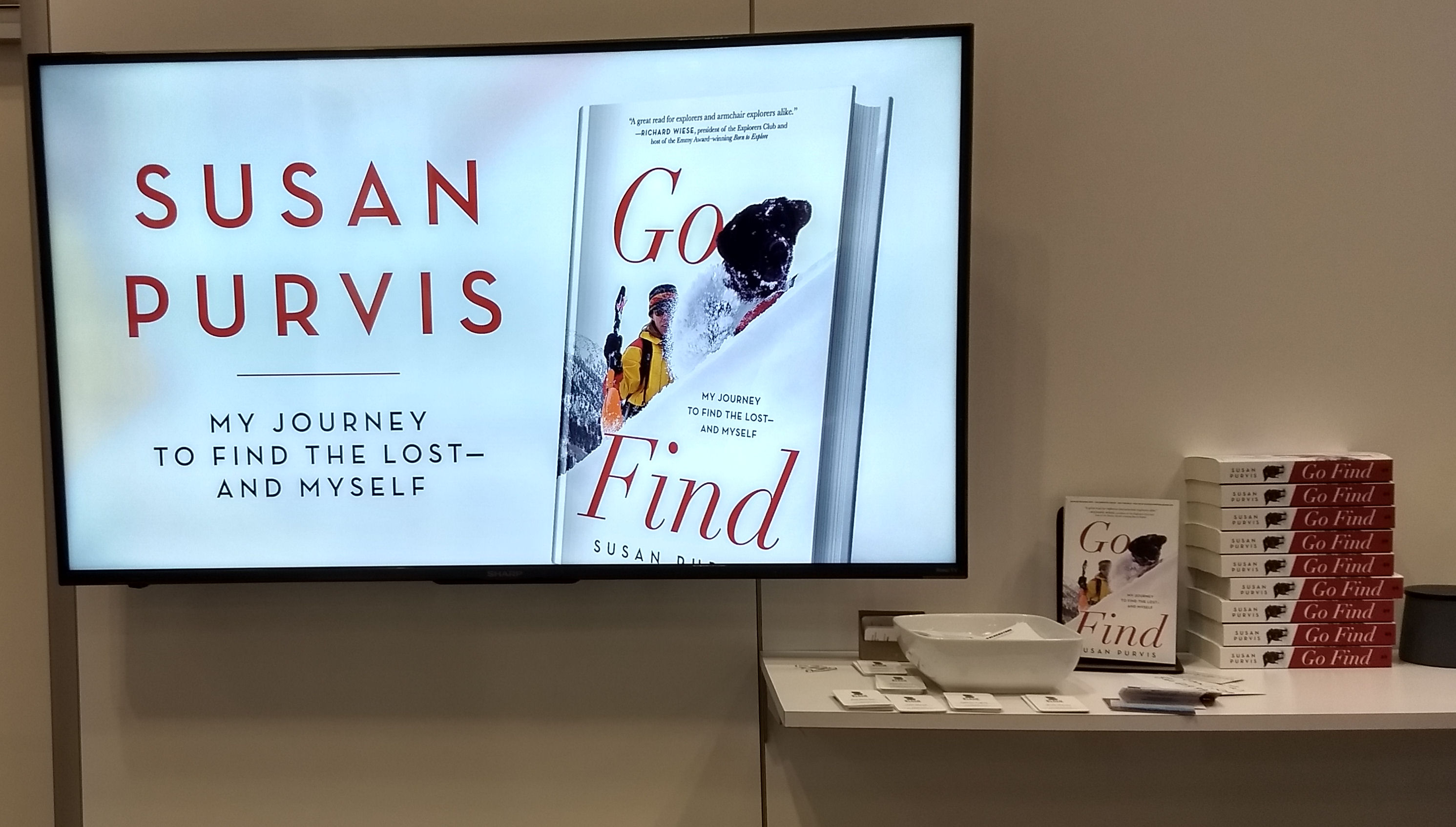
At their booth, lighted signs showcased new releases. Book covers were displayed on video screens. During signings, representatives guided people through the waiting line, graciously giving out swag including postcards, book bags, and ARCs.

This contrasted sharply with some author signings sponsored by bigger houses where I wondered if cattle prods might be in use!


Blackstone’s good treatment of authors has resulted in them picking up bestsellers like Orson Scott Card, cozy queen M.C. Beaton, and mother-daughter fantasy writers P.C. Cast and Kristin Cast.

Despite BEA’s gargantuan scope, it offered opportunities to make personal contacts.

A couple of hours into the first morning, I sank down at a vacant table, already exhausted, eyes glazing over. A woman with a similar dazed expression sat across from me and we commiserated about feeling overwhelmed. Her name was Bee Kapitan, a designer from Vancouver. She had just received an Independent Publisher Award for her interactive e-book How To Say Cheese. I showed her the proposed cover for my new book, Stalking Midas, and she graciously made suggestions. She introduced me to the burgeoning world of interactive book design. We’ll be keeping in touch.

I’m learning from Umair Kazi (l) and Francesco Grisanzio (r)

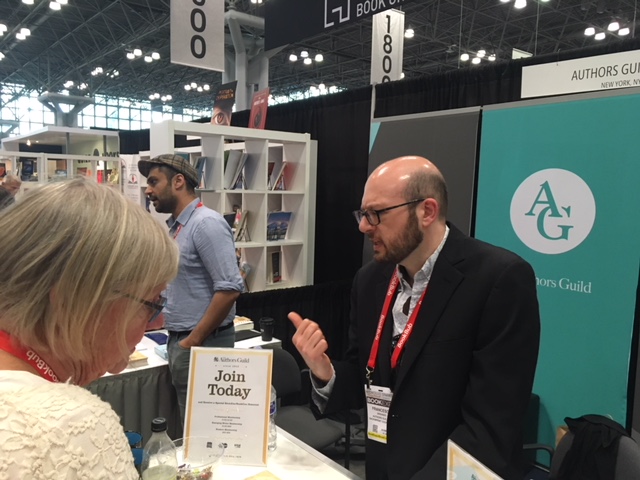
Another valuable connection occurred with the Authors Guild. I knew of their excellent advocacy for writers but hadn’t gotten around to joining. At their booth, I talked with staff attorney Umair Kazi and digital services coordinator Francesco Grisanzio about rights reversion. Their guidance helped me make a career decision I’d been putting off. Needless to say, after their assistance, I signed up to become a member.

Another service they offer to authors is contract review. Before you sign a publishing contract, AG attorneys will review it and clarify the Byzantine maze of legalese. That alone is worth the $125 annual dues.

Authors Guild has also forged a communication channel into Amazon to register author complaints. Hopefully AG’s advocacy will temper Amazon’s review policies that, to authors, often appear capricious and arbitrary.

BEA gave me amazing insight into the publishing business. If I included all the adventures and interesting people I met in the Big Apple, this post would run into next week!

I’ll stop now and turn it over to TKZers for questions and comments.

A final post script: on the trip home I was privileged to meet a 91-year-old Holocaust survivor. That story is too long to add here but it can be found on my blog.