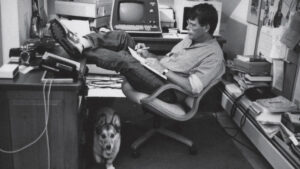
 When I was growing up, immersed in dreams of one day becoming a writer, I romanticized what the process must be like. Where would one go to imagine new worlds and create new adventures? Movies romanticized the whole process, and I bought into it. Then I saw this now famous picture of a then less-famous Stephen King in his writing space. It seemed so . . . ordinary. Yet at the same time it seemed very special. The dog under his feet is a nice touch. This is a guy with a job. And his creative space is . . . an office. Just an office. But of course, it’s more than that. It’s Stephen King’s office. (As you’ll see below, it turns out that I was not the only budding young writer who was impressed by the photo.)
Offices are important–more important to some than to others. In some ways, creative spaces reflect the personalities of their occupants. They fascinate me.
Following up on a comment made on Friday’s Reader Friday post by our beloved Brother Bell, I sent emails to my fellow bloggers here at TKZ, suggesting that we let our readers into our creative spaces. My one caveat was a pinky swear to not clean up before taking the picture. Here’s what we came up with.
John Gilstrap
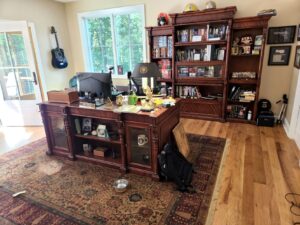 Our move to West Virginia presented a unique opportunity to design an office as an office–as opposed to a purloined bedroom. Now that I think about it, I suppose there’s not a lot of difference between the two. I wanted lots of light and direct access to the outdoors. That door leads to a deck that overlooks the woods. The orange helmet on the left end of the bookcase belonged to my father. A closer look will show that it’s quite banged up from the helicopter crash he survived on the deck of the USS Forrestal in 1959. The two yellow helmets are mine from the two jurisdictions where I ran fire and rescue. (I had to turn my white lieutenant’s helmet back in when I left.) Since the house is now run by a 12-pound ball of fur named Kimber, chew toys and water bowls litter the floor of every room.
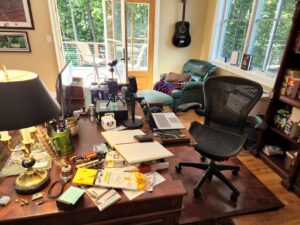 Here it is from a different angle. This is messier than it normally is, but a pinky swear is a pinky swear. Note the studio grade microphone and the webcam–a new bit of ubiquity in office photos, I’ve found. All of those Gilstrap books stacked on the far end of the bookcase are the background for Zooming and YouTube videos (when I start shooting them again). The opened journal you see on the desk is one of many that I have stacked around the place (each novel gets a new journal). That’s where I scratch my way through difficult parts of the story that are somehow resistant to being typed. That green chair in the corner used to belong to me. Now it’s Kimber’s day bed and she gets very annoyed if I move the blanket from where she left it.
Kristy Montee (PJ Parrish)
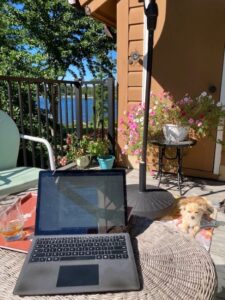 When we moved out of Fort Lauderdale five years ago, it meant big downsizing. As some wag said (might have been George Carlin): You spend the first half of your life accumulating stuff and the second half getting rid of it. We now live half the year in Tallahassee and half in Traverse City, Michigan. We don’t have the luxury of an extra “office” space anymore, so I store everything on line and cart my laptop around wherever the spirit moves me. Often it’s the sofa, but more likely my local coffee shop or after 4, the Traverse City Whiskey Co. where they make a mean whiskey sour. On spectacular days like today, the balcony will do.
Terry Odell
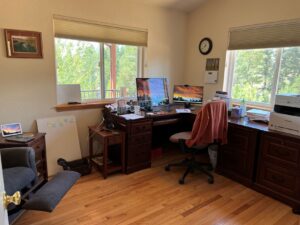 I’m fortunate to have a bedroom dedicated to me. This is my workspace, which doesn’t show my cluttered closet space or bookshelves. The desk is also a little less cluttered than usual, since the request for the photo came on Friday, and I clear my desk on Thursday for the housekeeper. The stacks of paper next to the printer and behind the monitor represent my method of ‘housekeeping.’ The stacks will eventually topple over, and I’ll attempt to separate the wheat from the chaff.
Watching the wildlife is my biggest writing distraction. (The hummingbird feeder is just out of camera range, but not out of eyeshot if I’m sitting at my desk.)
Kay DiBianca
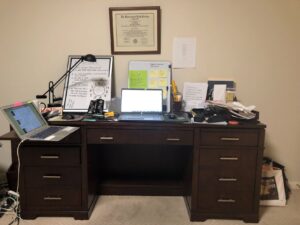
Sue Coletta
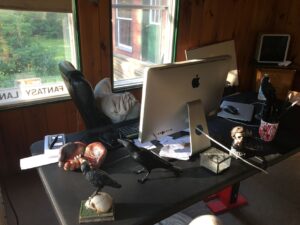 Attached are two photos of my office from different angles. The Holy Hands on my desk were made and blessed by a Cherokee chief. They hold tiny replicas of my Mayhem Series. Both gifts from a couple (readers) who said I touched their lives.
 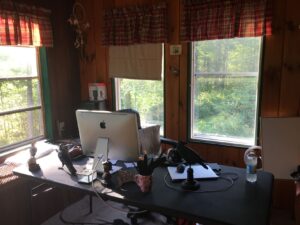 Most of the crows, as well as the crow dreamcatcher hanging above, were also gifts from readers. All mean a lot to me. Constant reminders of why I write.
Elaine Viets
 Here’s my office. I’m most comfortable surrounded by books, and many of these mysteries are signed by friends. The box with the white rug is for my cat, Vanessa. She “helps” while I work.
Garry Rodgers
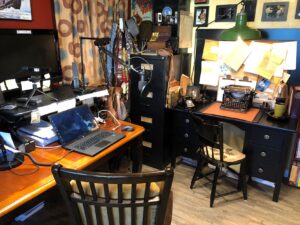 Here’s a shot of my mind lab. Brief description: “My creative place is a combination of old and new. Side-by-side, I have a Windows 11 laptop with audio/visual recording devices next to a retro 1920s private detective office with stuff like a pristine vintage typewriter and a cool rotary phone that’s tweaked to work in the digital age. Fun place. BTW, that filing cabinet is stuffed full of books.”
James Scott Bell
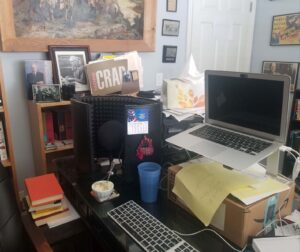 My desk, with microphone and sound foam. To the left, pics of Stephen King (with legs on desk), Ed McBain, and John D. MacDonald, all telling me to stop whining and write. My coffee mug with WRITER on it, which I bought a few days after I decided I had to try to become a writer. And a file folder for my first drafts.
As you read this, I will be on my way to Bouchercon in Minneapolis, my first large-scale book event since the Covid insanity. It’ll be nice to see old friends again.
 In story terms, a villain is a person, entity, or force who is cruel, evil, or malicious enough to wish the protagonist harm. Rather than simply blocking a goal or interfering with the hero’s plan, a villain causes suffering, making it vital for them to be conquered by the protagonist. Clarice must find and defeat Buffalo Bill if she wants to rise above her past and become a great FBI agent (
 Like the hero, the villain has an overall objective, and they’re willing to do anything within their moral code to achieve it. When their goal is diametrically opposed to the hero’s, the two become enemies in a situation where only one can succeed.
  Becca Puglisi is an international speaker, writing coach, and bestselling author of The Emotion Thesaurus and other resources for writers. Her books have sold over 900,000 copies and are available in multiple languages, are sourced by US universities, and are used by novelists, screenwriters, editors, and psychologists around the world. She is passionate about learning and sharing her knowledge with others through her
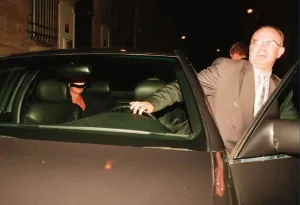
 Circumstances surrounding Diana’s death are exhaustively investigated. Everyone knows basic facts that Diana and her new boyfriend, Dodi al-Fayed, were leaving a Paris hotel for a private apartment and trying to avoid the ever-present Paparazzi. They got in the back seat of a Mercedes sedan driven by Henri Paul—a hotel security agent. Diana’s bodyguard, Trevor Rees-Jones, rode shotgun in the passenger front.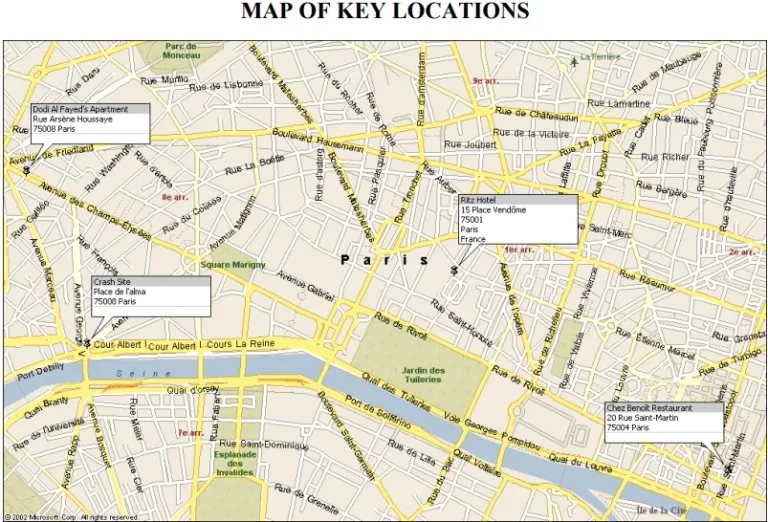
 Blood Alcohol Count (BAC) — 174 milligrams per 100 milliliters of blood or commonly termed a BAC of 0.174% (This was corroborated by his vitreous humor or eye fluid count being 0.173%, his urine being 0.218% and his stomach BAC being 0.191%.)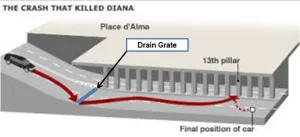



 Learn more about