Why Criminals Believe They Are Heroes

As most of you know, I write romantic suspense with a lot of police procedure, and one of my favorite research tools is a book written by Jennifer Dornbush: Forensic SpeakHow to Write Realistic Crime Dramas. She and Debbie Burke are two of my favorite resources on villains…not that either is one. All that to say, I’ve invited her to do a guest post on the Killzone today.

Jennifer Dornbush is an author, screenwriter, and speaker. Here’s a bit about her in her own words:

The television or movie screen is the closest most people will ever come to witnessing the forensic world. But I actually lived it. As a daughter of a medical examiner whose office was in our home, I investigated my first fatality, an airplane crash, when I was 8 years old. Picking up pieces of skull and brain matter, my father simply saw this as a hands-on anatomy lesson. This would be the first of many coroner lessons I experienced over two decades.

Now for a look at how a villain thinks:

The body tells you what happened.
Behavior tells you why.

In crime fiction, readers may be drawn in by the mystery or the puzzle of who committed the crime. What keeps them turning pages is the psychology behind the act.

Readers want to understand how someone justifies crossing the line into violence. They want to see how the logic of the crime holds together from the inside, even when it appears monstrous from the outside.

This is where forensic psychology becomes essential.

One of its most important insights is this: most offenders do not see themselves as villains.

They see themselves as heroes.

That may sound surprising, but it is one of the most consistent patterns investigators observe. People rarely commit serious crimes while believing they are evil. Instead, they construct a narrative that reframes their actions as necessary or justified.

In other words, they tell themselves a story.

That story explains why they are right and the world is wrong. It allows them to bypass the moral barriers that normally prevent harm.

Psychologists call this rationalization or moral disengagement.

Understanding this mechanism matters in both investigation and storytelling. The most compelling antagonists are not chaotic villains. They operate within a belief system that makes sense from their own perspective.

When readers see the internal story driving the crime, the antagonist becomes far more believable—and far more disturbing.

To see how this works, we can look at three powerful examples from real life and storytelling.

The Unabomber: Violence in the Name of Salvation

Ted Kaczynski, known as the Unabomber, carried out a bombing campaign that lasted nearly two decades. His attacks killed three people and injured many others, targeting universities, airlines, and individuals connected to technological development.

From the outside, the crimes appeared senseless and cruel.

But from Kaczynski’s perspective, they were part of a moral crusade.

He believed modern technological society was destroying human freedom and trapping humanity inside systems that stripped life of autonomy and meaning. In 1995 he demanded that newspapers publish his manifesto, Industrial Society and Its Future, which argued that technological progress would ultimately erode human dignity.

Within that worldview, violence became a form of resistance.

Kaczynski believed he had recognized a truth others refused to see. His attacks were meant as warnings—attempts to force society to confront what he saw as an existential danger.

He did not see himself as the villain.

He believed he was trying to save humanity.

This kind of rationalization allowed him to commit violence while maintaining the conviction that he was morally justified.

Forensic psychologists study these belief systems because they reveal how offenders justify crossing moral boundaries.

Violence rarely begins with the thought I want to harm people.

It begins with a belief that harm is necessary in order to get people to pay attention and listen up.

Once that belief takes hold, destructive and violent behavior follows.

Walter White: The Hero of His Own Tragedy

Crime fiction often explores the same psychological dynamic. One of the most famous examples appears in the television series Breaking Bad through the character of Walter White.

At the beginning of the story, Walter appears sympathetic: a struggling high school chemistry teacher facing a devastating cancer diagnosis and the fear of leaving his family with nothing.

His decision to manufacture methamphetamine begins as an ultruistic attempt to secure financial stability for his wife and children. At first, the reasoning feels almost noble. Walter convinces himself he is sacrificing his morality to protect the people he loves.

But as the story unfolds, that justification begins to fracture.

Walter’s actions grow increasingly ruthless. He lies, manipulates partners, and orchestrates violence that destroys multiple lives. Yet he continues to insist he is acting out of necessity.

“I did it for my family.”

That phrase becomes the foundation of his self-image. As long as he believes this heroic mantra, he can continue crossing moral boundaries.

Over time, however, the audience sees what Walter cannot admit. What began as fear for his family becomes pride, ego, and the intoxicating pull of control. Yet abandoning the original story would mean confronting who he has become.

Walter White never wakes up and decides to become a villain.

He simply continues believing he is the hero.

Thanos: The Logic of Catastrophe

Blockbuster films build compelling antagonists around this same psychological principle.

In the Marvel Cinematic Universe, Thanos believes the universe faces inevitable collapse. In his view, overpopulation will exhaust resources and lead to universal suffering.

His solution is catastrophic: eliminate half of all life.

To others, this goal is horrifying. But Thanos does not see himself as a monster. He believes he is the only one willing to make a difficult decision others refuse to consider.

In his mind, he is not committing genocide. He is saving the universe.

What makes the character compelling is the sincerity of that belief. Thanos does not act from cruelty. He believes he is preventing greater suffering and frames his actions as mercy.

The audience rejects his conclusion but understands the logic behind it.

A villain who believes he is evil is predictable and stock.

A villain who believes he is saving the world is far more dangerous and human.

Why This Psychological Pattern Matters

These examples illustrate one of the most powerful principles in forensic psychology: people behave in ways that align with their beliefs about themselves.

If someone believes they are protecting others, their behavior will reflect that narrative. If they believe they are correcting injustice, they will frame their actions as necessary. If they believe they are restoring balance to the world, violence and disruption may become part of that mission.

The key element is not the act itself.

It is the story behind the act.

Criminal rationalization often follows a familiar pattern. A grievance forms, and the offender begins to believe they have been wronged by society, by individuals, or by circumstance. That grievance expands into a broader explanation, identifying an enemy, a corrupt system, or a threat that must be addressed. Eventually, disruption and violence become framed as a solution for that problem.

Once that narrative is fixed in a villain’s mindset, they don’t see themselves as a perpetrator of harm but as hero correcting a grave wrong.

This does not excuse the behavior, but does it explain how humans are able to cross boundaries they normally never would.

Forensic psychology studies these disordered belief systems because they shape both motivation and behavior of criminals. Investigators examine writings, communications, victim selection, and crime scene behavior to understand the internal narrative driving the offender.

The same principle applies to storytelling. The most compelling antagonists are not chaotic forces of evil but individuals whose actions follow a distorted conscience, yet recognizable logic of justification.

Their worldview is warped. Their conclusions and actions are horrific. But their “why” makes sense within their disordered trails of logic.

When the Criminal’s Story Collapses

Every criminal narrative eventually faces the same challenge: reality, truth, order, and justice.

Evidence accumulates. Contradictions appear. The internal story the offender constructed begins to fracture under pressure of real consequences and failed logic.

Sometimes that fracture happens during interrogation. Sometimes it occurs in court. Sometimes it emerges slowly as investigators piece together the truth.

But eventually, the offender’s false narrative collides with the facts and natural law.

That collision is where crime stories reach their most powerful moments.

Because what is being dismantled is the belief system that justified the crime.

When the offender can no longer sustain the story they told themselves—when the hero they imagined themselves collapses under the weight of natural law, truth, and justice— that is when they lose the final battle.

And when they do, the result is the most unforgettable part of the story. Chaos is ordered. Truth wins. Justice is restored. The right and true hero emerges victorious.

The Heart of Crime Stories

Crime fiction is often described as a genre about puzzles, evidence, and the fight for justice. Those elements are certainly part of the appeal.

But at its core, the genre explores a deeper level: the stories bad people tell themselves about who they are and what they deserve… and what they think others deserve.

Forensic psychology helps us understand those stories.

It reveals how grievance and trauma warps a bad guy’s justification, how that justification turns into criminal action, and how action shapes their identity as heroes, not villians.

Offenders never see themselves as monsters.

They see themselves as misunderstood.

They see themselves as necessary.

They see themselves as right.

They see themselves as change-makers.

And most of all—

They see themselves as the hero of the story.

Jennifer Dornbush is an author, screenwriter, and forensic specialist who brings crime stories to life with authenticity and heart. With a background rooted in real-world forensics and a passion for crafting unforgettable mysteries, Jennifer offers readers and viewers a front-row seat to the intersection of science, justice, and human nature. Jennifer’s crime expertise has made her a sought-after speaker, consultant, and educator. Through her webinars and master courses, Jennifer guides writers in melding suspenseful storytelling with forensic realism to the screen and page. Meet her at www.jenniferdornbush.com


Managing Backstory

By John Gilstrap

Backstory is an often undeniable temptation for inexperienced writers. We see it all the time in First Page Critiques submitted and reviewed here at the Killzone Blog. And I’m not just talking about the throat-clearing data dumps that poison those first paragraphs. Unnecessary backstory invades minor moments as well, and handled improperly, those moments stop the story one hundred percent of the time.


Backstory is the crutch that explains everything. It’s like the Chorus in ancient Greek plays that represents the epitome of telling and not showing. With a sprinkling of backstory, we can tell our readers why a character flinches, why she drinks too much, why he doesn’t trust authority.

Here’s the tragedy of squandering that slice of real estate on the page: the reader doesn’t care why a character thinks something or does something until the rationale is important to the story. But the worst part of the wasted real estate is that you’re ruining future tension. The fact that a character has a signature tic is cause to keep reading. Once the mystery is solved, interest evaporates.

This is a difficult concept for me to explain, so stick with me as I try to work through that which I was never taught, per se, but have been told I do well.

Backstory should arrive as consequence, not as explanation. Earn the reader’s curiosity before presuming to answer a question he hasn’t yet asked. If your character checks the locks three times before going to bed, don’t explain it. Let it sit there. Let another character notice it. Let it cause friction. Let it slow characters’ actions down when speed matters. Now it’s a problem, not a quirk.

A book is a limitless canvas. Take your time. Make the reader beg to know before you grant them knowledge.

Backstory is best revealed when it is pulled out of a character. It falls flat when it’s pushed onto the character by the author. Conflict is your delivery system. You want your characters to feel real, right? Well, real people don’t sit around in the middle of a crisis and reveal historical details of why they feel the way they do. (Okay, they did that very thing in The Breakfast Club, but that was the eighties, and we should all strive for better than that.)

Some elements of backstory needn’t ever be explained. Why does Charlie have a scar across his cheek?  Why does Agnes walk with a limp?  If it’s not critical to the story being told, there’s no need to explain. That’s a lot harder to do when Charlie or Agnes are your POV characters, but even with them it’s doable. Imagine an exchange like this:

“Hey, Charlie. I’ve always wondered where that scar came from?”

“I go it in a fight with the last guy who didn’t mind his own business.”

That’s a complete reckoning, and it does everything you want a plot to do: it builds mystery, establishes character, and even advances the relationship between the two characters.

Then there’s subtle backstory. I don’t particularly like quoting my own work, but here’s a passage from my current WIP—the one that triggered the idea for this blog post:

Irene parked her cruiser at the curb in front of the streetside door that she knew to be locked and walked around to the right, where the side entrance served as the ceremonial portal with its covered entrance and double doors.

This presents backstory in an implied way that doesn’t get discussed very often in classes. This little passage tells us that 1) Irene has been here before; and 2) she’s comfortable in what she’s about to do. The point here is that backstory can be implied as well as being called out.

Then there’s this from a paragraph or two later:

As she crossed the threshold into the forced faux comfort of a giant living room for the dead, she winced against the mixed aromas of flowers and formaldehyde that she’d come to associate with such places.

Here, we got some emotional history as well as physical recall. We know that she’s been to funeral homes, the tone delivers that she’d rather be someplace else. We don’t need to know the reasons for those previous visits.

Some shortcuts for hiding backstory inside the front story

Let expertise reveal history. Avoid telling us what a character used to be. Show us how they move through their world now. If your character constantly checks over his shoulder for approaching strangers, or he notes where exits are, that’s plenty to tell us that he has an interesting past. You don’t need to reveal what that past is until that story beat has an immediate impact on the main story.

Reveal character details through third-party observation. And here again, only to the degree that is necessary. Consider a retake on the issue of Charlie’s scar:

Adam pulled Baker into an empty office. “Do you know where Charlie got that scar?”

Think of all the opportunities here. Choose your favorite:

“I have no idea. I asked him once, and that didn’t go well at all.” This one is sort of dismissive. It shows that Baker is either afraid of Charlie, or just isn’t interested in the drama.

Or

“Something about Afghanistan. Traumatized the crap out of him. I think it’s what makes him angry. He doesn’t want to talk about it, and I don’t push.” Here, we learn an extra nugget of information about Charlie’s scar, but we also read respect mixed in with the fear of confronting Charlie. Baker has previously shown curiosity, but nods to Charlie’s desire to be left alone.

Or

“Yeah, I do, and it’s none of your damned business. When you’ve endured half the crap Charlie’s put up with—what he’s survived—maybe you’ll understand that when a man says he wants to be left alone, it’s a survival skill to leave him the hell alone.” Here Baker not only projects respect for Charlie, but also loyalty to him—apparently an earned loyalty. It also shows Adam to be pretty small for asking.

Or

“Ten years ago, when Charlie was in the Army, his unit was assigned to clear out a building. The place was packed with bad guys . . .” This one is a data dump disguised as dialogue. While it provides backstory, it is, I believe, hands down the worst of the options. Unresolved questions drive tension, tension drives conflict, conflict drives character, and character drives plot. Data dumps are just piles of words.

I’ve written here before that I think it’s a mistake to study the writing process as a series of component parts. Setting, plot, character, dialogue, backstory, chaptering and all the rest need to be reduced to a stew, not a list of ingredients. I don’t think about any of those things when I write. I just . . . write. That’s the blessing and the curse of being self-taught.

It all boils down to this in the end—the only true, inviolable rule of writing commercial fiction:

Never Squander Drama!

In any writing project, every plot point presents infinite choices derived from infinite variables. If you over-think it, you’ll spend ten years rewriting Chapter One. If you’ve ever been part of a writing group, you know at least one of those people. My suggestion to everyone reading this is to consider one challenge:

For each of the choices you make, choose the one that reveals as little as possible while simultaneously piquing the greatest interest in the unknown.

So, TKZ family, does this make sense?

7 Unusual Ways to Improve Focus

We live in a world filled with distractions. Attention spans have shrunk from roughly 2.5 minutes in 2004 to about 40-47 seconds — some report a reduction to as low as 8 seconds — a drop of 60-70% since portable digital screens entered our lives.

Now more than ever, focus is at an all-time low, many preferring social media to writing. With the introduction of AI to shortcut the writing process, the problem is only worsening.

Writers who focus long enough to write without AI tools have become valuable to companies and organizations who hire freelance writers to grab the attention of their target audience. With the exception of tech companies who hire writers to train AI models — no amount of money is worth selling your voice! — all say they’ll trash your application if you use AI tools for any part of the application process: resume, cover letter, and writing samples.

Freelance writers need to able to flex their creative muscles, or they’ll never find work.

Authors need to be able to flex their creative muscles to touch the lives of readers.

Freelance writers — or authors who supplement their income with freelance work — have run across the “No AI” warning many times.

When I first ran across it, it made perfect sense. Of course, companies and organizations want the human touch. Any AI prompter can produce thousands of words on various topics. Only a real writer can trigger emotions in the reader.

Writers can’t flex those mental muscles without the ability to focus. In today’s world, new writers especially may suffer with a lack of focus. They’re juggling school, work, family, or all three, and don’t take their writing seriously yet. Many professional writers juggle just as much, if not more, but they’ve learned to hit the keyboard whether they’re inspired or not.

The ability to focus is an important life skill for us all. Hence my motivation for this post.

7 Unusual Ways to Improve Focus

Chewing Gum

Sounds crazy, I know, but I read this recently and couldn’t avoid diving headfirst into a research rabbit hole.

  • The physical act of chewing, or mastication, acts like a motor for the brain that activates motor fibers in the jaw that increase cerebral blood flow. This delivers more oxygen and glucose to regions responsible for attention and memory, such as the thalamus and hippocampus, according to Scientific America.
  • Chewing stimulates the trigeminal nerve, which is linked to the brain’s arousal system.
  • EEG studies show shifts in brainwave patterns associated with being both calm and alert — what researchers call “relaxed concentration.”
  • Improved Reaction Times: Many studies found that “chewers” have significantly faster reaction times on cognitive tests.
  • Reduced Stress: Gum can lower cortisol levels, which help manage anxiety that often interferes with focus, according to the National Institute of Health.
  • While non-chewers often see their performance decline over 30 minutes, gum chewers maintain consistent accuracy.
  • Some experts believe chewing serves as a form of productive fidgeting, keeping the brain stimulated enough to stay on track without being a major distraction, according to Science Daily.

The Spider Technique

This mental training exercise helps you ignore external distractions.

If you held up a vibrating tuning fork to a spider web, the spider will rush out to investigate. After several repetitions without finding prey, the spider wises up and stops reacting.

Train yourself to be the wise spider. When a door slams or someone enters the room, acknowledge the sound but choose not to glance over. Practicing “tunnel vision” helps build a mental barrier against interruptions.

Look at “Kawaii” Images

Kawaii means “cute” in Japanese. Hope this one doesn’t sidetrack you for hours, but looking at cute photos of baby animals can significantly boost performance on tasks that require high focus, like writing a novel. A study by Japanese researchers found that cuteness-triggered, positive emotions narrow the breadth of attentional focus, making you more detail-orientated and less prone to veering off-course.

Loop One Song on Repeat

I’ve done this one, and it does work.

Listening to music is common among writers, but listening to one song or album on a loop for hours is a specific high-focus strategy. Your brain has two attention systems: conscious and unconscious. Familiar, repetitive music occupies the unconscious system — the part that usually scans for distracting background noises to assess potential threats — without taxing your conscious mind. This creates a “trance-like” state, or as creatives call it, “the zone,” our ideal happy place.

Create a To-Do List

Sounds simple, I know, but it works. I’ve done it for years.

Rather than fight stray thoughts, whether it be ideas for future scenes or things you need at the grocery store, give them a temporary home by writing it on paper or in Notes on your phone. This externalizes the To-Do item and sends a signal to your brain that the item is safe and can be released from your working memory. Otherwise, your mind will keep trying to remember it.

Practice Positive, Constructive Daydreaming

Sometimes the best way to focus is to stop trying. I do this a lot, too. When I reach a point where I’m spinning my wheels or hit a mental wall, I walk outside and watch my wildlife. Or go for a 20-minute walk. Or take a shower. Or read a book for a while. Or meditate. Or exercise. Do anything that allows free thoughts to flow, like daydreaming. This engages the brain’s default mode network, which replenishes your “willpower reserves” and often leads to creative breakthroughs that a forced focus cannot reach.

Strategic Cold Exposure

Dunking your face in a bowl of ice water for 20-30 seconds is not only an anti-aging technique but a reset for your nervous system. Cold exposure triggers a sharp release of norepinephrine and activates the sympathetic nervous system. This is often followed by a parasympathetic rebound that leaves you feeling calm, alert, and mentally sharp.

How many of these have you done? Did they help?

Chipping Away What Isn’t My Book

by James Scott Bell
@jamesscottbell

There’s an apocryphal story about a fellow admiring Michelangelo’s magnificent statue of David. He asks the artist how he produced something so divine. Michelangelo answers, “I looked at the block of marble and chipped away everything that was not David.”

That quote is so good I wish he’d actually said it. He did have a real zinger for the impatient Pope Julius II, while working on the Sistine Chapel. “When will you be finished?” shouted the pope. “When I am done,” Michelangelo replied. (Writers with a contract and a deadline may not be so cavalier with their quips.)

The art of sculpting blows me away. How can you make something so beautiful from a great big formless slab? How may slabs do you have to go through to get competent in your craft, where one errant stroke means disaster. With sculpture, you an add something back. How did Michelangelo do it? I mean, one false chip and David loses a nipple.

I thought of the David quote the other day as I was going over a hard copy of my WIP. I found myself doing a lot of this: taking out a word here, a phrase there, substituting one word for another. Chipping away, as it were, whatever wasn’t my book.

This is what I call polishing. It’s my last step before publishing.

My first draft is for getting the thing down. I don’t do heavy edits. I go over the previous day’s pages, correct obvious mistakes, make some quick changes, and then get on with it.

I let that draft sit for a couple of weeks, to get some distance, then make a hard copy and put it in a binder. For fun I put a mock cover on it with a fictitious blurb on how great it is.

Then I read it as if I were a harried acquisitions editor on a commuter train. I keep asking myself, Are there places where I’m tempted to put this book aside?

I put a big old checkmark √ in the margin, and read on. I don’t make detailed notes. In addition to the √ mark I use:

• parentheses ( ) around confusing sentences

• a circle O in the margin where I think material needs to be added

• a question mark ? for material I think is confusing

When I’m finished, I analyze, asking questions like:

• Does the story make sense?

• Are there any loose threads?

• Does the story flow or does it seem choppy?

• Do my main characters “jump off the page”?

• Are the stakes high enough?

• Is there enough of a “worry factor” for readers?

I make any major changes, then print out another draft. That goes to my first editor, the lovely Mrs. B, and a trusted beta reader. They give me valuable notes, because I always miss things on my own. I make the changes.

Then comes the polish. Here’s what I’m looking for:

Scene Openings

• Does the opening scene have a disturbance?

• Can I begin a scene a little further in?

• Do my descriptions do “double duty?” (visual and tone)

• Do many of the scenes begin the same way? Vary them.

Scene Endings

I’ve found that sometimes cutting the last lines or even paragraphs of a scene gives it more momentum. Or I may need:

 • a line of moody description

• an introspection of fear or worry

• a moment of decision or intention

• a line of dialogue that snaps

Dialogue

• Is there plenty of white space in the dialogue exchanges?

• Can I cut any words to make the dialogue tighter?

• Is there a line I can “curve” to make it more memorable?

[Note: More tips, and my Ultimate Revision Checklist may be found in Revision & Self-Editing for Publication.]

And that’s how I chip away at what isn’t my book. Are you a chipper? Do you have a standard revision plan you follow?

Never Give Up

Last night I was working on my presentation for the Pikes Peak writers conference scheduled for May. My oldest daughter, the Redhead, was on the couch with her laptop, miraculously inserting the slides as they popped up on my screen at the same time. In addition, she was adding bits of period music here and there in real time.

Kids can do this, even the ones who are now 38 and the mother of two. Technology ain’t my friend, and I’m counting all the ways My Road to Publication and Other Great Disasters presentation can screw up with an electronic hiccup.

At some point in this program, and I never know when because I kinda wander around without notes (which is going to be a problem with slides in and music in a specific order), I reach a point where I discuss the thousands, nay, the millions of rejection notices I received through the years from editors and agents alike.

I wish I’d kept them all, but in a fit of self-pity just before my first novel was accepted, I threw two paper boxes full of them into the dumpster. Okay, it wasn’t millions, but it was a lot.

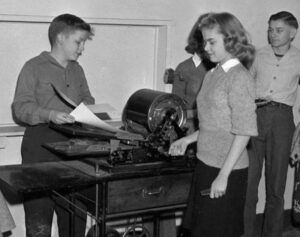
Some were so faded you couldn’t read the faint blue letters because they were cheap mimeographed notices that said, “Thanks for your submission, but they do not meet our needs at this time.”

Of course the first thing I did after opening the envelope, each and every time, was sniff the mimeograph paper as all kids did back when we were in school. I still try it today. Back then, the whole class did it as one, and it became so iconic, Fast Times at Ridgemont High created that same scene. Lordy, we were probably high ten seconds after all that methanol and isopropyl alcohol hit our lungs.

The teachers were probably buzzed pretty good themselves after returning from the workroom with their own lungs full of those same vapors, and nerves jangling with enough nicotine and caffeine to jolt a dead elephant back to life.

On top of all that, if you were a good kid (me), you got to sometimes make those copies for them back there, inhaling the heady aroma of chemicals and second-hand smoke.

What a time to be alive.

However, back to the rejection notices. Many of them were mimeographed boilerplate blowoffs, and I soon learned it by heart.

Thank you for your submission. Unfortunately it doesn’t meet our needs at this time.

As the years progressed, the letters became more formal, probably because I wasn’t hand-writing them and had graduated to typing. Some were form letters, but others were hammered out by the literary agents or editors themselves.

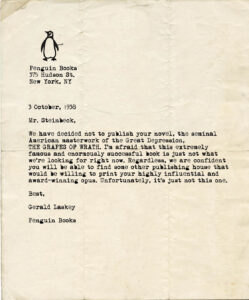
In one personally written rejection, the agent dismissed my submission with a clear and cutting declaration . “This manuscript has trees in it. I don’t do trees.”

Somewhere around two thousand, I’d reached a point in my attempts to sell a novel and was done and the box was gone that afternoon.

I immediately regretted it.

Desperate for some kind of positive affirmation, I decided to cold call Joe R. Lansdale and ask if he’d suffered the same continual stream of No Thanks. He answered his land line, I told him who I was and how I was a fan, but despite success as a newspaper columnist and magazine writer, I was done.

He didn’t know me from Adam, or even Eve, but he spent nearly an hour on the line, talking me out of stepping off the ledge.

Only weeks letter, I received an email from my starter agent accepting my first manuscript and I quit second-guessing myself.

Rejection letters are a guaranteed stumbling block for all authors.

Stephen King’s first novel, Carrie, received 30 rejections.

Animal Farm was rejected and the editor wrote, “it’s impossible to sell animal stories in the USA.”

Tell that to James Herriott (All Creatures Great and Small series) and Watership Down (Richard Adams).

Even Lord of the Flies was turned down a number of times and one editor declared the manuscript was “absurd and uninteresting.”

J.K. Rowling’s original manuscript for Harry Potter was rejected by 12 different publishing houses. One literary agent warned, “You do realize, you will never make a fortune out of writing children’s books?”

John Steinbeck, well –––.

The secret is to grow a thicker skin and keep working. Neil Gaiman, English author of short fiction, novels, comic books, audio theatre, and screenplays, suggests that rejection slips will always arrive, and, if you get published, you can pretty much guarantee that bad reviews will follow as well. Just learn how to shrug and keep going or “you stop, and get a real job.”

Let’s end with this quote.

“Starting when I was fifteen I began to send short stories to magazines like Esquire, and they, very promptly, sent them back two days before they got them! I have several walls in several rooms of my house covered with the snowstorm of rejections, but they didn’t realize what a strong person I was; I persevered and wrote a thousand more dreadful short stories, which were rejected in turn. Then, during the late forties, I actually began to sell short stories and accomplished some sort of deliverance from snowstorms in my fourth decade. But even today, my latest books of short stories contain at least seven stories that were rejected by every magazine in the United States and also in Sweden! So, dear Snoopy, take heart from this. The blizzard doesn’t last forever; it just seems so.” — Ray Bradbury

So how many rejection notices have you received? Dozens? Boxes delivered via dolly? Or is there one drawer in your desk that is the Dead Zone?

No matter. Keep at it and never give up


Reader Friday-What’s In Your Bucket?


Let’s talk about buckets. Or, more specifically, bucket lists.

From Wikipedia:  “The term “bucket list” refers to a list of things a person wants to accomplish before they die, derived from the phrase “kick the bucket,” which is a euphemism for dying.

“Nuff said there, I think.


Next, what does your bucket look like?

The one above? Or this…? If you’ve got a lot left you want to do, this might be the one you need.


To the point, what’s in YOUR bucket that you want to accomplish before you move on to the next sphere?


Me: I hate flying, but when I was about 12, my friend’s dad was a pilot and owned a small plane. He took us up one day and flew around our small valley here in central Washington. At one point, he handed over the controls to me. And I’ve always wanted to do that again.

TKZers, it’s your turn. What’s inside that bucket you’ve been carrying around?

And, just because I couldn’t resist . . . isn’t she cute?


True Crime Thursday – Government License and Permit Scams

by Debbie Burke

You may be familiar with email and text scams from fraudsters claiming you missed jury duty or owe traffic fines or road tolls. Immediate payment is demanded, or they threaten you’ll be arrested, your driver’s license suspended, yada, yada, yada.

https://creativecommons.org/licenses/by-nc/4.0/

When such messages are sent by email, they’re called “phishing.” Those sent by text are “smishing.”

https://creativecommons.org/licenses/by-nc/4.0/

Many victims fall for these scams because the convincing messages look and sound like the government agencies they supposedly represent. Plus they play on fear and urgency.

Well, criminals have stepped up to a new level of sophistication.

If you plan to build, remodel, make additions, or otherwise change the use of your property, you may need to obtain permits and/or licenses. When a business or individual applies, the information filed for those projects is publicly available and can be accessed by criminals. That includes the property address, as well as actual code numbers for required permits.

In some states (like Florida), even a change as small as replacing a window requires permits, inspections, and, of course, fees.

Zoning and licensing departments are usually backed up, causing delays in project completion while the property owner waits for inspections and re-inspections before they receive approval to continue.

So it’s not surprising to receive an email that appears to originate from these agencies demanding fees. If you don’t pay immediately, they warn your project will be delayed, disapproved, and blocked.

Anyone who’s ever built a house or developed property understands the frustration of constant delays, as well as fees on top of fees on top of more fees.

Criminals are quick to recognize new profit opportunities. Permit and license scams are among the latest.

The FBI issued a public service announcement on March 9, 2026, warning about the recent rising trend of phishing emails from criminals impersonating government departments.

According to the PSA:

  • The emails contain detailed, accurate information about planning and zoning requests, including property addresses, case numbers, and the true names of city and county officials.

  • The emails use professional language, formatting, and imagery consistent with legitimate government communications for planning and zoning applications, including review processes, planning commission procedures, regulatory compliance, and relevant ordinances.

  • The email addresses contain usernames similar to city or county planning and zoning departments but originate from non-governmental domains, such as “@usa.com”

  • Email delivery may be timed to coincide with ongoing communications with city and county officials regarding the permitting process.

  • Attached PDF invoices contain itemized statements of purported fees and direct applicants to request payment instructions via email, rather than telephone, to ensure a reliable audit trail for all correspondence related to the application. This is designed to deter the victim from calling the city or county office to verify the fees.

  • The emails emphasize urgency, threatening delays or other obstacles in the permitting process if the applicant does not immediately render payment.

So how do you determine if an email is real or fraudulent?

  • If they demand payment by wire transfer, peer-to-peer payment service, or cryptocurrency, it is a fraud. Government agencies do not require these methods. But criminals love them because funds can’t be traced, and you can’t recover your money.
  • Check the actual website (NOT the link in the email). You may find the agency has posted warnings with updates about new scams.
  • Call the agency using the phone number listed on their official website (NOT a number from the email). Find out if fees are actually due.

Some agencies even reach out proactively to warn of scams. For instance, a few days ago, I received an email from the Montana Secretary of State who handles business licenses. She warned impersonators were making bogus demands for fees from business owners.

Since her email didn’t ask for money, I knew it was genuine!

The FBI adds:

If you or someone you know has fallen victim to this impersonation scam, file a complaint with the IC3 at www.ic3.gov. Be sure to include any available information including:

  • The email address, date of email, phone number, if provided;

  • The date of your project’s scheduled hearing, if applicable; and,

  • The amount listed in the fraudulent invoice, the method requested to pay fees, and bank account information, if provided.

Under the best circumstances, the permit and licensing process is glacial in speed.

Unfortunately, in some instances, internal corruption means shakedowns and bribes are required before a project moves forward. Remember The Sopranos?

Now phishing scams will mire systems even more as people call to find out if notices are fakes. Plus agencies must field complaints from victims who’ve been defrauded.

Ironically, so-called “artificial” intelligence is being used to create scams that appear increasingly real.

Credit: Andrea Pokrzywinski

As AI improves, new phishing emails may not smell as phishy as older versions but they still are frauds (phrauds?). 

~~~

TKZers: Have you encountered phishing or smishing?

~~~

In Stalking Midas, glamorous con artist Cassandra Maza doesn’t need AI. Instead, she uses charm and flattery to ensnare her latest prey: a cranky senior who loves his nine rescue cats. Then investigator Tawny Lindholm uncovers the scam. Cassandra has killed before and each time it gets easier. Now Tawny is in her sights.

Sales link

Truncating Phrases

Truncating Phrases
Terry Odell


tree trunk with axe cuts and an axe

Image by Sabine Kroschel from Pixabay

Language changes over time. Ask anyone who’s tried to keep up with a teen’s usage. But it can be more than words. As writers, we might be having our characters use what seems like a common phrase. However, a lot of these phrases have been truncated over time, and their full meanings have changed. Here are some examples:

“Curiosity killed the cat.”
The full saying: “Curiosity killed the cat, but satisfaction brought it back.
The full version actually redeems curiosity, but we usually quote only the first half, turning it into a warning.

“Jack of all trades.”
The full saying: “Jack of all trades, master of none, but oftentimes better than master of one.
The original praised versatility, but the shortened version now implies mediocrity.

“Great minds think alike.”
The full saying: “Great minds think alike, but fools seldom differ.
The full saying actually balances the idea with a caution against conformity.

“Money is the root of all evil.”
The full saying: “The love of money is the root of all evil.” — The Bible
The missing words change the meaning from greed being the issue to money itself being evil.

“Blood is thicker than water.”
The full saying: “The blood of the covenant is thicker than the water of the womb..
The original meant chosen bonds can be stronger than family ties — the modern version says the opposite.

“Rome wasn’t built in a day.”
“Rome wasn’t built in a day, but it burned in one.” (later addition)
The addition adds a twist about destruction being easier than creation.

“The proof is in the pudding.”
The full saying: “The proof of the pudding is in the eating.
The original means you can only judge something by experiencing it, but the shortened form is often misunderstood.

Starve a fever, feed a cold.”
The full saying: If you starve a fever, you’ll feed a cold.”
The complete saying was a warning against undernourishment, not medical advice.

“The exception proves the rule.”
The full saying: “The exception that tests the rule.”
“Proves” originally meant “tests,” not “confirms.” The modern reading flips the meaning.

“Nice guys finish last.”
The full saying: “Nice guys don’t always finish first.” (from Leo Durocher’s quote)
The original was contextual, but it’s now used as a cynical generalization.

Any surprises in this list? Any to add, TKZers?


Find me at Substack with Writings and Wanderings

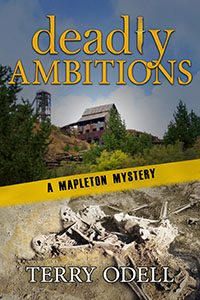
Deadly Ambitions
Peace in Mapleton doesn’t last. Police Chief Gordon Hepler is already juggling a bitter ex-mayoral candidate who refuses to accept election results and a new council member determined to cut police department’s funding.
Meanwhile, Angie’s long-delayed diner remodel uncovers an old journal, sparking her curiosity about the girl who wrote it. But as she digs for answers, is she uncovering more than she bargained for?
Now, Gordon must untangle political maneuvering, personal grudges, and hidden agendas before danger closes in on the people he loves most.
Deadly Ambitions delivers small-town intrigue, political tension, and page-turning suspense rooted in both history and today’s ambitions.


Terry Odell is an award-winning author of Mystery and Romantic Suspense, although she prefers to think of them all as “Mysteries with Relationships.”

Five Tips to Keep Track of Characters Behind the Scenes

by Debbie Burke

Crime fiction has multiple story lines. Readers see the story on the page, but important events also unfold behind the scenes that the reader may not see. TKZ’s own Jim Bell has a terrific term for this, “the Shadow Story.”

The shadow story follows the antagonist’s actions to thwart the hero. The hero (and the reader) may not be aware of what’s happening offstage as the villain lurks in the shadows, scheming and wreaking havoc.

That’s why the author must always keep track of antagonists and/or villains. (For this post, I’m using the terms somewhat interchangeably).

Stories require conflict. Antagonists cause conflict. Therefore, antagonists are as necessary, if not more so, than heroes.

If you lose track of your villain, you’ve lost the story’s primary cause of disruption and distress.

Here are five tips to monitor what antagonists are doing offscreen.

  1. Create two documents, parallel stories with one for the hero, one for the villain.

The hero’s story is what the reader sees on the page.

The shadow story tracks the villain offstage. This may or may not ever be visible to the reader.

In traditional whodunnit mysteries, the villain is hidden and not revealed until the end. The point of view is often limited to the hero’s, either first person or close third person. The parallel shadow story will not be shown on the page. Rather it is a working document for the author’s eyes only.

In suspense and thrillers, the reader may know or quickly learn the villain’s identity. With a known villain, the shadow story can be visible on the page in parallel with the “onscreen” story. Multiple points of view can include the villain’s. That’s how I write my thriller series, with POVs alternating among several characters.

  1. Track your shadow character with a baby cam or your phone. An imaginary baby cam keeps a constant watch on your villain. The locator dot on the phone screen blinks along the street map to follow the villain’s movements.
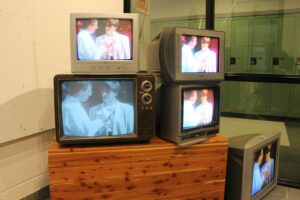
  2. Think of two TVs side by side. One is showing the hero’s channel. The other plays the villain’s channel. The timeframe is the same, but the locations are different. Flip back and forth between them.

    Photo credit: Annette Dawm, Pexels

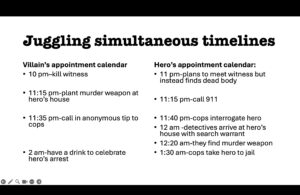
4. Use a calendar or appointment book. Log the day, time, and location for each character in each scene.

Screenshot

In time-critical scenes, like a bomb ticking, you may need to detail the action minute by minute, or even second by second.

5. Use index cards or sticky notes in different colors (blue for hero, yellow for villain, green for secondary characters, etc.). Write a short summary of each scene (time, place, characters present, what happens) on the appropriate color card or sticky.

Another alternative is a white board using different color markers.

When the draft is complete, lay the cards out on a table. Kay DiBianca puts her stickies on closet doors in her office.

Study the color pattern. This visual review points out potential problems. Are there too many scenes in a row in one color? Do you need to rearrange the order to improve pacing or balance the characters?

Are there missing scenes? Or scenes that could be cut without hurting the story’s forward momentum?


Our creative brains all work differently. To keep track of multiple characters and story lines, some writers prefer programs like Scrivener (which Jim Bell uses), Memory Map, Wave Maker, and Fantasy Calendar.

I’m more visual and tactile-oriented so it’s easier for me to stay organized with physical appointment books, calendars, and index cards.

The method doesn’t matter as long as the author always stays aware of what the antagonist is doing in the shadow story.

Because that’s the wellspring of your story’s conflict.

~~~

TKZers: How do you monitor characters in the shadows? Do you use time-tracking programs? Low tech tools like calendars and index cards? Or another method? Comments welcome below.

~~~

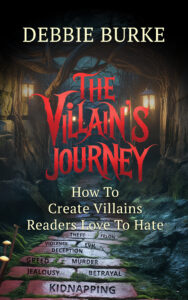
Today’s post is based on The Villain’s Journey-How to Create Villains Readers Love to Hate.

“Debbie Burke has filled a critical gap in writing craft instruction. We needed a book of solid advice for creating compelling, three-dimensional villains. This is it.” – James Scott Bell

Amazon

Barnes & Noble

Apple 

What Are You Reading in 2026?

“If you don’t have time to read, you don’t have the time (or the tools) to write. Simple as that.” ― Stephen King

* * *

Most writers are avid readers. An article on medium.com sums it up this way:

In a nutshell, reading and writing are inseparable. The better writers tend to be exceptional readers, and better readers can produce exceptional writing. A writer who doesn’t read is like a musician who doesn’t listen to music or a filmmaker who doesn’t watch films. It is demoralizingly hard to do good work without experiencing the good work that has been done before.

A well-read writer has better verbal skills, discerns the nuances of language, and distinguishes between poor and quality writing, so read more, read widely, and learn from other people who do what you are aiming at with the facility and the skill level you would love to cultivate.


I’ve been reading an eclectic variety of books in 2026. Here are some of them:

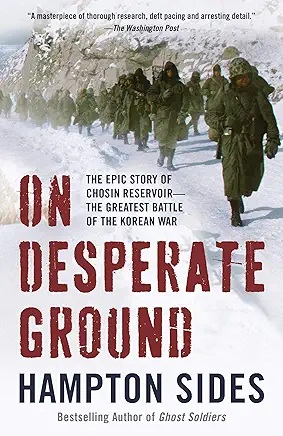
On Desperate Ground by Hampton Sides

The story of the battles around Chosin Reservoir in the Korean War. I’m writing a novel with Korean War veterans and I wanted to get details of the actual battles.


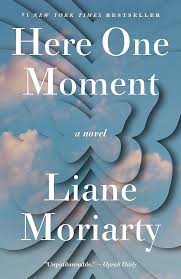
Here One Moment by Liane Moriarty

A book club pick. It’s an interesting novel that explores aspects of the fear of death, the art of fortune telling, and the power of suggestion. Most authors will appreciate the first chapter which almost guarantees readers will turn the page.


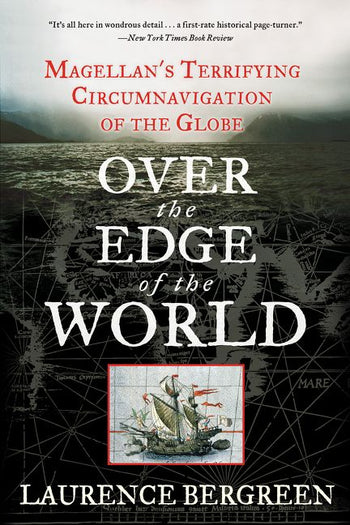
Over the Edge of the World by Laurence Bergreen

A fascinating look at the expedition led by Ferdinand Magellan that resulted in the first circumnavigation of the Earth. It’s one of the books that fuels my fascination with the early explorers.


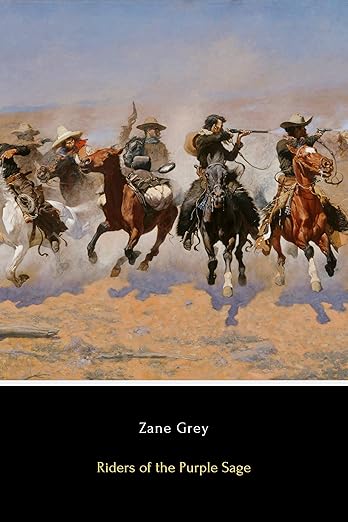
Riders of the Purple Sage by Zane Grey
Time to saddle up and read about the cowboys. Although I skimmed the long, descriptive sections, I liked the story and found myself eager to get back to it each evening.


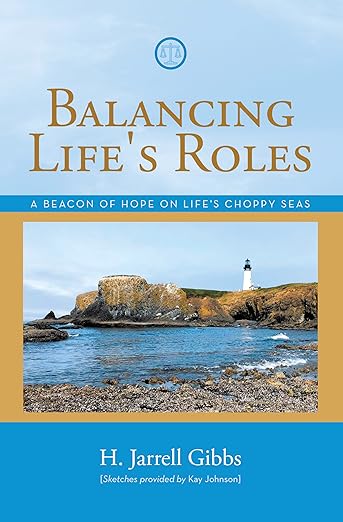
Balancing Life’s Roles by Jarrell Gibbs

This common sense guide to handling all the different roles we play in life was written by a friend of ours. Very useful advice especially for young people.


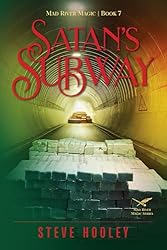
Satan’s Subway by Steve Hooley

Our very own Steve Hooley authored this middle grade fantasy. Once again, Steve tackles a serious issue through the eyes of a the Mad River Magic gang.


Theo of Golden by Allen Levi

This was also a book club pick. I read just a few chapters before it had to be returned to the library. The book is wildly popular, and I’d be interested to know if any of you have read it and what you think about it.


Quiet: The Power of Introverts in a World That Can’t Stop Talking by Susan Cain

Just started this one. I imagine it would be interesting to many authors.


Now I’m looking for a good mystery. Any recommendations?

* * *

So TKZers: What books are you reading in 2026?

* * *


A missing person. A trail of secrets. Private pilot Cassie Deakin reluctantly follows a mystery that refuses to stay buried—uncovering truths that shine brighter, and more dangerously, with every step.

Click the image to go to the Amazon book detail page.