
by James Scott Bell
@jamesscottbell
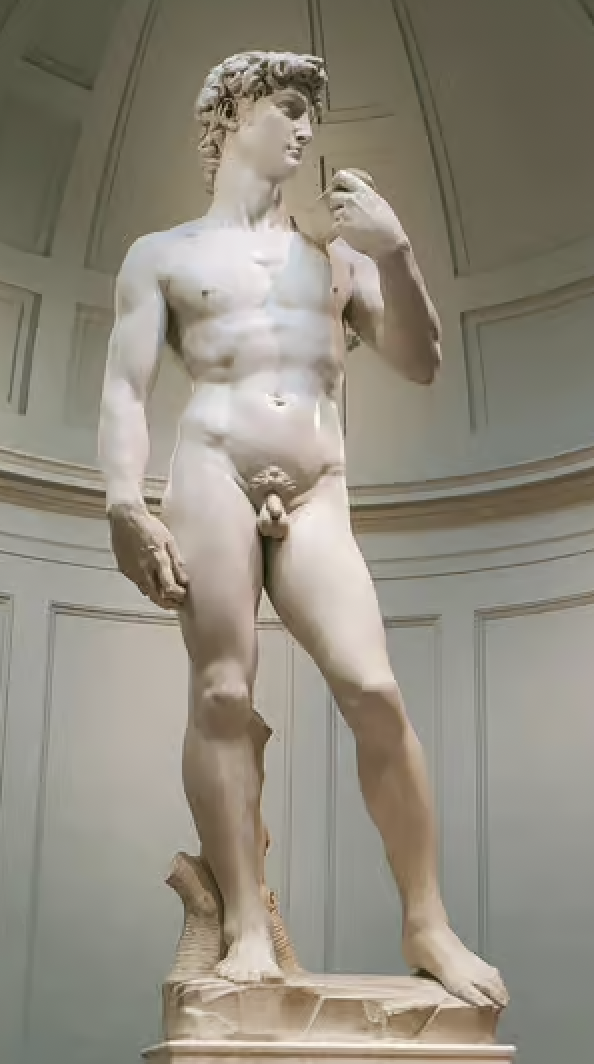 There’s an apocryphal story about a fellow admiring Michelangelo’s magnificent statue of David. He asks the artist how he produced something so divine. Michelangelo answers, “I looked at the block of marble and chipped away everything that was not David.”
That quote is so good I wish he’d actually said it. He did have a real zinger for the impatient Pope Julius II, while working on the Sistine Chapel. “When will you be finished?” shouted the pope. “When I am done,” Michelangelo replied. (Writers with a contract and a deadline may not be so cavalier with their quips.)
The art of sculpting blows me away. How can you make something so beautiful from a great big formless slab? How may slabs do you have to go through to get competent in your craft, where one errant stroke means disaster. With sculpture, you an add something back. How did Michelangelo do it? I mean, one false chip and David loses a nipple.
I thought of the David quote the other day as I was going over a hard copy of my WIP. I found myself doing a lot of this: taking out a word here, a phrase there, substituting one word for another. Chipping away, as it were, whatever wasn’t my book.
This is what I call polishing. It’s my last step before publishing.
My first draft is for getting the thing down. I don’t do heavy edits. I go over the previous day’s pages, correct obvious mistakes, make some quick changes, and then get on with it.
I let that draft sit for a couple of weeks, to get some distance, then make a hard copy and put it in a binder. For fun I put a mock cover on it with a fictitious blurb on how great it is.
Then I read it as if I were a harried acquisitions editor on a commuter train. I keep asking myself, Are there places where I’m tempted to put this book aside?
I put a big old checkmark √ in the margin, and read on. I don’t make detailed notes. In addition to the √ mark I use:
• parentheses ( ) around confusing sentences
• a circle O in the margin where I think material needs to be added
• a question mark ? for material I think is confusing
When I’m finished, I analyze, asking questions like:
• Does the story make sense?
• Are there any loose threads?
• Does the story flow or does it seem choppy?
• Do my main characters “jump off the page”?
• Are the stakes high enough?
• Is there enough of a “worry factor” for readers?
I make any major changes, then print out another draft. That goes to my first editor, the lovely Mrs. B, and a trusted beta reader. They give me valuable notes, because I always miss things on my own. I make the changes.
Then comes the polish. Here’s what I’m looking for:
Scene Openings
• Does the opening scene have a disturbance?
• Can I begin a scene a little further in?
• Do my descriptions do “double duty?” (visual and tone)
• Do many of the scenes begin the same way? Vary them.
Scene Endings
I’ve found that sometimes cutting the last lines or even paragraphs of a scene gives it more momentum. Or I may need:
• a line of moody description
• an introspection of fear or worry
• a moment of decision or intention
• a line of dialogue that snaps
Dialogue
• Is there plenty of white space in the dialogue exchanges?
• Can I cut any words to make the dialogue tighter?
• Is there a line I can “curve” to make it more memorable?
[Note: More tips, and my Ultimate Revision Checklist may be found in Revision & Self-Editing for Publication.]
And that’s how I chip away at what isn’t my book. Are you a chipper? Do you have a standard revision plan you follow?
I can be too much of a chipper–always finding fault with aspects of the manuscript but I learn a little more how to manage that with each successive story. But that’s why I’m eternally grateful for beta readers. It’s absolutely essential for me to have that pair of eyes that will assess the story without the baggage of having labored over writing it.
Indeed, BK, part of the art of this is knowing when to stop chipping. It could go on indefinitely! Virgil worked for many years chipping at The Aeneid. Dying, he asked that it be burned because it wasn’t perfect enough! Luckily, Augustus ordered it preserved.
I’m a chipper. My process is similar to yours. Instead of printing the first draft, I format a copy and send to my Kindle. I add notes and color-code words, clunky sentences, weak descriptions, etc with the highlighter. The hardest part, for me, was learning when to stop picking at the MS. Deadlines help. 😁
I tried Kindle editing, but found it too cumbersome. Whatever works!
I give a rough edit to each chapter as I finish it. My critique partners point out places that are confusing. What’s obvious in my head doesn’t always make it to the page. By the time I hit “the end” most chapters have been tweaked several times. I print a hard copy using a different font and columns to make things look “different” and then I give it the first start-to-finish read. I cut more than I add during this pass.
So, sometimes I chip, and sometimes I use a chainsaw. I don’t consciously follow your methods, but ultimately, that’s what I’m doing.
I’ve never used critique partners. I want to get down my book, my way, no second guessing, then let the editors/betas have a look. For newer writers, a good critique group can be helpful; the trick is to avoid the “bad” ones.
You might call them chapter beta readers instead of critique partners. My two partners and I have been together for about 20 years, so we know each other’s stuff, and we don’t try to change anyone’s story; we just point out things that cause hiccups (and typos). And there’s no rule saying we have to agree. But I’d rather find out early on that what my character is doing (usually with technology) isn’t possible instead of having to deal with a snowball effect at the end. Or, “why doesn’t she just do XXX?” which never occurred to me.
My first drafts are bare bones skeletons. I add layers of tissue, muscle, sinew, and flesh during rolling edits. My critique group reads chapters in progress and advises what they want to know more about, what isn’t clear, what doesn’t make sense, etc.
When I think the skeleton is fully fleshed out, I give the whole ms to first round beta readers. By then, it’s been polished for spelling, grammar, and sentence structure.
While they read, I work on something else which I guess constitutes “cooling off” time.
When the first round betas are done, I rewrite, almost always implementing their suggestions b/c they’re smart and I trust them. .
Then a second round with a couple of fresh beta readers who haven’t read the earlier version.
After that, the book is generally ready to go.
I forget who it was who said there are two types of writers: the taker-outters and the putter-inners. I’m ore the latter, after a lean-mean first draft.
This is great, Jim! Your process makes sense. (Can any of us borrow Mrs. B.?)
Here’s where I get stuck, and am right now:
“My first draft is for getting the thing down.”
I’m about 6050 words in on my current project, and stuck like Chuck.
🙁
Mrs. B is under an exclusive contract, solemnized by a vow unto death. Sorry…
One of the best pieces of writing advice I’ve ever received was – “Get in late, get out early”. It made a tremendous difference in my novels. Not only did it lessen the word count, but it kept the action flowing, the pace quick, and the reader anxious to turn pages. This is one of the major items I focus on when editing.
Yes, that’s great advice, Henry. So many new writers would benefit tremendously just by following it.
Excellent advice, Jim. I’m a chipper. In general my method is to write the first draft straight through. Once I finished the draft I turn around and begin a big rolling edit, tackling story issues, scenes etc., followed by a second edit cleaning up prose, catching typos, missing words etc before sending it to my beta reader.
My betas provide varying degrees of feedback, answering questions I’ve sent, and, in some cases, doing additional copy edits for me. My wife always provides copy edits alongside her feedback, working on a hard copy of the novel.
I take a few days to. go over their feedback, and then put together a master document from what I feel I need to change. I also merge the word documents a couple of them returned, which have line notes. I take the hard copy with my wife’s comments and copy edits on a stand beside the computer, and then go through the book, page by page.
After that, I send the final edited version to my copy editor for her input, and implement her edits when she’s finished. I’ll do a final proofing run and then it’s ready for publication.
That’s a solid process, Dale. Thank for sharing it.
“I let that draft sit for a couple of weeks, to get some distance”
That’s essential. You need to review your ms with new eyes and be as objective and unforgiving as possible when you pick it up again. The longer you let that draft sit, the better.
Absolutely. As much as possible, that first read needs to feel like the first time I’m seeing it. Not entirely possible, of course, but easier after the cooling off period.
Great analogy, Jim. Thank goodness writing isn’t exactly like sculpting in stone. One little sneeze…
The hardest part of writing for me is the first draft. Getting the entire story down takes a lot of time. But once the story is written, I enjoy the revision process. After my dev editor and I decide the plot is solid, I start the chipping process. ⛏ I also like to work from a printed copy. Polishing continues after the copy/line editor has her turn. Then text-to-speech to sand off that last speck of marble.
When I was trad, I didn’t like the revision process (though it made me a better writer). Now, I’ve come to look forward to it. Maybe that’s because I know more now, am more confident in my craft, and love finding ways to make things better.
I’m a chipper, like Sue, and sometimes go too far. Best bit of advice I got for that is “when you find yourself changing ‘a’ to ‘the,’ it’s time to stop.” Don is my Beta reader, and took the same vow as Mrs. B
When you’re married to your beta, dinner conversations get a lot more interesting than “How was your day?”
I got advice from an author who advised that as you go through your drafting, lightly edit the former days works so that it ends up as your almost writing a second draft on top of the first then do the core editing when finished. Saves some time plus it immerses you in the day before’s work to carry on easier. Hope that helps somebody. Take care.
Right. What I do.
I write romantic suspense so I usually lay down the first draft which is the mystery or suspense line, and then go back and add the romance line. Lately I’ve been interrupted during my first draft, so when I get back to it, I do some editing.
It’s always a plus when I still like the story at this point.