
by James Scott Bell
@jamesscottbell
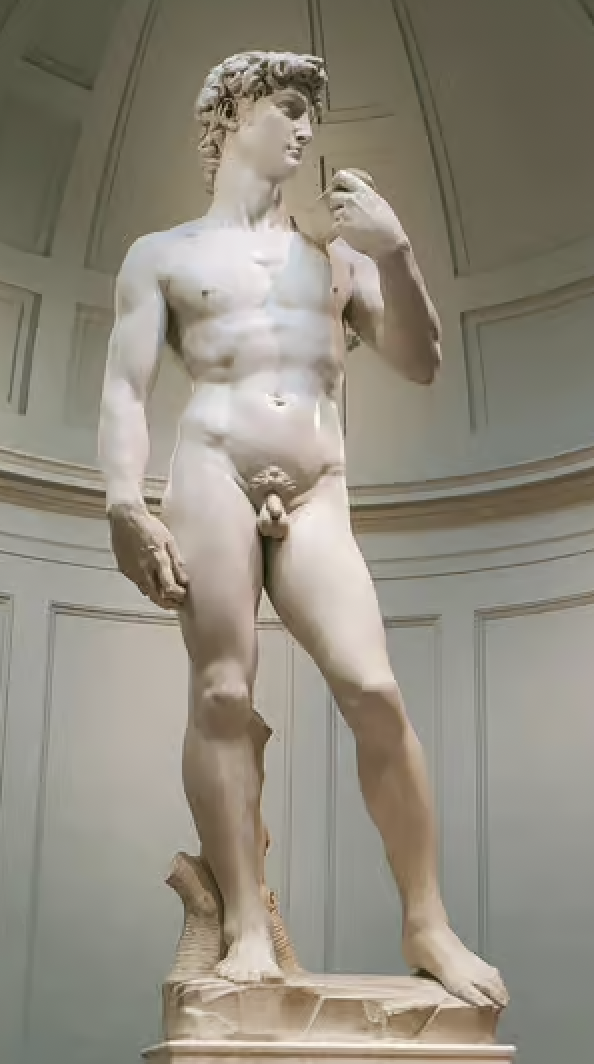 There’s an apocryphal story about a fellow admiring Michelangelo’s magnificent statue of David. He asks the artist how he produced something so divine. Michelangelo answers, “I looked at the block of marble and chipped away everything that was not David.”
That quote is so good I wish he’d actually said it. He did have a real zinger for the impatient Pope Julius II, while working on the Sistine Chapel. “When will you be finished?” shouted the pope. “When I am done,” Michelangelo replied. (Writers with a contract and a deadline may not be so cavalier with their quips.)
The art of sculpting blows me away. How can you make something so beautiful from a great big formless slab? How may slabs do you have to go through to get competent in your craft, where one errant stroke means disaster. With sculpture, you an add something back. How did Michelangelo do it? I mean, one false chip and David loses a nipple.
I thought of the David quote the other day as I was going over a hard copy of my WIP. I found myself doing a lot of this: taking out a word here, a phrase there, substituting one word for another. Chipping away, as it were, whatever wasn’t my book.
This is what I call polishing. It’s my last step before publishing.
My first draft is for getting the thing down. I don’t do heavy edits. I go over the previous day’s pages, correct obvious mistakes, make some quick changes, and then get on with it.
I let that draft sit for a couple of weeks, to get some distance, then make a hard copy and put it in a binder. For fun I put a mock cover on it with a fictitious blurb on how great it is.
Then I read it as if I were a harried acquisitions editor on a commuter train. I keep asking myself, Are there places where I’m tempted to put this book aside?
I put a big old checkmark √ in the margin, and read on. I don’t make detailed notes. In addition to the √ mark I use:
• parentheses ( ) around confusing sentences
• a circle O in the margin where I think material needs to be added
• a question mark ? for material I think is confusing
When I’m finished, I analyze, asking questions like:
• Does the story make sense?
• Are there any loose threads?
• Does the story flow or does it seem choppy?
• Do my main characters “jump off the page”?
• Are the stakes high enough?
• Is there enough of a “worry factor” for readers?
I make any major changes, then print out another draft. That goes to my first editor, the lovely Mrs. B, and a trusted beta reader. They give me valuable notes, because I always miss things on my own. I make the changes.
Then comes the polish. Here’s what I’m looking for:
Scene Openings
• Does the opening scene have a disturbance?
• Can I begin a scene a little further in?
• Do my descriptions do “double duty?” (visual and tone)
• Do many of the scenes begin the same way? Vary them.
Scene Endings
I’ve found that sometimes cutting the last lines or even paragraphs of a scene gives it more momentum. Or I may need:
• a line of moody description
• an introspection of fear or worry
• a moment of decision or intention
• a line of dialogue that snaps
Dialogue
• Is there plenty of white space in the dialogue exchanges?
• Can I cut any words to make the dialogue tighter?
• Is there a line I can “curve” to make it more memorable?
[Note: More tips, and my Ultimate Revision Checklist may be found in Revision & Self-Editing for Publication.]
And that’s how I chip away at what isn’t my book. Are you a chipper? Do you have a standard revision plan you follow?