Self-doubt is a crippling condition for any artist. (Spoiler: It never goes away. You just learn to manage it.) For young or inexperienced artists–hereinafter called writers because this is a blog about writing–self-doubt can be paralyzing. You write something you think is pretty good, but when you show it to your “beta readers” they have suggestions, so forward progress stops on your story.
The writer’s internal monologue goes something like this: I thought that description of the lightning strike was pretty strong. But if Beta George didn’t like it, there must be something wrong. He said he didn’t like the word “struck” because he thought it was a cliche. And he said Main Character Harriett wasn’t scared enough. I don’t get why she’d be more scared than she is, but if Beta George thinks. . .
I call this navel gazing. No further work gets done on the story because the writer is wrapped around his own axle trying to make Beta George happy–even if it’s against the writer’s own better judgment.
Does this scenario sound familiar to anyone: Mary has been working on her story for eighteen months but hasn’t gotten past Chapter Three. Every time she tries to move forward, she looks back and realizes that what she’s written is terrible. She wonders why she ever thought she could write a book, maybe has a little cry or maybe a big cocktail, and then she goes back to the beginning.
NOTE: Up to and excluding the part where she starts over, this is a process I go through with every book. Twenty-one of them. It’s part of the process. Literally, writing crappy prose is a necessary element of the journey to get to the end of a project. And not just at the beginning of a career. Every. Friggin’. Book.
Having done this a few times grants the advantage of having confidence in the crappy parts. I know that once the creative boiler comes up to pressure and I’m steaming through the story, I’ll be able to take care of damage control. But I have to get up to pressure. I have to move the story forward.
I’m going to share my strategy for managing doubt and crappy prose, and then I’m going to share how I think you should handle it until you feel confident that your boiler is sound.
I start every writing session by rewriting what I wrote in the previous two sessions. Then, when I finish today’s session of moving forward, I intentionally do not go back and edit. That’s tomorrow’s job, after things are less fresh in my head. Rewriting takes about an hour most days, and then I forge ahead. By the time I get to the end of the first draft, I’m really on my third or fourth draft, and all I need is a quick pass for a polish.
My system works for me because a) I’ve been doing this for a very long time, and b) I force myself to add at least a thousand words to yesterday’s count. Two thousand is better, and I think my record is 8,900. I don’t want to do that again.
Here’s my suggestion for others: Eyes Front. Don’t look back. Period. Hard stop.
Pick a targeted word count or a date on the calendar (think 10,000 words or three weeks–a real stretch). Until that milestone is reached, you are forbidden to look back at what you’ve written. Keep the story moving forward. Only forward. Get that boiler churning. Fall in love with your story again. And no cheating! If you forget what you named that guy in Chapter Two, mark the spot with asterisks and keep going.
When you reach your milestone, you MUST congratulate yourself for having met it. If you’re sailing your book at full speed through calm waters, set another goal and keep pressing on. If you need to go back to fix stuff (all those asterisks, for example), go for it. Make all the changes you feel are necessary, but remember that you still owe yourself a thousand words of forward progress.
Don’t let your book run aground while you’re cleaning the bilges.
What do you think, TKZers? Worth a try?
 An interesting discussion arose while working on copy edits for
 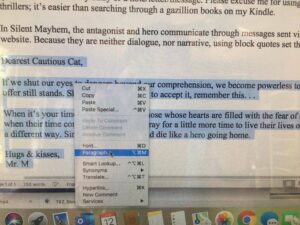 Choose “paragraph” and this screen will pop up…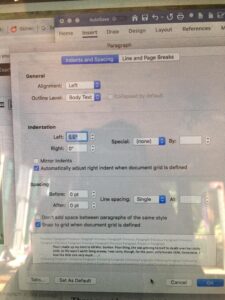

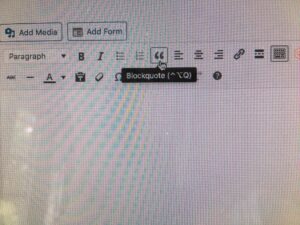 And that’s it. Easy peasy, right?