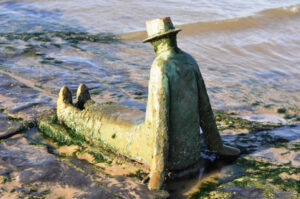
Courtesy of eltpics
Please welcome Steven Ramirez to TKZ!
If, as Stephen King likes to say, the road to hell is paved with adverbs, then finishing a novel is paved with mouse traps; and here you are trying to get across that minefield in your bare feet.
As writers, we tend to get distracted—a lot. Thanks, Netflix. And then, there’s life. How many of you have said, “If only I could focus exclusively on my writing, I’d finish this damn book, by cracky.” I know I have. Repeatedly over the years, much to the irritation of my long-suffering wife.
Then, a little thing called COVID-19 happened. We were told we had to shelter in place. Sure, there was still Netflix and Amazon Prime to distract us, but we couldn’t go anywhere. What’s a writer to do? Well, like the wily poker player whose bluff was called, I decided to shut up and write. And guess what, I finished the damn book.
Pantsers Are People, Too
I’m a pantser by trade. That means I don’t have a clue where I’m heading when I begin a new book. That’s not entirely true. I do know where I would like to end up, but I haven’t worked out the details. I have a main character in mind, of course. And I’m pretty clear on the conflict arising between the MC’s goal and the thing standing in the way. Other than that, I’m free as a bird when it comes to the plot. I suspect that some plotters look at pantsers as undisciplined children with uncombed hair and sticky fingers. My image of a plotter is a person who dresses impeccably and has an English accent. Borrowing from the wonderfully insane film Galaxy Quest, plotters are Alexander Dane, while pantsers are Jason Nesmith.
The book in question is the third in my supernatural suspense series, Sarah Greene Mysteries. My main character sees ghosts, which tends to get her into serious trouble. Over the course of the three novels, Sarah goes from discovering a mirror that holds the spirit of a dead girl to the entire town pretty much erupting into flames.
Now, as a card-carrying pantser, I had no idea how I was going to go from a murder mystery to Armageddon. I had to trust that the characters would get me to my destination. Spoiler alert—going about crafting a novel this way requires you to rewrite. Often. That’s the downside. The upside is, there are lots of opportunities for discovery. And then, there is what I like to call the happy accident, which in my opinion, is a gift from heaven and makes for a better story.
Brain Teasers
I’m no psychologist, but I suspect that somewhere deep in the nooks and crannies of my brain is THE STORY. By the way, can you even have a nook without a cranny? Just wondering. Anyway, like a sculptor working a block of marble, my job is to remove everything that isn’t the story. I’m pretty sure this is easier for plotters. I’m guessing they sit down and chisel out the plot until it operates like a Swiss watch. That’s just not for me.
“So, what about writer’s block, Mr. Too-Busy-To-Be-A-Real-Writer?” you say. Well, I don’t believe in it. Sure, there are times when we get stuck. But guess what. Even when the words are not flowing onto the page, your brain is working on the story. Maybe not consciously. But, trust me, you’re still writing. My belief is, once we can accept that not all writing translates into words on paper, the more relaxed we become. I was going to say happy, but whoever heard of a happy writer, am I right?
When I get stuck, I set aside the manuscript for a few days and either work on something else (and you should always have something else to work on) or watch television. While my conscious mind is laughing its butt off at The Good Place, my unconscious is free to work. In fact, my psyche—whose name is Stan, by the way—was probably praying I would stop looking over his shoulder and vacate the room so he could get back to creating. Stan does tend to get irritable. But I don’t blame him. I mean, I’m no picnic. Ask my wife.
Survey Says
So, where does all this leave us in terms of writing while sheltering in place? Well, when things happen that are beyond our control, we are presented with choices. I suspect that many of you out there took a look at the situation and, like me, wrote like the wind these past few months. Maybe you didn’t finish your book, but I’ll bet you made significant progress.
But what do we do when life returns, more or less, to normal? With luck, we’ve developed the discipline to carve out time each day to write. And that, my friends, is a happy accident.
TKZers: As writers, what are some of the ways you have taken advantage of these pandemic times?
 Steven Ramirez is a 2019 Best Indie Book Award (BIBA) winner and a 32nd Annual Benjamin Franklin Award Silver Winner for The Girl in the Mirror, the first novel in the supernatural suspense series Sarah Greene Mysteries. A former screenwriter, he also wrote the acclaimed horror thriller series Tell Me When I’m Dead and Come As You Are, a horror collection. Steven lives in Los Angeles.
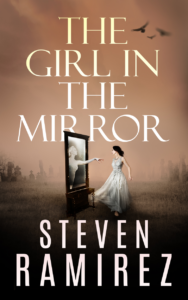 The Girl in the Mirror: A Sarah Greene Supernatural Mystery
While renovating an old house, Sarah Greene finds a mirror holding a dead girl’s spirit. As she explores the house’s secrets, Sarah awakens dangerous dark forces that could harm her.
Available now at Amazon.


 An interesting discussion arose while working on copy edits for
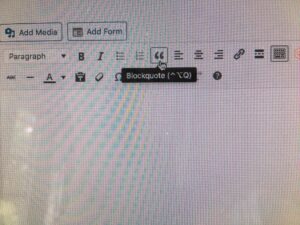
 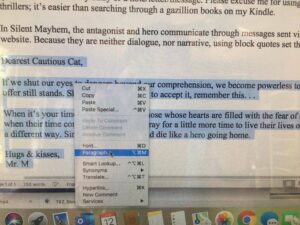 Choose “paragraph” and this screen will pop up…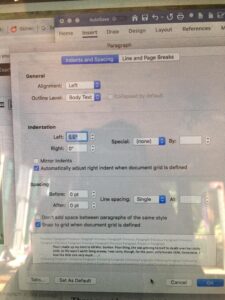

 And that’s it. Easy peasy, right?