Put Your Lead Between Opposite Characters

by James Scott Bell
@jamesscottbell
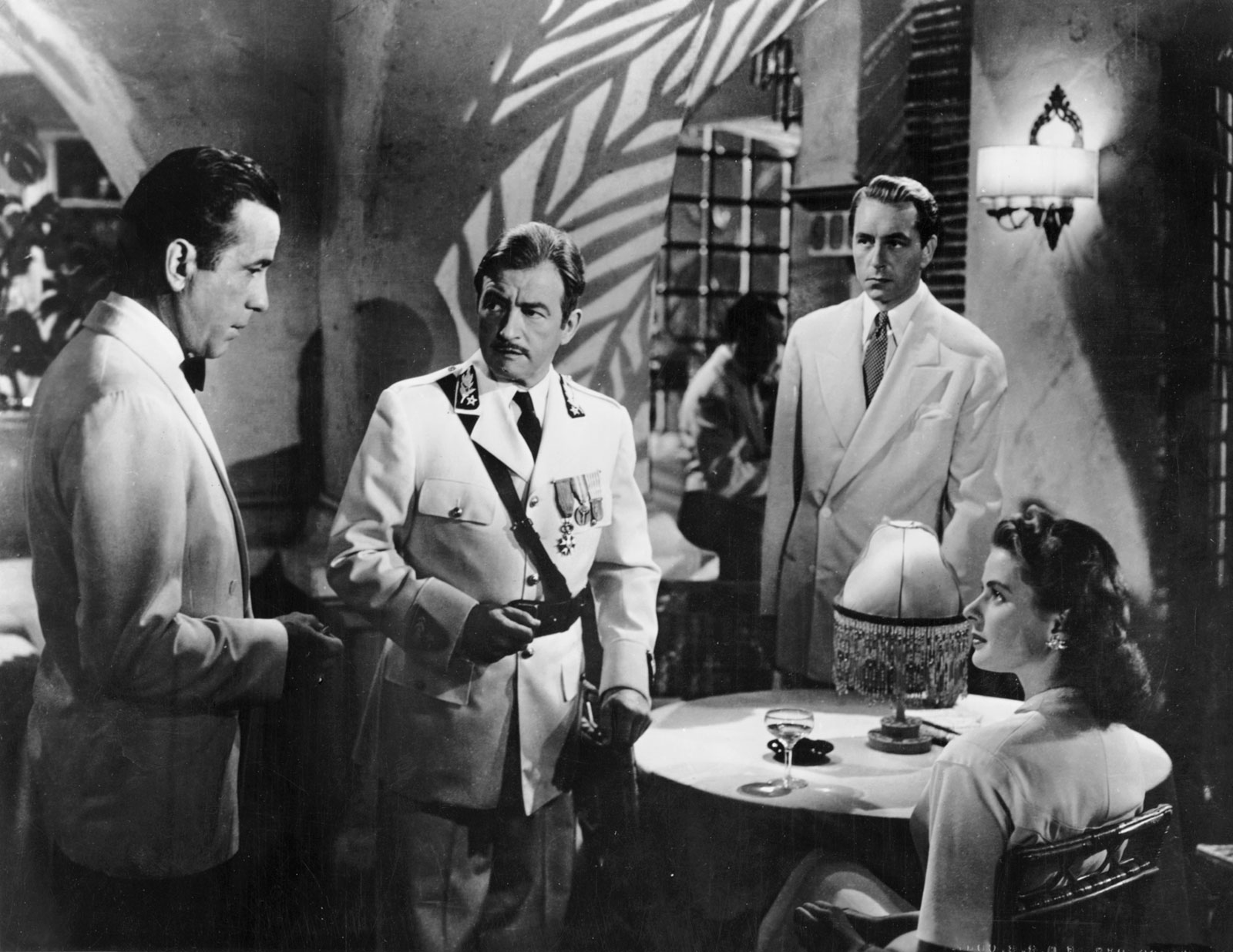
Humphrey Bogart, Claude Rains, Paul Henreid, Ingrid Bergman in Casablanca

In Write Your Novel From the Middle, I explain a crucial moment in a plot where the lead character must make a choice. It usually involves a moral dilemma, with the character’s realization of who he is and how his flaws affect the characters around him. He then has to make a decision about what kind of person he is going to be: Stay the same and continue to hurt people? Or find his way to redemption?

In the middle of Casablanca, for example, we see Rick being a mean drunk toward Ilsa, who has just poured her heart out to him explaining why she had to leave him in Paris. As soon as she tearfully exits the scene, Rick drops his head into his hands, and we know he’s looking with disgust at himself, as if in a mirror. That’s why I call this the “mirror moment” which usually happens smack dab in the middle of a novel or film. Indeed, it is the moment that tells us what the story is really all about.

Casablanca does something else to magnify Rick’s dilemma—it places Rick between two characters who represent opposite moral poles. On one side is Louis Renault, the corrupt French police captain whose sole purpose in life is holding on to his cushy job and bedding desperate women trying to get out of Casablanca. He isn’t loyal to the French or the Germans; he’s loyal to Louis, and does what he can to keep from rocking the boat.

On the other side of Rick is Victor Laszlo, the heroic resistance fighter. Rick admires him, but isn’t going to help him, even though Louis has announced his impending arrest in Rick’s café. In addition to his avowed detachment, Rick has another reason not to help Laszlo—turns out he’s married to Ilsa, the woman Rick believes betrayed him.

What Casablanca is really about, then, is how Rick gets to the decision not just to help Laszlo and Ilsa, but even to sacrifice his life (potentially) to do it. And in the famous ending twist, Rick’s moral reformation inspires Louis to make a similar choice. It’s “the beginning of a beautiful friendship.”

Hold that thought.

The other night I watched the Paul Newman film, Hud (1963). This superb movie (based on Larry McMurtry’s novel Horseman, Pass By) won three well-deserved Academy Awards: Best Actress (Patricia Neal); Best Supporting Actor (Melvyn Douglas); and Best Cinematography (James Wong Howe). The protagonist is Lon Bannon. He lives on a modest cattle ranch with his Granddad and uncle, Hud, and Alma, their housekeeper.
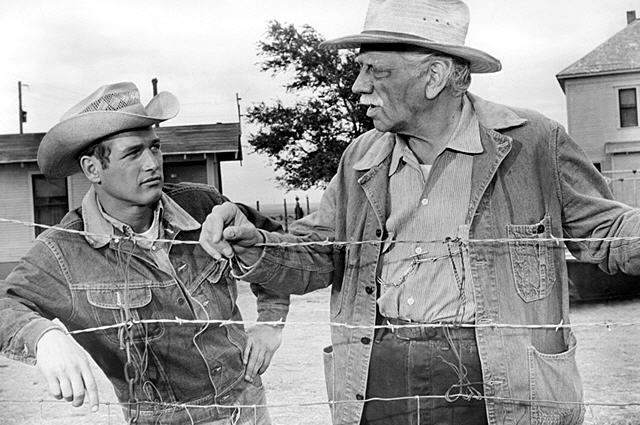
Paul Newman and Melvyn Douglas in Hud

Lon has just turned seventeen. He’s on the cusp of adulthood. And he’s offered two paths. The first is from his beloved Granddad, who has built his entire life on working hard and doing what’s right and honest. The other is from Hud, whom Lon admires for his way with women and ease at being a “good ol’ boy.” As Hud explains to Lon, “When I was your age, I couldn’t get enough of anything.” Lon is increasingly leaning in Hud’s direction.

Then tragedy strikes the ranch. A herd of cattle Granddad recently brought in from Mexico has foot-and-mouth disease. All of the cows have to socially distance be exterminated. Hud tries to convince his father to sell off the bad cows to unsuspecting neighbors. Granddad, of course, will have none of it. “You’re an unprincipled man, Hud,” he says.

“Don’t let that fuss you,” Hud snaps back. “You’ve got enough for both of us.” Indeed, deep down, Hud would like nothing better than for Granddad to kick the bucket so Hud can take his half of the ranch and do what he pleases with it.

Once again, the mirror moment happens in the middle of the film. Lon and Granddad have gone to a movie together and are having a bite to eat at a diner. Hud comes stumbling in with a woman—another man’s wife. There’s a tense exchange between Hud and Granddad, who clasps his chest and keels over. Hud and Lon get him into a pickup truck and drive him back to the ranch. As Granddad sleeps between them, Lon says:

LON: He’s beginning to look kind of worn out, isn’t he? Sometimes I forget how old he is. Guess I just don’t want to think about it.

HUD: It’s time you started.

LON: I know he’s gonna die someday. I know that much.

HUD: He is.

LON: Makes me feel like somebody dumped me into a cold river.

HUD: Happens to everybody. Horses, dogs, men.  Nobody gets out of life alive.

That “dumped into a cold river” is Lon’s awakening to the stakes. He’s going to have to make a decision on how to live life once Granddad is gone.

Two plot points happen that turn Lon away from Hud. First is Hud’s attempted rape of Alma, which Lon breaks up. Alma has been through the grinder of life, and Lon considers her good and kind. Seeing what Hud tries to do to her disgusts him.

The second point is when Lon and Hud are driving back to the ranch from a carouse in town and find Garnddad crawling on the road. He’d fallen off his horse, and is in bad shape. Lon cradles his head, tells him to hang on, that everything will be all right. Granddad says, “I don’t know if I want it to be.” He looks over at Hud. “Hud’s here waitin’ on me. And he ain’t a patient man.” With that he gives up the ghost.

Hud’s ill treatment of Granddad is the final straw for Lon. He decides to pack up and leave, not quite sure where he’ll end up. Hud makes one last pitch for Lon to stay on.

HUD: I guess you’ve come to be of your granddaddy’s opinion that I ain’t fit to live with. That’s too bad. We might’ve whooped it up some. That’s the way you used to want it.

LON: I used to. So long, Hud.

Lon walks away. Hud goes into the ranch house and grabs a beer from the icebox. He returns to the door to look at his departing nephew. Then, with a dismissive wave, he shuts the door.

That’s the end. Hud is all alone. No one to love him, no one for him to love. In this instance, contrary to Casablanca, the immoral character does not change, and we are shown the tragedy of that choice.

So consider setting your Lead between two characters who represent opposites on the moral scale. This will deepen the Lead’s dilemma and the story as a whole.

Comments welcome. 
The Beginning, the Virus, and John Kauffman

By Steve Hooley

It was college prep English class, junior year, in a little high school in rural Ohio, when I was first infected with the virus.

We had a new teacher that year, Miss Linda Warner, fresh out of college with a degree in English and teaching. She was only six years older than we were, which is probably why the boys paid such close attention. Plus, new teachers were supposed to be tested. Right?

We soon discovered that we weren’t the only ones paying attention. A new student, John Kauffman, showed up that year. We had never seen him before, and have never seen him since. In fact, we didn’t see him when he was with us. He was either invisible or a ghost.

He had to have been present though, because he turned in assignments on time and on topic. Somehow, his papers became shuffled in with the other students’ papers and ended up on the teacher’s desk. We didn’t actually know John was in the class until Miss Warner began reading his papers.

Apparently, she fell in love with John’s writing, because she read his papers to the class nearly every day. John pushed the boundaries of acceptability with his writing, and the class loved it, laughing and cheering. Junior English became a favorite class that year.

John stayed for the whole year and got an A in English. He apparently enrolled in band as well, where a new teacher gave him a B for the year. The rest of us never heard a note he played or saw his instrument.

By the next year, our senior year, John had disappeared. The mystery of his identity was never solved. I often wondered what became of him. I say John was real, and he was sent there to infect us with the bug, the virus, Scribophilia (the love of writing). Some of us never recovered and now have the chronic disease, Scribophiliosis.

For me, the disease went into remission for decades, as I studied math and science, medicine, and finally woodworking. But, in 2009 the virus recurred when I edited my father’s memoirs of his service for the United Nations during WWII. He was descending into dementia, his manuscript was nearly lost, and he was turning 90 that year. I spent the summer organizing his story, had the book printed, and presented him with a box of his books on his 90th birthday. While I stood and watched my father sign books with a confused smile, the virus got me again.

I took some correspondence courses from the Institute for Writers (then called Long Ridge Writers Group). I thought I would write magazine articles for the woodworking journals, but quickly fell in love with fiction.

I tried my hand at Science Fiction, but had no success.

I returned to the Institute for Writers and, under the tutelage of Carole Bellacera, took the novel writing class and completed my first novel.

I found James Scott Bell’s books and began seriously studying the craft of writing. I joined the ACFW and began attending conferences. And then, from a fan of the authors here, I learned about The Kill Zone blog.

I learned from Joe Hartlaub the pitfalls of publishing contracts when a small publisher offered me a contract for my first book, then quickly went bankrupt. Joe helped me retrieve my copyright before it was lost forever.

About four years ago, after hearing JSB preach about Indie publishing, I decided to go that route. Two unpublished books, four anthologies, three published books in a children’s fantasy series, and the virus is still clinging to my DNA. And happily, I am not interested in a cure for my disease.


So, how about you? Can you remember when you were first infected with the virus? What were the circumstances? Is there a teacher, relative, or friend you would like to thank (or curse) for encouraging your interest in writing? Or, has there been a particularly memorable milestone along your writer’s journey that has shifted you into a higher gear?

Reader Friday – Comfort Zones

Reader Friday – Comfort Zones

Comfort ZonesMost of us will admit that 2020 has had plenty of added stress. We all have different ways of coping. Hiking, reading, meditating. I discovered my stress reliever turned out to be watching the Great British Baking Show. Even though I can’t understand half of what they’re saying, there was something about the show that pulled me away from my real world, which is surprising, since baking is a whole different game at 9100 feet!

What’s your comfort activity? Did it change in 2020?

Is Speed Reading Efficient for Writers?

There’s a famous quip from Woody Allen that goes like this, “I took a course in speed reading. I read War and Peace in twenty minutes. It was about Russia.” There’s a lot of truth in those lines because when writers read for research (and pleasure) they need to find that balance between speed, comprehension, and production. It all comes down to efficiency.

Some folks naturally read faster than others. During my research for this Kill Zone piece, I sourced statistics that the average person reads at the speed of about 200 to 250 words per minute (wpm). That’s like a typical 12 point page spaced at 1.15 inches in 60 seconds. Speed demons can go as high as 400 wpm, but there’s a distinct line where speed becomes counter-productive, and the ability to comprehend and retain those words drastically diminishes.

Other stats I found compared reading speed to conversation cadence. Most of us talk at about 150 wpm which, I read, is the optimal spacing for podcasting and audio books. Cattle auctioneers bark at around 250 wpm, and I once worked with a cop who spoke so fast that no one could understand him—probably blurting out about 300 or more. It was a thing of beauty to listen to his evidence in court.

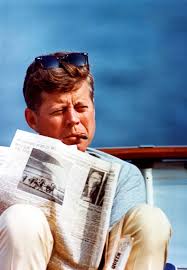
Here are some other speed reading tidbits.US President John Kennedy reportedly read three major newspapers before his morning coffee cooled. JFK’s rate was around 1,100 and he, himself, said it was his ability to skim for what he was interested in. The World Speed Reading Championship has a six-time winner, Anne Jones, who read at 4,200 wpm with a recorded comprehension at 67 percent.

Then there’s Kim Peek. He’s a savant who has memorized over 9,600 books. No one knows how he does it because Kim’s corpus callosum has been missing since birth. That’s the nerve bundle connecting the right and left cerebral hemispheres.

Anyway, back to us mortal writers. We have to read to be able to produce writing. Most of us, myself included, are bookies. We love to read as well as write. Like me, you’re probably a closet bibliomaniac who practices the art of tsundoku. (I linked these words to Wikipedia—you’re welcome.)

Another quote, while I’m in quoting mode, is from Stephen King himself who savantly said, “To be a good writer you must do two things. Read a lot and write a lot. If you don’t have the time for reading, then you do not have the tools for writing.” I’ll take King’s advice any day, but the 64-thousand dollar question is, “How do I read quickly but still write efficiently?”

To start with, there are certain limitations built into us writing mortals. They involve interactions between the eye and the brain. Brains are linguistically programmed through instinct. We naturally learn to speak. However, we have to be taught to read, and then we have to practice. A lot, if we’re going to be good readers who can efficiently transpose information into intelligible writing.

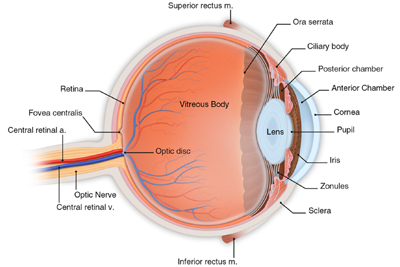
When you look at images on a page—letters, words, sentences, paragraphs, and symbols—light reflects from the page or screen to the back of your retina. Here a tiny, dot-like feature called your fovea centralis takes the information and passes it to your cerebral cortex for processing. Your cortex decides whether to use the information, store it, or chuck it.

As amazing as your fovea is, it has a limited capacity to function with speed. Foveas are focused fellas, and they only see about three words at a time. That’s because only so much light passes into cell cones in the center of the fovea. Light coming from peripheral page regions, like words to the left and right, fades into the fog of cell rods that aren’t so good at transmitting useful reading information.

There’s more to this reading science than meets the eye. You’re programmed to read in small chunks at a time. Reading scientists call this fixations and saccades. Fixations are the spots where your fovea stops and saccades are the jerk actions between the stops that keep your eye moving across the page.

From what I read and retained, your fovea fixation lasts from about a quarter-second to a full-second. This depends on your mental focus and how much your brain decides that particular info-bit is worth to you. A saccade period is about a tenth-second. Saccades are pretty predictable, and the only control you have is to decide how much you want to skim.

You can’t will or teach your fovea to act faster or look farther. It’s only going to take in about three words between stops. What you can do, however, is to exercise your cortex to retain more, and that comes from reading lots.

When you read a lot, you become more familiar with words that your brain can find useful. You expand your vocabulary as well as your overall knowledge. More understood and informative words equals higher efficiency when it comes to reading fast and retaining more. However, there comes a point where you’re reading too fast and miss too much.

So, is there such a thing as efficient speed reading? A balance? Well, let’s look back to where this craze came from and went to. Travel back to 1958 and meet Evelyn Wood who wrote Reading Skills. She was a Utah school teacher who used a three-point system to make her kids better readers. Evelyn recognized these three efficient reading methods:

Method 1 — Take more information in at a time. She encouraged scanning by moving a finger or pen across a page to increase saccade action.

Method 2 — Eliminate subvocalization. This is the little voice in your head that wants to read out loud rather than be still and absorb information.

Method 3 — Eliminate regressive eye movements. Evelyn encouraged students to read it right the first time and not to keep going back over things.

Evelyn Wood was probably the mother of all speed reading courses. She went on to offer Reading Dynamics and made a ton of money by teaching adults to read faster and absorb better. Some historians question Wood’s effectiveness at significantly improving speed, but you can’t argue with her worldwide exposure.

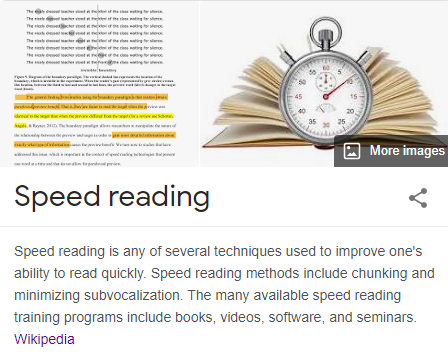
Forward to 2020 and the app age. This speed reading thing hasn’t gone away. Google “speed reading” and you’ll find tools like Spritz, Spreeder, Outread, Acceleread, and Reedy to help reduce your TBR pile. Do any of these apps really work? I don’t know, because I have my own system for researching and writing that I’d like to share with you.

As I mused, there’s a balance between time and efficiency. It depends on what you want to do with your reading material. I’m not one to “speed read” a novel, but it pays to rip through resource material as quickly as possible to write an article like this.

Case Study: Is Speed Reading Efficient for Writers?

I spent five hours researching this post. I have a fair amount of experience doing online articles, as I spent two years working with my daughter in her content writing agency. That business pays by the article. Not the word count or by time. A typical content piece is 2,200 words and to make a decent hourly return, you have to be somewhat speedy in reading your research.

I used the keywords “Speed Read” to “Google” information. I found 14 suitable articles online ranging from Psychology Wiki (which I had no idea existed—you’re welcome again) to Wired, Lifehacker, and the BBC. I copied the content and pasted it on a Word.doc which is what I religiously do for research. I formatted the doc in Ariel 10 point with 1.15 spacing and set the color on black with a white background.

Then, I printed each article on 8 ½ x 11 and went at them with a yellow highlighter and a red pen. I used a side page for black-inked notes. By this time, my cortex knew what it was looking for so, as my fovea followed my saccade spacing, I yellow-highlighted interesting stuff and red underlined really interesting stuff. I then made black notes of key points and I moved it along.

The printed 14 documents contained 21,823 words. That’s an average of 1,559 per piece. Out of the 5 hours in research time, about 2 ½ were spent in reading the printed docs and making notes. 2 ½ hours is 150 minutes, so my words-per-minute was 145. That’s no speed demon by any measure.

However, my comprehension, retention, and piece production were (in my opinion) reasonably efficient. Sure, I could probably have scanned the stuff at 3 times the rate. But, I wouldn’t have been able to efficiently write this 1,593-word article in 1.75 hours. That’s composing at 906 words per hour or 15.1 words per minute.

Do I have room to increase my writing efficiency? Certainly. Probably we all do. But is speed reading to save research time worth the reduced value of the final product? I say no.

What about you Kill Zoners? What’s your view on speed reading, and what tips on writing efficiency do you have? Please drop them in the comment box.

___

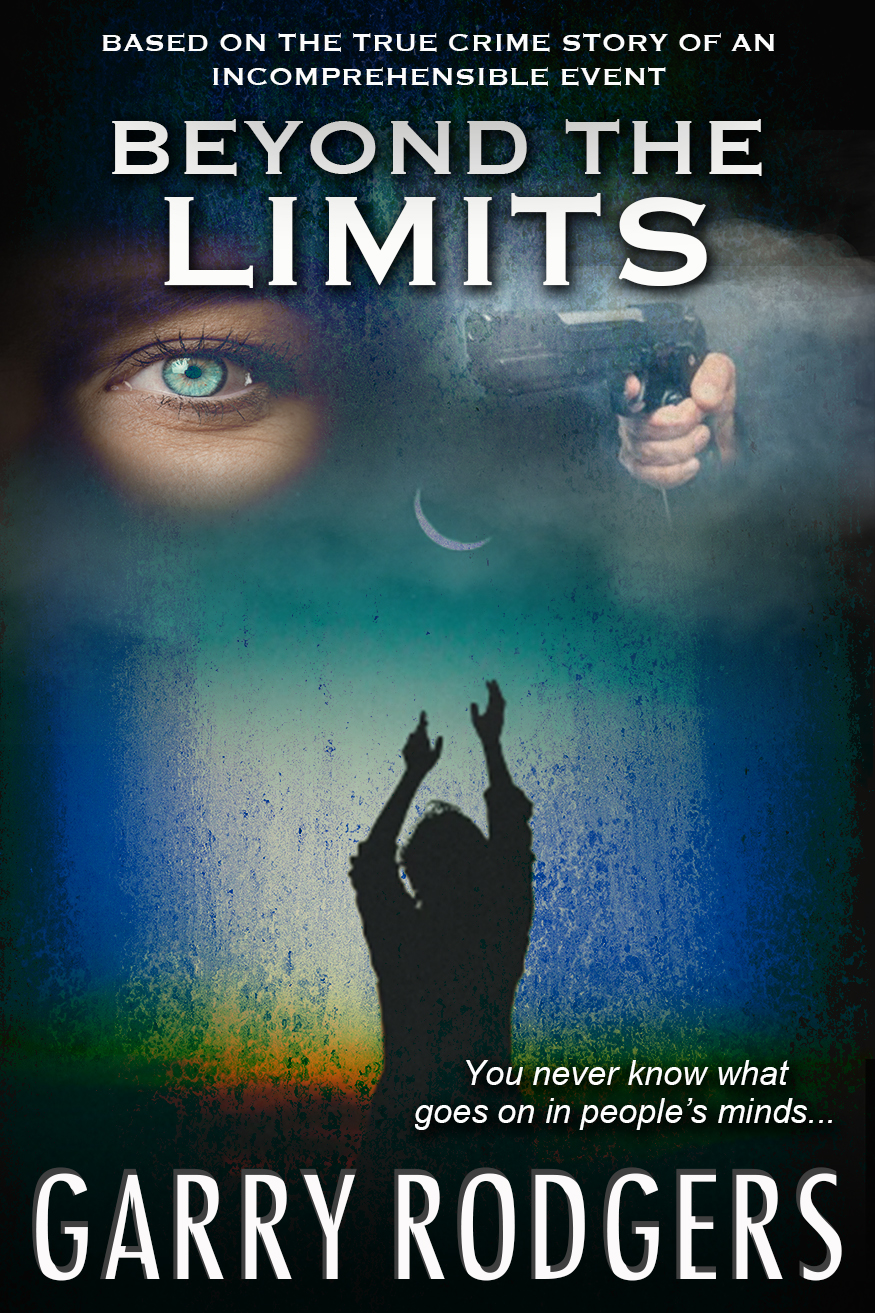
Garry Rodgers is a retired homicide detective with a second career as a coroner investigating sudden, strange, and unexplained deaths. Now Garry has reinvented himself as an indie writer who’s working on a series of based-on-true-crime stories. His latest venture, Beyond The Limits – Book #7, is scheduled for release in early January, 2021.

Besides writing at the Kill Zone and on his popular blog at www.DyingWords.net, Garry Rodgers spends his spare time putting around the saltwater near his home on Vancouver Island in British Columbia, Canada. To his aghast, there was a skim of frost on Garry’s windshield this morning.

Throat Clearing

By John Gilstrap

This morning, we take a look at a few hundred words that were submitted by Valiant Author, looking for an honest critique. I think we all know the drill by now. First, I’ll present the submission as I received it, and then it’ll be my turn on the back end:

Chapter 1

Beginnings

There was a knock at the door. “Major Edwards? It’s 0600; you requested a wake-up call, sir.”

Elijah turned the lamp on beside him and folded back the covers of his bed. The stark contrast between the warmth of the sheets and the chill of the room caused him to shiver. He sighed heavily as he placed his feet in the slippers beside the bed. He drew a short breath as they touched his skin, feeling more of ice than leather, before slowly walking to the door. Opening it, there stood a corporal with a clipboard.

“Thank you, Corporal, I’m up now,” said Edwards.

The Corporal nodded, “Yes Sir, do you need anything else Major?”

“No, that will be all.” Edwards replied closing the door.

The day’s ritual had begun.

He could hear the corporal move down the hallway and knock on the next door. Edwards rubbed his face, trying to wipe the fog of sleep from his mind, the stubble of his beard scratching his palms as he did. He turned from the door and paused to look around his “home”. A bed, with a washstand next to it, occupied most of the room. On the far wall, a wingback chair and ottoman sat before a fireplace. The walls, covered by large red roses on blue-tinted wallpaper, meant to be cheerful and welcoming.

The wood floor reflected his mood of late, worn, bare, and darkened by the passage of time. An Orderly cleaned it daily, yet it always smelled the same. A thick musty odor hung in the air, a reminder, of the many lives that passed through before him.

Edwards glanced at calendar on the wall, his only reminder that the world still moved along, read Friday, March 3rd, 1944.

It’s been over two years since I arrived in 1942, just one of thousands of Americans. Each of us, full of piss and vinegar, ready to kick the Nazis clean back to Germany. It seems like a lifetime ago. The swift victory we all believed in never came and one day just became the next in this interminable war.

=

It’s Gilstrap again.

A common trait among first chapters is what I call throat clearing, akin to the moment in public speaking when you approach the microphone and deliver an ahem as your first message to the audience. It centers you as a speaker. It makes the vocal cords vibrate to assure you that they are in place and ready to go, but the noise itself does little to advance the message people have gathered to hear.

In fiction, throat clearing is often disguised as setting or, heaven forfend, a prologue. It happens to all of us in early drafts, and I wager these passages rarely survive the final edit. All of that is fine. It’s part of the process. And it’s the bulk of what we find in this submission.  It’s less story than it is pre-story.

I can’t begin to calculate the number of times various writers in this space have espoused the importance of beginning at a high point in a story. As one who writes a fair amount of violence into my books, I feel confident in proclaiming that the process of awakening from a sound sleep is rarely the high point in a book set in the midst of war. Even if what follows is not a series of shoot-’em-up action scenes, the fact of the war–and the sense of melancholy that flows from it–is the central theme of this opening. I would feel much more empathy for Major Edwards’s situation if he were blowing bloody snot out of his nose in a trench than having been rousted out of the rack by his orderly.

Alas, I feel that Valiant Author’s actual story begins on the other side of the page turn.

That said, let’s take a look at the sample itself, ignoring the strategic location within the story and concentrating instead on the craftsmanship itself. My comments are in bold face.

Beginnings (Okay, this is purely my own prejudice, and I confess that I might be completely off-base, but I dislike named chapters. They seem trite and old-fashioned to me.)

There was a knock at the door. (This form of sentence construction–“there was . . .” is toxic to narrative. It’s so horribly passive. It means nothing. Room service knocks on doors, and so do SWAT teams when they serve a warrant, but each represents an entirely different variety of contact with the door.) “Major Edwards? It’s 0600; you requested a wake-up call, sir.” (A wake-up call? Is this in fact a hotel? And if so, why is a corporal doing the wakeup duty? Under the circumstances, not knowing what corner of the war Major Edwards occupies, 0600 feels a lot like sleeping in. While we’re here, another pet peeve of mine is the use of numerals in dialogue. I always spell things out–oh six hundred. Also a pet peeve: semicolons have no place in fiction. [Cue the arguments from English purists.])

Elijah (Because we’re not yet acclimated to these surroundings or these characters, we don’t know who Elijah is. I would write this as, Major Elijah Edwards . . .) turned the lamp on beside him and folded back the covers of his bed. (This seems at once precious and vague. Did he yank the chain on the lamp? Spin a knob? Was the knob knurled? Yellow light? Bright enough to hurt his eyes? And as for folding down the covers, is that really the image you’re after? That seems so very fastidious.) The stark contrast between the warmth of the sheets and the chill of the room caused him to shiver. (He shivered in the cold. We’ll understand why.) He sighed heavily as he placed his feet in the slippers beside the bed. (Generally speaking, sighs are a mistake. Heavy sighs are always a mistake in all genres but a few. As for the slippers, well, I guess we all must suffer in wartime.) He drew a short breath as they touched his skin, feeling more of ice than leather, before slowly walking to the door. (I don’t know where you intend to go with this story, so this might not be a criticism, but I hate this guy. He’s a whiny, privileged REMF [look it up]. If that’s what you’re looking for, then you’ve nailed it.) Opening it, there stood a corporal with a clipboard. (This is a tortured sentence. Notice the recurrence of the “there” construction.)

My recommendation is to kill all of the above paragraph–and the one immediately below–and replace it with something like, “Yup.”

“Thank you, Corporal, I’m up now,” said Edwards.

The Corporal nodded, “Yes Sir, do you need anything else Major?” (I wasn’t around in WW2, but this seems like a lot sucking up to a major. It’s not that senior a rank. Here again, I could be wrong.)

“No, that will be all.” Edwards replied closing the door.

The day’s ritual had begun.

Note: In over 150 words of text, nothing has happened. A guy heard a knock and he stood up. In 154 words.

He could hear the corporal move down the hallway and knock on the next door. (So everyone on the hall gets a wakeup call?) Edwards (He was Elijah above. Pick one and stay with it.) rubbed his face, trying to wipe the fog of sleep from his mind, the stubble of his beard scratching his palms as he did. He turned from the door and paused to look around his “home”. A bed, with a washstand next to it, occupied most of the room. On the far wall, a wingback chair and ottoman sat before a fireplace. The walls, covered by large red roses on blue-tinted wallpaper, meant to be cheerful and welcoming. (Still, nothing has happened. But I am hating him more. I mean, honestly. Who chose such awful wallpaper? I’m sure he’d take a trench any day.)

The wood floor reflected his mood of late, worn, bare, and darkened by the passage of time. An Orderly cleaned it daily, yet it always smelled the same. A thick musty odor hung in the air, a reminder, of the many lives that passed through before him. (Now, I might be thinking too hard. Are we in a hospital? Orderlies (never capitalized in the middle of a sentence) could be stretcher pushers, or, since this is a military setting, they could be folks who wake up officers and get their uniforms ready–though not likely for a major.

Edwards glanced at calendar on the wall, his only reminder that the world still moved along, read Friday, March 3rd, 1944.

It’s been over two years since I arrived in 1942, just one of thousands of Americans. Each of us, full of piss and vinegar, (cliche) ready to kick the Nazis clean back to Germany. It seems like a lifetime ago. The swift victory we all believed in never came and one day just became the next in this interminable war. (Quoted thoughts can be really tricky. We don’t think in complete sentences–at least I don’t. I think in feelings, images. I certainly don’t engage in eloquent internal monologues. If I were writing this, I would write it as close third-person narrative.)

It’s still me, but I took off the heavy dark coat.

Valiant Author, I hope you understand that honest feedback is intended as a kindness, not as a spirit-breaker. I encourage you to re-think your story’s opening–and perhaps the entire story, whatever that might be–to approach it from the point of view of readers who crave good tales and want authors to snatch them by the lower lip and pull them into drama from which they cannot look away. At each turn in your story–at each new paragraph, even–ask yourself if the words you’re writing are advancing either plot or character. In a perfect world, every passage advances both at the same time.

Okay, TKZ family, it’s your turn . . .


Knives Out! Every Writer
Needs Sharper Tools

It’s none of their business that you have to learn to write. Let them think you were born that way.” — Ernest Hemingway

By PJ Parrish

If you want to do it right, you need a good sharp knife.

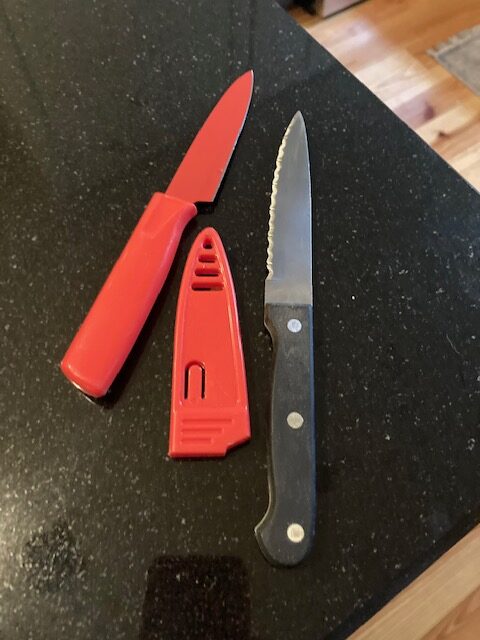
I never believed this until recently. For decades, I struggled along with cheap knives picked up at yard sales or the sale rack at Target. Useless, these dull tools all eventually found their way to a sad dark drawer of my kitchen, leaving me dependent on one little plastic job and an old serrated steak knife to do everything I needed, from slicing a tomato to carving a turkey. (See actual evidence below).

Which leads me to my friend Peter. He was a terrific cook and believed in good knives. He had a set of Wüsthof knives, which I came to learn was the ne plus ultra of knives. He kept them whetted and ready. When he would come to my place for dinner, he would scoff at my pitiful duo. “You can’t be a serious cook without good knives,” he said.

Peter left me his knives when he died last spring. They came to me in a box, gleaming and razor sharp. They frightened me. I was sure I’d slice an artery if I tried to use them.

Well, I didn’t. I came to appreciate the way the paring knife could effortlessly slice a cuke paper-thin. I loved the way the 8-inch utility knife churned through an onion. Carving a roast with the 10-inch chef’s knife was an epiphany. The right tools have made me a better cook.

Life is like this. Sometimes, you’re tempted to make do with the inferior, to take the easy route, to tackle a task with less-than. You folks out there who do carpentry or gardening know what I mean. You buy shoddy tools, you get shoddy results. Or you have to work twice as hard. Or you slice off a finger.

You can probably tell by now that this is a metaphor. As in life, a writer can’t get the job done without acquiring the right tools. You have to learn the craft. And here’s something you’re not going to like to hear: What tool you seem to lack, that’s the one you need the most.

Where do you find the right tools? Well, there are a million how-to books out there in the ether. Not all are good. Most are dull, and many are useless and should be stuck in a kitchen drawer. So let me suggest you start with The Kill Zone archives. Our contributors are laser-focused on practical craft advice, and a couple of us have written some pretty good how-to books. See that search box at the right top of this page? Type in what you need and you’ll find the tools.

Don’t be afraid to face your weakness. Find the right knife for the job you need done.

Are you bad at plotting? Does your story have a thicket of sub-plots obscuring the true story? Does your plot lack dramatic arcs (“What’s an arc?”) Does your middle act sag? Well, type “plot structure” in the search box.  Great tips galore. Start with this one from James Bell, which is a basic lesson in why plot and character go hand in hand. Trouble coming up with a great ending? Debbie has it down. Type in sub-plots, or three-act structure, layering scenes or chapter transitions and you’ll find more knives.

Are your characters lacking? Are they stereotyped, unbelievable, wooden or one-dimensional? Every great story begins and ends with great characters. If this is your weakness, find the tools to help.  Start with this post from Jordan. Need to learn about motivation? Type in “man in the mirror” or “What does your character want?”

Does description leave you cold? We can’t all be Elmore Leonard. Most of us need at least a little descriptions to make our readers care. I love description so whenever my sister and I got to this, she’d shovel the football to me. Or she’d send me back a chapter she had worked on with big read capitals saying: INSERT DESCRIPTION OF MANSION HERE. I finally forced her to do it herself so she could learn. And she did. Start with this post for some great tips.

Stymied about your setting? You can’t tell a story without creating a world. Setting is, to my mind, one of the most neglected aspects of craft that I see in our First Page Critique submissions. If you struggle with this, check out Terry’s guide here. Or read Jordan’s inspiring take.

Is your dialogue tone-deaf? Dialogue is action. Dialogue is sleight of ear. Dialogue is hard to get right. It might be the hardest writing craft to master. Here’s a terrific primer to get you started. What point of view works best for your story? Let John Gilstrap clarify things here. Should you use a dialect? Read this first.  Does your dialogue sound fake? Try this knife. 

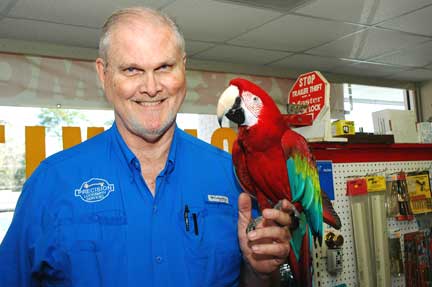
One last piece of advice. Knives get dull. Even the really good German ones. You have to get them professionally sharpened, at least every couple months. I go to Precision Sharpening & Key Shop where Jeff (that’s him and Bird at left) keeps me sharp.  Not sure where the metaphor is here, other than to say that even old dogs like me — even the most experienced writers, and especially the well-published — need to keep their craft honed.  Or they lose their edge. And as anyone can tell you, when you lose your edge, you lose your readers.  And now, I am off to pick up my knives from Jeff. Stay sharp, my friends.

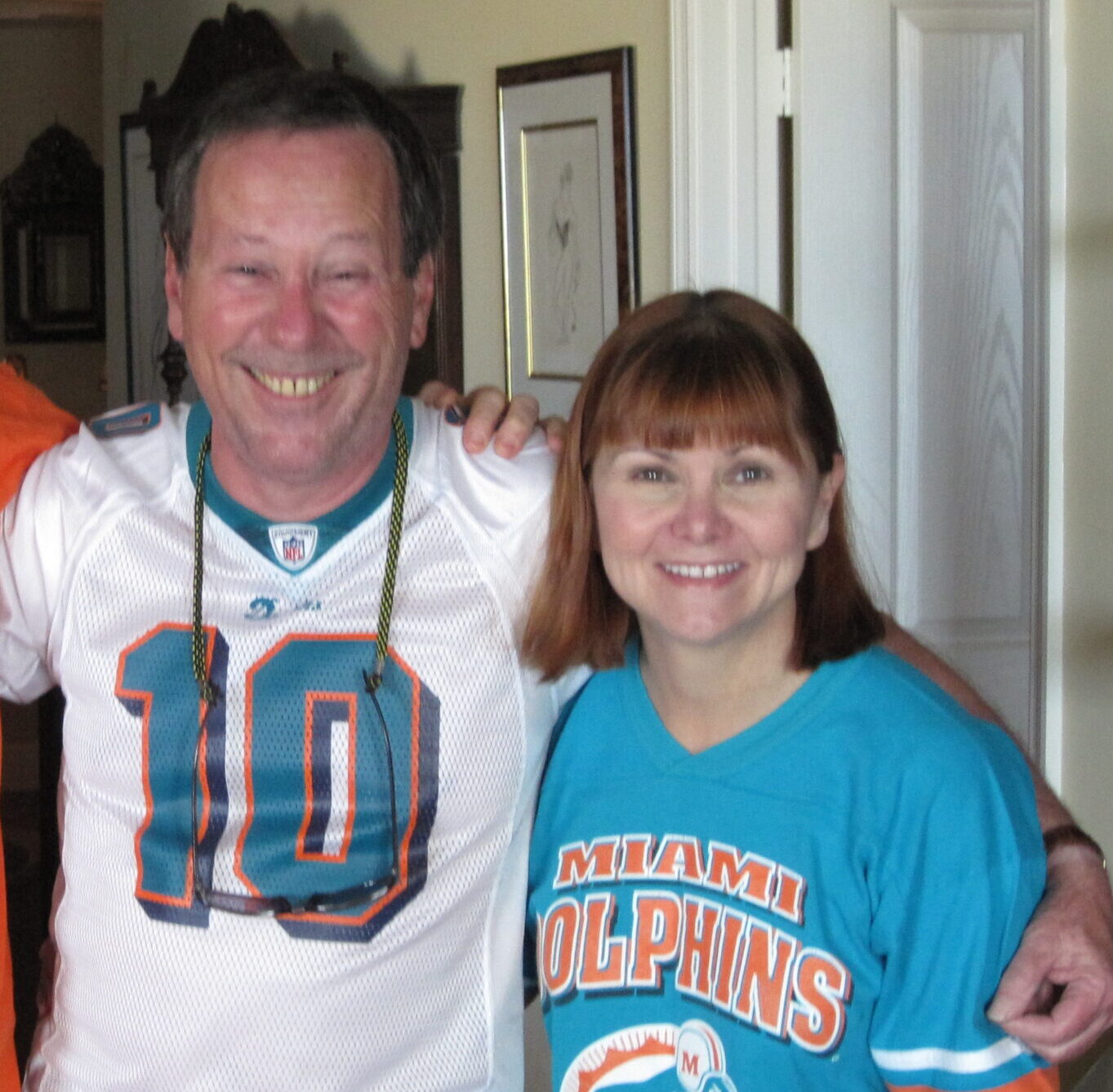
This post is dedicated to my friend Peter, who loved food, knives and the Redskins. He is wearing a Dolphins shirt because he lost a bet.

How To Explode Your Email List

Back in 2017, Jim wrote a terrific post with tips for success in traditional or independent publishing. One of his top tips for all authors is to build an email list.

Did you follow that advice? If you didn’t, heed Debbie’s warning on how NOT to get started. Even if you’re working on your first novel, you should be actively building your list. I’ll let David Gaughran explain why an email list is the most powerful tool at our disposal.

I’m sure all of you know the power of having thousands of committed readers signed up to your mailing list, allowing you to send each new release into the charts. Even if you’re not there yet personally, this should be something you are aiming for. Every single author should have a mailing list and be seeking to actively grow it.

Now that we know why an email list is so important, how do we go about it?

SUMO

To build an email list, we need a way to collect emails on our website/blog. SUMO is the #1 email capture tool. And it’s free. As of this writing, 886,114 sites use SUMO.

We’ve noticed lots of people struggle to collect emails because the tools just aren’t available or are too expensive. So we thought, why not make our tools available for you?

Our goal, plain and simple, is to help you grow your website.

— SUMO mission statement

Create a scroll bar, pop-up, smart bar, Welcome Mat, or static form to trigger visitors to subscribe to your list. If you offer a free book as an incentive (called a reader magnet), be sure to mention it in your form. No coding required. Takes less than a minute to design a form.

I’ve used SUMO for years with excellent results. I started with a smart bar that hung at the top of the website. I can’t remember why I switched to a popup. There’s no question popups are effective. They’re also annoying as all heck. So, I switched back to the smart bar. A Welcome Mat covers the entire page. The visitor must interact with the form to read the article underneath. They’re effective, but I’ve passed on articles because of them. Do what works best for you.

Pro Tip: Rather than offering the same reader magnet for years, swap it for a new freebie from time to time. Using the same one can become white noise after a while.

A Word About the “F” Word: Free

Being an author requires a long-term game plan. There is no get-rich-quick scheme. For most of us, one book won’t produce enough income to survive. Thus, we need a strategic approach to building our brand. The #1 way to do that is to grow our email list, and a free ebook campaign can accomplish that goal.
Many authors put their books into Kindle Unlimited. Which is fine, in theory, but it won’t grow your email list. Amazon won’t tell you who downloaded your book or how to contact them. Sure, you might gain visibility, but wouldn’t you rather form a long-lasting relationship with a fan who can’t wait for your next book? There’s only one way to meet that goal: grow your email list.

If you’re still not convinced, let me ask you this. How many $5 ebooks have you bought from an author you’ve never heard of without a recommendation from someone you trust? Not many, I suspect. Now, what if the book was free? You’d be more apt to take the chance, right? Of course you would.

Some of you may be thinking, offer my book baby for free? Gasp! Believe me, I get it. I know how much of your heart and soul you’ve poured into that book, but we need to shed the emotional attachment to move forward. View each book as a steppingstone leveraged for future sales. By sacrificing short-term gains, we set up long-term rewards. Capeesh? Super. Moving on…

Book Funnel

BookFunnel isn’t only a platform to send ARCs, though I do love that aspect. They automatically add a watermark to Advance Reader Copies to help prevent piracy.

Whether it’s delivering your reader magnet, sending out advanced copies of your book, handing out ebooks at a conference, or fulfilling your digital sales to readers, BookFunnel does it all. Just like you, we’re in the business of making readers happy. Let us help you build your author career, no matter where you are in your journey.

All true. You do need to pay-to-play, but they offer affordable plans. The New Author Plan is $20/yearly. If you only have 1-5 books, the New Author Plan might be enough to get started, but you won’t be able to collect email addresses unless you join a group promo. Even then, the starter plan has limitations. So, if you’re hoping to explode your email list, my advice would be to upgrade. The benefits far outweigh the cost.

Mid-List Author costs $100/yearly or $10/monthly (if the yearly plan is unaffordable right now, choose the monthly plan; you can always change it later). The premiere plan is Bestseller for $250/yearly. The plan titles are a marketing ploy to shame you into upgrading. That said, there are a few key differences.

  1. Mid-List allows 5K downloads per month; Bestseller allows unlimited downloads.
  2. Mid-List allows 2 pen names; Bestseller allows 3 pen names.
  3. Mid-List doesn’t include Priority Support, Bestseller does.

There’s one other difference worth mentioning. Mid-List has no email integration. Meaning, after a promo they’ll send a .csv file for you to upload to your list. Email integration uploads the names/addresses automatically. You can add email integration to Mid-List for $50/yearly, if you’d like. Or stick with the original plan and upload the .csv file yourself. Whatever works best for you.

Bestseller comes with 3 email integrations. Meaning, if you separate your email list into segments or groups, you can integrate a specific list for each BookFunnel promotion.

BookFunnel Landing Pages

You’ll need to do some work to setup your dashboard, but it’s a painless process. Add books and create beautiful landing pages in minutes. No coding or tech skills required. A landing page is where we send readers to download our freebie.

We have various options when creating landing pages. To grow the email list, check the box that ensures readers must give a valid email address to download the book. BookFunnel verifies each address before granting access.

BookFunnel Promotions

BookFunnel membership comes with free promotions. Hosts offer several different promo opportunities.
To grow the email list, scroll through active promotions in your dashboard and search for Newsletter Builder promos.

Check the requirements for each promo before joining. Some require a minimum number of subscribers in your email list (usually 1K).

Next, subscribe for updates in your genre. Every time an author sets up a new promotion, you’ll be notified via email. Spots fill up quickly, so don’t delay. Or host and run your own promotion and invite other authors to collaborate.

Pro Tip: When the promo goes live, share your personal tracking link in your newsletter, on social media, and your website. BookFunnel tracks your shares. It’s how you build a good reputation for future promos.

BookSweeps

If you like BookFunnel, you will love BookSweeps.

A premiere membership costs $50/yearly, but it discounts future promo opportunities, promotions that add hundreds of voracious readers to your email list. Not freebie seekers, either. These are book buying readers. Freebie seekers join email lists to get the reader magnet, then immediately unsubscribe.

Even with book buying readers, it’s normal for a few to unsubscribe when you send your first email. This happens for various reasons. Don’t take it personally. Think of it as a good thing. Once you hit a certain number (1K-2K email addresses, depending on email provider), sending newsletters is no longer free. Why pay for a reader who has no interest in your work?

Add a Pen Name

A premiere membership allows three different pen names. If you don’t have an alternate author name, create book specific pen names. For example: I created Sue Coletta for my Mayhem Series and another Sue Coletta for my Grafton County Series. Why? Because my two series have different character types, tropes, settings, etc., all of which we can distinguish under separate Pen Names.

Create a Reader Magnet

Generate email subscribers by adding an ebook to the BookSweeps directory, where readers can download the book in exchange for their email. When we create a reader magnet in BookSweeps, we can link to the next book in the series (for sale), add testimonials, and add sub-genres and tropes. It’s an excellent marketing tool.

BookSweeps Promotions

You do have to pay-to-play, but BookSweeps offers discounts once you’ve run a promotion or two. A $50 promo becomes $25 – $35, depending on the promotion.

The best part about BookSweeps promotions is they do all the work for you. All. The. Work.

  • 5 days before the promotion they send you the group promo images for FB and Twitter; they even create a shareable image for your individual book.
  • On promo day, they send you a reminder email with links to the shareable images.
  • During the promo, they remind you when the promo will end.
  • After the promo, they send you an email on what to expect next.
  • 5-10 days after the promo, they send you the spreadsheet with the email address, a separate spreadsheet for the winner and runner-up. That email also contains links on how to upload the list to your email provider, tips for writing a welcome letter, and other valuable information about nurturing your email list. 

Pro Tip: When running a promotion on BookFunnel, Facebook, Twitter, or your website, add a Sweep in the BookSweeps giveaway directory to increase your reach. Free traffic!

Writers: If you follow this advice, your email list will explode with new subscribers.

Readers: If you join BookFunnel or BookSweeps (both free for readers), your e-reader will explode with free books. Win-win!

Over to you, TKZers. What’s your #1 tip to grow your email list? Please share your experience.

Try Writing Sprints to Overcome Writing Setbacks

by James Scott Bell
@jamesscottbell

Okay, let’s not mince words. 2020 has been one hell of a year. This is how it’s felt:

Getting whapped in the face over and over is not fun. But, as the Stoics used to say, it is what it is. It’s what you do with the “is” that counts.

This applies to any field of endeavor. No one gets to have a successful career without confronting and overcoming setbacks. Some will be big, some small, but come they will.

Steve Jobs built Apple into a powerhouse, only to be forced out in 1985. Twelve years later Apple was circling the drain. Jobs was brought back in and turned Apple around. When he died at age 56, Jobs was worth $7 billion.

Wally Amos started Famous Amos Cookie Company in 1975. I was there. I was walking along Sunset Boulevard one day that year when a friendly man in a cool hat and holding a plate of cookies stopped me. He was standing outside a little A-frame store with a giant cookie on the sign. So I sampled one of his little beauties and was hooked. I bought a bag. And shook hands with Wally Amos.

But then came the setback. In 1985 Amos was forced to sell the company. He was prohibited from using his name to start another. So what did he do? He started the Uncle Noname Cookie Company. Faced more setbacks. Started another company, and at age 84 is working on another. This is called never giving up. 

Writers have their unique challenges. When their career is in the hands of another, there’s always the possibility of being dropped if things don’t work out financially. This can lead to some depressing conversations. The screenwriter played by Albert Brooks in his movie, The Muse, had one such talk:


Setbacks are often due to circumstances beyond our control. I know one writer who got a mega book deal, the first hardcover coming out with great fanfare on the usual release day, Tuesday. Only this Tuesday happened to be September 11, 2001. Suffice to say the book stalled and so, for a time, did the author’s career. But he came back.

So did a guy named Gilstrap. Back in 2003 “everyone told me that my career as a writer was over.” Now what have we got? A hit series and another one on the way. (Read John’s account of what happened here.)

Among my writing friends are several “midlist writers” who were phased out, dropped, or otherwise shown the door by their former publishers. Most of them are now happily publishing independently—which in and of itself is the most amazing “comeback machine” ever handed to the writing community. 

Then there are setbacks that come from life itself: pandemics, family issues, physical challenges, mental fatigue. All this can affect our work. 

How to handle them? My advice has always been along the lines of the flippant doctor’s prescription for insomnia: Just sleep it off. I’ve counseled writers to keep writing, or “write your way through” whatever it is that knocks you flat.

But I know that’s easy to say and hard to do. So let me suggest an exercise I call writing sprints. This is where you set yourself a goal of writing 250 words—a nifty 250—as fast as you can. The three rules of writing sprints are: 1) Write without stopping; 2) Don’t judge what you’re writing as you write; and 3) Wait ten minutes before you look over what you’ve done and decide what to do with it. 

I’ve broken writing sprints into five categories:

1. Scene sprints

That scene you’re about to work on? Pick a spot in the scene, any spot, and write 250 words. It could be the beginning, or it could be the “hot spot” where the meat of the scene is taking place. You can also write an ending, too. There is no wrong decision. 

2. Emotion sprints

This is my favorite. Find a place where your viewpoint character is feeling something deeply. Then write 250 words just on that feeling. Expand it. Use internal thoughts. Use metaphors. Follow tangents wherever they lead. Later, you’ll use the best of this in your writing. Even if it’s only one line, you’ll have found gold.

3. Dialogue sprints

I love dialogue. It’s fun and easy. In a sprint, don’t use quote marks or attributions. Just the dialogue between characters. Let them improvise. Let them argue. Let them reveal things. Usually you’ll find something that is delightfully surprising (and it will delight your readers, too).

4. Description sprints

Go wild on describing a person, place, or thing. I often close my eyes for this, and let my imagination give me pictures. 

5. Random Word sprints

Open a dictionary at random (I used to carry a pocket dictionary for this, back in the days when it was acceptable to write in a coffee house). Pick the first word you see that is a noun, verb, or adjective. Write 250 words on whatever that word triggers. You can apply it to your WIP if you like. Example: You find the word bloodhound. You can just start writing and follow rabbit trails (hey, just like that dog!) Or can ask yourself, “How might a bloodhound figure in my story?” and then go. Maybe your Lead can have a memory of a bloodhound. Or maybe he feels like a bloodhound. Okay: what does he think about that feeling? Keep writing! 

Here’s another benefit. After you’ve done those 250 words, you’ll almost always feel the flow. You’ll want to write some more. So write! Because setbacks won’t stop a writer who produces the words.

What’s a setback you’ve faced as a writer? What did you do to overcome it? Or are you still in process?

Slow Down. Please.

I had a different post (almost) ready to go. It is interesting, but a bit long. I thought that many of you might still be emerging from food comas two days after Thanksgiving and accordingly would appreciate something short with a striking visual and a gentle reminder.

And here we go!


The foregoing incident, as near as I am able to determine, took place in 2017 in a multi-goods warehouse in South Africa. Videos of similar occurrences in a cheese storage facility in England in 2015 and a Russian facility in 2017 are also online. This one, however, is the one to which I keep returning. 

We can learn a number of things from this video. Most are important throughout the holidays in a variety of settings but apply throughout the year as well:

— There is a reason that patience is called a virtue.

— Life, like football, is a game of inches.

— “Maximum load capacity” is not a suggestion.

—  When given a choice between “set-up” and “clean-up” always choose “set-up” and leave before “clean-up.”

— Never turn your back on the FNG (an acronym for a term meaning “the new employee”).

I hope that you continue to enjoy your weekend. If you are feeling overwhelmed, please try to remember that this too shall pass. The same, alas, cannot be said of the poor soul who found second gear on the forklift. Once. My understanding is that he did live through this but is working in a different occupation.

Have you ever witnessed a catastrophic incident? Did it provide you with a spark or element for a story?

Enjoy and be well. And thanks for stopping by today on one of the busiest weekends of the year.

Author/physician Steve Hooley will be taking over the alternate Saturday slot commencing next week on December 5. He is a terrific guy with multiple talents and will give us plenty to think about.