Collecting Moments of Pleasure,
Thanks To A Favorite Author

By PJ Parrish

It was going to be a tough crowd. They had gathered out on the docks of the Bahia Mar resort in Fort Lauderdale — a pelican-glide away from the Busted Flush’s slip F18, no less.
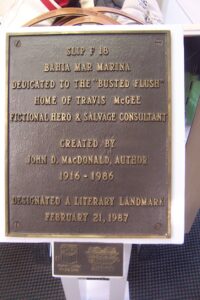
The plaque at slip F18 at Bahia Mar.

It was hot, and the audience was sweating under the October sun. But no one was sweating more than me. Because I was there as part of a panel of mystery writers to talk about what John D. MacDonald meant to me, and I had never read one of his books.

I could have lied. But I didn’t. I fessed up, and after the gasps died, I talked about the stuff I had read -– the good old stuff -– John D. MacDonald’s short stories.

I hadn’t read them all. He turned out nearly a million words worth of stories in his life, and many were lost to time. But I had read everything I could get my hands on because in those days, I was teaching myself how to write short-form fiction, and sticking to Carver, O’Conner, Oates just wasn’t doing it for me. I found a copy of MacDonald’s collection, The Good Old Stuff in a used book store in Fort Lauderdale. When I read those stories, it was like someone smacked me aside the head with an oar, forcing new synapses to fire in my writer-brain.
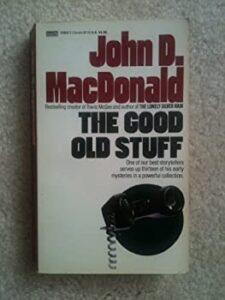
Most these stories were begun after MacDonald returned from the army as a way to support his family. He worked eighty hours a week, writing across a style spectrum that included crime pulp, westerns, sci-fi and fantasy, keeping as many as thirty-five submissions in the mail at all times.

He also wrote love stories for women’s magazines, usually about hapless husbands. I still remember this scene from “She Tried to Make Her Man Behave,” where a wife confronts her husband with this: “The marriage book said a good marriage is a case of both people making adjustments.” To which the husband relies, “That sounds as if I’m due to make one.”

Cheever might have liked that one.

In 1950, in “Breathe No More,” MacDonald gave us the McGee prototype Park Falkner, an eccentric sarong-wearing millionaire who lives on Grouper Island in Florida. Falkner’s gal-pal is Taffy Angus, who is the sun-kissed rough draft for every McGee woman who drifts off or dies horribly.

So, back to that sweaty day at Bahia Mar. I told the audience what I had learned from reading the good old stuff. I told them that these stories had everything — vivid characters in diamond-bright settings, elegance and economy, wryness and wit, and that sense of inevitability that I search for in all good fiction. And every one of them, even the flawed efforts, had that strange music, what MacDonald himself called “a bit of unobtrusive poetry.”

For my reward, the organizer of the event presented me with pristine copy of The Deep Blue Goodbye. I read it that night in one sitting and I didn’t look back as I made my way across the MacDonald rainbow. On my beside table now is The Scarlet Ruse. 

Maybe it is because I am getting old, but when I read this passage recently, it really got to me. It is classic Travis and undoubtedly classic MacD himself (who was a mere pup of 56 when he wrote it):

I collect moments of total subjective pleasure, box them up, and put them in a shed in the back of my head, never having to open them up again, but knowing they are there.

So what would be a gem in the collection?

A time when I am totally fit and I have just come wading through one the fringes of hell, have been stressed right up to my breaking point, have expected to by whisked out of life, but was not. I am out of it, and if there is any pain, it is too dwindled to notice. I am in some warm place where the air and sea are bright. There are chores to do when I feel like it, but nothing urgent. I am in some remote place where no one can find me and bother me. There is good music when and if I want it. There is a drink I have not yet tasted. There is a scent of some good thing a-cooking slowly. There is a lovely laughing lady, close enough to touch, and there are no tensions between us except the ones which come from need. There is no need to know the day, the month, or the year. We will stay until it is time to go, and we will not know when that time will come until we wake up one day and it is upon us.

The passage resonates with me because this past annus horribilis has made me cling ever more tightly to the few things in my life that matter. Like Travis, I am in a remote place (northern Michigan) where no one can bother me. I am happy with good music, a little drink of the locally distilled whiskey, perch cooking in butter, friends and family held close. Like McGee, I am comforted in the notion that I am lucky to have survived, hell, even thrived, for six decades and counting. That, and the fact that I as I slide into…ahem…the late autumn of life, I, too, am more determined than ever to “collect moments of total subjective pleasure, box them up, and put them in a shed in the back of my head.”

And to not fret about the future, to just “stay until it is time to go, and we will not know when that time will come until we wake up one day and it is upon us.”

I love the fact that I can still mine nuggets like this from old books. I love the fact that I can count on certain writers to still make me laugh, teach me things, inspire me, and reaffirm what is important when it is easy to forget. I love the fact that the MacDonald rainbow remains ever green.

TKZ hive: What books or writers do you return to again and again? What writers tickle your brain and enlarge your heart?

 

Writing Community Etiquette

One of the most amazing things about being an author is mingling within the writing community. Writers, as I’m sure you’ll agree, are some of the most generous, supportive, and kind humans on the planet.

That said, there are a few unwritten rules within the community. Let’s discuss to enlighten the newer members of our family.

Other Writers are NOT Competition.

They are our people, our tribe. The longer we’re in this business the more it becomes a kinship. I can’t even imagine working without other writers by my side. We share successes, as Joe so beautifully demonstrated last Saturday. We also share failures (privately, btw, never rant on social media). We lift each other up and try to help where we can.

Without other writers, imagine how lonely this profession would be? As it is, we spend countless hours alone at the keyboard, hanging with our fictional homies or burrowing down one research rabbit hole after another. What if we had no one to share our discoveries with? Or to bounce ideas off of? Or to help us celebrate a new release? Or to knock some sense into us when nothing seems to go right?

We’re better because of, not in spite of, our relationships with other writers.

Lose the Ego

If this business hasn’t taught you humility, you haven’t been part of the publishing industry long enough. You might be soaring now, but you will fall one day. It’s inevitable. Yes, celebrate your successes. Don’t let it go to your head, though. A reality check now and then is an important exercise. Chances are there’s plenty of writers who sell more books than you, who are more loved by readers, who has rocketed to heights you (or I) might never reach.

John’s recent post is the perfect example of success and humility. It’s one of my favorite posts he’s written because of its honesty and realness.

Don’t be a Jerk

Do you really need to point out a typo in a tweet? We’re all fallible. Smile and move on.

Do you really need to say how much you disliked a fellow writer’s work?

What you put out in the universe has a way of boomeranging at the most inconvenient times. It may not be today, but eventually Karma will bite back. Count on it.

When you first join the writing community, it may seem endless. Here’s the thing about skewed impressions. Objects in the mirror are closer than they appear. Cross a fellow writer, and that circle can and will get downright claustrophobic. Why? Because writers protect other writers. It’s what we do; it’s who we are as a community. Just ask Disney.

Give More Than You Receive

Did a fellow writer blurb a book for you? Great! What did you do to help support them? I’m not saying you need to match the gesture by blurbing their next book. Maybe you’re not at that level yet. What should you do? Here are a few suggestions:

  • Review one of their books
  • Offer to beta read
  • Share their good news, new release, book cover(s), blog posts, interview, etc. on social media
  • Better yet, pay it forward to a writer farther down the rungs of the ladder—most writers will love knowing by helping Writer X, they also helped Writer Y.

The worst thing you can do is to ask for another helping hand when you’ve showed no appreciation for the last favor. And for the love of God, NEVER ask a fellow writer to fund your writing career because, in your eyes, they’re successful and you’re entitled enough to think you shouldn’t have to work a day job while you hone your craft. Yeah, those people exist. And they all seem to have my email address. Lucky me. 🙂

Common Courtesy

Treat fellow writers as you would like to be treated.

  1. Respond to blog comments. If someone has taken the time to comment on your article, don’t treat them like they’re invisible. Reciprocate with a response. Common courtesy is not rocket science. How would you feel if one day everyone stopped commenting on your blog posts? If you continue to ignore your audience, that can and will happen. If chatting with your audience isn’t important to you, then close the comment section. By leaving it open you’re obligated to respond.
  2. Share a fellow writer’s posts. Let’s take Twitter, for example. If someone retweets everything you share, or even if they only share one post, return the favor. They didn’t have to take the time to share your tweet with their audience, but they did. Do the same for them.

But Sue, what if their books have sex acts on the covers? If you don’t feel comfortable sharing their pinned post with your audience, then scroll through their timeline until you find a more appropriate post that you can share.

  1. Never hijack another writer’s social media timeline. We’ve all met the writer who thinks it’s acceptable to tag 90 authors in their book promos. It isn’t. If anything, said writer looks unprofessional and desperate. I have a few followers on Twitter who do it constantly, and it drives me crazy. The only ones I haven’t blocked (yet) are the writers who also RT my tweets. Does that make tagging okay? No. Unless you’re having a conversation with someone or sharing their work, pretend tagging doesn’t exist.

Lose the Automated Message

I admit, when I first joined Twitter, an automated message to greet my new followers seemed like a good idea. Let me set the record straight—they are never a good idea.

Nothing screams amateur more than an automated message. I once followed this writer whose automated message read: “I want to be your favorite author!” I wrote back: “I want to be your favorite author, too!”

Surprise, surprise, she unfollowed me. Good riddance.

I can think of only two possible exceptions for sending a private message.

  1. If you’re extending an offer that will benefit them, not you. And it’s free. You wouldn’t ask someone you just met at a party for money, right?
  2. If you’re having trouble finding their books and are asking for a link.

In both these non-automated scenarios, most writers won’t mind. But first try to find their email address. Email is less intrusive than private messaging.

Auto-Add Email to Newsletter

If a fellow writer accepts your friend request on Facebook or follows you on Twitter/Instagram or subscribes to your YouTube channel, that does NOT mean they’ve signed up to receive your newsletter. I’ve had friends add me to their list, but they’re actual friends who I chat with all the time. For everyone else, there’s a big difference between showing support for your fellow writers and signing up to receive their newsletters.

Think of it this way. I have over 12K followers on Twitter alone. Imagine if they all added me to their email list? My inbox would explode! The less-informed writer may be thinking: But Sue, you can unsubscribe at any time.

Oy. I hear that excuse all the time. Newsflash. Unsubscribing from a newsletter you never signed up for in the first place annoys most writers. Plus, it takes time away from writing, researching, marketing, or the gazillion other things we do daily.

Read the room, dear guppy (new writers a la MWA). A follow-back or an acceptance of a friend request is just that. Nothing more.

Final Thought

As I said at the beginning of this post, writers are some of the best people on the planet. Most of us would agree that without other writers, this profession would be a lonely one. But we’re never truly alone. There’s always another writer who’ll be there when we need them, just as we were there for them. We’re blessed, and that gift should never be taken for granted.

Over to you, TKZ family.

Did I miss anything? Add your tip! If you can’t think of anything to add, then share a story of a writer helping you or vice versa.

Writing Lovely Moments

by James Scott Bell
@jamesscottbell

Sidney Poitier in Lilies of the Field (1963)

I believe writers are here to “bring the light.” It’s a dark world out there and most readers, I venture to say, don’t want more of the same in their leisure hours.

By that I don’t mean we avoid the harsher edges in our fiction. Indeed, that’s what the best thrillers take us through in order to deliver us at the end.

I do mean, though, that light (e.g., hope, justice) is a powerful—even necessary—element for today’s market.

Which brings me to the subject of lovely moments.

The other night Mrs. B and I re-watched one of our favorite movies, Lilies of the Field. This 1963 gem was a low-budget production that ended up nominated for five Oscars, including Best Picture and Adapted Screenplay. Sidney Poitier took home the Best Actor prize for his performance. Lilia Skala, the Austrian actress, was nominated for her supporting role (and should have won, in my humble opinion).

It’s the story of an itinerant worker, Homer Smith (Poitier), who is driving his old station wagon across the Arizona desert. His car needs water, so he pulls into the only homestead within miles. It turns out this is the humble dwelling of five nuns who are scraping out their subsistence by growing vegetables, raising chickens, and milking one cow. The nuns do not speak much English. We learn later they escaped over the Berlin Wall and came 8,000 miles to this desolate place.

The iron-willed Mother Superior (Skala) is convinced that God has sent “Schmidt” to them for a very special purpose—to build a chapel for the poor, mostly Mexican locals to attend mass.

Mass for this community is administered outside a local hash house by a priest who works out of a motor home. In a conversation with Homer, the priest admits that when he was ordained he prayed to be called to a majestic cathedral in some wealthy diocese. Now, he notes ruefully, he has to pray that his tires don’t blow out.

Near the end, with the chapel finished, the priest is brought in to see where he will now be saying the mass. He is so moved he can hardly speak. Finally, he says to the Mother Superior, “Many years ago, I made a very vain and selfish prayer. Now He has answered my prayer through you, through many people. I pray now I become worthy of His trust. And yours.”

A lovely moment. It’s with a minor character, but it deepens the emotional impact of the entire film.

So I’ve been thinking about how to add such moments to our fiction. Here are two prompts:

  1. Where can your Lead show mercy?

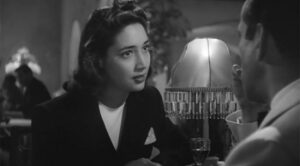
One of the best examples of this type of moment is from, not surprisingly, Casablanca. A desperate young wife asks Rick to answer the most important question in her life. She and her husband, refugees from Bulgaria, are desperate to get out of Casablanca, but need exit visas signed by the French police captain, Louis Renault. These visas cost serious money. The husband is trying to raise it in the gambling room, but is losing. The wife, however, has been approached by Louis (offscreen) with his standard offer—if she will sleep with him, he will grant the couple their visas.

Casablanca (1942, Warner Bros.)

The young wife wants to know if Renault is a man of his word. Rick knows immediately why she’s asking. He tells her, with cynical disdain, that yes, he’s a man of his word.

Then the wife wants to know something else:

“Monsieur, you are a man. If someone loved you very much, so that your happiness was the only thing that she wanted in the world, and she did a bad thing to make certain of it…could you forgive her?”

Bitterly, Rick says, “Nobody ever loved me that much.”

She goes on: “And he never knew, and the girl kept this bad thing locked in her heart, that would be all right, wouldn’t it?”

“You want my advice?”

“Yes, please.”

“Go back to Bulgaria.”

But a few minutes later Rick goes to the roulette table and suggests the husband bet everything on 22. The croupier picks up the cue, and 22 wins. Rick says, “Leave it there.” And 22 wins again.

Rick tells the husband, “Now cash it in and don’t come back.”

A lovely moment. So lovely that when the Russian bartender hears what Rick has done, he rushes over to give Rick a kiss on the cheek!

This is also what I call a “Pet the Dog” beat, which is where the Lead forgets for a moment his own troubles in order to help someone who is weak or vulnerable. He doesn’t have to do so. Indeed, his action puts him in jeopardy (Louis begins to suspect Rick is not as neutral as he claims to be). But the action bonds us deeply to the Lead, compelling us to read on.

  1. Where can your Lead be shown mercy?

Les Misérables (1935, 20th Century Pictures)

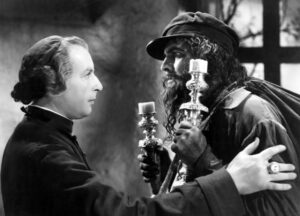
Who can forget the mercy shown to Jean Valjean in Victor Hugo’s Les Misérables? When the ex-convict is fed by a kind priest, Valjean repays him by stealing a basket of silverware. He doesn’t get very far before the gendarmes nab him and drag him back to the priest’s abode. They have caught him red-handed with stolen silver! Now all the priest has to do is make a complaint and Valjean will be back in prison forever. They are not prepared for what the priest does next:

“Ah! here you are!” he exclaimed, looking at Jean Valjean. “I am glad to see you. Well, but how is this? I gave you the candlesticks too, which are of silver like the rest, and for which you can certainly get two hundred francs. Why did you not carry them away with your forks and spoons?”

Jean Valjean opened his eyes wide, and stared at the venerable Bishop with an expression which no human tongue can render any account of.

“Monseigneur,” said the brigadier of gendarmes, “so what this man said is true, then? We came across him. He was walking like a man who is running away. We stopped him to look into the matter. He had this silver—”

“And he told you,” interposed the Bishop with a smile, “that it had been given to him by a kind old fellow of a priest with whom he had passed the night? I see how the matter stands. And you have brought him back here? It is a mistake.”

“In that case,” replied the brigadier, “we can let him go?”

“Certainly,” replied the Bishop.

The priest then gets the silver candlesticks and hands them to a bewildered Jean Valjean.

“Now,” said the Bishop, “go in peace. By the way, when you return, my friend, it is not necessary to pass through the garden. You can always enter and depart through the street door. It is never fastened with anything but a latch, either by day or by night.”

Then, turning to the gendarmes—

“You may retire, gentlemen.”

This is, of course, the great turning point in Valjean’s life. And an unforgettable moment in a classic novel.

What lovely moments in books or films are memorable to you?


Get Thee to a Party

Photo by Tyler Rutherford from unsplash.com

 I have a quick fix if you are out of dialogue ideas and/or characterization elements.

Go to a party. 

That would have been hard advice to follow a few months ago but the genie is out of the bottle now. Folks are throwing soirees for all sorts of reasons. There are mask-burning gatherings, graduation parties, birthday celebrations, and all sorts of other gatherings. No matter how social-adverse you are (and I’m in the redline there, I assure you. I just fake sociability. For awhile.) someone is going to invite you to a gathering somewhere. Go. Observe. Listen. Heck, with graduation parties you can just follow the signs and balloons and enter, whether you are invited or not. 

Photo by NIPYATA! from unsplash.com

I went to a graduation party last weekend for a young woman I have known for many years who has finished high school. She is part of one of the best families I have the pleasure to know. Each and every member of the clan is instantly memorable, for different reasons. . We live in the same city in a similar neighborhood. Their home is wonderful. It puts mine to shame. I have a backyard. THEY have a nature preserve.  It has a small barn with a fenced-in corral in which a mini-pony cavorts and takes apple slices from your hand while trying (though not too hard) to avoid stepping on a couple of Flemish rabbits that hop around while merrily depositing chocolate chips, or something like them. There is a separate chicken coop next to the corral, where a rooster and a few chickens warily eye a calico cat who wanders about gazing wistfully through the chicken wire at them (Buddy…I know how you feel). It’s all wonderfully maintained and beautiful. One could spend hours there, just watching.

Photo by Levi Guzman from unsplash.com

It is the family’s friends, however, who received the primary focus of my concentration last week. Imagine if the characters of Twin Peaks and Fargo came together for a party, all knew each other, and were benevolent, without a woodchipper in sight. That’s what it was like. I wandered about, aurally dipping into conversations and taking mental notes. I occasionally noticed individuals sitting more or less alone. I beelined over. If people are sitting alone for no apparent reason there is probably a very good one that will eventually manifest itself. You should find out what it is without directly asking. I always check to make sure that there is not a mechanism labeled “Point in Direction of Enemy” within their reach before I fully approach and strike up a conversation point like, “Pretty good ice cream, isn’t it?” 

They are going to say something

It might be anything from “No” to “That isn’t ice cream. I had an accident” to 

“Well, it was okay, but we had this Isaly’s in Wadsworth when I was growing up and my dad had just left us and the waitress knew the story and would give us a little extra because it was tough on my mom and everyone knew we didn’t have much and we’d get lunch for free sometimes too but what nobody knew was that Mom ran the Pain Clinic on Medina Street and was making money hand over fist but it was all in cash so we had to be careful, hee heh!”

Now…I did not have that conversation. I did, however, have one with an elderly-looking gentleman (who was actually younger than I am) who appeared unapproachable at first but quickly warmed up when we found a bit of common ground. He noticed the guitar pin on the Santana Mohican fedora I was wearing. It seemed he had played guitar for some time before turning to truck driving. My response to the truck driving information was, “You probably have driven more miles backwards than most folks drive forwards.” He liked that and proceeded to tell me all sorts of stories that were easy to remember because they were extremely interesting and for the most part probably true. I also encountered an individual who I have not seen for awhile and who I am convinced will develop notoriety as a serial murderer within the next five years. He may have started already and just hasn’t been caught yet. That is an entirely different story for another time. 

Circling back…I finished up my conversation with my new friend, said goodbye to my hosts and the guest of honor, and then sat in my car for several minutes while I recorded everything that I could remember of what I had heard and seen (yay, Easy Voice Recorder app!).  Everything, because that which might seem inconsequential and uninteresting on a Sunday afternoon might be of use the following Wednesday, in the same way that one might dual-purpose a screwdriver handle for a hammer, or use a party in general for a TKZ topic. 

Photo by Dallas Reedy from unsplash.com

I hope that your current weekend is as good as the one I had last week. In the meanwhile…have you ever overheard a conversation that developed into dialogue within your work-in-progress or provided inspiration for a new work? If so, where did it happen? Thanks in advance. 

Photo by Hedi Alija from unsplash.com

But wait, there’s more! I would be sorely remiss if I failed to note that TKZ’s Elaine Viets is named on the cover of the new Mystery Scene magazine (Number 168, Summer 2021) and contributes the article “My Book: Death Grip,” in which she discusses her new novel and dive bars. Congratulations all around, Elaine!


Creating Likeable Villains

By Elaine Viets

This month got off to a pleasant start. My short story, “Dog Eat Dog” was nominated for two awards: the Macavity and the International Thriller Writers.
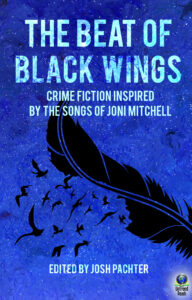
The story was in The Beat of Black Wings, an anthology based on the songs of Joni Mitchell. I chose “Dog Eat Dog.”

This story was difficult to write, because my protagonist was so dislikeable. We learn straight out that Tiffany Yokum is a gold digger – and a calculating killer.

Here’s her introduction:

“The first time I tried to kill my husband, I failed. Miserably. I gave him a little push at the top of the stairs and Colgate tangled himself in his walker and fell down twenty-seven marble steps, just as I hoped. And he cracked his head – but not hard enough.
“Now he’s in a coma. The doctors say there’s still brain activity and he could wake up at any time, so I can’t pull the plug. He could live forever this way. As I sit by his bedside, I watch the fluid drip through his IV, and imagine each drop is a dollar. Even his immense fortune will be drained away.
“I want desperately to finish him off, but I don’t want to get caught.”

Greedy Tiffany put a nice old man into a coma, and now she wants him to die. How do I make readers root for this little moneygrubber?
Unlikeable protagonists are extremely popular, thanks to Gillian Flynn’s Gone Girl. Before Gillian, there was the disgusting pedophile Humbert Humbert in Lolita. And Rabbit Angstrom in John Updike’s Rabbit, Run and other novels in this series. Books I pretended to read in college but couldn’t finish because I found Rabbit, the protagonist, self-absorbed and dull.
Short stories don’t have time to create the subtleties of a novel. Which gets us back to Tiffany and how to make readers root for this crafty killer. Here are some ways to do it.
Give your villains a minor illness.

The award-winning Evan Hunter – a.k.a. Ed McBain – made that recommendation. It works if your villains aren’t too evil. McBain had a lot of sniffling and sneezing detectives in the 87th Precinct. But I could give Tiffany pneumonia – heck, Covid-19 – and she still wouldn’t be likeable.

Give your villains a sympathetic background.


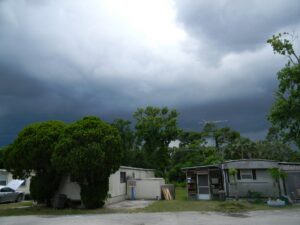
Tiffany is by no means her rich husband’s social equal. She’s an 18-year-old clerk at a hardware store in Festus, Missouri. “Colgate Osborne was a randy seventy-two when he first spotted me behind the cash register, falling out of my tank top,” Tiffany says. She grew up in a trailer park. So she’s at the bottom rung of the ladder, looking to climb. Readers like to root for a rags-to-riches scenario.

Make your villains smart. Or at least crafty.

Tiffany quickly becomes the fourth wife of rich old Cole Osborne and they live in luxury in Fort Lauderdale.

“I never went to college, but I wasn’t stupid,” Tiffany said. “I knew now that Cole had tied the knot with me, my struggle had just begun. Cole was very, very classy, and I had to fit in with his rich friends.”

Make your villains self-aware.

The Joni Mitchell song was Tiffany’s anthem, and she recognized herself in the lyrics of “Dog Eat Dog.” Especially the part about slaves. Some were well-treated . . .
And some like poor beasts
Are burdened down to breaking
Tiffany said, “This was a dog eat dog world – more so than the trailer park where I used to live. I was a well-treated slave, and I’d sold myself into slavery, but I knew that.”
Our villain has knows she’s living in comfort, but she can’t get comfortable.
“One misstep, and I’d be one of those poor beasts, working again at the local hardware store or greeting people at Walmart. I had a prenup that would give me a measly hundred thousand dollars if we divorced, but if I could hang on until Cole died, I’d get half his fortune.”

Make your villains work for their success. That way, readers can root for them.

Cindy knew she’s landed her pretty derriere in a tub of butter, but she knew her work has just started. Among other things, Cindy changed her name to a classier “Tish.”


She also “made friends with his housekeeper, Mrs. Anderson. She’d been with him for twenty years and three wives. I slipped her a little extra out of my mad money account that Cole gave me, and Mrs. A told me where to shop on Las Olas, the local Rodeo Drive, and which saleswoman to make an appointment with. She also advised me to ditch my long fake nails and get a nice, refined French manicure, then sent me to a salon where I had my long hair tamed into fashionable waves and the color became ‘not so blonde’ as the tactful stylist said.”

Make your villains aware of the stakes if they fail.

Now readers have more reasons to root for them.
“As I got into my mid-twenties, I had to work hard to keep my girlish figure,” Tiffany said. “My trainer was worse than a drill sergeant, and I endured endless runs on the beach. Awful as it was, it beat standing on my feet all day on a concrete floor, running a cranky cash register for nine dollars an hour.”

Create a conflict – and an even worse villain.

Tiffany says, “I thought I could sail smoothly into Cole’s sunset years and collect the cash when he went to his reward. But then that damn preacher showed up. The smarmy Reverend Joseph Starr, mega-millionaire pastor of Starr in the Heavens.”
As much as we may dislike money-hungry Tiffany, the bloodsucking TV preacher is even worse. He plays on Cole’s fear of death and walks off with a check for a million dollars on his first visit – and the Reverend has his sights set on more.
“Starr would work on Cole’s guilt and milk him for every dollar – my husband was one big cash cow,” the practical Tiffany said.
Now that her husband was in the hospital on life support, Tiffany has to find a way to kill her husband and put the blame on the Reverend Starr.
Does Tiffany succeed? Or does the Reverend Starr walk off with the money? You’ll have to read “Dog Eat Dog” to find out – and see if I made you root for her.
Tell us, TKZers. How do you humanize your villains?
***

The Beat of Black Wings, edited by Josh Pachter, is an anthology of 28 crime writers who wrote short stories inspired by Joni Mitchell’s lyrics. The award-winning authors include Art Taylor and Tara Laskowski, Kathryn O’Sullivan, Stacy Woodson, and Donna Andrews. A third of the royalties will be donated to the Brain Aneurysm Foundation in Joni Mitchell’s name.

Order your copy of Beat of Black Wings here: https://tinyurl.com/38x2cyar

When the Right Word is Wrong

When the Right Word is Wrong
Terry Odell

As writers, we deal in words. Thousands of words. And we’re always looking for the right word to use. But what happens when the right word is wrong?

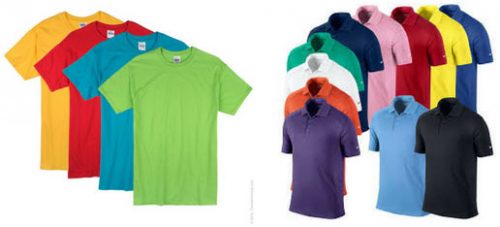
For example, I was reading a draft chapter from one of my writing pals. She’d written something about a man pulling up the collar of his t-shirt to wipe sweat off his face. My comment to her was, “T-shirts don’t have collars.” Her reply was “Yes, that’s what I was taught when I took sewing classes.” I recalled that when I worked a temp job, our jackets were provided, but we were told to wear shirts with collars, and the accepted attire was either a blouse with a collar or a polo shirt, but absolutely no t-shirts. Being curious, I hit the search engines and looked up t-shirts.

Merriam-Webster said this: a collarless short-sleeved or sleeveless usually cotton undershirt; also :  an outer shirt of similar design

Wikipedia had this to say: a style of unisex fabric shirt, named after the T shape of the body and sleeves. It is normally associated with short sleeves, a round neckline, known as a crew neck, with no collar.

So, I was “right”—to a degree. Will readers stop reading to research words, especially ones they assume they know the meaning of? Not likely (as authors, we hate to pull anyone out of the read). However, some readers won’t notice it, because they consider the neckline of a t-shirt a collar. Others might hiccup, thinking the same way I did. Will it spoil the read? No.

Is there a solution? Maybe. When in doubt, I’d go with the dictionary definition. That way, if someone is puzzled enough to wonder, when they look it up, they’ll see the author was right.

Another example. My Triple-D Ranch series includes a character who runs a cooking school. I was writing a scene where she was teaching her students about the various pots and pans they’d be using. She was talking about the differences between frying pans and sauté pans (based on my trip through the Google Machine). I ran my draft by my (former) chef brother to see if I got things right. He came back and told me all my research was “wrong” because anyone trained in cooking wouldn’t use those terms, and proceeded (at some length) to set me straight. And therein lies the rub. He’s not my “target” reader, but he knows of what he speaks. Other readers might, too. And just as many would “know” that they’re right about the differences between sauté pans and frying pans. Either way, I’m right for some, and I’m wrong for some.

What did I end up writing? My instructor now says,

“Most cooking techniques and terminology we use comes from the French. However, a lot of names have been Americanized, and none of you will be ready for a fancy French restaurant simply by completing this course. You’ll be cooks, not chefs. So, I’m not going to dwell on terminology too much. As long as you can match the right tool with the right task, you’ll do fine.”

And then there’s the most important part about choosing the right word. POV.

Example 1

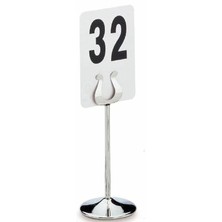
My characters were in a café, and it was one where customers place their orders at the counter, and the clerk hands them a metal stand with their order number on it to display on their table so the servers can find them.

First, I’d shown the heroine entering the café and placing her order.

She paid for her meal, accepted the metal holder with the number eighteen from the clerk, and found a small table in the back of the crowded café, inhaling the blend of aromas as she waited for her order to be ready.

In the next scene, the hero arrives and places his order.

At the counter, Bailey ordered a burger—a man had to eat, right?—and carried his stand with its number to Tyrone’s table.

My critique partner had trouble with the word “stand” in the second example, and asked what they were really called, and maybe I should use that definition instead.

So, I took a quick trip through Google and learned they’re called “Table Number Stands,” so my use of the term is correct.

Example 2

My character was at an event in a hotel, and she was going to leave, so she wanted to get rid of the half-empty glass she was carrying.

I’ve been to enough events at hotels or banquet halls, and I know the catering people normally have trays on stands set up at various places around the room where guests can deposit their used dishes. But I didn’t know what they were called.

But you know what? I forgot one crucial aspect. Would the character know?

What if my research showed the aforementioned table number stands were called Grabbendernummers. Then, I could have written, “Bailey carried his Grabbendernummer to the table.” But would he know that?

You see, it doesn’t really matter what you, the author knows or doesn’t know about something. It’s what the character knows. If my character with the half-empty glass were in the catering business, then yes, she’d refer to that tray by a proper name, if it had one. (And per my brother the chef and all the Googling I’d done, there isn’t a specific term for them.) So, my heroine, would simply see the tray on a stand. It might be black, or brown, or covered with linens, but she’s going to think of it as a tray.

Yes, do your research. But if you want to save a lot of time—especially if you’re easily sidetracked while looking something up—ask yourself if the character would know whatever you’re researching first. Just because the author knows (or looked up) what a particular object is called, in Deep POV, it’s the character who has to know it. The character is going to use whatever vocabulary exists in his head, not the author’s.

Are you a stickler for the correct word? Do your characters know them?


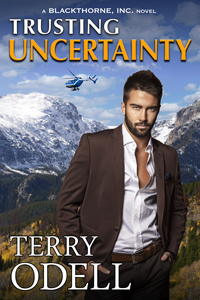
Trusting Uncertainty by Terry OdellNow available for Preorder. Trusting Uncertainty, Book 10 in the Blackthorne, Inc. series.
You can’t go back and fix the past. Moving on means moving forward.


Terry Odell is an award-winning author of Mystery and Romantic Suspense, although she prefers to think of them all as “Mysteries with Relationships.” Follow her on Facebook and Twitter.

The Reluctant Book Marketer – Guest post by Mark Leichliter

By Debbie Burke

@burke_writer

Photo credit: Alex Loup, Unsplash

In May, Steve Hooley and I surveyed TKZ contributors about marketing and how they promote their work. Links below:

Part 1    Part 2

For most of us, marketing holds the same appeal as a kale and rutabaga smoothie.

A few weeks ago, I had a discussion with Mark Leichliter, author, writing instructor, and editor. I mentioned what writers really need is advice about how to overcome our aversion to marketing.

Mark took up the challenge. He probed into why we hate it so much and offered some solutions.

I thought his ideas would make a good companion post to our recent marketing discussion.

Today please welcome Mark to the Zone.

~~~

If a tree falls in the forest…okay, we all know how this old philosophical question goes. How about this one? If an author publishes a book and no one knows about it… Easy to answer, right? A book without readers is still a book in the metaphysical definition, but its existence is pretty pointless. With one exception, the person who wrote it—you. But what if you are the sort of person who would rather hang around in the forest awaiting the sudden tree toppling than face marketing your book?

Count me as a forest dweller. The thought of promotion sends me scurrying into the deep timber. But unless you’re one of the eleven and a half writers around the world that a Big 5 publisher runs full page Times ads for, the work is going to fall to you. Big press, small press, no press, if we want to expand our audience beyond our own front door, we’ve got to face down marketing, even if we hate it.

I’ve got a few counts against me when it comes to book promotion. Perhaps you do as well. First, I’m shy. Students in classes or participants in workshops I’ve taught might not guess this to be true, but it is. Give me a business dinner where it’s all small talk, and I’m a disaster. It takes me ten minutes of chanting mantras to make a phone call. Second, my parents raised me—and I thank them—to be humble. And I grew up in the Inter-mountain West, a culture where people respect my right to be an individual but they’d rather not hear about my individuality. Third, I openly despise consumer culture. It’s apparently the marriage partner to an open capitalist market, but why must we constantly be sold everything? Ads stalking us on our phone, our clothing, in our music and movies and emails. Why would I want to participate in something so intrusive?

Here’s the thing. We’ve got to think about that silent forest again. Unless you are content with your audience of one, you’ve already entered the marketplace. So how do we take our reluctance to promote our books and change our approach to marketing? And how do we rise out of the din? Here are some tips I’ve learned for those of us who become physically ill at the thought of book promotion.

  • Distinguish between the book you’ve created and your role as its creator. Yes, in the vernacular of the marketplace, you’ve got a product to distribute now. But it’s also a book, something that can defy demographic typecasting and time. Books are unique products, so treat them that way. It starts by letting the thing exist separately from you. Sure, you poured yourself into it but now it exists (more metaphysics!). So do it a favor. Here’s a simple analogy; you might be reluctant to share some tiny triumph at work or some personal accomplishment, but if one of your children scored a goal or won a ribbon at the science fair, you’re going to shout it from the rooftops, right? Doesn’t your book-child deserve the same?
  • This is key; change the game. Don’t see your actions as marketing. More to the point, don’t reduce the book to only being a product you’re trying to sell. You’re used to flipping psychological switches in your brain on slow writing days in order to remain productive, so flip a different switch in how you see interacting with readers. It’s really a matter of respect for them. People seldom want to buy “products” anyway. They want to participate in a lifestyle they value. They want to follow passions. They want to be associated with things in which they place importance. You didn’t spend the years and the drafts writing your book while lukewarm about its themes, characters, and ideas. See promotion as an opportunity to engage others with those fronts. Don’t sell a product to consumers, enter a conversation with readers. Even if you are shy like me, when speaking about the topics I’m passionate about, I come out of my shell without thought. I can’t stomach that trivial cocktail party chitchat, but find the person at the party who shares interest in something we both find meaningful, and we’ll be there all night. Instead of “marketing” your book, look for venues where you can have conversations about mutual passions. There are thousands of bloggers and podcast hosts who run author interviews. Readers like to know the person behind the page. They like to engage with a writer because they love books. Find venues that take reader questions. Reach out to book clubs. Provide readers something of value and neither they, or you, will see your outreach as a sales job.
  • Control what you can control and work from your strengths. If the idea of appearing on a podcast makes you cringe, then focus on print interviews instead. You’re a writer aren’t you, then the prospect of providing written answers to questions for a blog actually offers you the chance to be creative, probe topics you care about, and do so from the comfort of your writing desk. Get more creative still. Propose a “day in the life” first person post from the viewpoint of one of your characters. Interview one of your characters. Or present the city your write about from the lens of your book. Or get yourself off the hook entirely and use an actual human source you turned to as a consultant for your book and interview them. There are plenty of fun, creative ways that feed your imagination and give readers something original in the process.
  • “See your friends.” My favorite soccer coaching colleague was a wonderful Thai guy who was a genius at simplifying the game. His go-to expression to players during scrimmage was, “See your friends.” Shy? Uncomfortable? Humble? Rather than go it alone, reach out to other writer friends or other authors from your publishing house. There’s tremendous comradery among writers, probably because we’re the only ones who truly understand how difficult writing and marketing a book really is. Propose dual blogger posts or offer a book site a conversation between you and another author. Suggest a multi-author panel for a podcast, a remote event, or a live appearance. There’s strength in numbers, for you, and for your audience. I guarantee that you will enjoy the conversation that emerges, and it won’t feel like marketing because it really isn’t. Sales and exposure are the offshoot. Moreover, you can share the workload.
  • Champion others rather than yourself. Remember that comradery comment. It’s real. And I know you’ve found other writers you want to see succeed. I’ve spent a great deal of time trying to help find an agent for a writer friend simply because I believe in him and his book. Put some energy into broadcasting reviews, recommendations, and announcements about books by writers you admire or have learned from. Stand up for books you love. You’ll be doing a valuable service for readers. Do it because you care. Maybe the author will reciprocate. Don’t worry if they don’t. That shouldn’t be your motivation. You’re a participant in a bigger writing community, so be a good neighbor. We live in times where we need more kindness, so do someone else a solid. Put awful things like social media to some good use instead. Or take that five minutes to write a review on a seller’s site or a book community site. If people value what you have to say about books you love, many are going to want to know about your work as well.

You don’t have to become a PR cliché to produce effective promotion for your book. Look, you really do believe your book has value, right? Whether that’s simply entertainment value for a reader or a book that will challenge how they perceive the world, surely you are producing work that you are proud to have written—a book that deserves an audience. The thing is, you’re going to have to go out and find that audience. There’s a first step that has to happen before we can have the contemplative conversation about whether an unopened book on a bookshelf has value; first we’ve got to get it on the shelf, or better yet, in a reader’s hands.

~~~

Thanks for your insights, Mark! 

TKZers: Do you have mind tricks that help overcome your aversion to marketing? Please share.

~~~


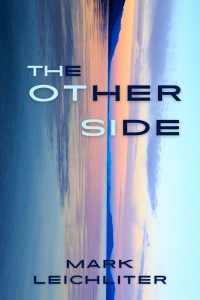
Mark Leichliter’s new novel The Other Side debuts today, June 8. Sales links here.

How do you start an investigation when you have no evidence a crime has been committed?


Troubleshooting Plot Issues

When it comes to writing, I’m a plotter not a pantser, but despite my best intentions there’s almost always a point in the process where I have to take a step back and assess something that has gone awry in the overall arc of the novel. More often than not it’s my own desire to over complicate things and so I have a bit of sub-plot and exposition pruning to do – sometimes, however, I just can’t pinpoint what isn’t working and that’s when I have to troubleshoot the issue. At the moment, I’m in the strange position of having over-pruned my current WIP but, nonetheless, I’m going to employ similar strategies to work out what to put back in and what new material will be required (especially as a lot of what I took out needed to be taken out). Given I’m in the throes of troubleshooting mode, I thought I’d share some of the strategies I employ and get some (no doubt very useful) feedback from all you wonderful TKZers on your own troubleshooting strategies!

My first point of reference is always the original plot outline (the one I’ve undoubtedly veered off from…) and as part of my revision process I always refine the outline to keep pace with the changes I’ve made. With my current WIP I’m about to take two additional steps: First, I’m going to lay out the plot in ‘bubble format’ where I go through the manuscript chapter by chapter to identify the main scene and plot points to track how the story pans out; second, I’m going to graph the story out, tracking high and low dramatic points to see whether the overall arc of the story seems to work. This second stage is  gives me a visual snapshot of the pacing of the novel and whether the overall story arc conforms to a basic 3-act structure.

If neither of these strategies really help identify the problem then my plan is go back to the ‘drawing board’ and ask myself these key questions.

  • Have I started the story in the right place?
  • Is there a fundamental flaw in the premise of the book? (I really hope not!!)
  • Is the story getting weighted down by too much narrative – or is the balance of background, character, setting, or plot weighing down the momentum of the book?
  • Have I got too many POVs? (a major revision in my current WIP was the elimination of an entire POV as the shift to that character’s perspective was interrupting the flow of the plot too much)
  • Are there inconsistencies in the length of my chapters or pacing in the way the story unfolds? (for example it would be a major red flag for me if I discovered that the chapters in the middle of the book are much lengthier than the early or later ones – would signal a saggy middle for sure!)
  • Have I resolved all the threads of the story?

Well, this is the plan at least! Hopefully once I’ve finished troubleshooting I’ll have a good sense of what I need to do next to revise my plot outline and get back to revisions/ rewriting mode.

What about you TKZers? what strategies do you employ to troubleshoot plot/pacing/arc issues during your revision process?


Avoid the Bait-and-Switch Opening

by James Scott Bell
@jamesscottbell

Today’s first page is a thriller submission. Read it, then we’ll talk.

Out of the Cold

Cara Conroy sat straight up in bed. Sweat soaked both her and the bedding. Instinct drove her hand into the nightstand draw and around the grip of her Glock 26. Her eyes swept the haze of her moon-draped room.

Sampson perked his ears and padded to the bed, laying his muzzle next to Cara’s leg. His soulful eyes searched hers, hypervigilant and ready to pounce at a moment’s notice.

It had happened again. She was absolutely positive.

Cara fought the urge to run to the next room and check on her daughters. She knew they were fine, but so had all the mothers whose children hadn’t been. She heard it all the time—I looked away for just a second—and a second was all it took.

The urge won. She threw back the covers. Her feet barely touched the floor before she raced, heart pounding, Sampson on her heels.

She held her breath. The Glock shook ever so slightly as she toed the door open a crack. The light from the hallway sliced into the darkness, and illuminated the innocent faces of her daughters who lay sleeping, unaware of the dangers lurking for them in an evil world.

Sampson stealthed into the room and nosed each girl in turn. The ceiling fan thrummed its constant low thump like a tire out of round. Cara searched for Raina’s faint snore, an assurance the child was still breathing. After finding its reassuring cadence, she lowered her weapon and dragged back to her bedroom. Inside the sanctity of her own room, she closed the door and leaned her back against it, allowing it to support her controlled collapse.

Silent sobs wrenched her gut.

***

JSB: This author can write. The prose flows. Exposition and description are kept to a minimum, but with just enough to give us a feel for the setting and the setup.

All good. But I have an overarching critique, which I’ll attempt to explain.

What we have here is a type of opening that agents warn about, namely the “character alone” variety. I see two types of these. The first type is “character alone, thinking/feeling.” This is when the author gives us a character who is in the throes of some deep emotion or thinking about some terrible situation. The author believes this will immediately bond us to the character. It doesn’t, because we don’t know the character yet. The author is asking us to sympathize with a stranger.

But Jim, this is the first page! Of course the Lead is a stranger!

True that, but the better way to get to know a stranger is by observing what they do.

Which leads me to the second type of “character alone” opening, one that is functionally better: character alone, doing. When we see a character engaged in some sort of action that holds our interest, we’ll follow her for a long time before wanting more exposition.

JSB Axiom: Act first, explain later.

So why am I not giving full-throated approval to this opening, which is a clear case of character-doing, along with the elements of fear and child endangerment? Isn’t that the very essence of what I preach for the opening—a disturbance?

Stay with me on this.

You know how we’re warned about not opening with a dream? I agree with that. You read an incredibly gripping opening chapter, only to have the character wake up at the end. It feels like a big cheat, a bait-and-switch.

Because it is.

(Literary mavens may delight in reminding yours truly about one of the most famous openings of all time, from Daphne Du Maurier’s Rebecca: Last night I dreamt I went to Manderley again. Of course that is not a cheat because the narrator tells us up front that she’s describing a dream. But thanks for playing.)

This opening is not a dream, but it has a bit of bait-and-switch to it. It gives us a potential threat, but it turns out only to be in the Lead’s head.

We get this set up: It had happened again. She was absolutely positive.

Okay, we think, “What is it?” We read on.

In the next paragraph we get the answer: there have been kidnappings of small children! So Cara grabs her Glock and checks on her kids.

Is there a kidnapper in the house? Are her children gone?

Nope, all is well.

So there was never really an it. It feels a bit like waking from a dream, no?

One way out of this is to put an actual it in the scene—a real noise, a seen shadow, an open window. True, a disturbance that awakens the Lead is a bit of a cliché, but I don’t think readers care if the writing is taut and action-oriented (which this author is capable of).

There’s also disconnect here that lessens the tension. Look again at: It had happened again. She was absolutely positive. Okay, fine. That’s why she woke up in a sweat, right? And we’ll find out it’s because of the kidnappings that have happened.

But then we get: She knew they were fine.

Wait, what? A second ago she was absolutely positive it had happened again.

So if she knows they’re fine, why the sweats and the Glock?

Also, the it alluded to appears to be about children kidnapped in public. I looked away for just a second.

But this scene is taking place inside a home.

Further, if Cara is so concerned about a potential kidnapping, why isn’t she sleeping in the same room with her daughters? Why doesn’t she have a security system? Why doesn’t she station her hypervigilant dog near the front door?

So when at the end of the scene Cara collapses as silent sobs wrench her gut, I’m unmoved.

I’m also confused because a silent sob is an oxymoron. A sob is, by definition, a sound. You can have a loud sob, a weak sob, a low sob…but not a silent sob.

Yet, whatever it is, it is wrenching her gut.

But why such a reaction? Cara seems to be on the edge of a nervous breakdown because of some kids being snatched somewhere out there in an “evil world.” The collapse into gut wrenching sobs is meant to garner our sympathy. Instead, it causes me alarm about her mental state. What it doesn’t do is compel me to care about the character.

Here’s a suggestion that will help you here, dear writer. And also anyone writing a scene of heavy emotion.

Show us the character fighting against the emotion, not succumbing to it.

This has a two-fold benefit.

First, it give us an action rather than a reaction. The action can be internal (She told herself she would not cry! Her kids needed her…) or external (She took a deep breath and forced herself to stand…) or a combo of both.

Second, we are drawn to characters who, by strength of will, fight against obstacles in their way. We don’t have sympathy for characters who don’t fight.

The only thing Cara fights in this scene is the urge to run to the next room and check on her daughters. But why? She’s sweating, armed, worried about her children. Why would she fight against checking on them?

In sum, the actions taken and motivations for same confuse me.

So I offer these takeaways:

  • Re-think your opening to give us real action in response to real stimuli.
  • Show your character fighting, internally and/or externally, against breaking down. She has her kids to protect!

Notes:

the nightstand draw

Should be drawer.

Sampson stealthed into the room

Be very careful when stretching a word into a new meaning. I was pretty sure stealthed was not a word, so I looked it up. Ack! It apparently is a word, a slang term, and not one to be used in polite society.

nosed each girl in turn

I get a picture of the dog poking the girls with his nose, making me wonder why they didn’t wake up. I would think a mom wouldn’t want the dog to disturb her softly sleeping daughters. Did you mean sniffed?

Cara searched for Raina’s faint snore

I’m not sure you can search for a sound. You can certainly search for the source of a sound. But Cara knows the source. Use listened instead.

After finding its reassuring cadence

Again, finding is the wrong word in this context. Use hearing.

she lowered her weapon

Ack! She was pointing a loaded weapon into a dark room where her children are sleeping? The most basic of rule for loaded handguns is don’t point them in an unsafe direction. This is especially so if the gun is shaking in her hand! What if it goes off accidentally?

A Final Word

Don’t let any of this discourage you, writer friend. You’ve got what it takes to write good, gripping scenes. So go forth and write them. Get them critiqued, and write some more.

And never stop.

Carpe Typem.

Comments are welcome.