The Plunge

When I was a kid, the historical aspect of Six Flags over Texas was an absolute treat. I was a history buff even back in elementary school and absorbed everything I could find about Davy Crockett, Daniel Boone, and of course, local history. By the time seventh grade rolled around and I found myself in the mandatory Texas History class, I’d read everything about the settlers, the Alamo, and Texas independence.

The Six Flags theme park was based on the six nations that have governed the territory of Texas, starting with Spain, France, Mexico, the Republic of Texas, the Confederate States of American and the United states. When it opened in 1961, the six nations of historical influence had their own specific areas that reflected those past cultures.

As the years passed, the park’s theme shifted in focus from historical accuracy to pure family entertainment, though the different regions still remain in place and the architecture and sense of place still remain. Until recently, a few of the original rides remained, particularly the Log Ride and the Runaway Mine train.

It was my favorite ride until I became afflicted by vertigo.

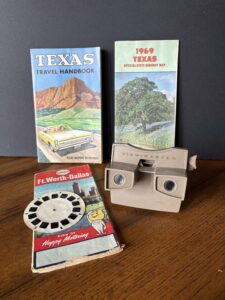
Maybe you remember View-Masters, children’s stereoscopes that were popular in the 1960s. When you were in one of the many Six Flags souvenir shops designed to separate visitors from even more their money, you could buy a set of the discs with photos of the rides.

We were in one of those shops filled with the delicious aroma of leather in the late 60s and I picked up one of the sample viewers on display. After flicking the side lever a couple of times with a forefinger, I came across a photo of my family on the ride a couple of years earlier. Unfortunately, the Old Man wouldn’t buy the set, but I remember how cool it was to know we were “famous.”
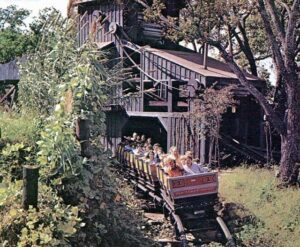
The Runaway Mine train was a small version of the popular giant rollercoaster rides at the fair, but it was an experience on steroids. While big rollercoasters’ pacing was a long, slow ride to the first big drop, the mine train started much faster, and after the initial dive, it became manic.

The turns and drops were incessant, snapping riders back and forth. We barely had time to catch our breath before something else happened. An abrupt twist, drop, sudden neck-snapping elevation to a quick, short, breathtaking plunge until, finally, it leveled off to take passengers through an “abandoned” old west town.

This gave riders a break in order to catch our hearts slow down, dizziness to pass, and to catch our breath. The train cars went through a haunted saloon, complete with cowboy skeletons playing cards and a few leaning against the bar. Humor designed to give the passengers a rest.

Then came an abrupt, steep drop, a bend, another turn, up, down, and finally, the long, slow level track to our starting point. A quick internet search revealed the ride was only one minute and fifty seconds. And for that, we stood in line upwards to two hours.
The ride was all about thrills, and pacing, which brings us (finally) to my topic of the day, pacing, or the speed at which a story unfolds. You, the author, are in control of your reader’s experience, be if fast or slow.

I prefer fast-paced books, but that’s today. Back in the Olden Days–––

When was that, Grandpa?

––– in the 1960s and 70s, when I was reading Robert Ruark (1950s-early 60s releases), K.B. Gildner’s Hurry Sundown (1964), any James Michner (1960s-80s). Those old classics didn’t develop quickly, and readers waded through a hundred pages of setup and backstory before the plot accelerated.

Times and tastes have changed, and today’s authors are in a gunfight for attention due to the enormous volume of releases each month, so we need to advance our pacing. That comes through structural choices such as the length of scenes and sentence structure, and of course, timing.

Many authors begin their novels in the wrong place, as has been discussed at length in forum. Too much setup at the outset can lose readers faster than a toddler will get lost in Walmart.

We can increase pacing through dialogue. Read Elmore Leonard for tutorials on past-paced action scenes and snappy dialogue. Think about it, when you see pages of long, long paragraphs, you mind natural slows you down. With quick dialogue and lots of white space and a page visually less dense, the eye blazes across the written field and soon the reader is absorbed into the exchange that feels as if we’re there in the room with those characters.

This is a perfect time for character development.

The first sentence sets the tone, (that first breath-taking drop on the runaway mine train). Start your story in the middle of the action to hook the reader. Imagine you’re standing in a bookstore and pick up a Michner novel (and I love the guy, so not taking any shots here) and a modern thriller. Micher has a long setup. Today’s authors start with a gunshot, or in the case of a C.J. Box novel, two rednecks and a rocket launcher.

Boom. There it is.

After that, the rhythm and flow pulls us into the narrative. A quick burst of action is followed by narrative, character interaction, and the chapter(s) which establish the storyline. Now we’re on that runaway mine ride.

Another drop, something exciting happens, and our protagonist is thrust into danger, or a dangerous situation. Tension rises, (another expectation of acceleration as the chain rattles beneath the mine train on the lift hill) dialogue brings us backstory and the characters’ motivation. A character arc rises, and readers become engaged in the plot and motivation.

We’re almost to the top of the crest.

If the pace slows too much there, be careful, or you’ll lose your reader engagement.

Another breath-stealing drop. An action-packed scene, and quick-moving plot points create urgency and excitement. This is a great time for humor to give us a rest, not unlike the abovementioned haunted saloon. (Please attempt humor only if you’re good at it).

The story builds again, another rise, (we look forward to see nothing but sky on the next lift hill) and we know another stomach-rising drop is coming soon.

The second act is always a challenge to write, so authors build even more tension here and find reasons to push the protagonist forward. The use of longer, descriptive scenes builds tension (anticipating the next downhill plunge) and more character development leads to an increasingly hair raising emotional impact.

Then, comes the third act and the final build toward the huge acceleration that should be followed by a sharp turn, or twist.

It is there that my own chapters shorten, a trick I learned from my first editor. Short chapters increase the pacing and keeps the reader turning the pages. You wouldn’t believe how many readers tell me they stay up late with my novels, thinking they’ll read just one more chapter and then realize it goes by so fast they want to read just one more.

Then another

Then another.

It’s like eating potato chips, the chapters are quick and satisfying.

Short sentences. Fast dialogue. Action packed scenes. Here there’s no relief! No long smooth track through the ghost town. We’re on the downhill nose-dive, folks, and we need the payoff now!

Then the reward. The final descent. For those of you who like casinos, think the slot machine rattling silver dollars into a metal catch pan designed to amplify the noise. Check the clock. Midnight? Wait! Only two more extremely short chapters!!!??? I can finish it tonight!

Sigh. Close the book. Put it on the nightstand. Click off the light. Ahhhh. Relief and satisfaction.

Here, there be rest.



Reader Friday-Digging Deep

If you had to choose, which amongst the range of human senses is the one most likely to dredge up memories (good or bad) in that RAM called your brain?


There are five basic senses: sound, smell, touch, sight, and taste. 

Here’s my example of a good memory, evoked by music:

Hearing CCR on the radio transports me right back to my carefree college days in southern California when I didn’t have a worry in the world. When the studying was done, my friends and I would pile into a light blue ‘60s-something VW bug–it’s amazing how many teenagers you can stuff into one of those–and head for the beach for a little body surfing.


The character-building skill of using the five senses to tell a story is an important one to develop, and is much-discussed here at TKZ.

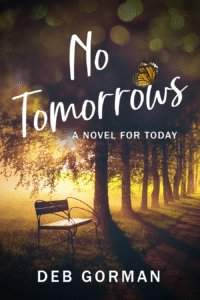
When I wrote No Tomorrows, I had to dig deep into my fear of losing a child. My parents lost two, my younger brother to a traffic accident and my younger sister, five years later, to suicide. There are sights and sounds in my world today that bring those dreadful memories careening back into my consciousness.

In No Tomorrows, Annie faces that same fear when she loses track of her small daughter in the park. As I wrote the scene, I put her shoes on my feet as she raced around the park, frantically calling Nora’s name. It was a difficult section for me to write. But as I relived my memories and looked my own fear of the death of a child square in its ugly face, Annie became flesh and blood, and in a way her fear took the teeth out of my own monsters.

Your turn! Which of the five senses takes you back in time, or causes you to remember a person from your past, or evokes a feeling of comfort?


How deep will you go into your own RAM to create a character who will resonate with your reader?

As a reader, which sense/emotion connects you to the story/character the quickest?


A Lighthearted Look at Writing

A Lighthearted Look at Writing
Terry Odell

I’ve had editing on my mind lately. The process with my editor is I send her my “best I can make it” file, which she returns with her feedback. I make the adjustments as I see fit and send it back.

I’ve just returned my second round of edits, and I’ve also gone through the tedious process of letting my computer read the manuscript to me, which reveals things we’ve both missed. In this phase, it’s less about the story and more about accuracy. The eyes glaze over.

I stumbled across this piece buried in my hard drive. The closest I came to finding its origin was William Safire, Fumblerules: A Lighthearted Guide to Grammar and Good Usage , New York Times, November 4, 1979; later also published in book form. Most sources gave credit to “Anonymous.”

Although the piece is designed to be humorous, the points made are legitimate considerations to make while writing and editing.

How to write English

Remember to never split an infinitive. The passive voice should never be used. Do not put statements in the negative form. Don’t use contractions in formal writing, and don’t use no double negatives. It is incumbent on one to avoid archaisms. Proofread carefully to see if you words out or incorect speling. It has come to our considered attention that in a large majority of cases, far too many people use a great deal more words than is absolutely necessary when engaged in the practice of writing sentences. If you reread your work, you can find on rereading a great deal of redundant repetition can be removed and eliminated by rereading and editing.

A writer must not shift your point of view. If the writer is considerate of the reader, he won’t have a problem with ambiguous sentences. Don’t write a run-on sentence its hard to read you must punctuate it. If a dependent clause precedes an independent clause put a comma after the dependent clause. But avoid commas, that are not necessary, and don’t overuse exclamation marks!!! Use the semicolon properly, always use it where it is appropriate; and never where it isn’t. Reserve the apostrophe for it’s proper use and omit it when its not needed. In statements involving two word phrases, make an all out effort to use hyphens, but make sure you hyp- henate properly.

Take the bull by the hand and avoid mixing metaphors. Always pick on the correct idiom. Avoid colloquial stuff, and trendy locutions that sound flaky. Also, avoid all awkward or affected alliteration. Unqualified superlatives are the worst of all. Beware of and eschew pompous prolixity, and avoid the utilization of enlarged words when shortened ones will do. Avoidification of neologisms strengthenifies your prosification. Avoid using sesquipedalian words. It is not resultful to transform one part of speech into another by prefixing, suffixing, or other alterings. Perform a functional iterative analysis on your work to root out third generation transitional buzz words. Steer clear of incorrect forms of verbs that have snuck into the language. The de facto use of foreign phrases vis-a-vis plain English in your written tete-a-tetes makes the sentence harder to understand.

Everyone should be careful to use a singular pronoun with singular nouns in their writing. Place pronouns as close as possible, especially in long sentences, as of 10 or more words, to their antecedents. Writing carefully, dangling participles must be avoided. If any word is improper at the end of a sentence, a linking verb is. Write all adverbial forms correct. Verbs has to agree with their subjects, and the adverb always follows the verb. This sentence no verb. Which is not a complete sentence, but merely a subordinate clause. A preposition is something you should never end a sentence with. And don’t start a sentence with a conjunction.

Last but not least, avoid dyed-in-the-wool cliches like the plague; seek viable alternatives.

OK, TKZers. Sometimes it’s nice to take a break, right?


New! Find me at Substack with Writings and Wanderings

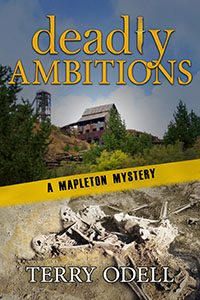
Deadly Ambitions
Peace in Mapleton doesn’t last. Police Chief Gordon Hepler is already juggling a bitter ex-mayoral candidate who refuses to accept election results and a new council member determined to cut police department’s funding.
Meanwhile, Angie’s long-delayed diner remodel uncovers an old journal, sparking her curiosity about the girl who wrote it. But as she digs for answers, is she uncovering more than she bargained for?
Now, Gordon must untangle political maneuvering, personal grudges, and hidden agendas before danger closes in on the people he loves most.
Deadly Ambitions delivers small-town intrigue, political tension, and page-turning suspense rooted in both history and today’s ambitions.

Preorder now


Terry Odell is an award-winning author of Mystery and Romantic Suspense, although she prefers to think of them all as “Mysteries with Relationships.”

First Page Critique – This Uneasy Place

by Debbie Burke

Today, let’s welcome another Brave Author who submitted a first page entitled This Uneasy Place. The genre is described as speculative with horror elements. Please read then we’ll discuss on the flip side.

~~~

Lennie was about to give up sifting through the book from the Dwyton estate when she found it. A stray envelope. Fountain pen writing and a green halfpenny stamp, dated close to a century ago. But empty, by the looks of it.

She picked up the envelope to set aside for the customer who’d been searching for that very stamp for years – he’d be tweedy, about seventy, with smeary glasses and a smile of yellowed teeth, and he’d have fluttered into her bookshop on a whim, shaking his mammoth umbrella and hee-hawing gamely about British summers – and a letter lay folded beneath it.

A squeak escaped her. Tweedy old guy vanished. Crowds materialised instead, salivating over the letter and its illuminating contents, or important writer, or… Lennie picked through two pages covered with spikes and curls of Edwardian handwriting.

…I cannot impart to you by words alone how unshakeably (and rather unnervingly) Loweheaf village believes in old superstitions…

She called past antiquated spines of calfskin, sheepskin, goatskin, aged hardback, paperback, musty velvet, on rows of bookshelves bathed in low-watt fluorescence, to where Ollie, her boyfriend, stood, his cigarette hand suspended out of the bookshop’s open door. Traffic hissed through pools of rain from the latest deluge of June’s utter drenchfest. The smell of wet London pavements intruded on the chocolatey fragrance of her mother’s shop. Her shop, now, yes. But her mother the silent partner in her head.  ‘Hey, look at this letter.’

‘Letter? Savill’s making you a reasonable offer, again? Foxton’s? Or is it John D. Wood you’re turning down this time?’

Hilarious. No estate agent was going to get its claws her mother’s shop. She still had time, still had enough money to keep it going. Before that ran out, there’d be a turning point.

…old superstitions…legendary creatures included…Surely not in 1909? Not when the industrial age had seen off phantoms of old beliefs, shone electricity into dark corners, sent behemoths roaring and seething on rail tracks to upstage childhood monsters.

 ~~~

I found this piece intriguing yet frustrating. The mystery of a century-old letter caught my attention. So did the humorous, somewhat caustic voice. But I got lost in long, convoluted, parenthetical sentences and wandering descriptions that held promise but led to dead ends.  

There were wonderful turns of phrase and descriptions like:

“he’d be tweedy, about seventy, with smeary glasses and a smile of yellowed teeth, and he’d have fluttered into her bookshop on a whim, shaking his mammoth umbrella and hee-hawing gamely about British summer.”

This character leapt to vivid life in my imagination, yet it turned out he wasn’t even the point of the sentence. Maybe he’ll reappear later in the story. I hope so. But for now, he was a disappointing dead end.

I had to chop through bramble-bush narrative to find the actual point: Lennie found an old envelope with a rare, interesting stamp and a letter, tucked inside a book from an estate collection.

“A squeak escaped her. Tweedy old guy vanished. Crowds materialised instead, salivating over the letter and its illuminating contents, or important writer, or… “

Now I’m thoroughly lost.

Was the tweedy guy physically present? Did he vanish in a poof of smoke? Or was he only a memory?

Where did crowds come from? Are they pushing inside the bookshop? Why are they salivating? What illuminating contents? Which important writer?

The visual detail about the letter is lovely: “two pages covered with spikes and curls of Edwardian handwriting.”

But the mysterious warning about “old superstitions” gets buried under a rambling 37-word sentence about “calfskin, sheepskin, goatskin, aged hardback, paperback, musty velvet on rows of bookshelves bathed in low-watt fluorescence…”

As a description of the shop, it’s vivid, sensory, and beautiful. I’d like to get lost in this cool old bookstore.

But a reader shouldn’t get so lost that they’re unable to follow what’s happening.

After three readings, I finally got the gist of this page. It’s a rainy June in London. Lennie’s mother died and left Lennie a store full of antique books from estates. Her boyfriend Ollie smokes but is thoughtful about holding his cigarette out the door. His jibes about estate brokers indicate he thinks she’s being unrealistic about the business’ prospects, but she doesn’t want to sell the shop because it’s her mother’s legacy.

Apparently, Lennie has a fantasy that she’s going to discover valuable documents hidden among the musty old books. Then historians and collectors will offer her lots of money for the treasure, enabling her to continue to operate the store.

A 1909 letter about old superstitions in Loweheaf village may be the treasure she’s been hoping for.

At least I think that’s what’s going on.

The style has a distinct British voice that sets the appropriate tone and mood. However, style shouldn’t overwhelm the plot and make the reader work to decipher what’s relevant amid extraneous (although beautiful) description.

Brave Author, this page is frustrating because your writing has exquisite sensory detail and a lush style that should be preserved.

However, you need to shorten sentences so they’re comprehensible.

Journalists are warned: “Don’t bury your lede.” Unfortunately, you’ve done that.

I’m guessing you’re well into the story to the point where you’re so familiar with Lennie’s voice that she sounds completely natural to you. But a fresh reader needs to get accustomed to her voice before they can grow comfortable with it.

You may intend Lennie to be an unreliable narrator who drifts between fantasy and reality. If so, you still need to first ground the reader in reality. If Lennie engages in flights of fantasy, give the reader more clues.

Here’s a suggested rearrangement:

The spikes and curls of Edwardian handwriting in the letter made her squeak with excited curiosity. One particular sentence sounded compelling: …I cannot impart to you by words alone how unshakeably (and rather unnervingly) Loweheaf village believes in old superstitions…

Could this be the discovery she’d dreamed of? Tweedy old guy vanished from her imagination. In his place, crowds of eager historians and collectors materialized, salivating over the letter and bidding on the illuminating contents from an important writer, or…

Lennie called to her boyfriend Ollie, “Hey, look at this letter.”

Ollie stood at the front of the shop by the open door holding his cigarette outside. 

Traffic hissed through pools of rain from the latest deluge of June’s utter drenchfest. The smell of wet London pavements intruded on the chocolatey fragrance of her mother’s shop. Her shop, now, yes. But her mother the silent partner in her head.

Ollie extinguished his cigarette and sauntered toward her, past rows of shelves lined with antiquated book spines of calfskin, sheepskin, goatskin, aged hardback, paperback, musty velvet. Low-watt fluorescence bathed the interior.

‘Letter?’ he asked. ‘Savill’s making you a reasonable offer, again? Foxton’s? Or is it John D. Wood you’re turning down this time?’

Hilarious. No estate agent was going to get its claws her mother’s shop. She still had time, still had enough money to keep it going. Before that ran out, there’d be a turning point. Her concentration returned to the letter.

…old superstitions…legendary creatures included…Surely not in 1909? Not when the industrial age had seen off phantoms of old beliefs. By then, electricity shone light into dark corners of ignorance. Fanciful childhood monsters had been upstaged by progress with iron behemoths roaring and seething on rail tracks.


Brave Author, as harsh as some of my comments sound, the fixes are easy.

Shorten sentences. Read the page out loud to someone else. One hint that a sentence is too long is if you run out breath reading it. Ask the listener if they can understand the meaning. Are they confused? If so, rewrite until it’s clear to them.

Most important, don’t bury the lede. Lennie’s excited about the possible answer to her dilemma. Fit the superb descriptions of the shop around that lede. Descriptions should enhance the story, not overshadow it.

You’re a skilful writer with a wonderful eye for specific details. You can make this story compelling without much rewriting.

Thanks for submitting This Uneasy Place and wishing you good luck with it.

~~~

TKZers: what are your impressions of Lennie’s shop and the mysterious letter? Any suggestions for the Brave Author?

~~~


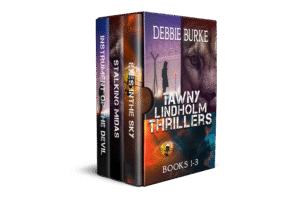
Binge on a new thriller box set. Three exciting novels only $7.99.

Tawny Lindholm Thrillers Volumes 1-3

How Gratitude Helps Writers

“Gratitude is the sign of noble souls.” – Aesop

* * *

Many years ago, when my husband and I were just newlyweds, I came home from work one night and complained about something. I honestly don’t remember what it was. Maybe it was something I wanted but didn’t have, or maybe it had to do with work. Whatever the reason, I wasn’t happy about it.

Now I’m not normally a dissatisfied person. I’m more of a glass-half-full type, but I guess I was tired and out-of-sorts, and I let hubby know it.

My husband is a guy who loves math and science, and he’ll use any excuse in a conversation to bring up something that has to do with numbers. Percentages are especially dear to him, and Frank dropped a number into our conversation that night that wasn’t just informational—it was a game changer. He said (very matter-of-factly), “Don’t you realize you have more than 99 percent of the people on Earth?”

I’m not sure about the number he used, but his point was well taken. I was grumbling about some minor thing and missing all the majors. My glass wasn’t just half-full. It was overflowing.

I can’t say I’ve never griped about anything else since then, but that conversation made me acutely aware of how fortunate I am. And that knowledge makes each Thanksgiving season a meaningful reminder to count my blessings.

Why is Gratitude Good for You?

I’ve written about gratitude before on TKZ when I referred to findings by Dr. Robert Emmons from the University of California, Davis. Dr. Emmons is a leading expert on the science of gratitude. In his article “Why Gratitude is Good,” he lists a wealth of benefits experienced by people who regularly practice giving thanks. Some of these are

  • Stronger immune systems
  • Lower blood pressure
  • Better sleep
  • Higher levels of positive emotions
  • Relationship strengthening
  • Feeling less lonely and isolated
  • Increased daily word count in their writing (Okay, I made that last one up, but it’s probably true.)

Does Gratitude Help Writing?

As a matter of fact, it does. I found another article by Dr. Emmons in UC Berkeley’s Greater Good Magazine where he addresses the creativity aspect of gratitude. While his article was specifically about gratitude in the work environment, its conclusions on the subject of creativity apply to everyone.

Beyond the social sphere of work, gratitude also drives enhanced performance in the cognitive domain: Grateful people are more likely to be creative at work. Gratitude promotes innovative thinking, flexibility, openness, curiosity, and love of learning.

Emmons goes on to observe that researchers at the University of Zurich observed

grateful people were likely to be “idea creators”: successful with developing new and innovative ideas and reaching solutions in unconventional ways.

So it would seem that gratitude is the key to creativity, and creativity is the gateway to writing great novels.

Ted Talk about Gratitude

In addition to all the above, I watched an entertaining Ted Talk given by Shawn Achor on the role of gratitude in achieving success. I’ve embedded the talk below. It’s worth the twelve-minute investment, but if you don’t have the time, here’s a list of things Achor mentions that you can do daily to achieve that state of happiness and creativity. (Notice that naming three things you’re grateful for every day is first on the list.):

Here’s the Ted Talk:

HAPPY THANKSGIVING! 

* * *

So TKZers: What three things are you grateful for today?

* * *

Three things I’m grateful for:

  1. Having the time and resources to write.
  2. Friendships I’ve made within the writing community.
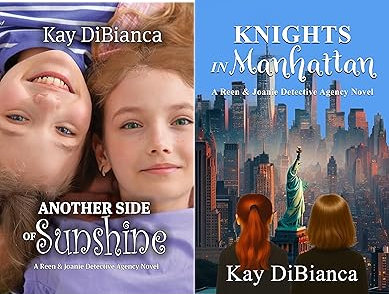
  3. Characters Reen and Joanie, the sharpest kid detectives ever, who won’t quit until they find the truth. (Click the image to go to the series page.)


Living, Breathing Characters

by James Scott Bell
@jamesscottbell

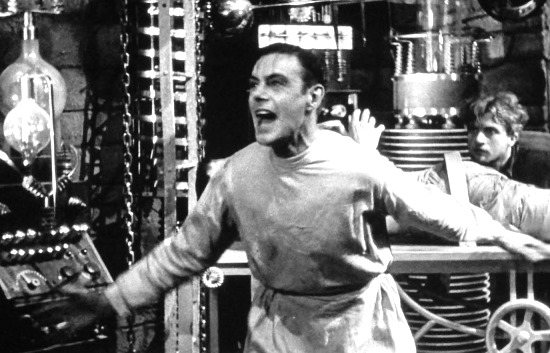
Colin Clive in Frankenstein

In the classic Universal horror movie Frankenstein, Colin Clive, overacting as Dr. Frankenstein, shouts, “IT’S ALIVE! IT’S ALIIIIIIVE!” He’s thrilled to the core when his creation takes on real life.

The doc was onto something. Isn’t that how you feel when your character starts to come alive as you write?

While there are many aspects of great character work, I think the following three features are always present.

1. Attitude

Compelling characters have a way of looking at the world that is uniquely their own. This is attitude, and done well it sets them apart from every other fictional creation.

If you are writing in first-person point of view, attitude should permeate the voice of the narrator. Julianna Baggott’s Lead in Girl Talk, Lissy Jablonski, is smart, witty and a bit cynical. She describes an old boyfriend:

He’d been a ceramics major because he wanted to get dirty, a philosophy major because he wanted to be allowed to think dirty, a forestry major because he wanted to be one with the dirt, and a psychology major because he wanted to help people deal with their dirt. But nothing suited him.

We learn a lot about Lissy from her singular voice. One thing she’s not is dull.

A third-person character shows attitude primarily through dialogue and thoughts. In L.A. Justice we’re given a look into the head of Nikki Hill, the deputy D.A. who is the Lead in the Christopher Darden/Dick Lochte legal thriller. In one scene she reacts to her superior, the acting D.A. He’s a man of two personalities she had labeled “Dr. Jazz” and “Mr. Snide.” In the office he was the latter, bent and dour, with an acid tongue and total lack of social grace . . . At the moment, he was definitely in his Mr. Snide mode.

This is a quick look at Nikki’s attitude toward authority, which continues to be developed in the novel.

The best way to find your character’s unique views is to listen. You do this by creating a free-form journal in the character’s voice. It’s okay if you don’t know what the voice is going to sound like when you start. Keep writing, fast and furious, in ten to twenty minute stretches. A voice will begin to emerge.

Have the character to pontificate on such questions as:

  • What do you care most about in the world?
  • What really ticks you off?
  • If you could do one thing, and succeed at it, what would it be?
  • What people do you most admire, and why?
  • What was your childhood like?
  • What’s the most embarrassing thing that ever happened to you?

Let the answers come in any form, without editing. Your goal is not to create usable copy (though you certainly will find some gems). Rather, you want to get to know, deeply, the character with whom you’re going to spend an entire novel.

2. Courage

A great novel, I say again, is the record of how a character overcomes some form of death—physical, professional, or psychological. Which means the Lead has to have guts.

In Rose Madder, Stephen King gives us a Lead who is weak and vulnerable—a terribly abused wife. In the Prologue we see Rose Daniels, pregnant, savagely beaten by her husband. The section ends, Rose McClendon Daniels slept within her husband’s madness for nine more years.

Chapter One begins with Rose, bleeding from the nose, finally listening to the voice inside her that says leave. She argues with herself. Her husband will kill her if she tries. Where will she go? But finally she works up the courage to open the front door and take her first dozen steps into the fogbank which was her future.

Every step she takes now requires courage. Rose is unprepared for dealing with the outside world, with simple things like getting a bus ticket or a job. And all the while she knows her husband is going to be tracking her. Still, she moves forward, and we root for her.

3. Surprises

A character who never surprises us is dull by definition.

Surprising behavior often surfaces under conditions of excitement, stress or inner conflict. Archie Caswell, the 14-year-old protagonist of Han Nolan’s When We Were Saints, is torn about his experience of the divine. Alone on a mountain he dug his hands into the ground beneath him, pulling up pine needles and dirt. He threw it at the trees. He picked up some more and threw it, too. He berates God, then asks God’s forgiveness.

It’s completely unexpected behavior from a heretofore normal, troublemaking kid. And bonds us to him all the more.

When your character has an emotional reaction, don’t choose the first one that comes to mind. That’ll be expected. Brainstorm. Make a surprise.

If you plumb the depths of your characters’ lives by exploring these three aspects, your fiction will truly come ALIIIIIIVE!

What do you do to bring life to your characters?

Mental Words of Wisdom

Last time I wrote about suffering from what I call “revision block”, and discussed some possible solutions to this particular writing conundrum.

Writers can face a number of other mental challenges, to put it mildly. Today’s Words of Wisdom examines a trio of potential roadblocks, courtesy of three excerpts from the Kill Zone archives.

Clare Langley-Hawthorne considers how digital distractions can make you lose focus. Laura Benedict deals with a bane for many of us, procrastination. Sue Colletta discusses how “multi-tasking” can make writing harder.

All three excerpts are worth reading in full. Each excerpt is date-linked to its respective full version.

For writers, digital distractions are everywhere. At the moment my personal bugbear is my inability to wean myself off mindlessly checking the internet whenever I lose steam in my writing – the result? At least ten minutes of Daily Mail, Facebook and Gmail distraction resulting in – you guessed it, a complete loss of focus. Over the last week I’ve been paying greater attention to my writing habits (or lack thereof) and have realized that checking the internet has become a sort of ‘default’ setting whenever I’m stuck on a sentence or unsure of a passage of dialogue. I worry that my brain has lost the ability to focus for more than an hour at a time without craving some sort of distraction when the going gets tough. The answer to my problem is clearly weaning myself off the distraction itself but I’m surprised at how difficult this has become. I know I’m going to have to retrain my brain somehow as well as impose much stricter limits on succumbing to these distractions. My fear is that my ability to focus for long periods of time is already slipping away from me (can you hear the screams?…)

As readers, digital distractions allow ourselves to fulfill our craving for something new and more interesting whenever our focus wavers. Recently, I’ve found it is much harder to keep my focus on a book when my interest starts to wane. Whereas in the past I would plough on for a bit, hoping that a book would regain my interest, I now find myself turning to digital distractions much quicker than I ever would have put a book down before. It would be amazing to be able to create a safe room, look into options such as Soundproofexpert, and have that room as a digital hideaway, away from what ever distractions you may find on a day to day basis, or unfortunately even an hour to hour basis now.

I’m sure lack of focus has always been an issue for writers and readers, but I do feel that the increasing levels of digital ‘noise’ that surrounds us is making it much harder (at least for me) to keep the level of sharp focus I need on my writing. It certainly makes me less efficient and productive – although, thankfully, I still manage to pull off bursts of fear-induced focus which means I am completing my writing projects on time. I just feel that I need to develop techniques to sharpen my focus, increase my attention span, and spurn the digital ‘siren’ call that is all too easy to heed.

So what about you – do you find the digital world is making you lose focus? Have you developed strategies to overcome this while writing (or reading). Although disconnection is always an option for periods of time, it’s hard for this to be a permanent ‘default’ setting when so much of our world revolves around digital communications.

Clare Langley-Hawthorne—February 1, 2016


Even some of the most productive bestselling writers I know sometimes procrastinate. Personally, when I’m in my deepest procrastination moments, I forget that. It feels lonesome, and I become my own harshest judge. (That whole comparing oneself to other writers is deadly too, but we can consider that another time.) Being judgy while procrastinating is doubly unhelpful.

Procrastination offers an escape from tension. If I have a project (or chapter or paragraph or phone call or chore) that makes me feel anxious, I sometimes literally walk away from it. It might be for five minutes. It might be for an hour. It might be for weeks. Eventually I’ll return to it–or, if it’s some kind of chore or event–my lack of action will mean it expires and goes away.

Avoidance. It’s embarrassing to admit that I’m sometimes guilty of it. Ouch.

I’ve read many, many books to try to improve my productivity, shape my behavior, and, yes, fix my procrastination habit. Because it is a habit, not a disease or fatal flaw.

Here’s the latest book I’ve read on the subject:

I listened to it on audio via Overdrive and liked it well enough that I bought the ebook. (I often do that, anecdotal proof that library reads influence consumer book purchases.)

Notice that appealing subtitle. “A Strategic Program for Overcoming Procrastination and Enjoying Guilt-Free Play.” How sexy is that? I couldn’t resist checking it out when I was browsing available audiobooks. The subtitle worked on me exactly the way I’m sure it was intended: put the focus on the positive, not the procrastination.

KillZone is not the place for book reviews, but is about the writing life. So I’ll be brief.

THE NOW HABIT

  1. Helps you identify when and why you might be procrastinating.
  2. Doesn’t judge you for procrastinating–and even explains how it becomes an active coping tool.
  3. Doesn’t prioritize work over pleasure (a real revelation for me).
  4. Offers some compelling client stories.
  5. Has focus exercises and talks about the process and importance of flow.
  6. Helps you create your own “unschedule.”
  7. Has a good section about dealing with the procrastinators in your life.
  8. Explores goal setting.

The “unschedule” is my favorite piece of the process because it turns one’s schedule upside down. After blocking out the time you require for life’s necessities like eating, cleaning, sleeping, and tending dependent creatures, you mark out time for things that give you pleasure and put you in a state of play or creative play. Working out, practicing hobbies, spending time with friends. It might happen daily, weekly, or bi-weekly. Whatever you choose. It becomes a priority. A reward to work toward.

Work (or writing or publishing business for most of us here) can become more energizing. More efficient. I confess that on the days I’ve managed to put this into serious practice, I’ve found myself happily working overtime, sometimes working well into my scheduled pleasure time–but not feeling a bit deprived because I know I’ll get to play again soon. Also, I’m getting a huge amount of pleasure from my work hours.

Laura Benedict—July 11, 2018


Writers need to multitask. If you struggle with multitasking, don’t be too hard on yourself. The brain is not wired to complete more than one task at peak level. A recent study in the journal Frontiers in Human Neuroscience showed when we’re concentrating on a task that involves sight, the brain will automatically decrease our hearing.

“The brain can’t cope with too many tasks: only one sense at a time can perform at its peak. This is why it’s not a good idea to talk on the phone while driving.” — Professor Jerker Rönnberg of Linköping University, who conducted the study.

The results of this study show that if we’re subjected to sound alone, the brain activity in the auditory cortex continues without any problems. But when the brain is given a visual task, such as writing, the response of the nerves in the auditory cortex decreases, and hearing becomes impaired.

As the difficulty of the task increases—like penning a novel—the nerves’ response to sound decreases even more. Which explains how some writers wear headphones while writing. The music becomes white noise.

For me, once I slide on the headphones, the world around me fades away. I can’t tell you the number of times my husband has strolled into my office, and I practically jump clean out of my skin. Don’t be surprised if someday he kills me by giving me a heart attack. But it isn’t really his fault, even though I’ll never tell him that. 😉 I’m in the zone, headphones on, music blaring, my complete attention on that screen, and apparently, my brain decreased my ability to hear.

Strangely enough, I don’t listen to music while researching. When I need to read and absorb content, I need silence. This quirk never made sense to me. Until now.

Have you ever turned down the radio while searching for a specific house number or highway exit? Instinctively, you’re helping your brain to concentrate on the visual task.

Research shows that our brains are not nearly as good at handling multiple tasks as we like to think they are. In fact, some researchers suggest multitasking can actually reduce productivity by as much as 40% (for everyone except Rev; he’s a multitasking God). Multitaskers have more trouble tuning out distractions than people who focus on one task at a time. Doing many different things at once can also impair cognitive ability.

Shocking, right?

Multitasking certainly isn’t a new concept, but the constant streams of information from numerous different sources do represent a relatively new problem. While we know that all this “noise” is not good for productivity, is it possible that it could also injure our brains?

Multitasking in the brain is managed by executive functions that control and manage cognitive processes and determine how, when, and in what order certain tasks are performed. According to Meyer, Evans, and Rubinstein, there are two stages to the executive control process.

  1. Goal shifting: Deciding to do one thing instead of another
  2. Role activation: Switching from the rules for the previous task to the rules for the new task (like writing vs. reading)

Moving through these steps may only add a few tenths of a second, but it can start to add up when people repeatedly switch back and forth. This might not be a big deal if you’re folding laundry and watching TV at the same time. However, where productivity is concerned, wasting even small amounts of time could be the difference between writing a novel in months vs. years.

Sue Coletta—July 12, 2021

***

  1. What’s your biggest digital distraction? How to you avoid it?
  2. Does procrastination hinder you in getting to the keyboard? If so, what gets you writing?
  3. Do you multitask when writing? How much of a hindrance or a help is that to your own process?

Reader Friday-The Last Novel

Noooooo!


Sorry if I skeered ya…the last novel hasn’t actually been written yet. (I think…)

Whew!


Here’s what today is about.

Please share with us the last novel (or novella) you read. Include the title, author, and publish date, and maybe your critique. Would you recommend it to readers?


Here’s mine:  Finished “Out of the Far North” by Amir Tsarfati and Steve Yohn—the 3rd of 4 in a series, published in 2023. Just started the 4th, “The Sick Man’s Rage”, and I’m hoping there’s going to be a 5th! Middle East, spies, heroes, cool weapons, and a teensy bit of romance. Right up my reader’s alley.

Okay, your turn!


New Words, New Worlds

By Elaine Viets

 New words are multiplying faster than mosquitoes in a Michigan summer. I mean “official” new words. The ones enshrined in a dictionary.

New words are a sign that English is a living, active language. This year, the Merriam Webster Collegiate dictionary added some 5,000 new words and a thousand new phrases.

Some of us are already using these new words. Take “farm-to-table,” which Webster says means food that is “sourced locally and served directly to customers. Old news.

Here are a few other new words and phrases I’m pretty sure you already know:

“Cold brew” is coffee “made by steeping grounds in cold or room temperature water.” That phrase has been around for so long, Starbucks has about nine different cold brew flavors.

“Hard pass,” means not just no, but hell no. Excuse me, it’s a “firm rejection.”

Here’s one new word I’m not familiar with: “petrichor,” which is a “distinctive, earthy, usually pleasant odor that is associated with rainfall especially when following a warm, dry period . . .” I didn’t realize there was a word to describe that smell.

The Oxford English Dictionary has added another definition of the noun  “goo”: “characteristic babbling noises or vocalizations made by babies and by people interacting with them.” The OED reminded us to check out “goo-goo,” which has a similar definition for baby noises.

“Para-athlete, a physically disabled athlete,” is another already familiar OED addition.

And every TKZ reader and writer knows about the dreaded phrase “plot hole.”

The OED likes to add foreign words familiar to many English speakers, including “pobrecita.” The OED says, “Among Hispanic Americans and in Spanish or Latin American contexts” it’s “a poor or unfortunate girl or woman, especially one who deserves pity or sympathy…”

“Perreo” is defined as “a type of dance originating and popular in Puerto Rico and usually performed to reggaeton music, typically characterized by a female dancer  . . .” I’ll stop there. The rest of the entry is a bit spicy, especially for the venerable OED.

The most puzzling word of the year is Dictionary.com’s choice of “67” or “6-7.”

That word has been driving teachers crazy. When they tell their class to “turn to page 67,” or ask students to recite numbers one through ten, “six-seven” can cause pandemonium.

Avoiding ’67’ can be a mark of respect. TKZ reader Alan Portman said, “I was at a class last week. The instructor stopped saying 6 or 7 things and started saying 8. There were several middle school teachers in the room.”

What’s it mean?

Dictionary.com, which nominated “67,” isn’t sure.

“Perhaps the most defining feature of ‘67’ is that it’s impossible to define,” the site said. “It’s meaningless, ubiquitous, and nonsensical. In other words, it has all the hallmarks of brainrot. It’s the logical endpoint of being perpetually online, scrolling endlessly, consuming content fed to users by algorithms trained by other algorithms. And what are we left with in the wake of this relentless sensory overload? ‘67.’”

Don’t underate the power of “67.”

“ . . .it remains meaningful to the people who use it because of the connection it fosters. ‘67’ shows the speed at which a new word can rocket around the world as a rising generation enters the global conversation.”

Six-seven (never sixty-seven) belongs to Gen Alpha, mostly children born from 2010 to the present, though I doubt many babies care about 6-7.

SlangSphere.com gave an erudite explanation. It said, “Simply put, ‘67’ is a slang term that means ‘kill,’ or more broadly, to get rid of, drop, or even ‘leave’ something or someone. . . If someone tells you to ‘67 that plan,’ they mean scrap it.”

The article also has helpful hints on how to use 67:

“Do: Use it with close friends or in casual texting where informal slang is welcome.

“Do: Keep it light and playful—this is slang, not a serious threat.

“Don’t: Use it in professional or formal settings—your boss might get confused (or alarmed).

“Don’t: Use it toward strangers or in sensitive contexts—tone can get lost.

“Do: Use 67 when you want to sound casual and meme-savvy.

“Don’t: Panic if someone says ‘67’ to you. It’s slang, not actual harm.

“Do: Pair it with an emoji to soften the tone, like 😂 or 👋.

“Don’t: Use it to seriously insult someone.

“Do: Remember context is king—know who you’re talking to!

“So, next time you want to digitally ‘kill’ a dull plan or leave a chat dramatically, ‘67’ is your shorthand hero. It’s quirky, a little mysterious, and definitely meme-worthy.”

It’s mysterious, all right. So mysterious, I still can’t figure out if 67 means to kill something, or if it means nothing.

Is it a word with clearly defined rules of etiquette? Or is it a feeling?

67.


Preorder now: “Sex and Death on the Beach,” my new Florida mystery, will be published in paperback Dec. 16. https://tinyurl.com/mrc87fm7

“But why didn’t they just . . .”

By John Gilstrap

As a thriller author, I know all about testing the boundaries of suspended disbelief. As a consumer of thrillers, I do it all the time. Coincidences have to happen to make a story work, and as writers, it’s our job to make the coincidences feel organic to the situation the characters are enduring. For the sake of tension and drama, we stack the odds against our good guys. That way, when they ultimately prevail, the victory feels that much sweeter.

We’ve been watching a lot of streaming movies and television shows in our special viewing room over the past couple of months, and as the tropes stack up, I’m having a progressively harder time keeping my inner commentary silent, earning a few elbow shots from my beloved and more than a few harsh shushes. Consider . . .

. . . When crashing the drug den and the SWAT team is stacked up behind a ballistic shield and armed with enough fully-automatic firepower to topple Venezuela, why is Detective Danny Reagan with his pistol and designer ballistic vest out in front of everybody?

. . . Why don’t detectives ever just turn on a light? Instead, the search the dusty darkness of a suspects bedroom–or the basement where all murders were committed–with only the illumination provided by a tiny penlight.

. . . Why does our brilliant good guy wait till he arrives at the site of trouble before he chambers a round into his pistol? That means he’s been driving around all day essentially unarmed.

. . . After prevailing in the firefight in Room A, why doesn’t our good guy take advantage of the relative peace to reload before moving to Room B? Never bring old bullets to a new gunfight.

. . . For heaven’s sake, good guy or bad, just friggin’ shoot! You’ve achieved your goal. You’ve got your prey in your sights. And let’s be honest: At that point, while the victim very likely cares deeply that you intend to kill them, they’re not really going to be listening to the why. If they’ve got any sense, they’re going to be focused exclusively on either how to get away or to kill you first. Any way you cut it, your best call is to pull the trigger. Conversely, if you change your mind, your only move is to run like a bunny rabbit because only bad things lie ahead for you.

I make it a point to never pick on particular shows by name, but there’s one very popular program that makes my head explode every week. Let’s pretend there’s a show called “Trooper” and it features a character named Dalton Shames. To our knowledge, Dalton’s never had a conventional job, but it’s clear that he was raised by MacGyver. Give Dalton a can of Dr. Pepper, and he can turn a paper clip into a flame thrower.

Okay, I joke about the flame thrower, but he routinely produces a full-size 1911 platform pistol from the waistband of his trousers, right at the small of his back. His limp-wristed grip is all wrong for that gun (that’s a real description, not a pejorative), and none of the nations most draconian gun laws apply to him. Not even New York or Los Angeles.

In last week’s episode, a plucky 19-year-old is able to infiltrate the lair of a dangerous drug kingpin with the intent of kingpin regicide. It’s quite a feat given the army of armed guards. Dalton, in the company of the local sheriff, who has inexplicably ceded all law enforcement powers to this stranger from out of town, raid the compound themselves by ramming their way through the front gate. They have to keep the 19-year-old from being killed by the cartel, don’t you know.

Here’s the plan: The sheriff will hold off the army with his six-shot revolver while Dalton makes his way to the kingpin’s throne room, where the plucky kid has his highness dead to rights, but can’t bring himself to pull the trigger. Yada, yada . . . shot from off camera, kingpin gut shoots plucky kid, Dalton shoots kingpin and takes off running with plucky kid over his shoulder. Bad guys with rifles can’t hit a running target at ten yards, Dalton can’t miss with unaimed shots while running.

All is well but for this kid with a hole in his gut. Not to worry. There’s a horse veterinarian with a pouch of goodies who says he can help.

CUT TO: A kingpin’s yard filled with cop cars that would have been really handy a little while ago. But the vehicle we really care about it the ambulance with our plucky-now-gut-shot 19-year-old looking like a million bucks, all cleaned up, sitting upright in the stretcher while Dalton tells him everything’s going to be okay. Then Dalton allows the paramedics to close the back doors and drive him away.

Sigh.

There’s suspension of disbelief, and then there’s no element of this story is possible so therefore none of the story is engaging. I am without a doubt becoming progressively more curmudgeonly about these things, but I swear that lazy storytelling is becoming the norm.

In these days of Chat GPT and even simple YouTube searches, even uninformed storytelling is lazy. A car door has never been adequate to stop any but the smallest bullet, but ten years ago, not knowing that was forgivable. Now, there are entire channels dedicated to what stops what caliber of bullet. I have to assume that s true of every other once-esoteric subject.

What say you, TKZ family? How forgiving is the suspension mechanism for your disbelief?