Writers love words, the weirder the better. Here’s a selection of unusual words and phrases that were unfamiliar to me until recently.
JUST DESERTS – This isn’t a new phrase but for many years, I spelled it wrong. I always assumed it was “desserts” (like cake and ice cream) because that’s how it’s pronounced. Turns out the correct spelling is “deserts.” A savvy TKZ follower (sorry, I can’t remember who) provided the correction. Thanks!
The original phrase came from 16th century Latin. “Just deserte“ meant “what is deserved.” Back then, it could refer to either reward or punishment. Over time, it took on a negative connotation. When someone did something bad, they had a comeuppance and got what they deserved. In crime fiction, when a villain is caught, they get their just deserts.
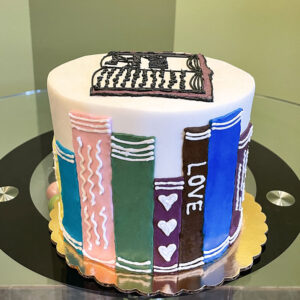
Why doesn’t someone start a business that’s a combination mystery bookstore and bakery? Call it “Just Desserts.”
A big thank you to a knowledgeable reader of British military history who introduced me to the following three examples:
INFRA DIG – This is a British slang term meaning “beneath one’s dignity” or “lower than one’s status.” TheOxford English Dictionarydefines it as an adjective. Borrowed from the Latin phrase infra dignitatem, its earliest known use was traced to Sir Walter Scott in 1824.
Example: A snobbish author may feel it’s infra dig to have to do their own marketing. They’re in for a comeuppance.
OLQ – More British slang that’s an acronym for “officer-like qualities.” It’s used to describe enlisted personnel who have the potential to be promoted to officer ranks. Traditionally, social class was important in English military hierarchy. Due to family status, someone could automatically become an officer, whereas a person without social standing had to work extremely hard to be promoted.
COR BLIMEY or GOR BLIMEY – A British exclamation of surprise, shock, or anger. Cor or Gor are substitutions for the word “God” and are used to avoid the blasphemy of taking the Lord’s name in vain. Blimeyis an abbreviated Cockney pronunciation for “blind me.” Therefore, cor blimey means “God blind me.” The term is firmly established in British slang and is the title of a 2000 TV movie.
SYNECDOCHE and METONYMY – These are literary terms that refer to using part of a phrase as an abbreviated substitute for the entire phrase.Oregon State Universityoffers a helpful video to explain these related but slightly different definitions.
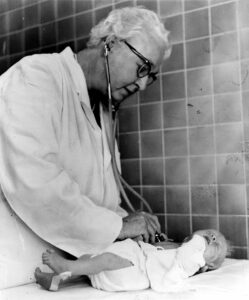
Dr. Virginia Apgar examines a newborn. Photo credit: Wikimedia
APGAR test or score – This is a quickassessmentof a newborn’s condition administered by medical providers at timed intervals, the first within one minute following birth, then followed at five minutes following birth. It’s the acronym of:
A – appearance
P – pulse rate
G – grimace (indicates responsiveness)
A – activity
R – respiration
Little-known fact: the APGAR test or score is named for Dr. Virginia Apgar, an obstetric anesthesiologist and university professor who devised the test in 1952. Her mission was to reduce infant mortality by quickly recognizing problematic symptoms so they could be treated promptly.
This last phrase is from a crusty, cranky guy who’s done contracting work at my house. Mark brags he’s never read a book in his life, but he comes up with colorful expressions like this one:
“The sun sometimes hits a dog’s ass.”
~~~
TKZers: Do you recognize any of these examples? Do you have your own favorite weird word or phrase to share?
When I was taking private pilot lessons, my instructor drilled this three-word phrase into me in every lesson as essential to successful flying. Although you need to keep all three of these skills in mind and not fixate on any one of them, there is a priority order.
Aviate. Fly the plane. This is always first. The pilot must maintain the altitude, airspeed, and position in the air (attitude). Things can get busy in the cockpit, and a mechanical failure or some other unanticipated issue can divert a pilot’s attention from simply flying the plane. The Society of Aviation and Flight Educators notes:
A famous example of failure to follow the established aviation priorities is the crash of Eastern Airlines Flight 401. In December 1972, the crew of a Lockheed L-1011 TriStar became focused on the malfunction of a landing gear position indicator light for the nose gear. The plane subsequently descended into the Everglades northwest of Miami, killing 101 of the 176 people on board (two people died more than seven days after the accident).
Navigate. When you’re flying an aircraft, you need to know where you are and where you’re going. Whether the pilot is navigating or there’s a separate navigator onboard, their job is to monitor the flight and make adjustments as needed to get the plane to its destination. Mistakes in navigation can lead to loss of situational awareness and accidents.
Communicate. Air Traffic Control is the pilot’s friend. They direct flights to keep safe distances between planes and provide instructions for safe takeoffs and landings. Pilots communicate with ATC using protocols that must be followed or the communication fails. For example, the English language is the standard established by the International Civil Aviation Organization (ICAO) to ensure safety and clear communication. On initial contact with ATC, the pilot uses the “4 W’s” (who you’re calling, who you are, where you are, what you want).
* * *
From Cockpit to Keyboard
It seems like everything I do relates back to writing these days. Fortunately, a failure in the writing process isn’t as dangerous as in flying, but we might be able to map Aviate, Navigate, Communicate onto the writer’s job. Here’s a simplified look at the process:
Aviate: Write the book. Keep it moving forward. Don’t decide to clean out that closet once again because you’re looking for an excuse to avoid writing. And don’t rewrite Chapter One for the fortieth time to get it just right. TKZers: How do you keep moving forward? Do you allocate a certain number of words or hours per day to your work? How long does it take you to write a novel?
Navigate: While you’re writing, keep an eye on where you’re going. Does each scene move the story forward, or are you getting bogged down in unnecessary subplots or long, boring backstory? TKZers: How do you avoid getting off course when writing?
Communicate: Editors, critique partners, and beta readers are the author’s friends. Use their input to revise and polish the story. Clear communication will enable the author to make the necessary changes. TKZers: What types of communication do you use to improve the final product?
* * *
So TKZers: Do you use a method like “Aviate, Navigate, Communicate” to complete your novels? Tell us about it.
* * *
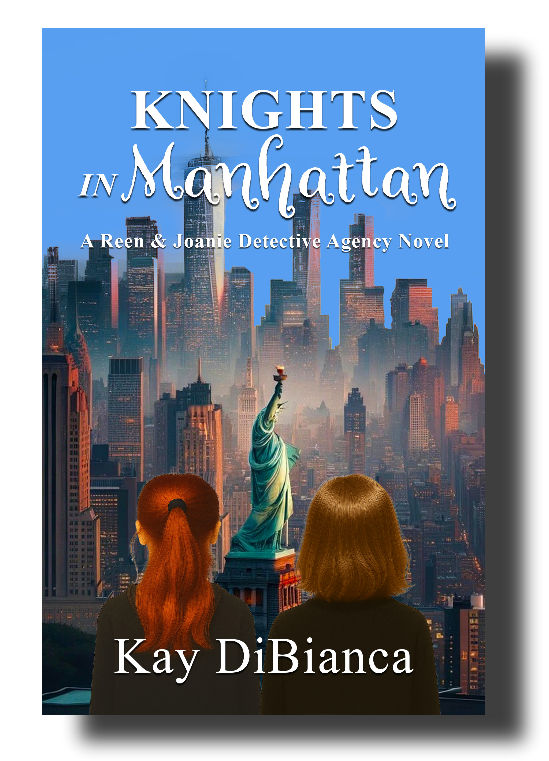
Knights in Manhattan begins on a flight that has encountered rough air. But there may be more turbulence inside the cabin than outside the airplane.
Walt Whitman’s poem “Song of Myself” begins this way (spelling in original):
I celebrate myself, and sing myself, And what I assume you shall assume, For every atom belonging to me as good belongs to you. I loafe and invite my soul, I lean and loafe at my ease observing a spear of summer grass.
Walt was on to something, namely, it is much better to observe grass than to smoke it. Loafing is not about psychoactive stimulation. It’s about inviting your soul.
Which is exactly what we should invite as writers. It is what makes our writing, our voice, unique. It is what a machine does not, and can never possess.
So just how do we invite our soul? We can practice creative loafing.
I had the privilege of knowing Dallas Willard, who was for many years a professor of philosophy at USC, where your humble scribe studied law. Willard was widely known for writing about the spiritual disciplines, e.g., prayer, fasting, simplicity, service, etc. I once asked him what he considered the most important discipline, and he immediately responded, “Solitude.”
That threw me at first. But the more I thought about it, the more it made sense. Solitude, which also includes silence, clears out the noise in our heads, the muck and mire, so we can truly listen.
“In silence,” Willard wrote, “we come to attend.”
Our world is not set up for solitude, silence, contemplation.
Boy howdy, how hard that is for us! According to a recent survey, Americans check their phones 205 times per day. Further:
6% check their phones within the first 10 minutes of waking up.
76% check their phones within five minutes of receiving a notification.
7% use their phones while sitting on the porcelain throne.
Needless to say, this doesn’t “invite your soul.” Loafing, even boredom, does. As one neuroscientist puts it:
Boredom can actually foster creative ideas, refilling your dwindling reservoir, replenishing your work mojo and providing an incubation period for embryonic work ideas to hatch. In those moments that might seem boring, empty and needless, strategies and solutions that have been there all along in some embryonic form are given space and come to life. And your brain gets a much needed rest when we’re not working it too hard. Famous writers have said their most creative ideas come to them when they’re moving furniture, taking a shower, or pulling weeds. These eureka moments are called insight.
Learn how to loaf, I say! And it is a discipline. I take Sundays off from writing. It’s not easy. I feel myself wanting to write a “just a little” (which inevitably becomes “a lot”). I have to fight it. If I win the fight, I always feel refreshed and more creative on Monday.
Try this: Leave your phone in another room and sit alone in a chair for five minutes and don’t think about anything but your breath going in and out. You’ll be amazed how hard that is. But it’s a start. If you’re working on your WIP, take a few five-minute breaks to loaf and invite your soul. You’ll get better at it. And your work will get better, too.
I will finish with this moving story about silence.
A fellow enters a monastery and has to take a vow of silence. But once a year he can write one word on the chalkboard in front of the head monk.
The first year goes by and it’s really hard not to talk. Word Day comes around and the monk writes “The” on the chalkboard. The second year is really painful. When Word Day comes he scratches “food” on the chalkboard.
The third year is excruciating, the monk struggles through it, and when Word Day rolls around once more, he writes “stinks.” And the head monk looks at him and says, “What’s with you? You’ve been here for three years and all you’ve done is complain.”
For years, my library colleagues would ask when I was going to write that library mystery. Afterall, I read mysteries, was a writer, and worked at library, so it seemed like a natural fit to them. While I thought about it I continued writing fantasy and science fiction.
Finally, in 2020, after I’d retired from the library, the desire to write a cozy library mystery novel grabbed me. As I finished the final novel in my Empowered series, I read a bunch more mysteries of all sorts, from Matthew Scudder to more Agatha Christie to Sara Rosett’s Murder on Location cozy series.
I also read books on writing mysteries: Mystery Writers of America’s How to Write a Mystery, How to Write Killer Fiction by Carolyn Wheat, our own KZB alum Nancy Cohen’s Writing the Cozy Mystery, Sara Rosett’s How to Outline a Cozy Mystery Workbook, as well as her Teachable course on writing cozies. Sara’s course also included interviews with cozy mystery authors like Lynn Cahoon and Anna Castle. I discovered very useful handouts at Castle’s website from a workshop she gave on mystery writing.
I read more mysteries, and watched mystery TV series like Midsomer Murders, Elementary, Monk, the new Father Brown series, Perry Mason, and Columbo.
My published fantasy novels had crime and mystery elements, so writing an actual murder mystery should be a snap, right?
I wasn’t surprised it wasn’t that easy. I consider actual mystery novels to be one of the hardest types of fiction to write, and took the challenge seriously, which was a good thing. From the time I began outlining my first library cozy mystery, then called Death Due, until I published the final version, A Shush Before Dying, over two years had passed. I wrote three different versions, with numerous outlines. I did a deep dive into upping my revision game after finishing the first draft.
The second book in the series, Book Drop Dead came faster, being completed in year.
I’m an outliner, who, once upon a time, discovery wrote (AKA “pantsed”) his novels. For me, figuring out story structure was the secret that unlocked being able to create a story that worked. Mysteries were no different.
Cozy mysteries, like other mysteries, usually center around a murder. For me, that meant learning who the murderer was, and why they committed the crime, before outlining the book. I began each book by creating an electronic document file which became a novel journal where I could brainstorm about the mystery, the killer’s shadow story (something I learned from our own James Scott Bell), spin out the web of suspects, background notes, and simple outlines I could flesh out later.
***
Mystery foundation
These make up the foundation of the mystery I’m building, and key to my process is asking myself questions about each.
Killer: Who and why? What lead them to kill, and why did they murder the victim? How do they react when they learn they are being investigated by our sleuth-hero?
The Victim: Often someone who is despicable in at least some of the time, and often at the center of a conflict, but they can be something other than a jerk—quirky perhaps, misunderstood, or even a good person who ran afoul of a killer. What was their relationship with the killer?
The setting: the location and community where the murder takes place. For my own cozy mystery, the setting was easy: the public library. I wanted the era to be the 1980s, when I began my at-first accidental career. This was the library before the Internet, when the card catalog ruled and staff used “dumb” terminals to check out books, stamping the date dues on a label on a page at the front of the book.
The public library then and now is a community in its own right, as well as a meeting ground for other communities, which provide opportunities for all sorts of situations and characters. How does the setting shape the murder, and the investigation?
The sleuth-hero: What pushes them to investigate the murder instead of leaving it to the police? Amateur sleuths are often nosy, curious, driven to solve puzzles. This describes my librarian-sleuth Meg Booker. The hero may be motivated to solve the crime because of personal concern if a friend is the suspect or survival if they themselves fall under suspicion.
In other cases, it may be the sense that thing about the murder doesn’t fit the facts as the police see them. The hero must have a reason to investigate and discovering that reason is vital. In cozy mystery the reason is often personal. The sleuth may have a connection to the victim, or to the person the police believe is the killer, as is the case in my first Meg Booker mystery.
The Web of Suspects: For me an ideal number of suspects is five to seven. The motivations can be similar, but it helps build the mystery if at least some have different motives for murder. For instance, two suspects might both be rivals with the murder victim for a job promotion, while three more have possible motives unrelated to the day job.
***
Plotting
The next thing I like to tackle is my story structure. I’m a fan of our own James Scott Bell’s signposts, such as the opening Disturbance, the Doorway to Act II, and especially the Mirror Moment. I brainstorm how the murder plays out, how the sleuth’s investigation begins and progresses, and what the killer does in response.
I’m an outliner, so I began putting the mystery into a beat outline, with sign posts marked and key scenes laid out. I’ll do additional brainstorming in a novel journal, a separate electronic document.
***
The Arc of Suspicion
I also work out what I call “the arc of suspicion,” which is the sleuth-hero and readers progression in who they suspect committed the crime. I posted about this here. I’m going to crib from that earlier post and share the beats of the suspicion arc. I don’t necessarily write all these out, but keep them in mind as the story progresses, brainstorming as needed:
The arc begins with noticing something is off about someone’s behavior, or a set of circumstances.
Doubt ensues.
Then, discovering “evidence” which increases suspicion. This can be an overheard conversation, reading a note or email, seeing a meeting without hearing what is being said, looking at a pattern of behavior, perhaps behavior out of character for the suspect, etc.
Discovering a lie, or a false alibi can heighten suspicion.
There can be a deepening fixation on a suspect’s behavior, words, deeds, and trying to figure out what they were thinking, why they did what they did, etc.
Acting on that suspicion to the point of taking risks and putting yourself in potential jeopardy. This often precedes the confrontation/reveal in the final act of a mystery.
Given that mysteries usually have multiple suspects, there will be a point where the sleuth (and the reader) rule out a person because of evidence, alibi, or learning what the secret was that made a particular individual act suspicious to the main character.
Of course, heroes and readers often suspect more than one character at the same time, so the arcs can overlap. Sometimes the behavior or evidence is one thing, which leads to doubt about a particular person. Doubt which might deepen to suspicion or might simmer in the background. Or, even forgotten for the moment, until the end, when new evidence makes the sleuth suddenly suspect that person with a cold-in-the-bones feeling.
Finally, the sleuth’s suspicions lead to the actual killer and/or can lead the killer to them.
***
Drafting
As I write the first draft, I’ll come up with new ideas, clues etc., and, if they make the grade, will add them to my outline.
***
Revision and feedback
Revision is where I work to fix plot holes, add missing clues, clarify motives if needed, along with the usual revision tasks of improving scenes, pacing, characterization, setting details etc. I then send the revised novel to my beta readers, who give me invaluable feedback on whether the mystery worked for them, where they were surprised, if they guessed the identity of the murderer, etc. I then make any additional changes based their feedback.
***
The resources which helped me learn how to build a mystery
Nancy Cohen’s Writing the Cozy Mystery. Nancy’s book provides an instructive break down of the elements of a cozy mystery.
Sara Rosett’s How to Outline a Cozy Mystery. Rosett gives the building blocks of a cozy mystery, as well as different outlining methods, tips on clues and red-herrings, conventions of cozies etc. While Rosett’s online course on writing a cozy mystery appears to be no longer available, the book still is.
Carolyn Wheat How to Write Killer Fiction. Wheat looks “the funhouse of mystery” as well as the “rollercoaster of thriller,” and reading the book gives a useful comparison between the two as well as the elements of each.
Hallie Ephron Writing and Selling Your Mystery Novel. Ephron’s book is a deep dive into the elements of mystery, looking at plotting, characters, mystery, sense of place, revision, as well as advice on publishing, both traditional and self-publishing.
Mystery Writers of America How to Write a Mystery. A collection of essays by mystery masters also covers the different aspects of mystery fiction.
***
So, this is how I build a mystery. If you write mysteries, what tips you do have?
Somewhere there’s an Aunt Betty roaming the grocery aisles looking for the ingredients to make her famous Thanksgiving dish that no one in the family likes.
Is there an Aunt Betty in your family? 🙂
Ahem…
What is your least favorite Thanksgiving food?
I know, I know—we usually talk about our favorites, right? But today is different.
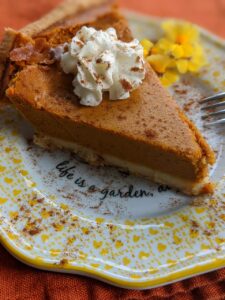
My least favorite Thanksgiving food is—wow! I really hate to admit it, but it’s pumpkin pie. Especially store-bought pumpkin pie. I’ve just never been a fan of pumpkin anything.
I had to keep it a secret for a long time because my mother and both grandmothers were so proud of their pumpkin creations . . . and I didn’t want to hurt their feelings. So I would take some and make sure no one was watching when—well, you get it.
How about you?
Is there a Thanksgiving food you’ve always hated? And maybe had to hide it like I did? It’s okay, go ahead and spill those hated beans. You’re safe in these halls.
Today’s True Crime occurred on the early morning of Thanksgiving 2013 when a clumsy character attempted to rob a Miami Gardens, Florida gas station.
According to reports by odee.com, CBSNews.com, and NBCMiami.com, security video shows Johnny Anton Love, then 22, entering the store armed with a 9 mm Glock. He jumps over the counter and demands money from the clerk. In the process, he drops his hat and stumbles back and forth to find it. Next he fumbles with a plastic bag, trying to open it to carry the cash.
Then he puts his gun down while he takes his time choosing candy and gum from sales displays.
The clerk remains calm, suggesting he take some beer also. While Love meanders to a cooler in the back of the store, the clerk sounds the alarm.
Love loads up the plastic bag with beer. When he exits the store, the bag busts like an overstuffed turkey. Bottles roll around the parking lot. Love is apparently preoccupied with trying to stuff his gun back in his pants and corral the escaping beer, and doesn’t notice the police officer who responded to the alarm.
He is taken into custody without incident.
The merchandise and $722 cash were recovered and Love spent Thanksgiving in jail held without bond.
Overstuffing aturkey can mean a mess to clean up and increased risk of salmonella.
Overstuffing a plastic bag can mean arrest and jail.
~~~
True Crime Thursday always falls on Thanksgiving, reminding me how thankful Io am to be part of The Kill Zone family and for the many writing friends I’ve met through TKZ.
Wishing you all a day of gratitude, good food, and good memories with loved ones.
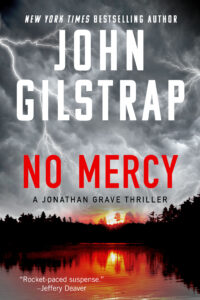
When Zero Sum, #16 in my Jonathan Grave thriller series hit the stands in 2024 as a “premium mass market paperback,” the paper copy retailed for $9.99 and the Kindle version cost $7.99. Fifteen books and as many years earlier, the standard mass market version of No Mercy, the first book in the series, retailed for $6.99, and for two weeks, the Kindle price was $0.00 before it skyrocketed to $2.99 after the promotional period expired*.
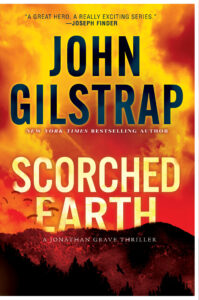
This coming February, when Scorched Earth, #17 in the series is revealed to the world, it will be in a trade paper format. If you’re not familiar with the jargon, trade paperbacks have the dimensions and font size of a hardcover, but with soft covers. Paper copies will retail for $18.95 and the Kindle version will cost $9.99.
For what it’s worth, I had nothing to do with this decision, and the decision itself isn’t about greed–at least not directly. Without wallowing too deeply in the weeds, the demand for mass market paperbacks has been dwindling for years, kept alive mainly by the reprints of last year’s bestsellers by big name authors. Those were the books you’d see in grocery stores and pharmacies and airports, but the real driver for the mass market were big box stores like Walmart and Costco, both of which announced that they would no longer be stocking their shelves with mass market paperbacks, with certain exceptions, including category romances.
This change concerns me. First of all, it’s change and I hate fixing things that don’t feel broken. I’ve always lived by the mantra, “Never try to make a happy baby happier.”
Trade paper has always been the format for literary fiction. At least that was the case in the United States. Thrillers were hardcover and mass market reprints. We are all creatures of habit. Will readers who generally trend toward hardcovers be more drawn to my books because they’re larger yet still softcover? Will mass market paperback readers who’ve reserved a specific spot in their briefcases for a small book be pissed off that they now have to carry something larger?
And there’s the price. Over the years, I’ve been blessed to be able to build a devoted fan base that’s willing to spend mass market prices for my stories. Will they stay with me as the price for the handheld book doubles? I guess I’ll find out. I worry less about my eBook fans because the price increase is less drastic, but it’s still change.
Now for the exciting part . . .
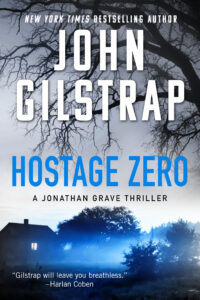
The format change has provided an excuse to re-release all of my Grave series in trade paper format. No Mercy and Hostage Zero will hit the stands at the same time as Scorched Earth. While all the concerns remain, it’ll be nice to see out-of-print titles returning to the shelves.
Good news for autograph collectors. If there’s one complaint I’ve heard more than any other over the years about the mass market format is that bibliophiles who collect autographs don’t like the way small paperbacks look on their shelves. I understand that, actually. And as the man signing the autograph, I confess that I will be happy to have a larger signing area on the page.
This brings us to the importance of pre-orders. I’m not a “please buy my book” kind of guy. I figure that if you have to beg, something’s wrong. In fact, I don’t even bring books with me to sell when I teach workshops. First and foremost, I’m not set up to be a retailer and have no desire to manage another layer of taxation. But also, I figure if I do my job right, people will be inspired to buy my books from a bookstore, or to borrow them from a library.
That said, if you’re inclined to buy my books when they come out, given the expanse of this change in the way of doing business, it would be extremely helpful for you to pre-order the book through your retail outlet of choice. Whether you prefer a physical book or an eBook, preorders send a message to the publisher and the marketplace in general.
So, what say you, TKZ family? How price sensitive do you think readers are? Are you going to miss pocket-size books?
=
*I’m proud to note that No Mercy shot to the #1 free book on Amazon, “selling” over 60,000 copies during that time. When the price returned to $2.99 the book remained the #1 overall Kindle bestseller for the next week. That was a promotional gambit that worked better than I’ve ever witnessed.
All I can do is read a book to stay awake. And it rips my life away, but it’s a great escape. — Blind Melon, No Rain.
By PJ Parrish
There’s a drought here in Tallahassee. My lawn is yellow. My herb garden is shriveled. The fire ants mounds are two feet high. Inside my house, the lights in my bathroom suddenly died. I can’t get the microwave to stop blinking ERROR. And my laptop mouse is acting like hamster on meth.
And my brain has stopped working. I can’t get my new short story moving again. And I couldn’t think of anything interesting to write about here today either. My husband sidled in and I whined, “I’ve got nothing to write about.”
“Well, write about that,” he said.
So here we are. I don’t believe in writer’s block. I believe in the demon laziness. But after I read Kay’s post here from last Monday on gratitude, I knew I had to stop carping and do something. So I went for a walk. Walking is my mental Senakot. When I got home, I was able to at least face my short story again. Which led me to re-realize — you forget the really simple stuff at times — that I had to go back before I could go forward. So I opened up the file and look a cold hard look at what I had written.
Which brings me back to today’s post. I know we’ve covered this a lot, but I’d like to offer up, yet again, some good ways to get yourself out of a slump:
Take a hike. Get outside and get moving. Even if it’s just 30 minutes. Which is how long it took me to go to ABC Liquor yesterday and get some Hendrick’s Floradora gin.
Write something else. I don’t have any other WIPs right now. But I have you guys. And just the process of writing this blog got my wheels unstuck from the mud. If you have other projects — a story, an free-lance article, a journal entry — switch over for a while. Fingers moving on a keyboard is a good warm-up.
Read something. For inspiration, I chose one of my favorite books, Joyce Carol Oates’ Because it Is Bitter, And Because It Is My Heart. Check out this opening paragraph:
Little Red Garlick, sixteen years old, skull smashed soft as a rotted pumpkin and body dumped into the Cassadaga River, must not have sunk as he’d been intended to sink, or floated as far. As the morning mist begins to lift from the river a solitary fisherman sights him, or the body he has become, trapped and bobbing frantically in the pilings about thirty feet offshore. It’s the buglelike cries of gulls that alert the fishman — gulls with wide gunmetal-gray wings, dazzling snowy heads and tail feathers, dangling pink legs like something incompletely hatched. The kind you think might be a beautiful bird until you get up close.
Watch Something. I get juiced by watching great movies because I learn from screenplays, specifically about how dialogue illuminates character. One of my favorites is Fargo because Marge Gunderson is such a pip. One favorite line:
Say, Lou, didya hear the one about the guy who couldn’t afford personalized plates, so he went and changed his name to J3L2404?
Take a step back. It’s vital to keep your shark-novel moving forward, lest it die. But it doesn’t hurt, when you’re stuck, to go back and re-read and maybe even re-write a little. When I faced my short story again, I realized I had veered off into a bad description ditch. I cut about 250 really lovely words. (There’s a reason they call it a short story) Pruning is vital for gardens and fiction. If you’re surrounded by briar, you can’t see the path.
Come up with an idea then do the opposite. Few of us are brilliantly original on first attempts. To get moving, we resort to stock characters, lazy description, confusing action and the obvious. If your setting is Paris, don’t authomatically plunk the hero down in the Louvre; set your scene in La Goute d’Or, the muslim enclave. Don’t make your sidekick a wizened old cop with a whiskey bottle in his desk; make her the brave tomboy George at Nancy Drew’s side. If you need a plot twist, don’t settle for smelly red herrings or cheap ticks. Oh my god, nobody shot J.R. It was all a dream! What, you mean Bruce Willis is really dead but only the kid can see him?
Phone a friend. I am lucky in that I can call my co-author sister Kelly and together we can always find a solution. Maybe your friend is a critique group pal, someone with a cold eye who wants you to suceed. If you don’t have anyone, make someone up. Picture in your head a discerning reader; would that person let you get away with cardboard characters or a cliched plot? Talk to yourself. Out loud. It’s a conversation with someone who understands you.
And finally…
Keep your butt in the chair. I am really bad at this. I will abandon my post at the first muted trumpet call of the mundane. Laundry needs folding! Dog smells, must bathe! Lights have died in the bathroom so gotta go to get a new dimmer switch! No…stay put. If you shoulder-push on that rock long enough, it will eventually start moving downhill.
Remember, no one ever finished their book while roaming the lighting aisle at Home Depot.
I am closing on my new home today. Yay! After which, I need to finish packing before the movers arrive. So, please excuse my reposting of an article I wrote in 2021 that still holds true today.
To master the art of writing we need to read. Whenever the words won’t flow, I grab my Kindle. Reading someone else’s story kickstarts my creativity, and like magic, I know exactly what I need to do in my WIP.
“Read” is the easiest writing tip, yet one of the most powerful. And here’s why.
READING BENEFITS OUR WRITING
Reading strengthens our skills and storytelling abilities.
Reading helps us become more persuasive, which is an essential skill when pitching a book to an agent, editor, producer, etc.
Fiction reading helps us hone the skills to draw the reader into the story and engage the reader.
Nonfiction reading helps us learn how to condense research into an authoritative proposal. And ultimately, into a storyline.
Reading expands our vocabulary, improves grammar, and shows how to use words in context.
Reading helps us find the right word!
READING IMPROVES BRAIN HEALTH
Narratives activate many parts of our brains. In a 2006 study published in the journal NeuroImage, researchers in Spain asked participants to read words with strong odor associations, along with neutral words, while their brains were being scanned by a functional magnetic resonance imaging (fMRI) machine.
Brain scans are revealing what happens in our heads when we read a detailed description, an evocative metaphor or an emotional exchange between characters. Stories, this research is showing, stimulate the brain and even change how we act in life. —New York Times
Whenever participants read words like “perfume” and “coffee,” their primary olfactory cortex (the part of the brain that processes smell) lit up the fMRI machine. Words like “velvet” activated the sensory cortex, the emotional center of the brain. Researchers concluded that in certain cases, the brain can make no distinction between reading about an experience and encountering it in real life. Pretty cool, right?
4 TIPS TO READ WITH A WRITER’S EYE
1. Look for the author’s persuasion tactics.
How does s/he draw you in?
How does s/he keep you focused and flipping pages?
What’s the author’s style, fast-pace or slow but intriguing?
Does the author have beautiful imagery or sparse, powerful description that rockets an image into your mind?
2. Take note of metaphors and analogies.
How did the metaphor enhance the image in your mind?
How often did the author use an analogy?
Where in the scene did the author use a metaphor/analogy?
Why did the author use a metaphor/analogy? Reread the scene without it. Did it strengthen or weaken the scene?
In a 2012 study, researchers from Emory University discovered how metaphors can access different regions of the brain.
New brain imaging research reveals that a region of the brain important for sensing texture through touch, the parietal operculum, is also activated when someone listens to a sentence with a textural metaphor. The same region is not activated when a similar sentence expressing the meaning of the metaphor is heard.
A metaphor like “he had leathery hands” activated the participants’ sensory cortex, while “he had strong hands” did nothing at all.
“We see that metaphors are engaging the areas of the cerebral cortex involved in sensory responses even though the metaphors are quite familiar,” says senior author Krish Sathian, MD, PhD, professor of neurology, rehabilitation medicine, and psychology at Emory University. “This result illustrates how we draw upon sensory experiences to achieve understanding of metaphorical language.”
3. Read with purpose.
As you read, study the different ways some writers tackle subjects, how they craft their sentences and employ story structure, and how they handle dialogue.
4. Recognize the author’s strengths (and weaknesses, but focus on strengths).
Other writers are unintentional mentors. When we read their work, they’re showing us a different way to tell a story—their way.
Ask, why am I drawn to this author? What’s the magic sauce that compels me to buy everything they write?
Is it how they string sentences together?
Story rhythm?
Snappy dialogue?
How they world-build?
Or all of the above?
I don’t know about you but I’m dying to jump back into the book I’m devouring. What’s your favorite tip?
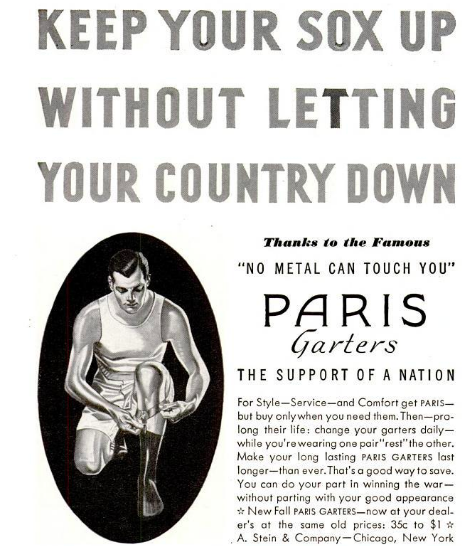
At the turn of the last century, the Second Industrial Revolution was well underway (dating roughly from the mid-19th to the mid-20th). Demographics moved from rural to urban. Cities swelled. And men faced a real problem—sagging socks.
Oh, it was fine back on the farm, when only Bessie the cow and a few scattered chickens were witnesses to sartorial sag. But for the city-dwelling male—businessmen, newspaper reporters, plainclothes cops, or any man going to a public space like a ballgame, church, or saloon—slumping hose was a real challenge. Thus arose the men’s garter business. (It would not be until the late 1930s that synthetic fiber was patented by DuPont and made possible elastic socks.)
Novels can sag, too, in five key areas. Let’s see if we can’t make them tighter and firmer, and eliminate the need for garters.
The Opening
We talk a lot about opening pages here, for obvious reasons. They can make or break a potential sale. (Search our archives for First Page Critiques.) I’ve written about beginning with a disturbance. This is an automatic hook. The enemy is too much backstory and exposition.
Sag Fix: Act first, explain later. Cut out all explanatory material on the first few pages. But I need the readers to know the circumstances and set up, don’t I? No! “Exposition delayed is not exposition denied.” Readers will wait a long time for exposition if they’re caught up in a disturbance.
The Delayed Doorway
The Doorway of No Return is when the Lead is forced into the “death stakes” of the novel. It’s the turning point into Act 2 and the main plot. In classic movie structure, this happens at the 1/4 mark. In a novel, I’ve found that it’s best at the 1/5 mark. But that’s too much to think about! I just want to write my story! I hate outlines!
I hear you, pantser. Keep your pants on. Write the way that makes you happy. But if you don’t know structure, all that happy creativity may be for naught. If a reader is going along and starts feeling This story is dragging, they may not stick around.
Sag Fix: Know how and where to cut or move scenes, so that the battle is joined around the 20% mark. You can look at the total word count of your first draft to figure it out. I use Scrivener with four folders: Act 1, Act 2a, Act 2b, and Act 3. Scrivener shows me the total word count in each folder.
Friend Scenes
There are times when you slow the action a bit to have the Lead confer with a friend or confidante or potential ally. Often these are “eating scenes,” which has its own fixes (see How to Write an Eating Scene).
Sag Fix: You can always find a way to insert tension into a friend scene. Something inside a character is making conversation difficult. For example, your Lead doesn’t want to fully open up about something, and the friend starts to probe. Brainstorm possibilities.
The Middle
Oh boy, that sagging middle! It’s a three-bear problem: Is it too cold? Too hot? Just right? Is it too short? Too long? Too boring?
It’s funny (or nerve-wracking) how so many writers report the same problem around the 20k or 30k mark. “Holy Moly! Here I am and I’ve got 60k or more words to go! Yikes! Do I have enough going on? Too much? Is it getting out of hand? Or is this thing I’m writing just a novella? Should I make this a “trunk” novel and put it away for another time? Or should I just junk it? Is this wasted effort? Where did I put the bourbon?”
There are too many ways writers get lost in the Act 2 weeds that it is beyond one section of a blog post to deal with. (Let me modestly mention that I cover the whole subject in my book Plotman to the Rescue.)
Avoid the temptation to add “padding.” By that I mean scenes you conceive just to increase word count, as opposed to scenes that are organically related to the plot.
Sag Fixes:
Add a true subplot. This comes in the form of an additional character who complicates the main plot for the Lead. In a thriller, it’s often a romantic or family subplot.
Bring in a guy with a gun. This oft-quoted piece of advice is attributed to Raymond Chandler. It of course does not mean a guy with an actual gun (unless that fits your thriller or mystery mode). It can be a character with a bombshell secret, or a link to past trauma, or a connection to the “shadow story.”
A corollary to Chandler’s tip is: Kill somebody. Pick a character in your draft and send the poor thing to their maker.
Add a societal complication. In my Mike Romeo thrillers I usually have some issue of collective madness swirling around, muddying up the plot.
Anti-Climax
When the final battle has been won (or in some cases, lost), and the loose ends all accounted for, wrap it up! Don’t give us pages and pages of after-plot.
Sag Fix: Add a scene that adds resonance to the ending. This is a scene that resolves a character issue for the Lead. It should be short and sweet, as it is in my favorite Bosch, Lost Light.
She lets go of her mother’s hand and extended hers to me. I took it and she wrapped her tiny fingers around my index finger. I shifted forward until my knees were on the floor and I was sitting back on my heels. She peeked her eyes out at me. She didn’t seem scared. Just cautious. I raised my other hand and she gave me her other hand, the fingers wrapping the same way around my one.
I leaned forward and raised her tiny fists and held them against my closed eyes. In that moment I knew all the mysteries were solved. That I was home. That I was saved.
This fulfills Spillane’s axiom that “the last chapter sells your next book.” Connelly has sold quite a few. Go thou and do likewise.
What plot sags have you encountered? What do you do about them?






 This coming February, when
  The format change has provided an excuse to re-release all of my Grave series in trade paper format. No Mercy and Hostage Zero will hit the stands at the same time as Scorched Earth. While all the concerns remain, it’ll be nice to see out-of-print titles returning to the shelves.
 This brings us to the importance of pre-orders. I’m not a “please buy my book” kind of guy. I figure that if you have to beg, something’s wrong. In fact, I don’t even bring books with me to sell when I teach workshops. First and foremost, I’m not set up to be a retailer and have no desire to manage another layer of taxation. But also, I figure if I do my job right, people will be inspired to buy my books from a bookstore, or to borrow them from a library.

 What’s your favorite tip?