Weird Words

Merriam-Webster 1847-1947 dictionary now on my iPad | Flickr

Photo credit: https://www.flickr.com/photos/spelio/8246404410, CC BY-NC-SA 2.0


by Debbie Burke

Writers love words, the weirder the better. Here’s a selection of unusual words and phrases that were unfamiliar to me until recently.

JUST DESERTS – This isn’t a new phrase but for many years, I spelled it wrong. I always assumed it was “desserts” (like cake and ice cream) because that’s how it’s pronounced. Turns out the correct spelling is “deserts.” A savvy TKZ follower (sorry, I can’t remember who) provided the correction. Thanks!

The original phrase came from 16th century Latin. Just deserte meant “what is deserved.” Back then, it could refer to either reward or punishment. Over time, it took on a negative connotation. When someone did something bad, they had a comeuppance and got what they deserved. In crime fiction, when a villain is caught, they get their just deserts.

Why doesn’t someone start a business that’s a combination mystery bookstore and bakery? Call it “Just Desserts.”
A big thank you to a knowledgeable reader of British military history who introduced me to the following three examples:

INFRA DIG – This is a British slang term meaning “beneath one’s dignity” or “lower than one’s status.” The Oxford English Dictionary defines it as an adjective. Borrowed from the Latin phrase infra dignitatem, its earliest known use was traced to Sir Walter Scott in 1824.

Example: A snobbish author may feel it’s infra dig to have to do their own marketing. They’re in for a comeuppance.

OLQ – More British slang that’s an acronym for “officer-like qualities.” It’s used to describe enlisted personnel who have the potential to be promoted to officer ranks. Traditionally, social class was important in English military hierarchy. Due to family status, someone could automatically become an officer, whereas a person without social standing had to work extremely hard to be promoted.

COR BLIMEY or GOR BLIMEY – A British exclamation of surprise, shock, or anger. Cor or Gor are substitutions for the word “God” and are used to avoid the blasphemy of taking the Lord’s name in vain. Blimey is an abbreviated Cockney pronunciation for “blind me.” Therefore, cor blimey means “God blind me.” The term is firmly established in British slang and is the title of a 2000 TV movie.


SYNECDOCHE and METONYMY – These are literary terms that refer to using part of a phrase as an abbreviated substitute for the entire phrase. Oregon State University offers a helpful video to explain these related but slightly different definitions.

 

Dr. Virginia Apgar examines a newborn. Photo credit: Wikimedia

APGAR test or score – This is a quick assessment of a newborn’s condition administered by medical providers at timed intervals, the first within one minute following birth, then followed at five minutes following birth. It’s the acronym of:

A – appearance

P – pulse rate

G – grimace (indicates responsiveness)

A – activity

R – respiration

Little-known fact: the APGAR test or score is named for Dr. Virginia Apgar, an obstetric anesthesiologist and university professor who devised the test in 1952. Her mission was to reduce infant mortality by quickly recognizing problematic symptoms so they could be treated promptly.


This last phrase is from a crusty, cranky guy who’s done contracting work at my house. Mark  brags he’s never read a book in his life, but he comes up with colorful expressions like this one:

“The sun sometimes hits a dog’s ass.”

~~~

TKZers: Do you recognize any of these examples? Do you have your own favorite weird word or phrase to share?

~~~


Is your writing group looking for a speaker? I’m scheduling zoom classes based on The Villain’s Journey-How to Create Villains Readers Love to Hate and would love to talk with your group. Please check out the book and email me at debbie@debbieburkewriter.com


Slang Fun Facts

by Debbie Burke

@burke_writer

The saying “two countries divided by a common language” certainly applies to slang.

American and British slang are confusing enough. Throw in Australian slang and one needs a translator with a doctorate in linguistics to interpret.

Here’s an example I recently ran across in an Aussie news story: Dob in a hoon.

Translation: to report a driver who’s reckless and dangerous.

The story reported that the Greater Shepperton City Council and police have a “Dob in a Hoon” tip line where citizens can call in tips about dangerous drivers.

Being a writer fascinated by word origins, I headed down the rabbit hole to learn about this unusual phrase.

Hoon driving means driving recklessly, quickly, and irresponsibly. It includes street racing, fishtailing, burnouts, excessive noise to draw attention of bystanders.

Digging a little deeper into origins, I discovered the word hoon was coined by Aussie author Xavier Herbert in the 1930s and means a “hooligan” or “lout.”

What about the rest of the phrase dob in?

According to the Cambridge Dictionary, dob in means to “secretly tell someone in authority that someone else has done something wrong.”

Quick grammar review from Grammarly:

transitive verb needs to transfer its action to something or someone—an object. In essence, transitive means “affecting something else.”

transitive verb is one that makes sense only if it exerts its action on an object.

An intransitive verb will make sense without an object.

That makes dob in a transitive verb, where the verb action of dob in passes to the object noun hoon.

In Australian slang, dob in is comparable to the American slang terms rat out or squeal on.

The person who dobs in someone is often called a stool pigeon, canary, cheese eater, rat, informant, squealer, fink, narc.

While rooting around in the research rabbit hole, more Aussie slang sidetracked me. Here are a few examples:

If someone imbibes too much from the Bottle-O (liquor store) then gets behind the wheel, they could wind up riding in the Booze Bus (police vehicle that chases drunk drivers).

If you visit Australia, beware of the dreaded Drop Bear. This mythical beast is a carnivorous Koala-type bear that drops from trees to prey on creatures walking below.

Drop Bear attack
Photo credit: wikipedia

Aussies enjoy warning unsuspecting tourists about the Drop Bear, along with other fun Furphies (plural).

A Furphy (singular) is defined by Dictionary.com as “a false report or improbable story; rumor.”


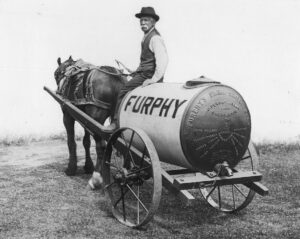
Furphy water cart, ca 1905

Furphy is an actual brand name for traveling water tanks and sanitary disposal carts manufactured by the Furphy family of Victoria. During World War I, soldiers gathered around Furphies to gossip and spin yarns. That led to widespread slang usage of telling a furphy.

Do you think “sanitary disposal” could have inspired the term? 


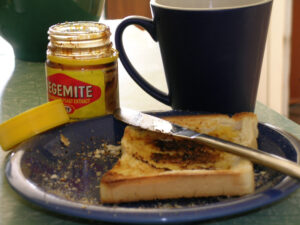
Those friendly, helpful Aussies also suggest repellants that supposedly protect from Drop Bear attacks. One method is to spread Vegemite behind the ears.

Vegemite isn’t slang but is an actual food product created and produced in Australia. It is made from leftover byproducts from brewing beer.

Here is a description of Vegemite from thetraveltart.com: “It looks like tar, has the consistency of thick paste, and has a salty/malty/yeasty taste to it that sounds just a bit weird but actually works – if you don’t plaster it too much!”

Applied behind the ears, Vegemite not only protects from Drop Bears, it makes a memorable cologne that’s also edible.

Those Aussies have a wicked sense of humor.

Photo credit: Sultan 11 cc-by-sa-4.0

The Drop Bear is similar to the North American “Jackalope”, another mythical creature with origins in folklore. Imagine a cross between an antelope and a jackrabbit.

Which brings me back to rabbits and falling down the rabbit hole. 

Here’s an entertaining article by Elaine Zelby about the origins and usage of that particular slang.

TKZ emeritus Clare Langley-Hawthorne was raised in Australia. If Clare is online, maybe she’ll chime in with her favorite Aussie slang terms.


Pros of using slang in fiction:

  • Adds authenticity;
  • Adds regional color;
  • Gives deeper dimension to characters and makes them unique and memorable.

Cons: 

  • Slang changes with the times. Twentieth century meaning may be totally different in the 21st century;
  • The same slang can have different meanings in different cultures, causing reader confusion;
  • May require explanation to the reader. Anything that takes them out of the story can be a problem;
  • Overuse of slang is distracting and annoying.

A taste of slang in fiction goes a long way. Like Vegemite, don’t spread it too thickly.

~~~

This is my last post for 2023 before TKZ’s annual break. I’m honored to be part of this vibrant writing/reading community.

Warm wishes for a joyous holiday season with family and friends!

~~~

TKZers: How much slang do you use in your stories?

What is the most unusual slang term you’ve run across?

Do you research the origins of slang words?  

Please share a few of your favorites.

~~~


Deep fakes lead to deep trouble in Debbie Burke’s thriller, Deep Fake Double Down, BookLIfe Prize FinalistClick on the cover for the sales link.