Building a Mystery

For years, my library colleagues would ask when I was going to write that library mystery. Afterall, I read mysteries, was a writer, and worked at library, so it seemed like a natural fit to them. While I thought about it I continued writing fantasy and science fiction.

Finally, in 2020, after I’d retired from the library, the desire to write a cozy library mystery novel grabbed me. As I finished the final novel in my Empowered series, I read a bunch more mysteries of all sorts, from Matthew Scudder to more Agatha Christie to Sara Rosett’s Murder on Location cozy series.

I also read books on writing mysteries: Mystery Writers of America’s How to Write a Mystery, How to Write Killer Fiction by Carolyn Wheat, our own KZB alum Nancy Cohen’s Writing the Cozy Mystery, Sara Rosett’s How to Outline a Cozy Mystery Workbook, as well as her Teachable course on writing cozies. Sara’s course also included interviews with cozy mystery authors like Lynn Cahoon and Anna Castle. I discovered very useful handouts at Castle’s website from a workshop she gave on mystery writing.

I read more mysteries, and watched mystery TV series like Midsomer Murders, Elementary, Monk, the new Father Brown series, Perry Mason, and Columbo.

My published fantasy novels had crime and mystery elements, so writing an actual murder mystery should be a snap, right?

I wasn’t surprised it wasn’t that easy. I consider actual mystery novels to be one of the hardest types of fiction to write, and took the challenge seriously, which was a good thing. From the time I began outlining my first library cozy mystery, then called Death Due, until I published the final version, A Shush Before Dying, over two years had passed. I wrote three different versions, with numerous outlines. I did a deep dive into upping my revision game after finishing the first draft.

The second book in the series, Book Drop Dead came faster, being completed in year.

I’m an outliner, who, once upon a time, discovery wrote (AKA “pantsed”) his novels. For me, figuring out story structure was the secret that unlocked being able to create a story that worked. Mysteries were no different.

Cozy mysteries, like other mysteries, usually center around a murder. For me, that meant learning who the murderer was, and why they committed the crime, before outlining the book. I began each book by creating an electronic document file which became a novel journal where I could brainstorm about the mystery, the killer’s shadow story (something I learned from our own James Scott Bell), spin out the web of suspects, background notes, and simple outlines I could flesh out later.

***

Mystery foundation

These make up the foundation of the mystery I’m building, and key to my process is asking myself questions about each.

Killer: Who and why? What lead them to kill, and why did they murder the victim? How do they react when they learn they are being investigated by our sleuth-hero?

The Victim: Often someone who is despicable in at least some of the time, and often at the center of a conflict, but they can be something other than a jerk—quirky perhaps, misunderstood, or even a good person who ran afoul of a killer. What was their relationship with the killer?

The setting: the location and community where the murder takes place. For my own cozy mystery, the setting was easy: the public library. I wanted the era to be the 1980s, when I began my at-first accidental career. This was the library before the Internet, when the card catalog ruled and staff used “dumb” terminals to check out books, stamping the date dues on a label on a page at the front of the book.

The public library then and now is a community in its own right, as well as a meeting ground for other communities, which provide opportunities for all sorts of situations and characters. How does the setting shape the murder, and the investigation?

The sleuth-hero: What pushes them to investigate the murder instead of leaving it to the police? Amateur sleuths are often nosy, curious, driven to solve puzzles. This describes my librarian-sleuth Meg Booker. The hero may be motivated to solve the crime because of personal concern if a friend is the suspect or survival if they themselves fall under suspicion.

In other cases, it may be the sense that thing about the murder doesn’t fit the facts as the police see them. The hero must have a reason to investigate and discovering that reason is vital. In cozy mystery the reason is often personal. The sleuth may have a connection to the victim, or to the person the police believe is the killer, as is the case in my first Meg Booker mystery.

The Web of Suspects:  For me an ideal number of suspects is five to seven. The motivations can be similar, but it helps build the mystery if at least some have different motives for murder. For instance, two suspects might both be rivals with the murder victim for a job promotion, while three more have possible motives unrelated to the day job.

***

Plotting

The next thing I like to tackle is my story structure. I’m a fan of our own James Scott Bell’s signposts, such as the opening Disturbance, the Doorway to Act II, and especially the Mirror Moment. I brainstorm how the murder plays out, how the sleuth’s investigation begins and progresses, and what the killer does in response.

I’m an outliner, so I began putting the mystery into a beat outline, with sign posts marked and key scenes laid out. I’ll do additional brainstorming in a novel journal, a separate electronic document.

***

The Arc of Suspicion

I also work out what I call “the arc of suspicion,” which is the sleuth-hero and readers progression in who they suspect committed the crime. I posted about this here. I’m going to crib from that earlier post and share the beats of the suspicion arc. I don’t necessarily write all these out, but keep them in mind as the story progresses, brainstorming as needed:

  1. The arc begins with noticing something is off about someone’s behavior, or a set of circumstances.
  2. Doubt ensues.
  3. Then, discovering “evidence” which increases suspicion. This can be an overheard conversation, reading a note or email, seeing a meeting without hearing what is being said, looking at a pattern of behavior, perhaps behavior out of character for the suspect, etc.
  4. Discovering a lie, or a false alibi can heighten suspicion.
  5. There can be a deepening fixation on a suspect’s behavior, words, deeds, and trying to figure out what they were thinking, why they did what they did, etc.
  6. Acting on that suspicion to the point of taking risks and putting yourself in potential jeopardy. This often precedes the confrontation/reveal in the final act of a mystery.
  7. Given that mysteries usually have multiple suspects, there will be a point where the sleuth (and the reader) rule out a person because of evidence, alibi, or learning what the secret was that made a particular individual act suspicious to the main character.
  8. Of course, heroes and readers often suspect more than one character at the same time, so the arcs can overlap. Sometimes the behavior or evidence is one thing, which leads to doubt about a particular person. Doubt which might deepen to suspicion or might simmer in the background. Or, even forgotten for the moment, until the end, when new evidence makes the sleuth suddenly suspect that person with a cold-in-the-bones feeling.
  9. Finally, the sleuth’s suspicions lead to the actual killer and/or can lead the killer to them.

***

Drafting

As I write the first draft, I’ll come up with new ideas, clues etc., and, if they make the grade, will add them to my outline.

***

Revision and feedback

Revision is where I work to fix plot holes, add missing clues, clarify motives if needed, along with the usual revision tasks of improving scenes, pacing, characterization, setting details etc. I then send the revised novel to my beta readers, who give me invaluable feedback on whether the mystery worked for them, where they were surprised, if they guessed the identity of the murderer, etc. I then make any additional changes based their feedback.

***

The resources which helped me learn how to build a mystery

Nancy Cohen’s Writing the Cozy Mystery. Nancy’s book provides an instructive break down of the elements of a cozy mystery.

Sara Rosett’s How to Outline a Cozy Mystery. Rosett  gives the building blocks of a cozy mystery, as well as different outlining methods, tips on clues and red-herrings, conventions of cozies etc. While Rosett’s online course on writing a cozy mystery appears to be no longer available, the book still is.

Carolyn Wheat How to Write Killer Fiction. Wheat looks “the funhouse of mystery” as well as the “rollercoaster of thriller,” and reading the book gives a useful comparison between the two as well as the elements of each.

Hallie Ephron Writing and Selling Your Mystery Novel. Ephron’s book is a deep dive into the elements of mystery, looking at plotting, characters, mystery, sense of place, revision, as well as advice on publishing, both traditional and self-publishing.

Mystery Writers of America How to Write a Mystery. A collection of essays by mystery masters also covers the different aspects of mystery fiction.

***

So, this is how I build a mystery. If you write mysteries, what tips you do have?

A Retreat for Renewal

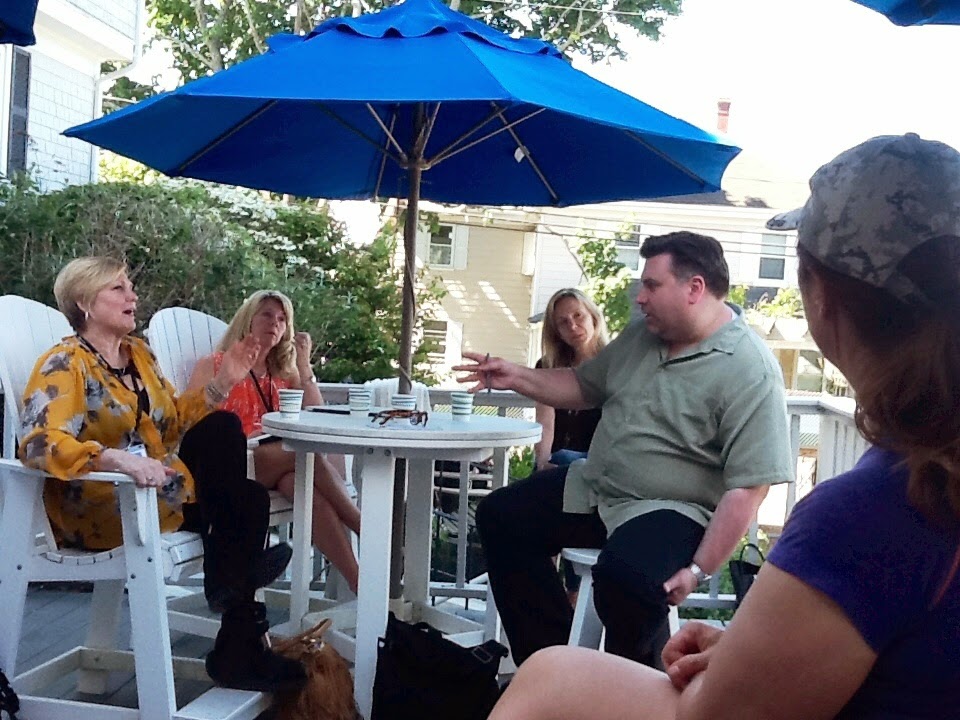
I’m on the road today, wending my way home from the Retreat by the Sea, a writer’s retreat organized by Writer’s Digest. It was a fabulous weekend. This particular retreat is special because you are given the opportunity to have your own work reviewed during intensive sessions that focus on preparing your manuscript for submission to industry professionals. Other sessions are jam-packed with information about craft and shaping a story.

Our instructors were the talented author and reviewer Hallie Ephron; Paula Munier, a Senior Literary Agent and Content Strategist at Talcott Notch Literary Services; and Phil Sexton, Publisher of Writer’s Digest.

Discussion with agent Paula Munier

I had always been curious about what a writer’s retreat would be like, and this experience exceeded my expectations. In addition to the workshops and learning sessions, there was a wonderful bonhomie as the attendees got to know each other. I came away from the retreat feeling refreshed, renewed, and optimistic about the future of publishing. If you ever have a chance to go to a retreat (expecially this one!), I highly recommend that you seize the opportunity.

Have you been to a writer’s retreat before? How was the experience for you?

A Retreat for Renewal

I’m on the road today, wending my way home from the Retreat by the Sea, a writer’s retreat organized by Writer’s Digest. It was a fabulous weekend. This particular retreat is special because you are given the opportunity to have your own work reviewed during intensive sessions that focus on preparing your manuscript for submission to industry professionals. Other sessions are jam-packed with information about craft and shaping a story.

Our instructors were the talented author and reviewer Hallie Ephron; Paula Munier, a Senior Literary Agent and Content Strategist at Talcott Notch Literary Services; and Phil Sexton, Publisher of Writer’s Digest.

Discussion with agent Paula Munier

I had always been curious about what a writer’s retreat would be like, and this experience exceeded my expectations. In addition to the workshops and learning sessions, there was a wonderful bonhomie as the attendees got to know each other. I came away from the retreat feeling refreshed, renewed, and optimistic about the future of publishing. If you ever have a chance to go to a retreat (expecially this one!), I highly recommend that you seize the opportunity.

Have you been to a writer’s retreat before? How was the experience for you?

Bacon-wrapped Innovation

by Michelle Gagnoncreme brulee guy

Bear with me, in this post there are going to be some metaphorical leaps and truly questionable analogies. I partly blame an excellent roundtable discussion by the JungleRed crew on “weeding someone else’s garden,” both literally and figuratively.

That post was on my mind when I went to my monthly book club meeting last night. Now, I love my book club for many reasons- it forces me out of my reading comfort zone (especially when it comes to non-fiction, which research aside I rarely read willingly), and also because I usually return home with some fascinating new bit of information. Last night was no exception.

One woman was complaining about a strange-let’s call it a compulsion- that her husband has developed. At 10:30 at night, he’ll suddenly get a message on his Blackberry and will run for the door, yelling, “I’ve got to go. He’s on 24th and Mission.”

Sounds suspicious, right?

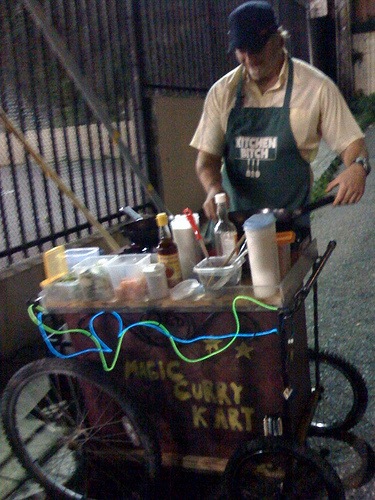
Well, it turns out that her husband is a religious follower of the bacon-wrapped hot dog guy. That’s right, there’s a guy in San Francisco who operates a guerilla (read: unlicensed) food cart, selling bacon wrapped hot dogs. He moves constantly, staying one step ahead of the authorities (hopefully)–and people find him thanks to frequent Twitter updates.

This story struck me on many levels. First, how on earth is it possible that I’ve lived in a city for over a decade and had no idea that we even had street food vendors, never mind ones who sold bacon wrapped hot dogs? After further investigation, I discovered that the bacon wrapped hot dog guy is not alone. There’s a muffin man, a creme brulee guy, and a “magic curry cart.” Even one of my favorite restaurants, Chez Spencer, has a cart. This is critical, potentially life changing information.

magic curry cart This discovery also marks the first time I fully understood the point of Twitter (please don’t jump all over me, tweeters- I just hadn’t grasped any practical applications until now). The vendors post where they’ll be appearing, and followers flock to that intersection for $1 chai and amuses bouches. Genius.

When interviewed, a few of the vendors explained that thanks to the recession they lost their high end restaurant jobs, or couldn’t get one in the first place. So, rather than give up on their passion, taking jobs in telemarketing or retail, they decided to branch out on their own. It’s a lot of work, the margins are slim, but they’ve each managed to build up a steady and devout following (my friend’s husband apparently has many cohorts who share his obsession for the food carts- a tweet goes out, and they all flock to the nearest one. It’s become an impromptu party for them).

I found their commitment and creativity inspirational.

Okay, brace yourselves for the leap.

I spoke with my agent yesterday. He returned from BEA somewhat disheartened- apparently all anyone was talking about was the downturn of the industry, the plummeting sales. And when sales are down, acquisitions are down, which creates a self-fulfilling death spiral. Editors are even more overburdened than usual; if they still have a job, chances are they’ve picked up numerous projects that were initially acquired by laid-off colleagues. There were fewer vendors at fewer booths, and as opposed to previous years the air was heavy with doom and gloom (although whether or not that is a deviation from the norm is largely a matter of opinion).

Which is exactly what the restaurant industry is experiencing. Fewer customers, smaller margins, a sharp downturn. Maybe the publishing industry should take a lesson from the street vendors- when times are tough, it’s time to innovate. Maybe that means authors take advantage of something like the new Scribd publishing program we’ve discussed in earlier posts. Maybe it means eliminating remaindering and starting with smaller print runs, or figuring out a way to build support for new authors by tapping into the popularity of more established ones. Heck, maybe we should start wrapping our books in bacon. Adapt or die, as they say. And while you’re doing it, you might as well eat well.

Now, if you’ll excuse me, I just got a tweet. The Korean Taco guy is a few blocks away, gotta run…

And special thanks to Cym Lowell for providing a link to this article on food cart vendors nationwide. I’m trying to convince my husband to visit DC so we can try the mango lassi popsicles.

What makes you stop reading?

by Clare Langley-Hawthorne
http://www.clarelangleyhawthorne.com/

Aloha from rainy Hawaii! Waiting for the sunshine and inspired by a panel I attended on the weekend at Left Coast Crime on ‘things that make me stop reading’, I thought I’d offer my top 5 reasons for putting a book down (or throwing it against a wall!) and find out from you what, as readers (and writers perhaps), you consider ‘deal breakers’ – when you just cannot continue with a book.

The panelists (Hallie Ephron, Mysti Berry, Kate Stine, and Sue Trowbridge) mentioned a number of things which caused them to put down a book and not read further. Here’s some of their (abbreviated) list:

  • Stereotypes
  • Lack of clarity – where the hell are we, when are we, who is talking etc…within the first few pages.
  • Gratuitous violence, sex or animal cruelty
  • Lack of character pull – the character fails to draw them in
  • Geographical inaccuracies (like someone flying all the way from San Jose to San Francisco!)
  • Prologue that seems gratuitous, manipulative or contrived

Reducing these issues to a list always seems to lessen the impact of the discussion but I agree with all that was said and with the panelists’ assertion they will forgive almost any of these if the writing is sufficiently compelling to keep them interested.
As for my top five list – well here goes:
  1. Characters that make me a yawn- if I’m not drawn in by them then I’m not going to keep plowing through the book.
  2. Set up requires more than just a suspension of disbelief but putting aside all reality.
  3. Clunky, awkward writing that requires way too much concentration – I want the story to flow, to draw me in – I don’t want to have to take out the paddles and brave the rapids to get there.
  4. A sense of manipulation or self-awareness – if I sense the author pulling the strings I’m taken out of the story (and I’m pissed off).
  5. Blatant inaccuracies that make me doubt the writer. I think when you start a book you place a great deal of trust in an author and if that trust is broken too quickly by inaccuracies or false steps it’s hard to regain it and keep reading
So what are the deal breakers for you – what makes you stop reading a book? What about in a series – when does an author ‘blow it’ and stop you from continuing? For me bringing back dead characters (Patricia Cornwall anyone) is a deal breaker – If I want that kind of plot twist I’ll tune in to General Hospital…What about you?

“I hate scrabble”: Q & A with Hallie Ephron

Hallie-Bricks-smaller Today The Kill Zone is delighted to welcome Hallie Ephron. NEVER TELL A LIE, her first solo thriller, has drawn wide acclaim. It received a PW starred review and was described by the San Francisco Chronicle as, “A book to be gobbled up whole, its pace never slackens.” A renowned writer, book reviewer, and writing teacher, Hallie was kind enough to share how she feels about reviews of her own books, and why she doesn’t play Scrabble.

Q: As a reviewer, how do you feel about reading reviews of your own work?

A: I hate it. Doesn’t everyone? Oh, the good ones are great, but every little jab and jibe goes right to the jugular.

Q: What influence do you feel reviews now have in an online world where everyone can blog/review a book?

A: I think the influence is still very significant. As I watch my Amazon numbers (a bad idea; don’t do it) I see a very significant bump when a good review comes out in the mainstream press. A nice blog review? Not so much.

Q: Along those lines, what’s happening to the book publishing industry, and where does book reviewing/reviewers fit into the picture? Can they help save it?

NeverTellALie_cover-smaller A: Like every other industry, the publishing business is shrinking. I think book reviewers have always, and I hope they will continue to guide readers to worthy books.

Q: NEVER TELL A LIE starts with a seemingly innocent yard sale. What’s the best yard sale purchase you’ve ever made? Ever had a bad experience? (hopefully not as bad as what happens in the book!)

A: BEST: A Stickley 2-door, glass-fronted oak bookcase with hammered copper pulls—the real deal—for $25!

WORST: Well, there was 1920’s bakelite “tombstone” radio I bought at a friend’s yard sale for $20. When I discovered it was worth over a thou, I returned it to her. Moral: Don’t shop at a friend’s yard sale.

Q: Do you believe that there is now gender equality in terms of the reviews and/or coverage mystery books get – particularly thrillers?

A: I’m not sure about equity, but I’d be surprised if differences are measurable. Publishers are very bottom-line oriented—they want to publicize what sells.

Q: Your previous novels were written with a writing partner, Donald Davidoff, under the pseudonym G.H. Ephron. How was it different for you to fly solo this time?

A: The writing was the same because I did the writing for the partnership. But plotting is a bear. Coming up with ideas, working my way out of plot-holes, coming up with credible surprises are so much easier when there’s someone else in the boat rowing. Brainstorming really requires at least two brains.

Q: What are your next plans? Another solo novel, one with your writing partner, or a non-fiction work?

A: I’m finishing “The Bibliophile’s Devotional” – a book for each of 365 days. And I’m in the middle of a solo novel.

Q: Do you think there is any self-published crime fiction out there worth reading?

A: Of course there is. But there’s too much crime fiction being well published by mainstream publishers for there to be time (for me) to look at self-published work.

Q: Why don’t more reviewers come to writers’ conferences or participate in panels?

A: One reason: it’s so darned expensive. And given that, a lot of them do, they just don’t advertise their presence. At the New England Crime Bake, we invite crime fiction book reviewers and ask them to speak or chair panels, and we try to comp their registration – as a result we’ve had quite a few come.

Q: What are the well-regarded review sources, and the ones to watch out for? (Not counting NYT, LAT, Boston Globe)

A: There are the trade publications like Publisher’s Weekly, Kirkus, and Library Journal that review in advance of publication. They can make a huge difference in terms of pre-orders from bookstores and library sales. Beyond that, there are just a few mainstream newspapers that regularly review crime fiction. You’ve mentioned some. The wonderful Oline Cogdill no longer works full time for the Sun Sentinel, but the silver lining is that her reviews now get picked up by papers nationwide. And then there are a gazillion self-anointed reviewers who write about books on the bookseller web sites, on blogs, on listservs, on FaceBook and other social networking web sites, and on it goes. So many! For an author that’s daunting and hard to know exactly how to crack.

Q: You come from a family of writers. I’m curious: do family Scrabble games get a little too intense?

A: I HATE Scrabble. I know that’s anathema. But I’m married to a lovely man who can beat me and everyone I know or am related to. I long ago gave up playing because, to put it bluntly, I hate to lose.

Q: And along those lines, Kathryn wanted to know: “Does Nora still hate her neck? I’ve been contemplating having a neck lift ever since reading her book.”

A: It’s not something I’ve asked her lately. She does have a movie coming out next summer. It’s based on Julie Powell’s wonderful book “Julie and Julia” – that delightful memoir about cooking all the recipes in Julia Childs’s cookbooks. Meryl Streep plays Julia (can’t wait to hear her do the voice) and Amy Adams plays Julie. Scuttlebutt on the movie: it’s going to be a blockbuster. Nice distraction from a saggy neck.