
A Lighthearted Look at Writing
Terry Odell

I’ve had editing on my mind lately. The process with my editor is I send her my “best I can make it” file, which she returns with her feedback. I make the adjustments as I see fit and send it back.
I’ve just returned my second round of edits, and I’ve also gone through the tedious process of letting my computer read the manuscript to me, which reveals things we’ve both missed. In this phase, it’s less about the story and more about accuracy. The eyes glaze over.
I stumbled across this piece buried in my hard drive. The closest I came to finding its origin was William Safire, Fumblerules: A Lighthearted Guide to Grammar and Good Usage , New York Times, November 4, 1979; later also published in book form. Most sources gave credit to “Anonymous.”
Although the piece is designed to be humorous, the points made are legitimate considerations to make while writing and editing.
How to write English
Remember to never split an infinitive. The passive voice should never be used. Do not put statements in the negative form. Don’t use contractions in formal writing, and don’t use no double negatives. It is incumbent on one to avoid archaisms. Proofread carefully to see if you words out or incorect speling. It has come to our considered attention that in a large majority of cases, far too many people use a great deal more words than is absolutely necessary when engaged in the practice of writing sentences. If you reread your work, you can find on rereading a great deal of redundant repetition can be removed and eliminated by rereading and editing.
A writer must not shift your point of view. If the writer is considerate of the reader, he won’t have a problem with ambiguous sentences. Don’t write a run-on sentence its hard to read you must punctuate it. If a dependent clause precedes an independent clause put a comma after the dependent clause. But avoid commas, that are not necessary, and don’t overuse exclamation marks!!! Use the semicolon properly, always use it where it is appropriate; and never where it isn’t. Reserve the apostrophe for it’s proper use and omit it when its not needed. In statements involving two word phrases, make an all out effort to use hyphens, but make sure you hyp- henate properly.
Take the bull by the hand and avoid mixing metaphors. Always pick on the correct idiom. Avoid colloquial stuff, and trendy locutions that sound flaky. Also, avoid all awkward or affected alliteration. Unqualified superlatives are the worst of all. Beware of and eschew pompous prolixity, and avoid the utilization of enlarged words when shortened ones will do. Avoidification of neologisms strengthenifies your prosification. Avoid using sesquipedalian words. It is not resultful to transform one part of speech into another by prefixing, suffixing, or other alterings. Perform a functional iterative analysis on your work to root out third generation transitional buzz words. Steer clear of incorrect forms of verbs that have snuck into the language. The de facto use of foreign phrases vis-a-vis plain English in your written tete-a-tetes makes the sentence harder to understand.
Everyone should be careful to use a singular pronoun with singular nouns in their writing. Place pronouns as close as possible, especially in long sentences, as of 10 or more words, to their antecedents. Writing carefully, dangling participles must be avoided. If any word is improper at the end of a sentence, a linking verb is. Write all adverbial forms correct. Verbs has to agree with their subjects, and the adverb always follows the verb. This sentence no verb. Which is not a complete sentence, but merely a subordinate clause. A preposition is something you should never end a sentence with. And don’t start a sentence with a conjunction.
Last but not least, avoid dyed-in-the-wool cliches like the plague; seek viable alternatives.
OK, TKZers. Sometimes it’s nice to take a break, right?
New! Find me at Substack with Writings and Wanderings
Deadly Ambitions
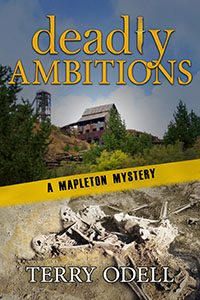 Peace in Mapleton doesn’t last. Police Chief Gordon Hepler is already juggling a bitter ex-mayoral candidate who refuses to accept election results and a new council member determined to cut police department’s funding.
Meanwhile, Angie’s long-delayed diner remodel uncovers an old journal, sparking her curiosity about the girl who wrote it. But as she digs for answers, is she uncovering more than she bargained for?
Now, Gordon must untangle political maneuvering, personal grudges, and hidden agendas before danger closes in on the people he loves most.
Deadly Ambitions delivers small-town intrigue, political tension, and page-turning suspense rooted in both history and today’s ambitions.
 Terry Odell is an award-winning author of Mystery and Romantic Suspense, although she prefers to think of them all as “Mysteries with Relationships.”
I have to applaud you, Terry, for being able to type this piece without corrections. It made my eyes and brain bleary. Thanks for sharing the fun.
I confess the red squiggly lines were a bit of an annoyance! Thanks for stopping by, Becky.
Loved this tongue-in-cheek look at grammar. So be sure to remind me not to forget to remember to write correctly.
Consider yourself reminded, Patricia.
Thanks for giving us something to smile about this morning, Terry. I thought of this one:
If you use a cliche like “died in the wool,” be sure to spell it correctly. 🙂
Unless the character is sheering sheep!
Thanks, Kay.
LOL, Terry! Thanks for a much needed laugh with today’s post, which is indeed also instructive. I never fear to boldly go where infinitives are split.
Glad to bring a moment of lightness. And thanks for your bravery.
Thanks for the laughs, Terry!
Only one thing, though. I had to look up the definition of a split infinitive–it’s been a long time since my English grammar days. And what did I find?
One of my fave TV shows of yesteryear uses one in its opening credits! Say it isn’t so…
“To boldly go where no one has gone before.”
And BTW, why did they always find aliens where no one had gone before? (Asking for a friend.)
Have a great day!
I recall a bit of a kerfluffle about the grammar in the ST opening. And before it was “no one” it was “no man” which DID get changed. Eventually.
Glad I could make you smile.
When an editor corrected one of Churchill’s speech drafts, she rewrote a sentence that ended with a preposition. Churchill changed it back, with a note, “This is the kind of pedantic nonsense up with which I will not put!”
Love that one, JSB. I’ve violated that ‘rule’ countless times.
That was fun, Terry. Remember the shock over the slogan, “Winston tastes good like a cigarette should”? The shock was because grammarians said it should be “as a cigarette should.”
Oh, yes I do remember. And I remember my English teacher using it as an example and a reminder for the correct grammar.
Fab! I remember writing a LETTER, yep, real letter to a friend, purposely using all the grammatic and punctuation errors that made both of us groan. It was a masterpiece. He sent back a letter with a fuming face. Result!
More recently, I came across an American on youtube or some-such who said ‘sneaked’ was wrong and it should be ‘snuck’.
Ah, but did you write the letter longhand? My cousin and I used to play “tricks” with writing letters. I wrote one with every other word on a second page and mailed them separately. She sent the first one back saying “Send the other page!” Which was already in the mail. But our grammar was fine.
As for snuck, you sent me hunting. This is what I found:
Sneaked is the original past tense form of sneak, but in the late 1800s, the alternative past tense form snuck began making its way into American English. It is now very common and is considered standard.