True Crime Thursday – Easter Bunny Didn’t Bring THESE Eggs

Photo credit: Pawel Czerwinski – Unsplash

By Debbie Burke

@burke_writer


On Palm Sunday 2020, residents of Flagler County in Florida found small plastic eggs in their mailboxes. Had the Easter Bunny arrived early?

Not exactly.

When recipients cracked open the eggs, they found each one contained a sheet of toilet paper, a goldfish cracker, fizzy drink powder, and…a crumpled page of pornography.

Even by 2020 weirdness standards, this incident rated high on the Bizarro-meter.

Sheriff Rick Staley asked the community to check their home surveillance cams and call leads into Crimestoppers to try to determine the identity of the perverse egg dispenser.

The following Thursday, based on a tip, deputies arrested Abril Cestoni, 42, a supermarket employee who reportedly had delivered about 400 plastic eggs to area mailboxes. She had created the pornographic pages using a computer program.

The reason is not exactly clear.

Here’s bodycam video from the arresting officer.

If there was an explanation in the footage, I missed it.

Ms. Cestoni was charged with multiple counts of distributing obscene materials, failure to appear on a traffic summons, and violating the governor’s stay-at-home order.

According to the Inmate Detail form, charges were later dismissed or she was sentenced to time served.

To the relief of Flagler County residents, on Easter Sunday, the legitimate Easter Bunny delivered regular Easter eggs.

~~~

TKZers: Have you run across any particularly bizarre and/or inexplicable crimes in the past year or so? Please share in the comments.

~~~


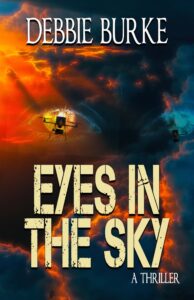
$.99 on sale from July 29 through August 1, 2021! Debbie Burke’s thriller Eyes in the Sky is available for Canadian friends on Kobo plus other online stores. 

Please check out the international links here and for Kindle. 

Writing Ritual and Routine

I always write to music, but a problem arose recently that made me question my writing ritual.
But I love writing with my headphones on, music blocking out the world around me. There’s no better way for me to strike the right mood in the WIP. I create a playlist for each book, with overlapping “series songs.” Songs I listen to only while writing books in that series. Since my series are vastly different so are the songs in each playlist.

As soon as I slide on the headphones, the music transports me back to my story world.

The problem I ran into recently was with writing true crime. I’d created a playlist for Pretty Evil New England. But for this new book I veered away from my usual writing routine and threw on Pandora.

Big mistake.

I struggled. The words wouldn’t come like they normally do. My mind felt cluttered and bogged down. Hence why I wrote my last post about multitasking and the brain. Frazzled, I panicked. Why I couldn’t reach “the zone” with my WIP? The beginning had been so easy, words flowing like Niagara, paragraphs in perfect harmony with one another. Had I finally lost my writing mojo?

The answer seemed clear. Only it wasn’t an answer I could accept. I emotionally degraded myself, exercised, read . . . I tried everything I could think of to breathe life into my muse, dying next to two unfinished WIPs. And yet, every time I slid on the headphones and clicked Pandora . . . total brain block.

After several grueling days (felt more like years), I stumbled across a blog post that advised writers never to listen to music unless it has no lyrics, background instrumental music. In other words, the total opposite of my music. But I’ve written all my books to music. What changed?

The metaphoric lightbulb blazed on.

By switching to Pandora, not knowing what song would play or when, my brain couldn’t interpret the music as white noise.
As soon as I went back to YouTube and clicked the playlist for Pretty Evil New England (since I’m writing true crime), my fingers could barely keep up with the flood of creativity.

I’m back!

Writers have writing rituals/routines for a reason. The ritual or routine encourages focus and has the ability to get us back on track if we drift off course. The familiarity snaps us out of the funk and reminds us that yes, we can finish the WIP, just as we’ve always done. It also allows the words to flow. Rituals help us find comfort and balance and sets the tone for a solid writing session. Routine is especially important. Employing a consistent writing routine can be the difference between hitting our word count or staring at a blinking cursor.

If your writing comes to a screeching halt for no apparent reason, a change within your writing ritual or routine may be to blame.

For me (obviously), it’s sliding on the headphones with a familiar playlist cranked. Emphasis on familiar. An argument could be made that I’m not really listening to music. Rather, the playlist morphs into white noise and acts as the gunshot to start the footrace. Although, strangely, I’ve tried the white noise app and it’s not nearly as effective (for me). All my research is done on my iMac, but I switch to my MacBook to write. This was a subconscious act. I wasn’t even aware of the ritual until I focused on changes within my writing routine.

For others, the writing ritual may include an environmental change, like shutting the door to the office or sitting outside in a special chair. Some writers trek to the local coffee shop or settle in at their designated desk in the university library. *waves to Garry*

Some of our most celebrated authors had/have consistent writing rituals and routines.

JAMES JOYCE

Joyce’s ritual included crayons, a white coat, and a comfy horizontal surface. For word flow, he would lay flat on his stomach in bed. Since he was severely myopic, crayons enabled Joyce to see his own handwriting more clearly, and the white coat served as a reflector of light.

MAYA ANGELOU 

In her own words:

I keep a hotel room in my hometown and pay for it by the month.

I go around 6:30 in the morning. I have a bedroom, with a bed, a table, and a bath. I have Roget’s Thesaurus, a dictionary, and the Bible. Usually a deck of cards and some crossword puzzles. Something to occupy my little mind.

I think my grandmother taught me that. She didn’t mean to, but she used to talk about her “little mind.”

So when I was young, from the time I was about 3 until 13, I decided that there was a Big Mind and a Little Mind. And the Big Mind would allow you to consider deep thoughts, but the Little Mind would occupy you, so you could not be distracted. It would work crossword puzzles or play Solitaire, while the Big Mind would delve deep into the subjects I wanted to write about.

I have all the paintings and any decoration taken out of the room. I ask the management and housekeeping not to enter the room, just in case I’ve thrown a piece of paper on the floor, I don’t want it discarded. About every two months I get a note slipped under the door: “Dear Ms. Angelou, please let us change the linen. We think it may be moldy!

But I’ve never slept there, I’m usually out of there by 2. And then I go home and I read what I’ve written that morning, and I try to edit then. Clean it up.

TRUMAN CAPOTE 

The creative genius behind In Cold Blood was a superstitious man. Capote’s writing ritual often involved avoiding things like hotel rooms with phone numbers that included the number 13, starting or ending a piece of work on a Friday, and tossing more than three cigarette butts in one ashtray.

I am a completely horizontal author. I can’t think unless I’m lying down, either in bed or stretched on a couch and with a cigarette and coffee handy. I’ve got to be puffing and sipping. As the afternoon wears on, I shift from coffee to mint tea to sherry to martinis.

No, I don’t use a typewriter. Not in the beginning. I write my first version in longhand (pencil). Then I do a complete revision, also in longhand. Essentially I think of myself as a stylist, and stylists can become notoriously obsessed with the placing of a comma, the weight of a semicolon. Obsessions of this sort, and the time I take over them, irritate me beyond endurance.

Even so, Capote stuck to his writing routine because it worked.

ERNEST HEMINGWAY 

In stark contrast to James Joyce, Hemingway was a firm believer in standing while writing. While working on The Old Man and The Sea, he followed a strict regimen.

“Done by noon, drunk by three.”

This entailed waking at dawn, writing furiously while standing, and eventually hiking to the local bar to get hammered.

JOAN DIDION 

Didion holds her books close to her heart—literally.  When she’s close to finishing a manuscript, she’ll sleep with her WIP.

“Somehow the book doesn’t leave you when you’re asleep right next to it.”

E.B. WHITE 

In his own words:

I’m able to work fairly well among ordinary distractions. My house has a living room that is at the core of everything that goes on: it is a passageway to the cellar, to the kitchen, to the closet where the phone lives. There’s a lot of traffic. But it’s a bright, cheerful room, and I often use it as a room to write in, despite the carnival that is going on all around me.

KURT VONNEGUT 

Check out Vonnegut’s writing routine:

I awake at 5:30, work until 8:00, eat breakfast at home, work until 10:00, walk a few blocks into town, do errands, go to the nearby municipal swimming pool, which I have all to myself, and swim for half an hour, return home at 11:45, read the mail, eat lunch at noon. In the afternoon I do schoolwork, either teach or prepare.

When I get home from school at about 5:30, I numb my twanging intellect with several belts of Scotch and water ($5.00/fifth at the State Liquor store, the only liquor store in town. There are loads of bars, though.), cook supper, read and listen to jazz (lots of good music on the radio here), slip off to sleep at ten. I do pushups and sit ups all the time, and feel as though I am getting lean and sinewy, but maybe not.

JODIE PICOULT 

Picoult doesn’t believe writer’s block exists:

Think about it — when you were blocked in college and had to write a paper, didn’t it always manage to fix itself the night before the paper was due? Writer’s block is having too much time on your hands. If you have a limited amount of time to write, you just sit down and do it. You might not write well every day, but you can always edit a bad page. You can’t edit a blank page.

Wise words. I agree. Nothing motivates quite like a looming deadline, self-imposed or contracted.

DAN BROWN 

Most writers would do anything and everything to get rid of writer’s block. According to The Da Vinci Code novelist, Dan Brown hangs upside down to cure writer’s block. Sounds crazy, doesn’t it? But we can’t argue with the results. If Brown didn’t hang like a bat, imagine all the amazing thrillers we would have lost?

Bats can’t launch into flight until they’re upside down. Why not Dan Brown? He says he’s more productive and creative afterward. He also does push-ups and stretches every hour. Not only has he found the cure for writer’s block, he’s in tip-top shape.

Writers are complicated beings. 😉

Do you have a writing ritual and/or routine? Tell us about it.

My publisher ran a sale for Pretty Evil New England last week. Not sure how long the sale will last, but for now the ebook is $1.99 on Amazon.

POP QUIZ ON ADJECTIVES

By Debbie Burke

@burke_writer

When we first learned to talk, most likely we never gave a second thought to the order of words. We just mimicked our parents until the sentences that came out of our mouths made sense and were understandable.

If a five-year-old said, I kicked over the fence the ball, most likely Mom, Dad, or a kindergarten teacher would tell the child it sounded better to say: I kicked the ball over the fence.

We instinctively knew how to place the words in the right order, even though we didn’t realize exactly what it was we knew or how we knew it. 

[Side note: English is a particularly difficult language for non-native speakers to learn because it’s full of inconsistencies and contradictory rules. If you didn’t learn English as a first language, please accept my condolences for the misery you’re going through.]
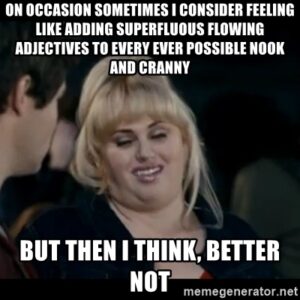
 

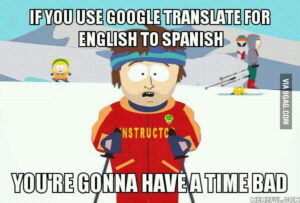
At some point in our language development, we learned that adjectives make sentences more descriptive. For those of us destined to become writers, adjectives became fun new toys.

Consider the three examples below:

The Jack Russell tan frisky terrier chased a mouse.

Hey, wait a sec. That sounds awkward. What’s wrong?

Instead, how about:

The frisky tan Jack Russell terrier chased a mouse.

Sounds natural.

A hot-air red massive balloon floated above farm land.

Awkward.

A massive red hot-air balloon floated above farm land.

Natural.

A new silver shiny Cadillac was parked in the murky dark shadows of the concrete parking high-rise garage.

Awkward.

A shiny new silver Cadillac was parked in the dark murky shadows of the high-rise concrete parking garage.

Natural.

In these examples, one flows easily off the tongue while, in the other, words come out in halts and jerks.

What is the difference?

The order of the adjectives.

Huh? Who even thinks about that?

Writers, that’s who.

Turns out there are actual rules about the correct order of adjectives.

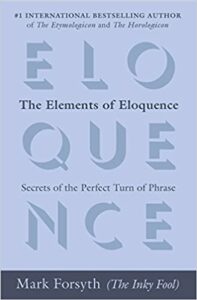
Recently I learned that new lesson when TKZ regular Chuck sent me an interesting article that quotes The Elements of Eloquence: Secrets of the Perfect Turn of Phrase by Mark Forsyth. In his book, Forsyth separates adjectives into eight different types of descriptors and their proper order:

  1. Opinion
  2. Size
  3. Age
  4. Shape
  5. Color
  6. Origin
  7. Material
  8. Purpose

There is even a handy little acronym to remind you of the correct order, using the first letter of each type: OSASCOMP.

Cambridge Dictionary doesn’t want the rules to be that simple so they offer an alternate option that divides adjectives into 10 classifications in slightly different order.

  1. Opinion
  2. Size
  3. Physical quality
  4. Shape
  5. Age
  6. Color
  7. Origin
  8. Material
  9. Type
  10. Purpose

Translated to an acronym: OSPSACOMTP.

Hmm, I think I’ll stick with Forsyth’s version.

In Elements of Eloquence, Forsyth illustrates the correct order with this complicated yet coherent phrase:

A lovely little old rectangular green French silver whittling knife.

Take a moment to experiment. Can you rearrange the adjectives in a different order that makes sense and sounds better?

Me neither.

Of course, no author would dare string that many adjectives together without a stern reprimand from the editor.

Photo credit: Isaak Alexandre Karslain, Unsplash

Let’s have some fun with a quiz. Read the following jumbled descriptions and put them in the correct order. Your choice of either Forsyth’s or Cambridge Dictionary’s rules.

  1. The wicked old shriveled witch cast a permanent vengeful curse on the young innocent maiden.
  2. The black-and-tan huge guard German Shepherd dog growled when the child grabbed her puppy.
  3. The parchment ancient yellowed fragile scroll crumbled when touched.
  4. Margie couldn’t resist buying the silk designer black sexy strapless dress.

Below are my answers. If you disagree, please share in the comment section.

  1. The wicked (opinion) shriveled (physical quality) old (age) witch cast a vengeful (opinion) permanent (type) curse on the innocent (opinion) young (age) maiden.
  2. The huge (size) black-and-tan (color) German Shepherd (origin) guard (purpose) dog growled when the child grabbed her puppy.
  3. The fragile (physical quality) ancient (age) yellowed (color) parchment (material) scroll crumbled when touched.
  4. Margie couldn’t resist buying the sexy (opinion) strapless (shape) black (color) designer (origin) silk (material) dress.

Here’s a shortcut for when you’re writing a sentence with several adjectives but can’t remember the rules:

Read the sentence out loud.

If it sounds awkward, rearrange the order of the adjectives until the sentence flows smoothly and naturally.

If you’re still not sure, read the sentence out loud to someone else. Ask how the adjective order sounds best to their ears.

If you can’t remember the rules or would rather ignore them, here’s the easiest option of all: don’t string more than two adjectives together.

Your editor will appreciate it and so will your readers.

~~~

TKZers: Did you know there were rules for the order of adjectives?

As a writer, do you love adjectives? Or would you rather discard them in the same wastebasket with adverbs?

~~~

Debbie Burke is an absentminded (opinion) aging (age) blond (color) Montana (origin) thriller (purpose) writer who never uses more than two adjectives in a row. You can verify that if you read Debbie’s six-book series at this link.

To Adverb or Not to Adverb?

I’m in the midst of revisions – which is why today’s blog post is rather short – and (as always) wrestling with some of the the writerly tics that seem to invade every new manuscript. Today I faced the perennially thorny issue of adverb use, particularly when it comes to dialogue tags. I have a wonderful writing group partner who is particularly good at pointing out sloppy adverb use, highlighting all the ‘quietly/desperately/softly/angrily’ kind of dialogue slips that I have a tendency to make. She’s also very good at pointing out all the times I ‘tell’ rather than ‘show’ so I’m definitely feeling rather humble at the moment:)

As with any revision process, I make a judgment call on whether to keep the dreaded adverbs and when to curtail the amount of ‘showing’ versus ‘telling’ (sometimes not using an adverb actually makes the prose sound more awkward). My writing partner uses (and highly recommends) a program called ProWriting Aid, which apparently helps highlight problematic and sloppy writing but I am reluctant to go down that path for fear it will wreck my prose (or maybe I’m just afraid of all the writing errors it will illuminate!). Another writing partner ran some of her latest novel through ‘Grammarly’ with nightmarish results…which only confirmed my fears!

So my question to you all, is do you use any of these online writing aids? Have you run your prose through any of these kinds of grammar/writing checks and if so, was it helpful? How do you approach this type of stylistic revision when it comes to fiction  (up till now I’ve tended to prefer to go with my gut…) and finally – to adverb, or not to adverb, that is the question…

PS: Congratulations Jim on completing your draft of the new Mike Romeo thriller! – I’d be interested to hear if you’ve considered adding any of thee online tools to your revision process!

Hook Your Readers with a Compelling Storyline, Tagline, & Back Cover Copy

by Jodie Rennereditor & author 

You run into a friend and mention you’re writing a novel. “What’s it about?” they ask.

You stammer, “Well, it’s about this guy… Actually, and his sidekick too. She’s a woman. They don’t really get along all that well… at least, not at the beginning. He’s former FBI agent and she used to be a cop. Did I tell you they’re private detectives? Anyway, they get this weird case… Hey, where are you going? I was just getting to the good part!”

This is the kind of situation where you wish you had created a succinct, compelling storyline or “elevator pitch,” well-prepared and memorized.

Here are some tips on writing an engaging storyline, tagline, elevator pitch, and back cover copy for your novel. These are all essentials for hooking potential readers and enticing them to read your novel. If you’re still writing your novel, doing these exercises will help you focus on the core of your story and how best to engage readers.

STORYLINE:

Your storyline (or logline) gives the gist of your book in a few sentences. It tells something about the main character, the conflict or dilemma, and the stakes.

When someone casually asks you what your book is about, you’ll probably give them your storyline/logline. It’s a condensed version of the elevator pitch.

Even if you haven’t yet finished your novel, writing a storyline for it will help you zero in on what your story is really about, at its essence, and what emotion(s) you want to evoke in your readers.

Start with a 5-6-sentence version (up to a paragraph or two) and work down to one or two sentences. Keep your longer version as your “elevator pitch” for when the situation allows enough time to use it.

To create your storyline, first answer these questions:

Who is your main character? (Not just the name, or not necessarily the name at all.)

Where does the story take place? (if it’s of interest)

What is the protagonist’s goal?

What is the situation, problem, challenge, obstacle, or dilemma the protagonist faces?

Why does it matter? Why does he/she have to overcome the obstacle, vanquish the foe, or solve the problem?

How does he/she solve the problem?

Of course, you won’t reveal the answer to the last question in your logline, tagline, or back cover copy!

Randy Ingermanson and Peter Economy, in their excellent book for newbie writers, Writing Fiction for Dummies, talk about a one-sentence storyline or “one-sentence summary,” which is kind of like a condensed elevator pitch or condensed back-cover copy. They say to “shoot for 25 words or less. If you can do it in less than 15 words, you get extra credit.” Other tips by them for a compelling one-sentence storyline, condensed and paraphrased:

  • Limit the storyline to just a few main characters. Of course, include the protagonist.
  • Tell one thread of the story, ether the most essential one or the most interesting one.
  • Most of the time, don’t name the characters. Instead, find unique, fascinating ways to describe each of them.
  • Use adjectives that evoke empathy or cast a character as vulnerable or an outsider.
  • Include verbs that pack a punch, like battles or struggles.
  • Backload the storyline by putting a surprise or some emotively punchy words at the end of the sentence.

Ingermanson and Economy provide some one-sentence storylines for well-known novels. Here are a few of them:

The Firm, by John Grisham (legal thriller): “A brilliant young lawyer gets a fabulous job at a firm that is a cover for a Mafia money-laundering operation.”

The Clan of the Cave Bear, by Jean Auel (historical): “A young human girl in Ice Age Europe struggles to survive persecution by her adoptive clan of Neanderthals.”

Gorky Park, by Martin Cruz Smith (mystery): “A Moscow homicide detective investigates a bizarre triple murder and runs afoul of the KGB and FBI.”

The Kite Runner, by Khaled Hosseini (literary): “A boy raised in Afghanistan grows up with the shame of having failed to fight the gang of boys who raped his closest friend.”

The Lord of the Rings, by J.R.R. Tolkien (fantasy): “A Hobbit learns that destroying his magic ring is the key to saving Middle Earth from the Dark Lord.”

Outlander, by Diana Gabaldon (time-travel romance): “A young English nurse searches for the way back home after time-traveling from 1945 to 1743 Scotland.”

The Da Vinci Code, by Dan Brown (thriller): “A Harvard symbologist and a female French cryptographer solve the puzzle of the Holy Grail in a race against death across Europe.”

Pride and Prejudice, by Jane Austen (romance): “A young English woman from a peculiar family is pursued by an arrogant and wealthy young man.”

Resources: Randy Ingermanson & Peter Economy, Writing Fiction for Dummies; Shaunta Grimes, The Everyday Novelist blog, “How (and Why) to Write a Logline and a Tagline for Your Book”

TAGLINE:

The tagline evolves from the storyline but is even briefer and snappier. It’s a one-line hook whose job is to evoke emotion and compel readers to open your book. Readers want to know what they will feel if they read your book, so it needs to pack an emotive punch.

The tagline might go on the front cover of your book, in bold and/or italics at the top of your back cover or your book description on Amazon, at the beginning of a query letter, in the signature of your emails, as part of your Facebook or other social media page, or elsewhere. It might be as long as two or three brief sentences if it goes at the top of your back cover or Amazon description.

What makes a great tagline? Here are some tips:

  1. Keep it short – a sentence or sentence fragment is best.
  2. Make every word count. Skip “This book is about.” Make it pack a punch.
  3. Hint at genre. Readers want to know what they’re getting into, whether this is going to be their kind of book.
  4. Capture the tone of your story – overall, is it lyrical, nail-biting, romantic, sad, humorous, intriguing, fanciful, sexy, adventurous?
  5. Arouse curiosity. Maybe ask an intriguing question, raise a question just by the wording, or hint at danger or an impossible dilemma.
  6. Invoke emotions. Choose words that appeal to readers’ emotions.
  7. Make sure your phrase has an easy rhythm and flow. Read it aloud and cut out any unnecessary or convoluted words.

Brainstorm a variety of taglines. Write them all out and compare them for emotional punch, intrigue, brevity, and flow.

Here are some taglines from the front cover, the top of the back cover, or the top of the Amazon book description of well-known novels:

Blue Moon, by Lee Child: “Jack Reacher comes to the aid of an elderly couple . . . and confronts his most dangerous opponents yet.”

The Return, by Nicholas Sparks: “In the romantic tradition of Dear John, an injured Navy doctor meets two extremely important women whose secrets will change the course of his life.”

The Dark Hours, by Michael Connelly: “Has a killer lain dormant for years only to strike again on New Year’s Eve?”

Legacy, by Nora Roberts: “…a new novel of a mother and a daughter, of ambition and romance, and of a traumatic past reawakened by a terrifying threat…”

Odd Thomas, by Dean Koontz: “Every gift has a price.”

Willa of the Wood, by Robert Beatty: “Move without a sound. Steal without a trace.”

Insurrection, by Tom Combs: “Domestic terrorists, a captive ER, and a nation held hostage.”

Her Last Tomorrow, by Adam Croft: “Could you murder your wife to save your daughter?”

Taken, by Robert Crais: “The search for a missing girl leads private investigators Elvis Cole and Joe Pike into the nightmarish world of human trafficking.”

The Husband’s Secret, by Liane Moriarty: “The trouble with the truth is that it can change everything.”

Silent Child, by Sarah A. Denzil: “Her child has the answers. But he can’t tell her the unspeakable.”

Gone Girl, by Gillian Flynn: “There are two sides to every story.”

The Crucifix Killer, by Chris Carter: “Cross your heart and hope to die…quickly.”

Outfox, by Sandra Brown: “One man with multiple identities. Eight vanished women. The next target…his wife.”

BACK COVER COPY

Your back cover copy or book description is the biggest deciding factor for readers picking up your book for the first time. Not only does it have to be enticing and polished, but it has to strike at the heart of your actual story, hint at the genre and tone, and incite curiosity among the readers, to compel them to open the book and read the first page (which, as you know, is also critically important).

Your back cover copy or book description needs to:

– Grab readers’ attention – in a good way

– Incite curiosity about this book 

– Tell us roughly what the story is about

– Give an indication of the genre and tone of the book

– Introduce us to the main character and his goal

– Tell us the protagonist’s main problem or dilemma

– Leave us wanting to find out more

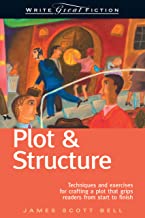
James Scott Bell (Yes, TKZ’s beloved Sunday columnist and writing guru) gives us a great template for writing strong, compelling back cover copy in his excellent book, Plot & Structure.

Jim’s outline is a perfect jumping-off point for creating your own book description.

Paragraph 1: Your main character’s name and her current situation:

__________________ is a ________________ who ___________________________________.

Write one or two more sentences, describing something of the character’s background and current world.

Paragraph 2: Start with Suddenly or But when. Fill in the major turning point, the event that threatens the character, disrupts his world and forces him to take action. Add two or three more sentences about what happens next.

“But his world is turned upside down when…”

Paragraph 3: Start with Now and make it an action sentence, for example, “Now (name) must struggle with….”

Or use a question or two starting with Will: Will (name) be able to….? Or will she….? And will these events….?

Then add a final sentence that is pure marketing, like “(Title) is a riveting…. novel about …. that will …you…till the … twist at the end.

Now polish it up, making sure every word counts and you’ve used the best possible word for each situation. Aim for about 250-500 words in total.

There are of course many other ways to grab your readers in your book description, but be sure to use the main character’s name and hint at the threat that has upset his world and the obstacles he needs to overcome to win, survive or defeat evil, and right wrongs. And leave the readers with a question, to pique their curiosity and propel them into the story.

Then, if there’s space, you could squeeze in a great blurb or two, or a short author bio.

Resource: James Scott Bell, Write Great Fiction – Plot & Structure. I highly recommend this book of Bell’s, as well as his excellent Revision & Self-Editing for Publication, which I recommend to all my clients.

TKZers – Would you like to share your back cover copy, book description, storyline, or tagline with us? Or create one for a well-known novel?

*By the way, I’m over at Kay DiBianca’s blog today as well. Kay is interviewing me about my writing advice in Fire up Your Fiction and related topics. Hop over there for a look! 

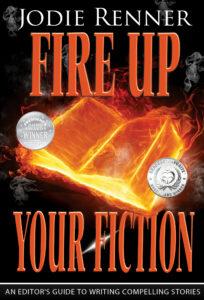
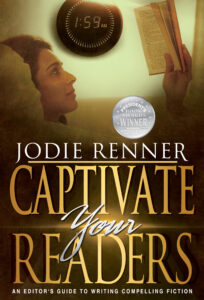
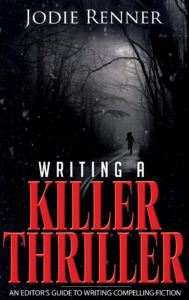
Jodie Renner is a freelance fiction editor and the award-winning author of three writing guides in her series An Editor’s Guide to Writing Compelling Fiction: FIRE UP YOUR FICTION, CAPTIVATE YOUR READERS, and WRITING A KILLER THRILLER, as well as two clickable time-saving e-resources, QUICK CLICKS: Spelling List and QUICK CLICKS: Word Usage. She has also organized and edited two anthologies. Website, Blog – Resources for Writers, Facebook, Amazon Author Page.

Can Multitasking Harm the Brain?

Writers need to multitask. If you struggle with multitasking, don’t be too hard on yourself. The brain is not wired to complete more than one task at peak level. A recent study in the journal Frontiers in Human Neuroscience showed when we’re concentrating on a task that involves sight, the brain will automatically decrease our hearing.

“The brain can’t cope with too many tasks: only one sense at a time can perform at its peak. This is why it’s not a good idea to talk on the phone while driving.” — Professor Jerker Rönnberg of Linköping University, who conducted the study.

The results of this study show that if we’re subjected to sound alone, the brain activity in the auditory cortex continues without any problems. But when the brain is given a visual task, such as writing, the response of the nerves in the auditory cortex decreases, and hearing becomes impaired.

As the difficulty of the task increases—like penning a novel—the nerves’ response to sound decreases even more. Which explains how some writers wear headphones while writing. The music becomes white noise.

For me, once I slide on the headphones, the world around me fades away. I can’t tell you the number of times my husband has strolled into my office, and I practically jump clean out of my skin. Don’t be surprised if someday he kills me by giving me a heart attack. But it isn’t really his fault, even though I’ll never tell him that. 😉 I’m in the zone, headphones on, music blaring, my complete attention on that screen, and apparently, my brain decreased my ability to hear.

Strangely enough, I don’t listen to music while researching. When I need to read and absorb content, I need silence. This quirk never made sense to me. Until now.

Have you ever turned down the radio while searching for a specific house number or highway exit? Instinctively, you’re helping your brain to concentrate on the visual task.

Research shows that our brains are not nearly as good at handling multiple tasks as we like to think they are. In fact, some researchers suggest multitasking can actually reduce productivity by as much as 40% (for everyone except Rev; he’s a multitasking God). Multitaskers have more trouble tuning out distractions than people who focus on one task at a time. Doing many different things at once can also impair cognitive ability.

Shocking, right?

Multitasking certainly isn’t a new concept, but the constant streams of information from numerous different sources do represent a relatively new problem. While we know that all this “noise” is not good for productivity, is it possible that it could also injure our brains?

Multitasking in the brain is managed by executive functions that control and manage cognitive processes and determine how, when, and in what order certain tasks are performed. According to Meyer, Evans, and Rubinstein, there are two stages to the executive control process.

  1. Goal shifting: Deciding to do one thing instead of another
  2. Role activation: Switching from the rules for the previous task to the rules for the new task (like writing vs. reading)

Moving through these steps may only add a few tenths of a second, but it can start to add up when people repeatedly switch back and forth. This might not be a big deal if you’re folding laundry and watching TV at the same time. However, where productivity is concerned, wasting even small amounts of time could be the difference between writing a novel in months vs. years.

Multitasking Isn’t Always Bad

Some research suggests that people who engage in media multitasking, like listening to music through headphones while using a computer, might be better at integrating visual and auditory information. Study participants between the ages of 19 and 28 were asked to complete questionnaires regarding their media usage.

The participants completed a visual search task both with and without a sound to indicate when the item changed color. Heavy multitaskers performed better when sound was presented, indicating they were more adept at integrating the two sources of sensory information. Conversely, heavy multitaskers performed worse than light/medium multitaskers when the tone was not present.

I can attest to that. If I don’t have my headphones on, chances are I won’t hit my writing goals that day. I’ve conditioned my brain to focus when the music starts. And I store a spare set of headphones in case mine break. Learned that little lesson the hard way.

“Although the present findings do not demonstrate any causal effect, they highlight an interesting possibility of the effect of media multitasking on certain cognitive abilities, multisensory integration in particular. Media multitasking may not always be a bad thing,” the authors noted.

How can writers multitask and still be productive?

  • Limit the numbers of things we juggle to two (*laughter erupts in the audience*)
  • Use the “20-minute rule.” Instead of constantly switching between tasks, devote your full attention to one task for 20 minutes before switching to the next task.

What do you think about these studies? How well do you multitask?


WHAT MY HORSE TAUGHT ME ABOUT CHARACTER ARCS – Guest Post by Kay DiBianca

by Debbie Burke

@burke_writer 

Today, I’m pleased to host cozy mystery author Kay DiBianca who shares her fun and unique perspective on character arcs. Kay is a familiar name around The Zone, offering frequent, insightful comments. Welcome to Kay and the horse she rode in on! 

It was a day for speed. A wind-at-your-back, smile-on-your-face day when a youthful gallop overruled frumpy caution, so we barreled down the dirt trail into the park and around a blind turn. As the bushes on our right gave way and the road ahead came into view, a terrifying specter suddenly loomed up in the middle of the trail, no more than fifty yards in front of us.

Dixie, my high-strung, prone-to-panic filly, slammed on the brakes. I had no idea a horse could stop like that. Two stiff-legged hops – thump, thump — to a dead halt.

I went straight over her head. Turns out an English forward seat saddle is particularly ill-suited for sudden deer sightings.

As I was flying through the air, anticipating an unpleasant reacquaintance with Mother Earth, Dixie began some kind of crazy cha-cha in reverse, trying to flee the tiny deer creature. I was still holding on to the reins, however, so she couldn’t turn and run. Instead, she made a determined dart backward, dragging me along in her wake.

You might be wondering why I didn’t just let go of the reins and save myself from a mouthful of dirt and a painful awareness of my sudden change in circumstances. I’ll be honest with you. I would have let my horse drag me into the next county before I allowed her to return riderless to the barn. I have my pride, you know.

Body-surfing down a dirt trail at the whim of a frightened animal is an excellent way to focus one’s mind.  I’m older now, but sometimes I still get that urge to gallop furiously into the next adventure, no matter what form it takes. But when I recall that day in the park, the awful taste of grit in my mouth, the look of terror in Dixie’s eyes, and the acrid scent of fear in the air, I pull back the reins on my emotions and proceed at a deliberate trot.

Whether dramatic or not, we each have a set of experiences that have transformed the way we view the world. Likewise, we all know the characters we write about must change from the beginning of the story to the end, and the change must be meaningful.

So TKZers: Tell us about a character in one of your novels that went through a metamorphosis. Was it a dramatic, once in a lifetime experience? Or a slow coming to grips with reality over the course of the story? How did you accomplish the change in a way that would grab your readers?

I’m deeply grateful to Debbie Burke for giving me the opportunity to post to the Kill Zone Blog. And thanks to all the TKZ contributors and commenters for allowing me to be part of the journey.

~~~


SAVING ONE LIFE IS LIKE SAVING THE WHOLE WORLD.

Kay’s delightful cozy mystery, Dead Man’s Watch, features characters the reader cares about.

Available at Amazon, Kobo, Barnes & Noble, and Apple Books.

Mid-Year Update on the State of Publishing Today

I’ve been hearing a lot in recent weeks about the state of publishing today – especially about the general sense of ‘flux’ and uncertainty as well as the lingering sense of trauma following the pandemic. This particular issue came up recently on social media when a writer demanded on Twitter (never a good thing…) why agents and editors seemed particularly slow in responding to submissions at the moment. This set the stage for a flood of responses from those in the publishing industry reiterating just how traumatic the pandemic had been for many of them – stemming not only from the lay-offs and economic uncertainty, but also coping with working from home (often with young children), and generally being in the midst of a confluence of horrors and illness which affected everyone’s ability to focus.

Now, as we pass the mid-point of 2021 many in the industry are still struggling to catch up with the backlog of work and trying to regain a sense of normalcy after the pandemic upended so much within the industry. Reading this Twitter thread was both reassuring (given my own creative struggles during the pandemic), as well as terribly sad (so many people still trying to come to terms with their experiences last year). What was unnerving/shocking (although given it’s Twitter also inevitable…) was the number of negative responses (even from writers!) criticizing agents and editors as if they should somehow not have any human frailties… Witnessing this whole exchange on Twitter made me wonder about what others were experiencing when it comes to the publishing industry at the moment, whether they see a ‘reset’ any time soon, or whether we are really just in the throes of a kind of post-traumatic syndrome that may take many more months to overcome.

Some of my fellow writers have received a fair bit of ‘doom and gloom’ talk from their agents and editors (though to be honest I say ‘so what’s new?!’) so I thought I’d reach out to our TKZ community to see what your experience has been so far in 2021. Are your agents and editors still reeling from the pandemic? Are submissions or responses to queries taking longer than normal? What feedback have you got from those in the industry about the state of things at the moment?  One interesting tidbit I’ve heard is that many publishers are now looking for projects that they feel they can sell to Netflix for a future movie/TV show – I’m assuming because of the success of the recent Shadow & Bone series perhaps…??…anyway not sure if anyone’s heard this…

For those of you out there in TKZ with their fingers on the pulse, what are you hearing about the state of publishing at the moment?


Be the Mouse

A recent exchange with the hubster went something like this.

Him: What’d you do today?

Me: Same as yesterday, and the day before, and the day before that.

Him: You’re a persistent little bugger, aren’tcha?

Me: *shrugs* I’m a writer.

But it’s not as simple as that, is it? Persistence can be grueling at times.

If someone told me ten years ago that in 2021 I would stumble across a true story that’s so meaningful and important it might forever change my writing trajectory, my first reaction would’ve been: Ten years is a lifetime away.

But the truth is if I found this case ten years ago, I wouldn’t know how to do it justice. Today I do. 🙂 This narrative nonfiction/true crime project has so many parallels to my own life, my passion is at an all-time high. Which brings me to persistence. Persistence while researching. Persistence while re-investigating the crime. Persistence while interviewing witnesses. Persistence while submitting the proposal.

The Big Dream

When I wrote my first novel—longhand, by candlelight—the Big Dream was all I could think about. I remember searching for other writers’ interpretation of success and how long it took them to “make it” in this business. Most said a new writer won’t make any money until they’ve written five novels. If they’re lucky, they’ll sell a few hundred copies of their debut. That’s the last thing an aspiring writer wants to hear.

The aspiring writer thinks: If you build it, they will come.

Which isn’t necessarily a bad mindset if it drives the writer to the keyboard. I’m a dreamer. Always have been, always will be. As long as we offset the dream with a dose of reality, I say dream big, dream often, dream without limits.

Now, with a backlist of 17 titles and 5+ trunk novels, I look back on that early advice and it means something completely different.

Writing five novels isn’t only about building an audience. It means the writer has honed their craft. They’ve let their passion lead them on a journey of self-discovery (Think: Who are you as a writer?). It means the writer never gave up. Or quit. S/he continued for love, not money. S/he kept her head down, fingers on the keyboard, butt in chair, and created, edited, rewrote passages, scenes, or whole chapters, and finished five manuscripts.

What else happened?

S/he learned the business side of writing—found an agent, publisher, or learned the ins and outs of self-publishing. Lastly, it means s/he learned how to market a product, build a brand and an audience. S/he persisted, even though the odds seemed insurmountable. S/he leaped out of the nest and learned to fly.

Sometimes this biz can be disheartening, other times it’s super exciting. The ups and downs are all part of this amazing journey. The minute we stop trying to achieve future goals, we’ve already lost. Aside from creatives—writers, singers, artists, actors, musicians, etc.—I can think of no other field that requires as much persistence.

What is persistence?

The dictionary defines persistence as:

  • continuing firmly or obstinately in a course of action in spite of difficulty or opposition
  • continuing to exist or endure over a prolonged period

The definition clarifies how difficult it is to persist.

What happens in the brain during the act of persistence?

Serotonin is a neurochemical in the brain important for feelings of happiness. It’s also known for:

  • promoting good sleep by helping to regulate circadian rhythms (a 24-hour inner clock running in the background to carry out essential functions like the sleep-wake cycle)
  • helping to regulate appetite
  • promoting memory and learning
  • helping to promote positive feelings and behavior

If you have low serotonin, you might:

  • feel anxious, low, or depressed
  • feel irritable or aggressive
  • have sleep issues or endless fatigue
  • become impulsive
  • have a decreased appetite
  • experience nausea and digestive issues
  • crave sweets

Scientists have studied serotonin levels and persistent behavior in mice.

During foraging, all wildlife explores an area for food and/or water. But at some point, they must move on to a different area. Thriving animals exhibit patience and persistence before exhausting their search at each location.

In the study, researchers required water-restricted mice to “nose poke” while foraging to obtain water as a reward. The probability of obtaining water in each area lessened with each nose poke. The higher the number of nose pokes equaled more persistence in that individual mouse. Scientists also used video tracking to measure how long it took for the mice to switch to a different foraging area.

Mice exhibited optimal foraging behavior. Meaning, they optimized the trade-off between time spent searching an area for water and leaving to find a water source in a different area.

The mice who received serotonin neuron stimulation performed a greater number of nose pokes compared to mice who didn’t receive stimulation. They also took longer to leave an area, suggesting they were more persistent.

This is the first study to show a correlation between serotonin neuron firing and active persistence. Previously, scientists hypothesized that serotonin was involved in patience. We now know a rush of serotonin is involved in persistence, as well.

If our persistence starts to wane, we need to increase our serotonin level.

Here’s how:

  • Eat healthy
  • Exercise
  • Bright light
  • Massage

The list is almost meaningless without more explanation. So, let’s dive into each tip.

Healthy Snacks

We can’t get serotonin from food, but we can get tryptophan, an amino acid that’s converted to serotonin in the brain. High-protein foods contain tryptophan. For example, turkey and salmon. But it’s not as simple as eating tryptophan-rich foods, thanks to the blood-brain barrier—a protective sheath around the brain that controls what enters and exits. Isn’t the human body amazing?

Like with most life hacks, there’s a shortcut around the blood-brain barrier.

Research suggests eating carbs along with tryptophan-rich foods pushes more tryptophan into the brain, thereby raising the serotonin level.

Some tryptophan-rich snacks include:

  • oatmeal with a handful of nuts
  • plums or pineapple with crackers
  • pretzel sticks with peanut butter and a glass of milk

Exercise

Exercising creates an ideal environment for serotonin by triggering the release of tryptophan in the blood and decreasing the amount of other amino acids. Thus, more tryptophan reaches the brain.

Aerobic exercise of any kind releases the most tryptophan. Don’t fret if you’re unable to do aerobics. The main goal is to raise the heart rate. This can be accomplished by:

  • a brisk walk
  • a light hike
  • swimming
  • bicycling
  • jogging
  • blaring the music and dance

Bright Light

This surprised me, but it makes sense when you consider seasonal affective disorder. Serotonin levels dip in the winter and rise in the summer. What should we do? Spend 10-15 minutes in the sunshine. Or, if you live in rainy climate or can’t get outside, use a light therapy box. Both will increase serotonin levels.

Massage

Massage therapy increases serotonin and dopamine levels. It also reduces cortisol, a hormone produced when stressed. If paying for a professional massage therapist isn’t within your budget, ask a friend/spouse/partner to swap 20-minute massages.

Be the Mouse

Writers cannot achieve goals without some form of persistence. Be persistent, dear writer. Be the mouse.

First Page Critique – Little League; Huge Trouble

Photo by NeONBRAND on Unsplash

By Debbie Burke

@burke_writer

Good morning and welcome to another Brave Author who’s submitted the first page of a mystery for discussion. Please enjoy the following then we’ll talk about it.

~~~

Little League; Huge Trouble 

Genre: Mystery

The streets were empty, black puddles filling the trench where they dug up the gas line. It was the quiet time after school and before the commuters wind through the neighborhood.

If anyone was walking through the neighborhood, they would have seen him. He was running with hard plastic soles slapping the pavement.

On Milbert Street, according to the police report, he ran behind the shingled Victorian and through the garden that’s been featured in 40 magazines and down 220 yards of wooded trails to Salmon Street.

He ran left on Salmon, which descends through three quick curves and a patch of native rhododendrons, rising 30-feet high and exploding with faded pink blooms.

The next street, Greenway, is a short road with only seven houses and just beyond the fourth home, the midcentury showplace, he was shot. The bullet entered behind his left ear, severing the spinal cord and the slug tumbled underneath his skull, burrowing through the brain tissue like an angry metal worm.

He rolled down the embankment to the water that collects in the culvert after every strong rain.

When I learned he died and that he had been murdered, I hate admitting my initial reaction.

Damn, I thought, I just lost my leadoff hitter and best catcher.

My leadoff hitter and best catcher, who two weeks earlier had celebrated his 11th and final birthday.

~~~

I confess to mixed feelings about this page. There are some really nice, evocative visuals—black puddles in trenches, hard plastic soles slapping the pavement, etc. Rather than an info dump to describe the town, Brave Author blends action with  description. Well done.

However, the POV is awkward and off-putting, switching from omniscient to first person. More on that in a moment.

Title: Little League; Huge Trouble sounds catchy, light, and humorous, as if this might be a cozy or a story for young readers. But the title is at odds with the vivid, gritty description of a bullet tumbling in a little boy’s brain like an angry worm, which, BTW, is an excellent simile.

I’m not a fan of semicolons in fiction and especially not in a title. It’s distracting and appears pretentious. Suggest you replace it with a comma or a dash:

Little League, Huge Trouble or Little League–Huge Trouble.

Point of View: The drone’s eye view of the streets, houses, and the boy fleeing from his killer is a cinematic effect that can be intriguing.

Omniscient POV is one way to show the overview of the setting. However, omniscient keeps the reader at a distance and delays introduction of the “I” character.

Tone: I felt off-balance and unsettled because the tone is uneven and inconsistent. It skips from an almost-flippant travelogue of an idyllic town featured in 40 magazines to the horrifying death scene of a little boy. Rather than becoming engrossed in the story, I spent too much time trying to figure out what direction the author was going.

This opener fouled out for the following reasons:

In parts, the tone tries to sound like a detailed official police report with precise factual details: “40 magazines”, “220 yards of wooded trails”, “three quick curves”, “rhododendrons, rising 30-feet high”, “seven houses”, “fourth home.”

But those cold facts feel in conflict with the wonderful, sensory descriptions that evoke emotion: “running with hard plastic soles slapping the pavement”, “exploding with faded pink blooms”, “burrowing…like an angry metal worm.”

Further, the observations about 40 magazines and midcentury showplace sound like authorial intrusions, further muddying the mood.

The contrast technique can work but must be carefully constructed so the reader doesn’t feel like a pinball bouncing from hard facts to the narrator’s flippant observations to strong emotions.

Likeability:  When the POV shifts from omniscient to “I”, the character’s reaction to the murder strikes out big time.

When I learned he died and that he had been murdered, I hate admitting my initial reaction.

Damn, I thought, I just lost my leadoff hitter and best catcher.

My leadoff hitter and best catcher, who two weeks earlier had celebrated his 11th and final birthday.

Gotta tell ya—The character may hate himself or herself but not nearly as much as I hate the character for that selfish, self-absorbed attitude. A child has been murdered and s/he worries how that affects their team’s chances to win.

Even the hardest-boiled noir treats a child’s murder more gently.

S/he may be a snarky anti-hero whose character arc eventually leads to redemption. But, after reading this beginning, I wouldn’t continue. No matter how much I want to see a child’s killer brought to justice, it isn’t worth spending 300 pages with a character whose values are so crass and selfish.

The Brave Author may be trying for irony, a technique that can be used to great effect. But it must be done deftly when dealing with a sensitive, emotionally-charged subject.

Writing: Overall, the craft is skillful and well done with excellent descriptions. There are some repetitious words (neighborhood twice in the first two paragraphs) and phrases (leadoff hitter and best catcher). Several times, the tense shifts from past to present within the same sentence (It was the quiet time after school and before the commuters wind through the neighborhood). That may be deliberate but it’s jarring.

The unevenness of tone and an unlikable narrator hit a grounder instead of a fly ball out of the park.

But this page is easily salvageable and can be rewritten into a home run.

In the example below in red, I tinkered with reordering and refocusing the tone to put more emphasis on irony: the contrast of a brutal murder in an idyllic setting; and the contrast of the promising sports career of a young boy who’s suddenly and violently cut down.

According to the police report, the streets were empty, the quiet time after school but before commuters wound through the neighborhood on their way home. Black puddles filled a trench where the gas line had been dug up.  

No witnesses had come forward yet. If anyone had been walking through the area at the time, they would have seen him, heard his hard, plastic soles slapping the pavement.

On Milbert Street, he ran behind the shingled Victorian and through the garden that’s been featured in 40 lifestyle magazines. He continued an eighth of a mile down a wooded trail to Salmon Street.

He ran left on Salmon, through three quick curves, passing 30-foot-tall native rhododendrons exploding with faded pink blooms.

The next street, Greenway, is a short road with only seven houses. Just beyond the fourth home, a mid-century showplace, he was shot.

The bullet entered behind his left ear and severed the spinal cord. The slug tumbled underneath his skull, burrowing through the brain tissue like an angry metal worm.

He rolled down the embankment into the water that collected in the culvert after every strong rain.

That evening, I learned the news that my leadoff hitter and best catcher had been murdered—a boy who two weeks earlier had celebrated his 11th and final birthday.

By starting the first paragraph with a reference to the police report, readers immediately know a crime has been committed. Then they follow the victim as he flees, setting up the contrast between the storybook setting and the horrific crime.

Lastly, the shock that the victim is a little boy is revealed but the “I” character’s reaction is not as off-putting. S/he may later admit disappointment that the team’s chances have been dashed IF that’s an important detail. But I suggest delaying that until the reader is much more invested in the story.

Brave Author, there is a lot of potential here for a compelling mystery but I think you need to decide on an overall tone that’s appropriate for the subgenre you choose.

Is this a small-town cozy? Unlikely because a child’s graphic murder takes it out of cozy realm.

A traditional whodunit mystery? More likely.

An amateur sleuth tale where a youth sports coach must solve a murder? This seems like the most appropriate slot.

What audience do you hope to appeal to?

Once you answer these questions, you can focus on a tone and title that are consistent and appropriate for that subgenre. Then the reader won’t feel off-balance. Instead s/he will be pulled into the story.

Thanks, Brave Author, for submitting this promising first page.

~~~

Over to you, TKZers. What are your impressions? Do you have suggestions for our Brave Author? Would you turn the page?

~~~


Try the first book in the Tawny Lindholm Thriller series for FREE. Available at Amazon and major online booksellers.