
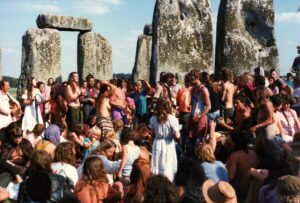
Photo credit: Salix alba at en.wikipedia, CC BY-SA 3.0
By Debbie Burke
Welcome to summer and the longest day of the year…at least in the Northern Hemisphere.
To readers in the Southern Hemisphere, sorry, this is your shortest day but, from now on, the days will grow longer, honest.
To folks who live in the far north, summer solstice is especially appreciated after long, dark winter days. Today, at my Montana home, latitude 48 north, the sun rises at 5:37 a.m. and sets at 9:41 p.m. But dawn can be seen coming for almost an hour before then and twilight lingers until around 11 p.m.
At latitude 64.8 north, Fairbanks, Alaska enjoys almost 24 hours of sun today. Here’s time-lapse video:
For TKZ’s crime dogs who are also star-gazers, five planets—Mercury, Venus, Mars, Jupiter, and Saturn—are currently lined up across the sky like train cars with the moon as the caboose. According to Space.com, the last time this type of alignment occurred was March 5, 1864.
The Farmer’s Almanac offers these tidbits from history and how different cultures celebrated summer solstice.
-
In Ancient Egypt, the summer solstice coincided with the rising of the Nile River. As it was crucial to predict this annual flooding, the Egyptian New Year began at this important solstice.
-
In centuries past, the Irish would cut hazel branches on solstice eve to be used in searching for gold, water, and precious jewels.
-
Many European cultures hold what are known as Midsummer celebrations at the solstice, which include gatherings at Stonehenge and the lighting of bonfires on hilltops.
Here’s a fun quiz about the summer solstice, also from the Farmers Almanac. Feel free to share your score in the comment section.
In the early 1960s, archeoastronomer Gerald Hawkins was the first to theorize that Stonehenge (built somewhere between 2950 – 1600 B.C.) was a giant astronomical calendar that tracked movements of the sun and moon. According to Wikipedia:
He fed the positions of standing stones and other features at Stonehenge into an early IBM 7090 computer and used the mainframe to model sun and moon movements. In his 1965 book, Stonehenge Decoded, Hawkins argued that the various features at the monument were arranged in such a way as to predict a variety of astronomical events.
From the center, the observer can see the summer solstice sun rising and setting in exact alignment between the monolithic stones.
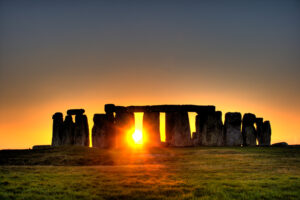
Photo credit: By simonwakefield – https://www.flickr.com/photos/simonwakefield/3149066878/ (cache of original license), CC BY 2.0,
While rabbit-holing, I ran across a site called Spiritual Gangster, which sounded appropriate for crime writers and readers. Here’s an excerpt about setting summer intentions:
The Summer solstice is an energetically charged day and an important one to set intentions. Direct your intentions on the themes of this phase, which are patience, nourishment and trust. Create powerful “I am” statements that reflect these qualities and the development of them. Include “reception” statements that open you up to receiving the energies available on this day. Examples are; “I am open to receiving nourishment and growth” or “I am able to receive the energy needed to develop trust in my life.” Set your intentions and continually remind yourself of them all summer long.
The longest day of the year is a good opportunity to review New Year’s resolutions you may have made in January and assess how well you’ve achieved them (or not!).
Remember that solemn vow to write XXX words or pages each day?
Or submit to XX agents?
Or organize your writing space?
Or finish that #%&$ manuscript languishing on your hard drive?
Or send your First Page to TKZ for critique? Here, I’ll make it easy for you with this link. We’re waiting—don’t make us come and get it!
Who cares if you didn’t check off resolutions in the first half of 2022? You still have six months to nail goals you want to accomplish.
June 21 is the longest day of the year. Grab your hazel branch, set a bonfire, and dance like a Druid. Make the most of that additional daylight and score some extra words.
Happy Summer!
~~~
TKZers: Do you take stock of your writing/reading goals at the year’s midpoint? How are you doing?
Do you celebrate the first day of summer? Favorite activities and traditions?


 Emotion, Beginnings, and Anti-heroes
 The nice weather has finally hit New England. Yay!
 My name is Kimber. I am a Cavaston–a mix of Cavalier King Charles Spaniel and Boston Terrier. My new parents drove all the way up to Pennsylvania to pick me up on February 15. It was cold and I was scared.
 I had to go to the doctor for a checkup during my first week at the apartment. The doctor was nice, but there’s not a lot of privacy. They stuck me with needles and squeezed me a lot, but they let me eat spray cheese out of a can while they did it, so I didn’t mind all that much.
 Not everybody recognizes the origins of my name. John tells me it’s the same as one of his favorite pistols. One day, when we were visiting the new house before we moved in and the heat wasn’t turned on yet, I got cold and climbed inside of his vest. After this picture was taken, John called me his quick-draw puppy.
 These days, we’re all moved into the new house and the construction is over with–well, mostly. John complains that the master bedroom closets still aren’t finished. I like living in the country more than I liked living in the apartment. Out here, I get to pee and poo outside instead of on the little pads that I never really hit. (Apparently, you’re supposed to have your back legs on the pad, too. Who knew?)
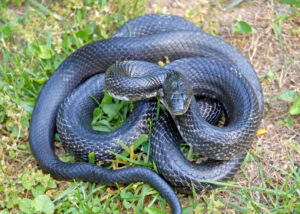 Country living can be scary. I was playing in the woods just a few days ago and I saw something that looked like it wanted to play with me, but not in a good way. It kept hissing and trying to bite me. I’m really fast, though. I barked and barked, and finally, John came out to see what was happening. The stranger hissed and tried to bite him, too. He got very stern and told me to go back into the house. A few minutes later, I heard a really loud noise. I haven’t seen the stranger since.
 I think John’s really happy that I’m around the house. All day long, he sits in a chair in front of a folding thing with buttons on it, but I’m tall enough now that I can jump right up onto the buttons and help him push them. He pretends not to like me doing that, but he always ends up playing with me. Maybe not the first time I jump up, or the second, but sooner or later, he gives in and plays. He said something about not being able to say no to my face.
 Zoosemiotics is the study of animal communication, and it’s played an important role in the development of ethology, sociobiology, and the study of animal cognition. Writers can also learn from zoosemiotics. Think characterization and scene enhancement.
 Keep in mind, a dog could use more than one response at a time. Hence why it’s important to analyze the entire dog, not just one body cue (the same applies to characters).
 Brother Gilstrap’s recent