by James Scott Bell
@jamesscottbell
 It’s about time we talked about Casablanca. This classic consistently shows up at the top of favorite movie lists. It has perhaps the most famous ending line of all time. And of course it’s got Bogart, Ingrid Bergman, Paul Henreid, and Claude Rains—not to mention Peter Lorre and Sydney Greenstreet and a host of great Warner Bros. character actors.
I’ve been teaching workshops for a quarter of a century, and back when I started I could assume that everyone had seen Casablanca, probably more than once.
In recent years, however, among the younger set, I can no longer make that assumption. It’s astonishing to me that anyone wanting to write commercial fiction would not have seen this movie. But I have to remember that when I grew up there were only twelve channels on TV, five of which got no reception. The local channels ran old movies. These were our cultural glue. Not so anymore, with a zillion streaming networks and five zillion series to binge on; and TikTok and YouTube vids to take up every waking moment. Who has time for settling in with an old movie anymore?
Well, if you want to be a good writer, settle in with Casablanca. If you haven’t seen it, I suggest you do so this afternoon!
The Plot
Rick Blaine (Humphrey Bogart) is an American expatriate running a café-saloon-gambling hall in French Morocco during World War II. The local police captain, Louis Renault (Claude Rains), keeps tabs on Rick. He allows him to stay open because Rick refuses to take sides in the war, but mostly because Louis gets kickbacks in the gambling room and uses Rick’s Café to procure desperate wives to sleep with him in exchange for exit visas.
All is routine until Ilsa Lund (Ingrid Bergman) walks into Rick’s with her husband, the resistance hero Victor Laszlo (Paul Henreid). This throws everything off, for Rick and Ilsa have a past…and it’s going to force everyone to take sides, especially when the Nazi major, Strasser (Conrad Veidt), determines to stop Laszlo for good.
Rick, who begins the film by declaring that he “sticks his neck out for nobody” will now have to decide whether to reclaim the woman he loves, or sacrifice all—including his life—for a greater cause.
The Anti-Hero
Rick is a classic anti-hero. While a hero represents the desires and values of the community, the anti-hero stands only for himself. He has withdrawn (literally or figuratively) from the community, either by choice or circumstance.
In an anti-hero story, the Lead is drawn back into the community to deal with a troubling situation. The question at the end is whether he will rejoin the community or return to his exile.
The key to a good anti-hero is “the code.” He has his own code to live by, usually in opposition to community standards.
For example, Dirty Harry is an anti-hero. His community (the police) has standards (little things, like following the 4th and 5th Amendments). Harry finds that too restrictive. At the end of the movie, his extra-judicial tactics have saved a busload of children from a psychopath. Will Harry return to his community? Nix. He throws his badge into the drink. (Studio executives, however, seeing the box office results, recovered the badge and put Harry right back on the force for four more movies.)
Rick has chosen to exile himself in Casablanca after being betrayed—he thinks—by the love of his life. His code is that he will treat his customers fairly but will not stick his neck out for any of them.
So why do we care about an anti-hero?
Because you give him someone to care about. Dirty Harry cares about his partner. Katniss Everdeen cares about her mother, little sister, and a cat.
In Rick’s case, he cares about the ragtag staff in his café, especially his one friend, Sam the piano player (Dooley Wilson). By showing us this aspect of the anti-hero, we hope for his redemption. That’s why we keep watching, or reading, the story.
Structural Beats
Opening disturbance. The first time we see Rick he’s playing chess…by himself! How’s that for an anti-hero visual? He’s interrupted by the smarmy hustler Ugarte (Peter Lorre) who informs Rick that he is in possession of the most valuable items in all Morocco—two Letters of Transit, which will allow the holders to get out of Casablanca, no questions asked. He is going to sell them that very night. This spells potential trouble for Rick, for if the police find out about it his place will get shut down and he’ll no doubt be arrested.
Here I must include one of my favorite movie lines of all time, perfect in defining Rick’s character:
UGARTE: You despise me, don’t you?
RICK: If I gave you any thought I probably would.
In a novel, get your disturbance in the first line, first paragraph, or first half-page at the latest.
Doorway of No Return. At the one-quarter mark we get the event that forces Rick out of his relatively trouble-free existence in Act 1 into the death-stakes conflict of Act 2: Ilsa walks into Rick’s Café with her husband, Victor Laszlo. This forces Rick to deal with his conflicting feelings for Ilsa (love and hate) and how those feelings complicate his isolation. Death is on the line for Laszlo, and perhaps for Rick himself. Indeed, possible death overhangs all the refugees in Casablanca. It’s a closed city, and the Nazis are watching.
Your novel’s main conflict does not begin until the Lead is forced through this doorway. Further, it needs to be before the 1/5 mark, or the story starts to drag.
Mirror Moment. I started to formulate my theory of the mirror moment by watching Casablanca. I moved the DVD to the very middle of the film, and here’s what I found.
Rick is dealing with Ilsa’s presence by doing what any red-blooded American man of the time would do—get drunk. It’s after hours at the café, and as Rick drowns his sorrows we get the flashback that explains the backstory of his falling in love with Ilsa in Paris, and their plans to flee and get married. When she sends him a note to say she can’t go with him, for undisclosed reasons, he takes it as a complete betrayal.
We return to his drinking…when Ilsa slips in through the back door. She has come to explain to Rick why she stayed behind. She found out her husband, Laszlo, whom she had thought dead, was still alive. She pours her heart out to Rick. The besotted Rick answers by accusing her of being a whore. Tears streaming down her face, Ilsa leaves.
And Rick, full of self-loathing, drops his head in his hands.
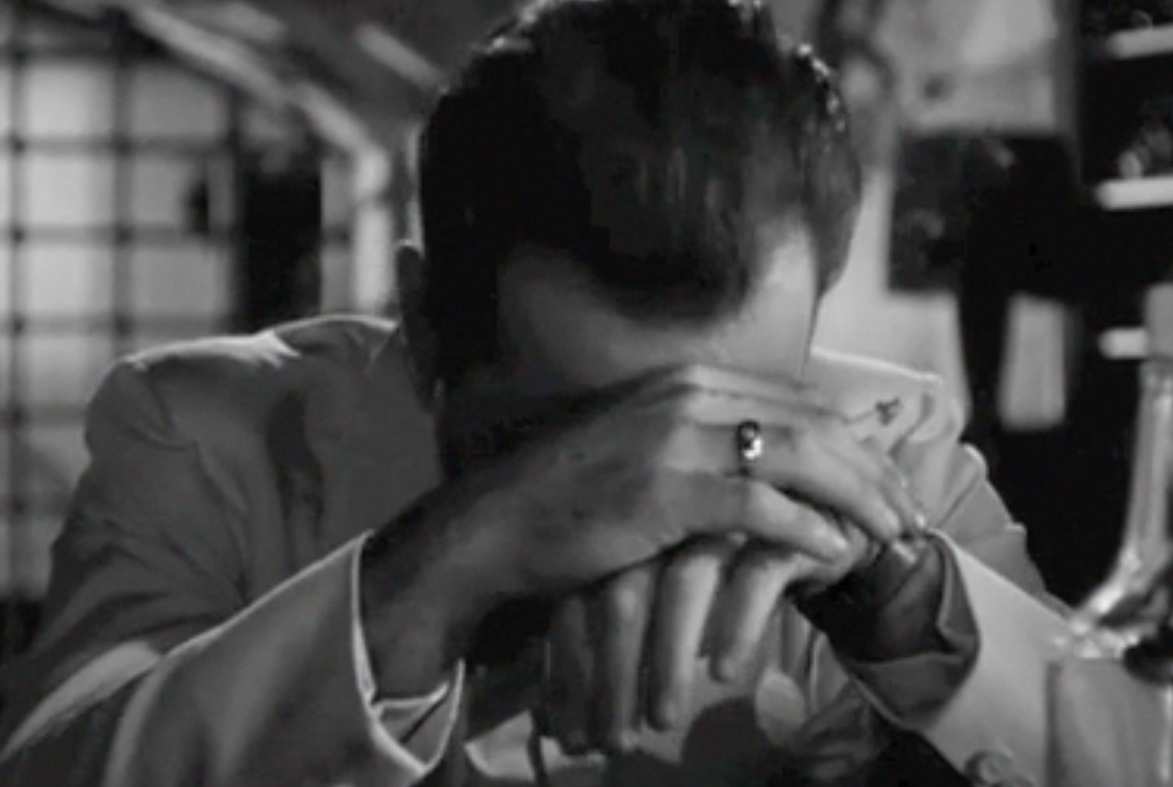 Visually what we see is Rick having to take a hard look at himself, as if in a mirror. Is this what he has become? Is this the kind of person he will remain?
Bogart does it with acting. In a book, you can include interior thoughts. The point is that the mirror moment tells us what the story is really all about—here, it’s about whether Rick will recover his humanity.
Be ye plotter or pantser, very early brainstorm possible mirror moments for your Lead. Come up with four or five or more possibilities. Plumb the depths of your subconscious. Inevitably, one of these choices will jump out and announce, This is it! You’ll be wonderfully pleased at how organic your writing becomes after that.
Dialogue. The script is full of great lines and exchanges. One of the most famous is this:
I’ve always said that dialogue is the fastest way to improve any manuscript. There are techniques you can learn. You’ll find them here.
Proving the Transformation
At the end of Act 3, we finally get the answer to the question raised by the mirror moment. Rick gives up the woman he loves for the greater good. He signs his death warrant by killing Major Strasser so Ilsa and Laszlo can escape on the plane to Lisbon.
The source material—the play Everybody Comes to Rick’s—ends a bit differently. At the beginning of the play and movie Rick bets Louis ten thousand francs that Laszlo will escape. At the end of the play, Rick holds a gun on Strasser until the plane leaves. But then he says, “I have never killed a man” and gives up the gun. He’s immediately placed under arrest by Strasser and marched off to his execution. Just before he exits Louis asks him, “Why did you do it, Rick?”
Rick says, “For the folding money, Louis, for the folding money. You owe me ten thousand francs.” Curtain.
That’s a pretty good ending, with Rick the anti-hero refusing to plead for his life, content with his sacrificial act.
In the movie, of course, there’s a reversal. Rick kills Strasser, but when the French police show up Louis tells them to “round up he usual suspects.” Because the conniving Louis has watched Rick operate throughout, he is finally inspired to recover his own humanity. As they begin to walk away…oh, heck, let’s see it again:
There is nothing so satisfying to a reader as an ending scene that proves the hero’s transformation.
Many a successful writer has written their endings first. Try it. You’ll know what it should feel like if you know your mirror moment. Now write a scene with all the emotional power of a Casablanca. Here’s the thing: even if you change the scene later on, the emotion you create in yourself as you write toward the ending will add power and direction to all your scenes.
Whew! That’s enough for today. Talk it up. I’m traveling today, so my comments may be limited. I’ll try to catch up when my feet are firmly back on terra firma.


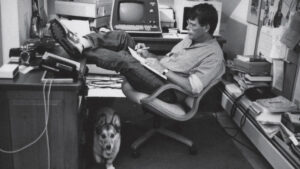 When I was growing up, immersed in dreams of one day becoming a writer, I romanticized what the process must be like. Where would one go to imagine new worlds and create new adventures? Movies romanticized the whole process, and I bought into it. Then I saw this now famous picture of a then less-famous Stephen King in his writing space. It seemed so . . . ordinary. Yet at the same time it seemed very special. The dog under his feet is a nice touch. This is a guy with a job. And his creative space is . . . an office. Just an office. But of course, it’s more than that. It’s Stephen King’s office. (As you’ll see below, it turns out that I was not the only budding young writer who was impressed by the photo.)
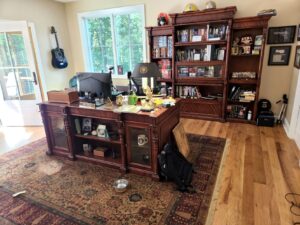 Our move to West Virginia presented a unique opportunity to design an office as an office–as opposed to a purloined bedroom. Now that I think about it, I suppose there’s not a lot of difference between the two. I wanted lots of light and direct access to the outdoors. That door leads to a deck that overlooks the woods. The orange helmet on the left end of the bookcase belonged to my father. A closer look will show that it’s quite banged up from the helicopter crash he survived on the deck of the USS Forrestal in 1959. The two yellow helmets are mine from the two jurisdictions where I ran fire and rescue. (I had to turn my white lieutenant’s helmet back in when I left.) Since the house is now run by a 12-pound ball of fur named Kimber, chew toys and water bowls litter the floor of every room.
 Here it is from a different angle. This is messier than it normally is, but a pinky swear is a pinky swear. Note the studio grade microphone and the webcam–a new bit of ubiquity in office photos, I’ve found. All of those Gilstrap books stacked on the far end of the bookcase are the background for Zooming and YouTube videos (when I start shooting them again). The opened journal you see on the desk is one of many that I have stacked around the place (each novel gets a new journal). That’s where I scratch my way through difficult parts of the story that are somehow resistant to being typed. That green chair in the corner used to belong to me. Now it’s Kimber’s day bed and she gets very annoyed if I move the blanket from where she left it.
 When we moved out of Fort Lauderdale five years ago, it meant big downsizing. As some wag said (might have been George Carlin): You spend the first half of your life accumulating stuff and the second half getting rid of it. We now live half the year in Tallahassee and half in Traverse City, Michigan. We don’t have the luxury of an extra “office” space anymore, so I store everything on line and cart my laptop around wherever the spirit moves me. Often it’s the sofa, but more likely my local coffee shop or after 4, the Traverse City Whiskey Co. where they make a mean whiskey sour. On spectacular days like today, the balcony will do.
 I’m fortunate to have a bedroom dedicated to me. This is my workspace, which doesn’t show my cluttered closet space or bookshelves. The desk is also a little less cluttered than usual, since the request for the photo came on Friday, and I clear my desk on Thursday for the housekeeper. The stacks of paper next to the printer and behind the monitor represent my method of ‘housekeeping.’ The stacks will eventually topple over, and I’ll attempt to separate the wheat from the chaff.
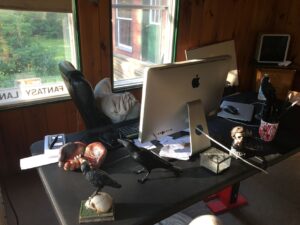 Attached are two photos of my office from different angles. The Holy Hands on my desk were made and blessed by a Cherokee chief. They hold tiny replicas of my Mayhem Series. Both gifts from a couple (readers) who said I touched their lives.
  Most of the crows, as well as the crow dreamcatcher hanging above, were also gifts from readers. All mean a lot to me. Constant reminders of why I write.
 Here’s my office. I’m most comfortable surrounded by books, and many of these mysteries are signed by friends. The box with the white rug is for my cat, Vanessa. She “helps” while I work.
 Here’s a shot of my mind lab. Brief description: “My creative place is a combination of old and new. Side-by-side, I have a Windows 11 laptop with audio/visual recording devices next to a retro 1920s private detective office with stuff like a pristine vintage typewriter and a cool rotary phone that’s tweaked to work in the digital age. Fun place. BTW, that filing cabinet is stuffed full of books.”
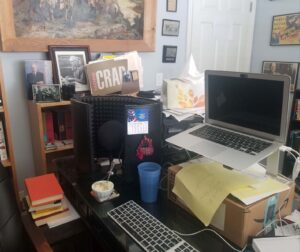 My desk, with microphone and sound foam. To the left, pics of Stephen King (with legs on desk), Ed McBain, and John D. MacDonald, all telling me to stop whining and write. My coffee mug with WRITER on it, which I bought a few days after I decided I had to try to become a writer. And a file folder for my first drafts.
 In story terms, a villain is a person, entity, or force who is cruel, evil, or malicious enough to wish the protagonist harm. Rather than simply blocking a goal or interfering with the hero’s plan, a villain causes suffering, making it vital for them to be conquered by the protagonist. Clarice must find and defeat Buffalo Bill if she wants to rise above her past and become a great FBI agent (
 Like the hero, the villain has an overall objective, and they’re willing to do anything within their moral code to achieve it. When their goal is diametrically opposed to the hero’s, the two become enemies in a situation where only one can succeed.
  Becca Puglisi is an international speaker, writing coach, and bestselling author of The Emotion Thesaurus and other resources for writers. Her books have sold over 900,000 copies and are available in multiple languages, are sourced by US universities, and are used by novelists, screenwriters, editors, and psychologists around the world. She is passionate about learning and sharing her knowledge with others through her