I wrote this post four years ago, but the subject is important enough to redux. Plus, I needed the reminder. Maybe you do, too.
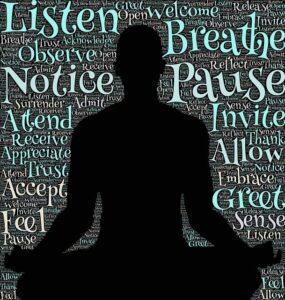
When chaos starts shaking the to-do list in my face, I close my eyes, lean back, and breathe… It’s amazing what a few deep breaths can do. There’s a running joke in my family that I’m so chill, I’m practically a corpse. It’s true! My blood pressure rarely, if ever, rises above 110/60, even under stressful conditions. And you know why? Because I take advantage of the most powerful and the most basic gift we have — the ability to breathe.
It may not sound like much of a superpower, but controlled breathing improves overall health. Controlled breaths can calm the brain, regulate blood pressure, improve memory, feed the emotional region of the brain, boost the immune system, and increase energy and metabolism levels.
The Brain’s Breathing Pacemaker
A 2016 study accidentally discovered a neural circuit in the brainstem that plays a pivotal role in the breathing-brain control connection. This circuit is called “the brain’s breathing pacemaker,” because it can be adjusted by alternating breathing rhythm, which influences our emotional state. Slow, controlled breathing decreases activity in the circuit while fast, erratic breathing increases activity. Why this occurs is still largely unknown, but knowing this circuit exists is a huge step closer to figuring it out.
Breathing Decreases Pain
Specifically, diaphragmatic breathing exercises. Ever watch an infant sleep? Their little tummy expands on the inhale and depletes on the exhale. They’re breathing through their diaphragm. We’re born breathing this way. It’s only as we grow older that we start depending on our lungs to do all the work.
Singers and athletes take advantage of diaphragmatic breathing techniques. Why not writers? If you find yourself hunched over the keyboard for too long, take a few moments to lay flat and concentrate on inflating your belly as you inhale through your nostrils. Then exhale while pulling your belly button toward your core. It takes a little practice to master the technique. Once you do, you can diaphragmatically breathe in any position. The best part is, it works!
Count Breaths for Emotional Well-Being
In 2018, another scientific study found that the mere act of counting breaths influenced “neuronal oscillations throughout the brain” in regions related to emotion. When participants counted correctly, brain activity showed a more organized pattern in the regions related to emotion, memory, and awareness, verse participants who breathed normally (without counting).
Controlled Breathing Boosts Memory
The rhythm of our breathing generates electrical activity in the brain that affects how well we remember. Scientists linked inhaling to a greater recall of fearful faces, but only when the participants breathed through their nose. They were also able to remember certain objects in greater detail while inhaling. Thus, researchers believe nasal inhalation triggers more electrical activity in the amygdala (brain’s emotional center). Inhaling also seems key to greater activity in the hippocampus, “the seat of memory,” according to Forbes.
Relaxation Response
The “Relaxation Response” (RR) is a physiological and psychological state opposite to the fight-or-flight response. RR therapy includes meditation, yoga, and repetitive prayer, and has been practiced for thousands of years. These stress-reducing practices counteract the adverse clinical effect of stress in disorders like hypertension, anxiety, insomnia, and aging.
Yet, research on the underlying molecular mechanisms of why it works remained undetermined until a 2017 study unearthed a fascinating discovery. Both short-term and long-term practitioners of meditation, yoga, and repetitive prayer showed “enhanced expression of genes associated with energy metabolism, mitochondrial function…” and more efficient insulin secretion, which helps with blood sugar management. Relaxation Response also reduces the expression of genes linked to inflammatory responses and stress-related pathways. In simpler terms, controlled breathing helps boost the immune system and improve energy metabolism.
Creativity
This probably goes without saying, but I’m mentioning it anyway. Good brain health increases creativity. Creativity helps inspiration. And inspiration ups the word count.
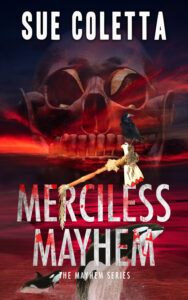 Shawnee and Mayhem continue to wreak havoc on the Killzme Corporation — the largest animal trafficking ring in the country — by killing one poacher at a time. The stakes grow increasingly higher when the nefarious group retaliates by putting a bounty on their heads.
Meanwhile, the traffickers set their sights on capturing Orca for profit and pleasure.
With a ticking clock and no place left to hide, Shawnee and Mayhem alternate between undercover surveillance and clandestine battles to save their loved ones and the Innocent Ones from Killzme’s evil plans. Skills are tested. Tenuous alliances are formed. Not everyone will make it out alive.
Set in a world of cultural wonder, environmental threats, and looming danger, this heart-stopping eco-thriller will have you glued to the page from the first sentence to the last.
Now available for preorder! Steal it for the special preorder price of 99c.
 I recently had a reader comment, “I noticed most of your characters are tea drinkers. Is that because you are?”
 Check out the amazing “Poe Pen” Steve created for monthly giveaways for
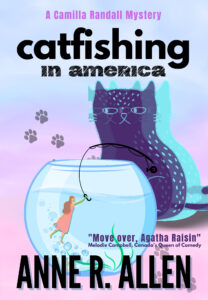
 Anne R. Allen is a popular blogger and the author of the bestselling Camilla Randall Mysteries as well as the Boomer Women Trilogy and the anthology Why Grandma Bought that Car (Kotu Beach Press.) Her most recent mystery is Catfishing in America (Thalia Press) a comic look at romance scams. Her mystery The Gatsby Game is being published in French at the end of this month. Anne’s nonfiction guide, The Author Blog: Easy Blogging for Busy Authors, is an Amazon #1 bestseller that was named one of the 101 Best Blogging Books of All Time by Book Authority. She’s also the co-author, with Catherine Ryan Hyde, of the writer’s guide How to Be a Writer in the E-Age. She blogs with NYT million-copy seller, Ruth Harris, at “Anne R. Allen’s Blog…with Ruth Harris.” You can find them at
  The rhetorical triangle is a concept that rhetoricians developed from the Greek philosopher Aristotle’s idea that effective persuasive arguments contain three essential elements: logos, ethos, and pathos.
 I am fiercely protective of my writing time. Maybe too much. The other day a friend asked me to lunch. At first, I was excited about it, but as I was getting ready, I couldn’t shake the feeling that I’d rather work on the WIP.

 JSB’s post yesterday