
“I love criticism just so long as it’s unqualified praise.” — Noel Coward
By PJ Parrish
So your friend whips out the phone and before you can slither away, out come the pictures of the new baby.
“Look at that face! Have you ever seen a prettier little girl?” new dad beams.
She looks like Karl Malden. What do you say?
- “What a beautiful child!”
- “Yup, that’s some baby you’ve got there.”
- “Are you still within the return period?”
I ask this today because a good friend of mine has an ugly baby problem. The son of her best friend has just published his first book, a sci-fi thriller about the world maybe sorta coming to an end. She read the book while here and says it is terrible. Like terrible in cardboard characters and incomprehensible plot. And now she has to go back and face her friend. Avoiding the writer’s mom is no-go because they play pickleball every week. She asked me what to say because she knows I’ve done a ton of manuscript evaluations and I once made my living as a dance critic.
What did I tell her? I suggested that she say that the genre was not her cup of chai, and thus she isn’t the best person to judge. Which was a true lie. She never reads crime fiction, and the idea of the world ending in ether gives her the creeps. Just to be safe, I read the first couple chapters, and yeah, the book is awful. So I think I told her the right thing. I dunno. I hope so.
I have been in her position. Over the decades, many friends and co-workers have asked me to read their mystery manuscripts, and while none were butt-ugly, not a one was publishable. I gently told them their work needed work before it could be seen in the harsh light of day. (This was mainly in pre-self-pubbing era). Most took it well. Some kept trying, a few quit, one guy never spoke to me again. A good friend, who was trying to write a mystery about retired NFL players, switched to non-fiction and got published by a good small press to great blurbs and national reviews .
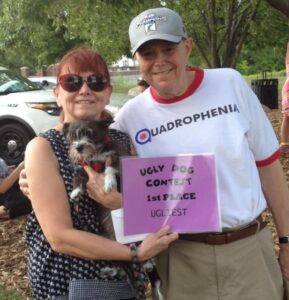
Ugly Dog winner Phoebe with proud parents
Brief digression. I don’t have any ugly kids. I have an ugly dog. So ugly she won the Ugly Dog Contest in Williamston, Michigan. First prize was three bags of golf-ball sized kibble, which I donated to the police canine unit. I also won a gift certificate to J&B Boots, which got me a nice pair of Italian kicks. They wrote a story about my dog in The Williamston Enterprise, which hangs framed in my office.
Giving criticism is a fine art. Our own John Gilstrap wrote about his adventures in critique groupland recently. Click here. It’s a little easier when the person you’re critiquing is a stranger and there’s no face-to-face time. But the basic rule still applies: You need to fair and you can’t crush someone’s spirit. I think about this every time I do a First Page critique here at The Kill Zone. I have a process I always go through:
- First, I read the whole 400 or so words quickly, without any eye toward editing. I try very hard to read it as only a reader would who has just bought the book. Does the opening pique my interest?
- Second, I ask myself: Do I have any prejudices against this TYPE of book that would make me unduly negative or even ignorant? For instance, I’m not a big sci-fi fan, and I’m clueless about what works in YA these days. So I read such submissions with that caveat.
- Next, I ask myself if the submission has something to teach all our readers. It’s not enough to just red-ink grammar mistakes or such. I look for a larger issue in each submission that can help all our writers learn.
- Sometimes, you get a submission that just isn’t up to snuff enough to critique. The writer hasn’t yet gotten the basics of the craft down. I decline to do these.
- Finally, I do a submission only if I can find something good to say about it.
That last one is important. Because I remember how hard it was to get any feedback when I was trying to publish my first mystery back in the late 1990s. Even though I had had four romances published by a big house, I was clueless about mysteries. When I showed my agent my freshman attempt, she told me I didn’t understand the unique structure of a mystery. “Go home and read,” she said. “Start with P.D. James and Michael Connelly.”
Today, when I do a critique, I use the Hamburger Method:
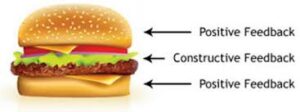
- Start out by staying something nice.
- Insert a big juicy slab of criticism.
- End with saying something encouraging.
A few other things I’ve learned about giving criticism:
Resist the urge to fix the problem. Unless you really have the solution, it’s not a good idea to offer up the answer to another writer’s problem. You don’t know their book; you’re not inside their head. They have to find their way.
Watch your tone. Being snarky is, unfortunately, encouraged in our culture today. Be firm but kind.
Don’t take out your frustrations on someone else. Your own WIP is falling apart. Your plot has more holes than a cheese grater. Your Acer died and your geek can’t do a data retrieval. Don’t take it out on someone else’s baby.
Don’t boost your own ego. Don’t go all alpha dog, using criticism to show how sharp you are. Nobody likes a bully.
Be empathetic. You’ve probably had the same problems the other guy is having. So tell him how you fixed your book’s issues.
Okay, so you’re done reading a friend’s manuscript. Or you’ve been doing your part in the weekly critique group. You’ve been kind, you’ve been constructive, you’re offering up suggestions that you think might cause a light bulb to go off over the other writer’s head. And then…
They turn on you. You don’t understand their genre. You’ve missed their plot points. You’re supposed to hate their protagonist. You’re just biased against second-person omniscient. I call these folks the Yeah Buts. “Yeah, but if you keep reading, things will get clearer.” “Yeah but if you read more dystopian Victorian zombie fiction, you’d understand what I’m going for.”
You can’t help a Yeah But. They don’t want to hear anything except how great their stuff is. Don’t get angry. You did what you could. Smile and walk away. Sometime, an ugly baby is nothing but an ugly baby with an ugly parent.
 I tell would-be writers that there are three things to forget about. First, talent. I used to worry that I had no talent, and it compelled me to work harder. Second, inspiration. Habit will serve you a lot better. And third, imagination. Don’t worry, you have it. — Octavia Butler
 By Elaine Viets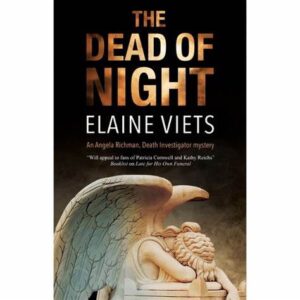

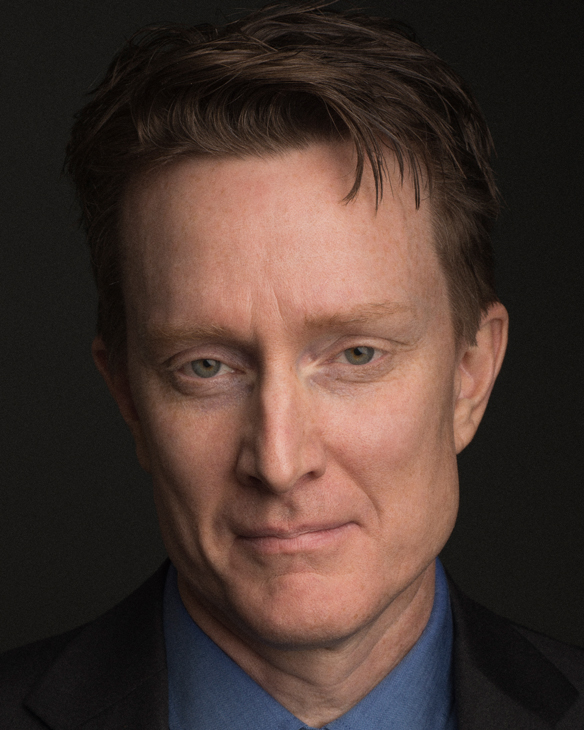 I’m pleased to have Steve “Captain” Marvel, the narrator of my Mapleton Mystery series, as my guest at The Kill Zone today. We’ve been working together for eight novels and a three-novella bundle and since I’m virtually clueless about how someone works with voice rather than fingers, I asked if he’d share a bit about himself and his process. He said he’d check in from time to time, so if you have any questions for him, ask away.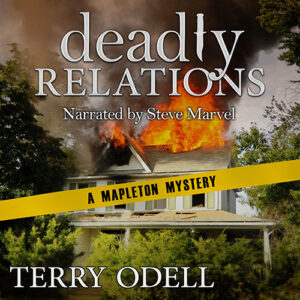
 What’s the favorite part of the job (not counting getting paid!)





 Around 850 A.D. a crew of Scandinavians was sailing around and got off course. They saw some land, and decided to check it out.