Subjectivity of Art

So we all know how subjective an assessment of any novel can be – we see it  all the time in conflicting book reviews, Amazon and Goodreads ratings, or, as demonstrated in every book group I’ve ever attend, the amazing array of reader reactions possible to the exact same book… Instinctively, I think we all know that our work cannot please everyone all the time. How then does a new writer know if the work he or she is producing is going to be of a standard that will attract an agent or editor’s interest? How (at the most basic level) do you know if you’ve written something that’s actually ‘good enough’ for publication?

Most writers I know suffer from a fair measure of self-doubt as well as ambition, and many, by their own account, are never totally sure when they complete a new draft whether others are actually  going to like it. That’s where beta readers, critique groups and manuscript/first page critique sessions come in –  these all provide writers with some initial feedback on their work. This is also where the thorn in every writer’s side comes in – subjectivity. We’ve all heard stories of agents and editors who didn’t like the next book a writer they previously loved  produced, or books rejected dozens of times only to be picked up by that one elusive editor and nurtured to success. Remember how many times the first Harry Potter book was rejected only to then go on to be  bestseller…well, many writers cling to that hope – but how to know when that hope is possibly true or, sadly, unfounded? Art by its very nature is subjective…so how is a new writer to gauge the success of their current WIP without being driven crazy by the spectre of ‘subjectivity’ ?

I admit I am just as plagued by self-doubt as the next writer and even when I think something I’ve written is pretty good I’m never sure anyone else is going to think the same…so when working with my own beta readers/critique partners I adopt the following approach in order to keep my sanity:

  • I ask for both an overall assessment as well as specific feedback on elements in the story that are critical ( e.g. POV, narrative flow and character) or areas where I know I am weakest (hello, plot and structure!). This enables my readers to pinpoint some elements that may not work as well as others (and hopefully avoid the vague “I’m not sure why I didn’t like that bit…” kind of response).
  • I look for consistency of the same feedback. If everyone feels like the POV isn’t as strong as could be, then there’s probably merit in considering reworking it. If only one person doesn’t like a particular element, I may be less sure…and I may need to probe their response a little deeper.
  • I accept the likes and dislikes of my beta readers. All of mine love historical fiction but some have a preference for lighter or darker mysteries, while others aren’t really into speculative or fantasy elements…and so I tailor my feedback requests to take this into account.
  • I reach out to new beta readers/critique partners that represent the readers I am targeting in my current WIP. If it’s a children’s book for example, I think children should give their feedback, not just adults.
  • I realize the limitations of any feedback and try to critically reappraise my own work as well. Just after I’ve finished a draft I’m usually too close to the material to take a step back and process its overall merits. I need to give myself time and space so I can re-evaluate my work – because often your own gut feel is just as important.
  • I try to accept that failure is the only means to achieving ultimate success. No matter the blow to one’s ego, sometimes we have to admit it that something doesn’t work and move on. I strongly believe that each ‘failure’ is an important learning step on the path to success (even if it does suck sometimes!)

What about you? How do you deal with the thorny ‘subjectivity’ issue when it comes to feedback for your own work? What process do you use to gain the confidence that your work really is ready…in terms of being ‘good’,  ‘marketable’ or ‘publication ready’?


From Failure to Success in Writing

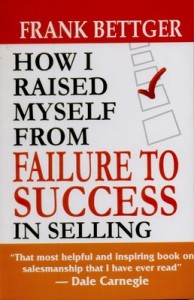
how-i-raised-myself-from-failure-to-success-400x400-imadpwd2t88rkgy8The rah-rah headline for today’s post is borrowed from a book I read as a young man, How I Raised Myself From Failure to Success in Selling by Frank Bettger. It’s considered a classic of sales-training lit. But lots of folks have given the book props for helping them get ahead in other professions, too.

The headline is also apt because I definitely thought myself a failure as a writer when I was in my twenties. The stuff I wrote didn’t work the way I wanted it to, and I was told that’s because you have be born a writer. You can’t learn how to do it.

For ten years or so I accepted that I would never make it in this business.

So I did some other things. I moved to New York to pursue an acting career. Started doing Off-Broadway, Shakespeare, avant-garde. But after awhile I wondered why I wasn’t being offered a starring role in a movie like Raiders of the Lost Ark (they gave it to some guy named Ford).

During a visit back to L.A. I met this gorgeous actress at a party. Knowing I’d be returning to New York soon, I only waited two-and-a-half weeks to ask her to marry me.

Shockingly, she said yes.

After we were married I decided it might be a good idea for us to have one steady paycheck. Since Cindy was the more talented of the two of us, she continued with her stage work while I applied to law school.

In my third year at USC Law I interviewed with a big firm with offices in Beverly Hills.

Shockingly, they hired me.

Later on I opened my own office. And found out I had to be a businessman, too. I had to learn entrepreneurial principles. So I started to read books on business, and one of these was Bettger’s.

A few years went by and the desire to write, with me since I was a kid reading Tarzan of the Apes, came back to me. Bettger’s principles helped me along that path, too.

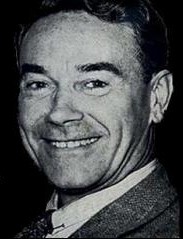
Frank_Bettger_(1888-1981)Frank Bettger was a former big-league ballplayer who went into the insurance game. After initial failures he started wondering if he really had what it took to be a good salesman. He decided to find out what others did. He began to apply a set of practices that helped get him to the top.

The first of these practices was enthusiasm. To sell successfully, you have to be enthusiastic about your product, your prospects, life itself. You need to exude joy, because the alternative is gloom, and gloom don’t sell.

Bettger noticed that if he didn’t feel enthusiastic, he could still act enthusiastic, and soon enough the feeling came tagging right along.

When I discovered you really can learn the craft, I got as excited as a man in the ocean who finds a plank to hang on to and then spots a lush island in the distance. It was enough to infuse joy and hope into my writing, and those two things alone started to improve it.

Another practice Bettger mentions is a system of organization. Make plans, record your results. When I got my first book contract I hadn’t thought through what I’d do for a follow-up. So I got organized. I began planning my career five years ahead, kept track of who I met with and pitched to, who I wanted to meet, and scheduled projects accordingly.

I’d already established the discipline of writing to a quota, but now I started keeping track of my output on a spreadsheet. Starting with the year 2000 I can tell you how many words I wrote on any given day, on what projects, and my weekly, monthly, and yearly totals.

Next, Bettger summarized the most important secret in sales: Find out what the other fellow wants, then help him find the best way to get it.

This got me thinking about pleasing readers. In college I was heavily influenced by the Beats (Kerouac, Ginsberg, et al.) Their writing was idiosyncratic and experimental. But I figured out early that what was idiosyncratic did not necessarily, or usually, connect with a large audience.

I knew I could write solely for myself, ignore genre, be hip (though a lot of the time it was artificial hip). But I wanted to make a living at this, so I backed up and looked for points where my own writing pleasure met with readers’ desire for a good story.

Still, I needed confidence this could be done. Bettger wrote that the best way to increase confidence is to keep learning about your business. Never stop.

The same holds true for writing, both the craft side and the business side.

If you are set on traditional publishing you need to know: What are publishing contracts like? What terms are you willing to accept … or, more importantly, walk away from? What are the characteristics of a good agent? What can you realistically expect in terms of editorial and marketing?

If you are going to self-publish, do you have a plan? Do you know what you need to know? Are you putting in a systematic effort to find out? Are you a risk taker?

In my business life I dedicated at least half an hour a day reading about business principles, thinking, and planning. I do the same thing in my writing life. I read every issue of Writer’s Digest. I enjoy books and blogs on the craft. My philosophy has always been that if I pick up one new technique, or see something familiar from another point of view, it’s worth the effort.

There’s a lot more packed into Bettger’s book, but I’ll close with the part that helped me most, both as a businessman and as an author. It’s his chapter on Ben Franklin’s plan for self-improvement.

In Franklin’s autobiography, he writes about his desire, as a young man, to acquire the habits of successful living. Franklin chose thirteen virtues, such as temperance, resolution, frugality, justice and so on. He made a chart and concentrated on one virtue for a week, ingraining the habit. That way, he could go through his list four times a year.

Bettger followed this plan by choosing thirteen practices that would help him as a salesman, such as sincerity, remembering names and faces, service and prospecting, and so on.

I did something similar with my writing. I formulated what I call the Seven Critical Success Factors of Fiction: plot, structure, character, scenes, dialogue, theme, and voice. By concentrating on these serially, I hoped to raise my overall game.

Bettger’s book helped me at two crucial points in my life––when I had to run a business, and when I made the decision to pursue the writing dream. In both pursuits there are challenges aplenty. Sources of inspiration are critical. I’m glad that ex-ballplayer was around to fire me up.

So what gets you enthusiastic about your writing? When you need an infusion of confidence, where do you turn?

Missing

question mark

Designed by Why Not Associates. All rights reserved.

One of the questions frequently asked of a writer is where ideas are obtained. If you are writing, and find yourself lacking for ideas, I have a suggestion: google “missing persons” and then your local city, county, or even neighborhood.  You will find enough tragedy, heartbreak, and yes, mystery to write volume after volume.

I am haunted by a particular incident that took place less than two blocks from my home. I am blessed to live in Westerville, just outside of Columbus, near a lovely area known as Hoover Reservoir. It’s a body of water that stretches for a few miles and has hiking and jogging trails, fishing opportunities, and a decent sized waterfall. It is also the situs of a disappearance that has baffled our local law enforcement for almost twenty years. A gentleman named Robert Mohney left his home — and a half-eaten steak dinner — on the evening of July 28, 1996 and was never seen again. His automobile — a cherry red Pontiac Firebird — was found in a parking lot at Hoover Reservoir. One reflexively thinks suicide, but no note was found. No, there is the impression of a meal interrupted and a sudden…disruption, perhaps?  Mohney had been going through a divorce but it reportedly was not an unfriendly proceeding; this wasn’t someone, according to those who knew him, who was intent on leaving for the other side. Inquiries were made and the reservoir searched but the man, a good looking guy in his late 20s, was and is gone. Police acting on a tip in 2010 dug up a field in an area north of the city hoping to locate a body and perhaps bring some closure —whatever that is — to Mohney’s family. They came up empty, unfortunately. Mohney is now the subject of high school legend, one in which his spirit can be seen late at night, wandering the banks of the reservoir, seeking peace. What happened to him? How does someone disappear from a popular picnic and recreational area without anyone noticing something? There’s your novel; have at it.

If that doesn’t interest you, here’s another.  Over nine years ago  a second year medical student at The Ohio State University named Brian Shaffer disappeared one night from a very popular campus-area bar and restaurant after becoming separated from friends. Security cameras show him going into the establishment with those friends but never coming out. Law enforcement has spent hours reviewing video and accounting for everyone who entered and left the place. Everyone but one.  Cadaver dogs were subsequently led through the premises but came up empty. There have been rumors a-plenty as to what occurred — everything from sighting in Atlanta to a tie-in with what have become known as the “Smiley Face Murders” — and if you want to feel as if you’re about to slip loose of your moorings, google that term — but nothing concrete has been determined. Shaffer is…gone.

There are more. A number of young women living on the fringes of polite society in a rural area south of central Ohio have disappeared during the past year. I stopped believing in coincidence some time ago; something bad and evil is acting, with impunity, in that area. Further afield, a number of ladies employed in some of the more popular adult entertainment establishments on Bourbon Street in New Orleans go missing under strange circumstances each year. Check out the statistics for the number of people who go missing in your city, your state, your country. There are all sorts or stories, real or imagined, waiting to be told. Be warned: after reading a few of those accounts you will want to take every person you love and keep them close and safe in a locked room. But if you need a story idea, you’re just a few keystrokes away from one, or two, or several.

That’s all I have. Tell me…what’s been happening near you? Are they heavily publicized, or were you surprised by what you found?


Reader Friday: What About Those Millennials?

millennialsA new report finds that Millennials (those born roughly between 1982 and 2000) are less likely to purchase ebooks than any other age group, with 63% of 16-24 year-olds saying they have never bought one, The director of the study said, “[I]t is clear from our research that authors, publishers and retailers must do more to appeal to younger audiences in order to remain commercially relevant.”

What do you think the future is for authors, especially indies living off ebooks, with the Millennials? Will they grow into readers? Will they buy ebooks? Or, with so much vying for their attention, is the very idea of spending time with a novel destined to become a relic of the past?

My Rolling Edit Process

800px-Reader48

Jordan Dane
@JordanDane

I expect to get a few push backs on this post. Many writers use the “draft” process of editing their book after they get it written. They push to get a first draft done before they edit in several more drafts, but for me, I’ve never been able to do this. There’s a compulsive part of my nature that can’t let my own imperfections remain on the page until the end. If I know my book is riddled with my idiosyncrasies, it would haunt me too much, but that’s just me.

I do what I call “rolling edits” because I want to stay close to the action and character motivation at hand. I still get my daily word count in, but I read and reread my daily new material until I have nothing more to edit. In other words, if I write a chapter on one day, I edit it as I continue to move forward until I consider moving on.

Here’s my edit process:

1.) DELETE WITH A VENGEANCE – My first pass is always to delete and tighten each sentence. To help this process, I usually read aloud. Anything I stumble over gets a redo. I have a tendency to use compound sentences, so I make sure not to have dangling participles or long sentences that are hard to follow. I have a two comma rule. Any sentence that needs more than two commas, should probably be broken apart.

2.) LOOK FOR REPETITION (MORE DELETES) – I look for overused words, redundant wording, repeated phrases or “crutch” words that I fall back on too often. This can change from book to book and each author will have their own verbal handicaps.

3.) ADD EMOTIONAL LAYERING – Every scene has an emotional component to it. I push to add more emotion, even if it seems over the top. In fiction, this works because stories are about triggering emotions that the reader can relate to. If the scene is action packed, I’m looking for those delectable word choices to support the action or short viscerally descriptive sentences that will make the thrill palpable to the reader.

4.) REVISE THE DIALOGUE – I read the scene dialogue (without the narratives) to see if I can imagine the characters in my head and hear their voices. If there is humor in the scene, I work to punch it up or improve the timing (usually by deleting). If there is menace in the exchange, I ramp up the threat.

5.) EDIT THE BODY LANGUAGE – I often add body language in each scene as if I am watching a movie, but books aren’t that visual and I can sometimes overdo certain “crutch” reactions, like too many shrugs or nods. Again this is another opportunity to delete usually and it’s worth having a step to look for this.

6.) SPOT CHECK CHARACTER MOTIVATION – Do the characters’ reactions ring true? What if one of them reacted differently, how would that change my scene. I test my character motivation while I am “in” the scene to make sure it feels authentic. As I go through the book and stay close to each character’s story arc, I want the ability to “feel” a different outcome or twist as it is occurring, rather than waiting until the end to realize I like a different turn to happen and have to rewrite major sections.

7.) LAYER IN SETTING – I like to make sure my setting enhances each scene to infuse the action with a setting that is almost like another character. I love writing stories with a strong sense of world building, to make the reader feel as if they can walk the same streets that my characters do, with all their senses.

8.) REMEMBER THE INTIMACY – If my characters have a spark of attraction (that can have it’s own story arc), there is nothing more titillating than mounting intimacy. A glance, a first touch, can be drawn out so the reader feels everything. This can be construed as #3 (adding emotional layering), but for me, a growing romance should carry its own importance. If you can strip out the romance of a story, and the book no longer makes sense, then you have the right balance. This means that the romance is integral. The lovers are “punished” for wanting to be together and they get into more trouble because of it.

ROLLING PROCESS:
As I’ve mentioned, I keep writing my daily word goals, but continue to edit prior scenes (usually a chapter or two previously written) until I’m content to move on. Because I’m old school, I kill a lot of trees by printing out my edit pages and making notes in the margins. Every night I read what I’ve written before I go to bed. My reward is to get my own work done first before I treat myself to reading someone else’s book. The next morning, I make the changes.

By the time I get to the end, my novel is fully edited by me. I usually make one or two more passes through, to read it as a reader might. But most of the major edits are done. When I’m done, I’m done.

I set my daily word count, depending on the contractual due date. The usual range can be 2500-5000 words per day. My advice to other writers, on setting word count goals, is to take into account your priorities and set realistic goals. Even if you can only squeeze in a page a day, that is still progress and you will eventually get done.

DISCUSSION:
1.) How many of you do something similar? Anything you would add to my list?

2.) If you edit in drafts, what tips do you have to make this draft process more effective?

Book Talk Checklist

Nancy J. Cohen

Do you give talks at libraries, bookstores, or community groups? If so, here’s a handy checklist so you don’t forget your essential items.

P1040720

Autographed by Author Stickers Optional; not all readers want a sticker on their signed book.

Book Cover of Upcoming Release

Bookmarks: Yes, readers still like them. And even if your books are only available in ebook format, a bookmark or postcard is a reminder the guest can take home.

Books to Donate: Optional; This works for a library donation or door prizes if you’re a guest speaker at a community group.

Box of Books: Always bring a box or two for when you sell your own; otherwise keep some in your car trunk in case the bookseller doesn’t come through.

Bottle of Water: This isn’t necessary if you’re in a conference hotel that provides water for speakers or if the talk takes place at a restaurant.

Business Cards: Be sure to include your website, blog, and social media URLs.

Calculator: This might be needed if you are selling your own books, or else bring a pad of notepaper to add the cost of multiple copies. Or use your cell phone for this purpose.

Camera: Bring a camera or use your cell phone to take pictures of your event.

Cash: Bring an envelope with small bills for change if you are selling your own books. Consider if you want a credit card app on your cell phone or if you will accept personal checks.

Computer Thumb Drive or Laptop: If you are doing a PowerPoint presentation.

Conference Brochures and Flyers: For your local writers’ group for recruitment purposes.

Handouts: If you are doing a lecture, bring a handout people can take home. It’s always appreciated and stays with them longer than a PowerPoint presentation.

Mailing List Sign-up Sheet: This is the most important item to bring. If you are speaking to a writers group, offer to send new sign-ups a file via email of a related handout of interest to them.

Notices of Upcoming Appearances: If you have a slate of appearances, give it to attendees. They might tell a friend who’ll want to hear you speak.

Printed Promotional Material: i.e. postcards, bookmarks, and brochures for your series.

Sharpie fine point black ink permanent markers: Bring plenty of pens, but not expensive ones in case you lose them.

Wheels: You’ll need to haul boxes of books if you bring your own. Look in luggage stores for folding wheels or put the books in a carry-on size suitcase.

With this handy checklist, you won’t forget anything important. What else would you add?


4 Techniques for Adding Depth to a Scene

shutterstock_187206578Have you ever wondered how to add emotional depth to a scene you’ve written? There are a number of techniques you can use to inject emotional depth and drama into a scene. Here are my top four techniques for scene deepening:

1. Ban the bland

Many writers create a bland main character surrounded by quirky, interesting secondary characters. Let your hero be the one who goes through emotional experiences in the scene. Secondary characters should play off/react to the main character’s emotions, not the other way around.

2. Heighten suspense through avoidance

Have your characters dance around an emotionally charged issue. By hinting at trouble to come rather than addressing it directly, you will avoid “on the nose” writing, plus you will create suspense for your readers.

3. One stimulus, two responses

You can inject some energy into a scene by giving your characters contrasting responses to the same situation in a scene. The following example is a bit of a cliche, but think of the veteran cop who doesn’t blink an eye at a gory murder scene, contrasted with his newbie partner who is quietly losing his lunch in the bushes.

4. The human touch

Seed your scenes with small, human moments. Think of the gruff cop who, after he throws his arrestee into the slammer, offers to buy him a bag of chips from the vending machine.

There are dozens of ways to deepen a story scene. Which techniques have you used, and can recommend?


Essential Answers the Mystery/Thriller Author Must Have

Put ten writers in a room, ask them about their creative process, and you’ll likely get ten different answers varying by approach and degree, and volume. The gamut includes planners, plotters, pantsers, hybrids, muse-followers and in some cases the prayerful, at least when you can get them to admit this as a last resort.

All of these methodologies work (okay, the last one is iffy), though with a diverse range of efficiency and the measure of Xanax consumed.

Some contend they are writing drafts.

And that this – their way – is the only way, it is what writing is at its core and at its best.

Others, while disagreeing, admit they are planning drafts, which is something other than – preliminary to – actually writing a draft.

A debate often ensues.

It is clarifying, as well as stupendously good news, to realize that all of us, in the early stages of story development, and no matter which process we sign up for, are doing exactly the same thing, at least when expressed as an objective. We are searching for our story, culling it from an original notion, trying out ideas, vetting others, seeing what fits, what works, and hopefully tossing what doesn’t.

Different approaches heading toward an identical destination, at least when – either way – it works.  Too often – also either way – it doesn’t.

Storytelling is not an exact science.

There is no math here. Opinion, imprecision, world view, comfort-level and a default do-whatever-Stephen-King-does ethos become the raw grist of the author’s choice.

The reason this is worth noting is that the criteria for – and the moment of – our rounding the corner toward actually writing the story, versus searching for it, is a milestone portending massive consequences.

Because if we haven’t actually completed the search for story – indeed, if we don’t possess the tools and story sensibilities to know when we’ve truly found the best possible story and its beats – then the search draft at hand cannot possibly be just that: the best possible story that awaits us down the storytelling road, the one where everything works.

Same goes for a story plan.  Story sensibility, rather than process, is the hallmark of creating a killer story.

The search for story is essentially a search for answers

… good answers, compelling answers, answers that trump more obvious answers, that when viewed in sum actually become the core elements and essences of the story itself.

But answers to what, specifically?

Answers to questions that define what it is we must discover, what we must know about our story before it can work.  Answers that become the raw grist of effective exposition.

This is often – usually – where experience counts, and mightily.

Rare is the newer author who nails these questions with consistency, regardless of their creative process.

Indeed, it is a dearth of compelling answers that explains the percentage of rejection that defines our avocation. It is why so many breakout first novelists have a drawer full of incomplete and rejected manuscripts that are rarely spoken about. It is evidence that the rumored degree of difficulty has not been elevated casually.

Story planners and plotters seek to find these answers before they write a draft, using them as components of the draft, and thus – in theory – reducing the number of drafts required to reach the Valhalla of “Final” in its highest form.

Pantsers, and to a lesser degree hybrid planners who quietly do a little planning on the sly, use the drafting process as the primary means of story search, which quickly separates that particular sub-demographic into three categories:

– pantsers who, within a draft somewhere down the line, finally do find the best possible answers, thus enabling their next draft to become a contextually solid story that embraces foreshadowing, context and nuance;

– or, pantsers who either believe they’ve found those answers, but have actually lowered the bar because, after all, writing draft after draft can be exhausting and life is short;

– or, pantsers who really do hit on that best possible story in the middle of a draft, which then (tragically) turns out to be the draft they submit, half of which is randomly context-free and the last half context-driven, rather than writing one more (at a minimum) fully-informed draft that has the more likely shot.

The latter is like a college student who, after three years of study, still doesn’t know what their major will be, but during one random night in their senior year bolts upright with an Epiphany that envisions their future, prompting him/her to change their major the very next day.

We all know how that turns out. Usually it means one or more extra, unexpected and unplanned for years of school, because worthy majors have prerequisites that begin back at Square One of one’s Freshman year (pre-med students and science majors: remember Chemistry 101?).

A good novel, regardless of how it got good, depends on context, foreshadowing, nuance and optimal pacing to work, all of it beginning at Page 1, and all of which are impossible if you don’t truly understand – and nail – these questions and their answers, including how the story ends.

I can’t squeeze all 54 of those questions into the space parameters of The Kill Zone.

But I will offer the more foundational questions among them, which experienced pros will recognize immediately, and newer writers and some MFA grads, especially those who are “all about character and theme,” might find daunting.

Here they are:

What is the core DRAMATIC story spine the emerges from your premise, and the DRAMATIC QUESTION it poses?

The key word (fragment) here is drama, not character.

In other words, what is your hero’s primary story problem or opportunity – a.k.a. the plot – expressed as a hero’s quest or journey, motivated by stakes and opposed by an antagonist?

Without a good answer to this one and you haven’t finished your story search.  Try to write this manuscript without that answer and you are virtually assured a rejection and a rewrite.

What is CONCEPTUAL about your premise?

Newsflash: concept and premise are different things. Most new writers don’t know or understand this, and a high percentage of practicing writers and their agents are confused by it. But it’s true. A premise infused with the notion of something conceptual makes a story more intriguing, beginning with the pitch itself.

Does your thriller unfold within the walls of the CIA, or the Herman Miller partitions of an accounting office in Sacramento? Is the hero playing for world peace and survival, or the keys to a stolen Buick? Is the femme fatale seeking to steal nuclear detonation codes, or palming a few lottery tickets when her shift at the 7-11 concludes?

What blocks your hero’s path, and what is the agenda of the antagonist?

In thrillers and mysteries, the worst possible answer sounds like this: “The hero never felt approval from his/her father, and has always felt low self confidence and self-esteem.”

Heroes who are their own primary villains rarely work, especially in mysteries and thriller.

That’s about as dramatic as someone crying as they watch The Bachelor. The degree of external drama – conflict leading to tension – defines thrillers and mysteries, and is necessary to some degree in each and every other genre, as well.

How do you set up your hero’s quest, prior to launching it?

This implies you know what a setup is, and how and where the hero’s quest hits the page for the first time in a fully-informed way (hint: it’s called the First Plot Point, and it happens 50 to 90 pages in, after the setup).

Blow this one and a narrative domino effect of Voldemortesque consequences will follow.

What is your First Plot Point, and how does it change/interrupt the hero’s life and thrust them down a sudden, new and urgent path?

It may or may not be big (thought it often is), but more important is what it means, how it causes the hero to drop everything to react and respond emotionally (fear is often involved), literally thrusting them into the core story.

How does the hero respond to that first encounter with their new mission/quest?

If your answer is they begin kicking butt immediately, then a lesson in classic story structure is required. Rather, the hero has to find their own answers, seeking more information, grasping the magnitude of the situation, enlisting help, or simply fleeing or hiding until they can hatch an informed plan.

Meanwhile, the threat looms and evolves.

How does your story change at the Midpoint, thus empowering the hero toward a more proactive attack on the problem?

New information needs to enter the story here, and it needs to change the story while empowering the hero. The Midpoint twist has its own unique context, pulling the curtain back to reveal a clearer understanding of what’s true and in play for either the reader, the hero, or both.

What does your hero do – decisions and actions – that shifts the odds their way, perhaps after playing catch-up until this point?

Stories should escalate in terms of dramatic tension. When the hero ups his/her game, the villain does the same. So the hero has to really ramp it up after the Midpoint, and it’ll have nothing to do with luck, a fortunate deus ex machina or the troops arriving in the nick of time.

How does your hero become the primary catalyst that brings about the resolution of the story?

Simply put, if someone else saves the day, then make that guy the protagonist in your next draft. Or better, put the ball back in your hero’s hands and call a play with his/her name on it.

To make it work, the author must have full awareness and command of your ending. No saving the hero, no having the hero observe the denouement from the cheap seats. This is where the hero gets his/her hands dirty and earns the name tag.

It’s natural not to know all these answers early in the process.

That’s why we call it the search phase of story development, however you choose to go about it. At first these questions work as criteria for the search, and then, when all the blanks are filled in, as a qualitative standard.

The writer’s sense of that defies process, it is what separates the good from the great, the published from the unpublished.

Pantsers need to know what to pants. Planners need to understand what to plan. Either way, answers emerge and the story progresses, for better or worse. And if you aren’t sure, you’ll know soon enough when you submit the work.

With these questions and some stellar answers in your quiver, the story may exceed even your own highest expectations, especially if you don’t settle for the first idea that fits the moment in question. Rather, cultivate a better, fresher and more emotionally resonant answer that will make an agent, editor or reader leap from their chair and throw money at you.

That’s the real story, after all.

****

If you want to dive deeper into the middle of your novel, I have an ebook on this subject:
Middle cover

Also, TKZ’s James Scott Bell has a great ebook on this topic, as well.


Writing Blunder #14: No Push Through The Door

enter-27853_1280Structure is my beat.

My book Plot & Structure (Writers’ Digest Books) is the foundation. It was a labor of love from someone who was told you can’t learn to be a writer, that the ability to plot was something you had to have born into you, that you might as well sling hash if you think you can write for a living without “it” being in you from birth.

I believed that twaddle for a long time. I lost ten good years of a writing life because of the chuckleheads who said you can’t learn to write fiction.

When I sat down to try—because I wanted to be a writer more than anything, and just had to give it a go, even if I failed—I began by studying structure.

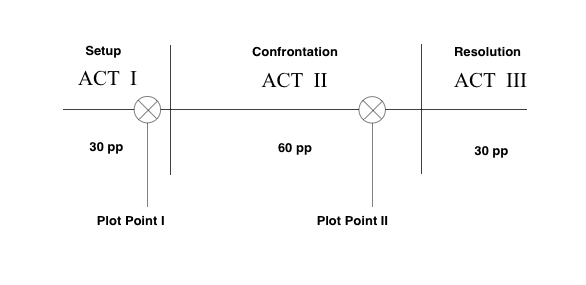
At the time, the big structure book was Screenplay by Syd Field. Field said there were three acts in a good movie, with Act I comprising the first quarter of the running time, Act II half the time, and Act III the last quarter. He then determined there were two “plot points” that occurred to move the action from Act I to Act II, and from Act II to Act III. His “paradigm” looked like this:

Field Paradigm

All well and good. But as I studied this out I got hung up on those plot points. What Field said they did was “spin the action around” in another direction. I could not figure out what that meant. Was it any random action? Because there are an infinite number of actions and an infinite number of directions a story can take.

Determined to find out what I was missing, I spent a year watching movies with a blank paradigm sheet in front of me. I divided the running time of a movie into quarters, and kept an eye on that first quarter, Act I, looking for the secret to the plot point.

I finally found it.

And dubbed it the “Doorway of No Return.” The key is this: Something pushes the Lead into the confrontation with death in Act II. The Lead has to be forced through, because no one wants to fight with death.

We want to stay in our nice, comfortable world and enjoy life as we know it.

We can’t let that happen to the Lead! A novel or movie does not become the story until the Lead is forced to fight death, which is what Act II is all about.

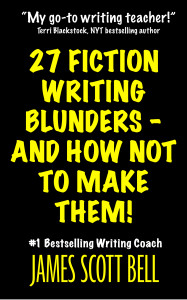
Not pushing the Lead through that first doorway is #14 of the 27 writing blunders I take on in my new book:

27 Blunders front cover.001

It’s a doorway of no return because the Lead can’t go back through the doorway to the old life. If he can, it’s not a true break into Act II.

When you do this right, the reader will go right along with you.

But if you don’t force entry into Act II, the story will feel weak. Unmotivated. Manipulative.

Note this, too. You must force that entry by the 1/5 mark of a novel or the 1/4 mark of a movie, or the story will start to drag.

Let’s look at some examples:

The Wizard of Oz. At the 1/4 mark, Dorothy is taken, physically, to the Land of Oz. She can’t go back through the Doorway. There is no return. She has to make it through the rest of the plot, and survive, in order to go back.

The Fugitive has the train wreck and escape in the first act. Then Tommy Lee Jones and his team of trackers show up. He immediately figures out Kimble has escaped. He orders roadblocks and a complete area search. “Your fugitive’s name is Dr. Richard Kimble,” he says. “Go get him.”

That line is exactly one quarter of the way into the film. See what’s happened? All the essential elements of the story are in place: escaped man and his opponent. They have competing agendas. Death is on the line. If Kimble is caught, he’s toast. Death Row will be his final stop.

The first doorway can be an emotional push if it is strong enough to motivate the character into the death struggle.

That’s what happens in Star Wars. Luke’s Aunt Beru and Uncle Owen are murdered by Imperial stormtroopers searching for the droids C-3PO and R2-D2. Up to this point, Luke has only dreamed of going off on adventures. His loyalty to his aunt and uncle kept him on his home planet.

Now, though, he is experiencing loss and the desire to fight. He will go off with Obi-Wan Kenobi and learn the ways of the Jedi and join the rebellion.

Ask yourself this: When does your Lead character get forced—by an action or strong emotion, or both—into the main conflict of your story?

Be clear in your own mind, and on the page so the reader will have no doubt.

Then place that scene before the 20% mark of your word count.

Do those two things, and your novel will not feel like a drag!

***
This post is adapted from 27 Fiction Writing Blunders – And How Not To Make Them! (Compendium Press). The book is available now:

KINDLE

NOOK

KOBO

iBOOKS

PRINT VERSION