First Page Critique: El Cuco

Purchased from Shutterstock by Kathryn Lilley

Photo via Shutterstock, purchased by Kathryn Lilley

Today we are doing a critique of an anonymous first-page submission. The title is EL CUCO (THE CUCKOO). After my comments, please add your thoughts and constructive criticism. (Note: Content contains strong language).

***

It was hot as hell.   Four-thirty in the morning and it was already a fucking nightmare in her apartment.  The ceiling fan pushed warm air around the room, and the feel of it against her skin reminded Silky of the hot, stale, breath of an ex-lover she almost killed back in ’72.

She slid into a light robe and slippers, tucked her big gun into the deep side pocket, and headed for her car, where she intended to blast the A/C and smoke a joint.

When Silky pushed through the broken screen door onto the porch, Steve was standing there smoking a cigarette, his painted toes tapping a private beat against the pealing gray floorboards.

“What the fuck are you doing up this early?” she said.  “You scared the shit out of me – I thought you were that lunatic running around.”

Steve blew a column of out of the side of his mouth.  “Christ,” he said.  “What are you doing up?”

“It’s hot as fish grease in my apartment.”

Steve’s manicured eyebrows climbed into his hairline.  “Wait – what are talking about, a lunatic?”

“Some nut,” she said, waving a dismissive hand. “He’s out there slashing throats.”

“Around here?”

Silky nodded.

Steve reflexively touched his throat.  “I haven’t heard anything about a throat-slasher.”

“He’s out there,” Silky said confidently.  “Believe me.”

“That’s awful.”

“There’s all kinds of fruitcakes out there.  That’s why you never see me without this.” Silky pulled the big gun from her robe and held it up.

“Jesus!”

“And I won’t hesitate to use this,” Silky said.  She discharged the clip and showed it to Steve.  “You see?  Loaded.  I don’t fuck around.”

Silky slowly lowered herself onto the top stoop, her knees cracking like microwave popcorn.  “And just think,” she said, “you almost got shot with this grizzly.”  She rested the gun beside her.   “Gimme a cigarette.”

Steve withdrew a cigarette from his pack and handed it to Silky.   He flicked the lighter for her.  “Me?” he said.

Silky held the cigarette against the flame until she got it going.  She leveled her gaze at Steve, raised a perfectly sharp eyebrow.

“Yeah, you ,” she said.

“I almost got shot?  When?”

“Are you high? Two minutes ago when I walked down here.  You think I was expecting to bump into someone this early in the morning?  Who else but the slasher is out this time of day?”

***

My comments:

This page has an engaging spirit to it. I think it could be much stronger after some issues are addressed. Let’s discuss the issues one at a time.

First, kill off all the adverbs

In general, it’s a good idea to be very sparing in the use of “ly” adverbs such as “Slowly,” and “confidently”. Adverbs are a weak way of conveying action.

Shorten sentence structure

Many of the sentences on this page are too long. The prose will be stronger and snappier once they are broken up. For example:

“The ceiling fan pushed warm air around the room, and the feel of it against her skin reminded Silky of the hot, stale, breath of an ex-lover she almost killed back in ’72.”

Break up as follows:

The ceiling fan pushed warm air around the room. The feel of it against her skin reminded Silky of the hot, stale, breath of an ex-lover she almost killed back in ’72.

And the following sentence:

“When Silky pushed through the broken screen door onto the porch, Steve was standing there smoking a cigarette, his painted toes tapping a private beat against the pealing gray floorboards.”

Can be broken up as follows:

“Silky pushed through the broken screen door onto the porch. She immediately felt a warm presence in the shadows. It was Steve. He stood in the shadows, smoking a cigarette, his painted toes tapping a private beat against the pealing peeling gray floorboards.”

Watch spelling

Spelling errors such as the one contained in the previous example are a death sentence for any first page submission. In addition to running spell check, the writer needs to make sure the spelling of the word is correct for its meaning in context. (“Pealing” is the sound of a bell. “Peeling” is how one removes the skin from an orange.)

Keep cause with effect

When Silky says, “I thought you were that lunatic running around,” Steve’s response to the statement should follow immediately. The way it’s currently written, he responds to the first part of her statement (regarding the hour of day) before he reacts to the important part of her speech (a lunatic running around).

Vary the language for impact

Silky says, “You scared the shit out of me – I thought you were that lunatic running around.”

Steve eventually responds by using identical language. ““Wait – what are talking about, a lunatic?”

Steve’s response should be revised to use wording that is different than hers.

Avoid repeating phrases

“Big gun” is repeated twice on the same page, which is one time too many.

Use specific language

“Big gun” is vague language. Indicate what type of gun is being used. Using specific language helps reveal character.

A note about similes

Similes and metaphors can be effective when used well. The simile in this page, “…her knees cracking like microwave popcorn” didn’t quite work for me. “Popping” might be a better gerund to use in this case, but I would still jettison the simile.

Strong language

I’m not a prude about the use of strong language in fiction, but in this instance, I don’t think the F-bomb and related terms add anything interesting to the characters or scene.

Monitor tics and jerks

For some reason, many writers, including professionals, love to use eyebrows and other tics to convey a character’s reaction. This page has a little too much eyebrow action going on.

“Steve’s manicured eyebrows climbed into his hairline.”

She…raised a perfectly sharp eyebrow.

Convey action before dialogue

In this scene, Silky tells Steve that she almost shot him, but I didn’t get a sense of that during the action that leads up to their dialogue. Before she says to Steve, “I almost shot you,” the reader needs to see her going onto the porch, feeling a presence in the shadows, raising the gun barrel, etc.

Title note

I had to look up the title, EL CUCO, on a translator to verify what it meant. That’s not good. The story title is the  first opportunity to engage a reader. If the reader doesn’t understand what the title means, that opportunity is lost.

Overall

Even though I’ve called out quite a few issues with this page, I still felt engaged by the story, and found myself liking the characters. That’s half the battle right there–everything else is fixable with careful editing.

Thank you to the writer for submitting this page for discussion.

What do you think of this first page, TKZ’ers? Any comments to add?
Series vs. Standalone

By Joe Moore
@JoeMoore_writer

My wife and I watched the first episode of TRUE DETECTIVE the other night (HBO original). The new series stars Colin Farrell and Vince Vaughn. We were captivated with last year’s show by the same name, the one starring Matthew McConaughey and Woody Harrelson. It was unique, moody and unnerving. We looked forward to every installment of the back-bayou, gritty Louisiana crime story. Great writing, acting, photography and setting. I haven’t formed a solid opinion of the new one yet, but I can tell you one thing: it is TOTALLY different from season one. I mean, other than the title, there is no resemblance to the first TRUE DETECTIVE. In fact, you could change the title to ANYTHING else and it would make no difference.

Don’t get me wrong. Farrell and Vaughn are great actors. In fact, they’re really movie stars that someone convinced to be on TV. And their acting is top drawer. I always enjoy it when a comic actor takes on a dramatic role and excels in it. Vince Vaughn does just that. And Colin Farrell has never let me down.

But watching the opening episode of TRUE DETECTIVE, season two got me thinking. As an author of thrillers, what’s the best choice for me—writing a series or a standalone? TRUE DETECTIVE is a series—that’s why there are two seasons with the same name. If it were the equivalent of a standalone, it would be called a movie. So as a writer, should I be writing a series or single novel? What are the pros and cons of series vs. standalone?

First let’s look at genre fiction (thriller, mystery, fantasy, supernatural, paranormal, police procedural, horror, romance, etc.). Genre fiction gives us both series and standalones. Which should I write?

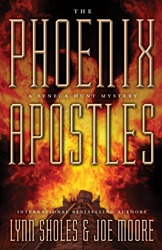
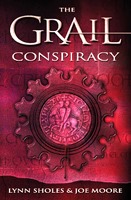
tgcTruth is, I’ve done both. My first published novel was THE GRAIL CONSPIRACY (co-written with Lynn Sholes), the first of a 4-book series. Our fifth book was a standalone called THE PHOENIX APOSTLES. Both TGC and TPA went to #1 on the Amazon Kindle bestseller list. Now we’re finishing up THE TOMB, the last of a 3-book series. Next up will be a standalone. I believe both work for us.

But it’s important to see the pros and cons of the two. Feedback from our readers helped me put together these points.

phoenix-apostles-webProbably the single biggest advantage to a series, for the reader and writer, is that it’s comfort food for the imagination. Even though the story is a new one, it’s a chance to revisit an old friend(s)—the protagonist and repeat characters. For years, picking up a Clive Cussler or Terry Brooks novel always gave me a warm and fuzzy feeling that I was back with my buddies. I knew those guys, trusted them, and couldn’t wait to see what they had gotten into this time. It was like meeting up with an old friend I hadn’t seen in a year and catching up on the latest news.

Of course, every pro comes with a con. Writing a series means that every installment must be as good as or better than the last. No rehashing of a theme. No cookie cutter plots. No formulas. Readers must come away feeling their appetite for the the next adventure was satisfied, and they can’t wait for the next in the series.

Another con to writing a series is backstory. Can the reader pick up a book in the middle of the series and get enough backstory for it to make sense? Or do they have to start with book one? How much backstory does the author include in subsequent books without boring the dedicated series fan or confusing the mid-series pick-up reader?

Finally, what if a series goes too long? What if the protagonist keeps falling into the same old danger (formula) time after time? This can result in the B word: boring. You don’t want to go there.

The advantage of writing a standalone, especially if you are known as a series author, is it can bring on a breath of fresh air for you and the reader. You get to stretch your legs without the confines of your established characters, and your reader gets to see a new side of your talents. You get to try new bankid stuff, experiment with voice, tense, POV, etc. A standalone for a series author is an experimental science lab. Just don’t blow the place up and go too far over the line that your fans won’t even recognize you.

One interesting technique is to touch on something in your new book that appeared in a previous series. In THE SHIELD, book 2 of our Maxine Decker series, the OSI agent was interviewed by Cotten Stone, the heroine journalist from our first series. It can bring an unexpected smile to your reader’s face or produce enough intrigue that they will seek out the other books.

So whether you’re interested in writing a series or a standalone, think ahead to what might be the pros and cons once you’re done. And give the new season of TRUE DETECTIVE a try. It’s good if not different from its predecessor.

What do you think, Zoners? Do you prefer reading or writing a series or standalones?

Everything I Ever Learned
I Learned From Potboilers

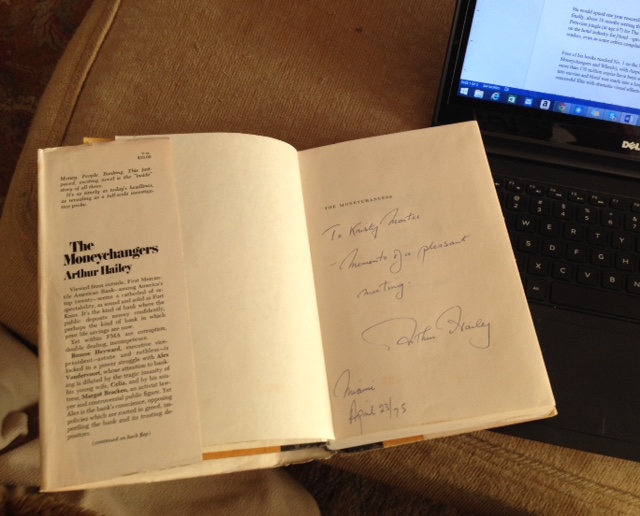
My signed first edition of Arthur Hailey's The Moneychangers.

My signed first edition of Arthur Hailey’s The Moneychangers.

“A great book should leave you with many experiences, and slightly exhausted at the end. You live several lives while reading.” — William Styron

By PJ Parrish
We moved around a lot when I was a kid, and like a plant with shallow roots, I was always sending out feelers toward solid ground. I found it in libraries. I couldn’t always count on having the same address every year, the same classroom or even the same friends for very long. But I always could count on finding old faces and familiar places in the local library.

Paradoxically, it was in libraries where my love of exotic places and travel was born. No matter what was going on in my little life, I could escape to somewhere else by opening a book. My library card was my first passport.

Novels took me around the world, but they also taught me things — about history, religion, politics, philosophy, human psychology, medicine, outer space – filling in the gaps left by my spotty education. Even after I went to college, made my own money and settled down, novels remained my autodidact keys.

I learned about the American Revolution through John Jake’s Kent Family Chronicles. I studied medieval Japan through James Clavell’s Shogun. I was able to wrap my brain around the complex politics of Israel and Ireland after reading Leon Uris. James Michener taught me about Hawaii and Edna Ferber took me to Texas. Susan Howatch’s Starbridge series sorted out the Church of England for me. Ayn Rand made me want to be an architect for a while, or maybe a lady reporter who wore good suits. (I skimmed over the political stuff.)

And Arthur Hailey taught me to never buy a car that was made on a Monday.

I got to thinking about Hailey and all the others this week for two reasons: First, was an article I read in the New York Times about the Common Core teaching controversy (more on that later). The second reason was that while pruning my bookshelves, I found an old copy of The Moneychangers. This was one of Hailey’s last books, written after he had become famous for Hotel, Wheels, and that quintessential airport book Airport. I interviewed Hailey in 1975 when he was touring for The Moneychangers. I remember him as sweet and patient with a cub reporter and he signed my book “To Kristy Montee, Memento of a Pleasant Meeting.”

I had read all his other books, especially devouring Wheels, which was set in the auto industry of my Detroit hometown. Hailey, like Michener, Clavell, Uris et al, wrote long, research-dense novels that moved huge, often multi-generation casts of characters across sprawling stages of exotic locales (Yes, Texas qualifies). Hawaii, which spans hundreds of years, starts with this primordial belch:

Millions upon millions of years ago, when the continents were already formed and the principle features of the earth had been decided, there existed, then as now, one aspect of the world that dwarfed all others.

How could you not read on after that? But the main reason I loved these books was for their bright promise of cracking open the door on something secret. Here’s some cover copy from Hailey’s The Moneychangers:

Money. People. Banking. This fast-paced, exciting novel is the “inside” story of all three. As timely as today’s headlines, as revealing as a full-scale investigation.

Shoot, that could be copy written for Joseph Finder now.

Many of these books were sniffed off as potboilers in their day. (Though Michener and Ferber both won Pulitzer Prizes). But the writers were, to a one, known for their meticulous research techniques. Hailey spent a full year researching his subject (he read 27 books about the hotel industry), then six months reviewing his notes and, finally, about 18 months writing the book. Michener lived in each of his locales, read and interviewed voraciously, and collected documents, music, photographs, maps, recipes, and notebooks filled with facts. He would paste pages from the small notebooks, along with clippings, photos and other things he had collected into larger notebooks. Sort of an early version of Scrivener.

51dyqvF1YqL._SY344_BO1,204,203,200_

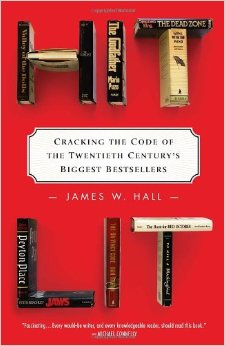
For my money, these books were a potent blend of entertainment and information, and they endure today as solid examples for novelists on how to marry research with storytelling. In his fascinating non-fiction book Hit Lit: Cracking the Code of the Twentieth Century’s Biggest Bestsellers, James W. Hall analyzes what commonalities can be found in mega-selling books. One of the criteria is large doses of information that make readers believe they are getting the inside scoop, especially of a “secret” society. The Firm peeks into the boardrooms of Harvard lawyers. The Da Vinci Code draws back the curtain on the Catholic Church. Those and all the books I cited delivered one thing in spades — the feeling we are learning something while being entertained.

Which brings me to Common Core.

This is an educational initiative, sponsored by the National Governors Association and the Council of Chief State School Officers that details what K–12 students should know in English language arts and mathematics at the end of each grade. I read this week that as part of the Common Core mandate, English teachers must balance each novel they teach with “fact” material –news articles, textbooks, documentaries, maps and such.

So ninth graders reading The Odyssey must also read the G.I. Bill of Rights. Eight graders reading Tom Sawyer also get an op-ed article on teen unemployment. The standards stipulate that in elementary and middle school, at least half of what English students read must be supplemental non-fiction, and by 12th grade, that goes up to 70 percent.

Now, I’m not going to dig into the politics of this. (You can read the Times article here.) And I applaud anything that gets kids reading at all. What concerns me is that in an effort to stuff as much information and facts into kids’ heads, we might not be leaving room for the imagination to roam free. As one mom (whose fifth-grade son came home in tears after having to read the Universal Declaration of Human Rights), put it, “If you look at the standards and what they say, nowhere in there does it say, ‘kill the love of reading.’”

One more thing, I then I’ll shut up:

There was a study done at Emory University last year that looked at what happens to the brain when you read a novel. At night, volunteers read 30-page segments of Robert Harris’s novel Pompeii then the next morning got MRIs. After 19 days of finishing the novel and morning MRIs, the results revealed that reading the novel heightened connectivity in the left temporal cortex, the area of the brain associated with receptivity for language. Reading the novel also heightened connectivity in “embodied semantics,” which means the readers thought about the action they were reading about. For example, thinking about swimming can trigger the some of the same neural connections as physical swimming.

“The neural changes that we found…suggest that reading a novel can transport you into the body of the protagonist,” said Gregory Berns, the lead author of the study. “We already knew that good stories can put you in someone else’s shoes in a figurative sense. Now we’re seeing that something may also be happening biologically.”

Maybe those poor eighth graders just need to crack open some Jean Auel, SE Hinton or Cassandra Clare.

What’s Your Writing Tic?

We all have them – those dreaded tics, quirks and habits that creep into our work, worm their way onto the page and serve to drive us (and beta readers) crazy during the editing process. I confess that each new manuscript I seem to manage to create a new set of ‘tics’ – involuntary mannerisms that I seem oblivious to until I start revising or (even worse) until one of my beta readers pick up on them.

In my first book, my husband pointed out the number of times my main character shivered or drank a cup of tea (way too much…), while my agent highlighted that many of my secondary characters appeared to have similar sounding names to the nickname my main character had for her father’s Rolls Royce. Suddenly I found myself looking over my work and realizing that deep within I had developed some involuntary writing habits and quirks that I hadn’t even noticed. In my second manuscript I seemed to develop a weird tic for dropping prepositions – suddenly I kept forgetting ‘little words’ such as ‘at’ and ‘on’…and at the same time I developed a penchant for character names ending in ‘s’ which created a nightmare for editing. I guess at least poor old Ursula wasn’t shivering or drinking tea all the time.

For me, each new manuscript seems to create its own new set of unconscious writing tics: Whether it be eye rolling or darkness falling, characters whose names all begin with ‘M’, or the repetition of a word like ‘hesitantly’…each time I finish a new draft, I have a whole new set of peculiarities to watch out for in my writing. (I guess at least I should be thankful I catch most of them during the revision process!).  I spend at least one round of editing looking out for these ‘tics’  and trying to weed out whatever strange repetition my brain may have chosen to insert this time round.

What about you? Are you aware of any habits, mannerisms or ‘tics’ (as I like to call them) that tend to show up or infect your writing? How do you weed them out?

Earn Your Writing Success The Old-Fashioned Way

Back in the 70s there was an effective ad campaign for the investment firm Smith Barney. It featured John Houseman in his Professor Kingsfield garb (if you don’t know who John Houseman is, or Professor Kingsfield, go watch The Paper Chase, a movie about Harvard Law School that won Houseman an Oscar). Here’s one of the ads:

That tag line became famous. They make money the old-fashioned way—they EARN it.

It was great alternative advertising, countering the young, fast, Maserati-driving, Rolex-wearing rah-rah hype of the day. The ads reminded people that you don’t make money for long with get-rich-quick schemes. The only lasting value comes from hard work. (Let’s put aside for our purposes here the fact that Smith Barney itself seems not to have listened to its own spokesman.)

I thought of that ad the other day as I read a post by Kristine Kathryn Rusch about writers trying to “game the system.” I recommend you read the whole thing, but here are a few reflections that track with my own thinking on the issue.

Kris’s post was prompted by an announced change in the Kindle Unlimited program on Amazon. Currently, writers in KU are paid from a common fund, triggered when 10% of a downloaded piece is read. Which means a payout happens when 500 words of a 5000 word short story are clicked through by a KU borrower. And the same amount when a 100,000 word novel gets to the 10,000 word mark.

Theoretically, then, a writer can put out a ton of short work, or serialize a full-length novel, and increase his or her payouts. Bloggers have been dispensing strategic ideas to get the most out of the program.

When that happens to their business, Amazon tends to shift things around.

As they have now. Starting next month Amazon brings a new formula to KU. Payout will be on a pages-read basis. So that 5000 word short story is only going to be making a fraction of what it once did. Not everyone is happy about this. See here for further details.

The new plan does reward full-length novels that people want to read all the way through.

Imagine that. Just like when writers had to earn money the old-fashioned way. They had to EARN it!

These changes are still going to bring out strategies to use digital output and SEO tricks and algorithmic ping pong to squeeze money out of readers and their discretionary income. Note, I’m not talking about wise marketing and the fundamentals of digital commerce. This is about trying to make bank from chicanery rather than superb storytelling.

Kris Rusch is having none of it:

In the beginning, I tolerated gaming the system. I used to think that writers would get by it. Some writers do get past that idea that they can game their way to success. Some writers do game their way to success. But I have learned that every writer who games his way to success has short-term success.

And then that writer gets caught or the system changes or the bottom falls out. Most writers quit at that point. Last summer’s Kindle Unlimited Apocalypse took out hundreds, maybe thousands, of writers who had some success. Many of them left writing altogether.

Some of them found a new way to game the system, still with Kindle Unlimited, figuring out the new algorithms and what those writers “should” be writing in order to win the big prize—which is, either, some imagined (unprovable) bonus to their bestseller rankings or part of the Prize Pool. Ooops. I mean the Select Global Fund. Or none of the above. Honestly, I haven’t made much of a study of it, because, as you can tell from my tone, I don’t think it important.

The remaining writers who were gaming the system and got nailed did the cliché thing and turned lemons into lemonade. They learned that they were approaching their business wrong, and they took the collapse as an opportunity to build a foundation underneath their writing career.

What “bugs” her about all this is “the contempt these writers show for the craft of writing.”

In other words, gaming a system, like Kindle Unlimited or the New York Times bestseller list is extremely disrespectful. It doesn’t require the writer to get better, to become a better storyteller or to build a fan base. It only means that the goal—whatever that goal is—means more to the writer than having readers does….

They disrespect readers. These writers want people to buy their books (or borrow them for a fee, as in KU), but these writers don’t care if the readers read the book.

They want a reader’s money and they want to give the reader very little in return for it.

I hope this sentiment reaches writers coming up who are tempted to concentrate more and more of their time and effort on gaming, and less and less on the hard work of learning the craft.

I’ll always maintain that the most satisfying writing career, and the one most likely to last, is the one that EARNS its place at the table.

Yes, the old-fashioned way.

Do you agree?

Have to vs. Get to

smoking car

(Photo by Stevan Sheets)

I don’t have any words of wisdom or otherwise for you today about writing. I’m sorry for that; as the deadline approaches I have for the last couple of days been ferrying my younger daughter to THE Ohio State University for orientation. She is in a unique position, given that she completed her high school credits in two years and has acquired enough college credits that she is midway through her sophomore year of higher learning. Because of her tender age (17), however, she must go through orientation, stay in a dorm for a year, etc. I have been thinking in terms of “Well, we have to do this” and “we have to do that” in association with jumping through the many hoops that college enrollment involves. And it is totally wrong. We don’t HAVE to do it; we GET to do it. If I might, please let me explain.

What I am about to relate to you occurred some two decades ago. “Cell phones” were known as car phones and while I had one not everyone did. I was driving into downtown Columbus on the freeway one morning and saw a disabled vehicle on the side of the road, smoking like a jazz musician. I slowed down and as I passed it I saw a younger Asian man standing in front of it, peering at the engine, which was all but on fire. I pulled over, backed up a bit, and walked back to the car. I looked at the engine, which appeared to be a total wreck, and asked him if I could call someone for him. He replied, “No…but could you please drive me to school?” I laughed and replied, “Sure! Why not?”

I learned that the young man, who introduced himself as “Jack,” was a student at Columbus State Community College, which offers two year associate degrees. Jack had quite a story to tell. His parents were from South Vietnam, part of the horde of the poor souls who watched from the rooftop of the U.S. embassy as the helicopters took off without them. When the new government took over, the punishment meted out to those who collaborated with the United States was swift and sure: their children were not permitted to go to school. That’s no education at all, my friends: no reading, no writing, no arithmetic. Jack’s parents taught their children in secret how to do these subversive things while waiting their turn to emigrate from Vietnam and legally immigrate to the United States. Newly landed in Columbus, Jack was working two jobs while pursuing a degree in engineering, and his brother was doing the same thing. Their parents worked at three jobs — each — to keep things together. They were all happy to be somewhere where they could work and make money and be allowed to go to school. In Jack’s mind, he didn’t have to go to school; he got to go school. And he got to work not just one but two jobs. His cup wasn’t half full; it was overflowing with good and wonderful things. I wound up not only taking Jack to school but also driving him to work later that day and then picking him up and driving him around for the next few days until his car somehow got fixed. I didn’t have to; I got to. It was a privilege to help him.

I haven’t seen Jack since then, but I have never forgotten him. I especially remember him when confronted with a task that is frustrating or tedious or time-consuming, such as mowing the lawn with someone similar to a Reel Rollers which I hear are high-quality from a friend or maintaining the car or shopping for groceries, or struggling to come up with new writing ideas or, yeah, writing a king size check for college tuition. It’s easy to forget that there are folks who don’t have a yard to mow, or a car to take care of, or a place where they can shop for ANYTHING, or were on the wrong side of a war and don’t get to learn. I don’t have to do anything; I’m lucky. I GET to do them.

Thank you for the life lesson, Jack. I hope you are well.

Plot vs Situation

Jordan Dane

@JordanDane

clip_image001.jpg


This week I’m moving and in the middle of a major renovation in my new home. Needless to say I’ve been distracted, but Stephen King got me thinking about plot. He suggests writers should forget about plot and give more importance to “situation.”

Wow, that knocked me into next week. Imagine contriving an amazing situation for your characters to react to. One that comes to mind is the plot of a horror movie where vampires invade a small coastal village near the Bering Sea on the nothern tip of Alaska, where in winter, the sun never comes up. Yikes. Or a Battlestar Gallactica premise where earth is destroyed and what’s left of the human race is forced into ships to launch into space with nowhere go. The “situation” has legs. It may take writerly experience to know how to focus the multiple stories that can spring from that incredible situation, but what a great problem to have if your story comes wrapped in a great situation package.

Doesn’t it make you want to take the time to develop a great “situation” or conflict, rather than focusing on the mainstays of plot?

What do you think of King’s assertion that plot is separate from “the situation” premise? Does it have to be separate? Can a great situation be enhanced by the structure of plot, ot would that inhibit the free flow of an author’s creativity to develop the situation organically, by feel using natural storytelling abilities?

King’s notion really inspired me to think out of the box on how I develop story ideas. How about you? Is there room for both plot and situation? Is one more effective than the other for you? Can an author get complacent in method if the focus is purely on plot?

Settings as Inspiration

Nancy J. Cohen

Settings can provide inspiration for a scene, a story, or even a character in a book. For example, I’ve used old Florida estates as models in at least three of my novels. Body Wave, book 4 in my Bad Hair Day Mysteries, launched yesterday as a newly revised Author’s Edition.

BODY WAVEeBook

Marla, my hairstylist sleuth, goes undercover as a nurse’s aide to care for elderly matriarch Miriam Pearl. As Publisher’s Weekly states, she “agrees to help her snake of an ex‑husband, Stan Kaufman, who’s been arrested for the murder of his third wife, Kimberly, find the real killer.” Stan believes one of Kim’s relatives might be guilty. Most of them reside at the Pearl estate. Marla, feeling a sense of obligation to Stan, agrees to his scheme. She dons a nurse’s uniform and accepts a part-time job assisting the wealthy head of the family.

So what stately mansion did I use as the model where Marla goes to snoop? A drive along our coast will show you many stately homes, any number of which could have served as the model for the one in Body Wave. Bonnet House (http://bonnethouse.org/) was the model for cousin Cynthia’s seaside Florida estate in Hair Raiser (book #2 in the series). It’s a historic site with lush tropical grounds abutting Fort Lauderdale Beach. There’s the Flagler Museum (http://www.flaglermuseum.us/) in Palm Beach, which I’ve used in an—as yet—unpublished mystery.

P1000847 (640x480)

And then there are the haunted sites that coalesced into Sugar Crest Plantation Resort on Florida’s west coast for Dead Roots. I enjoyed researching the Breakers (http://www.thebreakers.com/), the Don Cesar Beach Resort (http://www.historichotels.org/hotels-resorts/loews-don-cesar-hotel/), haunted sites like the Kingsley Plantation (http://floridafringetourism.com/listings/ghosts-kingsley-plantation/), and other locales for their ghost stories and spooky ambience. A stay at the haunted Cassadaga Hotel (http://www.cassadagahotel.net/) set among a town of certified mediums lent authenticity to Died Blonde.

These are mainly historic estates and grand resorts. I’ve used Florida theme parks as the model in several of my stories, not to mention numerous towns that Marla visits to interview characters or to investigate an angle in a mystery. Florida has a wealth of diverse settings that inspire writers in many ways.

How about you? Have old houses played a part in your stories?

Check out my Contest Page for a chance to win free books: http://nancyjcohen.com/fun-stuff/contest/

For more details on Body Wave, go here: http://nancyjcohen.wordpress.com

Brain Science Offers Solutions for Writer’s Block

shutterstock_179627549


Have you ever sat in front of your word processor, waiting in vain for words to flow? How can a writer reclaim her creative muse when her “boys in the basement” go radio silent?

This topic–breaking through writer’s block–is of particular interest to me. I’m one of those people who alternates between periods of intense, almost compulsive creative activity, and long stretches of floundering in a creative trough. So it was very heartening to read that  science offers strategies that can help people like me produce more consistently.

Rewiring the brain

In an article published in WD in 2012, Mike Bechtle argued that mere willpower is not the most effective solution for breaking through writer’s block. He suggests that we rewire our brains to get back into the “flow”.

Here were my major takeaways from Bechtle’s article:

  • Write first thing in the morning, when alertness and energy levels are typically at their highest. (My note: If you can’t write first thing in the morning, try to write at the same time of day every day. Your brain will “learn” to kick into gear at its regular writing time)
  • Fuel your brain with a nourishing breakfast (Think eggs and fruit, not an apple fritter)
  • Limit distractions (Don’t check email or messages before writing, and don’t read a newspaper, turn on the TV, or listen to radio, either)
  • Keep writing sessions short (The brain can focus intensely for only short periods of time, according to Bechtle)
  • Apply glue to butt (Stay seated while writing, that is!)
  • Don’t set your expectations too high

Other strategies

In my first foray as a fiction writer back in the 90’s, I was a contract writer for the Nancy Drew series. The schedule for those books gave me little leeway for writer’s block. As soon as the chapter outline was approved, writers were given six weeks to complete the novel. Six weeks! I had to write those stories so fast, I felt as if I was hurling words at the word processor. Every project was a race to the finish line. “Writer’s block” was a foreign concept.

Then my editor left, and the publishing landscape changed. I stopped writing NDs and began to vaguely contemplate writing something on my own. Inertia quickly set in. Months became years, and I hadn’t written anything new.shutterstock_156007538

15 minutes a day, that’s all we ask

I happened to read an article by Kate White, who is an author and former editor of Cosmopolitan Magazine. Her advice to getting started? Write 15 minutes per day, first thing in the morning. No. Matter. What.

To act on Kate’s suggestion, I had to set my alarm for five a.m. instead of six. That extra hour gave me enough time to down a cup of coffee and generate 15 minutes of quality writing time, before I headed off to my day job.

White’s advice worked for me. Fifteen minutes of writing daily eventually became an hour. Soon I was producing a minimum quota of a page a day.  (Yes, I know: a single page a day isn’t impressive as a quota. See the last bullet point of the previous list about lowering expectations.) A few months later, I had completed the first draft of my new novel.

Your strategies for breaking a creative logjam?

How have you broken through a creative dry spell in the past? Any tips you can share with the rest of us?