Scene Writing is Where the Fun Happens

by James Scott Bell
@jamesscottbell

We’ve had some good posts and comments about writing methods, grouped generally under the two broad headings of plotter/outliner and pantser. You can read the latest entries HERE and HERE.

What I want to examine today is a bromide I often hear when this subject comes up. It issues from the pantsing side of the room, and goes something like this: “If I had an outline and knew everything beforehand, that would take all the fun out of writing the book.”

I beg to differ. For the one thing both sides should agree on is that writing scenes is the most fun of all.

Why? Because, of course, the scene level is where the story actually happens, unfolds, gets “discovered.” For the pantser it’s all discovery. For the outliner, the discovery is in finding, and delighting in, the granular details of bringing the scene to life.

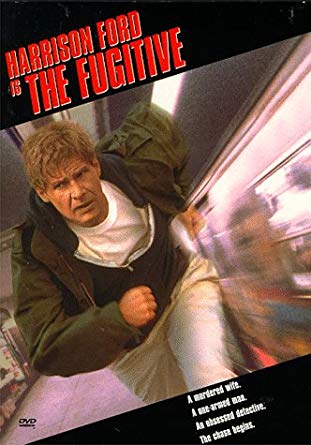
Let’s illustrate how this is done. I give you a writer named Jeb David Huggins (this is a mash up of the three writers behind one of my favorite action movies, The Fugitive starring Harrison Ford. Jeb Stuart and David Twohy did the screenplay; Roy Huggins was the creator of the TV series upon which the movie was based).

Jeb has a tight outline for the story and knows the ups and downs and ins and outs of the plot. He’s created a fantastic cast of characters, from Sam Gerard (Tommy Lee Jones) all the way to the Chicago detectives who muck up the case (Ron Dean and Joseph Kosala). Now he starts writing.

And does he knows how to open a thriller! A murder scene and the arrest of respected surgeon Dr. Richard Kimble on suspicion of killing his wife. Trial. Conviction. Death Row.

Then he’s on the prison bus, and there’s an attempted takeover by the inmates. The crash. The train coming! Kimble saves a wounded prison guard, and barely makes it off the train!

Now, in his outline, Jeb has a scene card: KIMBLE JUMPS OUT OF THE PRISON BUS JUST BEFORE TRAIN RAMS IT.

At outline time that was enough. But while writing the scene Jeb gets a happy idea. What if we keep this going? What if the train derails…and heads straight for the escaping Kimble, who is still in leg irons!

Hot dog! (That’s what writers say when they come upon a delightful idea).

More delight comes in the writing of dialogue. You have so much leeway here. Whether you’ve outlined the scene or are pantsing through it, dialogue is yet to be discovered.

In The Fugitive, after the bus escape, Kimble is alive but wounded. The one guy who helps him is Copeland, a big, bad dude from the bus. Really bad. He’s a stone-cold killer. He says to Kimble, “Now you listen. I don’t give a damn which way you go. Just don’t follow me. You got that?”

As he’s pulling away Kimble says, “Hey Copeland.” Copeland turns around. Kimble says, “Be good.”

It’s a great moment which was not in the original script. Sometimes happy surprises are provided by the characters in the scene!

Let’s cut to a scene further on, where Kimble has managed to find some old coveralls and now must sneak into a rural hospital. He has to tend to his wound, change his appearance, find clothes, and get out.

That could be the scene card: KIMBLE HAS TO TEND TO HIS WOUND, CHANGE HIS APPEARANCE, FIND CLOTHES, AND GET OUT.

Both outliners and pantsers need to understand scene structure. I break it down into the Three O’s: Objective, Obstacles, Outcome. This is where you brainstorm.

Kimble’s objective is as described above. You—be ye pantser or plotter—have an idea of the outcome (Kimble will get away, but with more trouble following).

Now the fun of the obstacles. In the movie we have the following: time pressure, finding a room with medicine and stitching supplies; a state trooper arriving; a fax coming in with Kimble’s face; finding a room with a sedated patient; Kimble shaving off his beard…(brainstorm, brainstorm) a nurse enters the room! Kimble hides, nurse leaves, Kimble needs food…he takes the uneaten breakfast of the sedated man…Kimble finds a doctor’s smock and puts it on and starts walking out…(brainstorm, brainstorm) the state trooper is coming right toward him! The trooper says, “Hey Doc, we’re looking for a prisoner from that wreck. He might be hurt.”

Kimble keeps walking. “What does he look like?”

TROOPER: Six-one, 180, brown hair, brown eyes, beard. Seen anyone like that around?

KIMBLE: Every time I look in the mirror, pal. Except for the beard, of course.

So far so good. Anything we can add? (brainstorm, brainstorm). Ah! As Kimble is about to walk off, the trooper says, “Hey Doc.” Uh-oh. Why? Then the trooper indicates Kimble should zip up. His fly is open. Happy surprise! (Any time you can add a little laughter relief to a thriller, do it.)

Outcome: Kimble exits the hospital and steals an ambulance. Wait…we can do better. As Kimble comes out an ambulance pulls up, and out of the back the paramedics have trouble with the gurney. Kimble helps, but on the gurney is the guard whose life he saved! The guard starts to say his name, so Kimble nabs an oxygen mask and presses it on the guard’s face.

Now what? Kimble tells the medics to inform the attending physician that the guard has a puncture in his upper gastric area. One medic says to the other, “How the hell could he tell that by looking at his face?”

Perfect! Kimble gets the ambulance, but because of his act of decency (he’s a doctor, he can’t help it!) he is going to get in more trouble pretty quickly.

This is fun! (Note: Outcomes should generally set the character back, make things worse. You can have an objective realized, as in this scene, but then have the good outcome lead to greater trouble down the line.)

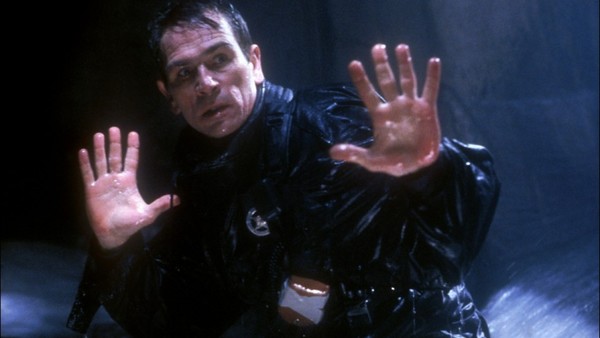
Here’s another area for surprise: how we characterize. In The Fugitive, the best lines come from Sam Gerard and the great turn by Tommy Lee Jones. Remember the spillway scene? Kimble has a gun on Gerard. Kimble says, “I didn’t kill my wife!” And Gerard says, “I don’t care!” Great dialogue! (Again, not in the original script; many of these lines were improvised on set.)

And then Gerard has a team with him, who provide more comic relief. At one point Gerard asks his youngest teammate, “What are you doing?” The young man says, “I’m thinking.” Gerard: “Well think me up a chocolate donut with some of those sprinkles, as long as you’re thinking.”

See how much fun we’re having? Yes, even the outliners!

So find your delight in your obstacles and outcomes, your characterizations and dialogue. If you’re doing this right you’ll say “Hot dog” a lot!

Are you having fun yet? Tell us about it. Note: I’m on the road and in the air today, so I’ll be sketchy checking in. Talk amongst yourselves!

To Buy or Not to Buy…

I recently had a defining moment in a used bookstore.

I have mentioned here on a number of occasions that my formative years were delightfully and wonderfully warped by perusing crime fiction on a regular basis. Every drugstore and supermarket had at least one revolving wire rack of paperback novels with several — I’m thinking twenty-four — pockets which could hold four to six books in each slot. Not all of these contained mysteries and detective fiction but it seemed as if more than half of them did. There wasn’t any particular rhyme or reason to the display, either. It wasn’t neat and orderly, with everything arranged by genre or alphabetically by title/ author, Each slot might have as many as six different titles. The book in the front of each slot concealed its brothers and sisters behind it. Browsing accordingly took a while. It also seemed as if titles were only there for a few weeks before they disappeared and a new crop of books took over.  Most of the covers were variations on a theme — weapons wielded by women in various suggestive stages of undress were the order of the day — and had little or nothing to do with the stories. My favorites were the Carter Brown stories and Richard Prather’s Shell Scott mysteries. Scott on each and every cover sported a blond crewcut and a knowing leer. I decided I wanted to be Shell Scott when I grew up. I kind of got my wish, but that’s another story. There were also titles by authors whose names are only remembered by their families, if that, but who no doubt had the same excitement, however briefly, that we do now when we see our names in print and for sale in public.

I used to spend hours browsing those books. I could on a rare occasion sneak one into the house but given that I was ten or eleven it was tough. I still have a few of them but at some point wistfully came to the realization that I was born too late to buy most of them at their cover price of thirty-five to forty cents apiece. Life, however, goes on. 

Flash forward sixty or so years. Last week I was in a local used bookstore and noticed that there were new displays of used paperbacks all over the premises. These weren’t just any displays of used paperbacks, either. What I saw were many of the books that I saw a few times in my youth at this or that drugstore. Each of the titles on display at the bookstore was priced at three dollars, eight or nine times the cover price but a bargain in the current collector market.

I buttonholed a clerk I knew and asked him what the story was. He said that the books had been owned by an elderly gentleman who had recently passed away after an extended illness. His longtime caregiver had been tasked with disposing of his estate, which included over fifty boxes of the paperbacks that the store now had on sale. The deceased had a longrunning interest in genre fiction (as well as several boxes of some other printed material which I was told that the store couldn’t, um, “appropriately” sell). There were so many books that the store did not want to go through the books and individually price each one appropriately. It was decided that three dollars per book was a fair average price. I was also told that if a fine gentleman such as myself wanted to make a reasonable offer on the whole kit and kaboodle, as it were, such an offer would be entertained and probably accepted. 

I thought about it. Picture the scene in the movie Animal House where the debate between the devil and the angel unfolds on the shoulders of Larry “Pinto” Kroger. The devil was telling me “Buy ‘em! Buy ‘em all, you f*****k! Who cares if your granddaughter goes to college?!” The angel was at the same time telling me, “You have all of those books at home you haven’t read yet! You should donate the money to a charity instead!” 

Twenty or thirty years ago I would have jumped on the opportunity to buy those books like it was a three-dollar government mule. My plan would have been to read every one of those books and eventually sell most of them, though not before enjoying their presence and inhaling the scent of old paper and ink. And yes, admiring the covers, too. In the here and now, however, I am aware that even under the most optimistic of estimates I have fewer reading years left than otherwise. There is also the consideration of space. I don’t have room for what I already have and am trying to downsize my possessions. Where would I put some additional fifty-plus boxes of books? How would I even get them home, realistically? Yes, I would still admire the covers. It just wasn’t enough of a reason to do it. I accordingly walked out empty-handed, though not before calling a friend who collects old Nick Carter books to see if there was anything he could use (he laughed and told me that he had a complete run of them).  I do have to admit that I tried to cajole the caregiver’s contact information out of the bookstore clerk, given that I was curious about that material that the store didn’t buy. He laughed but would not tell me. It’s just as well. 

I wasn’t a dollar short but I was two or three decades too late. It’s okay. Everything happens for a reason, including a situation where you have the opportunity to wisely walk away from a temptation that, like most temptations, is more trouble than its worth. I still find myself intermittently thinking about those boxes full of books, however, the way you might think of a stranger who you encountered and found attractive but who kissed your cheek and said, “I’m trouble. Bye” before walking away, never to be seen again. Still, I occasionally wonder what I would have done should I have had some of those revolving wire racks at home. 

*****

But wait, there’s more. A day or so after writing the above, I read a brand new mystery novel —published this week, actually — titled Eight Perfect Murders by Peter Swanson. It is Swanson’s sixth book, and in some ways, his best. Eight Perfect Murders is a dark love letter to the mystery genre, used bookstores, and readers. The book, which you really should read, in part concerns a bookseller who compiles a list of eight classic mystery novels,  each of which features a murderer who gets away with “it.” I was brought up short by one of the books which made the list of the character in Swanson’s novel. It was The Drowner, an all but unknown stand-alone work by John D. MacDonald. A character named Travis McGee brought MacDonald fame and fortune, but he wrote a number of other books of lesser note as well. Indeed, when I was standing in that used bookstore trying to decide whether to buy those boxes, it was the presence of The Drowner, with which I was unfamiliar, among those rows and rows of all-but-forgotten books that almost — almost — tipped me over to the dark side. When I saw it on that fictional bookseller’s list in Eight Perfect Murders I felt my world tilt on its axis for just a moment. Maybe I should have bought those books. If so, I’ll chalk it up to a long list of mistakes and keep moving forward. 

That’s it, my friends, for me and for now. Be well.


Tips & Pitfalls to Writing in First Person – First Page Critique: Organization K

Jordan Dane
@JordanDane

Today we have the first 400 words of a novel entitled ORGANIZATION K. With it written in first person, I wanted to talk about using first person – benefits and dangers – as well as give our brave author feedback. My comments will be on the flip side. Enjoy!

***

Insane or not, I refused to let Victor assassinate me without a fight.

Exaggerating my daze, I meandered toward the locked exit of Bienveillance Hospital’s Clinic for Psychiatry and Psychotherapy. If someone opened the door carelessly, I’d flee. My pale, youthful skin crawled, and I scratched my stubbly cheeks. I was nearsighted and had discarded my glasses, so my surroundings appeared blurry. As I passed a couple staff members in white uniforms and neared possible freedom, blood pounded behind my ears.

An olive-skinned female orderly intercepted me. “Breakfast time, Max,” she said in German with a Turkish accent. She pointed over my shoulder and tapped her foot.

I tugged on my bleached-blond hair’s jagged ends. “Oh joy.”

My former best friend, Victor, might reenter the recuperation prison to murder me. He’d once failed to kill me there. Given my lingering madness, the personnel would disbelieve my claim. Besides, in my disgrace, maybe I deserved to die.

Clenching my teeth, I plodded into a corner of the main common room. The space’s pastel green paint, which matched my ward outfit, reminded me of vomit. Outside the lofty windows, October 2001 fog obscured the Berlin Television Tower. On clearer days, the landmark from ex-East Berlin resembled a giant lance impaling a cratered moon. As an earlier East German, an Ossi, Germany’s tallest structure inspired me to surpass my rivals.

A boyish patient with a fair complexion draped a blanket over his shoulders. Wordlessly, he wandered around the roomy area in sandals and hugged people. He approached me.

My body stiffened, and I crossed my arms. “Go easy on me, man.”

The stranger embraced me. His obliviousness to his bleak position repulsed me. Like pins and needles accompanied a hand waking from sleep, regaining sanity hurt, but the pain came with healing. He released me and strolled away.

At long tables, many fellow sufferers clanked their tableware, grating my ears. The reek of greasy food and disinfectant seeped through the air. My stomach churned.

I rushed into my spartan room and sprawled on the bed or paced on the floor. Zoned out, I stood facing the murky outdoors. The door opened behind me. Someone thumped their boots toward me and stopped. As I turned around, my spine tingled.

Victor waved at me, grinning. “Hey, Mega Max, how the hell are you?” he shouted in German with a slight Californian accent.

I swallowed hard.

***

FEEDBACK & TIPS

This anonymous entry has an intriguing premise of a man confined in a mental hospital with an assassin out to get him, but the way it’s written, it made me wonder if I could suggest ways to make it more effective to draw the reader in. The author is counting on the reader to be curious, but are there other nuances the author could add that would intrigue the reader more?

Tips to Writing in First Person

1.) Start with action – Instead of being in the head of a character as they passively begin a story, have them DO SOMETHING. Is this character really in action? He’s stumbling through a ward and on alert, but it’s more like he’s taking inventory of the setting for the reader to “see it.” The action is TELLING. We’re being told about Victor wanting to kill him. If he’s purely delusional, the first line feels like a cheat to the reader. By the second line, any tension or intrigue the reader might’ve felt is gone when the action goes nowhere.

It might be more effective if Max is agitated and feeling the effects of an unexplained drug, attempting an actual escape from an unknown location. Leave the reader wondering – escape from where? The reader can wonder if he’s a captive, a good guy or bad. Give the reader something to care about with his situation.

2.) Make the reader care – Since this is the start of the story, I know nothing about Max. Yes, he is in a precarious position and vulnerable with an assassin after him, but why should a reader care about him at this early stage? Has the author given enough to get the reader engaged? Rather than focusing on describing the setting of the hospital through Max’s head, why not target his mental state and show the reader how he is vulnerable. Make the reader feel like THEY are held captive with him. I don’t know where this story is going, but I don’t feel enough empathy for Max because of the author’s choice to keep the story superficial.

3.) Show don’t tell – As I mentioned, Max is telling us what he fears. He’s not showing us enough of his emotional state or his vulnerability. He’s too in control and the threat doesn’t seem real – especially since he is locked up in a mental hospital. I’m not buying his fear. The author hasn’t done enough to make me feel it. Since I don’t know the rest of the story, it’s hard to suggest how to rewrite this intro, but the author should make the reader feel the threat and not just tell it.

There are many ways the author TELLS through Max, but below are specific examples:

  • Insane or not, I refused to let Victor assassinate me without a fight.
  • If someone opened the door carelessly, I’d flee.
  • My former best friend, Victor, might reenter the recuperation prison to murder me. He’d once failed to kill me there.
  • Given my lingering madness, the personnel would disbelieve my claim.

4.) Make your character’s voice stand out – It’s a challenge to cram a great deal into 400 words, but why squander the opportunity with generic? I’m assuming Max is the main character. When he enters the scene, make him show why he has earned the storytelling role. Give him an attitude about what he sees and let the reader in on it. Give him color and make him memorable. Think about how movies portray main characters when they first walk into the scene. In the first minutes of Pirates of the Caribbean, Captain Sparrow makes a splash for moviegoers. That intro defines him for the rest of the film. Shouldn’t that be how books are written? It takes thought and planning on how to do this effectively.

Make each word count on what he says? Does he have an accent or a unique way of speaking? How does he express himself? The author controls ALL of this. Is Max a chameleon in appearance? Does he have skills that would make it hard to confine him in a hospital or anywhere? Is he charming or funny and can he talk himself out of any situation? If he’s a cynic, why not infuse his surly, sarcastic nature into his dialogue? Less internal thoughts, more dialogue with another character to set up a mystery?

5.) Use your character’s self-deception as an unreliable narrator to manipulate the reader into your mystery. How much are they delusional or unreliable? Is their self-deception in small ways or is the character completely unaware of the situation. With first person, the author has a unique perspective for plot twists and misdirection. Be patient and savor the moment to add mystery and intrigue.

DANGERS OF USING FIRST PERSON

First person is fun to write. It is very intimate if the author stays in the head of the character. The insights into the nature of the protagonist are alluring for an author. Even if you use third person for your book, it can be a great exercise in getting to know your character by writing a scene in first person to get a feel for their personality. But first person also has dangers. Here are a few:

1.) The reader is trapped inside the head of one character. Even if you mix the POV between first and third in your book, the first person character generally dominates the story. It could be a major turnoff for the reader if the character weren’t sympathetic or compelling.

2.) Don’t make the first person voice about YOU. Some authors have trouble distinguishing between their character and themselves. It can be limiting. It’s much more interesting if you don’t limit your imagination.

3.) Overuse of “I” & filtered words – In first person, it is important not to overuse the tedious sentence beginning with “I.” This leads to filtered words and sentences that diffuse the action through the character. It distances the reader from the action. For example:

Don’t:

I watched an angry crowd of protesters marching down the street.

Do:

The angry crowd of protesters marched down the street.

4.) Too much introspection can lead to telling and backstory dumps. Rambling internal thoughts can be boring, page after page. Give glimpses inside your character for insight or plot twists but get your character into the action with their attitude and color.

5.) First Person can be limiting plot-wise, especially if you only use first POV for the whole book. The plot is only seen through one set of eyes. It takes planning to make a plot work.

SPECIFIC FEEDBACK ON SUBMISSION

1.) In general, I found the action uneven and a bit jumbled. Max goes quickly from wandering the ward, into a large day room until we make a leap to a dining room situation until there’s another quick shift into his room. It’s as if the author wrote a quick draft and forgot to fill in details. The author is more interested in describing the hospital than in setting up Max’s story. There’s no real action. The story is taking place in Max’s head by telling.

Here are some sentences where the scene transition was most confusing and had me re-reading. There’s no transition between spaces and the leap from dining hall to private room is too noticeable.

At long tables, many fellow sufferers clanked their tableware, grating my ears. The reek of greasy food and disinfectant seeped through the air. My stomach churned.

I rushed into my spartan room and sprawled on the bed or paced on the floor. Zoned out, I stood facing the murky outdoors.

2.) The author chose first person POV but certain passages & word choices didn’t feel like an internal thought. In an internal thought, Max would feel his skin crawl. He wouldn’t picture his skin as pale and youthful. He might tug at his hair, but not describe the bleached color and jagged ends, as if he were seeing from outside his body.

I’ve highlighted these examples below:

  • My pale, youthful skin crawled, and I scratched my stubbly cheeks.
  • I tugged on my bleached-blond hair’s jagged ends. “Oh joy.”

3.) In the sixth paragraph, the author diffuses the action with a diversion from Max as he looks out a window and sees a historical site. It’s brief, but coupled with all the other distractions, this is a passage that could’ve waited for later in the story.

On clearer days, the landmark from ex-East Berlin resembled a giant lance impaling a cratered moon. As an earlier East German, an Ossi, Germany’s tallest structure inspired me to surpass my rivals.

4.) Californian Accent? At the end, Victor comes into Max’s room and speaks in German with an accent. I may have to defer to others on what a California accent is. I come from Texas and know about a distinctive accent, but I wasn’t aware that California had a unique one. Are we talking surfer dude lingo? This reads as more author intrusion. The author is cutting corners to introduce Victor and let readers know he’s not a local.

SUMMARY

I didn’t make line by line corrections. I wanted the author to reevaluate their introduction by considering my questions for Max and rethinking how this story begins. Give Max more action and give him a distinctive attitude for his voice. Eliminate the TELLING and add depth to this introduction with elements of mystery. I’m pretty sure the author has something more in mind for a plot to fill a book, but this excerpt doesn’t leave me wanting more. Reading into the piece, I would imagine Victor is someone Max knows well. Hence, the nickname Mega Max. That would completely deflate any intended tension written into this intro. I would rather the author give us something real to wonder about. Thoughts?

FOR DISCUSSION

I would appreciate your feedback. I’m sure the author would love more voices weighing in, but besides line edits, let’s try something a little different. Let’s keep the basic premise the same, that Max is in a mental hospital and he fears Victor will kill him.

1.) How would you rewrite Max’s actions? What would you have him do? Think out of the box. Let’s brainstorm as a writing exercise.

2.) How would you make Max unique and give him more character and a more memorable voice?

Stay in the Phone Booth With the Gorilla

Stay in the Phone Booth With the Gorilla
Terry Odell

One of my critique partners is a computer programmer by trade, and one of the things we frequently mention in our critiques is how much detail is needed, and when. His mind works in a very logical fashion, and he’s always looking at every what if possibility. Normally, I’m pointing out where he doesn’t need to cover all the possible permutations of any given situation. But once in a while, he’ll catch me dwelling on unnecessary details. I figure when he sees them, I probably need to cut.

When I’m writing my police scenes, I do like my character to weigh all the options, since they’re trying to piece together clues, and often they don’t know what’s a clue and what’s not. But in an action scene, it’s important to remember to stick with the action. This isn’t the time to have your characters stop to reflect on the past. Dripping in back story should be done judiciously, and it’s probably never appropriate in life-threatening situations. Or even tension-filled scenes. Here’s an example from when I was working on Dangerous Connections:

My heroine, an undercover Vice cop, was supposed to use her “feminine wiles” to distract another character so the hero could mess with a computer program. I had her thinking about her job, because I wanted to make it clear that because she worked Vice didn’t mean she was experienced at seducing men.

Elle shoved her mind to the place she sent it when she was working a major sting. Truth of the matter, her day-to-day routine working vice didn’t involve seduction. Seduction could lead to claims of entrapment, and that was a headache for everyone. The johns weren’t fussy, and they didn’t want romance. All she had to do was get the money to change hands, and someone from her unit would show up and take them both away so as not to break her cover.

My partner’s comment: “I think you need to stay in the phone booth with the gorilla.”

Where did that come from?

Here’s an explanation from Robert Newton Peck’s Secrets of Successful Fiction:

Alma walked hurriedly down the dark and deserted street. Hearing footsteps echo behind her, she darted into a telephone booth. Before closing the door, Alma Glook knew she was not alone. With her in that phone booth was a five-hundred pound gorilla.

“Help!” yelped Alma.

Seeing the gorilla, her thoughts turned back in time to when she was a little girl, back home in Topeka, living with her aunt Mildred who was a taxidermist and scratched out their meager living by stuffing gorillas. In fact, her aunt had earned quite a reputation in college when she had, as a prank, stuffed nine gorillas into a phone booth.

Your readers aren’t interested in Alma’s past right now. They want to know how she’s going to deal with the gorilla. And the readers probably don’t need to know the ins and outs of working Vice. They want to know if Elle is going to be able to distract Bill so Jinx can do what he’s supposed to do.

A character’s thoughts can reveal a lot. Just be careful where you insert them.

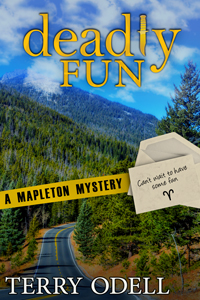
Deadly FunMy new release, Deadly Fun. I’m sharing all March royalties with the National Multiple Sclerosis Society.


Terry Odell is an award-winning author of Mystery and Romantic Suspense, although she prefers to think of them all as “Mysteries with Relationships.” Follow her on Facebook and Twitter.

Outlining in Reverse

By Debbie Burke

@burke_writer

Photo credit: Josue Isai Ramos Figueroa – unsplash

Jim Bell’s excellent post from Sunday about plotters vs. pantsers serves as an introduction to today’s subject: Is outlining useful for a pantser? Can it be done? 

The answer is yes…if you do it in reverse order.

Create the first draft.

Then go back and outline what you’ve written. 

In construction, there’s a term called “As Builts.” An architect may start out with an initial blueprint (outline) but the blueprint changes due to circumstances that arise during construction. The finished building is never the same as the original blueprint. Here’s an explanation from Precision Property Management’s site:

“An As-Built drawing should show the building exactly as it currently is, as opposed to a design drawing which shows the intended or proposed layout of the building. This is a critical distinction, because a constructed building almost never corresponds exactly to the original design drawings.”

Like a building, a finished story almost never corresponds to the initial idea. That’s why I don’t outline before writing that initial draft of discovery.

However, once the first draft is finished, I create an outline in the form of as-builts. That’s where the pantser’s errors and oversights show up. And, believe me, there will be plenty.

Oops, I forgot to install reinforcing bars before I poured the slab. Without rebar, the foundation cracks and sags. Gotta jackhammer up the concrete and start over.

Darn, I forgot to include a door that connects the kitchen and the dining room. Better get out the reciprocating saw and cut an opening in that solid wall.

Wow, the shingles on the roof look beautiful…except some of the trusses underneath are missing. The first snowfall causes the whole thing to collapse. Drat.

You get the idea.

Dennis Foley, novelist/screenwriter/educator extraordinaire, introduced me to the concept of “as built” outlines in fiction. He recommends writing in three steps:

  1. Think it up;
  2. Write it up;
  3. Fix it up.

Pantsers feel strangled if we try to adhere to a formal outline during the initial draft. We’d much rather give free rein to our imaginations during Steps 1 and 2.

But, eventually, all that unfettered creativity needs to be organized. Step 3, the “fix it up” stage, is the time to create an “as built” outline.

Outlining in reverse points out structural problems with the plot: events that are out of order, a character who shows up simultaneously in two different places, missing time periods that must be accounted for, lapses in logic, etc. Once those glitches are repaired, the story becomes a coherent sequence of rising complications that ultimately delivers a satisfying climax.

My WIP, Lost in Irma, takes place in Florida during Hurricane Irma in September, 2017, a catastrophe that left 17 million people without electricity. The story covers a two-week period during and after the storm and had to adhere to actual events in the order that they occurred.

The main characters, Tawny Lindholm and Tillman Rosenbaum, are visiting Tillman’s high school coach, Smoky Lido, in New Port Richey when Irma hits. During the height of the storm, Smoky disappears. Tawny and Tillman spend the rest of the book trying to find him. Is he dead or alive? Did he flee because of gambling debts? Was he abducted by thugs he owed money to? Or did he vanish into the storm to commit suicide?

Hurricane-related emergencies overwhelmed law enforcement, leaving Tawny and Tillman on their own to look for Smoky. Power blackouts, gasoline shortages, and unreliable cell service were integral to the plot. They couldn’t make phone calls or search the internet. If they drove, they risked getting stuck in floodwaters or running out of gas.

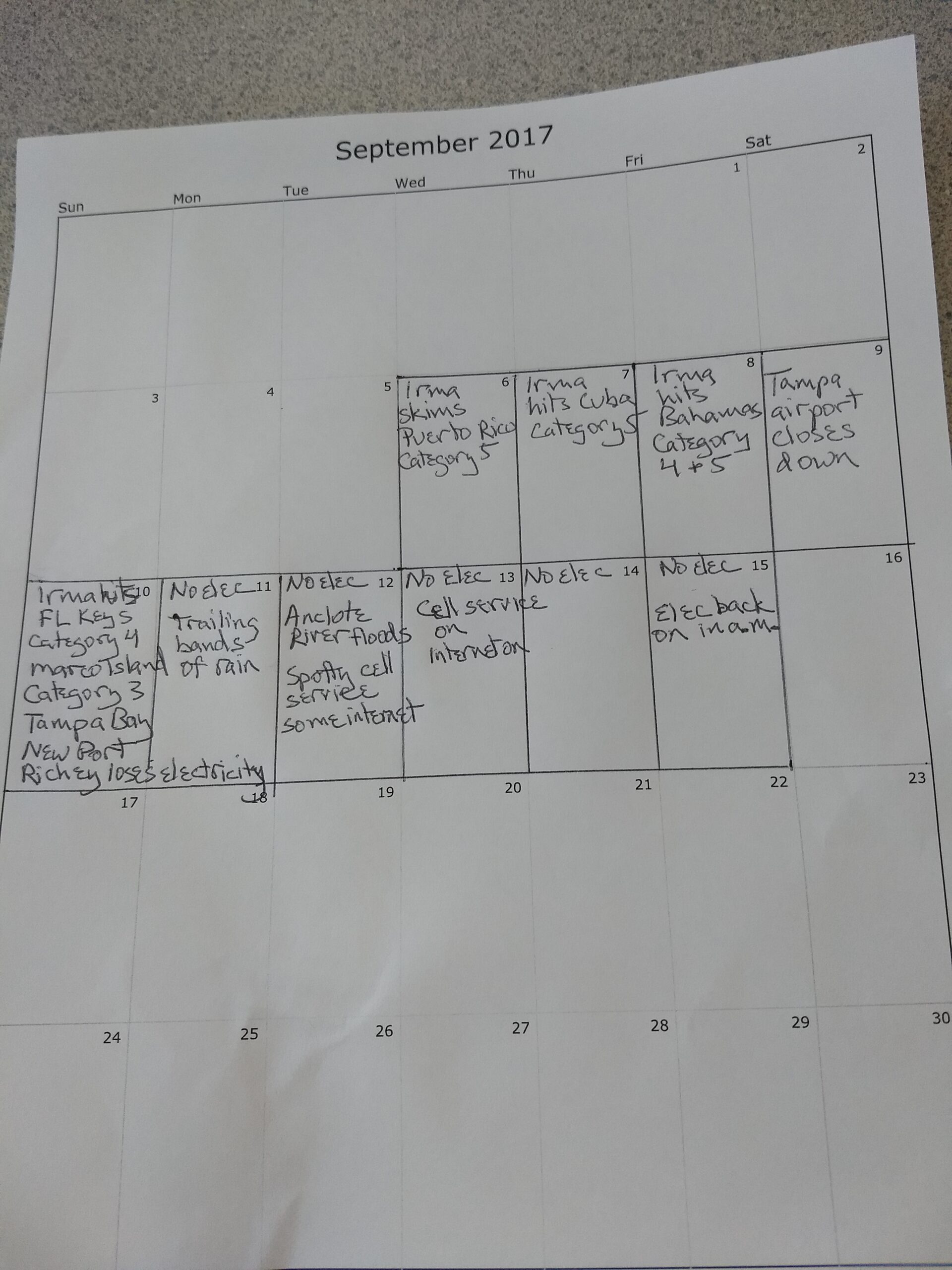
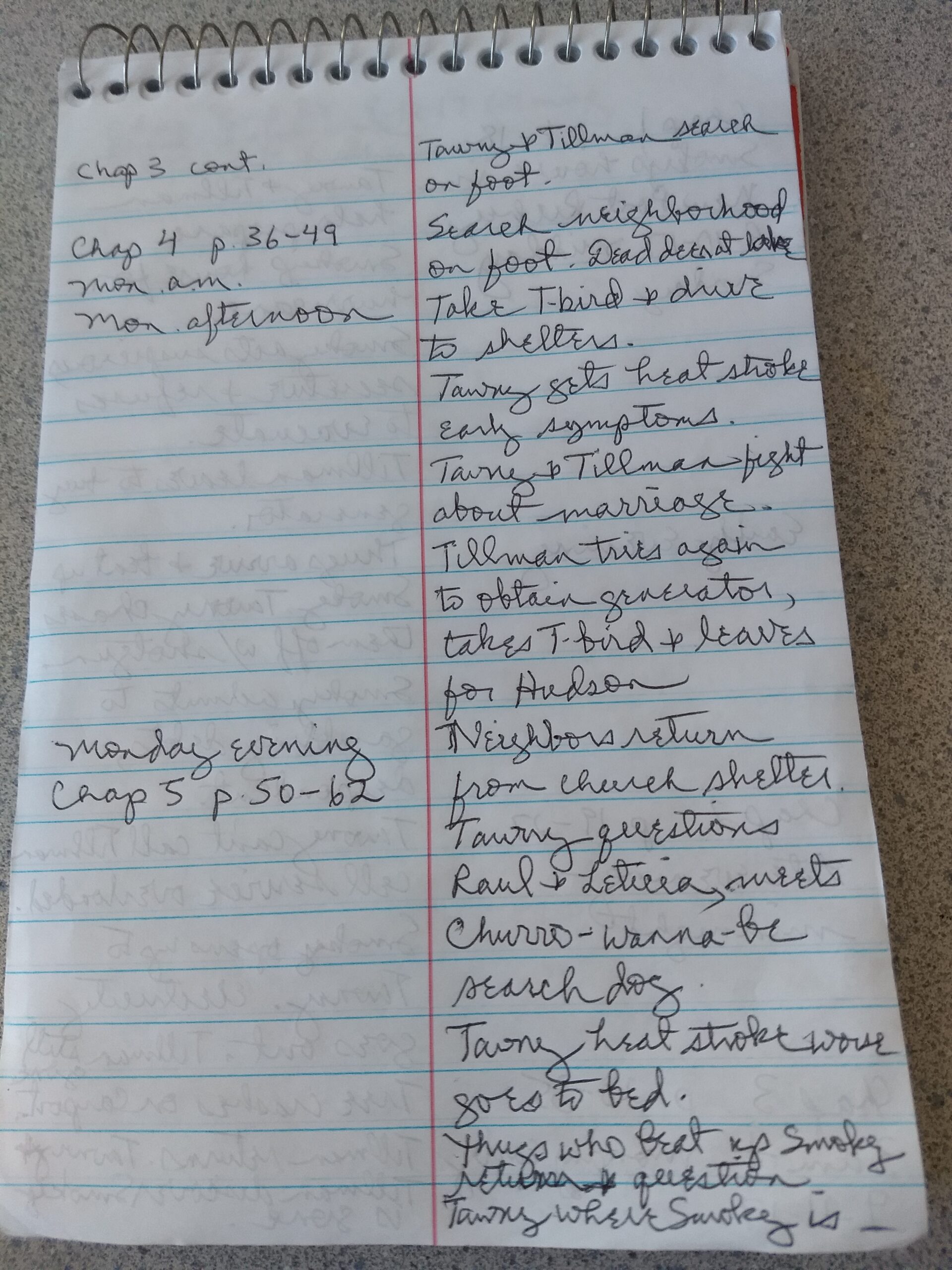
To pin down significant events on the dates they actually happened, I printed out a blank calendar from September 2017.  I filled in the squares with factual information like: what time did Irma hit New Port Richey (late Saturday night, early Sunday morning); what time did the power go out there (around midnight); when did the Anclote River flood (Tuesday)?

Here’s a link to a handy site that includes sunrise and sunset times for each day, which I also found helpful.


Electricity came back on in fits and starts—one street regained power almost immediately while the next block over stayed dark for days longer. That gave me fictional latitude to turn the power off as long as necessary for plot development.

While researching public shelters, I wondered if there was a roster or record kept of people staying there. Astonishingly, no.

I also learned Red Cross maintains an online “Safe and Well” website where victims of disasters can voluntarily register their names, phone numbers, and leave messages for loved ones. But there is no requirement to register.

I inserted that bit of info into the story, adding that the system can’t be accessed if internet and/or cell service aren’t working or your phone is dead with no way to charge it. That added more complications for Tawny and Tillman, who had to physically go through each shelter, looking for Smoky.

What goes into the as-built outline?

Timelines: The chronology of events is important to nail down correctly which is why I use the calendar technique above.

Scene by scene outline – This traces major characters and plot developments. What day is it? What time is it? Where are they? What action happens?

As you can see from the above illustrations, my outlines are low tech. You may prefer to use Scrivener, Excel, or other spreadsheet programs.

Onstage Characters and Offstage Characters:

Typically, the protagonist appears in most scenes, onstage, and the story is often told from his/her point of view. But if characters are not in a scene—in other words, offstage—they also need to be accounted for, especially in crime fiction.

In mysteries, the murderer’s identity may be withheld from the reader until the very end. But the author still needs to know what that character is up to while s/he is lurking in the shadows. S/he may be trying to elude discovery, throw down false clues, or menace the protagonist. I discussed this topic in a 2017 post.

As a pantser, I often get tripped up because I lose track of a character who’s not onstage at that moment. That’s where the as-built outline catches goofs in the sequence of events.

For instance, the hero can’t find the murder weapon in chapter 4 if the killer doesn’t discard it until chapter 6. Even if you don’t show the killer onstage while he’s tossing the gun off a bridge, you still need to know when that action took place in relation to what the hero is doing. A time line helps point out inconsistencies in the sequential order of events.

Altered Timelines: What if you use flashbacks or jump around in time? Pulp Fiction utilized that technique to memorable dramatic effect. I don’t know how Quentin Tarantino wrote the screenplay but I’m guessing the final version of the film was far different from his initial blueprint.

If you decide to mess around with time conventions, it helps to first write the outline in chronological order. Once that’s done, you can rearrange blocks of time and scenes in any order to best serve your plot line.

Writing About History: If you write historical novels, real events must be accurate. Set up a calendar or time line to cover the duration of the story. This may extend over years or even centuries. Plug in the dates of pivotal events.

For a World War II saga, that might translate to a time line like:

1939 – Nazis invade Poland

1940 – Dunkirk evacuation

1941 – Japanese attack on Pearl Harbor

1942 – Battle of Midway, etc.

Other genres: Even if you write sci-fi or fantasy where the story world is entirely made up, that world must still conform to its own time system that is consistent and logical within its parameters. Suppose in your sci-fi, time travels backwards rather than forward. Events happen in reverse order of what we’re used to. The story might start with the death of a character, then goes backwards year by year, to their birth. Within that logic system, you would see the effect before the cause, the consequence before the action that triggers it.

Time travel stories especially require a clear time line. When you zigzag back and forth through history, it’s easy to get confused. If the author is lost, the reader will also be lost and likely give up on your book.

Jordan Dane just published a gripping time-travel thriller, The Curse She Wore. Maybe she’ll chime in on her techniques to handle multiple time lines.

As-built outlining may seem bass-akward but, for this pantser, it works.

~~~

TKZers: What are your favorite techniques to organize a plot? 

~~~


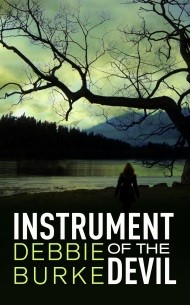
Debbie Burke first used reverse-outlining in her award-winning thriller, Instrument of the Devil. On sale for only $.99 at this link

The Political Mystery or Thriller

So in my ‘other life’ (not that I have much of one!) I’ve been working down at the Colorado State Capitol for one of our State Senators during the legislative session – a job I decided to take on, in part, to gain a more active understanding of the American legislative/political process and, in part, as potential research (for a writer, everything is book research after all!). Of course, as soon as my writer’s mind started ticking over, I started wondering how I could use what I’ve learned in a novel someday (although, to be fair, I thought the same thing last year when I participated in the police citizen’s academy and still haven’t done it!).

For a foreigner like myself the learning curve is always steep as I didn’t grow up in America and so my understanding of state politics is limited at best (and mainly based on Australian politics…). On the plus side though, I probably bring a different perspective to it all – one that maybe I can use to my advantage  in a future book (?). Unfortunately, my knowledge of political based thrillers and mysteries, however, is also very limited (mainly to those blockbuster novels you see at airports in which the machinations of DC politics and international intrigue collide and the resulting stakes are super high). But what of local politics where the stakes are much lower and the machinations are far more mundane? Is it possible to create tension and drama? Of course, the answer is yes, as a good writer can create tension and drama out of any conflict. But in terms of selling the concept of a political thriller, I’m not sure state politics is all that juicy!

When I think of these kind of thrillers and mysteries, often it’s the life of the president or his cabinet at risk, or the fate of the nation…so immediately you know that there will be high stakes and (usually) a high concept novel involved. At a state political level, often those stakes center on corruption or injustice, which obviously provides a fair amount of dramatic tension but still, the question of what makes a decent political based thriller or mystery has been nagging me…and this is where TKZers you come in! What elements do you think make a great political mystery or thriller? Have you read any great ones that focus on state or local politics (and I mean as a central part of the novel, most mysteries and thrillers necessarily involve a certain amount of politics when they have law enforcement/judicial system involved)…And then there’s the challenges of writing a political thriller or mystery. I meant no one really wants politics shoved down their throats, nor, in today’s polarized society do you want to risk alienating readers…so how do you think a writer can find the right balance when politics is a central part of the novel? Enquiring minds (well, mine at least) want to know!

What’s the Best Way to Discover Your Story?

by James Scott Bell
@jamesscottbell

Not many people know that the decades-long feud between the Hatfields and McCoys started at a writers conference. The head of the Hatfield clan was an outliner. McCoy was a pantser. They were on a panel together and things got heated. Then the shooting started.

In those days, several McCoys were heard to say that they had to write the book in order to “discover” what the book was really about. If they got tied down to an outline, that’d take all the originality and “fun” out of the writing. They’d chew tobacco when they said such things, and every now and then they’d spit and say something about how an outline removes spontaneity (although they didn’t know words like spontaneity). A McCoy once remarked, “Them ’liners don’t never have no surprises. They don’t discover nuthin’. Got no use for ’em.”

Well, the guns are put away now, but the outliner (plotter) v. pantser divide is still grist for the panel mill. What I want to home in on today is this notion that the best method for “discovering” your story is by not knowing what you’re going to write until you write it. That way the whole thing is organic and surprising. And if the author is surprised (so goes the reasoning) the reader surely will be surprised as well.

Implied in this is the idea that plotters are stuck with their outline and are thus discovery challenged.

I’m going to blow that notion up.

First, let’s follow a typical pantser. She begins writing about a character…that’s the “fun” part. The character has some sort of issue or problem, but we don’t know what it is yet, or how it will manifest itself. At the 15k word mark, our pantser wakes up one morning with a mind-blowing idea—the abusive antagonist actually turns out to be the brooding boy from the MC’s past. Wowsers! That’s not what she expected! But that’s what she loves about pantsing!

Full of delight, our pantser writes another 20k words along this new trajectory, until the plot begins to stall because there’s not enough conflict, or the love part isn’t working, or things have moved too quickly and the book is close to being over … or any of an infinite number of plot problems that pantsers have to figure out how to solve—now, or in the messy future when they take a tangled, unkempt first draft and try to make it something readable.

But the big discovery—that the antagonist is really the boy from the past—remains. To change it now would mean starting at ground zero again, and that’s not a happy thought.

So what’s happened? The pantser got to a major plot path, one that sprang up one day and said Take me! and she took it. One path. And maybe it works out.

Or maybe it doesn’t. Still, the pantser contends that this discovery method is “purer” storytelling than some stodgy old outline.

To which the plotter says, “Hold on there, Lightning. You need to understand something. We enjoy even more discovery than you, and faster, too! It happens before we outline. We look at many paths and follow them as long as we like. Each one is a surprise; we’re not limited to one or two. We can then pick the most exciting one and start to outline. If something better occurs to us along the way, easy…we tweak the outline. Discovery after discovery!

Which is a little more freeing that finding one discovery after thousands of words of writing.

Let me give you look at my own process. I always start with a “white-hot document.”

I got this idea from one of my first, and most beloved, craft books, Techniques of the Selling Writer by Dwight V. Swain. He advocated writing a stream-of-consciousness document, where you just let your imagination run wild. No editing. Jot whatever plot, character, scene, big picture ideas hit you. Follow tangents wherever they lead. The next day you come back to this document and annotate. Highlight the best parts, then start writing again, following your imagination wherever it goes. Annotate the next day. Repeat this process several days.

David Morrell has a similar practice as explained in his book The Successful Novelist. He advocates asking yourself question after question, getting yourself deeper into the reasons you like this idea.

What’s happening is I’m letting the imagination and subconscious play, bringing me surprise after surprise. But I’m not yet wedded to any!

Next, I get a bunch of 3 x 5 cards and go to a coffee house and grab a large brew. I find a chair and start writing down scene ideas. Randomly. Without thought as to where they go. It’s enough just to jot this much:

Sister J has to fight a knife-wielding dental hygienist.

Later, I shuffle the cards and take out two at a time to see what plot ideas they suggest. In effect, I’m taking dozens of paths, checking out the scenery, and choosing the best one to follow.

I’m also fleshing out the members of my cast, remembering the principle of “orchestration.” That is, each character ought to be different from the others so there’s a possibility of conflict with everybody else.

Finally, I start laying out my Super Structure signposts, setting up the major movements of the plot. I have plenty of scene ideas to go in between. (I use Scrivener for this.)

Then I write.

Now, I fully realize dedicated pantsers are to outlines as mosquitoes are to Off. And that’s fine. You’ve got to go with what works for you, what brings you the most creative joy. The point of my post today is to emphasize that there’s joy and creativity and spontaneity in plotting, too…and in buckets!

So put down your muskets and tell us: how do you do most of your discovering? 

Key Ways to Adding Depth to Any Setting: Resources & Tips

Jordan Dane
@JordanDane

Wizarding World of Harry Potter : Hogwarts


What makes a book setting memorable? We have all read books where the setting gripped us and drew us in as readers, but any setting takes research to develop the world we will portray in our books. Even settings we are familiar with, like a hometown, take vision to add to the plot we will develop. It takes even more to create a fictional world no one has ever known or a futuristic setting we want to make vivid in the reader’s mind. Some vivid setting books that come to mind for me are: the Hunger Games series, Harry Potter, and Game of Thrones. If you have a series in mind, your canvas for storytelling must be large and hold its mysteries for future plot lines. A good setting can become a character in your books.

Many new or aspiring authors don’t include much of a setting. They tend to focus on their plot, the actions of the characters and the dialogue, but any setting can enhance a scene or a book.

Here is an excerpt from THE CURSE SHE WORE with a sprinkle of setting to enhance the mood of the scene – in the voice of Trinity LeDoux.

French Quarter

Rain sluiced from rooftops and pinged through metal rain gutters as if God had given up and flushed the world. I knew the feeling, the ache and emptiness of loss, especially tonight.

Mixed with the din of the rain, Dixieland jazz and Zydeco grated on my nerves. I had no tolerance for good cheer. Not tonight. I only had a taste for straight up bourbon and the severed artery of soul sucking blues, but where I headed I’d get neither.

I clutched the vintage necklace I’d worn to remind me why I had to come.

When I look back at the stories I have written, especially after I wrote my debut book NO ONE HEARD HER SCREAM in my old hometown of San Antonio, I did NOT pick safe bets. I often wrote in the best setting for the plot I had in mind, even if that meant writing about locations I had never been. Since I had traveled, I knew what it felt like to navigate in a world where I didn’t know the language or where to go. I could use any of my experiences to color the world of my characters or I could invent things to throw in their paths to make challenges. My empathy and imagination would help make the plight of my characters “relatable.”

When I wrote my latest novel – THE CURSE SHE WORE – I picked New Orleans as the setting. I had been to NOLA a few times, but that didn’t make me an expert. I used advisers that knew New Orleans well. I picked their brains & listened for the subtle nuances of local lingo & iconic venues. These experts helped provide me with the color & the history that I would want added to my series. It can be a rabbit hole to chase down the things that interest you about a location, but if you don’t use the material in your current project, you may save the notes for future plots. A writer’s brain is like a sponge, thirsty for knowledge.

Here are key examples of things you should know about your setting to add depth:

1.) What is the culture and ethnicity of your setting? Are their inherent conflicts with differences?

2.) What key events in history helped shape & influence your setting? History can define people and social morays. It pays to know the history of the world you are either creating from scratch or researching for accuracy.

3.) Add subtext for your setting that is reflected in your character’s attitude or mood. Try having your setting mirror the mood or attitude of your character to add context. You do this by making deliberate choices on what your character notices about the setting that reflects or mirrors their mood. For example, if a young woman walks into a bar filled with men who stare at her as if she were a porterhouse steak, what would she notice? What would crawl under her skin about the setting? The dirt, the smells, the sounds that grate on her nerves.

I love playing off the setting to enhance a scene. For example, here is my character Trinity LeDoux as she is introduced to the opulent plantation estate of Hayden Quinn, the psychic she must convince to join her on a perilous mission. She has never known wealth or power but she sees it everywhere in Quinn’s world.

Excerpt: The Curse She Wore

Ivory Magnolia Plantation

I’d never sat under a thousand sparkling rainbows before.

The crystal chandelier in Hayden’s dining room cast pastels onto the lace tablecloth. Expensive wood-carved furniture surrounded me and made me feel small. In Quinn’s world, normal meant something else entirely, something I’m not sure I would ever figure out.

I had a grasp that my life wasn’t normal, but I couldn’t say whether Hayden Quinn’s world was any closer to that mark. The man was cocooned as much in history as in his comfortable wealth—but with a gift that stamped him as an abiding freak by most people.

Normal? Not even close.

Paintings on the wall turned the room into a museum—as close as I’d ever get to such comely abundance—but when Quinn lit candles for the occasion, the soft glow from the majestic candelabras made me drowsy with contentment. He could’ve confused me with fancy utensils and proper china plates, but he’d kept things simple.

I had no doubt he’d done that for me. He’d welcomed me into his world with more grace than I had a right.

4.) Use your fives senses to place the reader there, but don’t go overboard. Don’t pull the reader from your writing by deliberately citing each sense as if you are doing an inventory. Pick the most critical and visual and go for it.

5.) Use visual aids to tease into your settings. If you have an iconic location, pick one or two images that readers may know and insert them into your story. Integrate them naturally. When I researched the streets of White Chapel in THE CURSE SHE WORE, I loved finding old maps to help me visualize where my character would’ve walked and what she might’ve seen as she went. History books are great for this and there are online resources that can help.

6.) Use action to incorporate setting details into your scenes to be more subtle about the use of your research. Action can be a great way of merging plot with research in a natural way.

Excerpt from THE CURSE SHE WORE (in Victorian London, late 1800s):

“This is where you live?”

I feared for the girl and her Alfred. No wonder she’d brought the dog with her.

Dorset Street was still a hive of activity, even at this hour. Disheveled beggars hustled for any handout and street merchants hawked their wares and services. Their voices reverberated off brick to magnify the sound. I would’ve paid for silence.

Women huddled on corners, eyeing every man who walked by and making offers. Some were mothers in stained frocks who clutched at their crying babies. A mother’s duty to provide knew no limits.

I had a bad feeling on where the girl would head next as she ducked down a flagged passageway, next to McCarthy’s store. A lone gas lamp cast shadows into a narrow and dismal courtyard that would never see sunlight even at noon.

It had a public water spigot dripping rust onto cobblestone and a common toilet that smelled as if it had backed up. As I peered into the court, I took in the steady noise and imagined the life of a girl in this forsaken corner of hell. The brick walls didn’t cover up the sounds of squeaking beds and fake orgasms, or the constant noise from a small pub on her doorstep.

7.) What food best portrays your location? Many times you have only a few spots where you can showcase food to color your world. What would you pick as quintessential? I often use a real restaurant and research their menu to include in my book. Can my character afford the prices? Make it real. That way, if a reader knows the location or looks into the details, they can find the real venues and connect deeper to my books.

Word of caution – I like to use real restaurants when I can, but if I write something bad in my plot that happens in that establishment, I will only go with a fictional name for the location. I may tease the reader with a setting that’s similar to a local restaurant, but I would call it something different. For example, in my debut book NO ONE HEARD HER SCREAM, I burned down a historic theatre. I pictured the Majestic Theatre, but I called it by another fictional name. I would be drawn and quartered if I had burned down a real theatre as popular as the Majestic. I also described the iconic Fig Tree Restaurant on the Riverwalk, but called it another name because my crime boss had dinner there. I didn’t want to give the restaurant a bad name.

8.) What are the street sights and sounds as your character walks through your setting? You can imagine a typical street but when you go the extra mile to describe certain characteristics, the reader may know your setting well enough to appreciate it.

9.) What is the geography/terrain or weather in the region? How does it affect your story? Look for seasonal weather forecast averages for the time of year you are choosing for your story. Google Maps can help define the regional geography. Even if you don’t use much of this kind of information, it can help to add layers to your story if you give the reader glimpses, as if you have been there. (I have never been to South America, but when I had Brazilian advisers who read through some of my books for authenticity, they came back with great feedback – that they were homesick for their country. That really made my day.)

10.) What is the local language or slang for places, events and common sights? This can be a tough challenge. Local slang is hard to pin down, but look on social media pages/sites to get a start & read the comments to blog posts to find the local lingo. (For example, in Dallas Hwy 75 is called Central Expressway. Despite politicians renaming a northern section of it, most locals will always call it “Central.” Or the locals in New Orleans don’t use the full name for the French Quarter. They may simply call it “the Quarter.”)

11.) What is the flora and fauna of the region? When I wrote about a remote area in Alaska for THE LAST VICTIM, I contacted the Chamber of Commerce on the island and talked at length with Grace, a newfound friend. She not only sent me many brochures on the island, she also sent me personal photos of the exact areas I needed. She had hiked there many times. She was a wealth of knowledge for how the natives lived on the island and even how they brewed an herbal tea they called Swamp Tea, common to many households. This type of information is pure gold when you’re a writer.

12.) What do the locals do for entertainment? These activities can vary by how much it costs to do these things. Not everyone can afford the same entertainment.

13.) Imagine where your character may go in your setting location and research those places. Bistros, libraries, entertainment, homes in the area, & public buildings they might frequent.

14.) What are the local newspapers? I used this in several of my books, but it’s always fun to imagine what my characters would do to get information and make it feel real to readers.

RESOURCES:

Contact Visitors Bureaus and Chambers of Commerce – These organizations can be invaluable to get you started. Don’t be shy about speaking to someone. You never know who you will meet over the phone.

Research Locations on Social Media – Many places, like New Orleans, have Facebook pages and other social media. Don’t stop at the official sites. Look for realtors selling properties in the area or food/entertainment resources and other key sites to get your juices flowing over your plot.

Youtube/Vimeo – I did a huge amount of research on mountain climbing (something I would never have experience for) in my YA book – ON A DARK WING. I had friends who had made the climb up Denali, the challenge one of my characters faced, but there was also many videos of climbers who had traversed Everest. Videos from inside their freezing tents with winds howling. These are things an expert might not share with you.

Internet Image Searches – Look for images for the setting you are researching. Many times, a picture can jump start ideas on characters, plot or events. Create a vision board for ideas that give you the flavor you are searching for and immerse yourself in that world as you write.

Music – What sounds do you hear when you think of the location? Do you ever listen to certain music before you write or AS you write, to get in the mood? Take the time to get to know your locale or invent a new one.

Libraries – Libraries are a great way to research ANYTHING. They often carry newspapers and periodicals from your locale or they can be a resource for non-fiction books on the subject. When I wrote THE CURSE SHE WORE, I used Liza Picard books to color my Victorian London historical world.

Google Street View Maps – I call this “walking with yellow man” – the little yellow icon you can click and drag to what street view you want to see. I have picked scary/crime ridden areas of my setting to find specific locations for creepy stuff to happen and I describe it. Whether a reader knows I have done this, it doesn’t matter. The visual preparation stimulates my writing and I love going the extra mile to make things real FOR ME. Here is the app for Google Streetview from Google Store. I have this on my phone. I can search a street view to see it like my character would. Very cool.

In summary, I have always loved having a layer of setting in each scene and it’s especially gratifying for me to select the right location for my book’s setting where I can reflect my character’s emotional journey. Over the years, I have found different resources to build on my process.  I hope this post will get you to think about and appreciate your own process. Please share your tips.

DISCUSSION:

1.) Have I missed anything? Please share what you do to research setting for your books. Bonus points if you provide resource links.

2.) Are there tried and true methods you implement to research your settings? Describe your process.

2.) What are settings you have written (or read about) that you are most proud of as a writer or have stuck in your mind as a reader? What made it so authentic?
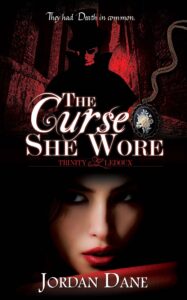
 

The Curse She Wore

They had Death in common…

Homeless on the streets of New Orleans, Trinity LeDoux has nothing to lose when she hands a cursed vintage necklace to a wealthy, yet reclusive clairvoyant.

During a rare public appearance, Hayden Quinn is unexpectedly recruited into Trinity’s perilous mission–a journey back through time to the exact moment of death for two very different victims.

Hayden and Trinity, two broken people with nothing but death in common, pursue the dangerous quest to stop a murderer from emulating the grisly works of a notorious serial killer. But trespassing on Fate’s turf comes with a price–one they never see coming.