
Thoughts on Thoughts
Terry Odell

A recent read dealing with the way a debut author dealt with characters’ thoughts triggered this post.
This author handled things differently from my preferences, which pulled me out of the story. Not to say the author was wrong, but it slowed the read. The subject has made it to these pages before, but here’s my take. (For courtesy reasons, I’m not using examples from the author’s book.)
I’m a Deep POV person. Doesn’t matter if I’m writing first (rarely, but I’ve done it) or third (where I’m most comfortable, and which is almost first), I want readers to be inside the characters’ heads. The basic 5 senses are obvious, but how do we show what they’re thinking?
**Note: If you’re following the one POV character per scene “rule”, the reader should be well grounded and know who the POV character is, making it easy to know who’s thinking, but there are still techniques that can help.
When I auditioned narrators for my audiobooks, I gave them passages with dialogue, narrative, and internal monologue and told them I wanted it to be clear which was which for listeners. I had one auditioner come back with a “technique” he was very proud of that made it sound like the characters was in a tunnel for thoughts.
Having no formal education in the craft of writing, I went to workshops and conferences. One book that showed up on almost every presenter’s Suggested Reading list was Self Editing for Fiction Writers by Browne and King. Another handy booklet I picked up was Going Deep with Point of View by Suzanne Brockmann. Together, they laid the foundation for my approach to handling thoughts (among many other things).
What are my thoughts about writing thoughts? My two biggies:
- Don’t use speaker attributions/tags to tell the reader someone’s thinking.
If you’ve put the reader in the character’s head, it should be obvious they’re thinking. Per Browne & King, removing “he thought” makes them “unobtrusive to the point of transparency.”
Example:
Had he meant to kill her? Not likely, he thought.
Becomes
Had he meant to kill her? Not likely.
The second gets the same point across and is more effective.
They also suggest using the question technique.
Example:
He wondered why he always ended up killing them.
Becomes
Why did he always end up killing them?
Brockmann says “Anytime you interject she thought, she reflected, she guessed and so forth in this way—that’s you speaking, taking on the voice of the narrator, and your doing this takes the reader outside of the character’s head.”
- Beware italics
Italics do have their place, but italicized thoughts should be short—a sentence or two.
My ‘rule of thumb’ is to use italics when the character is talking to himself, and set them off in their own paragraph. Browne & King also suggest it as a useful technique to show a character’s thoughts in the middle of an action scene. Action doesn’t have to be fights and explosions. Here’s an example from my Identity Crisis. The following passage is a mix of narrative and Brett’s thoughts, but there’s only one bit in italics.
After the helicopter had deposited the team five miles down the mountain from the cabin, he, Adam—their team leader—and Fish had hiked up, then taken their positions surrounding the cabin. Since they couldn’t see each other, the only way to communicate was via radio. Then Adam had put the stupid radio silence rule into effect. What did he think? They were all telepathic?
Brett shifted, tightened and released his muscles in an attempt to keep warm. Toes, feet, ankles, calves. Quads, butt, shoulders. After two hours of lying on his belly in the cold, he had doubts he’d be able to move when the order came down. He was an endurance athlete. Not moving wasn’t part of his regimen.
Of course you’ll be able to move. Could be worse. Could be snowing.
Did he detect motion inside the cabin? He adjusted his binoculars. Nothing different. Curtains shifting as the wind blew through rotting walls and broken windows. Brett itched to crawl closer. Hell, just to move, keep the blood flowing.
What does Command know? We’re halfway up a bloody mountain somewhere in Mexico, while they’re sitting on their asses at Ops—where the building was heated, damn it—in San Francisco looking at computer terminals.
Some more examples of the way I handle the technique. Your mileage may vary.
From Falcon’s Prey. Fish is the POV character in this scene. First, a ‘clunky’ version.
“You two are free to get back to whatever you were doing,” Dalton said. “We’ll call if anything changes. Let’s move our seventeen hundred sitrep to eighteen hundred.”
Get back to what they were doing? What did that mean, Fish wondered. Dalton couldn’t think Fish was getting things on with Lexi, could he?
He told himself to chill. He was reading his own thoughts into a casual remark.
He didn’t think he would mind a little diversion. No, for the duration of this assignment, Lexi was the principal. They had plenty to talk about, plenty to catch up on, but getting things on wasn’t one of them.
Fish admitted to himself he had considered it.
Now, the streamlined version, the way it appears in the book. Thoughts should be obvious to the reader.
“You two are free to get back to whatever you were doing,” Dalton said. “We’ll call if anything changes. Let’s move our seventeen hundred sitrep to eighteen hundred.”
Get back to what they were doing? What did that mean? Dalton couldn’t think Fish was getting things on with Lexi, could he?
Chill. You’re reading your own thoughts into a casual remark.
Not that Fish would have minded a little diversion. No, for the duration of this assignment, Lexi was the principal. They had plenty to talk about, plenty to catch up on, but getting things on wasn’t one of them.
Don’t kid yourself. You’ve considered it.
What would the second, cleaner passage look like if all the thoughts were in italics?
“You two are free to get back to whatever you were doing,” Dalton said. “We’ll call if anything changes. Let’s move our seventeen hundred sitrep to eighteen hundred.”
Get back to what they were doing? What did that mean? Dalton couldn’t think Fish was getting things on with Lexi, could he?
Chill. You’re reading your own thoughts into a casual remark.
Not that Fish would have minded a little diversion. No, for the duration of this assignment, Lexi was the principal. They had plenty to talk about, plenty to catch up on, but getting things on wasn’t one of them.
Don’t kid yourself. You’ve considered it.
I don’t know about you, but I find all those italics hard to read—even harder when I’m using my e-reader.
Does this mean you should never use “he thought” in your books? Of course not. It’s only when you’re using them as speaker attributions that you want to be careful. There’s nothing wrong with the “I thought” here:
The bus driver took the corner on two wheels. I was going to die. I thought of all the times my mother had urged me to go to church.
What about you, TKZ peeps? How do you handle character thoughts? Pet peeves, examples of those well done?
 And a quick moment of BSP. I’d bundled books 7-9 in my Blackthorne, Inc. series, and the set is available now.
 Terry Odell is an award-winning author of Mystery and Romantic Suspense, although she prefers to think of them all as “Mysteries with Relationships.” Follow her on Facebook and Twitter.

 The fourth book in my series,



 Today I begin an occasional feature—JSB at the Movies. I’m a lifelong movie fan, my B.A. is in Film Studies, and I often use movie clips in my craft workshops. The crossover between screen and page storytelling is substantial.
 Wonderful Life begins and ends on the same Christmas Eve, in a town called Bedford Falls. It opens with shots of the snowy town, and the voices of various townspeople praying for a man named George Bailey. The last voice is the one we’ll come to know as Zuzu (George’s youngest child) pleading, “Please bring Daddy back!”
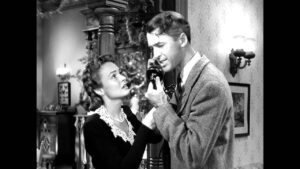 George Bailey (James Stewart) is a good man, a solid citizen, but is far from perfect. He’s not above leering at the attractive derrière of Violet Bick (Gloria Grahame) as she shimmies down the street. He loses his temper and becomes abusive. He verbally destroys the simple-minded Uncle Billy when the latter loses a crucial bank deposit. On Christmas Eve, his life at its lowest ebb, he screams over the phone at his child’s teacher, then yells at his children, bringing them to tears. (Stewart’s acting is brilliant throughout. He was suitably nominated for Best Actor, losing only because the equally brilliant Frederic March in The Best Years of Our Lives.)
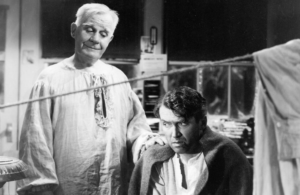 Every one of the secondary characters in Wonderful Life is well-drawn and engaging in their own right. Clarence the Angel (Henry Travers); Bert the cop (Ward Bond); Ernie the cab driver (Frank Faylen); the tragic Mr. Gower (H. B. Warner); all the way down to Zuzu (Karolyn Grimes, who is still with us). Old Man Potter (Lionel Barrymore) is a classic villain, and even his nonspeaking servant has an eerie presence.
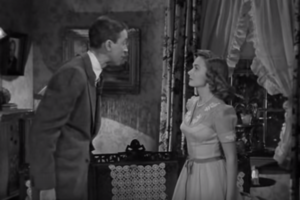 Which doesn’t help George’s frustration about staying in town. That evening he finds himself walking by Mary Hatch’s house. Mary, back in town from school, has been waiting for this moment. She has on her best dress and has set up the parlor to reveal a picture of a romantic moment from their high school days—when George said he would “lasso the moon” for Mary.
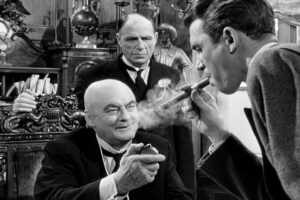 “You wouldn’t mind living in the nicest house in town,” Potter says, “buying your wife a lot of fine clothes, a couple of business trips to New York a year, maybe once in a while Europe. You wouldn’t mind that, would you, George?”
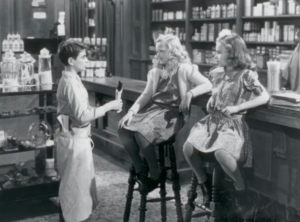 In Wonderful Life, George’s realization about his town’s love is argued against in Act 1. That’s when the young George Bailey tells the two girls, Mary and Violet, the following:
 Do you judge a book by its cover?
 “Hypnosis is a natural state of consciousness that we drift in and out of quite regularly. For example, while driving along a highway and then suddenly discovering that you ‘lost’ several miles without being aware of it. This can also happen during reading when you may notice that you have ‘read’ a chapter or two without being mindful of the content. Hypnosis is basically a technique for focusing consciousness by entering a deep state of absorption. It allows you to shift from your outer to inner awareness and tap deeper levels of consciousness so we can re-educate and reprogram the subconscious with empowering suggestions or beliefs.”
 “Hypnosis,” says Kevin McConkey, President of the Australian Psychological Society and co-author of Hypnosis, Memory, and Behavior in Criminal Investigation, “is essentially a phenomenon that reflects genuinely experienced alterations of reality in response to suggestions administered by a hypnotist. The subject’s testimony is what confirms the trance, although susceptibility varies among individuals. Those who are highly suggestive will behave as if going through truly significant cognitive alterations.”
 In wintery April, an elderly lady in her 70s was alone in her cabin on a remote gold claim in northern British Columbia. A masked man with a handgun appeared at her door, demanding she hand over her gold stash. She refused. He proceeded to blindfold and hog-tie her, then began torturing by burning her hands and ribs with a red-hot knife heated on her wood stove.
 Now knowing an accomplice was involved, we focused the investigation on a neighbor who’d been involved with a gold claim boundary dispute. We identified the suspect as a Hells Angels striker who’d been hired by the neighbor, so we ran a wiretap which caught him using the term ‘squirreled away’. This led to an elaborate, clandestine sting operation resulting in his confession to an undercover agent. He was convicted and got twenty years.
 Two months ago, we completed our move to West Virginia, which was two years in the making, the final 7 months of which was in a tiny apartment in an urban part of Northern Virginia. In moving into the new place I designed my office around the reality of video-oriented promotional opportunities. My office in the previous house was designed such that my desk was in front of a pretty bay window that looked out onto the neighborhood. I enjoyed having all that light coming in over my shoulders while I worked, but it made for a terrible video backdrop. As a consequence, I did all my Zooming from the bar in my basement. It looked cool, but was not appropriate for all audiences.
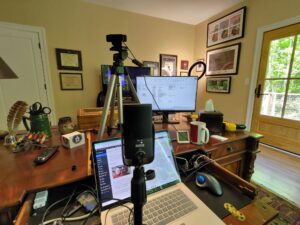 Because I can do what I need to do from my desk, I have the advantage of a second screen on which I can see the people I’m talking to without looking down, or, in the case of videos for
 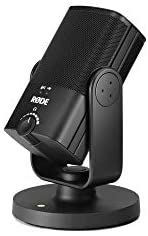 With the publication of
 Bears can kill with one strategically placed swat of the paw, but they have terrible eyesight.



 Using sharp claws on their fore-flippers, seals punch out 10-15 breathing holes in the ice and maintain the openings all winter but using these holes can mean sudden death if a hungry polar bear is nearby.
 Skunks use an overpowering odor for defense and can spray six times in succession, but once their foul-smelling liquid runs out it takes up to 10-14 days to refill the glands.
 Gray whales can submerge for 15 minutes at a time, but a mother’s calf can only hold its breath for 5 minutes, so when under attack by orcas the mother will flip onto her back to create a platform for her baby to lay on, but Momma can’t breathe upside down.