Flashback Words of Wisdom

Flashbacks. Some claim you should never use them, and urge instead that you take the information/background/emotional backstory etc. contained in a flashback and find ways to include it in the present time of your story. At the same time others point out flashbacks can be a very powerful technique when used effectively.

Today’s words of wisdom flashes back to three posts about this potentially controversial topic. Joe Moore, James Scott Bell and Kay DiBianca provide insightful advice on how and when to use flashbacks.
Flashback is a writing technique that allows the author to convey backstory (events from the past) while remaining in the present. It usually involves a situation in which something in a current scene causes a character to reminisce or ponder a previous event. The reason to create a flashback is to build character or advance the plot, or both. The secret to successfully employing this technique is to construct a smooth transition into and out of the flashback so as not to confuse the reader.

One of the easiest ways to enter a flashback is with the word “had”.

As Jim walked through his old neighborhood, a distant dog barking reminded him of the day he and his friends had skipped school to . . .

In addition, you want to shift the time progression from simple past tense (As Jim walked) to the past perfect tense (his friends had decided). Once you’ve entered the flashback and established the “past”, you can then revert back to simple past tense. At the conclusion of the flashback, use “had” again to transition back to current time.

Jim climbed the steps of his childhood home knowing those summer days with his friends had been the best times of his life. 

In addition to transitions in and out of the flashback, it’s also important that the timeframe in which the flashback covers somewhat matches the real-time in which it’s experienced by the character. For instance, a flashback that covers the highs and lows of a woman’s previous marriage cannot be experienced during her stroll from the kitchen to the bedroom. But it would be an acceptable timeframe if she poured a glass of wine, strolled out onto her back porch and experienced it while sitting and watching the sun set and night fall. The reader must accept that the past and present timeframes are not unreasonably out of sync.

One final thought about flashbacks: it’s not a good idea to use one in the first couple of chapters. They can be quite confusing if thrown at the reader too soon. Wait until your reader has established at least a basic relationship with a character before taking them on a leap into the past. Flashbacks should be used sparingly. Better yet, use other techniques to relay backstory and avoid flashbacks altogether if possible.

Joe Moore—November 11, 2015


The Placing of Flashbacks

My advice here is simple:

Not too early. Get your story rolling with action. Get your readers invested in the characters. Then when you drop in the flashback it will have more impact.

Not too late. With your story hurtling toward the climax, the last thing we need is a scene that whips us into the past.

After the Door Slams. The plot is fully engaged only after the Lead passes through The Doorway of No Return—which should occur no later than 1/5 into the book. My counsel is to place a full flashback scene somewhere just before or just after the middle. (For a full treatment of structure, I humbly recommend my book.)

Getting In and Getting Out

Sure, you can start a flashback by telling us something like, Wendy remembered when she was sixteen…

And you can tell us when it’s over: Wendy stopped herself from thinking any more about it.

But here is a more elegant technique that works every time. When you’re about to go to flashback, put in a strong, sensory detail that triggers the memory in the POV character:

Wendy looked at the wall and saw a spider making its way toward a fly caught in a web. It moved slowly, purposely toward its prey. The way Lester had moved on Wendy all those years ago.

She was sixteen and Lester was the big man on campus. “Hey,” he called to her one day at the lockers. “You want to see a movie?”

We are in the flashback now. Write it out as a dramatic scene.

And how do we get out of it? By returning to the sensory detail (sight in this case) of the spider. The reader will remember that and know we’re back in the present:

Lester made his move in the back of the car. “This won’t take long, baby.”

The spider was at the web now. A wave of nausea hit Wendy as she watched it cover the fly.

But she could not look away.

The Backflash

A full flashback scene is not the only way to deliver backstory information. There’s also what I call the backflash. These are short bursts in which you drop info about the past within a present moment scene. The two primary methods are dialogue and thoughts.

Dialogue

           “Hey, don’t I know you?”

           “No.”

           “Yeah, yeah. You were in the newspapers, what, ten years ago? The kid who killed his parents in that cabin.”

           “You’re wrong.”

           “Chester A. Arthur! You were named after the president. I remember that in the story.”

Chester’s troubled background has come out in a flash of dialogue. This is also a good way for shocking information from the past, or a dark secret, to be revealed at a tense moment in the story.

Thoughts

“Hey, don’t I know you?”

“No.” Did he? Did the guy recognize him? Would everybody in town find out he was Chet Arthur, parent killer?

“Yeah, yeah. You were in the newspapers, what, ten years ago?”

It was twelve years ago, and this guy had him pegged. Lousy press, saying he killed his parents because he was high on drugs. They didn’t care about the abuse, did they? And this guy wouldn’t, either.

The nice thing about backflashes is they create mystery. You don’t give all the info at once, leaving the reader wanting to know more. You make them wait until the next backflash, and the next…as they feverishly turn the pages!

James Scott Bell—June 5, 2022


What is a flashback scene?

Smartblogger.com defines a flashback as

“a literary device where a story breaks away from the present narrative to delve into the past, by showing us a past event or a scene from the past.”

 According to novelist James Hynes in his Great Courses lectures entitled Writing Great Fiction,

“One of the fundamental principles of plotting is the withholding of information.…  A plot is the mechanism by which the writer decides what information to withhold, what information to reveal, and in what order.”

If the reader knows there was some disturbance in the protagonist’s past, but doesn’t know the full story, he/she will be compelled to keep reading to find out. When the author decides to reveal that fact, it may be effective to use a flashback scene.

The Power of a Flashback Scene

According to writingmastery.com,

“The beauty of flashbacks is that they give writers the freedom to fully show instead of tell the details of a traumatic or significant event in a character’s history, at the moment when it will be most powerful.”

 How to move from the present to the past

Transitioning to a flashback scene can be achieved by a character remembering something from his/her past. Or it can be a break in the story that presents some important background information that is crucial to the narrative. In either case, it’s important that the reader understand where he/she is in the story. To that end, transition can be accomplished in several ways:

A change in verb tense: If the story is written in the past tense, switching to past perfect will clue the reader in.

The use of italics: Although some readers don’t like long passages in italics, I’ve seen this device used and found it effective.

A specific date: A flashback can be a separate chapter or scene that is clearly dated to indicate a previous time.

However you decide to handle a flashback, it’s a device that can add strength to your story.

A Word of Caution

In his book Plot & Structure, James Scott Bell warns us about the overuse of this plotting device.

“There is an inherent plot problem when you use flashbacks—the forward momentum is stopped for a trip to the past…. If such information can be dropped in during a present-moment scene, that’s always a better choice.”

But if you feel the flashback scene is necessary, then JSB advises to make sure it works as a scene.

“Write it as a unit of dramatic action, not as an information dump.”

Kay DiBianca—January 15, 2024

***

How do you feel about flashbacks in fiction? Do you use them in your own fiction? Any advice on using them or, if you don’t, incorporating what they might contain in the present time of a novel?

Reader Friday-A Waster of Time, Are You?

As Yoda would ask, “A waster of time, are you?”

That’s his question.

Mine is, “What is your favorite way to waste time?” Now, be honest—I know you’d like to say that you never waste time.

As would I. But we all do, don’t we? Might as well come clean with it. Especially here with our friends.

Oh…mine? Glad you asked. It’s called Quordle. A word game, so technically it’s not a time-waster. (Or so says I…)      😊

Here’s a link.  https://quordle.game/ 

So, TKZers, out with it…tell us how you prefer to waste time.


The Science of Skeletons: What Bones Can (and Can’t) Tell Us

The Science of Skeletons: What Bones Can (and Can’t) Tell Us

By Jennifer Graeser Dornbush


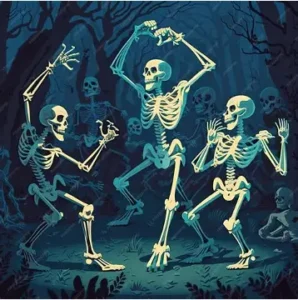
In the spirit of all things spooky, creepy and Halloweenie, let’s talk skeletons and what they tell our hero investigators about their murder victims.

Growing up in a coroner’s world, I learned that skeletal remains hold a kind of truth that outlasts everything else—identity, memory, even flesh. Bones remember. They record. They carry the quiet history of a life lived, right up to the moment it ended.

Bones don’t lie.

Let’s look at what bones can reveal with scientific accuracy… and where we writers can push beyond the boundaries while keeping our stories authentic and entertaining.

What Bones Can Tell Us

1. Age (Within a Reasonable Range)

Anthropologists can often estimate a person’s age at death by examining:

  • epiphyseal fusion (how long bones join at their growth plates)
  • cranial suture closure
  • dental wear and eruption patterns
  • bone density changes

Children and teens can be aged fairly precisely because their bones change rapidly on predictable timelines. Adults are trickier—the range becomes broader as we age, often spanning 5–10 years or more. Elderly adults are often placed into very broad brackets (“60+”) because degenerative changes vary widely depending on lifestyle, health, and nutrition.

One detail writers often miss: age estimates become less reliable when the skeleton is incomplete. A single long bone might give a ballpark range, but a full skeleton allows a multi-point evaluation and more confidence.

📌 Writers: Avoid giving an exact age like “34.” Anthropologists don’t speak that precisely unless the case includes supporting evidence.

2. Biological Sex (When Enough Bone Is Present)

The pelvis is the gold standard. Its shape, subpubic angle, and sciatic notch hold clear clues. The skull also offers markers—brow ridges, mastoid processes, jaw angle—but these are secondary indicators and less reliable on their own.

Accuracy increases when multiple indicators align, and confidence decreases sharply with incomplete or fragmentary remains. Hormone therapy, childhood malnutrition, and congenital differences can all blur the expected patterns, meaning even textbook traits aren’t always foolproof.

📌 Writers: If the pelvis is missing, anthropologists often phrase findings with caution: “biologically consistent with male,” not “definitely male.”

3. Ancestry (But Never With Certainty)

Contrary to what some crime series suggest, forensic anthropologists cannot state a person’s “race.” Instead, they may identify skeletal traits that statistically correlate with certain ancestral backgrounds—facial bone structure, nasal aperture shape, dental features like shovel-shaped incisors, or cranial index trends.

These are probabilities, not identities. Many people do not present textbook traits, especially in a multicultural society where ancestry is complex and blended.

📌 Writers: Emphasize probability, not absolute identity. Anthropologists work in “likelihoods,” not certainties.

4. Stature (Height Range)

Using formulas based on long bones—usually the femur, tibia, or humerus—scientists can estimate height with an accuracy range of a few inches. These formulas vary slightly by ancestry and biological sex, which adds even more nuance to the reconstruction.

📌 Writers: Don’t give a precise height like “5’10.” Use ranges: “between 5’8 and 5’11.”

5. Evidence of Trauma

This is one area where bones shine. Anthropologists can distinguish between:

Perimortem Trauma

Injury around the time of death—fractures with smooth, sharp edges and bending consistent with fresh bone.

Antemortem Trauma

Older injuries—healed fractures, remodeled bone, surgical implants.

Postmortem Damage

Breaks occurring after death—more jagged, brittle, and without biological response.

Anthropologists can also identify trauma patterns that reflect interpersonal violence—defensive wounds, repeated strikes, blunt vs. sharp-force trauma, and sometimes even directionality of force.

📌 Writers: Fresh breaks and old breaks look completely different under microscope and to the trained eye.

6. Lifestyle Clues

Long-term habits leave marks—literally.

Anthropologists can identify:

  • repetitive stress injuries
  • arthritis patterns
  • certain occupations (e.g., heavy lifting)
  • dental wear from specific diets
  • nutritional deficiencies (porotic hyperostosis, enamel hypoplasia)
  • healed fractures consistent with childhood accidents, sports, or violence

A life lived physically demanding work—like farming, manual labor, or elite athletics—often leaves distinctive signatures on the skeleton. Even habits like pipe smoking or chronic childhood illness can show up in subtle but telling patterns.

These clues paint a picture not just of how someone died, but how they lived—their health, labor, struggles, and resilience.

What Bones Cannot Tell Us

This is where fiction loves to stretch for the sake of entertainment. Be careful treading on this territory.

1. Personality or Emotions

Bones cannot tell you:

  • the victim was athletic (unless supported by robust muscle attachments)
  • the victim was cheerful
  • the victim was “a fighter”
  • the victim struggled with depression

Skeletal remains record biology, not biography. They hold structural truth, not emotional truth. A healed fracture may show resilience and health indicators, but it cannot reveal whether a person was kind, cruel, introverted, or lonely. These details belong to the psychological and social worlds—journals, digital footprints, witness interviews, personal effects—not the bones themselves.

📌 Writers: Keep internal traits internal. Bones don’t reveal emotional states.

2. Some Causes of Death

Unless the trauma affects bone—gunshot wound to skull, sharp-force trauma to ribs, strangulation fracturing the hyoid—many causes of death leave no skeletal trace at all.

  • Poisoning
  • Smothering
  • Drowning
  • Cardiac arrest
  • Hypothermia

Bones are silent on these. Even in cases with perimortem trauma, anthropologists still rely heavily on contextual evidence from the medical examiner, investigators, and crime scene analysis.

📌 Writers: Anthropologists often use the phrase “cause of death undetermined” without shame or drama—it’s a scientific reality.

3. Exact Time Since Death

Skeletal remains are notoriously difficult to date. Environmental factors—soil chemistry, temperature, humidity, insect activity, scavenging—can accelerate or slow decomposition unpredictably.

Anthropologists can give broad windows (“several months to a few years”), but bones cannot pinpoint the hour, day, or even reliably the season. Even “fresh” vs. “older” remains can blur when the environment is extreme.

📌 Writers: Avoid pinpoint decomposition timelines from skeletons alone.

4. Detailed Eyewitness Descriptions

Bones cannot reveal:

  • hair color
  • eye color
  • scars on skin
  • tattoos
  • freckles
  • gait (except in severe deformity cases)

Despite what television suggests, forensic anthropologists cannot conjure a photographic likeness from a skull. At best, they create approximations, using tissue-depth markers and artistic interpretation based on averages—not specific individual traits.

📌 Writers: Facial reconstructions are artistic approximations, not forensic certainties.

Where Fiction Cam Overreach

Let’s talk about those moments that make forensic anthropologists groan:

❌ “The bones show she was murdered right here at 8 p.m.”

Not possible.

❌ “We know she was a runner because her femurs are strong.”

Strong bones ≠ running.
Muscle attachments reveal repetitive stress—but not specific sports.

❌ “We matched the skeleton to a missing person by cheekbone shape alone.”

Impossible without DNA, dental records, or unique surgical implants.

❌ “The bones say the victim was happy.”

Bones do not record mood.

❌ “This fracture proves the killer was left-handed.”

Force direction is complex and rarely that conclusive.

How Writers Can Use Skeleton Science

The secret to realistic forensic fiction is simple:

Follow the limits — and let the uncertainty create tension.

Some of the most gripping scenes come from what the remains cannot tell investigators.

Writers often think more certainty equals more drama. But the opposite is true.
In real crime labs, ambiguity drives conflict, teamwork, and urgency. It leaves space for your detectives, MEs, and anthropologists to disagree—and disagreement drives story.

Here are ways to use skeletal limits to your advantage:

✔️ Use broad ranges (age, height, ancestry) to keep the investigation open.

✔️ Let characters debate the meaning of trauma patterns.

✔️ Allow missing pieces of bone to stall the case.

✔️ Introduce scientific caution as a personality trait for your forensic experts.

✔️ Let DNA or dental records be the turning point—not the bones alone.

These choices ground your story in truth while deepening the suspense.

The Humanity in the Bones

When I look at skeletal remains—even fictional ones—I see more than evidence.
I see the outline of a life.

Bones record:

  • injuries survived
  • hardships endured
  • nourishment given or withheld
  • age, growth, and decline

They hold our histories quietly, without embellishment or judgment.

And that, to me, is where the deepest storytelling power lies.

As writers, we’re not just reconstructing death; we’re reconstructing humanity.

Bones tell a story.
Not the whole story.
Not every detail.
But enough to begin.

As a storyteller, investigator, or crime-fiction lover— we can find a balance that honors the truth, lets the science shine and entertains.

Happy Spooky Season! Stay curious!

Jennifer

Jennifer Dornbush is an author, screenwriter, and forensic specialist who brings crime stories to life with authenticity and heart. WALKING ON WHITE, the latest novel in The Coroner’s Daughter mystery series drops October 20. With a background rooted in real-world forensics and a passion for crafting unforgettable mysteries, Jennifer offers readers and viewers a front-row seat to the intersection of science, justice, and human nature. Jennifer’s crime expertise has made her a sought-after speaker, consultant, and educator. Through her webinars and master course, WRITING THE KILLER CRIME SERIES, Jennifer guides writers in melding suspenseful storytelling with forensic realism to the screen and page.

Join her community at http://www.jenniferdornbush.com/

The Horror….The Horror!
Book versus Movie

“Beware the dark pool at the bottom of our hearts. In its icy, black depths dwell strange and twisted creatures it is best not to disturb.” –Sue Grafton (from I is for Innocent)

By PJ Parrish

It’s getting toward late Octoer, so something wicked this way is coming. I love Halloween. It’s like a welcome breath of stale air just before we’re lost in the miasma of Pumpkin spice and pine cones.

(Sorry…but I won’t apologize for my dark heart)

I also love creepy movies and books. While browsing in a Good Will store this week, I found an old paperback of Robert Bloch’s 1959 book Psycho. I would guess that most of you, like me, have never read the book. We were terri-reared on the movie. Which with its perfect casting and sinister psychology, is pretty much is etched in our nightmares.

Two things always give me the heebie-jeebies about Psycho the movie. First, Hitchcock shot it in a stark chiaroscuro style. Black and white, everything we see is in shadows and flashes of light. Like Janet Leigh driving in the black rain, blinded by oncoming headlights. Norman’s mother moving across a lone white-lit window in the black maw of the Bates mansion, And even Marion’s clothes — she first appears in white bra and slip in the hotel room with lover Sam Loomis. But after she steals the $40,000, her underwear shifts to a black bra and slip, signaling her moral crossing and loss of innocence.

The second thing that creeps me out is Bernard Herrmann’s unnerving score. Herrmann was the beating-heart behind all of Hitchcock’s movies. Hitchcock wanted the famous shower scene to be just silence but Herrmann talked him into the screeching violins. Here’s a sampling. Note the initial quiet but driving urgency as Marion begins her flight and how it keeps relentlessly and inevitably moving her down the black road to the neon VACANCY sign, a seemingly light in the night..

I was surprised, when reading the book, how different it is from the movie. As in all books vs movies, there’s deeper exploration of each character’s psychology. Some key plot scenes are different. The novel opens inside the Bates house with Norman arguing with his mother. The movie opens in a hotel room with Marion and Sam Loomis in bed. In the book Mary (renamed Marion for the movie) and Norman share a meal inside the Bates house. In the film, they eat together in the motel office, under the stare of dead stuffed birds — while Hickcock keeps the house mysterious until later.

And then there’s the shower scene. I was shocked when, in the novel, Mary was beheaded with a large knife. We all knows what happens to her in the movie. (By the way, Hitchcock used Hersey’s chocolate syrup for the blood and had a prop man stab a knife into a melon to make the grisly sound.)

I liked Bloch’s book, It’s tightly written, very short and fast-paced. Norman is oddly sympathic, an overweight book-geek with glasses. Bloch relies on stream of consciousness narrative to capture his loneliness and fractured psyche. Mary has her own demons — she had to care for her dying mother, giving up her future so her sister Lila can go to college. Life has passed Mary by. From the book, here’s Mary thinking, after she psycholgically snaps, steals the money and goes on the lam:

All at once she could hear the sullen patter of the rain and sense the sigh of the wind behind it. She remembered the sound, because it had rained like that the day Mom was buried, the day they lowered her into that little rectangle of darkness.

Which resonates later when Norman Bates says:

“We all go a little mad sometimes”

As much as I love Psycho the movie, I almost wish I had read the book first. Mary is such a sympathtic character, whose life was cut short by her mother’s death and then again by Norman’s mother’s knife. But every scene of Hitchcock’s classic is so etched in my brain that it overshadowed the subtlies of Bloch’s thriller, which leaves so much more to the imagination.

Such is the tug and pull of book vs movie, especially in the thriller-horror genre. I can think of at least a dozen other examples we could argue about — which is better? — among them:

  • Rosemary’s Baby.
  • The Exorcist
  • Silence of the Lambs
  • Almost anything by Stephen King.

And my favorite: The Haunting of Hill House by Shirley Jackson. Lucky for me, I read the book before I saw the movie. I read it when I was only about thirteen. It scared the daylights out of me. The movie is equally brilliant. There’s this one scene that haunts to me to this day and it’s in both the book and movie:

Eleanor and Theodora are sharing a room and a bed. As terrifying noises—including what sounds like a child being tortured in the walls—echo through the room, Eleanor blindly reaches out and clutches a hand in the dark for comfort. When the lights come on, Eleanor looks over and sees that Theodora is actually sitting up on the other side of the bed, completely out of arm’s reach.

Horrified, Eleanor stumbles back into the corner and asks the famous closing line of Chapter 5 — “God, God—whose hand was I holding?”

The hairs are standing up on my neck as I write this. Sweet dreams…

First Page Critique: The Accountant

Another Brave Writer submitted their first page for critique. See you on the flipside.

The Accountant – a crime novel

Donatelli glanced down as he stuffed his cigarette into the car ashtray with its integrated ember killer. It looked like a damn coffee cup. Nobody could tell him not to smoke in his own fuckin’ car, so there, Anna, put that in your pipe and smoke it. 

     He had just left his accountant’s office, odd duck, an ace with money. “and financial planner for all your needs…” he mimicked in his mind, in a sneering voice. Good at his job, but Kevin was a pussy.

     He flicked on the heat and massage feature as he wheeled the black Benz S580 onto Queen Street from the aging parking garage. His eyes rising to the windshield, he glimpsed the movement of a red dot criss-crossing his bespoke oxford cloth shirt. Panic engulfed him as it moved up the subtle stripes, out of eye range, toward the big bald dome of his head. He looked down, cross-eyed, searching frantically for the dot on his face and then around for the shooter, stomping on the gas as he completely forgot he was driving. Bad move, Donatelli. Bad move.

The shot never came but Donatelli shot through the windshield when the car slammed into the big maple, sedate and glorious in its fall foliage. He should have paid attention to the other red dot, the one that indicated “check airbag”.

     That day, the day Kev killed Donatelli, was an amber and scarlet October Friday. As he shrank back, Kev’s feet crunched the leaves scattered on the sidewalk while horror and disbelief churned inside him. The eyes of the leaving-work crowd were on the shattered wreck accordioned against the towering maple, smoke spiralling from the dead engine. And Donatelli. No one seemed to notice as Kev hastily thrust his hand into the swing-top bin on the corner and released the ‘weapon’. The sun glinted off Donatelli’s sunglasses, the tilt of his head hovering over the hood making it look as though he stared accusingly at his accountant. Although the dripping blood diminished the illusion, the shower of red maple leaves caused by the impact added to the colour.                                                 

     Kev thought of Dina. Would he tell her? Being married to Dina was like holding a helium-filled balloon. She relied on him to keep her grounded. The comparison to a balloon would not sit well with Dina who waged an ongoing war against balloons.

***

This Brave Writer must be new to the craft. Thus, let’s talk big picture first. First “rule” of writing is to limit one point-of-view per scene. Though an omniscient POV is one of the choices, I don’t think Brave Writer was going for that. I believe they intended to use deep 3rd.

This first page is a classic case of trying to fit too much information into the first page to draw readers into the story. Unfortunately, it has the opposite effect. Releasing too much information too quickly only causes confusion. The opening page should hint at the story to come. It should compel the reader to flip the page. By releasing too much information, the reader has no reason to continue. It’s also confusing, because we don’t have the story playing in our minds like the writer does.

This first page told us:

  • Donatelli had a meeting with his accountant, presumably Kev.
  • Donatelli doesn’t like Kev.
  • Donatelli dies in a car accident.
  • Car accident was caused by a red laser dot.
  • The make, model, and color of Donatelli’s car.
  • How Donatelli is dressed, including his sunglasses, which stay in place after he sails through the windshield.
  • Kev killed Donatelli.
  • The day of the week (Friday).
  • The month (October).
  • What the weather was like that day.
  • Kev is Donatelli’s accountant.
  • What Donatelli looked like dead.
  • The eyes of people leaving work on Friday. How do you see workers’ eyes from a distance? Or do you mean their attention turned toward the car wreck?
  • Kev is married to Dina.
  • Dina needs grounding.
  • Dina hates balloons for some reason.
  • Dina wouldn’t like Kev comparing her to balloons.

Whew! That’s a lot of information to squeeze into the opening page of a novel. See why this may confuse readers? It’s too much to absorb all at once. Save at least 80% of that information and sprinkle it in little by little later. Let me show you what I mean.

Here’s your opener again:

Donatelli glanced down as he stuffed his cigarette into the car ashtray with its integrated ember killer. <- No smoker would think about a car lighter in this way. Also, newer vehicles don’t come with lighters or ashtrays these days. It looked like a damn coffee cup. <- Don’t understand this visual. Nobody could tell him not to smoke in his own fuckin’ car, so there, Anna, put that in your pipe and smoke it. <- Like it. You’ve given us a peek at his personality, without telling us. Good job!

     He had just left his accountant’s office, odd duck, an ace with money. “and financial planner for all your needs…” he mimicked in his mind, in a sneering voice. <- The catch phrase adds no value. Also, how does one mimic in their mind? Good at his job, but Kevin was a pussy. <- That works. It shows Donatelli’s disdain for Kev.

     He flicked on the heat and massage feature as he wheeled the black of his Benz S580. When he turned on to Queen Street, from the aging parking garage. His eyes rising (<- nitpick: I envision loose eyeballs) his gaze lowered (not rose) to the windshield, he glimpsed the movement of a red dot criss-crossing his chest. bespoke oxford cloth shirt. <-What he’s wearing is not important. Think: suspense. Short. Punchy. A gazillion things should race through his mind, things like, who wants him dead? Why would someone, anyone, want to kill him? It must be a professional hit, if they’re using a gun with an infrared laser. Who would hire someone to kill him?

Panic engulfed him. (More powerful on its own line.)

as it moved up the subtle stripes, out of eye range, toward the big bald dome of his head. If he had a gun trained on him, he would not think about his outfit or his bald head. He looked down, cross-eyed, searching frantically for the dot on his face  How does he “look down” at his face? “Cross-eyed” also takes us out of his POV. 

In search of the shooter, his gaze flicked from window to window. and then around for the shooter, stomping on the gas as he completely forgot he was driving. No one forgets their driving. They may get distracted, but they don’t forget they’re behind the wheel of a moving vehicle. Bad move, Donatelli. Bad move. Stomped the gas instead of the brake—hit a tree—and shot through the windshield, glass shattering around him.

The shot never came but Donatelli shot through the windshield when the car slammed into the big maple, sedate and glorious in its fall foliage. Why would anyone, mangled and dying, take time to admire a maple tree? If the description is important to the plot, save it for later when the police come to the scene, and include in someone else’s POV. If it’s not important, delete. He should have paid attention to the other red dot, the one that indicated “check airbag”. <- He would never think this as he’s dying. 

These last two paragraphs don’t belong in the same scene as Donatelli’s POV. Save them for a future scene, but tighten the writing like above.

     That day, the day Kev killed Donatelli, was an amber and scarlet October Friday. As he shrank back, Kev’s feet crunched the leaves scattered on the sidewalk while horror and disbelief churned inside him. The eyes of the leaving-work crowd were on the shattered wreck accordioned against the towering maple, smoke spiralling from the dead engine. And Donatelli. No one seemed to notice as Kev hastily thrust his hand into the swing-top bin on the corner and released the ‘weapon’. The sun glinted off Donatelli’s sunglasses, the tilt of his head hovering over the hood making it look as though he stared accusingly at his accountant. Although the dripping blood diminished the illusion, the shower of red maple leaves caused by the impact added to the colour.      

     Kev thought of Dina. Would he tell her? Being married to Dina was like holding a helium-filled balloon. She relied on him to keep her grounded. The comparison to a balloon would not sit well with Dina who waged an ongoing war against balloons.

A few notes:

It’s fine to open a thriller with a murder victim. If you choose to stay in Donatelli’s POV (the victim), you must make us empathize with him. Otherwise, who cares if he dies? If you’d rather us care about Kev, then open with him as the POV character. Actually, I think the last two paragraphs in his POV are stronger.

Who is the protagonist of this story?

Does the story rewind to include Donatelli? Or is he the first victim of many?

Is Kev the antagonist? Or is he an antihero?

You need to establish these roles right away. Don’t make us guess. Hopefully, Kev, Donatelli, or both are main characters (hero/antihero or villain). Are they?

In terms of description, take sight out of the equation. Now, how would you describe a maple tree? How would you describe a car accident? Is the crash loud or silent? Both could be true, depending on whose POV you’re in.

Speaking as someone who shot halfway through a windshield, I can tell you, I heard nothing. It was more of an eerie stillness as my body immediately went into shock. It wasn’t until a Good Samaritan stunned me out of my silent haze that I heard the crunching of glass as I opened my eyes, tearing off one eyebrow, eyelashes, half my nose, eyelid, and upper lip. What I did not do was admire the trees. 😉 In fact, I had so much glass and blood in my eyes, I could barely see.

If you slipped inside Donatelli’s skin, how would you describe panic? Does your hearing muffle? Does your pulse race? Is your mind on high alert? What’s happening inside your body? It’s difficult if you’ve never experienced sheer terror. You need to speak to someone who has, someone willing to share their story. Don’t rely on the movies, which are visual mediums.

Slow down, narrow in on minute details without using sight. That’s how you make us care about Donatelli. Let us into his mind but not surface level. He’ll be dead soon. You must let us all the way inside to his true character, his hopes, his fears, his dreams for the future, how his body reacts, how his mind flusters, how his environment blurs.

If this was my first page, I’d open in Kev’s POV. Show how he uses the laser to cause the accident. Show his delight when the car crashes into the tree (your maple tree visual would make sense then). Show him standing over the body, with a snide smirk and a few choice words of inner dialogue to hint—not reveal—at why he killed Donatelli.

I’ve only opened in a victim’s POV once, but I pulled from life experience. When my gas pedal stuck wide open on a busy main drag littered with traffic lights, it terrified me. In my case, the hell ride was due to a manufacturer’s recall, and I eventually walked away unscathed. In the book, a serial killer hacked the victim’s car and took control. She died. See how easy it is to twist real life into fiction? Something to think about.

Okay, over to you, TKZers. Would you turn this first page? Any advice to add?

The Secret Sauce(s) of Fiction

by James Scott Bell

I love me a good burger. As master of the grill, I make a killer patty on my Traeger. Nothing like smoky goodness in brisket-blend ground beef. From there I make it personal: Colby jack cheese nicely melted, a slice of white onion, a slice of tomato (the way Miracle Max likes them, “perky”), and a crisp lettuce leaf, topped with Stubbs Sweet Heat BBQ sauce.

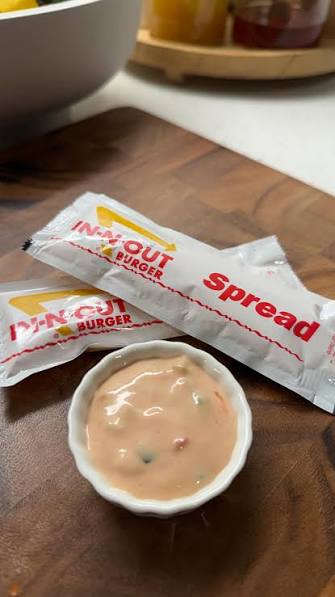
When it comes to fast-food burgers, there is only one place I’ll consider: In-N-Out. My go-to is their Double-Double—two patties with American cheese, lettuce, tomato and grilled onions.

And, of course, their secret sauce (“spread”). The nice thing is you can ask for extra spread if you like, and I like, one for splooching a bit on the next bite, and one for my fries. (You can look up recipes online that purport to duplicate In-N-Out spread, but it’s still officially a secret). It’s that sauce that makes all the difference.

Which invites the question: is there a secret sauce for fiction? I believe every author can make their own recipe, and should. It’s the way we can stand out from the generic, tasteless condiment produced by the machine.

I do believe that the writers who enjoy massive success all have a secret sauce.

For Dickens, it was in his cast of characters. As I wrote this, many came to mind, as fresh as when I first encountered them: Mr. Micawber, Peggotty, Betsy Trotwood, Mr. Dick, Fagin, The Artful Dodger, Mr. Bumble, Scrooge, Madame Defarge, Miss Havisham. I’ve often talked about supporting characters being the “spice” of fiction. Don’t ever waste them as a cliché or stereotype. This is one of the most potent ingredients in any sauce.

For Chandler, it was style. His was unique and tangy, often imitated, never surpassed.

I lit a cigarette. It tasted like a plumber’s handkerchief.

It was a blonde. A blonde to make a bishop kick a hole in a stained-glass window.

From thirty feet away she looked like a lot of class. From ten feet away she looked like something made up to be seen from thirty feet away.

John D. MacDonald also had a singular style, what he called “unobtrusive poetry.”

She sat up slowly, looked in turn at each of us, and her dark eyes were like twin entrances to two deep caves.  Nothing lived in those caves. Maybe something had, once upon a time. There were piles of picked bones back in there, some scribbling on the walls, and some gray ash where the fires had been.

Another word for style is voice. Sometimes that voice is the main ingredient in the sauce, as with the novels of Tom Wolfe and Douglas Adams.

For Harlan Coben, it’s about the plot, with more twists than a pretzel.

Elmore Leonard was a master of dialogue, and it’s spread throughout all his books.

   “I don’t know what it is,” his dad said, “you’re not a bad-looking guy. You could give a little more thought to your grooming. Get your hair trimmed, wear a white shirt now and then, see if that works. What kind of aftershave you use?”

     “I’m serious.”

     “I know you are and I’m glad you came to me. When’d she throw you out, last night?”

     “She didn’t throw me out, I left. I phoned, you weren’t home, so I stayed at Jerry’s.”

     “When you needed me most,” his dad said. “I’m sorry I wasn’t here.”

“Actually,” Chris said, “you get right down to it, Phyllis’s the one does all the talking.” (Freaky Deaky)

For Ken Follett it’s historical detail, deftly woven, not larded on. As one critic put it:

Readers do learn a lot about cathedral building in The Pillars of the Earth and about how Gothic architecture developed, but in a way that serves a clear and clever purpose in the story. It doesn’t feel stuck-on or like an excuse for the author to write endlessly about his passion and share the fruits of research. The exposition plays naturally and complements rather than impedes the flow of the narrative and build of suspense.

With Carl Hiaasen, humor is the main ingredient.

When I was conceiving my series hero, Mike Romeo, I asked myself what my secret sauce would be. What can I bring to the character that will make him unique and not just some knockoff of what’s worked for others? So far, with #11 out there now, I think my sauce is working. It’s a mix of dialogue, philosophy, a touch of humor, spicy minor characters, and horticulture. He is a former cage fighter who loves flowers, Plato, and his wife, Sophie.

A few secret sauce tips:

  1. Be judicious with it. Too much sauce of any kind can overpower the meat. Your sauce should enhance, not overwhelm, the book.
  2. It must be tasty. Not every mixture is palatable to the reading public. Of course, if you don’t care about sales, splatter on whatever spread you make.
  3. Don’t use AI to come up with your recipe. Mix it in your own mental kitchen.

And so I ask, do you have a secret sauce? Maybe you haven’t thought about it, but looking at your work so far, do you see a consistent ingredient that marks your books as uniquely yours?

What’s the secret sauce for some of your favorite writers?

Let’s talk about it. Bon appétit!

Procrastination can be good!

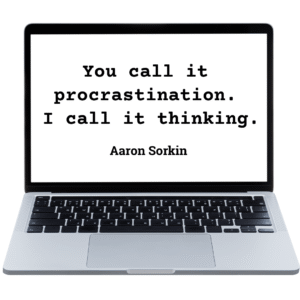
"You call it procrastination, I call it thinking." Aaron Sorkin thepitchmaster.com

Creative people are known procrastinators. We will spend three hours on the Internet researching, walk the dog, and organize our desk drawer all before we start working. Interestingly, that procrastination often serves a purpose. While we are doing other things, our brains are working on our creative problems. So when we finally sit down to work, the solutions appear like magic. This process is called creative procrastination.

The Shower Principle

Activities where you can let your mind wander like driving, walking, or showing work best. So many people get ideas when they take a shower that it is a real psychological phenomenon called the shower principle. Scott Barry Kaufman, a cognitive scientist and coauthor of Wired to Create, did a study that showed 72% of people get creative ideas in the shower. I know one writer who keeps a white board marker in his shower so that he can jot his ideas on the tile. Another writer friend of mine made a sale pitching over the phone an idea straight from the shower with soap still in his hair. For me, I get my ideas walking my dog or in the shower. Bestselling novelist Tess Gerritsen goes for a long boring drive whenever she gets stuck in a story. (She calls being stuck plot blocked, which is my new favorite story term.)

When you are stuck on a creative problem, the best thing to do is to get up from your computer. By focusing on something else you let your subconscious mind work on the problem. This is often when our greatest ideas come to us.

You call it procrastination. I call it thinking. –  Aaron Sorkin

Architect Frank Lloyd Wright dodged a client for nine months, until the man drove 140 miles to confront him about his missed deadlines. Knowing his patron was on his way, Wright sketched his masterpiece Fallingwater in two hours.

Sleep On It

Just like mindless tasks help your unconscious brain solve problems, sleep can do the same thing. The phrase let’s sleep on it, exists for a reason; it really works. Thomas Edison was a famous napper. He would often take a nap during the day and wake up with a solution for whatever project he was working on. Early on in my career, I figured out that this is one of the ways my creative brain likes to solve problems. When I am reacting to written material, I read it once, make notes, sleep on it, and come up with more solutions. In fact, I ask my clients to turn in their projects for feedback 48 hours in advance of our meetings so that I can sleep on it.

A Caveat

Both the shower principal and sleeping on it only work if you have given some conscious thought and conscious work to your project. You need to have wrestled with the problem a bit before you disconnect. In other words, you have given your unconscious brain direction about what to think about when you’re not thinking about it. If I am really struggling with a story problem, I will tell myself to think about it right before I go to sleep. I almost always wake up with a solution.

Non-procrastination

Ironically, not practicing creative procrastination can be a problem. People that compulsively finish things early are called precrastinators. And while being organized is wonderful, never allowing things to percolate means you’re missing a big step of the creative process. I encourage you when you finish projects, whether you are a precrastinator or a procrastinator, to let them lie fallow. Put them in a drawer for a little while and come back and look at them with fresh eyes. If you can take a couple of weeks, that’s ideal. But even a couple of hours can be helpful. It’s just another way to let your unconscious brain work its magic.

What is your favorite way to creatively procrastinate?

Dive Deeper

Wired to Create by Scott Barry

Precrastination and the Science of Doing Too Much, Psychology Today

The Creative Power of Procrastination, Tiago Forte

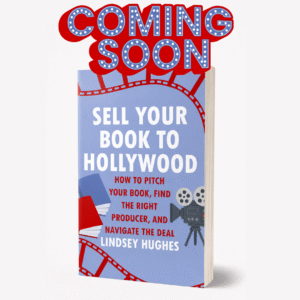
Sell Your Book to Hollywood: How to Pitch Your Book, Find the Right Producer, and Navigate the Deal by Lindsey Hughes        This is the playbook I’ve built from 30 years in the business: what producers want, how deals get made, and the mistakes that kill great projects. Join the list to get a launch day discount! 

Reader Friday-Teach Me!

As TKZers, it goes without saying that we are all very skilled…at something, I’m sure.

But, the question for the day is not what skill(s) you already possess, either naturally or after years of dedicated blood, sweat, and tears—but what skill you’d like to have.


So, here goes:  If a genie popped out of your water bottle and offered to imbue you instantly with any one skill, what skill would you choose?

Here’s my answer.

I would like to possess an unerring skill to discern the motives of people who cross my path–and say or do things that make no sense. Lots of that going around.

Nature is so much easier to figure out, right? The lion wants to eat me, and the mantis is trying to figure out how much I weigh…so she can eat me.   🙂

If that genie ever pops up in front of me, life is going to get very interesting in the Gorman household, yessirree Bob!

Your turn! What skill do you want?


Poor Unappreciated Me

By Elaine Viets

    Recently, a Very Important Person at Macmillian Publishers sent me a complimentary email. She’s a real senior editor at the British publisher. Modesty forbids me from using her name, so I’ll call her VIP.

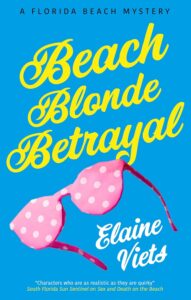
 The VIP editor’s email was headlined, “Editorial Interest in Beach Blonde Betrayal.” (That’s my new mystery.)

          VIP was “immediately drawn to the combination of wit, suspense, and vivid South Florida atmosphere” in my most recent novel.

          She outlined the plot in detail and said it was an “entertaining mystery with plenty of momentum, while the quirky residents and local setting give the story a distinctive character.”

          Wow. Move over Kristin Hannah and Georges Simenon, here’s someone who understands the poetry of my soul.

          The VIP editor wanted to know the name of my agent. (In publishing speak, that means she’s serious.)

Then VIP said, “there may be scope for a broader discussion regarding potential fit within Macmillian’s adult mystery, crime, and cosy mystery publishing programs.”

I noticed she spelled “cosy” in the proper British style. This was looking better and better. VIP said she’d be delighted to hear from me.

Not as happy as I was to hear from her.

I’d always wanted to take a long cruise. I could see myself relaxing in the ship’s spa after lunch, then resting up before a lobster dinner, followed by champagne cocktails at bedtime. In the morning, I’d work on my next international bestseller in my balcony suite. Meanwhile, the VIP editor would fend off the movie and TV offers for my latest work.

I was about to make my cruise reservations when the last line of the email stopped me: The VIP editor finished her email, “Keep being awesome.”

What!? My dream cruise was shipwrecked. The champagne cocktails spilled down the drain and the lobster was an empty shell.

No editor, especially not a British editor, would tell a writer to “keep being awesome.” Not unless Prince William slapped me on the back and invited me for a beer at the palace.

Furthermore, this VIP used a gmail address, often a sign of a scam. She should have used her corporate address.

Since then, I’ve been deluged with emails about my mysteries.

Marketing directors begged for the opportunity to increase my sales, starting with lowering the prices of my mysteries. (Those are set by my publisher, thank you.)

Dubious book clubs wanted to recommended my books to their thousands of readers. (For a small fee.)

 Flattering emails invited me to be a guest on prestigious podcasts. No charge, of course, though they’d appreciate a “donation” to help pay for the sound engineer. (No thanks.)

One of my favorite radio shows, “Fresh Air” with Terry Gross, invited me for an interview. I noticed the email for “Fresh Air” had an extra R. No Terry. No invite.

All of  these emails were AI scams. Writer Beware, the useful blog that helps writers navigate the darker corners of our industry, wrote “How Those Personalized Generative AI Scam Emails Are Built.” Check out the full article here: https://tinyurl.com/mr3c5ct4

These scams are surprisingly easy, Writer Beware’s Victoria-Strauss said. And common. My VIP editor routine has its own name.

“For the Editor Impersonation Scam, these emails use a real editor’s name and title,” Victoria-Strauss wrote. “But they often use a gmail address instead of the corporate address, and the scammers usually slip up some other way.”

 In my scam letter, they told me to “keep being awesome.”

These scam letters are extremely detailed. Not only do they include information about my book’s plot and characters, but my biography, sale rank on Amazon, and more. All that information can be picked off the internet.

“We still don’t know how the AI scams are structured or who runs them,” she said. “The payment and other data I’ve collected suggests that they mostly hail from West Africa, and there’s obviously some degree of centralization – the way the solicitations sort into distinct ‘types’ or categories suggests this (i.e., marketing, book club, impersonations of well-known authors, editors, agents, etc.).

“The one bright spot amid this scam tsunami is that familiarity breeds suspicion. . . . The scammers are still making money, though. The emails wouldn’t be flooding our inboxes if they weren’t. Be careful out there.”

          Since that email, I’ve been careful, resisting the siren song of those gushing letters.

Fortunately, I have a nice Nigerian prince to advise me.

***

Beach Bargain. Both my Florida Beach mysteries, “Sex and Death on the Beach” and “Beach Blonde Betrayal” are Kindle ebook deals. Click here: https://tinyurl.com/2uxyfa5d