
 I love me a good burger. As master of the grill, I make a killer patty on my Traeger. Nothing like smoky goodness in brisket-blend ground beef. From there I make it personal: Colby jack cheese nicely melted, a slice of white onion, a slice of tomato (the way Miracle Max likes them, “perky”), and a crisp lettuce leaf, topped with Stubbs Sweet Heat BBQ sauce.
When it comes to fast-food burgers, there is only one place I’ll consider: In-N-Out. My go-to is their Double-Double—two patties with American cheese, lettuce, tomato and grilled onions.
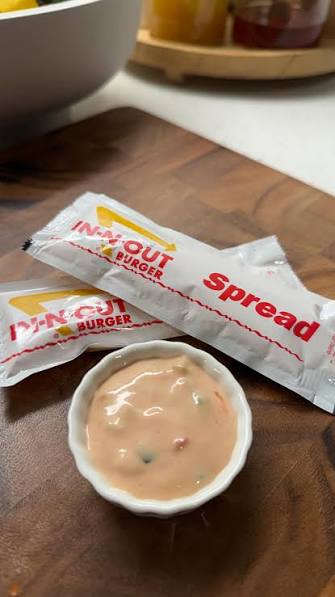
And, of course, their secret sauce (“spread”). The nice thing is you can ask for extra spread if you like, and I like, one for splooching a bit on the next bite, and one for my fries. (You can look up recipes online that purport to duplicate In-N-Out spread, but it’s still officially a secret). It’s that sauce that makes all the difference.
Which invites the question: is there a secret sauce for fiction? I believe every author can make their own recipe, and should. It’s the way we can stand out from the generic, tasteless condiment produced by the machine.
I do believe that the writers who enjoy massive success all have a secret sauce.
For Dickens, it was in his cast of characters. As I wrote this, many came to mind, as fresh as when I first encountered them: Mr. Micawber, Peggotty, Betsy Trotwood, Mr. Dick, Fagin, The Artful Dodger, Mr. Bumble, Scrooge, Madame Defarge, Miss Havisham. I’ve often talked about supporting characters being the “spice” of fiction. Don’t ever waste them as a cliché or stereotype. This is one of the most potent ingredients in any sauce.
For Chandler, it was style. His was unique and tangy, often imitated, never surpassed.
I lit a cigarette. It tasted like a plumber’s handkerchief.
It was a blonde. A blonde to make a bishop kick a hole in a stained-glass window.
From thirty feet away she looked like a lot of class. From ten feet away she looked like something made up to be seen from thirty feet away.
John D. MacDonald also had a singular style, what he called “unobtrusive poetry.”
She sat up slowly, looked in turn at each of us, and her dark eyes were like twin entrances to two deep caves. Nothing lived in those caves. Maybe something had, once upon a time. There were piles of picked bones back in there, some scribbling on the walls, and some gray ash where the fires had been.
Another word for style is voice. Sometimes that voice is the main ingredient in the sauce, as with the novels of Tom Wolfe and Douglas Adams.
For Harlan Coben, it’s about the plot, with more twists than a pretzel.
Elmore Leonard was a master of dialogue, and it’s spread throughout all his books.
“I don’t know what it is,” his dad said, “you’re not a bad-looking guy. You could give a little more thought to your grooming. Get your hair trimmed, wear a white shirt now and then, see if that works. What kind of aftershave you use?”
“I’m serious.”
“I know you are and I’m glad you came to me. When’d she throw you out, last night?”
“She didn’t throw me out, I left. I phoned, you weren’t home, so I stayed at Jerry’s.”
“When you needed me most,” his dad said. “I’m sorry I wasn’t here.”
“Actually,” Chris said, “you get right down to it, Phyllis’s the one does all the talking.” (Freaky Deaky)
For Ken Follett it’s historical detail, deftly woven, not larded on. As one critic put it:
Readers do learn a lot about cathedral building in The Pillars of the Earth and about how Gothic architecture developed, but in a way that serves a clear and clever purpose in the story. It doesn’t feel stuck-on or like an excuse for the author to write endlessly about his passion and share the fruits of research. The exposition plays naturally and complements rather than impedes the flow of the narrative and build of suspense.
With Carl Hiaasen, humor is the main ingredient.
When I was conceiving my series hero, Mike Romeo, I asked myself what my secret sauce would be. What can I bring to the character that will make him unique and not just some knockoff of what’s worked for others? So far, with #11 out there now, I think my sauce is working. It’s a mix of dialogue, philosophy, a touch of humor, spicy minor characters, and horticulture. He is a former cage fighter who loves flowers, Plato, and his wife, Sophie.
A few secret sauce tips:
- Be judicious with it. Too much sauce of any kind can overpower the meat. Your sauce should enhance, not overwhelm, the book.
- It must be tasty. Not every mixture is palatable to the reading public. Of course, if you don’t care about sales, splatter on whatever spread you make.
- Don’t use AI to come up with your recipe. Mix it in your own mental kitchen.
And so I ask, do you have a secret sauce? Maybe you haven’t thought about it, but looking at your work so far, do you see a consistent ingredient that marks your books as uniquely yours?
What’s the secret sauce for some of your favorite writers?
Let’s talk about it. Bon appétit!