 Which true crime novel shook you to the core? And why?
If you don’t read true crime, then substitute the fictionalization of a real crime.


 You’ve just been arrested for murdering your neighbor in the exact same way as the victim died in the last thriller you read.
How did your neighbor die?
Extra points question!
When the police search your computer, what will they find in your search history that will strengthen their case against you?
By SUE COLETTA
Joe’s Saturday post inspired me to share a strange encounter I had with a reader last week. I loaded up the SUV for my annual trip north to appear at a 5-star library in New Hampshire (rated by Library Journal). I’ve all but given up on libraries for book signings, but this library has the coolest librarian/director I’ve ever met. She’s a walking contradiction! Inside the library, she’s quiet, polite, and super helpful. When she locks the library doors, however, she really lets her hair down, hops into her supped-up Mustang convertible and races down the streets—a quick streak of blue and white whizzing by. I adore this woman! Every signing, successful or not, ends with a hug. Which keeps me coming back year after year.
Sometimes my timing is perfect. Other times, not so much.
Last week, the local priest decided to hold his retirement party across the street from the library on the same night as my book event. Needless to say, it wasn’t my most successful signing ever. Didn’t matter. Whether we’re speaking to a packed room or only three or four readers trickle in, we still need to put on the same show. Sometimes a more intimate setting is really nice, as it gives us the opportunity to chitchat with the folks who read our books.
Unless you get an angry-looking woman in the front row who does nothing but glare at you.
All she wanted was for me to keep reading excerpts, one after another. It was strangest thing. Every time I stopped she’d point to another book and ask me to read the opening chapter. No one else objected, so I gave her what she wanted. After I read about four, I was beginning to feel like a puppet on a string. So, I asked her why she’d rather hear me read than chat with me.
Her response? “I don’t even think about the writer when I read. I don’t care about the research. I don’t care about the story behind the story. All I want is the next book.”
“Wow,” was all I managed before the librarian jolted to her feet.
“I care,” she said, “I care very deeply for writers.”
The others in the room agreed.
Still, I couldn’t help thinking, how sad. Here this woman sat surrounded by books lining every wall, every partition. Decades, if not centuries, of writers who’d worked endless hours, alone, pecking the keyboard or typewriter or writing longhand by candlelight, their joys, their sorrows, their laughter and pain spilled across the pages, and this poor woman was incapable of seeing any of it. Didn’t care to, either, apparently. But even if she continued to disrespect writers, I wasn’t about to stoop to her level and spout an equally snarky comeback. I’m a big believer in karma. So, I gave her a free signed paperback and thanked her for coming to the event.
If you haven’t done book signings yet, let me put your mind at ease. For every one clueless reader, there are thousands of others who cherish every word. Readers who sit our books on a shelf of honor because they loved it so much. Our characters become their best friends, sometimes their only friends. When these devoted readers finally get the chance to meet the writer who brought their beloved characters to life, they shower us with love. Some might even mistake the writer for one of their characters. You know what? That’s okay, too… unless she’s a Delores Claiborne type. 😉 It means our words, our stories, touched their lives in some way.
Isn’t that why we write?
Please excuse me while I share my love for those who read my books. I’ve been blessed with an amazing, generous, thoughtful, kind, funny, loving, and downright nutty audience. It’s no secret that I adore crows, right? I’m so enamored with these birds that I’ve set out to change the public perception that crows are pests. Nothing could be farther from the truth. Spotting one in the yard does NOT equate to a bad omen. These amazing creatures—the smartest of the bird world, by the way, along with their cousin, the raven—do NOT bring death and destruction. They’ve been saddled with an unjustified bad reputation for no apparent reason. It’s time to stop judging birds by the color of their plumage.
Ahem. Excuse me. I get a little carried away when it comes to breed profiling. 🙂
Anyway, since I share my love for Poe (my crow who lives free, yet comes when called) along with Edgar, Allan, Thoreau, Shakespeare, and the rest of my black beauties (some of which I’ve turned into characters for my Mayhem Series) readers are now decorating my office with crows. Here are a few I received this summer…
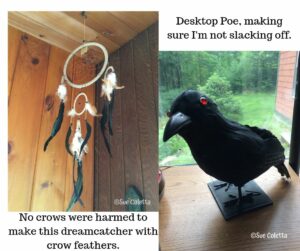
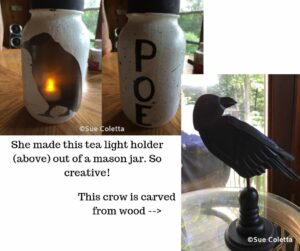
Over to you, TKZ family. Have you ever heard a similar remark as the woman in the library? If so, how’d you handle it? Tell us about your strangest — or best! — encounter with a reader?
*I’m on the road today, researching, so I may be late responding to comments.
 Imagine yourself in a prison visiting room, with a petition of plexiglass between you and a fictional villain.
Who’s sitting across from you? Why did you choose to interview this villain?
What’s the first question you’d ask?
If your favorite villain is still loose on the street, where are you conducting the interview? Do you feel safe? Why/why not?
By SUE COLETTA
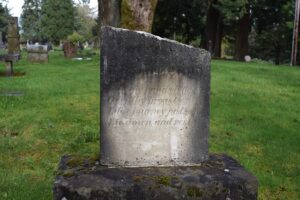 A few regular readers of TKZ requested tips to help research criminal cases from the past. If the crime occurred in the 18th or early 19th century, the task becomes much more difficult. My hope is that these tips will aid you in finding reliable information.
Let’s say you only have a name, place, and approximate year for your victim or killer. The first logical step is to conduct a Google search to see what’s available online. Someone must have written about the case, right? Well, not necessarily. Sometimes you get lucky and find a couple articles, other times … *crickets* Which I happen to like, because it means the industry isn’t saturated with books on the same topic. But it’s also harder to find what we need. Not impossible; we just need to think like an investigator.
GENERAL TIPS
If you find an online article about the crime, do not solely rely on that information. Instead, within said article search for the author’s sources. Most true crime writers will either link to another source or cite where they gathered their facts from, and that’s where the gold resides.
My overly suspicious crime writer brain tends to question where bloggers and/or journalists get their facts. To satisfy my own curiosity I use a three-source rule. Meaning, if I can’t verify a fact with two other sources, then I don’t consider it a historical fact.
By the way, this is my personal rule, not an industry requirement. Although, some publishers do ask that you verify each major fact with one other source. Even if they never request the citation, their legal department might. So, be sure to keep a log of where you find information, both primary and secondary sources. It’ll save you from having to go back to find where the killer said something, or whatever.
There’s one exception to my three-source rule…
Suppose I find a newspaper article that I am able to authenticate with a trial transcript, deposition, or other court document. Because I have the primary source (court document) which says the same thing, then the newspaper article gains credibility. If I don’t have access to a primary source for verification, then I need two secondary sources to substantiate the fact(s).
True crime readers expect the truth, not our fictional interpretation. It’s our job to question a reporter’s research and not take what s/he says at face-value. They want to sell newspapers, so facts can often be embellished or sensationalized. When I first started searching through old newspapers (I’ll share where you can find them in a sec), I was shocked to find misinformation, discrepancies, untruths, and rumors stated as fact. Embellishments help to create eye-popping headlines but can also hinder a true crime writer/researcher if we’re not careful.
For example, there’s a lot of online content about one of my five female serial killers due to the fact that she rocked the nation with her cold-bloodedness. But all these articles weren’t ideal. If anything, they muddied the water. In order to separate fact from fiction I had to wade through opinions, theories, innuendoes, and rumors. You may have to do the same. My best advice is to roll up your sleeves, consider it a challenge, and dig in. 😉
PRIMARY vs. SECONDARY SOURCES
Think of research as a bullseye, with the killer and/or victim at the center. The first ring around the bullseye includes eyewitness accounts, investigative reports, court testimony, the killer’s journal and/or confession — primary sources. Moving outward, the next ring would be secondary sources, such as a newspaper article written by a journalist who interviewed someone involved with the case (killer, detective, juror, DA).
The third ring includes newspaper articles written by someone with no first-hand or second-hand knowledge. To get the article written on time they simply regurgitated information from other articles — that’s where you’ll find the most mistakes. In this ring you’ll also find bloggers, some credible, some not.
See why I created a three-source rule? If we were to write historical nonfiction using only the third ring as our primary source, the book and its author would lose all credibility among historical nonfiction readers as well as writers. I’ve read numerous snarky remarks about true crime writers who play fast and loose with the facts. Since I would never advocate to spotlight another writer’s inadequacies, I’ll leave it at that. My point is, research as though the whole world is watching. It’ll keep you honest. 🙂
HOMING IN ON PRIMARY SOURCES
One of the best places to gather historic information is the National Archives. Once called the Archival Research Catalog (ARC), which retired in 2013 and was replaced with the Online Public Access (OPA) prototype, the National Archives Catalog searches all web pages on Archives.gov and lists articles, pdf documents, books, and periodicals on a search result page. Along with catalog records, researchers are able to add notes that may cite additional sources, so during your search also be mindful of gold nuggets hidden in research notes.
The current catalog provides access to over two million electronic records in the Electronic Records Archives (ERA). These digital records aren’t available elsewhere. The National Archives is a fantastic place to find reliable primary source material.
Now, suppose the case you’re looking for hasn’t been digitalized. In that case you’ll need to Google “National Archives of [insert the state capitol where the crime occurred].” Note the email address and send a formal record request. The more information you provide, the greater your chances of gaining results. Record requests take about ten business days to complete.
If the crime you’re researching was not heard in federal court, then you’ll need to drop down to the state level. Google: “[state where crime took place] State Archives.” Example: Massachusetts State Archives. This may sound like the same place as above, but it’s not. State Archives house court records on the district court level.
Then there’s the Supreme Judicial Archives. In Boston, it’s a separate building with a separate email address. This may not always be the case, though. You’ll need to find out how it works in the state you’re researching, but you can use this example as a guide.
Prepare to spend time on the phone with law libraries and historical societies. The folks who work in these places are extremely helpful, and they love writers. The law library directed me to a wealth of information that I wouldn’t have gotten on my own, because they have access to databases that the public does not. Search for the county where your crime was committed, then add “law library.” For example, I searched for “Barnstable Law Library” for one of my female serial killers.
For my New Hampshire killer, the local historical society had diaries tucked inside an old box, with daily logs written during the string of murders. The gentleman who wrote these diaries knew the victims and the killer. Scoring a firsthand account of a centuries old murder case is difficult to find, but when it happens, it’s the best feeling ever.
See why it pays to keep digging? You never know what you might uncover next.
Most police departments are useless, as they don’t keep investigative records that long. It’s still worth sending a quick email, though. If I didn’t contact one particular department, I would have never known that the town where my killer operated housed their own independent archives that were a lot more detailed than the records I’d acquired elsewhere. It also gave me two primary sources to check facts against.
NEWSPAPER ARTICLES
As you may have guessed, a great place to find old newspapers are libraries. Depending on your subject’s location, many libraries have transferred newspapers to microfiche. Be sure to have the month and date for the librarian. If the crime you’re researching made national headlines, you may even luck out at your local library.
But wait …
Before you truck down to the library, check out the Library of Congress. They list 15,273,703 digitized newspaper pages from 1789-1963. Always best to save the shoe leather whenever possible. 🙂
Remember, as you research, search for primary source material to verify your secondary or thrice-removed accounts. Readers will thank you for the added effort.
Researching historical crime takes time and patience, but it’s also fun to piece the puzzle together. Just don’t get discouraged. For every three or four dead ends, you’ll stumble across something new and exciting that’ll set your writer brain ablaze.
I better stop there before this post morphs into a book. Do you have any research tips to share?
By SUE COLETTA
 Remember my last post, entitled Why Waiting is Difficult? Well, I’m happy to report that my wait is over!!! And now, I can share my good news.
In May, Globe Pequot (Rowman & Littlefield) reached out to me about writing a true crime novel about female serial killers of New England who were active prior to 1950.
Some of you may have read the story on my blog, so I won’t bore you by repeating all the details here. Suffice it to say, Pretty Evil, New England: Female Serial Killer’s of the Region’s Past is anticipated to hit stores Fall 2020. Yay!!!
For those of you who missed the announcement on my blog, the acquisitions editor gave me two weeks to send her a book proposal. And like any professional writer, I assured her that a two-week deadline would not be a problem. When I hung up, panic set in.
What did I know about writing a nonfiction book proposal? Not a darn thing!
Plus, I now had mountains of research into historical female serial killers. I’ve written true crime stories on my blog many times, but never a novel-length true crime book. This was a huge opportunity, with a well-respected publisher in a new-to-me genre. All I kept thinking was, if you blow this chance you’ll regret it forever.
Once I managed to get my breathing somewhat regulated, I contacted my dear friend, Larry Brooks. You probably know this from his time on TKZ, but it bears repeating — he is amazing! Not only did he assure me that the editor didn’t contact the wrong author for the job, he explained in detail what she was looking for in the proposal. Most importantly, he told me why she’d asked for certain things, from a nonfiction publisher’s point of view. Knowing “the why” helped me focus on what to include. Incidentally, Jordan was also a godsend through the entire process.
See why it’s important to befriend other writers?
On TKZ, we’ve talk a lot about the business side of writing. In nonfiction, it’s important to show how and why the proposed book will be profitable for the publisher. My situation was a little different, since they came to me, but I still followed the same format as if I’d cold queried. After all, the acquisitions editor still needed the board to approve the project before offering a contract.
So, today, I’d like to share the proper format for a nonfiction book proposal. If you find yourself in a similar situation, perhaps this post will save you some agony.
Each heading should start a fresh page.
Title Page
Title
Subtitle
Author’s Name
If you’re cold querying an agent and/or publisher, then also include your address, website, phone number, blog address, and agent contact info, if applicable.
Table of Contents for the Book Proposal
Keep this basic format and chapter headings unless the publisher/agent guidelines asks for something different. Next, I’ll break down each chapter to show what to include.
TABLE OF CONTENTS
Overview ………………………………………………………………………… (page #)
Target Market ……………………………………………………………………. (page #)
Competitive Titles ………………………………………………………………… (page #)
Author Bio ………………………………………………………………………… (page #)
Marketing Plan ……………………………………………………………………. (page #)
Length & Special Features ………………………………………………………… (page #)
Chapter Outline ……………………………………………………………………. (page #)
Sample Chapter ……………………………………………………………………. (page #)
Overview
You need to hook the agent/editor with a strong opener and establish why the subject of the book is of interest to a definable audience and what your book offers to this market. A sales representative has an average of 14 seconds to sell a title to a bookstore buyer, and the editor in a publishing board meeting has only a few minutes to convince colleagues of the potential of a book.
A few questions to consider …
What’s the book about? What’s your pitch? Does the book fill a need? Why are you the right author to write this book? Are you passionate about the subject matter?
Target Market
You cannot say “this book will appeal to men and women from 18-80,” because it won’t. Instead, you need to provide an actual target audience with real figures to back it up.
Where do we gather these statistics? Social media is a great place to start. Search for Facebook groups about the subject of your book. For example, I included Serial Killer groups, True Crime groups, Historical groups, and groups related to New England, like the New England Historical Society. For each group, I listed the subscribers and, where available, a breakdown of the members’ gender, age group, etc. Next, I went to YouTube and searched for podcasts related to my subject matter. I also included a brief psychological study of why true crime attracts women.
See what I’m saying? Think outside the box to find your audience.
What if you’re proposing a cookbook? You can still use social media as a jumping off point, but I’d also search for culinary classes. Are your readers likely to subscribe to certain magazines? List the circulation numbers. Is your book geared toward college students? Call the universities.
Take your time with this section. It’s vitally important to prove there’s an audience for your book. Publishing board meetings sound more like product development meetings. By providing accurate, measurable data, you’re helping the acquisitions editor convince the board to approve your project.
Competitive Titles
Search bookstores, Amazon, barnesandnoble.com, Books in Print, and libraries. You want to show at least five title that would be considered competitive or at least somewhat related to the subject of your book. For each competitive title, provide author’s name, title, price, publisher, publication date, ISBN, any known sales figures, rankings, or other indications of the book’s success.
I also used this section to show why I chose to focus on five serial killers instead of ten (as proposed by the editor), with titles that proved my theory.
Author Bio or “About the Author”
Unless you’re proposing a memoir, write your bio in third person. Include why you’re qualified to write this book, as well as previous publishing credits and accolades. If you’re short on publishing credits, then include tidbits about yourself that show your passion and/or expertise in the subject matter.
Marketing Plan
How do you plan to market this book? Does your blog get lots of traffic? List how many hits per month. Also include the number of email subscribers, social media followers, etc. List speaking engagements. For example, I included a list of venues I appear at every year (all in New England).
If you’re writing a how-to, do you teach courses? Workshops? Have media exposure?
Length & Special Features
Here, you include word count, photographs, or other special features of the book. I can’t divulge the special features for my book, but again, I thought outside the box to make the book unique.
Table of Contents
There is no pantsing in nonfiction. You’ll have to outline each chapter, with eye-catching headlines, and list them here. To give you some idea of the work, I had 50 chapters in my book proposal, each chapter meticulously plotted. Will they change once I complete my research? Maybe, but the publisher expects you to stick fairly close to the original. After all, that’s the book you sold.
Sample Chapter(s)
Follow the agent/publisher guidelines on length, etc. They’re looking for writing style, tone, and voice. Now that the business side is completed, this is your chance to shine!
And that’s about it, folks.
Nonfiction writers, did I miss anything? Please share your tips.
Fiction writers, have you considered writing nonfiction? If so, which subject/genre are you interested in?

Image by Elias Sch. from Pixabay
A human with two different sets of DNA is called a chimera, and it’s more common than you might think. Most chimeras don’t even know they have this strange phenomenon going on inside them.
You could be a chimera, and so could I.
As we go along, take note of the interesting tidbits you could twist into a plot to add conflict.
Without any help from the scientific community, the process of becoming a chimera occurs naturally. Numerous books and movies explore chimerism using a killer who’s had a bone marrow transplant or blood transfusion. But are these characters based in fact?
Let’s take a look and find out.
The tissue inside our bones is called bone marrow, and it’s responsible for making white blood cells, red blood cells, and platelets. When someone has a bone marrow transplant, doctors use chemotherapy or radiation to destroy all the recipient’s diseased bone marrow. The donor’s healthy marrow is then introduced and continues to produce blood cells with the donor’s DNA, thereby transforming the recipient into a chimera.
In some cases, all of the blood cells in a person who received a bone marrow transplant will match the DNA of their donor. But in other cases, the recipient may have a mix of both their own blood cells and donor cells. A blood transfusion will also temporarily give a person cells from someone else, but in a bone marrow transplant, the new blood cells are permanent, according to the Tech Museum of Innovation in San Jose, California.
What if we’ve never had a transplant?
Doesn’t matter. There are other ways to become a chimera.
Early on in pregnancy a mother can be carrying fraternal twins and one of the embryos might die in utero. The surviving embryo may absorb cells from the deceased twin. When the baby is born, s/he can have two sets of DNA. Since twin loss occurs in 21-30% of multiple-fetus pregnancies, think of how many chimeras could be walking around. Are the story wheels spinning yet?
It can also happen with a normal pregnancy.
In the 1990s, scientists discovered that a pregnant woman may retain some DNA from her baby, if fetal cells happen to migrate into her bloodstream and travel to different organs. The New York Times referred to this as a “pregnancy souvenir”— but it’s more scientifically known as “microchimerism.”
A 2015 study suggests this happens in almost ALL pregnancies (you read that right), at least temporarily. The researchers tested tissue samples from the kidneys, livers, spleens, lungs, hearts, and brains of 26 women who died while pregnant or within one month of giving birth. The study found fetal cells in all of the women’s tissues. The researchers were able to tell the fetus cells from the mothers by searching for Y chromosomes (only found in males). The deceased mothers were all carrying sons.
Writers: Don’t take the obvious road. Think victims instead of killers.
This is one way to use research to our advantage.
Remember, we’re thinking victim, not killer, which puts a different spin on it.
According to Live Science, fetal cells may stay in a woman’s body for years. In a 2012 study, researchers analyzed the brains of 59 deceased women ages 32 to 101. A shocking 63 percent had traces of male DNA from fetal cells in their brains. The oldest woman died at 94 years old, suggesting that these cells can sometimes last a lifetime.
The blood-brain barrier is the body’s defense system to block many drugs and germs in the bloodstream from entering the brain, but doctors have found this barrier becomes more permeable during pregnancy, which may explain how these fetal cells migrated into the brains of their mothers.
If you said the medical field, you’re not thinking outside the box.
Interestingly enough, 26 of the 59 women had no signs of brain disorders while alive. The other 33 were diagnosed with Alzheimer’s disease. The researchers found that women with Alzheimer’s were less likely to have male DNA in their brains than women without the disease.
Previous work on microchimerism suggested fetal cells might protect against breast cancer and aid tissue repair in the mothers, but could increase the risk of colon cancer. Microchimerism can also incite various autoimmune diseases. Autoimmune diseases occur when a person’s body is mistakenly attacked by its own immune system.
Past research suggested Alzheimer’s is more common in women who had a high number of pregnancies than in childless women. One of the limitations of this research is that the number of brains studied was relatively small. Other researchers involved with microchimerism want to explore what effects a mother’s cells might have in her offspring’s development and health.
Imagine all the different scenarios? Parts of your writer brain must be on fire by now. No? Then check this out …
Are you a chimera?
You may never know. Unless you wind up in a similar situation to a woman named Karen Keegan. In 2002, her story became a report in the New England Journal of Medicine after doctors told her that she wasn’t the biological mother of her children.
Imagine? Think of all the ways this one conversation could implode an MC’s life.
Turns out, the DNA in Karen Keegan’s bloodstream didn’t match the DNA in her ovaries. The doctors later determined she’d most likely absorbed a fraternal twin in utero.
How’s the ol’ writer brain feeling now?
By SUE COLETTA
It’s no secret that the writing biz requires patience. Sometimes, though, waiting can be agonizing. Recently, an exciting opportunity came my way. In order to make this dream come true, I had two weeks (two weeks!) to produce something I’ve never done before. Sorry for being so cryptic, but I don’t want to jinx it.
Now that I made my deadline, all that’s left to do is wait. And wait. And wait. Even with a new release, my mind keeps wandering back to this secret project … and the wait.
That got me thinking, I wonder how or if waiting affects the brain.
Turns out, researchers recently asked the same question. For the first time, a research team at McGill University clearly identified the specific parts of the brain involved in decisions that call for delayed gratification.
Here’s how it works …
The hippocampus (associated with memory) and the nucleus accumbens (associated with pleasure) work together to make critical decisions where time plays a role. For example, suppose you send a query to a literary agent or publisher. You’re making a decision that requires you to wait for the outcome, thereby triggering both the hippocampus and nucleus accumbens.
Still with me? Okay, cool. Let’s look at exactly what these researchers did to prove or disprove their theory …
The researchers used rats trained to make choices between stimuli that resulted in rewards. Some rewards were delivered instantly, some meant delayed gratification. The rats had a choice between two identical visual shapes on a touchscreen (similar to an iPad). In exchange for sugar pellets, the rats had the choice to press their noses against the shape that delivered one sugar pellet immediately or the shape that would deliver four sugar pellets if they waited to receive the reward.
Over time, the rats learned to negotiate a trade-off between the smaller, instant gratification and a windfall, even if it meant waiting for a short period. Researchers argue that most people will also wait for a decision to pay off, if the reward is worth it.
Do you agree? she asks a community of writers whose dreams stand at the intersection of hurry up and wait.
Now, what do you think happened when the researchers disrupted the circuit from the rats’ hippocampus and nucleus accumbens? You guessed it. The rats became impatient and irritable, unwilling to wait even for a few seconds.
Why?
Our brains weigh the pros and cons of thousands of situations every day without conscious thought. The nucleus accumbens is made up of a group of tiny cells deep within our brains, and those cells are responsible for the release of dopamine. The amount of dopamine released depends on the size of the reward.
Is it any wonder why we hate waiting? Our bodies crave dopamine! Hence, why exercise is so important for good mental health.
What can we do to help with waiting for news? You guessed it. Get your body to pump dopamine. Which is why today (Saturday) I jumped on my husband’s tractor and mowed the lawn before writing this post. 😉
Yeah, he couldn’t believe it either. I’m not what anyone would describe as a manual labor type of chick. I like my fingernails too much to break them. But I needed a way to switch off my brain before I drove myself crazy by checking and rechecking my email. When I saw my husband on the tractor, it looked like fun.
You know what? I had a blast! Who knew mowing the lawn could double as an exercise in creativity? As my husband cringed, I sailed around the yard creating animal shapes with the blades. Always keep ‘em guessing, ladies!
Men, you can stop groaning now. You’ll be pleased to know I fixed the grass afterward by riding back and forth in military straight lines, but it was nowhere near as fun.
In other study, researchers at the University of Texas measured what occurs inside the brain during a long wait vs. a short wait. For the experiment they used two different tones. The first tone meant a 15-20 second waiting period, the second equaled wait times of 65-75 seconds. Both tones signaled the same reward. The only difference was the length of delay. What they discovered was the nucleus accumbens released more dopamine when the short wait tone sounded. Which means, we’re willing to wait for a reward if the wait doesn’t take too long.
Makes sense, right?
So, if you’re waiting for something to happen as a result of a decision you made, do yourself a favor and get outside, or hit the gym … anything that might help to release dopamine. If you follow this advice, the wait won’t feel as long.
Are you in the wait zone? Care to share what you’re waiting for? What are some ways that have helped you to wait?
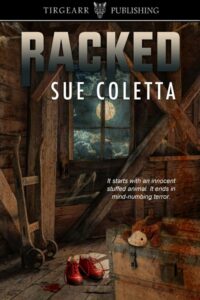
It starts with an innocent stuffed animal. It ends with mind-numbing terror.
RACKED, Grafton County, Book 4, is now available for pre-order! Only 99c.
 Real life offers inspiration when we least expect it. That moment can also be awkward, especially if you forget to mention one crucial distinction between you and a psychopath: the word writer.
A service person comes to your home. While you’re watching her — yes, a woman — do her job, a brainstorm strikes you out of nowhere; it rounds first base, second, and third, and charges at full speed for home plate. But you need more information to flesh out the idea, mentally draft the story from beginning to end to see if the premise has merit.
So, you drill her with questions, lots of questions, dark probing questions, and then you feel like you have to explain, but you’re so focused on the story — the story is all that matters — you blurt out, “It’s for a murder.” But you don’t expand, so now, this woman who’s working in a male-dominant field starts to twitch, flinch, her eyes pleading with your husband to stop you if things take a turn for the worse, her protective posture praying to God that you won’t snap right here, right now. Or maybe, she’s contemplating whether or not to call the police.
Whatever. You’ve been down this road before. At the same time, you’re not oblivious to the woman’s discomfort. After all, you’re not a monster. You just need facts, and she’s the perfect person to give them to you.
Ah, well, it’s not the first time your enthusiasm for murder and body disposal made a stranger squirm. Probably won’t be the last, either. No biggie. It’s all good.
You continue. “So, in your professional opinion, how long would it take for the flesh to fall off the bones? Oh, wait.” You mull over the possibilities. The hook of your story emerges like a phoenix from the deep recesses of your mind, and you try to control the smirk that threatens to expose your dark, grisly thoughts. “Would the bones also disintegrate?”
“Err … umm …” Her work boots shuffle backward a few feet. Nervous laughter takes hold — you know the type, that “he-he,” pause, “he-he,” pause, followed by a visual gulp. “Do you have somebody specific in mind?”
What a strange thing to say. Obviously, she’s never read your books. Bitch. “I’m still workin’ out the details.” Meh. You write it off to can’t-please-everyone and move on. “So, about that flesh, what’s your best guesstimate for a time-frame?”
“Ah … well, I worked with a guy once who had to be airlifted to Boston after his skin made contact with … third-degree burns all over his body … it took about five hours.”
“Five hours? Hmm, what if I added lye or sulfuric acid?” You weren’t really asking, more thinking aloud.
In a tone unfit for human ears, she says, “I’m not sure what that is.”
As your eyebrows arch in disbelief, your husband steps in to explain. “If she adds lye or sulfuric acid, the mixture should dissolve the flesh, skull, and whatnot a lot quicker.” Something must occur to him, because he whirls toward you. “Babe, wouldn’t you need to heat the sulfuric acid?”
That draws your full attention. “Not necessarily. If we didn’t kill her first, it’d definitely prolong the torture, but maybe that’s a good thing.”
He laughs.
You laugh, too. Perhaps a bit harder than you should.
The service woman’s stone-cold expression snaps toward your husband and then you, her gaze shifting back and forth before refusing eye contact with either of you.
To break the awkward silence, you say, “Really appreciate you comin’ out on a Saturday. You’re doin’ a great job.”
“Thanks.” Her rigid shoulders relax a bit. “This was my father’s business. After he passed, I left it up to my ex-husband to handle the day-to-day operation, but he screwed me over. So, now, I’m juggling this job with my day job.”
Half-tuning her out, this news doesn’t surprise you. It’s the reason you gave her the work in the first place; you’re a sucker for the underdog. To avoid being rude, you pretend that you’re unfamiliar with the story. As she rambles on and on about her ex, you retreat to fictionland where you create plot points and milestones for the new premise that has you all fired-up. You can’t afford to lose focus. If you do, the plot could slip away. Nothing can get in your way, not now, not while the creative juices are flowing like Niagara Falls.
“Yeah, what a shame.” To not appear unsympathetic, you wait a quick beat. “So, what about teeth?”
She startles. “Excuse me?”
“Y’know, the murder. Enamel reacts differently than bone.”
“Gee, I … I …” Another nervous giggle escapes her lips as she swivels to face your husband, who loves it when your writer brain takes over. “Aren’t you the least bit worried?” On the sly, she jabs a chin in your direction.
You catch the insinuation, and roll your lips. “Please. Don’t let the innocent face fool you. He’s just as bad as I am when it comes to driving aimlessly, searching for the perfect place to dump a body.”
More ideas skip past the concept, premise, plot points, and milestones. “Hey, you must know the area really well.” Your gaze slides to your husband, and he nods in solidarity. “A desolate area, a deserted farmhouse, a dirt trail that doesn’t seem to lead anywhere, a particularly eerie swamp, maybe woodlands that no one dares to enter due to a savage attack-slash-murder that happened decades ago … do ya get what I’m sayin’?”
Silent, her jaw slacks.
Some people, eh? Figures you get stuck with the weirdo. In an attempt to clarify, you rephrase. “What I mean is, have you ever had a call from a homeowner that lived in a Buffalo Bill-style house? Y’know, something remote, or a property that exuded evil, a place where as soon as you pulled on to the long dirt driveway all your tiny body hairs stood on end.”
She smacks her gloves together. “Well, I’m about done here. If you give me a minute, I’ll get you a receipt.”
“But–”
Your husband gives you the slow eye-close, signaling you to let her leave.
“Okay, thanks for your help.”
“Hey,” she hesitates, “you were kidding about killing somebody, right?”
“Not at all.” With no further explanation, you turn and strut back into the house. And your poor husband is left to relay the one piece of information that separates you from a psychopath: you’re a writer. Did you forget to mention that?
This scenario really happened to me. True story.
Can you relate? Care to share a funny miscommunication? Let’s start the week with laughter.
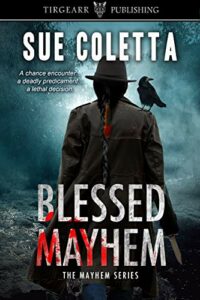 Winner of Readers’ Choice Award in Mystery/Thriller
When Shawnee Daniels–cat burglar extraordinaire and forensic hacker for the police–meets Mr. Mayhem in the dark, she piques his curiosity. Sadly for her, she leaves behind an item best left undiscovered. Or is it serendipity by design?
*All books in the Mayhem Series can stand alone.
Available as ebook or paperback on Amazon.
Other retailers listed on my Tirgearr Publishing page.
 Do you prefer to read stories set in contemporary or historical times?