By John Gilstrap
Google is nice and convenient and all, but I miss the multi-volume encyclopedias of my youth. I used to take a volume down and read it like a book–okay, it was a book, but work with me here. So many fascinating facts to learn, people to meet and places to visit, all from the comfort of the living room.
But that was different than what’s required to research a book. When you’re telling a story that is outside the real world of what you already know, you’ve got to find the way to inject the verisimilitude necessary to make the story resonate for the reader.
HEADS UP: At the end of this post, I’m going to ask the members of my TKZ family to help out. I know we have folks here who write about topics that are completely alien to me. In the comments, please share the sources and websites that help you with the details of the worlds you create.
Consider faking it–making stuff up.
Research and writing are two different tasks, though for research junkies they can feel very much the same. In reality, especially if you’re on a deadline, unnecessary research is an advanced form of procrastination. As you approach the opening to the rabbit hole, ask yourself this question: Does this part need to be real?
Many of my books are set in and around the areas where I grew up, in the suburbs of Washington, DC–Fairfax County, Virginia, to be exact. Given the nature of the stories, though, where local politicians are corrupt and incompetent, I decided to create Braddock County, Virginia, which, if you know the area and pay close attention, you’ll recognize to be parts of not only Fairfax County, but also of Prince William and Fauquier Counties.
Think of the burden I’ve lifted from my shoulders. If I wrote about the Fairfax County Police (as opposed to the Braddock County Police), I’d need to know their command structure, the weaponry they use, their shift schedules and the details of their uniforms. The Braddock County cops wear whatever I tell them to put on.
Remember, that you’re writing fiction. By definition, it’s okay to make stuff up if it doesn’t ruin the story.
Wikipedia and YouTube
Your novel is not a doctoral dissertation. The sources you use to write your fiction don’t need to stand up to academic scrutiny. Keep it as simple as possible. For the subject matter I write about–weaponry, military tactics, machinery operation, etc.–Wikipedia and YouTube do for me everything that needs to be done. Almost.
Develop your stable of experts
Nearly everyone is an expert at something. As a Type A extrovert, when I meet someone, I chat them up and get to know what they do. If their life’s work is in an area relevant to what I write, we exchange business cards. When I’m back to my desk, I send them a brief email telling them how much I enjoyed our conversation and promising/warning that I will be giving them a call if I ever need assistance in research. No one has ever said no. Not ever.
My virtual Rolodex is filled with the names and contact information for people I’ll probably never speak to again, but they’re there if I need them.
It’s hard to replace real exposure
“Hey, Loo, just got a call from EOC. They’re detailing the wagon and crew to Twenty-Seven.”
Translation: “Excuse me, Lieutenant. Just got a call from the Emergency Operations Center and their sending the pumper and its crew to Fire Station Twenty-Seven.”
Every group, like every geographic region, develops a patois that is unique to them. The only way I know of to actually learn those speech patterns and traditions is to immerse yourself in that world. How do you do that?
You make a phone call and ask. Whether it’s the police station, the local hospital or an Air Force base, there’s someone on staff whose job it is to give you a tour and answer your questions. While you’re there, you trade business cards with as many subject matter experts as you can find.
Write around what you don’t know
Jonathan Grave has access to vast amounts of intelligence data that is collected by his right-hand-gal, Venice Alexander. Venice is a master computer hacker, with cyber skills that rival any expert in the world. Like Jonathan, I don’t understand how she does what she does, but she’s able to take an order from her boss and return vast amounts of information. And she does it all off the page, presumably between the chapter breaks.
I’m not a technology guy. As such, I know that the deeper I research the topic and present my research on the page, the greater chance that I’m going to get a very important something wrong. So, I write around the holes in my knowledge.
Okay, your turn
It’s a big world out there, and we’re all chasing different research rabbits down different holes. Please share your tricks and sources and websites for the topics near and dear to you. Consider them to be virtual business cards to help other writers find the information they’re looking for.
 Design
 There are many ways to write a novel. That much has been made quite clear on TKZ and in the comments thereto.
 The Malice Domestic mystery conference is honoring me with the Lifetime Achievement Award for Malice 36 April 26-28, 2024. Malice Domestic is an annual fan convention in Bethesda, Maryland. I’m thrilled to be part of a star-studded line-up next year.
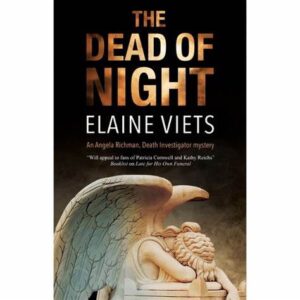 The Dead of Night, my new Angela Richman, death investigator mystery, is available in book stores and online:
 Passive voice is something else again. Consider The dog bit the boy versus the boy was bitten by the dog. The former is active voice, the latter is passive voice. (I know someone out there is saying, “But what about The dog was bitten by the boy? That’s passive voice, but unexpected, and therefore more interesting.)