First Page Critique: A Million Closed Eyes

Jordan Dane
@JordanDane

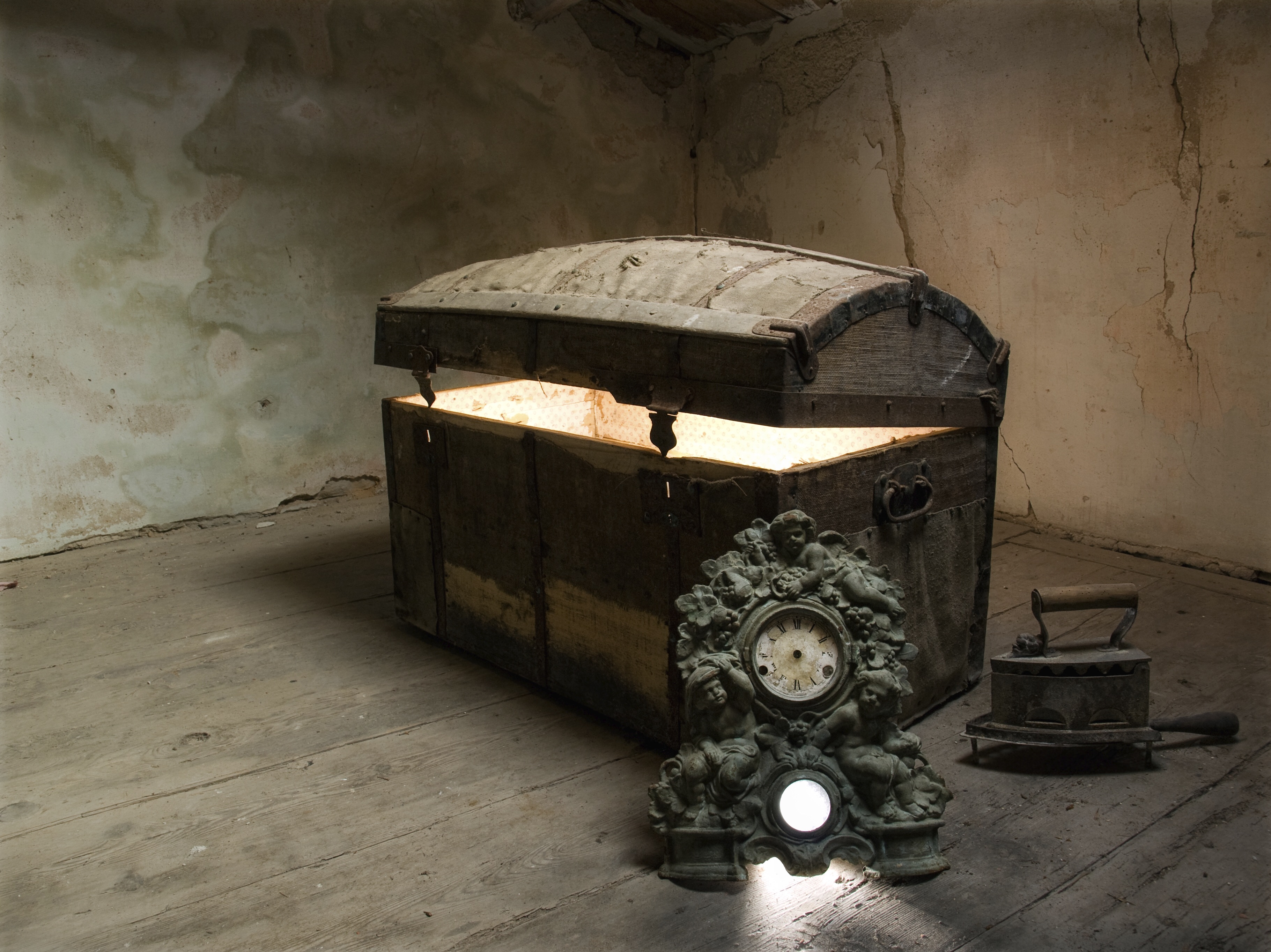
shutterstock_43668637 (2)

Shuttetstock image purchased by Jordan Dane


Today I have the pleasure of reading and critiquing the first page of this anonymous submission. My feedback will be on the flip side. Constructive comments appreciated for this daring author.

CHAPTER ONE: AUTHENTICATION

Patrick, when you were seven, the three of us—you, your twin Prairie and I—stood exactly here, on the sidewalk in front of the Thomas J. Cahill Hall of Justice. I was teaching you about the injustice system, but I never called it that in front of you and never in front of Prairie, even after the police treated us so abysmally when Flemming stole you. Mommy wanted you to watch a trial, to see real lawyers in action, not TV lawyers.

That day, the sun reflected off the white walls of the courthouse and hurt your eyes so I bought sunglasses for you after the trial. You wanted pink ones like the ones Prairie picked out. Maybe you’re like your uncle Max. Not that I’d mind. You can be anything except gone.

Today, the clouds hover close to the ground, like the fog you hated because you thought it would smother you. Couldn’t convince you it wouldn’t.

On my way up the courthouse stairs, I bump shoulders with a protester, say, “Sorry,” and enter the double-glass doors. Protesting light sentences for pedophiles would be fine if more than a scatter of ten showed up. Max can attest that more protestors turn up to complain about gay marriages. What an upside-down world we live in, right?

Some of the children I meet in Internet chat rooms when I’m trolling for pedophiles remind me of you. Silly to imagine I might be chatting with you, but I do. Makes it hard to act like a child instead of a mother. I’m pretty good at it, though…acting like a kid I mean. Good enough to have eight notches on my belt, eight sick suckers who turned up to meet the pretend me and met the police instead. Whatever they got in court, they deserved. And more, so much more.

Wonder what today’s pervert will look like.
Oops. Not supposed to even think that word. Way too easy to slip up in court.

The defendants don’t send pictures, you know. Not their faces. Some body parts, that’s all, and that’s more than enough, but when I turn up court to give evidence about the chat logs, I’m always surprised. They look normal, Patrick, just like Flemming. You tried to tell me he wasn’t normal. Not directly, but I should have known.

A mother should know.

FEEDBACK:

I read this submission several times before I pondered what might make it stronger. The intimacy of this first person narrative is compelling. Who wouldn’t be drawn to this mother’s story of a young son kidnapped by an online stranger?

By the end of this short introduction, I wanted to get a better sense for what was happening and where it might go, but because the story is told through the meandering thoughts of the mother, without any true sense of the present action, it bounces between the present and the past without clear context. There’s a fleeting mention of her trip to the courthouse (written in present tense) without giving a reason why she’s there. In my opinion, to make this stronger, I’d like to recommend the following:

1.) Stick With the Action – Pick an action for the character and this scene. It could be a grieving mother struggling to get into a courthouse where protesters are trying to free a Hollywood celebrity jailed for three days on a DUI charge, to show the injustice of the system, but the action would allow us to focus on a framework that has pace and movement.

Or this first scene could be centered on her in a dark room, guided only by the light of the computer monitor, as she obsessively engages another pedophile. Leave it a mystery until the end that it is a mother searching for her missing son. Picking the right action can still get the story set up across, but with more thought for suspense or mystery, the author could draw the reader into the story with more focus centered on this poor mother.

2.) Use of Tense – The intro starts with past tense because the mother’s mind drifts from past into present and back into the past again. At the mention of the word “today” where she is at the courthouse, the tense changes to present for only a brief instant before it changes back into the past. I think this would be hard to keep up with throughout the story. Some readers take issue with present tense. It’s used in YA, because teen readers like the immediacy of it, but adult readers tend to gravitate toward past tense as the norm. Because this story has the potential to drift in and out of the past, I would pick the past tense and make it clear when the narrator is thinking in memory.

3.) Show Don’t Tell – If this intro had a more definitive action to frame the scene, it would “show” the reader what is happening, rather than “tell” the reader the story through the recollections of the mother. The reader is distanced from the story without the action.

4.) Nitpick: If Prairie is a girl’s name, it might be a good idea to add her gender in the second sentence – ie: “…and never in front of your sister Prairie…”

Overall: The author did a good job of allowing the reader to know we are seeing the story unfold through the eyes of the mother and let the gender be known. That’s not easy to do in first person. Often authors forget to clue the reader in, but this author did a skillful job in layering in those clues. Because this story is about a mother’s plight involving a missing son, I would have kept reading, but I think there are ways to make this introduction stronger.

What about you, TKZers? Please share your thoughts on what would make this 400 word submission stronger. And please share what you  like about it.
Developing Memorable Characters

By Joe Moore
@JoeMoore_writer

As insatiable readers, we all have a favorite character or two or three. From Jay Gatsby to Sherlock Homes, from Atticus Finch to Hannibal Lecter, from Jack Ryan to Dirk Pitt. They all bore their way into our brains and became memorable. What was it about them that made them so? Why is it that even after years have passed since you read their stories, you still remember them as if they were your friend or neighbor? As a writer, can you produce characters like Scarlett O’Hara or Santiago or Jason Bourne? There’s no reason you can’t. Just follow these simple tips to creating memorable characters.

Probably one of the most effective techniques in character building is to give your characters flaws. If you want characters with perfect looks, perfect bodies, or perfect personalities, pick up a copy of Vogue. Otherwise, give them imperfections for which the reader can relate. We all have flaws, so should your characters—all of them from the main protag and antagonist to the most minor walk-on. They need to be imperfect.

Speaking of flaws, your protagonist should always have a fatal flaw. It could be anything from speaking in public to something life threatening like Kryptonite. It’s always there hanging over the protagonist’s head never knowing when it will fall.

Next, your main characters should be larger than life. This has nothing to do with physical size although it could. I’m talking larger than life in regards to courage, faith, kindness, intelligence, generosity, loyalty—a characteristic that exceeds most people, one that becomes necessary by the end of the story to solve the story question. We all have courage, but at the point where the common man’s courage gives out, the protagonist’s kicks in to save the day. And whatever the larger than element is, let the character learn how to use it having not known it existed before.

The antagonist should be equal to or in some respects greater than the protag. But not by much. The antag must challenge the hero’s standards and morals down to his very fiber. The antag must be a worthy adversary. If it’s a heavy weight fighting a bantam, who cares.

Your characters should have multilayers. They’re not just a tough guy or a beautiful woman or a genius. Give them a defining characterization such as being an introvert, then place them in a situation where they must become the opposite.

Indiana Jones had a fatal flaw—snakes. He had to overcome his biggest fear to answer his biggest call to action. Put your hero in a situation where the thing that stands in the way is that biggest fear. Now have them figure out how to overcome it.

Throw obstacles in your protags path. Never give them a cakewalk assignment. Always place speed bumps and walls in their way. You want your reader to be asking “How will they get out of this one?” And make each wall higher than the last. Even if the reader has no idea how to escape that current predicament, the protag somehow figures it out. That’s what makes them memorable.

Finally, make life miserable for your protagonist. When it gets bad, make it worse. Never give them a decent brake. Push, push, then push some more. That’s why we read thrillers. We want to see what happens when the good guy or gal gets pushed to the limit and overcomes it. If need be, torture your protag. Not necessarily physically. It could be mental or moral. Give him or her a decision that builds their character. Memorable characters are those that step up to the plate, make the right choice, and swing for the bleachers.

Happy Tax Day!

————————————

Vengeance can be earth-shattering!
tomb-cover-smallMaxine Decker returns this July in her most dangerous adventure yet; THE TOMB.
Be ready.

Things Left Behind Suggest Stories

imageI’ve been on the road for the past two weeks, helping family members get organized to downsize and move to a new home. Among other things, I spent the better part of two days rummaging around my dad’s attic in Vermont. My job was to determine which items should be given away, and which should be kept within the family.

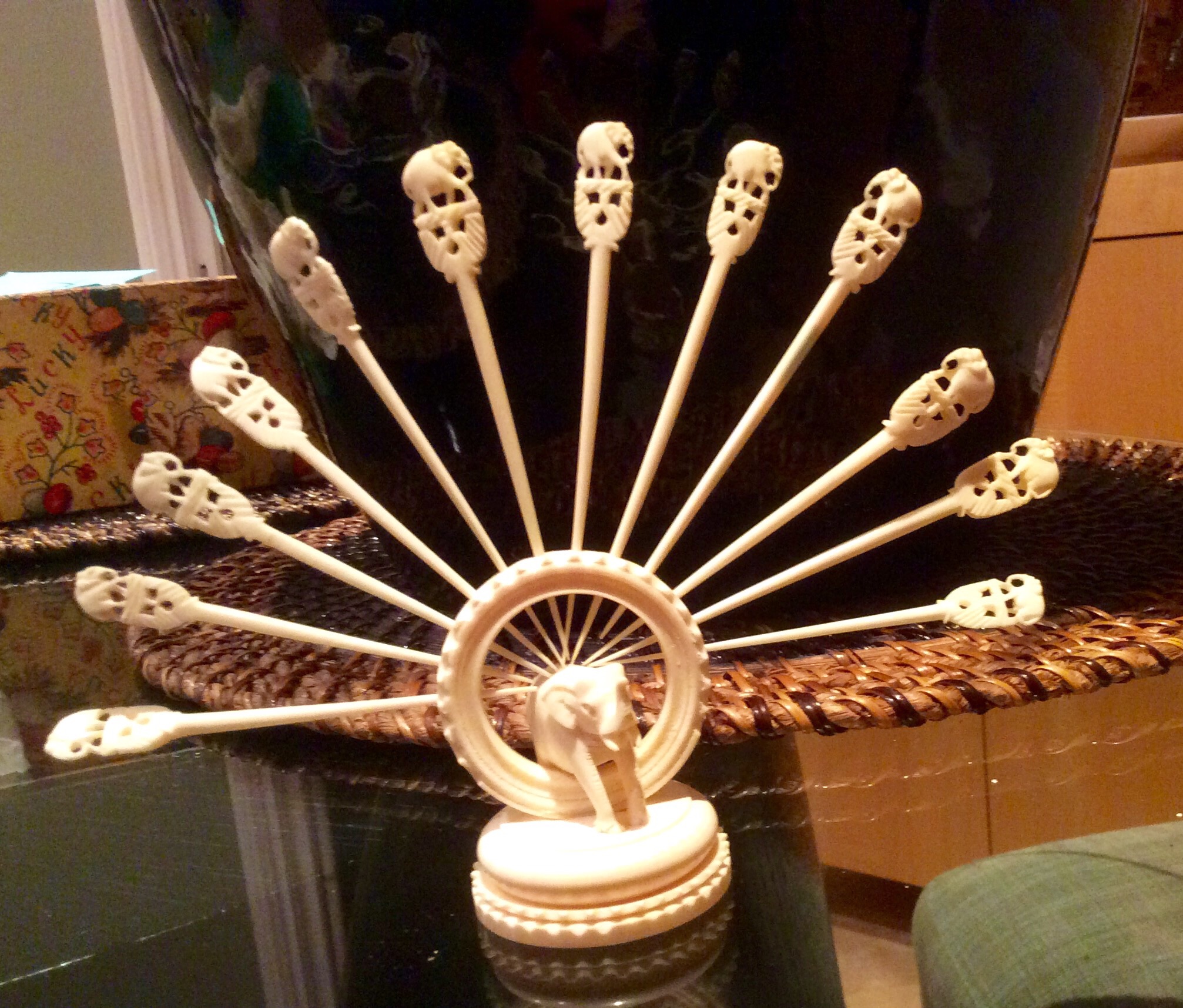
This was no easy task. My father has alimageways been an avid collector and Saver of Things. Walking through his farmhouse in Vermont is like being in a very homey museum or antiques shop. There’s the oil lamp collection, the vintage China sets, the scientific instruments, and the cannons (yes, cannons), for starters. I was really trying to help organize the process, but I kept getting distracted. For example, I came across a collection of silver spoons, the kind travelers buy when they’re visiting a new place. As soon as I found some spoons from the 1915 San Francisco Exposition, I was hooked. I then had to try to recreate that long-ago trip. And then I polished the spoons. There was a box of trinkets from a trip to Japan in the 1950’s, a set of antique toothpick holders from India, and a Victorian portable writing desk. Everything I saw suggested some interesting story. Who wrote on that desk? What lady kept her calling cards in the delicately carved ivory case? What ancestor used that Confederate sword in battle?

In the end, I couldn’t decide to part with any significant portion of my dad’s collection. So I’m renting a storage place to store it all, which I guess makes me the family’s official new Saver of Things. But if I’m ever in need of a story idea, I’ll know where to go for inspiration.

Has a family object ever inspired you to write a story? Tell us about it!

Accountability

Unknown-1I had an immensely frustrating week this week, basically having to put all my writing (and life) aside to get a volunteer project completed at my sons’ school simply because other people dropped the ball. The experience opened my eyes to an issue that vexes many people doing volunteer work – why is is that so many people feel they have no accountability? I often get the feeling that people view my writing in a similar way- to them it seems a fantasy life involving gazing out of windows, searching for inspiration in rainbows, and jotting down a few beautiful turns of phrase on a whim now and again. They don’t seem to realize that being a writer is all about accountability – to yourself, your agent, your editor as well as your readers. Unpublished and published writers alike know that 90% of the battle is showing up, time and time again and again (I call it putting on the bum glue), to get the writing done. It’s about setting goals or deadlines and making sure you meet them – otherwise a project can (and probably will) languish on the computer or in the drawer for years.

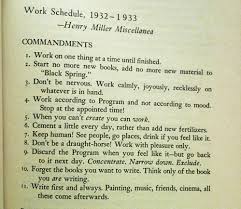
Recently, someone on Facebook posted a copy of Henry Miller’s work schedule ‘commandments’ for 1932-33 – I’ve copied it to this post below:Unknown

Miller had some great strategies which I need to remind myself of more often than I care to admit. I particularly like the two: ‘Work on one thing at a time until finished’ and ‘Forget the books you want to write. Think only of the book you are writing’. Who amongst us hasn’t started a new project only to fear, just a few weeks into it, that they really should be writing at least a dozen other projects instead? I always get my best ideas for other books as soon as I start writing one!

The one, however, that I was trying to really stick to was Miller’s commandment: “Write first and always. Painting, music, friends, cinema, all these come afterwards”. A few weeks ago, I had told my friends how I felt I really needed to start heeding this (I called it starting my era of ‘no’ – as I was spending way too much time getting sucked into other projects and activities that took me away from my writing). Part of my frustration this week, was that I could not hold to this in any shape or form. Despite communicating a deadline to my fellow volunteers (with summer looming I have to finish my draft WIP before the boys go on summer break) their lack of accountability meant I had to drop everything to get the  job done:(

But thankfully, it’s the start of a new week and I have a renewed commitment to follow Henry Miller’s ‘commandments’ (and get over myself in the process:)) So, TKZers how do you establish a maintain your own ‘accountability’ to your writing? I am sticking to my original deadline and trying to mentally readjustment my frustration to meet it despite the week’s delay. What about you, how do you manage putting the ‘writing first’? Is it just me, or do people just seem to feel less accountable these days?

The Power of the Shadow Story

ShadowsI was at a conference a couple of weeks ago and a new writer came up to me, said she had a great concept and had used one of my books to outline the plot. She was now 30k words into the novel and scared. She said it felt like she was looking out at sea from a tiny raft. There was this looonnng way to go in Act II, but now she wasn’t sure she had enough plot material to make it.

“Ah,” I said like a liposuction surgeon, “the sagging middle. No worries. I’m here to help!”

We sat and talked a bit about signpost scenes and she understood all that. But it was clear she needed more “story stuff” in her plans.

So I suggested she write the shadow story. This is the part of the novel many writers never think about, yet it’s one of the most powerful plotting techniques there is. It will take you places you’d never find if you only danced around in the light.

Simply put, the shadow story is what is taking place away from the scene you are writing. It’s what the other characters are doing “off screen.” By giving thought to the shadows, even minimally, you greatly expand your store of plot material.

A few tips:

Start With The Antagonist

The most important shadow is the opposition character. Someone once said a good plot is two dogs and one bone. So while your Lead is gnawing the bone in one scene, your antagonist (off screen) is laying plans to snatch that bone away. Or setting in motion a scheme to kill the lead dog. Or messing with the dogs who are helping the lead dog.

Or maybe he’s overusing canine metaphors.

Whatever it is, by getting into the head of the opposition character, who is somewhere else, you will come up with all sorts of ideas for plot complications. It’s almost automatic. Fresh scenes, mysteries, obstacles will spring up from your writer’s mind. Your Act II problems will begin to melt away.

Supporting Characters

You also have a cast of supporting characters, major and minor, who all have lives and plans and motives of their own. Here you will find the fodder for those plot twists every reader loves. Like when a seeming ally turns out to be a betrayer. Or an enemy becomes a friend. Why would that happen? Let their shadow stories tell you.

Shadows Inside the Lead

You can also delve into the shadows and secrets of your Lead. Maybe you’ve done this already, by giving your Lead a backstory and answering key questions about her life (education, hopes, fears, lost loves, etc.)

But every now and then, in the middle of the writing, pause to come up with something going on inside the Lead that she is not even aware of. Try what I call “the opposite exercise”: The Lead, in a scene, has a specific want or need (if she doesn’t, you need to get her one fast, or cut that scene!) Now, pause and ask: what if your Lead wanted something the exact opposite of this want or need? What would that be? List some possibilities. Choose one of those. Ask: Why would she want that? How could it mess with her head?

Then look for ways to manifest this inner shadow in some of your scenes.

Or imagine your Lead doing something that is the opposite of what the reader or, more importantly, you would expect in that scene. What sort of shadow (secret) made her do that?

Just by asking these sorts of questions, you deepen your Lead and add interesting crosscurrents to the plot.

That’s the power of the shadow story.

Practical Tools

There are two excellent ways to keep track of your shadow story material.

First, Scrivener. I know some people are intimidated by all the bells and whistles of this program. My advice is to use it for a few simple things (mapping your scenes on the corkboard; keeping track of your cast of characters) and then learn other stuff at your own pace, and only if you want to. At such a reasonable price, Scrivener is cost effective for whatever you use it for.

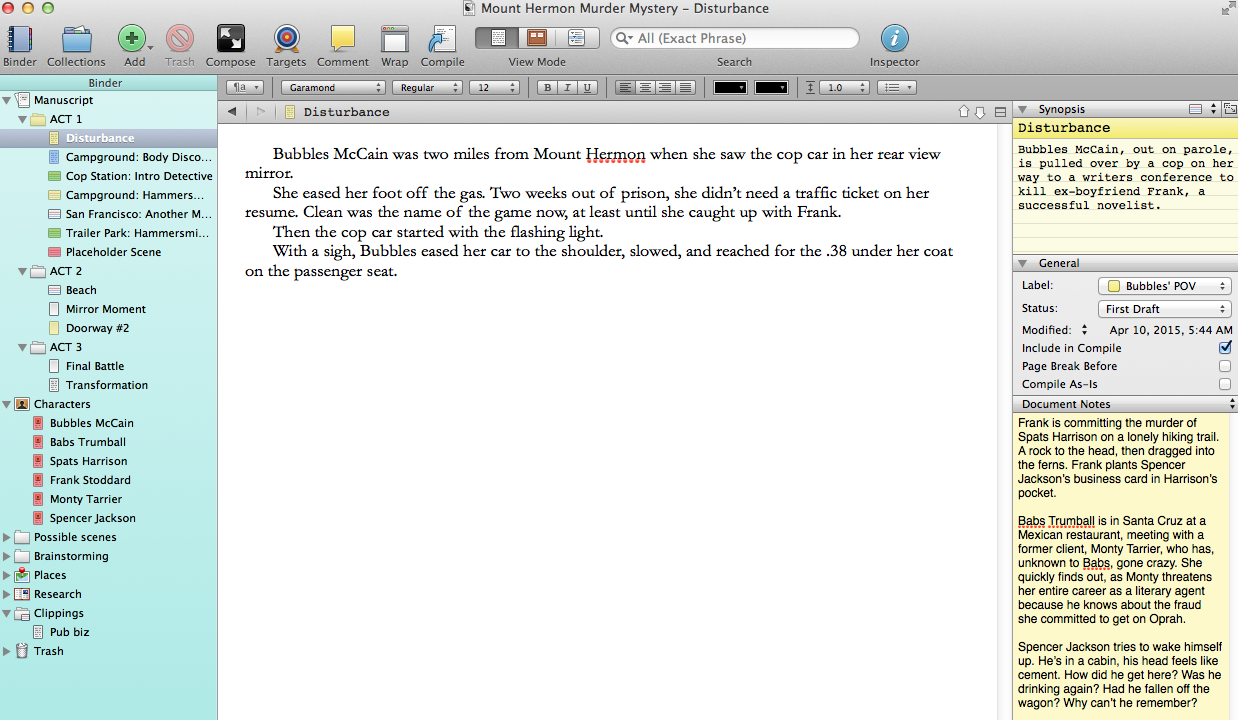
Here is a screen shot of a scene being written (click to enlarge). The page with the text is just like a Word document. Scrivener lets you dedicate a document to one scene or chapter.

Mount Hermon 1 Notice on the bottom right there’s a box labeled “Document Notes.” This is place where you can jot down anything relating to the scene on the left. Perfect for shadow story. You can be as brief or as detailed as you like.

The other method is to use the Comments function in Word. Just insert a comment which gives the shadow material:

Mount Hermon 2

Remember, all sorts of good stuff happens in the shadows. Go there, snoop around, then come back to the light and finish your novel.


You Might Use This When You Write Your Next Book

I love flash drives.  I collect them, actually. We have at least one of each gigabyte size currently available at casa de Hartlaub, and in a couple of different shapes as well. Late at night, when the rest of the house is asleep, I tiptoe downstairs and play 24, pretending I’m Jack Bauer, moving documents and photos and music, oh my, from one computer to another and back again and doing it quickly, because, y’ know, “we’re running out of time!” Yes, I love flash drives, particularly the ones that come in shapes. If technology stopped right now with flash drives, I’d be happy.

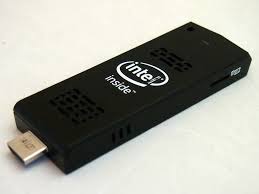
Technology of course isn’t stopping. I just this morning learned of something — a couple of something’s, really — that made a shiver run up (or maybe down) my leg. You will be able in less than a month to buy something called an “Intel Compute Stick.”

intel compute stick

It is a computer which is just a bit larger than a flash drive. Yes, I said a computer: not just a hard drive, but a computer. It will have an HDMI connector so that you can connect it to your television monitor (or that older computer monitor that you keep in the spare bedroom where you stash your brother-in-law when he turns up, unannounced) and a Bluetooth connection for a keyboard. The Stick will come in Windows and Ubuntu versions and will run between $100 and $150, and watch for that price range to drop quickly. That’s not the end however:

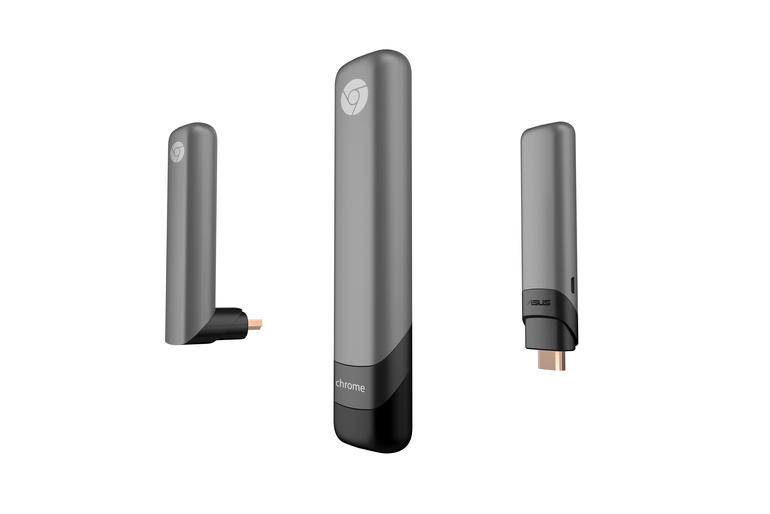
.asus-chromebit

Asus is coming out with something called the Chromebit this summer (which will — can you guess? — run Chrome). it is also a computer and it will be had for under $100.00 as well. A comparison between the two computer-on-a-stick models can be had in an excellent article by Jamie Lendino running on ExtremeTech and which you can find here.

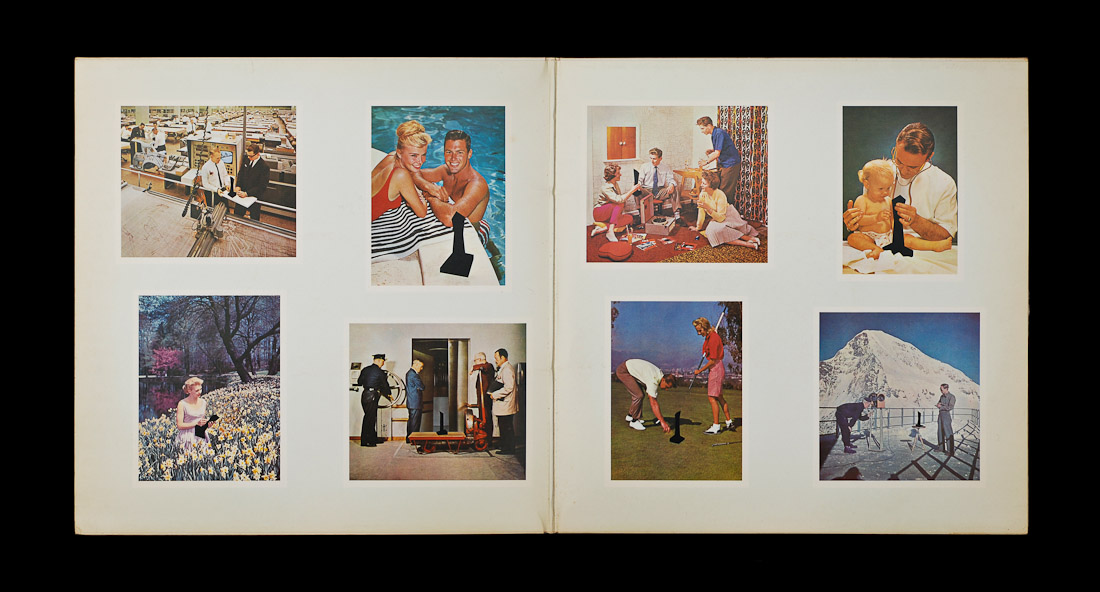
I’m going to go way out on the limb of the tallest tree of the forest and predict that these little innovations — computers that you can carry on your keychain — will change everything again. There will need to be a couple of innovations in the fields of monitors and keyboards (maybe those virtual tabletop models that keep popping up in the James Bond movies and, uh, 24) but this innovation put a computer in the hand — literally — of every school kid in the country for one-sixth the cost of an iPhone. And what does it mean for me and you? More portability.  More access.  More productivity. Things that are beyond my imagination.  It reminds me of the images that graced the cover and gatefold of the Led Zeppelin album Presence, which was created by a graphic design group named Hipgnosis. Those guys knew what was coming, back in the 1970s. They just didn’t think small enough:

presence led zeppelin

Check all of this out, if you are so inclined. What do you think? Can you use this? If so, how? Or do you think it will be a dud, for you and for everyone?


Libraries and Las Vegas

By Elaine Viets

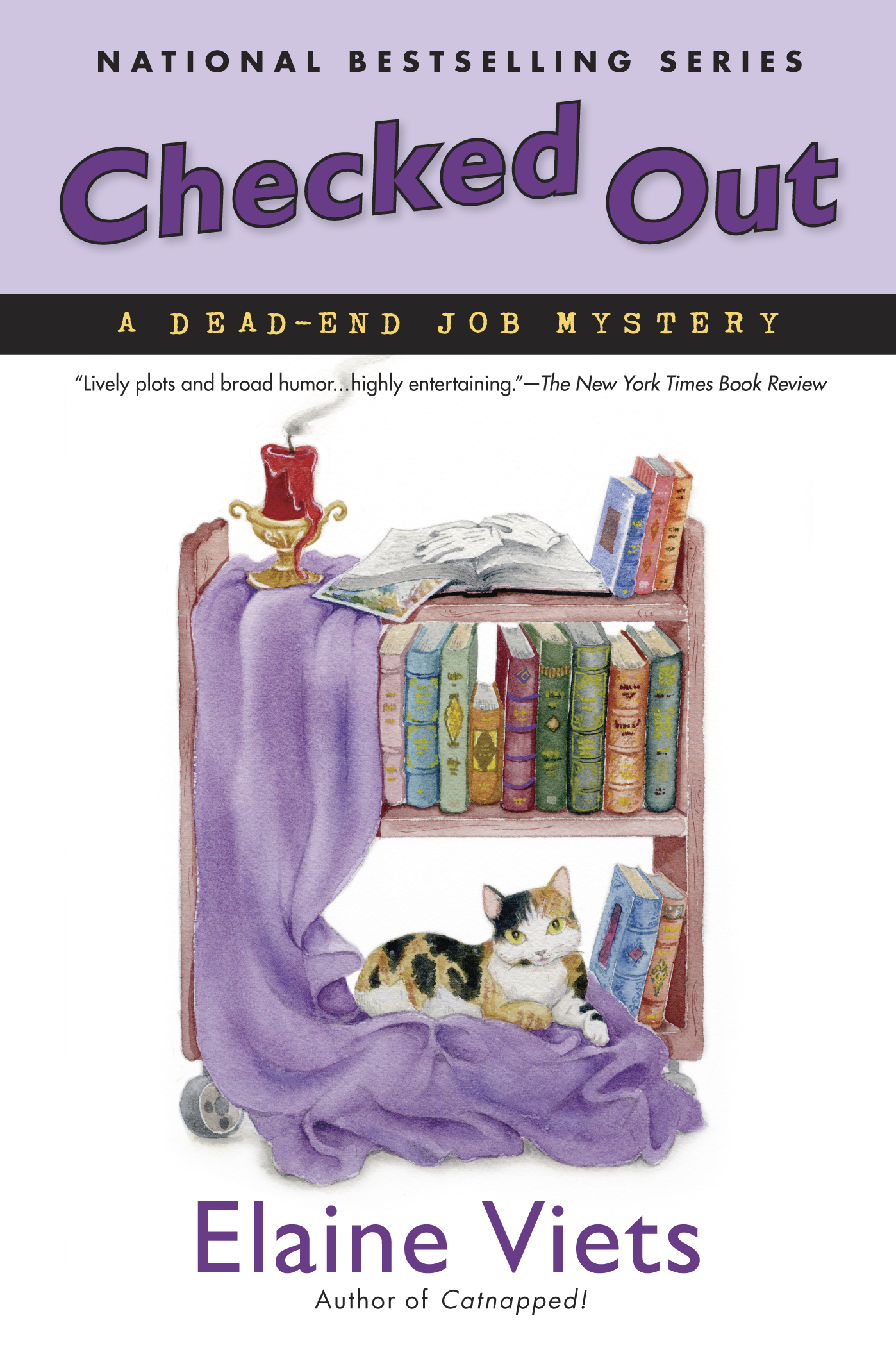
CheckedOut_FC

Libraries are like Las Vegas.
Seriously.
The bookies may look different, but the attitude is the same: What happens at the library, stays there.
In Checked Out, my 14th Dead-End Job Mystery, private eye Helen Hawthorne’s search for a missing million dollars hidden in a South Florida library leads to murder. Meanwhile, her private eye husband and partner, Phil, is booked to broil in the sun while he hunts for a ruby necklace stolen at a scandalous party.
I researched Checked Out by volunteering at my local library. That’s where I learned that libraries don’t blab about their patrons.
Helen found this out when she was snooping through the browser histories in the library’s computers. Alexa, the library director, caught her. Here’s the scene:

 “Helen!” Alexa said.
 Helen jumped. She didn’t hear Alexa enter the room.
  “Please tell me you aren’t violating our patrons’ privacy by reading their browsing history,” Alexa said.
 “Uh,” Helen said.
 “I’ll excuse you this time, since you didn’t know,” Alexa said. “But we don’t release information on what our patrons check out. We don’t tell anyone their reference questions. Actually, we don’t keep records on those, though some of our librarians keep lists of unusual questions.
 “We also consider database searches, interlibrary loans, any materials or equipment they use, even library fines and lost books, private information. Even law enforcement agencies can’t have this information unless they get a subpoena.
 “Now, are we clear on this policy?” 
 “Yes,” Helen said. “A library is like Las Vegas. What happens here, stays here.”
 Alexa looked a little startled, then said, “Yes, that’s correct. Unless a patron breaks the law in the library, then we call the police.”

This is good news for mystery writers. It means if our editor is found with a knife in her heart after she butchered our novel, the police can’t check the library computer where we researched “How to Stab Someone and Get Away With It” without a subpoena. And by that time, they’ll have caught the real killer.
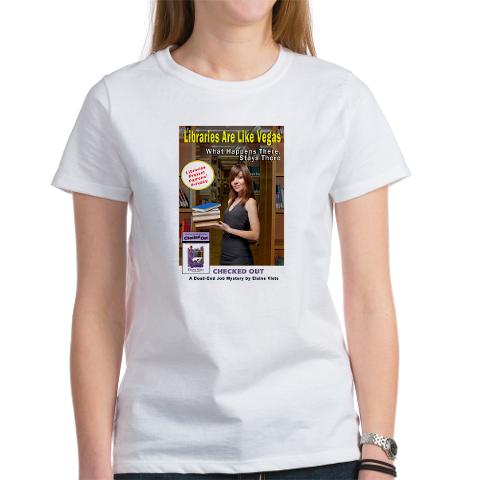
I thought the libraries and Las Vegas line had promo possibilities: Both librarians and patrons would appreciate it. I asked Kelly Nichols, one-half of the talented PJ Parrish writing team, to make me a meme. (Which rhymes with “theme.” I found that on the Internet, so I know it’s true.)
VietsMeme12x18 Now I have this free downloadable poster on my Website, www.elaineviets.com
But I wanted more. I also have Elaine Viets Merchandise, and my Webmaster made this T-shirt.T-shirt
Take my meme to heart, library lovers. Better yet, wear it over your heart.
***********************************************************************************
 Check out the freebies and good offers at www.elaineviets.com:
 (1) Download the Libraries and Las Vegas poster on the Home Page.
(2) Buy the T-shirt on the  Merchandise Page.
(3) Win a free hardcover Checked Out by clicking Contests at www.elaineviets.com.


Humor in Mysteries

Nancy J. Cohen

My reading preference leans toward humorous mysteries. Why? There are enough tales of horror in the daily news. I aim to escape into another world when I read at night, to ease my mind into sleep. If I’m reading a thriller with a rollercoaster ride or a suspense novel with a sense of dread, that doesn’t induce a calm state of mind. So I turn to lighter works for that escapism.

I do the same in my own writing. I’d rather have you smile than cry while reading my stories. Murder by Manicure is a perfect example. I’ve updated this earlier work, so it’s available in a new Author’s Edition. Revising the story brought me the same joy as when I originally wrote it. Besides the heroine’s wry outlook on life that is one source of humor, I’d set up a situation with a friend that would get her in trouble. Marla is a hairstylist and salon owner in sunny Palm Haven, Florida. In the same shopping center is Bagel Busters, a deli owned by her friend, Arnie.

MURDER BY MANICURE small online

One day, Arnie rushes into Marla’s salon. Here’s the condensed version of what happens:

“Marla, you have to help me!” The big man’s mustache quivered, and his dark eyes regarded her wildly.

“What’s wrong? Are your kids all right?”

“Yes. That’s not the problem. It’s Hortense.” Arnie wrung his hands. “She’s a former classmate. We went to high school together, and she had a crush on me. The ugliest dog in school, that was her. A real fresser, too. Ate everything in sight. And now she’s here! Oy vey, what am I going to do? She’s on her way over here.”

“So? You can exchange a few reminiscences and then she’ll leave.”

He leaned forward, breathing heavily. “You don’t understand. She likes me. Hortense said she’d been sorry to learn my wife had passed away, and how difficult it must be for me to raise two kids on my own. I could tell from her tone of voice that she’s still interested in me.”

“Hortense never married?”

“She’s divorced.” His brows drew together. “I said the only thing I could think of to get rid of her. I told her I was engaged.”

Marla smiled gently. “Arnie, how could you? The poor woman probably just wants an hour of your time.”

“No, no. She’s moving back to Palm Haven. I had to discourage her. Tell me you’ll play along.”

“Huh?”

“I knew you wouldn’t mind, since you’re such a good friend.” Taking her by the elbow, he steered her into the rear storeroom. “She’ll come to the salon. Tell her off for me, would you please?

“Me?” She wrinkled her nose. “Why would she come here?”

“Oh, God,” he moaned. “I remember how her second chin jiggled when she waddled down the hall. She was the only girl with frizzy black hair whose boobs were overpowered by her blubber.” His eyes grew as round as bagel holes when the front door chimed. “That may be Hortense,” he croaked. “Marla, you have to save me. I’ll give you free bagels for a year.”

Marla meets the woman, who turns out to be a buxom blonde. The story continues….

“Hey, Arnie,” she called, eagerly anticipating his reaction. “Someone here to see you.”

All eyes in the salon turned in their direction as Arnie shuffled toward the front, gaze downcast like a condemned man.

“Congratulations, Arnie,” crooned Hortense. “You have a lovely fiancée.”

Marla, entertained by Arnie’s sudden, shocked glare as he raised his eyes, didn’t catch on right away until she heard snickers from her staff.

“Don’t tell me,” she said to Hortense. “Arnie told you we’re engaged?”

You can imagine the hijinks that follow. And hopefully, readers will want to follow Marla’s crime solving exploits as well. It’s the personal connection to your characters that keeps bringing readers back for more. In this example, we have situational humor. Other sources can be physical antics like slapstick comedy, snarky comments, or outrageous characters. What methods do you employ to bring levity to your work?


A Plea for…Unhappily Ever After

nv-3

I see the novel ending with an open door. — Michael Ondaatje

By PJ Parrish

I just finished reading a terrific book. And I was going to blog this week about how much I liked it and why I thought it works on all levels – complex characters, a delicious plot with well executed twists, and a setting so well rendered that I felt I had been parachuted in.

But then last night, I got to the ending. It was so…tidy. After three hundred pages of gloriously messy narrative, the author chose to tie up all the plot threads into a pretty pink bow. It just didn’t work for me. Why? Because it deprived me of thinking for myself. It slammed the door on the possibilities I was creating in my head for her characters. It didn’t leave my imagination anywhere to go. And thus, it lost its power.

If you haven’t yet guessed, I love ambiguous endings. I love that Rhett tells Scarlett off and walks away into the fog. I loved that we don’t really know what happens to Offred in Margaret Atwood’s The Handmaiden’s Tale, when she says, “Whether this is my end or a new beginning I have no way of knowing: I have given myself over into the hands of strangers, because it can’t be helped.” And yeah, I even sorta kinda maybe liked the ending to Gone Girl.

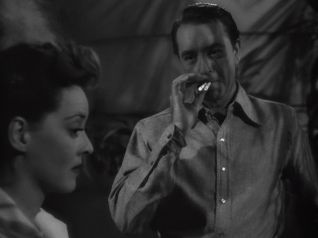
Four of my favorite movies are Now Voyager, The Graduate, Lost in Translation and Cinema Paradiso. Will Jerry continue to light two cigarettes for himself and Charlotte? Do Ben and Elaine stay together? What did Bob whisper to Charlotte at the end and did they go back to their awful relationships? Will the adult Toto ever believe in love again?

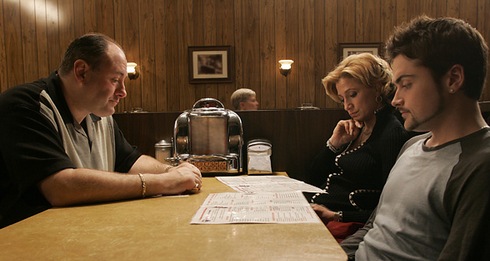
sopranos2

And about that last scene in The Sopranos? You know, where the family’s sitting in a diner as Journey’s “Don’t Stop Believin'” plays, the tension builds and then suddenly the screen goes dark and silent? Loved it! The series creator David Chase was later quoted as saying, “I have no interest in explaining, defending, reinterpreting, or adding to what is there. People get the impression that you’re trying to (mess) with them, and it’s not true. You’re trying to entertain them. Anybody who wants to watch it, it’s all there.”

Chase might well have added, “it’s all there…in your head.” Because for me, that is where the power of great storytelling lies. For me, even the best constructed novels can fail because almost always I can sense the author moving toward that inevitable ending, starting to close the circle and make sense of it all for me instead of letting me do it.

Now we crime dogs don’t have a lot of latitude when it comes to ambiguity. The conventions of our genre dictate that there is a crime to be solved and that usually implies something to be resolved. Readers are drawn to mysteries and thrillers because the stories usually attempt to impose order on chaos, to make sense out of the nonsensical, to have a hero triumph and make the world right again. I think readers of most kinds of fiction –- yes, even literary – want their novels to make sense. And while they might be willing to let things slide for a while, they usually crave a gratifying conclusion. The reason is easy to understand: Our real lives are messy, confusing, full of dead ends and false starts, horny toads instead of Christian Grey princes, and let’s face it, we all don’t live happily ever after. So when we turn to crime fiction and romance, we are looking for a satisfying conclusion.

But what is “satisfying?” Isn’t there room in there for shadows and crooked lines? Can’t we have some ambiguity?

Some crime writers try to allow for this, but readers sometimes get testy about it. I have two books in my series that have open-ended conclusions. One (A Thousand Bones) involves the case itself and I got emails from readers taking me to task for not “solving” the case in a conventional manner. But the crime was so awful and so personal for my protag, for her to do anything else would have been too…tidy. The other time I left an ending open was in our latest Louis Kincaid book, Heart of Ice, and it involves our hero’s personal life. My editor at the time wanted us to tell readers what exactly was going to happen, but we fought for the open ending. I trust the readers to figure it out.

Tana French, in her Edgar winning debut In the Woods, had similar reaction to her ending. The plot involves two separate cases, decades apart, that are playing on the psyche of the detective. He solves the newer one but the older one, that truly eats at his soul, remains unsolved. French actually cautions us this is going to be outcome in the book’s opening lines:

“What I warn you to remember is that I am a detective. Our relationship with the truth is fundamental, but cracked, refracting confusingly like fragmented glass. It is the core of our careers, the endgame of every move we make, and we pursue it with strategies painstakingly constructed of lies … and every variation on deception. The truth is the most desirable woman in the world and we are the most jealous lovers, reflexively denying anyone else the slightest glimpse of her. We betray her routinely … This is my job … What I am telling you, before you begin my story, is this–two things: I crave truth. And I lie.”

I was watching The French Lieutenant’s Woman on TMC the other night. I’m not crazy about the movie, but it got me thinking about the book, which I had to read eons ago as a literature major. I remember being baffled by it, because right in the middle of Sarah and Charles’s doomed love affair, a narrator appears out of nowhere and tells us we now will have three endings and even flips a coin to decide what order we will get them.

Now John Fowles loved bending narrative rules and was famous for his ambiguous endings. (Maybe because he studied the Existentialists at Oxford?) The Magus ends with the hero’s future an open puzzle that readers are challenged to solve for themselves.

Fowles once told an interviewer how he had received a sweet letter from a reader who wanted to believe that Nicholas, the protag of The Magus, was reunited with his girlfriend at the end of the book — a point Fowles had deliberately left ambiguous.

“Yes, of course they were,” Mr. Fowles told the woman.

Fowles got a second letter the same day from an irate reader taking issue with the ending and demanded, “Why can’t you say what you mean, and for God’s sake, what happened in the end?”

Fowles wrote back, “They never saw each other again.”

Now we mere mortals probably have to be a bit more careful when we use ambiguity. It doesn’t always work. At best, it conveys pretension and at worst, it just confuses the reader and pisses him off. Which brings me all the way back to that book I finished the other night. It was such a letdown to be spoon-fed that ending after such brilliance. Why was the writer compelled to tie the ends up so neatly?

E.M. Forster, in his splendid Aspect of the Novel asks the same question: “Why is this necessary? Why is there not a convention which allows a novelist to stop as soon as he feels muddled or bored? Alas, he has to round things off, and usually the characters go dead while he is at work.”

Okay, one last quote before I go, but it’s a beaut. And it comes from a fictional person, Stephen Maturin. He is a character in a series of novels by Patrick O’Brien, who shows up as the ship’s doctor in the fabulous move, Master and Commander.

“The conventional ending, with virtue rewarded and loose ends tied up, is often sadly chilling; and its platitude and falsity tend to infect what has gone before, however excellent. Many books would be far better without their last chapter: or at least with no more than a brief, cool, unemotional statement of the outcome.”

Oh yes.

Give me a book that makes sense and is satisfying. But don’t wind things up so tightly that you squeeze the life out of it. Let me think, when the story ends, that the characters are like Bette Davis and Paul Henreid, on a big ship, setting sail on some grand voyage, going…somewhere. And that I am going with them.