
Ernest Hemingway Public Domain
If you had to pick ONE, what is the most important trait an author must have to succeed? (Yes, only one. Share your best one and tell us why.)


Image purchased from shutterstock for Jordan Dane use
Before my first books had been bought by a traditional publisher and I was an aspiring author, I had not known another writer as a friend or relative. To help me achieve my goal of becoming published, I joined writer organizations and participated in a local writers’ group and attended conferences. Ultimately another author helped me get published and find my first agent. She changed my life forever. Now my life is filled with author friends who bring me so many gifts with that connection.
Please share your experiences with other authors and what they have done to make you a better writer.

Photo by Eberhard Grossgasteiger from unsplash.com
I sit this evening perplexed by mysteries, personal puzzles that really have no point in being discussed here. Pull one thread, however, and it catches another and then another, whether they be in the material or intangible world. So it is that I occasionally obsess for a few moments about a couple of local puzzles that are commemorated to varying degrees on the anniversaries of their occurrences.
The first of these occurred — or at least manifested itself — within walking distance of my home. I live two blocks away from Hoover Reservoir, a body of water consisting of five square miles which is by turns a water source, park, and recreation area. A gentleman named Rob Mohney also lived nearby until 1996. He abruptly disappeared one evening in July, leaving the door to his home unlocked and the supper on his table untouched, a still-life, landlocked model of the Mary Celeste. He was still missing when his car was noticed at the reservoir a few days later. One of the initial theories of explanation regarding his disappearance was that he had parked at the reservoir, then walked to the pedestrian crossing over the dam, where he had done a Peter Pan for whatever sad reason into the waters crashing beneath. We are not talking Niagara Falls, however, and the waters in question quickly give up their own when there is anything to give. Mr. Mohney was never found.
Local law enforcement still pursues the case. A tip led them to a nearby rural plot of land where a backhoe failed to give up any secrets. Mohney still lives, however, in the local lore. A year after his disappearance a group of drunken seniors from one of the local high schools reported seeing his shade wandering late at night on the far banks of the reservoir, and sightings are still reported by their successors some twenty years and change later.
Thousands of people are reported missing each year. Most are found in one condition or another, either reunited with loved ones or bound over to the state of deep and seemingly unending mourning, depending upon circumstance. The truth, however, is that some people just…disappear. There is no law against it if the person missing is an adult and the absence appears voluntarily. While the occurrence often raises suspicion of what is known as “foul play,” it isn’t always. Some people tire of their lives and decide to up sticks and reinvent themselves elsewhere. Stories abound of how the quick-witted and -footed took advantage of the 9/11 terror attack in New York and left a hated job or a tired relationship behind to go on permanent vacation in the Mohave.
It is hard to classify the second and better known mysterious absence which has occurred in my area. Theories about the perplexing disappearance of Brian Shaffer abound. Shaffer, a 27-year-old medical student at the Ohio State University in Columbus, seemed after a deep personal tragedy to have the world by the tail with a downhill pull. On Saturday, April 1, 2006, as he and two friends began a bar crawl through the North High Street campus area. Shaffer needed the break. His mother had died a few weeks earlier following a long battle with cancer and his life seemed to be entering a new and better chapter. Shaffer and his girlfriend were scheduled to leave the following Monday for Miami, and he had planned to propose to her after they reached their destination. The evening was a way of properly lubricating the beginning of the much-needed spring break. The trio entered a loud and boisterous two-story establishment named “The Ugly Tuna Saloona” (a dive bar with pretensions). Shaffer became separated from his friends soon after they entered. Their calls to his cell phone went straight to his voice mail. They eventually left the bar, assuming that Shaffer had gone home to bed. Their assumption was partially right. He was gone.
The area in question was — and is — heavily blanketed in security cameras and monitors. Columbus Police detectives assigned to investigate the case repeated reviewed hours of video from the night in question and were able to account for the exit of each person who entered the bar that night but for one, that being Shaffer. Cadaver dogs went through every inch of the building but found nothing. The Saloona has gone to that great tavern in the sky, and the empty premises have been examined again, but it still refuses to give up its secrets. Shaffer went in but apparently never came out.
A disappearance such as this leaves its own uncomfortable ripples behind. Shaffer’s father died two years later as a result of a home accident without knowing what happened to his son. An online memorial posting following his father’s death, allegedly from Shaffer and purportedly from the Virgin Islands, was concluded to be a hoax. Elaborate tips phoned into the detectives led nowhere. Rumors continue to this day, the most persistent being that Shaffer is pursuing a different life in a suburb of Atlanta. There have been “Where’s Waldo” sightings of him literally all over the world. Each false tip is a fresh wound for Shaffer’s brother, who understandably remains haunted and perplexed by the incident. The oddest post-disappearance manifestation, however, was experienced by Shaffer’s girlfriend, who is no doubt haunted to some degree by what occurred and what might have been. She continued calling his cell phone on a nightly basis after his disappearance. Her calls went straight to voicemail, each and all but for one that she placed approximately six months after he vanished. That call rang four times. It was found that the call had “pinged” off of a cell phone tour in a suburb southwest of Columbus. It was, unfortunately, another dead end.
Where did Shaffer go? And how did he get there? I’m repeating myself, but that area of High Street is heavily covered by surveillance. He was not seen leaving the building. It is all but obvious, however, that he did. I have my own theory, one that is unkind in some ways and that I accordingly keep to myself. Someday there might be an answer. Or not. There is no rule of the universe that states that all questions will one day be answered, that all mysteries will be revealed, other for than for the divine. The lesser ones, however, will still matter.
I’ve prattled on long enough, perhaps too long. Disappearances. What is the most puzzling unsolved one near you? Please share. And thank you as always for stopping by…
…and, like Columbo…I’ve got just one more very important item: Chag Urim Sameach to all of our many friends celebrating the Festival of Lights commencing tomorrow! We join you in spirit!
By SUE COLETTA
I’ve seen way too many medical professionals in the last six months (living with rheumatoid and psoriatic arthritis isn’t always easy). As Joe pointed out Saturday—beautifully, I might add—life as we know it can change in an instant. In short, remember to have fun. Laughter really is the best medicine.
One way I’ve amused myself while waiting in the exam room is by analyzing the skeleton suspended by a metal pole. You know the one … the staff usually names it Fred, or something equally common, as though the name will somehow lessen the impact of bad news.
What I find fascinating is the fact that the vast majority of doctors and nurses don’t know the sex of their skeleton, evident by the female skeletons tagged with a male name.
Determining the Sex of a Skeleton
Many differences exist between the two sexes, and the variations run as deep as our bones. This becomes especially important for corpses found in an advanced stage of decomposition. All that might remain is the skeleton, perhaps teeth, and possibly some hair. Even if the pathologist has teeth and hair to work with, that doesn’t mean enough DNA material remains to identify the victim.
This is where the skeleton offers more information. The only exception would be that of a pre-adolescent, where sexual dimorphism is slight, making the task much more difficult. Need to buy time in your story? Murder an adolescent. (Oh, no, she didn’t just say that.) Or have the killer shatter the key areas of the skeleton.
The most common way to determine a skeleton’s sex is by bone size. Not the most accurate, but it’s a starting point. Male bones are generally larger than female bones because of the additional muscle that increases on the male through adolescence and into adulthood.
Another good inclination of sex is the pelvic area.
The sub-pubic angle (or pubic angle) is the angle formed at pubic arch by the convergence of the inferior rami of the ischium (loop bone at the base) and pubis (top of loop) on either side. Generally, the sub-pubic angle of 50-60 degrees indicates a male. Whereas an angle of 70-90 degrees indicates a female. Women have wider hips to allow for childbirth.
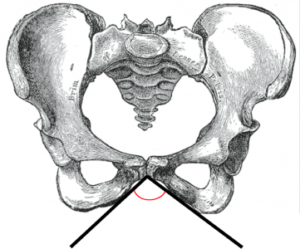
Female
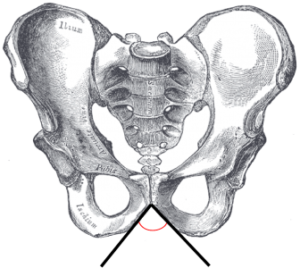
Male
There are also distinctive differences between the pubic arches in males and females. A woman’s pubic arch is wider than a male’s as is the pelvic inlet to allow a baby’s head to pass through.
The pubic arch is also referred to as the ischiopubic arch. Incidentally, this difference is noticed in all species, not just humans.
The area around the pelvic inlet (middle of the pelvic bone) is larger in females than in males. A female skeleton who has given birth naturally will be identifiable because this space widens during childbirth. Even though it contracts afterward, it never fully returns to its original size. In the picture above notice the heart-shaped space.
If you don’t want the pathologist to easily ID the victim, perhaps the neighborhood bear takes off with the pelvis bone. You could also have him return for the rest of the body as the coroner is examining the corpse. Talk about adding conflict to the scene! Just remember, most black bears don’t eat human flesh (in my area, anyway). So, do your homework. Grizzly bear, anyone? How about a Kodiak brown bear?
Other Body Clues
The acetabulum—the socket where the femur (thigh bone) meets the pelvis—is larger in males. Also, the head and skull have several characteristics that help the pathologist (or crime writer) determine male from female.
These differences and more tell the pathologist the sex of the deceased.
So, the next time you’re sitting in an exam room, get friendly with the skeleton in the room. Who knows? You may even sell a book or two when you educate the staff. Do it nicely, though. Some medical professionals don’t like to be schooled by a crime writer, as weird as that sounds. 🙂
Wishing you all a joyous Thanksgiving!

Photo courtesy Eddie Howell on unsplash.com
The weather has turned cool since last we met. Each area of the United States has its identifiable seasons, from the Deep South (where New Orleans has two, those being “summer” and “February”) to the West (where, as Mark Twain is reputed to have said, “The coldest winter I’ve ever spent was a summer in San Francisco”). Ohio has a more severe line of demarcation. The heat of summer at this time of year sinks into the chill of fall. Leaves drop. One can’t um, leave them go without raking or mulching for too long, as snow will almost inevitably fall by November. One sets the thermostat from “cool” to “warm” and calls for the furnace check-up, even as it seems as if but a few weeks ago it was the air conditioning system that was being checked out. The circle, it seems, moves faster and faster.
I’ve of late been feeling the rapidity of the turning of my own seasons. I came across a passage in a new book entitled THE DARKNESS by Ragnar Jonasson. The protagonist is a police inspector who is being involuntarily retired as she approaches the age of sixty-five, muses that she feels little different than she did in her forties, other than for perhaps some minor fatigue. Just so. I’m waking up at 3 AM much too frequently but I’m doing it in my bed in my house and know where I am. There are no real complaints there. Still, I am increasingly aware that the miles in the rear view mirror are substantially greater than those between me and the final destination, and I increasingly doubt whether I’m going to get there before the warranty expires. Most of my close friends are a few years older than I — in their early to mid-seventies — and seem to be hitting a wall. One of them, who I have known for well over fifty years, advised me yesterday that he was not up to making the two-hour drive to visit me this weekend due to vision problems. He reminded me that when we lived on the west coast he would call me and say, “Tahoe!” and off we would go, making the six-hour round trip to Nevada and back on the same day as if we had not a care in the world. We didn’t. Not then. It was high noon. We are well past that. The sun hasn’t kissed the horizon, but the lengthening shadows hint that, from our landlubber perspective, it is well-nigh approaching the yardarm. Sunset occurred for another friend last week. His body mercifully slipped loose of its moorings last week and followed his essence, which had been stolen by Alzheimer’s Disease, piece by piece, over the past two years. It’s not the way I want to go — I would prefer to pass either while writing at my desk or at the hands of an irate husband — but we don’t always get a choice. Shakespeare’s untimely frost follows no calendar.
Photo courtesy Eddie Howell on unsplash.com
What more to do? I have four wonderful children, each accomplished in their individual ways, and a terrific granddaughter. There might be time for one more dog. I think I’ve made more people smile than otherwise which is something that not everyone can truthfully claim. It’s been a good ride and there are many more miles and adventures to come. I hope. The lesson I’ve learned, and which I am making so bold as to impart to you —particularly those of you here who are younger — is don’t waste a day, or even an hour. Decide what you want to do and work toward it, whether it is writing the Great American Novel — someone will do it, so why not you? — adopting a stretch of highway, or visiting every Sonic, Tim Horton’s, and Cracker Barrel in the country. Regardless of what you want to do, there are only a finite number of times that you get to switch from cool to heat and back again. Cherish each one, and enjoy them.
Photo courtesy Pathecho Grid on unsplash.com

A man and his chicken
It’s my pleasure to have my friend, Bill Cameron, join us today. I’m a big fan of his writing ever since I read his debut book LOST DOG. Bill was in my debut authors group for the International Thriller Writers (ITW) in 2008. That book featured an unlikely kleptomaniac anti-hero smart ass, Peter McKrall, with his unique voice that has always stuck with me. It launched Bill’s detective series that features Detective Skin Kardash.
I also follow/harass Bill on Instagram (@bcmystery) where he posts pics of his urban chickens. His daily videos and pics of his chicken drama are tons of fun and addictive, like his writing. Thanks for being our guest, Bill. Shake a tail feather and take it away.
***
Much of my day was spent chasing chickens around my yard—an act of pure slapstick if there ever was one. Usually the ladies will come right up to me (probably because I often have treats), but today they sensed I had something else in mind. So they fled, making comical “bock-bock-bock” sounds as they went. I was no doubt equally comical, trying to both run and scoop up indignant chickens simultaneously. The result was a kind of bow-legged lurch with my hands flapping around near ground level. I may have fallen, but if you don’t have video you can’t prove anything.

My problem, or rather the chickens’ problem, was a possible infestation of scale mites. These awful little bugs burrow under the skin of a chicken’s legs, drink blood, and can wreak havoc on the well-being of a flock. (Do not image search for “chicken scale mites” unless you want to see true horror.)
Now, I say possible infestation because until the the situation gets really bad, the vermin are difficult to see. Some discoloration on the legs of our oldest hen, Hinie, was the only indication something might be amiss. That discoloration could also mean nothing at all, but since we don’t want the mites to get a leg-hold, I decided to address the problem proactively.
The treatment is basically Chicken Spa Day, which probably sounds nice to you and me. And in fact some chickens enjoy a soak in a warm bath and maybe a massage. (Do image search for “chicken taking a bath” for some entertaining pics.) Not so much our ladies. But I was not deterred.
In advance, I’d prepared a warm Epsom salts bath with a little mild soap. As I caught them, the girls each got a soak and a mild scrub to clean off any mite eggs or mites that hadn’t yet burrowed. Then, after they were dried off, I coated each hen’s legs with Bag Balm to suffocate the pestilent buggers who remained.
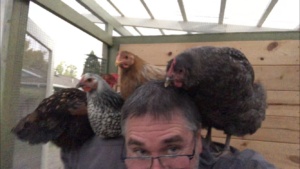
The good news is all went relatively as planned, though it took me more than an hour to get all four into the tub. (Farm Fact: chickens are fast.) The girls had a lot to say about it, probably in the form of chicken swearing. But the endeavor was a success—though I got wetter than the girls did.
So what does this shenanigan have to do with self-care?
Well, for me, taking care of chickens is a lot like writing. It can be rewarding, fun, challenging—and also a source of heartbreak. Right now we have four girls: the aforementioned Hinie, plus Cheeks, Tuchus, and Buns. (Do you detect a theme? Guess what!) Earlier this summer, one of our first hens, Fanny, died unexpectedly. And last year, two others (Moon and Patootie) turned out to be roosters, which are verboten within city limits. That’s the heartbreak side of things. But the rest of the time there’s the slapstick comedy and the reward of eggs and affection from smart, engaged birds who each have their own personality.
When I’m away from the keyboard, I find chicken care is a good way for me to get my “I’m not an incompetent buffoon” fix—something that can be rare in my writing life. On days when things seem especially dire (“wait, did you say there’s no market for that manuscript I spent five years on?”), time with the chickens can give me a sense of worth. They need me—for food and water and spa days, and for a lap or shoulder to cluck on. And I’m up to the task.
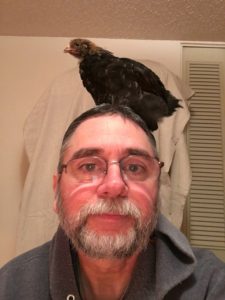
The day Hinie pooped on Bill’s head
But as with writing, there’s no guarantee of success. They might get scale mites, and while I’m confident I have that problem in hand, the next problem might cost me a beloved pet. In the morning, I might get a manuscript rejection, but in the afternoon I might get a fresh egg and a nuzzle from a bird named after a butt.
Chicken Tending (think about it) isn’t the only thing I do for self-care. But the ways it’s like writing helps me deal with the tribulations of my writing life. Sometimes we just need a little success. For me, chasing birds around the yard goes a long way toward keeping me grounded and believing I can make a difference—on the page as much as in the coop.

Fanny (RIP) & Hinie by Bill’s daughter, Jessica
FOR DISCUSSION:
What do you do to take care of yourself?

Bill Cameron is the critically-acclaimed author of gritty, adult mysteries featuring Skin Kadash. His short stories have appeared in Alfred Hitchcock’s Mystery Magazine, Killer Year, Portland Noir, First Thrills, Deadly Treats, and West Coast Crime Wave. In 2012, his novel County Line received the Spotted Owl for Best Northwest Mystery. His latest book, the young adult mystery Property of the State, was named one of Kirkus Reviews Best Books of 2016: Teen.
Bill is currently at work on a mystery set in the Oregon High Desert.

Credit: Go Daddy Stock Photo
A handy list for your writing day:
*Disclaimer: I have used all 25 methods at various times, and my Writer’s Butt comes and goes. As to number 3, I have gotten so tangled up in the huge number of power cords around my desk that I may as well have been chained because it was a real pain to try to get away from my chair and go to the kitchen.
Okay TKZ-ers! Please share your Avoiding-Writer’s-Butt strategies. We’re listening…
My adopted mother adored pretty shoes. She used to say if she won the lottery, she’d spend the money on shoes. A great pleasure in her life was dressing up for church on Sunday morning in a beautiful outfit with a fancy hat and matching shoes.
However, her feet were size 10 ½, limiting her choice of stylish footwear, always geared for women who wear size 6AA.
For her birthday, I often took her shopping for new shoes. The salesperson would use a shoehorn to jam, pummel, and squash her poor feet into lovely pumps that were at least two sizes too small.
Her pain made me cringe. I wondered how she could even walk. The ordeal brought to mind Lisa See’s brilliant book, Snowflower and the Secret Fan, about Chinese foot-binding.
By now, you’re wondering what shoes have to do with writing. Glad you asked…
A critique partner is rewriting her first novel. Her subject—a teenager struggling with a compulsive disorder that badly affects her appearance—is fresh and compelling. Her voice is wry and funny. For a relatively new writer, she has a strong grasp of how to write good scenes, from heart-rending to laugh-out-loud hysterical.
But, as good as they are, many of them don’t move the story forward.
No matter how hard we critiquers try to shoehorn these wonderful (but unnecessary) scenes into her plot, they don’t fit.
How do you determine if a scene is needed?
Novelist and writing instructor Dennis Foley identifies four major functions of a scene:
To test if a scene is needed, figure out what functions it performs. Today’s fast-paced fiction generally requires scenes that multitask, accomplishing two, three, or all four functions.
Revelations about a character can occur on the fly, while the character is taking action that moves the plot forward.
A scene may foreshadow lurking disaster, which increases tension for the reader at the same time it drives the story closer to that disaster.
Dennis offers another tip to determine if a scene is needed: remove the scene. Does the story still make sense? Can the scene easily be plunked down somewhere else in the story?
If so, it’s not part of the causal linkage that moves the story forward.
Causal linkage means something happens in A that leads to B where something else happens that leads to C, and so on. Each scene builds on the ones that precede it.
This tip is easy when stories are told in chronological order with limited characters.
However, what if you’re writing a Ken Follett-style saga or an epic fantasy with multiple plotlines and a large cast of characters? Such stories may jump around to different locations and time periods. That makes it tougher to determine whether or not a scene is necessary.
Even in “big” books, causal linkage can still be determined. Separate each plotline and string its scenes together. You can do this with color-coded index cards, plotting on a spreadsheet, or using Scrivener. After you’ve put all scenes from one plotline together, read them.
Does each scene link causally with the scene before and after it? If a scene could fit anywhere, it may not be needed.
“But,” the writer protests, “if I cut those scenes, my book will be too short.”
That leads to the question: how long should a book be? Lee Masterson at Writing-World.com offers guidelines for various genres but his main point is: a book needs to be as long as it takes to tell the story.
Better to write a concise, effective story than one that’s bloated and boring because of unnecessary verbiage added to reach an arbitrary number of pages.
If the story is “too short” as a novel, consider recasting it as a novella, a short story, or a screenplay. In a screenplay, one page equals approximately one minute of screen time. One-hundred-twenty pages is a two-hour movie.
The problem of excess scenes is not limited to newer writers. I just went through it with my current work in progress. About two-thirds of the way into the first draft, I hit a wall. A critique buddy suggested an abrupt, unexpected turn in the plot that punched a hole right through that pesky wall. Her idea was brilliant!
However, that change meant going back to the beginning and rewriting 200+ pages.
I’d worked diligently to hone certain scenes to the height of emotional resonance. As proud as I was of my darlings, they were now dead ends, irrelevant to the new plot direction.
So I used a trick TKZ authors taught me: cut those parts and stick them in an “outtakes” file.
You’re not killing your beloved children but instead sending them to a time-out.
A funny thing happened. Those scenes waited patiently, out of sight and out of mind. When critiquers and beta readers went through the revised draft, they didn’t notice their absence.
Those deleted scenes almost never get put back into the story. As wonderful as I thought they were at the time, those size 10 ½ scenes just plain didn’t fit the size 6AA plot. To shove them back in would require serious shoehorning.
And that just makes my feet hurt!
TKZers, how do you decide if a scene is needed? Do you have hints to chop the excess?

Debbie Burke’s thriller Instrument of the Devil is on sale in October for $1.99 or FREE on Amazon Prime. Here’s the link.
By SUE COLETTA
After my book signing on Saturday, October 6th, I was mulling over what to write for my TKZ post today, and this little treasure popped into my inbox. The video is so inspirational, I had to share it with you. It’s about four minutes long. If you’re short on time, not to worry. I’ve explained the video below.
Ray Edward’s thought experiment goes like this. Imagine you’ve been given a treasure. This treasure, like all magical treasures, comes with conditions. Here’s the catch. While this treasure is unlimited, each day you can only take one coin. Just one. And every day you suffer from amnesia. You forget you have this treasure and you lose a day of unlimited value.
What would you do to remind yourself? Would you leave notes for yourself? Would you phone a friend and ask them to remind that you have this treasure? How would you remember not to waste a single day?
Here’s a new flash. You already have this treasure. Consider this your reminder. The treasure you’ve been given is your life. Everyday offers endless possibilities, in life as well as writing. Yet we squander so many days with “Someday, I’ll travel. Someday, I’ll finish the manuscript.” Unfortunately, “someday” is often code for “never.”
Life is a mystery. We didn’t know when we’d enter the world and we don’t know exactly when we’ll depart, but we do know someday our life will end. Each day between now and then is a treasure-trove of limitless value.
What will you do with your treasure? Will you spend your time wisely? Will you use the day to hone your craft to achieve your goals? Will you strive to make your dreams a reality? Or will you use excuses for putting off writing till tomorrow?
Hey, we’re all guilty of procrastination from time to time. The trick is, making our writing a priority. Even though writers spend hours alone with a blinking cursor, the stories we write have the ability to entertain, to bring a smile to the lonely widow or widower’s face, to let the exhausted parent escape for a while, to inspire the aspiring writer to dream without limits, to brighten someone’s day, or even, just keep someone company for a while.
Writers hold great power. So, the next time you don’t feel like writing, remember this. Every day you don’t sit in front of that computer with your hands on the keyboard is a day you’ve let down your readers.
Bold statement, I know, but this truth hit home at my book signing.
A woman stood in front of my table, rambling on and on about the characters in my Grafton County Series. She told me she was never what you’d call an avid reader. A friend recommended my books, and she bought MARRED for the heck of it. Three books later, she’s embarrassed to admit that she considers Sage and Niko Quintano her closest friends. So much so, she desperately misses them in between books. The tears in her eyes as she spoke about how much my characters meant to her touched me on such a deep emotional level, it caught me off-guard.
How could I ever let this woman down?
By the time I got my game face on again, I glanced up to see another woman rushing toward my table. Unbeknownst to me, she’s a long-time fan who brought her three-year-old grandson to meet “her favorite author.” I have no idea what his grandmother told him, but this young boy gawked at me as if I were a superhero. The look in his eyes about shattered my cool façade. All I could think was, I’ll never live up to his view of me. << There’s the ol’ familiar self-doubt again. If only there were a way to silence that voice forever. Sadly, as Laura so eloquently wrote recently, self-doubt and writers go hand-in-hand. Sigh.
When this sweet woman asked for a group photo, I couldn’t form the words to tell her how much it meant to me. It’s a day I’ll never forget. It’s also the driving force (writer crack 🙂 ) that’ll keep me tied to my desk, hour after hour, paragraph after paragraph, scene after scene, till I type The End one more time.

So, my beloved TKZ family, let’s share inspiration today. Tell me about an encounter with a reader that renewed your love of writing.
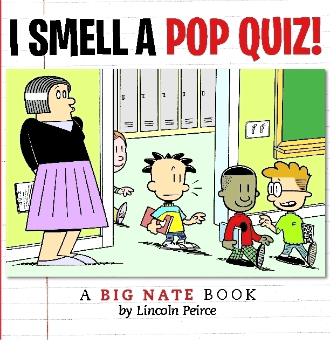 Time for a pop quiz to test your knowledge of sneaky word traps writers can fall into.
Today let’s talk about homonyms, homographs, and homophones.
Homonyms are words that sound the same but have different meanings.
Example: “write” and “right.”
Homophones are words that sound alike but have different meanings and spellings.
Examples: rein, reign; aisle, isle; suite, sweet.
Homographs are words that are spelled the same but have different meanings and different pronunciation.
Example: desert (a hot dry place, pronounced with an accent on the first syllable) or desert (to leave, accent on the second syllable).
Don’t worry—the above definitions won’t be on the test. Only hardcore grammar Nazis care.
Some words are just plain confusing. They may sound similar but are spelled differently and have different meanings.
But…professional writers should know how to choose the right word in a particular sentence.
We’ve all typed “there” when we mean “their” or “to” when we mean “too.” Those fall more into the category of typos.
I’m talking about out-and-out goofs because of incorrect word choices. When your book is published, some readers are quite happy to point out those errors that you missed. Embarrassing.
Standards of proofreading and copyediting are on a steep decline. The below examples are boo-boos I’ve collected lately from recently published books, news articles, and blog posts.
See if you can make the right choices.
How many of you looked up the test answers on Google? Come on, tell the truth.
That’s OK. It’s not cheating–it’s research. The lesson here is it’s always better to double-check before you submit to an agent or editor who might turn you down because of improper use. Or before you hit the “publish” button on your indie book.
Self-published books carry a stigma because many are full of such errors. If you’re an indie author, don’t contribute to the bad reputation with sloppy word choices.
Now that I’ve reached a certain age, I may think I’m sure about proper usage but sometimes find I’m mistaken. When it’s so easy to check on sites like Grammar Girl or Writing Forward there really is no excuse not to.
Answers:
Not only that, affect is a homograph (spelled the same but pronounced differently). When used as a verb, the accent is on the second syllable. When used as a noun, the accent is on the first syllable.
No wonder writers get confused. Glad I was born in the USA because I’d never master the vagaries of English if I had to learn it as a second language!
TKZers, how did you do on the quiz?
Which homonyms, homophones, and homographs do you find confusing?
What words do you tend to mix up?
Do you have favorite tricks or tips that remind you of correct usage?
During October, here are two ways to get a cheap thrill:
Debbie Burke’s bestselling thriller Instrument of the Devil is on sale for $1.99; or if you’re a member of Amazon Prime, you can read it for free. Click here.