A Farewell Message: Winnie the Pooh said it best

Jordan Dane 

@JordanDane

Photographer Credit: Shaun C Williams


“How lucky I am to have something that makes saying goodbye so hard.”

Winnie the Pooh


This will be my final TKZ post, my fine friends. It’s been nearly ten years that I’ve had the good fortune to be invited as a contributor. You might think all those years would make it an easy decision to step down, but the years made it harder to decide to move on.

I started writing in 2003, sold in auction in 2006 with my first 3 books released in 2008 and beyond. Even with the experience I have (on paper) from then until now, I still feel like the mesmerized kid who sneaked under the big tent at the circus, afraid someone will find me & toss me out. I’m a sponge for the information presented here every day–posted by each author contributor as well as the helpful comments made by our followers. That’s YOU. I’ve learned a great deal from our TKZ family of subscribers & followers. Thank you.

It’s clear how dedicated TKZers are about the passion we share when reading the comments to our posts. As a writing community, we take great care in nurturing the burgeoning talents of the many anonymous submitters who request feedback on their first pages, for example. Or we read a post & feel free to contribute our comments to develop the topic with our personal thoughts because we feel comfortable in doing it here. Our outspoken family is what I love the most and will never forget.

If there is anything I can wish for our followers, I wanted to share some parting words of encouragement.

1.) Be fearless. Write as if no one knows IT’S YOU. There’s an old saying that made a difference for me when I first started to write.

“Write like your parents are dead.”

Truer words were never spoken. I remember my first books when I pushed the line and wondered if readers will connect ME to what I wrote, especially my friends–or WORSE, my parents. My mother told the book store manager (at my first book signing) that she loved my book, except for the pages she had to duct tape together. True story.

Or the time I had my parents join me at a speech I gave to a large writers’ group in Austin, Texas. After reading a passage aloud, I gulped when I realized they were behind me, listening to a graphic excerpt. My mother told attendees afterwards that she would have to give me a time out.

I also heard from a fellow male author that his most mortifying experience came when his mother corrected his sex scene. OUCH!

2.) Push your skills with each new book. No one needs to know your limitations. If you keep pushing, you won’t have any.

3.) Write on the edge of your comfort zone. Try anything that intimidates you. Otherwise how will you ever overcome & achieve? With every new book, I picked a new plot method that stretched me. If another author claimed to know all the “rules” and told me what I shouldn’t do, that became my new goal.

The one genre I thought I would never write, I took a stab at with THE CURSE SHE WORE when I wrote historical fiction. It took a lot of research and the help of friends like the lovely and talented TKZ’s Clare Langley-Hawthorne to give me the courage to try it. One less thing to intimidate me. (TKZ’s Joe Hartlaub helped me with the setting of New Orleans and I will forever be grateful.)

4.) Pay your good fortune forward. Our writing community is very generous in helping other writers. We see that here at TKZ or we have probably all benefited by a helping hand from other authors in our circles. Do the same for others. You will receive far more from giving than receiving.

5.) Never forget who got you to the dance. Most times it is family who endure the challenges of living with an author. I definitely had the support of family, but I sold because one bestselling author stuck her neck out for me. The story is on my website at this LINK & I have never forgotten her kindness. She changed my life forever and helped me realize a lifelong dream. There are no words to thank someone for that. In fact, after I sent her flowers and gushed, she told me to simply ‘pay it forward.’ So there are no words – JUST DO.

My years of involvement with TKZ was one way I chose to spread her generosity and DO in the spirit of paying kindnesses forward. But I received far more than you’ll ever know. Thank you, TKZers! I won’t forget you.

***

Good friends never say goodbye. They simply say ‘See you soon.’ 

True Confessions

By John Gilstrap

I don’t think any creative person follows a straight line to a creative career. Motives and motivations and inspirations come from all kinds of angles. We bring our childhoods with us, along with our triumphs and lost loves. Recently, I’ve found myself in a more pensive mood than usual.

Last week, I binge-watched a few episodes of “Mannix“, starring the always-cool Mike Connors. As a kid, I thought that was one of the most riveting shows on the air. For those who are not old enough to remember, Mannix was a Los Angeles private investigator who got thoroughly beaten up pretty much every episode, and was shot more than 20 times in the same shoulder. He lived above his cool office in a cool neighborhood. His super-capable secretary, Peggy (Gail Fisher) was, I believe, one of the first African American characters of any real substance on television.

As I watched, I got smacked with a realization that came out of nowhere: Joe Mannix and Peggy are the inspiration for my characters Jonathan Grave and Venice Alexander. Even down to her race and the fact that she’s a single mom of one son! Honestly, this had never occurred to me, but now that I’ve seen it, I don’t think there’s any denying it. Jonathan lives below his office, but still. The subconscious stirs quietly and for a long time, I guess.

But wait, there’s more. With my brain primed for nostalgia, as I watched “Stand By Me” for the scumpty-seventh time (it’s one of the movies from which I cannot turn away), I was hit with another writing revelation. But first, some background . . .

After graduating from William and Mary in 1979, I got a terrible job working for Construction Magazine, a trade journal that was all about making advertisers look good. I was in a dark place writing-wise, and had pretty much abandoned my childhood dream of becoming a novelist. As the years progressed, I got consumed by grad school, the explosives business and the fire and rescue service and husbandhood and fatherhood. I’d say that writing went to the back burner, but in reality, it was off the stove entirely.

ENTER: 1986 and the movie, “Stand By Me”. An anthem to boyhood, the movie is bookended with scenes of the unnamed narrator as an author (played by Richard Dreyfus), writing the story of his great childhood adventure. We see the author/narrator typing away on the very first word processor I’d ever seen. The sound of the keys was melodic to me. The writer is also a dad, who’s made promises to take his kid and his friends swimming. Dad is distracted by the story he’s telling, though, and his son gets annoyed. The boy explains to his friend words to the effect, “He gets like that when he’s writing.”

Then in one of the most inspiring movie scenes ever, after the roller coaster that is the story, the film closes without dialogue. We hear the wonderful clicking sound of the keys as old-school white letters against the blue screen type, “I never had friends later on like the ones I had when I was twelve . . . Jesus, does anyone?”

That was my moment of clarity. The writer on the screen was living the life I wanted to have. Despite professorial opinions to the contrary when I was in undergraduate school, I was convinced that I had talent. I realized that the dream wasn’t going to just happen, though. The stories in my head were not going to write themselves.

So I pulled my grad school typewriter–a cheap electric–out of the closet and I wrote crap. Utter awfulness. I was rusty, I told myself. I forced myself to write that first book all the way to the end, and when I read it, I realized two things: 1) It needed a page-one rewrite, and 2) I didn’t like the story enough to do that. So, I wrote a second bit of drivel that was decidedly less terrible than the first, and it had some good moments. Number Three had more good moments than bad, but I knew it still wasn’t ready for prime time. The language was too stiff, too stilted. I don’t think I knew at the time that the problem had a label–voice–but I knew that that’s what was missing.

And I was really busy with life. By then–1994–I’d added CEO of a consulting company to the list of things I dealt with every day.

One night, feeling guilty about not writing, I re-read Different Seasons by Stephen King, the collection of novellas that included The Body, which was the source material for “Stand By Me.” No one on the planet has a stronger narrative voice than King, and as I was reading, it hit me: He doesn’t write like a writer. He writes like a fascinating friend telling you a story. He uses vernacular in his narration. I realized that King, the writer, is invisible in all of his stories. Even when we’re in the third person, every scene is narrated in the voice of the point-of-view character.

So, in August of 1994, I set to work on what would become Nathan’s Run. I wrote the story as if I were telling it to a friend. I kept my writerly vocabulary to a minimum and tried my best to bring characters to life on the page. Four months later, when the book was finished, no one was more startled than I that I liked the final product.

That was 21 books ago, and yes, I do zone out of the real world when I write. And even as I type this blog, I love the sound of those keys as they create words on the screen.

What say you, TKZers? Do you have unlikely inspirations that drove you to become a writer?


The Edgars…In Absencia

By PJ Parrish

The cruel irony of our awful time is that we have all the time in the world and little will to bend it to our means.

Okay, that’s just me talking. I hope it’s not you. I hope you are using this time of isolation to dig deep and find good stories inside you, and that these stories are finding form on your computers and note pads.  I know, from talking to friends, that this is happening. That gives me comfort.

I’m having problems staying focused. I’ve got a lot to be grateful for, that I am retired with some money in the bank (last time I looked), so I don’t worry about basic human needs. That I am not a front-line worker who carries their day into their nightmares. I am among the very lucky.

Still, I am distracted. I have not written anything in weeks.

I can barely concentrate to read.  The papers, yes, I devour them every morning. (After I spray them with Lysol). I spent too much time on Facebook, clicking on links that give me hope or cast me into despair. By venting on FB, I made a new friend who is a hard Republican. I lost a friend who is a Democrat. There is no playbook for this.

Einstein was right — time stretches and bends. April lasted 97 days and today, if it weren’t for the fact that my phone alerted me that my blog was due, I would not have known it was Monday.

Thank God for the Edgar awards. At least I have that.

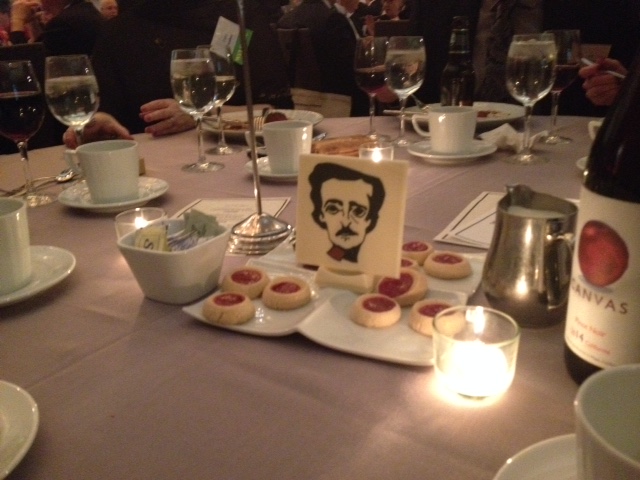
If you didn’t hear, the winners were announced last week. But the banquet — that grand black-tie atta-boy-atta-girl affair — it was cancelled, of course. The Edgars are always a fun time for me because I am the banquet chair and I love my gig. I edit the program book, which means working with great writers who contribute essays. (Who else can say they have edited Stephen King, Sara Paretsky, Walter Mosley, Robert Block, Michael Connelly to name-drop just a few). I produce the Powerpoint that displays the nominees as their names are announced, and it’s really cool seeing your cover on a forty-foot screen in the ballroom of the Grand Hyatt while 450 people applaud.

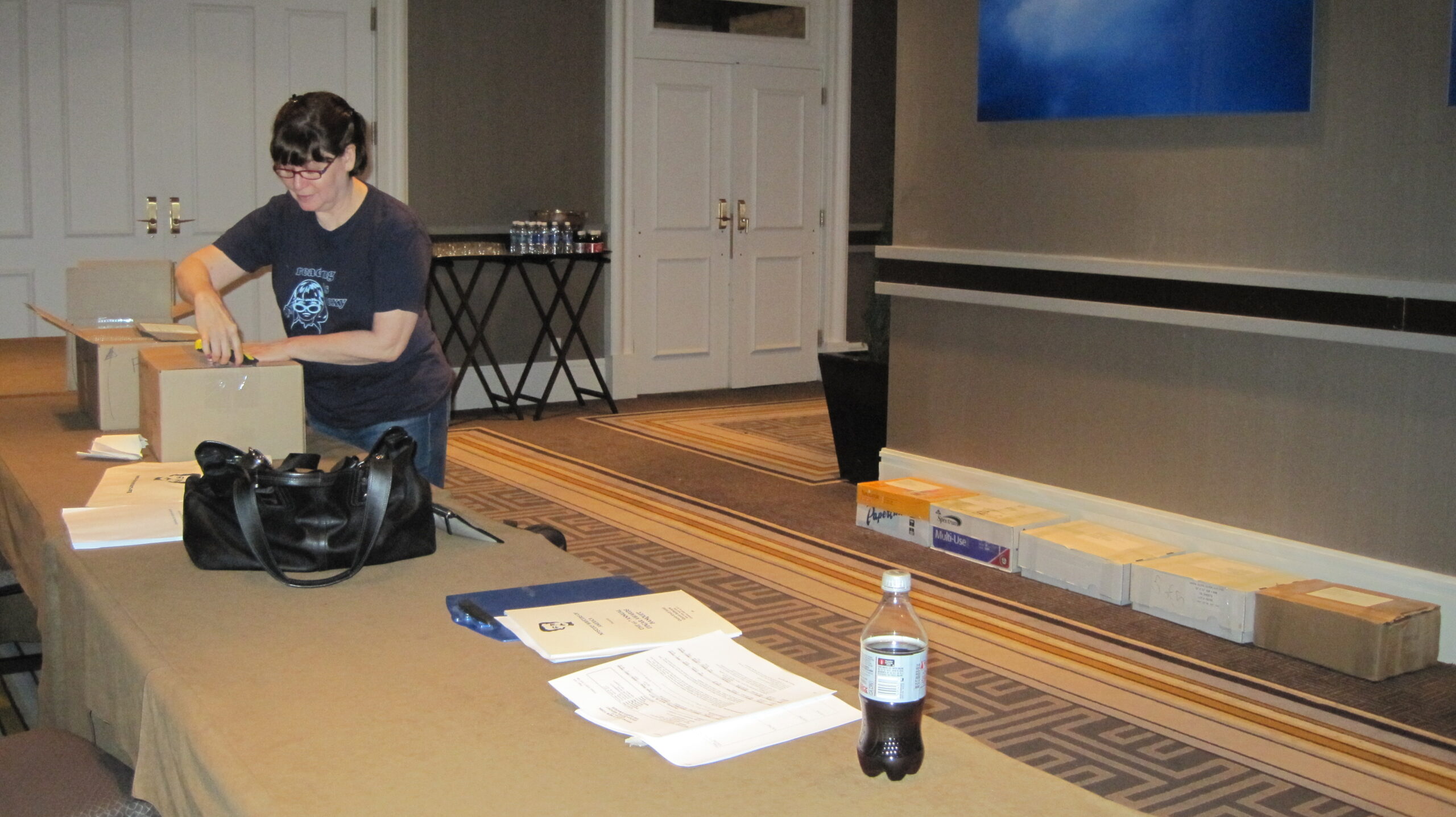
Margery hard at work setting up banquet.

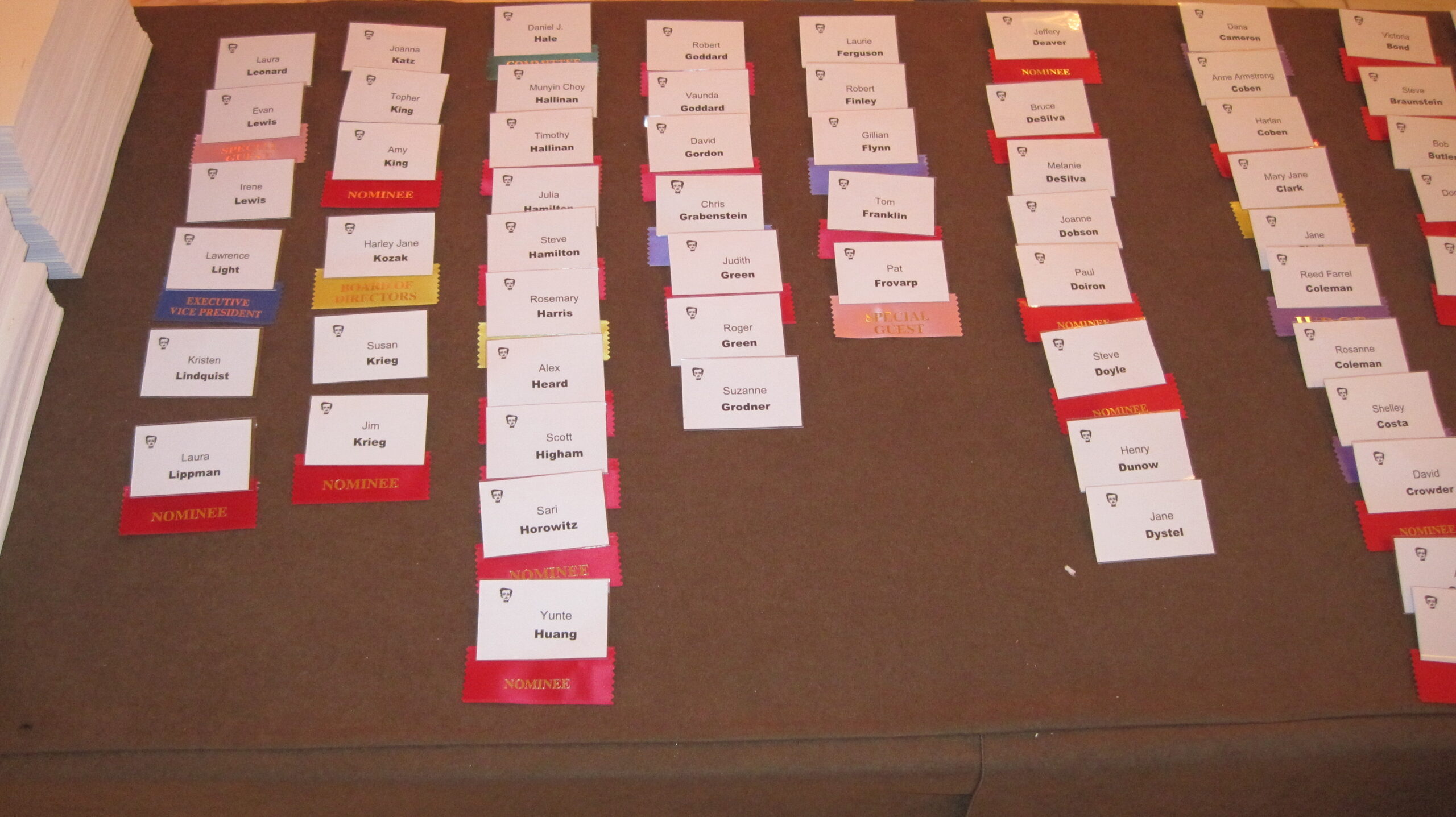
Second, I help MWA’s Executive Director Margery Flax, who is the real force behind all things Edgar, prepare the ballroom, which entails setting out registration tables and name tags, testing the sound systems and unpacking the Edgar awards. (Margery puts tape on the nameplates so, no, I don’t know who wins ahead of time).

Once things are set up, I grab a quick shower, slap on some makeup, dress and heels and head down to man the nominee check in.  I love this part. Some writers are old hands at this but most sidle up to the table and politely ask, “Is this where I’m supposed to be?” It feels great to hand them their ribboned badge and shepherd them to the nominee champagne reception.  When everyone’s checked in, I get to go in and mingle. I am not shy about asking for fan pictures.

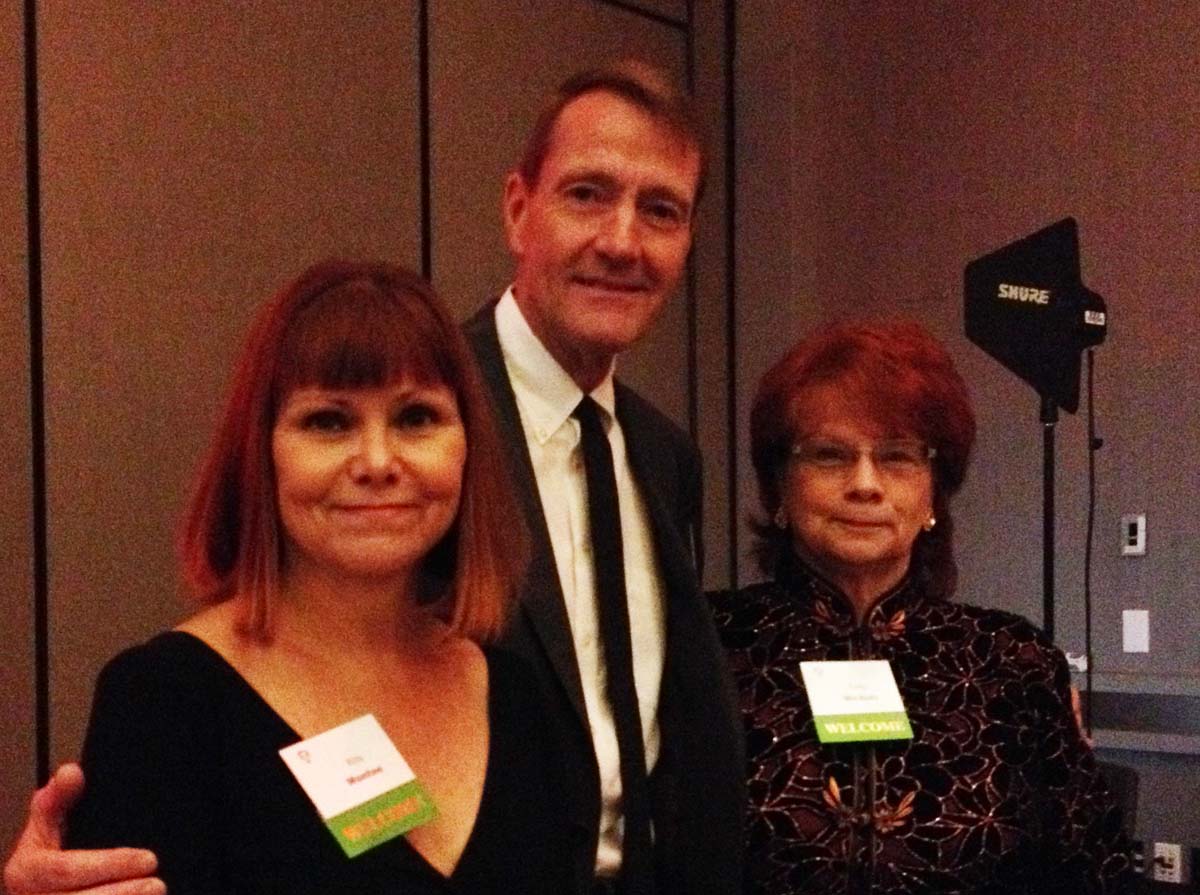
Kelly and me with some British guy who was hanging around.

Although I’ve been doing this for more than a decade, I still get nervous that things could go wrong. They have. Dave Barry screwed up and tried to introduce Grand Master Stephen King when it was supposed to be Don Westlake’s job. We had to wave King away and get Westlake on stage, whose first words where, “What am I? Chopped Liver?” And there was the time one of the porcelain Edgar heads arrived in two broken parts but Sandra Brown didn’t miss a beat and said, “And both pieces of the Edgar go to…”

I get  to go to New York, see old writer friends, enjoy the giddiness of the winners. The food is pretty good for hotel fare.

So, how do you hold an Edgar Awards in our times of social distancing? It wasn’t easy. Margery led a great team who live streamed the event as the awards were announced. You can find the winner’s lovely acceptance speeches on YouTube if you type in Edgars 2020.

My sister Kelly, who produces the videos every year, put together a touching tribute to Mary Higgins Clark. Click here to see it.

We are in the process of putting together a special edition program book that will be mailed out to nominees, winners and MWA members.

The only thing missing was…us. I missed the human touch. I missed seeing friends. I missed seeing the faces of the nominees. I missed hearing the tribute to this year’s Grand Master Barbara Neely. I missed hearing the winners’ speeches. I didn’t miss the high heels.

We’ll all be back with each other next year. For now, go here to read the Edgar Award nominees and winners. Buy their books. Then, get busy on writing your own. I am going to try very hard to do that.


Don’t Forget the Mask

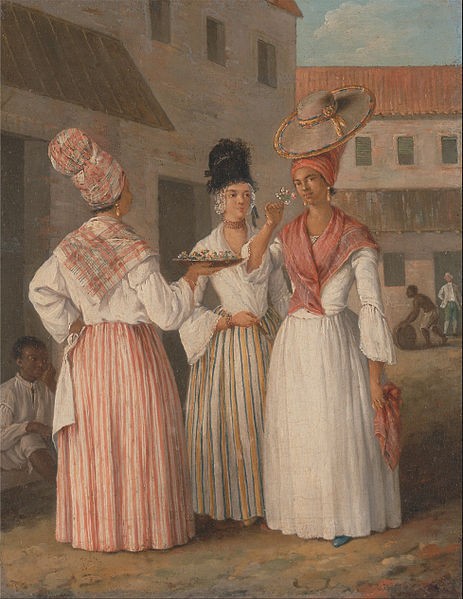
Brunias, Agostino, A West Indian Flower Girl and Two Other Free Women of Color, 1769, Public Domain

You may be familiar with the tignon laws which were applied to free women of color in Louisiana in the late eighteenth century. A “tignon” is a scarf worn to cover the hair. The purposes of the laws were 1) to infer that the women to whom they were applied belonged to the slave class and 2) to make the women unattractive to white men. 

What the women who were selectively targeted by the law did was ingenious. They observed the letter of the law by wearing scarves, but arranged them in elaborate patterns and accessorized them with jewels, beads, and feathers, among other things. The tignon laws were abolished after the United States purchased Louisiana, but the style continued. You can still encounter proponents of the fashion — primarily women of Creole descent — in present-day New Orleans.

The evolution of the tignon laws is an interesting research topic but is a little off the track of my visit today. I suggest that you do a deep research dive into the topic on your own. You won’t be sorry. My purpose for mentioning them, however, is that we are seeing somewhat the same thing — in practice though not purpose — occurring with government-mandated face coverings. While the majority of folks around me (and my age group) seem to be eschewing fashion for the familiar white or generic medical mask look, others are taking it a step or three further, utilizing designs, colors, and the like when they go stepping down Aisle 4 of the local supermarket. What started as a safety precaution has become a fashion statement. Some companies have begun selling entire outfits that coordinate with a face covering. Or is it vice versa? You can see some examples of this here, and they are interesting, to say the least. 

My purpose in mentioning this during our regularly scheduled Saturday morning visit is aimed at those of you who find writing fodder within our current collective experience.  If you are working on your dystopian novel using the coronavirus pandemic as a backdrop (as Mark Alpert encouraged you to do in his “Turning Crisis into Fiction” post last week) you might want to utilize the prevalence of masks or facial coverings as a plot element, particularly if you want to straddle genres and insert a crime of some sort into the proceedings. You need only peruse your local newspaper to discover that crimes of all sorts are still occurring in spite of or perhaps because of the secondary effects of the pandemic.

A mask as a general rule is an instrument of concealment. In the now, when most people in public places are wearing face coverings either by decree or due to being “strongly encouraged” to do so. This is fine as far as people with good intentions are concerned, but it gives the wolf in your story an opportunity to stalk unnoticed among the sheep since he is “dressed” pretty much like anyone else.  A mask can also distract, however, particularly if it is accessorized or otherwise made different from those worn by others in the immediate vicinity. Witnesses to crimes tend to remember, to the exclusion of much (if not most, or all) else, a mask, particularly a distinctive or memorable one. A mask or face covering can also with a bit of planning be quickly removed, disposed of, or changed to another more generic type to confuse things further, should such be advisable.   There is also a romantic and/or erotic element that the anonymity of a mask can occasionally spark. Ask anyone who has been to Mardi Gras or a costume party. 

It is a small detail, but conflagrations can result from tiny flames. I hope that your creative one burns long and bright as you hopefully take advantage of the free time created by the current impromptu gardening leave.

Enjoy and be well.


Reader Friday: BOSCH

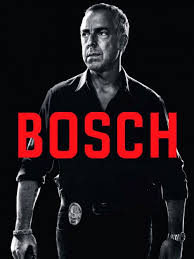
Photo credit: tvguide.com

We recently finished binging Season 6 of BOSCH. After so many seasons, Titus Welliver is Harry Bosch in my mind, even though the fictional Harry isn’t covered in ink. Somehow, the tattoos work for the character. BTW, did you know they’re real?

If Hollywood called to turn your latest novel into a series or movie, who would you want to play lead? Give us a little context to understand your choice.

If Titus Welliver never played Harry Bosch, who would you want to step into that role?

Focusing on the Writing

Focusing on the Writing
by Terry Odell

Focus on the Writing

Image by Pexels from Pixabay

I was supposed to be on a photo tour in Croatia today, but that’s been put on hold, so let’s talk about dealing with writing routines in times of distraction.

I’ve talked to a lot of people about how they’re having trouble focusing on their writing. Distractions abound, and the writing gets set aside. Guilt sets in.

It’s okay to be distracted, to flounder about. Writing less is acceptable. For me, I find the following techniques helpful. I’ve used them when coming back from vacations, when it takes a while to find my writing groove, and they work as well for me in these crazy times.

Get rid of chores that will nag.
If you are going to worry about cleaning house, paying bills, going through email, take the time to get the critical things dealt with. Otherwise you’re not going to be focused on your writing. If you’re a ‘write first’ person, don’t open anything other than your word processing program.

Do critiques for my crit group.
This might seem counterproductive, but freeing your brain from your own plot issues and looking at someone else’s writing can help get your brain into thinking about the craft itself.

Work on other ‘writing’ chores.
For me, it can be blog posts, or forum participation. Just take it easy on social media time.

Deal with critique group feedback.
Normally, I’m many chapters ahead of my subs to my crit group. If I start with their feedback on earlier chapters, I get back into the story, but more critically than if I simply read the chapters. And they might point out plot holes that need to be dealt with. Fixing these issues helps bring me up to speed on where I’ve been. It also gets me back into the heads of my characters.

Read the last chapter/scene you wrote.
Do basic edits, looking for overused words, typos, continuity errors. This is another way to start thinking “writerly” and it’s giving you that running start for picking up where you left off.

Consult any plot notes.
For me, it’s my idea board, since I don’t outline. I jot things down on sticky notes and slap them onto a foam core board. Filling in details in earlier chapters also helps immerse you in the book.

Figure out the plot points for the next scene.
Once you know what has to happen, based on the previous step, you have a starting point.

Write.
And don’t worry if things don’t flow immediately. Get something on the page. Fix it later.

What about you? Any tips and tricks you’ve found when outside world distractions keep you from focusing?

And one more thing. On Friday, May 1st, you have a chance to Ask Me Anything. I’ll be on a Draft2Digital Spotlight podcast talking with Mark Leslie Lefevbre. It’ll be broadcast on YouTube and Facebook. You can bookmark the links and you might be able to set up a reminder.
Time: 10 Pacific, 11 Mountain, 12 Central, Noon Eastern. It’ll be my first video appearance. Yikes!  The program is 45 minutes long, with the last 15 minutes for Q&A. I hope to meet you there.


Terry Odell is an award-winning author of Mystery and Romantic Suspense, although she prefers to think of them all as “Mysteries with Relationships.” Follow her on Facebook and Twitter.

My Brief Life and Tragic Death – First Page Critique  

 By Debbie Burke

@burke_writer


Photo credit: Wikimedia Commons

Please welcome another Brave Author who’s submitted a first page for a story entitled:

My Brief Life and Tragic Death

Chapter 1. Purple Pumpkins

I met Frank and survived an assassination attempt between lunch and teatime.

I suppose it started with the whistling. I had the palace library all to myself, as usual. The hush was shattered when a boy walked in, whistling. He caught sight of me and approached. It’s hard to smirk and whistle at the same time, but he managed it. When he reached my table, he stopped whistling and stood smiling at me. It was a good smile. It invited me to smile back, which I didn’t, of course.

He was a handsome boy of about thirteen, a year older than myself, with a haircut from the California side of the gateway. I liked him at once, which annoyed me. I didn’t get along with my fellow children.

His smile and likability made me uncomfortable. I gave him a cold stare. “This is a library, you know.”

He looked around in pretended astonishment.

I added, “You can tell from all the books? At least, I hope you can.”

“I’ll take your word for it. Hey, maybe you can help me. I’m looking for a sweet little girl named Flavia.”

I placed a bookmark and closed my book. “Are you being irritating on purpose?”

“Of course I am. How about you?”

I was taken aback. “Why?”

“Look, babe, do you know where Flavia is or not?”

“I’m Princess Flavia.”

“Then your portraits don’t do you justice. I like the freckles especially. A freckle is a beacon of honesty in a mendacious world. Allow me to introduce myself. Frank Barron, at your service.” He stuck out his hand.

If you ignored his actual words, he was wonderfully well-spoken, especially for his age. He had that command of language which only an intelligent person who reads a great many books develops, but without the stiff delivery of someone like me, for whom books are their only friends. I was a bit regretful when I said, “Princesses don’t shake hands.”

“Oh, that’s all right. I’m not a princess.”

I rolled my eyes. “But I am.”

~~~

First impressions:

Let’s start with the title: My Brief Life and Tragic Death.

It implies the first-person narrator, 12-year-old Princess Flavia, is apparently already dead. Is this fantasy? Magic realism? Is it similar to Alice Sebold’s The Lovely Bones, told by a murdered teenager watching her family deal with the repercussions of her death?

I’m not sure what’s happening but I’m intrigued.

The first line drops a provocative bomb about an assassination attempt. That definitely qualifies as a disturbance in anyone’s life. But the tone struck me as too casual and matter-of-fact. I can’t imagine a 12-year-old girl, even a self-possessed princess, being this blasé about someone trying to kill her.

Next, the scene flips back to earlier that day. Flavia is alone in the palace library when her reading is interrupted by the entrance of a whistling boy who’s looking for her. This also qualifies as a disturbance, although on a much smaller scale than an assassination attempt.

Foreshadowing and disturbances, major and minor, kick off a good start, enticing the reader into the plot. Nice job, Brave Author.

Setting and Time:

The mention of teatime suggests the locale is the British Isles, so a haircut from the California side of the gateway sounds exotic and faraway to the cloistered Flavia. Although the haircut and the gateway aren’t clearly defined yet, that’s okay. Longer descriptions could bog down the forward momentum at this point. I’m willing to wait for more explanation.

The time period isn’t defined. Physical books in a library could be contemporary but might also indicate a past before digital books. Again, I’m willing to wait to find out.

Characterizations:

Right away, Flavia’s character interests me. She sounds much older than her age. She’s alienated from people and may be lonely but won’t admit it: I didn’t get along with my fellow children.

She doesn’t react in predictable ways: His smile and likability made me uncomfortable.

And she’s irritated by her reactions, as if she can’t control her own mind: I liked him at once, which annoyed me.

The author raises questions: Why does Flavia react like this? Why does she expect herself to be detached from normal human emotions? As a princess, is she pressured to behave a certain way? Does she secretly want to rebel against those conventions?

Flavia is a character in conflict with herself. Already she’s presented enough complicated psychology to make a reader want to learn more about her. Well done.

Her observation of Frank is not superficial. Like a normal adolescent girl, she notices he is handsome but she also digs deeper, probing into his character.

Frank is brash, cocky, yet charming. She’s interested but, for some unknown reason, can’t allow herself to like him.

Brave author, in a very few lines, you’ve skillfully painted a picture not only of Frank’s appearance but also his personality. 

Flavia quickly sets Frank straight that she is a princess who won’t tolerate being called “babe.” Frank isn’t at all fazed by being put in his place and goes on to eloquently charm her, while at the same time giving readers a quick sketch of what Flavia looks like: Then your portraits don’t do you justice. I like the freckles especially. A freckle is a beacon of honesty in a mendacious world. 

In first person, it’s difficult to find effective ways for a character to describe herself without resorting to cliches like looking in a mirror. This was a nice blending of dialogue and description that didn’t sound forced. 

Voice:

The humor works well. The banter between aloof Flavia and smartass Frank is entertaining. They keep trying to one-up each other, competing over who gets the last word. That creates ongoing tension between them. The reader wants to find out who wins the verbal jousting.

The author also nicely juxtaposes that humor with Flavia’s wistful longing for connection with another human.

The following is my favorite sentence:

He had that command of language which only an intelligent person who reads a great many books develops, but without the stiff delivery of someone like me, for whom books are their only friends.

That really pins down both personalities and poignantly conveys Flavia’s loneliness.

Audience:

Flavia’s age indicates the target audience may be Young Adult. Overall, I like her voice, even though she sounds much more mature than an average 12-year-old. I know intelligent, articulate, well-read kids like her so she comes across as unusual but still realistic.

Line editing:

What if you rearrange the order of the first sentence like this?

Between lunch and teatime, I met Frank Barron and survived an assassination attempt.

Switching the assassination attempt to the end of the sentence creates a more dramatic punchline. 

Another thought about the first line: it could come off as a gimmicky ploy unless the author delivers a payoff within a few pages.

Is Frank the savior who thwarts the attempt on her life? That creates a compelling reason for an ongoing relationship between them.

Or is he the would-be assassin?

Because Flavia already knows what happens (even though the reader doesn’t), she could foreshadow a little more.To raise tension, perhaps she wonders how he got past security into the palace library.

The phrase If you ignored his actual words confused me.

Here’s what Frank says: “Then your portraits don’t do you justice. I like the freckles especially. A freckle is a beacon of honesty in a mendacious world. Allow me to introduce myself. Frank Barron, at your service.”

His “actual words” show a sophisticated command of language so I don’t understand why Flavia talks about ignoring them. Maybe delete the phrase: If you ignored his actual words, 

~~~

Overall, this first page works well. The characters are likable, multi-dimensional, and complex. There’s conflict, tension, and suspense.

Additionally, the author proof-read and submitted a clean page without typos, misspellings, or grammatical errors.

YA, fantasy, and magic realism are not genres I’m terribly familiar with. But the Brave Author did a good job of pulling me into this intriguing submission. Thank you for sharing it!

~~~

TKZers: What do you think of Flavia and Frank? Are you interested in the premise? Any suggestions for our Brave Author?

First Page Critique: Manuel’s Revenge

Happy Monday! (even though it’s starting to feel like everyday is like Sunday…)
Today I have a first page critique which illustrates the challenges in grounding a reader right from the start. My comments, and recommendations follow.  I also look forward to getting you input for our brave submitter after this first page submission.
Manuel’s Revenge

They wouldn’t understand, especially the little ones.

“Daddy’s gone to heaven,” she would say. They would cry and grieve and she would find someone else.

When he opened the door, the apartment smelled of greasy chicken and diapers. Earlier in the evening he told her he’d be at Jerry’s Bar and Grill. Julie was furious, of course, so she and the kids had gone to visit her sister for a few days. He and his wife had exchanged harsh words, but Manuel felt relief. She and the kids wouldn’t be home. They wouldn’t see the carnage.

The scotch having fixed his resolve, Manuel made the call.

As his eyes adjusted to the dark, he crossed the frayed carpet, opened the closet door and removed a plank near the back wall. He hadn’t used the weapon in years, a nine millimeter Smith and Wesson that felt strangely familiar. From years on the streets he knew how to use the gun, but only killed when necessary, always in self defense, never for pleasure—unlike the monster who murdered his brother.

After prison, Manuel truly believed he could change, but his mind never stopped playing that endless loop. His brother’s face—the pleading, the tears, the anguish—would never disappear. Graven into his memory like etchings on a gravestone was the leering face of the thug who pulled the trigger.

Tonight that man would die, and Manuel would die with him.

Replacing the plank, Manuel eased along the wall to observe the rendezvous point from his perch three stories up. On the street below, his brother’s killer would step into the alley expecting an easy exchange. Bills for baggies. No problem.

But when Manuel looked down on the scene, his fists tightened around the pistol. Cops were erecting a barrier and a tarp-covered body lay in the middle of the alley.

A crime scene.

Two uniforms conversed under a streetlight. The lights of a patrol vehicle rotated across the dark bricks of nearby tenements.  In the shadows something moved, something barely perceptible. Even from this distance, the thick man in the sideways baseball cap shifted easily from light to darkness, watching.

Then into the shadows the thug disappeared. The meeting would be aborted. The man who killed his brother would flee. Then, as it had so many nights before, Manuel’s cowardice would seize his thoughts and haunt another sleepless night.

Main Comments

This first page had some good things going for it, right from the get go. It was written in clear, direct prose, and was immediately personal. The reader could easily grasp that the stakes, at least for the main protagonist, were going to be high and that this story was going to be about avenging the murder of the protagonist’s brother. That helped create some nice tension right from the start, but for me, this first page suffered from a lack of specificity and grounding, that made the story, even though it was going to be high stakes and personal, feel almost generic.

In terms of lack of specificity, I wanted more detail about the main protagonist to set him apart. I wanted to be able to picture him, get a hint of intrigue (why had he been in prison for example?) and to hear a more realistic internal dialogue that made him feel like a real person – one I immediately felt sympathy for, and whose story created the kind of dramatic tension that could sustain a novel.

In terms of grounding, I wanted more details to be able to picture the apartment and the building – especially as it seemed such an easy vantage point from which he could have killed the ‘thug’ in the past (had he tried before? – this wasn’t clear).

Specific Comments/Feedback

Having mused over the best way to provide constructive feedback regarding this first page, I decided that providing further comments/notes in bullet form as I read the first page was probably the most useful. So here goes:

  • First line – ‘They wouldn’t understand, especially the little ones’ had me intrigued. But then, just as I was thinking about the children (and we never find out how many or their names, or ages), the comment ‘they would cry and grieve and she would find someone else’ suddenly seemed cold and rather flippant. I wanted to know more about his relationship with his children and their mother (who was, I assumed his wife) but was a little put off already.
  • We get a brief description of the apartment but nothing more. I wanted to be able to visualize the place, and feel grounded in the surroundings. Where are we? What is the socio-economic background of this family? (they sound poor but then he drinks scotch in the next paragraph which doesn’t seem consistent with this initial impression). I’m assuming Julie is his wife but why had they exchanged harsh words – was it because he was always at Jerry’s Bar and Grill (and here, the name is specific but seems unnecessary since I have no other information or context regarding all the other surroundings). Also ‘carnage’ is a very strong word and it makes me think of a large scale, mass killing.
  • Now Manuel makes the call – but I’m not sure what this means as we haven’t got the backstory or context yet – but I’m willing to go with it.
  • Then we have a paragraph about him getting his weapon out and again, we get specifics about it (9 millimeter Smith & Weston) but few specifics about his past. He always killed in self-defense? Why? How did he know the monster who murdered his brother killed for pleasure? I need more here to be invested in this story.
  • ‘After prison’ – again, we get a hint of a past/backstory but no details, except about his brother (who, as yet, remains nameless). The line ‘graven into his memory…” would work better if I had more details so I could really visualize the scene.
  • ‘Tonight that man would die, and Manuel would die with him’ – Why, if he’s shooting the man from the vantage point of a window three stories up, would Manuel have to die? This didn’t quite make sense without more context and information on what Manuel was planning. It sounds like he wasn’t going to be the one going to make the exchange below (as he is upstairs) but how is the exchange supposed to work exactly (?) – and how did Manuel know all this (had he set it up? I couldn’t tell by the end if he had, or if these kind of exchanges were just a frequent occurrence in the alley and Manuel had finally got the courage to try and kill the ‘thug’ this time (?) (again, this reveals lack of grounding and specificity to me).
  • Now, when Manuel looks down on the scene he sees cops…but didn’t he hear sirens or see the flashing lights as he walked across the dark room towards the closet in the previous paragraph?
  • So it’s a crime scene, but we have no context for it – and now a man is watching from the shadows but the police are clueless(?) There’s a reference to nearby tenements but again I can’t picture the scene, as I haven’t got any description or point of reference for where we are.
  • The final paragraph has the ‘thug’ disappear (which seems too easy given the police presence), and ‘then, as it had so many nights before, Manuel’s cowardice would seize his thoughts and haunt another sleepless night’. I really liked this last line, but it still confused me as I don’t have context for his previous attempts or the past that links him to the thug and the circumstances surrounding his brother’s murder.

As all these comments reveal, this first page really needs more specific details and a clear description of place, backstory, and characters to come to life for me, and to create the tension needed for me to turn the page and keep reading. That being said, the scene itself is a compelling one – a man risking everything to avenge his brother’s death – and our brave submitter no doubt knows all the details that could easily be added to bring color and tension to this story. Overall, most of my comments/recommendations are a relatively easy fix and I think once we get the specificity and grounding we need as readers, this first page could be the start of a something good.

So, TKZers, what comments or feedback do you have for our brave submitter?


True Crime Thursday – Crazy but True Laws


By Debbie Burke

@burke_writer

Criminal Kissing
Photo credit: Vera Arsic – Pexels

In Elko County, Nevada, the law requires people to wear a mask at all times.

Since Covid 19, many cities and counties have enacted similar ordinances requiring masks so what’s strange about that?

Elko County’s law has been in effect for a century. It was passed at the time of the Great Influenza Pandemic in 1918-1919. No one got around to repealing it so it’s remained on the books all these years.

As of April 13, 2020, the Elko City Council considered passing a new ordinance requiring employees of businesses to wear masks and gloves. Maybe if they dust off old records, they’ll find they’ve already had such a law…for the past hundred years!

While they’re at it, legislators should consider repealing a late 19th century law in Eureka, Nevada, that prohibits a man with a mustache from kissing a woman. The lawbreaker in the above photo is reportedly still at large, armed and dangerous. 


Photo credit: Wikimedia Commons

Since 1961, it’s been illegal in Gainesville, Georgia to eat fried chicken with a fork—only hands are permitted. That law actually makes a lot of sense because it’s “finger-lickin’ good.”


In Florida, it’s illegal for a man to wear a strapless dress in public—no mention of other dress styles. It’s also illegal to sing in public while wearing a bikini or bathing suit.

A widely-circulated urban myth is that Florida bans sex with porcupines. Actually Florida’s 2011 law prohibits sexual relations with any animal, not singling out porcupines. However, a couple of Russian tourists decided to challenge that law…with predictable results.

Also in Florida, you cannot legally ride a skateboard without a license.

Photo credit: Wikimedia Commons


Speaking of skateboards, on April 16, 2020 in Los Angeles, a front-end loader filled the Venice Skatepark with beach sand to prevent Covid 19. Hmmm.


Photo credit: Pexels


My home state of Montana has its share of unusual laws. For instance, it’s illegal to drive with a sheep in the cab of your truck unless you have a chaperone.


TKZers – What crazy but true laws does your state have? What is the weirdest law you’ve heard of?

The Hardest Writing I’ve Ever Done

By John Gilstrap

Allow me to share the first paragraph of an email I received yesterday from my editor regarding my new book, Crimson Phoenix (March, 2021): “I finished the ms at 1 am.  What a page-turner. It sure was eerie reading about a post-nuclear apocalypse while being held hostage by a global pandemic.”

Tell me about it.

Over a year ago, I signed a two-book contract to create a new thriller series.  This one features Victoria Emerson, a member of the House of Representatives, whose world is turned upside down when U.S. Army Major Joseph McCrea shows up on her doorstep one night and announces that CRIMSON PHOENIX is active.  That means the USA is inches away from nuclear war.  McCrea is there to evacuate Victoria to the United States Government Relocation Center, a bunker in the mountains of West Virginia that is meant to house the entire legislative branch in the event of Armageddon.  She cannot bring her family.

A single mother, Victoria refuses to abandon her three teenage sons. Denied entry to the bunker, they nonetheless survive the nuclear onslaught that devastates the country. The land is nearly uninhabitable. Electronics have been rendered useless. Food is scarce. Millions of scared and ailing people await aid from a government that is unable to regroup, much less organize a rescue from the chaos.

With Major McCrea’s help, Victoria devotes herself to reestablishing order—only to encounter the harsh realities required of a leader dealing with the violence wrought by desperate people . . .

I think the book turned out great, but never have I struggled so hard to put words on paper.  When I pitched the book back in 2019, the economy was booming, people were happy and the idea of citizens reverting to their feral instincts seemed like a fun diversion.  Over the last two months, writing from quarantine, every fictional act of self-preservation and confrontation I wrote felt all too possible–especially in the early days of the madness when the panic was most vibrant and threatening.

Early on in the pandemic–facing an immovable April 15 deadline with 30,000 words to go–it felt as if my imagination had been switched off.  Writing about the collapse of infrastructure and the moral relativism that it triggers really troubled me.  I am not a man prone to pessimism or depression, but for that first week or more, there seemed to be no light in any day.  To make it all worse, even the weather conspired against me in those early weeks, when every morning, it seemed, dawned cold and cloudy.

Then I wrote a bit of dialogue that allowed light back in.  In a discussion with McCrea, who’s worried that Victoria’s children won’t be tough enough for what lies ahead, Victoria says, “Just because every bit of infrastructure is broken, and just because people become desperate is no reason to dismiss kindness and understanding as some kind of a curse. Kindness is a blessing, not a liability.”

I don’t know if this makes sense out of context, but that bit came out of nowhere, and it changed not just the arc of the story, but it lifted my mood.  Victoria and her crew are the lucky ones.  They’ve survived the destruction that killed millions.  From that moment on, Crimson Phoenix ceased being about how they would survive, but rather about how they can help to fix some of what has been broken.  How to work to help make people less miserable.

Forgive me if I am rambling, but I’ve never before experienced the phenomenon of my work lifting my spirit in such a direct manner.  I am not a victim of this pandemic, nor am I a survivor.  I am an author with a job to do who’s living in strange, difficult times.  None of us knows what tomorrow might bring, but I know that today I am healthy.  I started celebrating the weird repetitiveness of each day.  For the first time in a very long time, my wife and I cook every meal together and eat it together at home.  In the evenings, we sit together and binge-watch Netflix and Amazon Prime.  Then we go to bed, get up and do it all over again.  I realize now that when this awfulness lifts, I’m going to miss the relative ease of these days.

As for the book, the words started flowing.  Think fire hydrant–easily ten pages a day.  I had a new focus, and now knowing what the book is really about, I created a story that was substantively different–and, I believe, far better–than the one I set out to write.  It’s not about victimhood, it’s about leadership.  It’s about triumphing over adversity. It’s still very much a thriller, and I think it may very well be the best thing I’ve ever written.  Of course, mine is the least important opinion on that last point.

Have y’all ever had your fiction make a profound impact on you like this?

==

On an unrelated note, I’ve added another video to my YouTube channel.  This one talks about what to look for in a publisher. Just click on the picture.