About Debbie Burke

Debbie writes the Tawny Lindholm series, Montana thrillers infused with psychological suspense. Her books have won the Kindle Scout contest, the Zebulon Award, and were finalists for the Eric Hoffer Book Award and BestThrillers.com. Her articles received journalism awards in international publications. She is a founding member of Authors of the Flathead and helps to plan the annual Flathead River Writers Conference in Kalispell, Montana. Her greatest joy is mentoring young writers. http://www.debbieburkewriter.com

True Crime Thursday – COVID 19 Scams

Photo credit: Mika Baumeister – unsplash

By Debbie Burke

@burke_twitter

The pandemic has provided new opportunities to enrich scammers. For today’s True Crime Thursday, I’m highlighting two popular schemes that thieves developed to profit from COVID 19.

First scheme: Economic Impact Payments. 

Your phone rings and caller ID says it’s the IRS.

Gulp! Your heart speeds up.

The caller claims to be an IRS agent. He or she sounds authoritative and convincing, offering a name (fake) and ID badge number (also fake). They may even already know some personal information about you.

They claim you owe the IRS money and demand you make immediate payment.

But, being compassionate, understanding folks, they offer several options they’ll accept for payment–such as a pre-paid debit card or wire transfer…

Or

You can sign over your economic stimulus payment check and send it to them, endorsing it as “payment for past debts.”

If you don’t comply, the formerly compassionate, understanding caller becomes aggressive and threatens you with arrest.

Variation: They claim you’re owed a refund but they need personal information before they send it to you.

Reality: Scammers can easily spoof the supposed IRS number. They often impersonate IRS agents, law enforcement, or other officials to intimidate their targeted victim. 

The IRS may call you but their first contact is generally by mail.

They do not demand payment by pre-paid debit cards. They do not request credit or debit card numbers over the phone.

If the caller becomes abusive, the IRS advises you to hang up immediately.

Variation: phishing by email or text – You receive an email, text, or message through social media, claiming to be from the IRS. The sender address appears similar to IRS.gov but may be IRSgov (no dot).

It claims you need to update your information or that you’re owed a refund. It instructs you to click on a link that takes you to an official-appearing IRS site. There, you are prompted to enter personal information like Social Security number, bank accounts, PINs, etc.

Reality: The IRS will never contact you by text or social media. They do however use email to contact you. Always study the sender’s address carefully.

If you click on a phony link and answer the questions, thieves have your personal information. They can then file fraudulent tax returns to obtain refunds.

Even worse, clicking on the link may install malware that gives criminals access to your computer where they can steal sensitive information like passwords.

If you have doubts that a call or email is legitimate, the IRS advises you contact them directly through the IRS.gov website.

Here’s a link to IRS scam warnings: https://www.irs.gov/compliance/criminal-investigation/irs-warns-about-covid-19-economic-impact-payment-fraud

Another wrinkle in economic stimulus payments is causing confusion. Your second payment may come in a different form than your first payment did.

The first payment may have been direct-deposited into your bank account or you might have received a check from U.S. Treasury.

But the second payment may arrive by mail as a VISA debit card. Because the envelope does not look like the typical IRS check, many people think it’s advertising or a solicitation and toss it.

Here’s what it looks like (click to enlarge):

The return address on the envelope has a Dept. of Treasury logo and says Economic Impact Payment Card from a P.O. Box in Omaha, NE.

Even though it looks peculiar, the VISA card is valid. 

~~~

Second scheme: Vaccine scams

You receive a phone call from the Social Security Administration or Pfizer, the drug company manufacturing COVID 19 vaccines.

At least that’s what Caller ID says.

The caller invites you to sign up to receive the vaccine.You only need to give them your Social Security number, Medicare number, bank account, and credit card information.

Further, the caller claims you can be placed higher on the priority list to receive the vaccine if you pay a fee.

Reality: According to attorney Steve Weisman in a recent Saturday Evening Post article

“The truth is that the Social Security Administration is not calling anyone about getting the vaccine, and no one is being asked to pay a fee to be put on a priority list to receive the vaccine. This is just a scam to get your personal information and use it to make you a victim of identity theft.”

Vaccine scammers also employ email messages and texts, like those described above by the IRS, to trick the recipient into clicking on malicious links.

~~~

Yes, in fact, there is a special list that gives preferential attention to seniors. Unfortunately, it’s the Scammers’ Roster of Favorite Prey.

Please watch out for vulnerable friends and family who might be on that most-favored list.

~~~

TKZers: Have you been contacted by someone impersonating the IRS, Social Security Administration, or a drug manufacturer?

Do you know anyone who’s been defrauded by COVID 19 scams? Please share that experience.

~~~


Debbie Burke’s new thriller Flight to Forever features a pair of plucky senior outlaws on the lam. Please check out the book here.


In Praise of Experts

Photo credit: Luke Jones, Unsplash

By Debbie Burke

@burke_writer

In fiction, you often walk into different worlds. Perhaps you speak a few words of the language but you’re not fluent. You have a general idea of the architecture and geographic layout. But there are secret passageways in which you can become lost and unseen chasms into which you can tumble.

But you’re committed. You must go forward on your story quest. So, you seek out natives from those worlds to guide you. 

Today, I’d like to introduce you to several insiders who shepherded me through unfamiliar terrain in my new thriller, Flight to Forever, which launches today. 

The story takes place in the rugged mountains of the Bob Marshall Wilderness in Montana. I’ve hiked and explored the area but am far from a hardcore outdoorswoman. I needed to call upon experts in various fields to fill in the gritty details.

Here’s an overview of Flight to Forever:

Main characters: investigator Tawny Lindholm and her husband, criminal defense attorney Tillman Rosenbaum.

Inciting incident: When the pandemic prevents a Vietnam veteran from seeing his wife of 50 years in a memory care lock-down, he busts her out. Because an off-duty cop is injured during their escape, law enforcement is hellbent on capturing the aging fugitives.

The couple flees into the mountains where they’ve gone camping for years. Their daughter begs Tawny and Tillman to help her parents. The determined veteran won’t go down without a fight, increasing the urgency for Tawny to find them before the cops do.

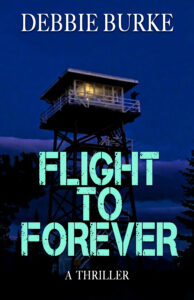
Setting: The fugitives choose an abandoned fire tower as their hideout.

In bygone days, fire spotters spent summers in isolation living on mountain summits in small wooden cottages built on high stilts.

When lightning sparked forest fires, the spotters used a mechanical device called a fire finder to pin down the exact map coordinates. Then they called in the report and crews were dispatched to fight the fires.

Satellites and advanced technology have now rendered the towers obsolete. A handful are preserved and have been renovated into vacation rentals. For $50/night, adventurous campers pack in supplies and stay in a lookout with staggering views from on top of the planet. Most lookouts have fallen into disrepair or been destroyed by fire.

One of those abandoned towers becomes the hideout for my fugitives.

My guide into that remote world is retired Forest Service employee Kjell Petersen, a former fire spotter.  He now volunteers to maintain the few surviving lookouts. Kjell is also a gifted photographer who’s snapped thousands of gorgeous mountain shots with wild critters and wild weather, taken during his career. He not only told me fascinating stories, he graciously offered a selection of his photos for the cover.

For hours, Kjell shared anecdotes full of details only a true insider knows. As he described being in a tower when it was struck by lightning, the hair on my arms stood up.

Kjell Petersen and friends

After the first draft of Flight to Forever was finished, Kjell reviewed it and fixed my goofs. At one point, I wrote that avalanches had destroyed many old lookouts. With a kind smile, Kjell gently corrected me. “Lookouts are built on top of mountains. There’s nothing above them. Avalanches happen below them.”

Well, duh.

Thanks for the save, Kjell!

Sue Purvis in Central Park

To research the setting, I could have slogged through grizzly territory in mud up to my artificial titanium knees.

While authenticity is important, with age comes wisdom. I know my limitations. 

Instead, I tapped another expert, Susan Purvis. She’s a geologist, search dog handler, and former search-and-rescue volunteer with more than her share of risky escapades. She also wrote the bestselling memoir, Go Find.

Sue gave me a quickie course about sedimentary limestone and sandstone cliffs. Harsh weather shears the rock off in massive slabs that crash down mountain sides. When rock crumbles into loose, unstable rubble, it’s called talus or scree, which is treacherous to hike or drive on–turning Tawny’s search into a white-knuckle adventure.

In conversation, Sue happened to mention she’d once slid her truck off an icy bridge and wound up hanging over the edge.

That anecdote was too good to pass up. I appropriated Sue’s harrowing experience to inflict on poor Tawny.

Legal eagle Phyllis Quatman

Since the male lead, Tillman, is an attorney, legal conundrums happen often. For that, I consult attorney Phyllis Quatman, who writes suspense under the name P.A. Moore.

Sometimes dodgy actions are necessary to move the plot forward even when they push my characters into gray areas of what’s legal vs. what’s moral.

Phyllis is an author as well as a lawyer. She understands the need to achieve story goals while also keeping the heroes out of serious legal trouble.

If I’m ever arrested, I know who to call.

Dr. Betty Kuffel


The unlucky folks in my thrillers get hurt a lot—drugged, beat up, knifed, shot, etc. Retired ER doctor Betty Kuffel has seen every injury known to humans. She is an encyclopedia of mayhem and murder methods. She also writes medical thrillers.

Paging Dr. Betty.

A subplot involves Tillman and his teenage son. While Tawny is busy tracking the fugitives up a mountain, Tillman must travel to the other side of the state when his boy is injured in an accident.

Betty upped the story stakes by suggesting complications that turned the son’s broken leg into a life-threatening crisis. She also infused realism with her insider knowledge of pandemic restrictions that keep frantic Tillman away from the bedside of his critically-ill son.

Sue, Phyllis, and Betty are my longtime critique partners and cherished friends. So it’s expected that we help each other.

But I’m constantly amazed at the willingness of complete strangers to assist a curious writer.

When I contact experts and introduce myself as an author doing research, they are almost always generous and helpful.

They’re eager to talk to an interested listener about their specialties. Plus, they like to be part of the creative process of writing a book.

As long as a writer is polite, respectful, and mindful of the expert’s time constraints, most pros are happy to go the extra mile to assist you.

A small gesture of appreciation is a customary courtesy. The people who help me are listed on the acknowledgement page and I always give them an inscribed copy of the book.

Today, I raise my coffee mug in a toast to the experts who helped with Flight to Forever: Kjell, Sue, Phyllis, and Betty.

~~~

TKZers: Have you consulted experts in your research?

What sort of assistance did they provide?

~~~


Today is launch day for Flight to Forever. 

Now that you know what happened behind the scenes, I invite you to check the book out at this link. 

Interview with Blackstone Publishing’s Rick Bleiweiss

By Debbie Burke

@burke_writer

Today, please welcome Rick Bleiweiss, Head of New Business Development for Blackstone Publishing. Rick is a former record company senior executive, Grammy-nominated producer, podcaster, and journalist. He is also the author of Pignon Scorbion & the Barbershop Detectives, a mystery set in 1910 in a sleepy English village, to be released in February 2022.

Rick Bleiweiss


…What I’m doing at 77 years of age [is] an example to other seniors that you are never too old to try something new or follow your dreams.


Debbie Burke: Thanks for visiting with us, Rick! Blackstone Publishing is unusual in that they started with audiobooks then later added print and ebooks. Could you tell us about that shift and the reasons behind it?

Rick Bleiweiss: The decision to begin publishing books and ebooks in addition to audiobooks was made about seven years ago. We published our first books in 2015. It was primarily driven by three things.

First, the more popular audiobooks became the more other publishers held onto those rights, made their own audiobooks, and stopped licensing them to other companies, such as Blackstone.

Second, we felt that we could succeed well as a publisher of books and audiobooks and have those as another income stream. And we felt we could ramp up quickly as we already were evaluating manuscripts, involved with authors and storytellers, and selling and distributing audiobooks to many of the same buyers at accounts whom we’d be selling books and eBooks to. So that would make it an easy transition.

An added benefit of licensing all rights to a book – print, ebook, audiobook – is that we would be getting the audios, which would start making up for the ones we were no longer getting from some other publishers.

Third, the vision of Blackstone’s CEO (and owners) was to make Blackstone into more than just a traditional publishing company, but rather to turn it into a media company that has publishing and storytelling as its foundation, but also is involved in securing film & tv deals and being a media producer, creating intellectual properties, doing video games, comic books and magazines, and creating and selling merchandising. And we are doing all of that today and more, including owning our own printing plant so that we can make everything in house and never be out of print.

Regarding how we started our print program, early on we obtained the rights to the Max Brand and Loius L’Amour catalogs and signed a number of authors who had some past success but were not yet major sellers. Then it really kicked up a notch when I signed PC & Kristin Cast and we published the last their books in their 12-million selling House of Night series. Then our visionary CEO Josh Stanton and I got the James Clavell catalog, and I signed Natasha Boyd, who has had one of our biggest on-going books, the USAToday best-seller, The Indigo Girl. That was closely followed by signing Nicholas Sansbury Smith and his Hell Divers series.

DB: In 2019, Blackstone, a family-owned, independent press, made news by luring heavy hitters Meg Gardiner, Steve Hamilton, and Reed Farrel Coleman away from Penguin Random House. Without spilling any secrets, do you anticipate Blackstone’s further expansion of authors who may be disgruntled with the Big Five?

RB: Actually, they were not the first nor have they been the last, although they were major signings. I wouldn’t characterize it as disgruntled with the Big Five as much as wanting to go with a different publisher paradigm. Josh Stanton and I were able to license the aforementioned entire James Clavell catalog (including his classic Asian Series featuring Sho-Gun) and Gregory McDonald’s catalog (Fletch and Flynn series) both of which I believe had been with Dell for many years but whose estates were looking for something different. Other authors who we have signed to do print and eBooks who have also been with major publishers are Sherilyn Kenyon, Heather Graham, Catherine Coulter, Rex Pickett, James Carroll, Peter Clines, Andrews & Wilson, PC & Kristin Cast, Josh Hood, a good part of the Leon Uris catalog, Gabriel Garcia Márquez, Neil deGrasse Tyson, Al Roker, Eric Rickstad, Brian Freeman, Adrian McKinty, Orson Scott Card, M.C. Beaton, Matthew Mather, Don Winslow, Shelley Shepherd Gray, Catherine Ryan Howard, The Black Berets series and quite a few others.

I think that many people are starting to realize that we are expanding well beyond the role of a traditional publisher and that we are looking at what tomorrow’s successful media/publishing companies will be like and look like, rather than what it the traditional way of doing things. Hopefully, we have taken the best time-honored industry practices and augmented them with newer ways of looking at what a publisher can and should do. As an example, we have a head of film/tv who got deals for eight of our books within the last three months.

DB: Please describe a day in the life of Head of New Business Development.

RB: Fortunately, because it keeps my business life interesting, there have been many different things I’ve done in that role. I’ve bought other companies for Blackstone (such as the direct-to-consumer company, Audio Editions), licensed our technology to other audiobook companies, arranged distribution deals with other publishers, made introductions between Blackstone and high-profile tech and content companies, I am on Blackstone’s Board of Directors, I put together the relationship between Blackstone and the Oregon Shakespeare Festival which resulted in Grammy-winning audio versions of their Shakespeare plays, I co-created a series of books by Native American elders to preserve their wisdom, humor and teachings.

In short, I have had my fingers in a lot of different pies and strive to be one of the people at the company who keeps Blackstone moving forward as well as in new directions.

DB: What specifically captures your attention when you review submissions?

RB: Since the majority of the acquisitions work that I’ve been doing lately has been more focused on celebrities, best-selling authors and hit catalogs, rather than on debut authors, I look for different things now than I did when I was evaluating day-to-day acquisitions. When I did that, I would look to see if the synopsis intrigued me, if I thought the story was something that the public would be interested in, what the author’s background, social media involvement and overall commitment to being a writer were, and what our sales and marketing people thought they could do with the book. And, of course, finally, was the writing any good?

For an author who wants to submit a query to an agent or a publisher (and submitting to an agent is probably a way lot easier than submitting directly to a publisher) they should make sure to know something about each person they are submitting to so they can personalize each letter/email. The author has to make sure the genre they are submitting is a genre the agent or publisher works in. The query letter should also contain a short, but effective, synopsis of the story, the author’s bio, comps to other books, anyone they could get to endorse the book who would be meaningful (if anyone), and, if possible, something that perks the reader’s interest and sets the query letter apart from the hundreds of others that the agent/publisher has received.

DB: Tell us about your own writing.

RB: When I was twelve, I hammered out the first two-page sports newspaper that I wrote on my old Royal manual typewriter and sold the two carbon copies I made of it to neighbors. Over the decades since that time, I have written multiple newspaper columns, magazine columns and articles (including cover stories), blogs, copy for a local political committee and candidates, contributed chapters to two anthologies of short stories, and have written six, as yet unpublished and unproduced books and plays, and a rock opera.

My “breakthrough” came when I wrote Pignon Scorbion & the Barbershop Detectives, an historical fiction mystery novel set in the countryside town of Haxford, England in 1910 (which will be published in hardcover by Blackstone on February 8, 2022. An eccentric, but gifted, police inspector named Pignon Scorbion, who possesses the skills of Poirot and Holmes, comes to Haxford to head its law enforcement. Through a prior friendship with the town’s barber, Scorbion begins solving his cases in the barbershop assisted by a colorful group of amateur sleuth assistants – the barbers, the shoeshine man, a young reporter, and a beautiful and brilliant, female bookshop owner who is more than a match for Scorbion in observation, deduction and brains.

Scorbion’s ‘universe’ includes Sherlock Holmes, Hercule Poirot and Dr. John Watson, with whom Scorbion has become friends, and I’ve written the book in the style of the authors of that time and genre.

DB: What’s in the future for author Rick Bleiweiss?

RB: I’ve completed writing over 95% of Pignon Scorbion & the Barbershop Detectives, Book 2 which I believe will be published in early 2023. Without spoiling anything, it contains a case about a man who is shot and killed by an arrow while riding alone in a hot air balloon, another about the shoeshine man’s visiting cousin who is attacked and brutally beaten, a third involving a blacksmith who is murdered while walking home in the early morning, and lastly, a moneylender who is poisoned and dies in one of the barber’s chairs.

I also have a piece in an anthology of mystery short stories called Hotel California that is publishing in May, 2022. I join some real heavyweights in the book including, Heather Graham, Andrew Child (who has contributed a new Jack Reacher story to the anthology), Amanda Flower, Reed Farrel Coleman, John Gilstrap, Jennifer Dornbush, and Don Bruns, all of whom have written new stories for the volume.

My story is about a premier NYC hitman named Walker who escapes a hit on his life and hides out in Maui while another hitman is sent to finish him off. It’s a cat and mouse game of who gets who.

I also will have another Walker story in the follow-up anthology, Thriller, due in mid-2023.

Lastly, at least for now, in January I have stories being published in Strand Magazine detailing a lot of the research I did for the Scorbion book, and another in Crime Reads Magazine in which I talk in depth about my favorite all-time mystery authors.

DB: Is there anything else you’d like to add?

RB: We are launching Scorbion in a somewhat unconventional manner. There is a Pignon Scorbion ‘Find the Hidden Objects” video game that will be available for free on the Apple and Android app stores. It will have six levels based on scenes in the book, but you will have to input an unlock code to play the last two – and that code is in the book and the audiobook. Shane Salerno of the Story Factory made a wonderful video trailer for the book, there will be retail display contests, we are making and will be selling Scorbion t-shirts, the book has already been voted the Buzz Book of the Pacific Northwest Booksellers Assn’s fall conference, has been featured multiple times in Publishers Weekly (including an excellent review), will be featured by BookBub on publication date, I am hosting a YouTube show interviewing authors and literary agents as they talk about their careers and give advice to aspiring authors, and we are going to make a strong media push hoping to get what I’m doing at 77 years of age as an example to other seniors that you are never too old to try something new or follow your dreams.

~~~

Thank you, Rick, for joining us at The Kill Zone. Best of luck with the February 2022 launch of Pignon Scorbion & The Barbershop Detectives!


First Page Critique – Rene Out on a Limb

Photo credit: evilpeacock cc by-nc-sa 2.0

By Debbie Burke

@burke_writer

 Happy 2021 and welcome back to TKZ after the annual holiday break!

Today, we kick off the new year with the first page of Rene Out on a Limb, a humorous middle-grade mystery. Please enjoy this submission then we’ll discuss it:


Rene Out on a Limb – First 400 words

The branch of the tree makes a creaky noise when I wriggle out on it, and the ground looks really far away. I’m not worried, though. Oak tree limbs don’t break … do they?

“Psst.” My cousin Joanie tries to whisper, but it sounds more like a moose wheezing. Joanie is nine years old, but she never learned how to whisper properly. She’s sitting on a low branch like she’s glued to the trunk.  A squirrel pokes its head out of a knothole and gnaws on an acorn while he stares at me. Like he’s surprised to see a girl halfway out on a limb. But this is my life. An investigative reporter knows no fear.

“Psst. Rene, stop.” Joanie’s voice gets a little louder and scaredier as I inch my way along the branch.

“Shh.” I whisper back with much better form. “I want to hear what they’re saying.” It’s good practice for a reporter to eavesdrop on possible subjects, and I’d radared in on Nate Peterson as he walked across campus with his girlfriend. They were so wrapped up in each other, they didn’t even see us. They stopped next to that big elm tree a few feet away, and the girl stood with her back against the trunk while he leaned toward her with his hand on the tree and a goofy expression on his face.

I’ll never understand adults. If Nate’s trying to impress his girlfriend, he’d do better if he stood on his head or did a couple of cartwheels. At least it would show a little talent. Maybe he could buy a yo-yo.

I creep another couple of inches forward, ease the notebook out of my pocket, and strain to hear. He calls the girl “Cassie.” I write it down.

Cassie was saying something about Reverend Newton. I know him. He’s the minister at the university chapel. She says, “He asked me to stop by today after lunch. It’s about Mr. Myet.”

Mr. Myet? Wasn’t he the librarian who died in that fire?

Cassie frowns. “Reverend Newton thinks there may have been foul play.”

Murder! My heart pounds and my ears become antennae. Maybe I can solve the mystery and expose the killer. I could be famous. I’ll be the youngest person who ever won a Pulitzer Prize!

I try to ease forward, but my foot gets caught.

~~~

This story blasts right out of the gate. In three short paragraphs, the author introduces Rene, the first-person protagonist, establishes her approximate age, and introduces her goal—she wants to be a famous investigative reporter.

By the ninth paragraph, she presents the mysterious death of the librarian, Mr. Myet. Rene’s mission grows more ambitious with that revelation. She’s determined to solve the crime.

The Brave Author includes another important detail: Rene is already in danger because the tree limb she’s clinging to could break. If that happens (and I’m fairly sure it will in the next page or two), Rene might be injured. But a more serious consequence: she will be discovered by the people she is surveilling. Her covert mission is blown.

That sense of risk propels the reader to turn the page. We need to find out Rene’s fate.

Does she survive? Once she’s discovered, can she talk her way out of her dilemma? Can she continue with her mystery-solving mission?

The Brave Author sidestepped the common problems we see on many TKZ first pages—lack of conflict, lack of action, too much backstory, difficulty with point of view (POV), unclear characterizations. In this excerpt, character, action, and conflict combine smoothly to engage the reader immediately. Effective pacing moves the story forward, inducing the reader to keep turning pages. Well done!

Humor is a bonus in writing stories for most age groups but particularly, it seems, for young readers. Rene’s voice is wry, witty, and delightful. She makes observations that sound appropriate for an intelligent child without being too advanced. Although her exact age is not mentioned, her mildly superior attitude toward her nine-year-old cousin suggests she’s perhaps a year older.

Joanie as the cautious sidekick contrasts with the fearless Rene, showing the personalities of both characters quickly and efficiently.

Rene pokes fun at Nate’s attempts to impress Cassie. Further, she inserts her own suggestions that standing on his head, turning cartwheels, or doing yo-yo tricks would be much more effective. Young readers can follow her child’s logic and older readers should find her lack of sophistication amusing and endearing.

I do suggest rearranging that paragraph a little, grouping all Rene’s suggested alternatives together and then drawing her conclusion.

I’ll never understand adults. If Nate’s trying to impress his girlfriend, he’d do better if he stood on his head or did a couple of cartwheels. If he’s super cool, he could demonstrate yo-yo tricks like The Elevator or Walking the Dog. At least that would show a little talent. Maybe he could buy a yo-yo.


The paragraph below works better if it’s split into two paragraphs. Joanie’s inability to whisper should be a separate thought from the squirrel’s action and Rene’s reaction.

“Psst.” My cousin Joanie tries to whisper, but it sounds more like a moose wheezing. Joanie is nine years old, but she never learned how to whisper properly. She’s sitting on a low branch like she’s glued to the trunk. 

A squirrel pokes its head out of a knothole and gnaws on an acorn while he stares at me. Like he’s surprised to see a girl halfway out on a limb. But this is my life. An investigative reporter knows no fear.

Let’s talk about verb tense. The story begins in present tense, which is common in children’s books. That sense of immediacy appeals to young readers.

Then there’s a switch to past tense. That is understandable for events that have already happened, like this paragraph:

I’d radared in on Nate Peterson as he walked across campus with his girlfriend. They were so wrapped up in each other, they didn’t even see us. They stopped next to that big elm tree a few feet away, and the girl stood with her back against the trunk while he leaned toward her with his hand on the tree and a goofy expression on his face.

Then the tense switches back to present as Rene makes her entertaining observations about how Nate should impress his girlfriend. Present tense is appropriate because the reader is inside her head, thinking her thoughts as they occur to her.

This is followed by Rene’s actions of creeping further out on the branch and taking notes, also in present tense.

But then, in the next paragraph, a change to past tense causes a slight clunk:

Cassie was saying something about Reverend Newton.

It might read more smoothly this way:

Cassie is saying something about Reverend Newton.

Here’s another tense change that tripped me:

Mr. Myet? Wasn’t he the librarian who died in that fire? 

The thought in Rene’s head should be in present tense, in the moment that it occurs to her:

Mr. Myet? Isn’t he the librarian who died in that fire?

These nits are tiny. Yet they make a subtle difference. When the author avoids small bumps like these, the reader stays totally engaged in the story, without even a millisecond’s distraction from the fictive dream.

I had a hard time finding ways to improve on this already-excellent submission. Maybe other readers can see places to change but I was entirely caught up in the story and would read further.

A young girl who wants to become a crime-solving reporter is an appealing premise. I discovered Rene has a real-life counterpart, Hilde Lysiak.

The ambitious young lady, originally from Selinsgrove, PA, started a local newspaper when she was seven as a homeschooling assignment. By age ten, she had scooped conventional media with her coverage of a grisly murder committed with a hammer.

Because of that story, she was publicly criticized on social media. Her response to criticism from (so-called) adults was posted on You Tube and went viral.

Hilde made headlines again when the marshal in Patagonia, Arizona (where she now lives) challenged her right to shoot video, claiming she broke the law. She repeatedly asked him what law she had broken.

She did not back down despite his threats. Gutsy Hilde was acting within her First Amendment rights.

The officer’s false assertion led to a formal apology from the town mayor.

Along with her father, former NY Daily News reporter, Matthew Lysiak, Hilde scored a six-book series, along with a new Apple TV show chronicling her adventures as a kid reporter.

Judging by Hilde’s success, the appeal of a young female reporter who solves crime is certainly commercially viable.

With the excellent quality of writing and storytelling skills in Rene Out on a Limb, the Brave Author should be able to grab the attention of children’s publishers and enthusiastic young readers.

Thank you for submitting this fun piece, Brave Author. I thoroughly enjoyed it!

~~~

TKZers: Does this first page capture your interest? What suggestions can you offer the Brave Author?

~~~

Flight to Forever by Debbie Burke is coming soon!

Nobody tells Vietnam veteran Lou Belmonte he can’t hug his wife of 50 years. When pandemic restrictions won’t let him visit his beloved Cameo in a memory care lockdown, he busts her out, injuring two employees who try to stop him. The couple flees to a remote fire lookout in Montana’s Bob Marshall Wilderness.

With cops in pursuit, investigator Tawny Lindholm and her defense attorney husband, Tillman Rosenbaum, race to find the aging outlaws first because Lou won’t go down without a fight.

Flight to Forever is the sixth book in Debbie Burke’s Tawny Lindholm Thriller series. Check out a sneak preview at this link.  

The “Other” Debbie Burke

by Debbie Burke

@burke_writer

Debbie Burke is not that unusual a name. But what if there are two Debbie Burkes who are both authors? Hmm.

About a year ago, I googled “Debbie Burke.” As expected, my thrillers, TKZ blog posts, news articles, and website came up.

But I did a double-take when I saw “Debbie Burke” was the author of jazz articles and a novel entitled Glissando.

I hadn’t written any of those.

Dug a little deeper and checked out the other Debbie Burke’s website which is debbieburkeauthor.com. Mine is debbieburkewriter.com. How confusing is that!

I discovered she is from the Poconos and now lives in Virginia Beach, VA.

For simplicity’s sake, from here on, I’ll refer to us at “Montana Debbie Burke (MT DB)” and “Virginia Debbie Burke (VA DB).”

A few months ago, I started to receive odd emails addressed to “Debbie Burke” that I initially thought were spam and deleted. More messages came from someone named Magdalena, who said she had texted me several times and wanted to talk about a jazz award. I realized Magdalena must be trying to reach VA Debbie. I replied that she had contacted the wrong Debbie Burke but I didn’t know an address for VA Debbie.

Then I received an email from “Debbie Burke” and, no, I wasn’t cc’ing myself.

VA Debbie had seen a comment by “Debbie Burke” on the Authors Guild discussion thread that she didn’t write, so she reached out to me. Turns out we’re both AG members. How confusing must that be for AG?

We had a good laugh about the mix-up and struck up a correspondence. Being writers, we inevitably played “What if?”

What if Debbie Burke interviews Debbie Burke?

So, today, here we are.


It’s my pleasure to introduce…Debbie Burke from Virginia. 


MT DB: I’ve described how I learned about you. How did you first learn about me?

VA DB: I was setting up my profile in Goodreads and saw that your name popped up with a book…something about the devil…I said hey, that’s not me!

MT DB: Please tell us a little bit about yourself.

VA DB: Born in Brooklyn, now living in Virginia Beach. Most of my career has been in communications, either in printing, publishing, PR, media and so on. I was a columnist for my local paper when we lived in Pennsylvania and I became the editor of a regional business journal there, then the editor of a lifestyle magazine.

My first book came about in 2011 when I joined a community band at a local university, playing sax (I had lessons in at The New School for Social Research in NYC the 1980s. Yes, I’m dating myself).

Anyway, I was in the band and hearing all about these very famous musicians who were said to live nearby. Wow, I thought, I’d love to find out more about the jazz legacy of this area, where can I find a book on that? Surely the local library had something on it. But nobody had written about it. The more I dug, the more I found out about the area’s connections to jazz from the 1920s onward. No book? No problem, I decided to write my own. That was the start of something beautiful. That was The Poconos in B Flat and others have followed. I love writing about jazz.

MT DB:  Where can your articles and blog posts be found?

VA DB: My blog (www.debbieburkeauthor.com) is all about the jazz world. I’ve done over 400 interviews of not just musicians but also jazz photographers, artists, record execs, promotions people and authors. I have published some articles that are deep in the archives at All About Jazz and wrote for the Jamey Aebersold blog a while back.

MT DB: Your first novel is Glissando. What inspired you to write it? How did you develop the main character Ellie? 

VA DB: Ellie is a composite of a middle-aged woman who’s found that she’s had just about enough of men, period. She joins a university band (that is the only similarity, I promise) where she meets a musician whom she falls very, very hard for. He’s married, and his wife has just graduated from college. A whole lot of drama ensues and Ellie has to make some tough choices about the musician and another man she’s become involved with.

I was inspired, I am inspired, by the dating (mis)adventures of women my age. The difficulties of finding somebody good, the idea of falling in love and in lust when you’re past your mid-point. It’s fascinating to me. I like to write strong women who are more than a little flawed. I don’t agree with all the things Ellie does in the book, but she sure feels real to me.

MT DB: You’re working your second novel. Care to share details?

VA DB: Sure! It’s about a stolen song, a stolen kiss and a stunning family legacy. A jazz bassist finds out his ancestor was enslaved on one of the biggest plantations in Georgia, and miraculously comes across a song that he had written. A shocking secret bubbles up and he embarks on a journey to face it and make things right.

MT DB: You also collaborated on a book that was published in the UK about under-representation of women in the field of jazz. What was that experience like?

VA DB: Yes, Gender Disparity in UK Jazz – A Discussion. The experience was amazing times two. Sammy Stein is the consummate interviewer and knows the UK jazz scene with an enviable thoroughness. She’s a great writer and has excellent contacts who made the content very honest and accessible.


I needed to deal first with the logistics of the language itself; avoiding the instinct to “correct” certain words that are spelled differently in the UK than in the US, and the same goes for idioms and expressions of speech. The other major task was creating it and developmentally editing it as we went along. I think we hit all the right notes, if you pardon the pun. Within three days of uploading it to Amazon, it made number 6 in the very competitive category of “Jazz Books.” 

MT DB: What is your main strength as a writer?

VA DB: Hearing my characters’ voices telling me the story.

MT DB: What quality as a writer do you need to work on?

VA DB: I’m a “pantser” – no outline in my fiction, writing by the seat of my pants. Well, I’ve come to find out the hard way that the more story threads you have, the more challenging this is. Actually, for me right now as I finish my WIP, it’s hellish. Though I feel like an outline could be suffocating, one guy I watch on YouTube (Michael LaRonn) made a great suggestion in one of his videos, which is to make the outline as you go. So it’s a roadmap that’s informed by your ongoing experiences of writing, not something that had been imposed on you before you knew how the book was going to unfurl.

MT DB: You recently started an editing business. What prompted you to hang out an editing shingle? What type of editing do you offer?

VA DB: I’ve been doing this for many years, and just decided to formalize it with Queen Esther Publishing LLC. It’s one of the most exciting things I’ve ever done, but also very intimidating. Being organized is the key. I have an idea of what I’ll work on each day, and even if everything doesn’t pan out exactly, I’ve stuck to it with broad strokes.

The editing I do – book manuscripts, professional articles, theses, and anything else really – goes all the way from proofing to line edits to developmental editing. I also coach authors in self-publishing and building an author platform.

MT DB: Any other information you’d like to add? 

VA DB: It was so nice to “meet” you and read some of your books. I had no idea how you wrote or what you wrote about and was hoping I wouldn’t have to change my name! I’m kidding of course, but I’m sure you felt the same relief. If somebody were to mix us up and look for our books on Amazon, they’d be in for a treat, regardless of which Debbie they got.

 MT DB: I couldn’t agree more!

On Twitter: @jazzauthor

On Instagram: @jazzauthor

On Facebook: debbieburkejazzauthor

Blog: www.debbieburkeauthor.com

Editing Services: www.queenestherpublishing.com

~~~

Recently VA Debbie posted her interview with me on her blog. If you’d like to read it, here’s the link: https://bit.ly/DebbieBurkethrillerwriter 

~~~

To paraphrase P.T. Barnum: “Say anything about us as long as you spell our name right.”

That’s D-E-B-B-I-E    B-U-R-K-E! 

~~~

Holiday note: Today is my last post for 2020 before the annual two-week break. Warmest wishes to the TKZ family for happy holidays. May you share this season with loved ones and enjoy it in good health! See you in 2021. 

~~~

 TKZers: Do you have a “name twin,” or “alter ego,” or “doppelganger”?

~~~

Please check out Tawny Lindholm Thrillers by the Debbie Burke from Montana.

True Crime Thursday – How Not to Cook Thanksgiving Dinner

By Debbie Burke

@burke_writer

Photo credit: TheKohser CC by SA-3

Happy Thanksgiving!

In case you haven’t yet put your turkey in the oven, here are a couple of new variations on cooking poultry—one legal, one illegal.

The legal technique:

Instant pots are the current go-to appliance for many meals but I hadn’t thought about trying to cram a turkey into one. According to this blog, apparently, it is doable.

Since today is True Crime Thursday, I’m compelled to also include the illegal technique:

This case involves chickens rather than turkeys. But I suspect, if enough alcohol is involved, someone will eventually try this with the larger bird.

Last August, Eric Romriell and Eric Roberts, both of Idaho Falls, Idaho, and Dallas Roberts, of West Valley City, Utah, visited Yellowstone National Park. The three men are in their forties and fifties. Romriell is an ophthalmologist.

Photo credit: Clarence Alford-Pixabay

While there, they decided to cook dinner…by boiling two chickens in the hot springs at Shoshone Geyser Basin.

They were observed carrying cooking pots to a remote location. There, they put two whole raw chickens into a burlap sack and lowered them into the steaming water.

A park ranger responded to the location. When asked what their intention was, Eric Roberts answered, “Make dinner.”

The ranger probed further and inquired which one had come up with this idea. Roberts answered, “It was kind of joint thing.”

Hmm.

The article didn’t say but one guess is the “joint” idea was cooked up with the help of an unidentified adult beverage.

Earlier this November, the judge ordered fines of $540 and $1250 and banned the three would-be chefs from Yellowstone for two years.

No report what happened to the chicken dinner.

~~~

TKZers, what are your favorite culinary tips for Thanksgiving?

~~~

Today—and every day—I give thanks for the energetic, talented, and encouraging TKZ community. You make writing fun and I’m constantly learning.

Wishing everyone in the TKZ family a healthy and happy Thanksgiving!

The Perfect Word – Eight Qualities to Look For

by Debbie Burke

@burke_writer

Image purchased from Shutterstock

I can now claim credit for contributing to a TED talk about the search for life on distant planets. Sounds impressive, right? 

My contribution?

One word.

Not an important insight. Not a blinding revelation. Not a ground-breaking development.

Nope.

One word, and not a particularly important one.

But it was the right word.

Dr. Sarah Rugheimer, an astrophysicist at Oxford (whom I’m privileged to call friend) was selected to give a TED talk about her research into detecting alien life. While preparing her speech, one line she’d written bothered her. She sent it to me for suggestions.

The concept was complicated. The sentence was awkward and ambiguous with double negatives. It lacked parallel construction.

We spent the morning texting variations back and forth. We finally whittled it down to an easy-to-understand line except for one stinkin’ word—something.

Something in fact means nothing. It’s a convenient catch phrase that’s vague and can refer any number of things. We fall back on it in conversation because it’s easy and we’re too lazy to be specific.

But this talk was too important to take the lazy way out.

The discussion with Sarah made me think more deeply into how to find the perfect word. I’ve edited a lot but never really analyzed the process.

In early drafts, don’t worry about perfection. Use whatever words come to mind, even if they’re not very good. These tips are useful after you’ve completed the manuscript when you edit and fine-tune.

What qualities does a writer and/or editor search for that make up perfect word choices?

Here are eight I came up with:

  1. Specific

Take a common word like road. That doesn’t convey much to readers. To create a vivid picture in their mind, consider alternatives: lane, trail, byway, path, street, interstate, thoroughfare, boulevard, avenue, alley, artery.

All mean road but notice how each variation conjures a different type of road.

Laser focus on exactly what you want to express. She wore a sexy dress becomes The silk chemise clung to her body.

Keep narrowing your list of possible words until you hit on the word that exactly reflects what you want the reader to visualize.  

  1. Descriptive

Verbs are perhaps the most important word choices writers make because they push, shove, and elbow the characters into actions that advance the plot. To convey action vividly requires precise verbs.

Crime writers have particular vocabulary needs.

How many ways can you say kill, murder, slaughter, butcher, dispatch, smoke, stab, strangle, garrote, assassinate, terminate, rub out?

How about kidnap, abduct, snatch, capture, shanghai, victimize?

Or con, bilk, swindle, bamboozle, fool, defraud, sham, exploit, deceive?

Jim Bell recently discussed using a thesaurus. I use it often to find verbs that are vivid …as long as they’re not pretentious!

  1. Appropriate

I’m not talking about adult language or NSFW (not suitable for work), although those are important considerations for a writer.

Rather, is a particular word in keeping with the setting, character, and circumstances?

A rural farm locale has a different cadence and rhythm than a noisy, bustling street in Hong Kong.

A preschool teacher probably won’t talk the same way a construction worker does.

In the middle of the flashing strobes of a rave, the character likely isn’t meditating about the meaning of life…although the setting may prompt an existential question: What the &*$# am I doing here?

Choose words that are appropriate for each scene.

  1. Sensory

Smell, taste, and touch are often neglected yet they add great texture to storytelling.

Smell can be flowery, acrid, pungent, stinky, musky, fragrant, mouth-watering, decaying, cloying, wet-dog.

Taste can be bitter, tart, sweet, salty, peppery, sour, rotten, nauseating, rich, creamy.

Touch can be a slap, blow, swat, caress, stroke, punch, slam, hug.

  1. Evocative

What kind of mood do you want to create for different scenes in your story? If a scene is mysterious, chilling, and foreboding, word choices are far different from a cheerful, sunny, carefree picnic.

Is the character slogging through a sweltering, stifling, claustrophobic jungle?

Or hiking in crisp, bracing, autumn air?

Is the character melancholy over the loss of a loved one?

Enraged by a driver who cuts him/her off?

Quivering with anticipation for a reunion with a lover?

  1. Emotional

Saying Rose felt sad or Bill was elated is not good enough. Telling emotions rather than showing them makes flat characters and flat writing.

Readers seek a vicarious emotional experience in books. Our quest as writers is to make readers feel as if they’re inside the character’s skin.

No one wants to be pushed off a cliff in real life. But when they read about a character whose hands are torn by sharp rocks and whose feet flail to stop their free fall, they get to have that experience vicariously…without broken bones and traumatic brain injuries!

Music is an effective conveyor of emotion. Think of songs that make goosebumps rise or carry you back to a forgotten time or experience.

The goal is to find words that evoke emotional reactions as strongly as music does.

In this 2014 article from Frontiers in Psychology, authors Ai Kawakami, Kiyoshi Furakawa, and Kazuo Okunoya state:

“We consider musically evoked emotion vicarious, as we are not threatened when we experience it, in the way that we can be during the course of experiencing emotion in daily life. When we listen to sad music, we experience vicarious sadness.”

What do you want the reader to feel in any given scene? Heartened, hopeful, distressed, depressed, ecstatic, puzzled, disappointed, awed, furious, impatient, frustrated, terrified. Choose the emotion then find ways to depict that feeling through carefully selected words that show the emotion.

  1. Accurate

When using jargon, be sure to use it correctly. Readers are fussy about terminology, meaning writers have to be fussier.

Is it a gun, rifle, shotgun, carbine, pistol, revolver? If you slip up and call a magazine a clip, John Gilstrap will bust you.

Is your character going to arraignment, trial, hearing, sentencing, inquiry, tribunal, proceeding?  Is s/he being questioned, deposed, interrogated, grilled?

Is the job title a prosecutor, county attorney, state’s attorney, district attorney, solicitor?

Is the character facing jail time or prison time? One hint: jail generally indicates minor offenses for a term less than a year. Prison generally means felony offenses with sentences for more than a year.

Even if you think you know the meaning of a particular term, double check.

  1. Resonant

When you find the perfect word, it’s like hitting a high note or that special crack of a bat that sends the ball into the stands.

You know it when you find it.

And readers know because your story is on pitch and memorable.


My one-word contribution to Sarah’s TED talk?

Clue.

See, I told you it wasn’t earth-shattering. But if we’d settled for a lazy, sloppy, meaningless word like something, listeners might not notice but they would be aware that something was off.


TKZers: Please share the resources and tricks you use to find The Perfect Word.

Before It’s Too Late – Six Tips to Speed Up the Pace

Image purchased from Shutterstock


By Debbie Burke

@burke_writer

Recently I read an excellent post about flash fiction written by Nancy Stohlman on Jane Friedman’s blog.

One line leaped off the screen:

“Flash fiction has an almost desperate need to tell a story before it’s too late.

Before it’s too late? What does that mean? Too late for what?

See what Nancy just did?

Something terrible could occur and you better keep reading to find out what it is.

Although Nancy was talking about flash fiction, the same principles apply to longer works.

Thrillers particularly are known for the breakneck pace that grabs readers by the throat and drags them along as the story unfolds.

But other genres can also achieve that compelling, can’t-put-it-down quality.

How does an author capture that sense of urgency?

Try these six tools:

1. Threats

In The Canterbury Tales, Chaucer wrote about the Sword of Damocles:

There was a sharpened sword above his head
That hung there by the thinnest simple thread.


Notice how just reading those lines makes you uneasy. That is the quality you want to provide for your readers.

Threats can start out minor but build to major.

Minor: being late to work.

Major: being late to work after the boss swore to fire you if you’re ever late again.

Minor: getting pulled over by a cop

Major: getting pulled over by a cop with a body in your trunk.

Threat level should increase as the story progresses. You might start with a petty annoyance. By the middle of the story, that annoyance has snowballed into a serious problem. At the climax, that problem has led to utter catastrophe for the character.

Threats need to maintain a consistent undertone of worry throughout the story. They may not always be front and center in the action but they should remain in the back of the reader’s mind, nagging and chafing like a popcorn kernel stuck between teeth.

Readers need to feel the thread is fraying and getting thinner with each chapter.

Is your pacing off or irregular? If so, the cause could be that a small threat occurs after a larger one. That causes a dip in the danger, a lessening of tension. Consider rewriting so each threat is progressively worse than the one before.

Exercise: Make a list of threats in your WIP. What is the overarching threat? What are the lesser threats?  Do they build one on top of another, escalating the danger?

2. What else can go wrong? 

Image purchased from Shutterstock

Each scene needs a purpose or goal for the character to work toward.

By the end of the scene, the character has either achieved the goal or failed.

Or, if s/he achieves the goal, that success leads to new unexpected complications.

At the end of each scene, ask yourself what else can go wrong?

Then make it happen.

Use failure or unexpected complications to propel them into the next scene.

Exercise: Analyze the ending of each scene. How did your protagonist fail? How can you make that failure even more devastating?

3. Juice up the action.

There’s a reason that chase scenes are a popular device in movies. Pursuits make watchers hold their breath at one moment and gasp at the next.

Just for fun, here’s the greatest car chase ever filmed. To skip the preliminaries, jump ahead to 3:30 for the screeching tires.

https://youtu.be/FJZ-BHBKyos

Unfortunately, car chases don’t translate well to novels. But the concept of “pursuit” can still be applied. Harking back to #2, the character is in pursuit of a goal.

Obstacles block his/her pursuit of the goal. They don’t have to be as dramatic as the near-misses, biker slide, or shotgun blasts in Bullitt. But they do have to thwart the character and prevent him/her from achieving the goal of the scene.

Exercise: What hurdles must your character leap over? Don’t have a hurdle? Invent one. When the character leaps, s/he can stumble and fall, physically or metaphorically.

A hint: The faster the action, the more the writer should slow down the description. This sounds counter-intuitive but check out a memorable slow-motion scene from The Untouchables.


Exercise: write this scene, using the same pacing and attention to detail that the camera did. In writing, can you include additional sensory details like smell, taste, and touch?

4. Employ the Hitchcock Factor

Photo credit: Andy Li, Unsplash

Alfred Hitchcock was famous for letting the audience in on secret knowledge that the character onscreen didn’t know.

Think of ways for the reader to know more than the character does. The character opens a door and descends the basement stairs, believing s/he is on the way to do laundry. But the reader knows the villain is lurking under the stairs.

To accomplish that, you might go into the antagonist’s viewpoint and reveal his/her plans to derail the protagonist. The reader knows but the protagonist doesn’t.

Exercise: In your WIP, do you let the reader in on a secret your protagonist doesn’t know? How?

5. Set the alarm

Photo credit: Elena Koycheva, Unsplash

The ticking clock is a standard device to ratchet up tension. But it doesn’t have to be a bomb planted under the baby’s crib, counting down to zero.

Set up a deadline the protagonist must meet. If s/he doesn’t, complications happen, leading to more grief that ultimately could cause him/her to lose everything.

Exercise: If your story doesn’t already have a ticking clock, can you insert one?

Before it’s too late!


6. Cliffhangers

Photo credit: Tobias Tullius, Unsplash

Cliffhangers don’t necessarily mean fingers slipping off the edge.

Unanswered questions are great ways to propel the reader into the next chapter. When you end a scene with a question, the reader must turn the page to learn the answer.

But finding the answer to one question isn’t enough. In the next chapter, the author poses more new questions. Again, the reader must turn the page to find answers that lead to…more questions. And so on and so on to the last chapter when the author finally answers all questions and resolves all problems…or not!

Exercise: Study your chapters. Do they end with questions? Can you think of more intriguing ways to tantalize the reader into the next chapter?


Try these six tools to grab your reader’s attention…before it’s too late! 

~~~

TKZers: Have you used any of these techniques? Do you have other tips to add? 

~~~

Debbie Burke uses the six tools in the Tawny Lindholm Thrillers with a Heart Series. Quotes from customer reviews: “Getting ready for bed? Don’t start this story!” “Kept me reading all night long.”  “Read it in one sitting.” “Impossible to put down.” 

Cover art by Brian Hoffman

First Page Critique – Murder for the Sleep Deprived

@burke_writer


Please welcome today’s Brave Author who submitted Murder for the Sleep Deprived a dark comedy mystery.

Enjoy this excerpt then we’ll discuss.

~~~

NOW

Kevin Mills-Greene wasn’t a nice young man when he was alive.

He wasn’t exactly any nicer when he was dead, either.

The sun was beating down and reflecting off the pool in the Harding’s back garden, the sky a swathe of pale blue that was dotted with fluffy clouds, as the dappled sunlight fell through the leaves of the trees that brushed the edges of the garden.

Nice weather.

The sort of weather that the first thing you’d think as you sat down outside would be – “Ah, this is lovely.”

The weather was nice the morning after Kevin Mills-Greene was murdered, even if he wasn’t. The teenager was lying on his back, unblinking, unmoving, and utterly, entirely dead. To be fair, dead people aren’t exactly famous for moving and blinking. You mustn’t hold that against him.

The twitching of a curtain from inside the Harding household.

No blood-curdling scream.

Not yet.

The grass was soft and a luscious emerald shade – the entire garden practically radiating elegance, overlooking the corpse – even the small shed in the corner has neatly painted a shade of chestnut brown, the brightly colored plastic bottles creating as stained glass effect through the frosted windows as the sun reflected through. The burnished wood of a bench under the cover of a tree glinted in the sunlight.

One of those rare, perfect days; the kind of day that makes people forget to worry.

Perfect and worry-free, for everyone except Kevin Mills-Greene, obviously.

The buzzing of flies was a thick blanket of sound as they swirled like a rain-heavy cloud around the body, the twittering of birds in the trees overshadowed. The flies crept over his stiff limbs, his purpled, blueish skin mottled and paling.

Believe it or not, Kevin had been a relatively handsome young man.

~~~

The Brave Author categorized this as a “dark comedy mystery” and it certainly fills the bill. The ironic, understated humor has a tone that might be British. The idyllic description of the Harding yard and lovely weather contrasts effectively with the ugliness of the crime. A beautiful, peaceful setting is not where you expect to see the dead body of a teenager with flies feasting on him. That juxtaposition works well because it’s unexpected and surprise is a necessary component of humor.

Title: Good job! It caught my attention, which is a title’s main task. It establishes the genre and tone and piques the reader’s curiosity. Who’s sleep deprived and why? How does that connect to murder?

Time period: Now indicates a contemporary story.

First line: We’ve talked at TKZ about starting a story with a body.

It’s an attention grabber.

But it’s also a risk because the reader doesn’t know anything about the character yet. At this point, he is a two-dimensional being without personality, loves or hates, flaws or strengths. Why should the reader care if he’s dead?

However, I think the author pulled it off because of the intriguing opening line:

Kevin Mills-Greene wasn’t a nice young man when he was alive.

Why does that line work? It immediately raises a reader’s curiosity. Why wasn’t he a nice young man? Why is he dead?

What not-nice thing did he do that provoked someone to kill him? Who was that person?

There’s a hint at revenge, a very human, relatable theme for anyone who’s ever dreamed of retribution against somebody who wronged them. If this is a story of the ultimate comeuppance, what motive is behind it? How did an angry thought turn into murder?

The author took a risk and I think it paid off. I’ll keep reading to find those answers.

Point of View: The author took another risk here. The POV is omniscient which is difficult to pull off successfully. An all-seeing being floats above the scene and describes it, directly addressing the reader:

…the first thing you’d think as you sat down…

and

You mustn’t hold that against him.

Many readers dislike when an author uses “you” and talks directly to the audience. Personally, I don’t mind it. But it’s a matter of taste. In the comments, maybe TKZers will weigh in if they like “you” or not.

Back to the omniscient POV. Here, it sets the scene and gives context that would not otherwise be known to the reader. The narrator informs the reader that Kevin was not nice. How does s/he know? Is the narrator the god of the story issuing divine proclamations with dark wit? Or will the narrator soon become a character in the play?

Omniscient is not a popular choice for POV because readers don’t identify with a detached voice. They generally want to get inside the skin of characters, to experience the senses and emotions more directly. Omniscient is also difficult to sustain through an entire book.

This may be an introductory chapter where the problem is laid out, similar to the stage manager in the play Our Town. In this submission, perhaps the narrator makes the introduction then steps back and turns the rest of the story over to the characters and their POVs. If handled well, that could be an effective technique.

Does this POV work for the first page? Because of the humor, I think mostly it does. But the author should be wary of trying to maintain omniscience through the rest of the story because of the reasons mentioned above.

Here’s my biggest problem with the submission:

Where’s the body?

The statement about Kevin’s death is immediately followed by a detailed description of the pool. That led me to believe the body was floating in the pool, like William Holden at the beginning of the classic film Sunset Boulevard.


But, in the sixth paragraph, Kevin is lying on his back. That stopped me because generally bodies float face down in water. That sent me on another false trail: why is he floating face up?

In the tenth paragraph, there is a detailed description of a lush lawn and a beautifully landscaped back yard.

Okay, does that mean the body is lying on the grass?

No, wait.

The next sentence reads:

…the entire garden practically radiating elegance, overlooking the corpse.

How is the garden overlooking the body? Does the garden have eyes? Or is the body lying below the garden? If so, where? What or who is overlooking?

The last paragraph is a good, vivid description of the thick cloud of flies around the body.

But…I’m still not sure where the body is.

The author led me to several assumptions that turn out to be wrong. After going down false trails, I feel disoriented. Now I don’t quite trust the author. Do I really want to embark on a journey deeper into this book when I’ve been misled?

I don’t believe this was intentional misdirection on the author’s part. More likely, s/he saw the scene vividly in his/her head but something got lost between brain and keyboard. It happens to all of us! 

Details:  The twitching curtain raises the reader’s curiosity more. Who’s behind the curtain? Why doesn’t s/he react to the dead body? A blood-curdling scream is foreshadowed. These all increase tension and suspense. Well done.

There are several passages of detailed description of the setting–the shed, colored bottles, the burnished wood bench glinting in sunlight. Do these details play a significant role in the murder? If not, readers may become impatient because they want to know more about Kevin’s death.

…even the small shed in the corner has [typo-should be was] neatly painted a shade of chestnut brown, the brightly colored plastic bottles creating as [typo-should be a] stained glass effect through the frosted windows as the sun reflected through [repeated word]. The burnished wood of a bench under the cover of a tree glinted in the sunlight.

How much detail is enough? How much is too much that bogs down the story? This is a tightrope for authors. Because the author does a good job seducing the reader with the title and first line, I hope these details have significance.

But, if they’re not important, would the space be better used to describe what killed Kevin? Gunshot? Rodent poison? Garden trowel? Unknown cause?

Beware of –ly: In one page, I counted nine modifiers that ended with –ly.

Exactly, utterly, entirely, exactly, practically, neatly, brightly, obviously, relatively

Perhaps it’s a stylistic choice but they occurred often enough to be distracting.

Precision of language: The word choices sometimes don’t work.

…dappled sunlight fell through the leaves

Fell doesn’t accurately describe rays of sun.

I already mentioned the garden overlooking.

The twittering of birds in the trees overshadowed

Does that mean the twittering overshadowed? Or the trees?

Small punctuation nit:

…the first thing you’d think as you sat down outside would be – “Ah, this is lovely.”

 Normally, quotation marks are used for spoken dialogue. Since this line describes a thought, what if you use italics instead, like this:

…the first thing you’d think as you sat down outside would be: Ah, this is lovely.

 Humor: For humor to work well, it needs to be tack-sharp and spot on target.

The narrator’s statement:

One of those rare, perfect days; the kind of day that makes people forget to worry.

Perfect and worry-free, for everyone except Kevin Mills-Greene, obviously.

Since Kevin’s dead, he’s free of worries, so the line doesn’t quite work.

Here are a couple of suggestions but you can do better:

Perfect and worry-free. Kevin was no longer perfect but his worries were certainly gone.

Or:

Perfect and worry-free. At least, until the discovery of Kevin Mills-Greene’s body.

Overall, the Brave Author did an excellent job of teasing us. The reader wants to learn why Kevin wasn’t nice. Who is looking out from behind the curtain? Why the lack of reaction to a murder?

The fixes are small: sharper wit, more precise word choices, and pinning down the actual location of the body.

I’ll be interested to hear how the author handles POV through the rest of the story.

I would keep reading. How about you, TKZers?

What are your suggestions for the Brave Author?

True Crime Thursday – A Little Birdie Told Me

By Debbie Burke

@burke_writer


Photo credit: imtfi CC BY-SA2.0

The day is lovely and you’re out for a walk in the fresh air and sunshine. Homes, stores, buildings, and traffic intersections are far away and so are security cams. You think you’re by yourself (except for the smartphone in your pocket that constantly broadcasts your location).

There, up in the blue sky, you spot a dove circling above you as it floats and dips on wind currents.

Except…it might not be a bird.

Surveillance drones masquerading as birds have been around for almost a decade (that we know of!).

In China, the Northwestern Polytechnical University Dove Program has flown to new heights. Weighing in at seven ounces, with a wing span of 20 inches, the Dove drone is indistinguishable in size from a real bird. It is also nearly silent and virtually undetectable, even by radar.

According to a 2018 article in Business Insider:

“Each of the drones has a built-in high-definition camera, a GPS antenna, a flight control system and data link with satellite communication capability.”

The “birds” are lifelike enough to fool real birds. The same article reports:

“…these robotic birds can go undetected in the presence of other animals, with some birds even flying alongside them.”

China is using Dove drones for domestic surveillance and law enforcement.

According to the UK publication AI Daily:

“The AI [artificial intelligence] in the robotic bird allows it to fly completely unaided, whilst taking measurements allowing it to compensate for the wind and to avoid other objects. If the camera detects something, the bird can simultaneously interpret this data and it will lock onto anything it perceives to be ‘suspicious’.”

AI Daily goes on to say:

“Cameras will no longer just record video, they will autonomously analyse and interpret the footage live…

After a sufficient amount of this data has been inputted, [web platform] Ella’s AI will be able to autonomously detect criminal activity and will be designed to subsequently alert the police.”

In other words, a fake bird may soon make decisions whether or not someone is arrested for an alleged crime.

Hmmm.

~~~

TKZers: What plot can you conjure where a “bird” is watching?

Can you think of ways to trick such surveillance? (asking for a friend)

~~~


No crime? No murder? What the heck is Debbie Burke doing in her new novella? Check out Crowded Hearts for only $.99 at this link.