Getting Started With Scrivener

James Scott Bell
@jamesscottbell

I got a comment in last week’s post wondering about the mighty program Scrivener, and speculating on how hard it might be to learn. So today I thought I’d give my overview for those who have been hesitant about taking the plunge.
Now, Scrivener does have a lot of “bells and whistles” that can, if taken in all at once, make someone think, “Sheesh! I can’t possibly learn all this!”
So … don’t take it all in at once! Scrivener is actually simple to use for many cool functions. Any other stuff can be learned at your leisure. (See the end of this post for my recommendation on that).
Here is how I advise approaching Scrivener:
1. Think of it as a binder
Many writers of the past used physical notebooks to house their drafts, notes, research and other items. I’m sure some still do. Well, Scrivener is a digital binder. Everything you generate can be stored here.
My binder always has my scene cards, the manuscript itself, character cards (with head shots), research, clippings (a cool feature is that you can highlight something on the internet and send that to a clippings file in Scrivener), and my novel journal.
All of this material is, of course, searchable.
2. Think of it as a corkboard
One of my favorite features in Scrivener is the corkboard. It’s just like the one in your office, with the push pins, only this one is virtual. I usually start my projects by thinking up random scenes, jotting notes on Scrivener’s “index cards” and “pinning” them on the corkboard. I can then move them around as I like. Below is a screen shot of a made-up project I created for a presentation:
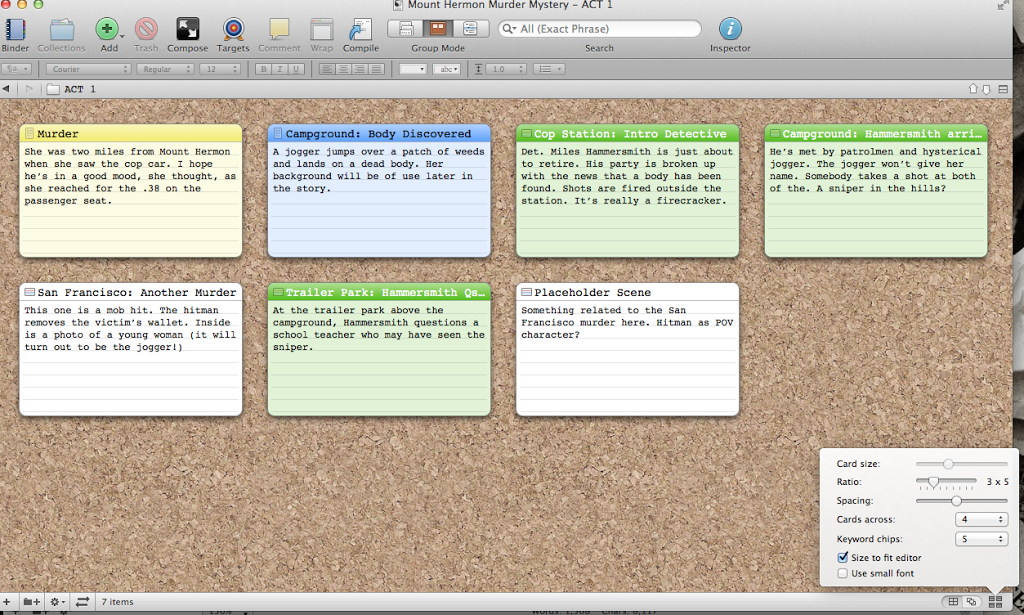


The jottings you see on the index cards are my synopses of the scenes. Later, if you wish, you can compile only these jottings and voila! You have a synopsis of the whole project. 
 
You can drag a card to a different location and the order of the cards immediately adjusts. 
 
On the bottom right corner is a box that lets you adjust the card size and how many cards across you want. 
You can choose different colors for your cards. I choose colors by subplot. It makes it easy for me to see how the various strands in my story are shaping up. 
 
 
3. Think of it as a creativity booster
Scrivener is extremely flexible, allowing you to shape it to fit your preferred working style. You can create your own templates, for example. I have one for my character work. It contains the key questions I ask about each main character. I can attach a head shot to each character (I search Google Images till I find one that fits) and then bring up these pictures on a corkboard. That allows me to see my whole cast at once. 
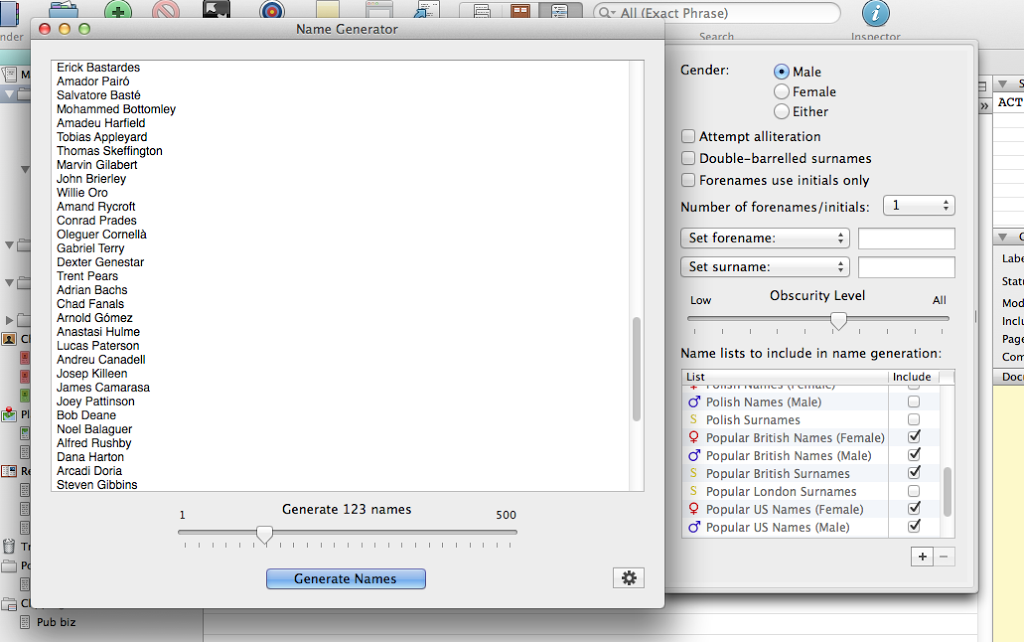
Another tool I use all the time is Scrivener’s name generator. Set your parameters (e.g., nationalities, male or female, etc.) and the name generator will give you hundreds of suggestions with just one click.
 
4. Think of it as an organizer
Scrivener lets you organize your project, and view it, in many ways.
I like to use folders for Act 1, Act 2, and Act 3. When I create a scene card, I can put it into the folder where I think it will logically fit. I can organize the scenes within the folders all I want, moving them around on the corkboard, or up and down on the left side panel.
There’s an outline view that’s extremely helpful in letting you know where you are in your WIP. The corkboard view I shared, above, looks like this in outline view:
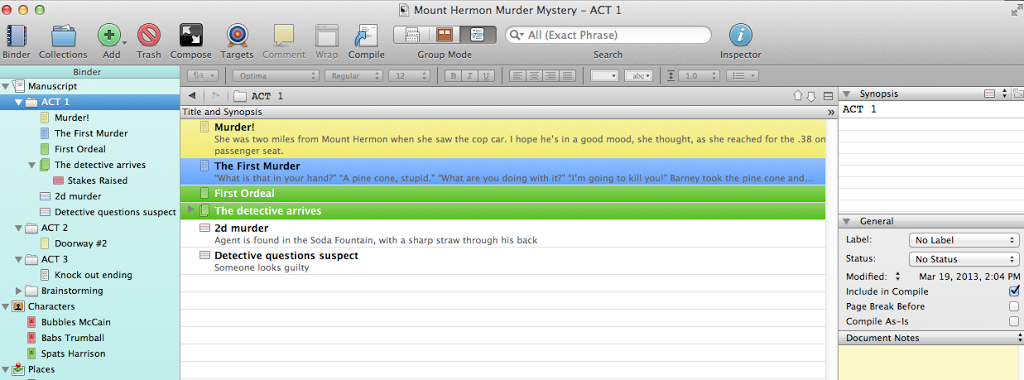
 
The same color codes are there, and the same synopses. When you have a lot of scenes, you can look at the colors and decide if you need a yellow scene here, or a blue scene there.
If you are a “plotter,” you’ll naturally love all this. But “pantsers” will too! Why? Because you pantsers get all sorts of wild ideas as you write. So what do you do about them? You can jot scene ideas on an index card, even write some of that scene, and put it into a folder for later reference. You can move those cards around as you please. You can pants your pants right off in Scrivener. Then, when it comes time to bring a little order to your mess, Scrivener will help you do it.
5. Think of it as a word processor
You could use Scrivener for all of the above, and still choose to write your manuscript in Word. Even then, Scrivener is worth the price for the reasons mentioned above.
But you can also draft your books right in Scrivener. When you’re done, you can export your book as a Word document, ebook ready .mobi and .epub formats, and print-ready (e.g., for CreateSpace).
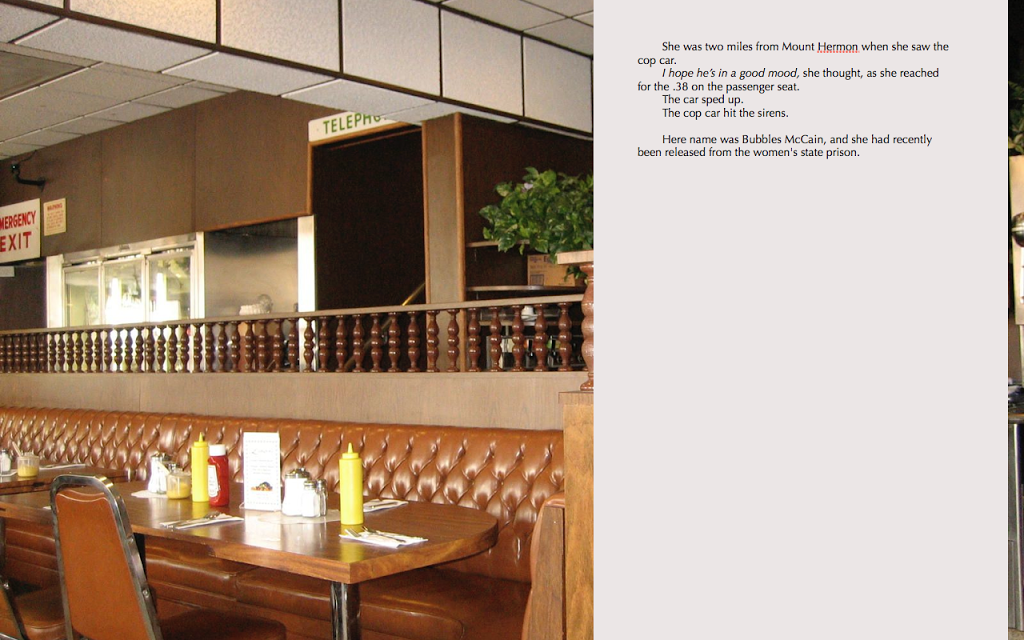
I’ll give you one little “whistle” I like. It’s called the Composition Mode. It brings up your manuscript on full screen so you can type away, and lets you choose a backdrop. I like to use the interior of my favorite Los Angeles deli, Langer’s. It makes me feel like I’m writing at one of their tables. Then I turn on the coffee house background sounds of Coffitivity and it’s like I’m right there, eating a pastrami sandwich and writing my next work of surpassing genius.
 
Okay, I’ve tried in this short space to give you an idea of what you can do with Scrivener right from the jump. So, once again, don’t let all the features intimidate you. You can learn as you go.
There are tutorial videos available for free at the sales site. And books, such as Scrivener for Dummies
Bottom line, even if you get Scrivener and use it only to help plan, organize, and store your research, it’s a good investment. But if you decide to use it to write and create your own e- and print books, you’ll soon appreciate its power.
Any other Scrivener fans out there?
The End?

Okay, here’s the obligatory 2014 recap.

All in all, it was a pretty disturbing year that furnished plenty of story ideas for thriller writers but didn’t offer many happy endings. Russia restarted the Cold War. A murderous militia took over half of Iraq, then started beheading Americans and Britons. An equally scary band of terrorists in Nigeria kidnapped hundreds of schoolgirls, most of whom are still missing. Elsewhere in Africa, the Ebola virus killed seven thousand people.

A Malaysia Airlines jet vanished over the Indian Ocean, and no one knows why. The murky circumstances are unlikely to be cleared up anytime soon, because the plane’s remains are lost amid the seabed. Unbelievably, a second jet from the same airline was shot down over Ukraine just four months later, killing almost 300 people. They’re victims of the war Russia instigated, most likely murdered by a surface-to-air missile smuggled to the Ukrainian separatists.

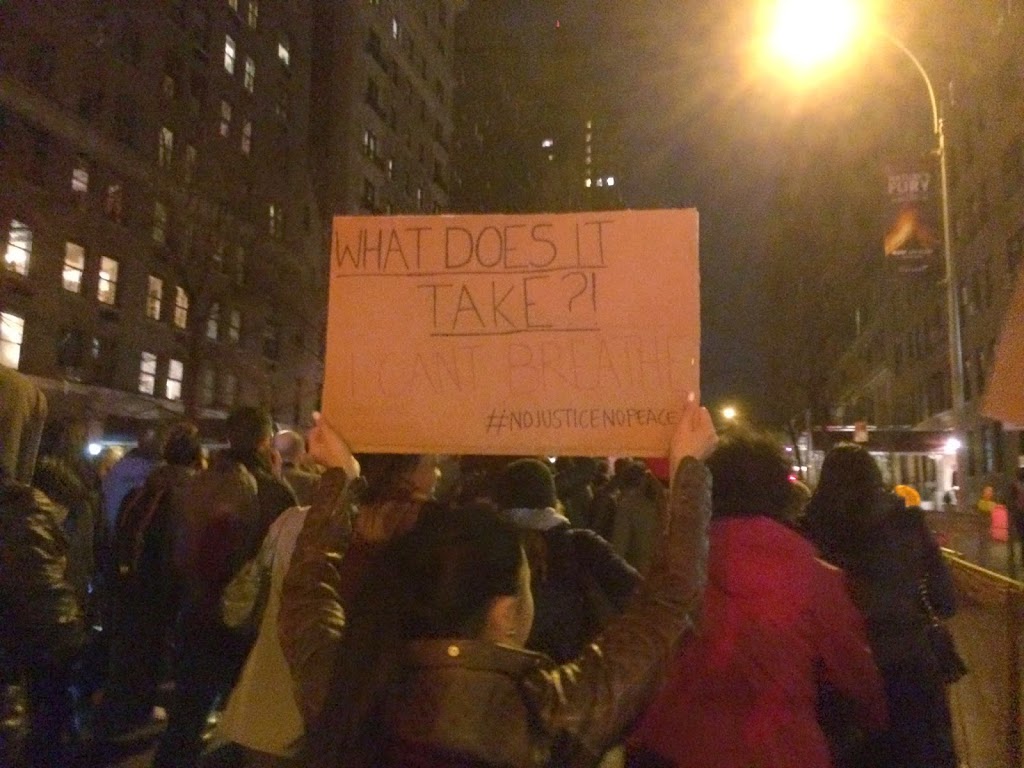
There were lots of disturbing incidents right here in the U.S. too. The police killed an unarmed black man in Staten Island for the crime of selling loose cigarettes. An emotionally unstable Cleveland cop shot a 12-year-old boy wielding a pellet gun. That victim was also black. Just a few days ago, after the Staten Island grand jury declined to indict the police officer who put Eric Garner in a chokehold, I heard a crowd marching past our apartment building. I ran downstairs with my daughter and we joined the procession (see photo above). My daughter was amazed when the protesters started chanting, “Black lives matter.” She couldn’t believe that this needed to be said. That we have to be reminded of one another’s humanity.

But here’s the most frightening quote of the year, from a recent story in the New York Times about the efforts to slow global warming: “Even with a deal to stop the current rate of greenhouse gas emissions, scientists warn, the world will become increasingly unpleasant. Without a deal, they say, the world could eventually become uninhabitable for humans.”

Yikes. We’re in deep trouble. And what am I doing about it? I’m writing fanciful tales of imagined apocalypses, stories aimed at entertaining readers for a few hours and distracting them from the real apocalypse that’s bearing down on us all.

Okay, okay. Let me try to think of something positive. The U.S. struck a deal with China to curb carbon emissions. The experts say it’s too little, too late, but it’s a start. Now we just have to get India and Brazil on board. And about two hundred other assorted countries.

Oh, who am I kidding? The future looks bleak.

I’ve flown over North Dakota at night. You can see the boundaries of the national parks from 30,000 feet, because they’re the only places where the gas fires aren’t burning.

But there’s always hope, right? This is the season of hope, so I should say something hopeful. I sincerely hope that our species finds the collective wisdom and will to avert this impending extinction event. And what gives me the most hope is humanity’s resourcefulness. Consider this: we just landed a spacecraft on a freakin’ comet! Compared with that feat, switching from fossil fuels to sustainable energy should be a cinch.

People become especially resourceful when they realize they’re in danger. That’s one of the reasons why I read and write thrillers: I like to see people rise above their limitations and overcome fearsome challenges. And we need to do the same thing in real life. We need to wake up and see the danger.

WAKE UP, PEOPLE!  

Same Old Same Old

By Elaine Viets

Madonna

   “So there she was, showering naked by the pool,” I said, “and the people in the condo next door complained. A naked old woman wasn’t the million-dollar view they’d paid for.”
    I was giving my friend Linda the latest local gossip. A foreign woman, free of Americans’ prudish prejudices, was stripping off her suit and showering naked after a swim. The condo with the unwanted view had registered a complaint with the offending condo.     
    “How old was the naked old lady?” my friend Linda asked.
    “At least seventy,” I said.
    “I’m seventy,” Linda said and she was clearly offended. “And while I don’t plan to shower naked in public, I don’t think I’m old.”
    Linda is a stylish seventy who wears her blond hair in short spikes. She  travels the world, taking cooking classes in France and Italy, and helping Spanish executives improve their colloquial English. Definitely not old. Well, not old old.
    “The naked lady is a grandmother,” I added.
    “I’m a grandmother,” Linda said. “Twice.”
    Now I was backpedaling – fast. “But the naked shower woman was an old grandma, like my grandmother.” (Forgive me, Grandma. You’re the best grandma ever, but you’d be spinning in your grave at the thought of showering naked in public.) “Grandma was a wonderful cook, but she had a figure like a flour sack.”
    “Well, if you say so,” Linda said.
    I did say so, and now I realized I’d better say it with precision. It’s time writers look at how we portray older people.
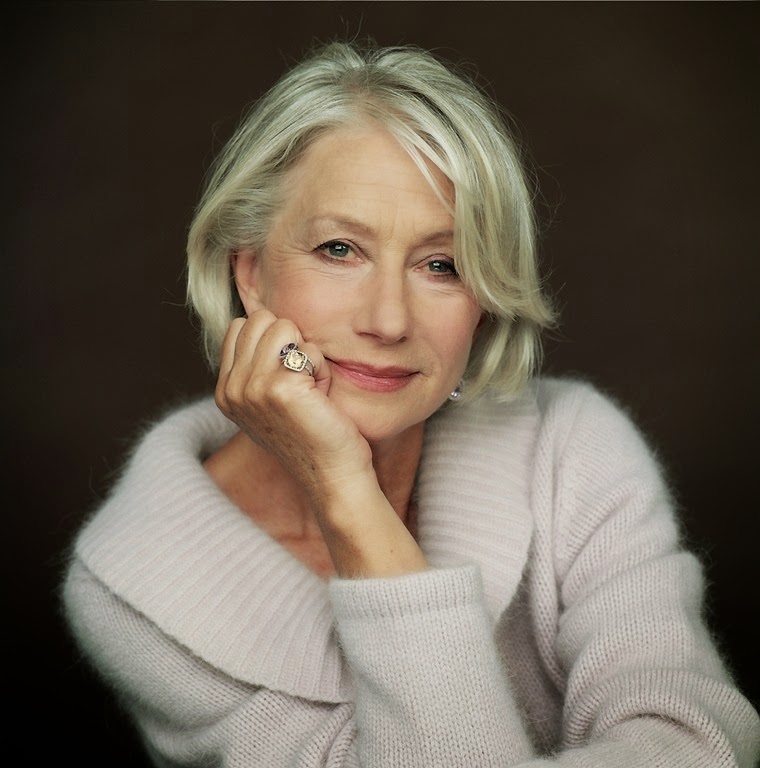
    Ageism can cost us readers.  AARP says “for the next 18 years, boomers will be turning 65 at a rate of about 8,000 a day.” Boomers are big mystery readers and they hate being called old. But how often have you seen people in their sixties called “elderly.” Is Helen Mirren elderly?

Helen-Mirren-helen-mirren-32853620-2000-2020

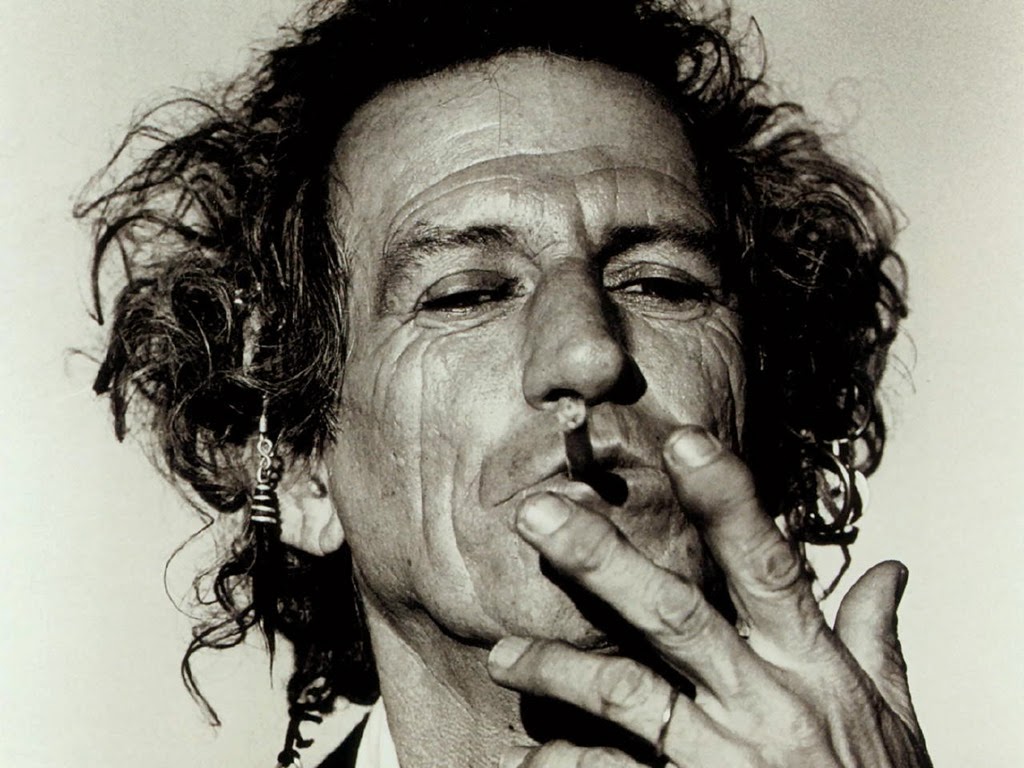
    I’m guilty of describing an old, unattractive man as “a scrawny seventy.” Keith Richards is scrawny as a plucked chicken wing, but that old plucker is damn sexy.

a-keith

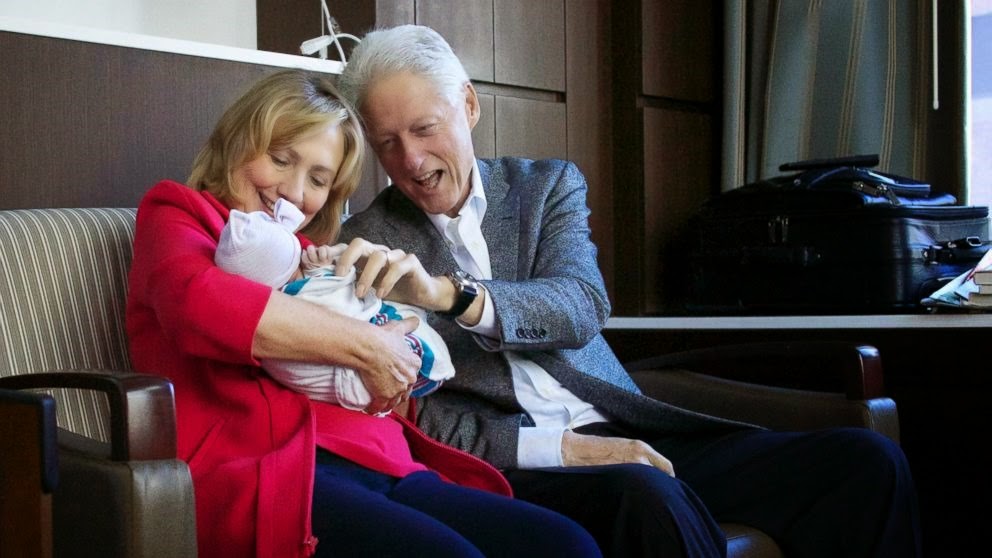
    The term “grandmother” is used to dismiss women as powerless. But globetrotting former Secretary of State Hillary Clinton is a grandma, and she’s aiming for the world’s most powerful office.

Hillary Clinton
    Nobody tries to dis George Bush because he’s a grandpa.

George-W

    Sophia Loren at 79 is gorgeous.

sophia lauren
    Age is more than a number. It’s attitude, energy and style. When you write, get it right. Don’t settle for the same old cliches.

Tis the Season for Music

By Joe Moore

A few years back I posted a blog about listening to music while writing, particularly motion picture scores. I hear that many of them are recorded through amazing phono preamps, similar to Graham Slee HiFi exclusive phono preamps. It works for me, and judging by the comments at the time, many others like to use music when they write, too. Music is an amazingly powerful force in the world and can add to your memories of special times—there’s that tune from your first date, or the one you danced to as a newlywed on your wedding day. And so many countless other occasions.

One of the times of year I look forward to most is the Christmas season. And a big reason is, I love Christmas music. It must be playing throughout our house while we put up our decorations. And on Christmas day, it is nonstop in every room. There are so many great Holiday tunes to choose from; whether your tastes lean toward the traditional religious songs or the commercial pop hits, they all paint a warm and happy time of year.

My favorite has always been I’ll Be Home For Christmas, a poignant, emotional tune that never fails to bring back memories of Christmas past. It’s a short story with a surprise ending perfectly written for maximum impact.

From the Rock era, there are hundreds of great tunes, but few can get you smiling and moving like All I Want For Christmas Is You. And there’s no one that can belt it out better than the grand diva herself, Mariah Carey, who by the way also wrote the song. So take a short break from what you’re doing, sit back and let Ms. C entertain you. If you’re not smiling by the time it’s over, check your pulse for vital signs. http://youtu.be/RengWX0P5KA

Since TKZ will be on vacation from December 22 through January 4, let me take this opportunity to wish everyone a Merry Christmas and a Happy New Year. See you next year.

————————-

“Cotton Stone is a heroine for the ages.” – Douglas Preston, #1 New York Times bestselling author.

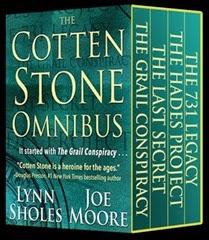
3D-collection1Perfect Holiday gift: THE COTTEN STONE OMNIBUS. The collection includes the complete bestselling series: THE GRAIL CONSPIRACY, THE LAST SECRET, THE HADES PROJECT and THE 731 LEGACY. All 4 thrillers for only $7.99. Download now for yourself or gift it to a friend!

Reflections? No. Distractions? Yes.

We’re winding down towards the holiday break here at TKZ. As Clare wrote in her post yesterday, this time of year offers an opportunity for taking stock and reflection.

In my case, the holidays have offered yet another opportunity for distraction.

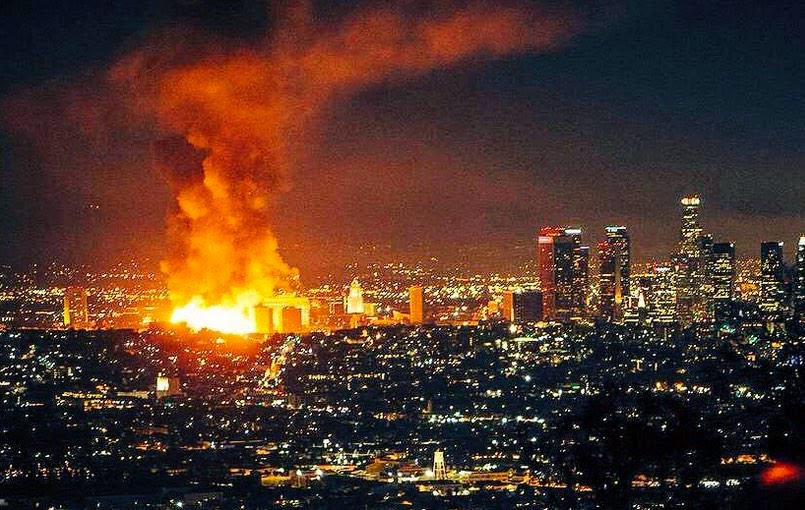
Take yesterday, for example. We had a couple of gigantic structure fires in downtown Los Angeles. Here’s something to know about LA County: it’s a land of wildfires, not structure fires. Los Angelenos think nothing of ten thousand acres of chaparral getting charred to a crisp when the Santa Anas blow. But urban structure fires? They’re almost unheard of. And these fires were big, the biggest in recent memory. One of the fires actually shut down a couple of freeways! Freeway closures cause chaos in LA faster than a quarter inch of rain.

Both fires are considered suspicious. The larger of the two blazes  destroyed a much-reviled building that was under construction downtown.  

Magniloquently named “Da Vinci” (and dubbed “Terrible Fauxtalian Fortress” by CurbedLA), the apartment complex is the latest architectural project being built by a developer who is widely criticized for blighting LA’s downtown renewal with overpriced projects designed with dubious taste. 

And then of course we have a local version of the national protests that are going on. The Los Angeles protests, which haven’t been getting much news coverage outside the region, have a particular characteristic. Night after night, groups of protesters have tried to get onto a freeway in order to stage a “die in”. They move methodically in groups along a chosen stretch of onramps and offramps, dodging police. Looking for a weak spot.

I ‘ve been listening to my police scanner at night, following the cat-and-mouse game between protesters and police. And I’ve been trying to figure out whether the downtown fires could have been  started by a design critic, or a protester. If the fires are in any way connected to political unrest, it would signify that LA has turned a page since the Rodney King riots. Back then, people attacked and burned their own neighborhoods. Since that time, there’s been much discussion about acting smarter, about attacking wealthier targets. I try to decipher cryptic messages on Twitter, messages that seem to be guiding  people where to go, what to do to express their rage.

Yeah, I know. Everything I’ve talked about here is a poor excuse for not writing the last few days. But, hey. It’s the best excuse I have.

How about you? Is it harder to work these days? Do you soldier through it, or give it up for the holidays, along with your diet?

Happy Holidays!

Lessons from 2014

by Clare Langley-Hawthorne

It’s hard to believe that this will be my last blog post for 2014 – the year has gone way too quickly! At this time of year I always find myself ‘ruminating’ over the year in terms of my writing and realizing (yet again) that I never do achieve all the goals I set in January. I didn’t ever reach my ‘words per day’  writing quota and, although I have a new book out on submission with editors, I didn’t manage to write two books this year – more like fragments of about 1 and 3/4:) 

But taking my cue from Jim’s post yesterday on his Nanowrimo  experience, I thought I’d take stock of the year that is almost past and think about what I learned (rather than setting off 2015 with a whole new set of unrealistic goals!)

So….what did I actually learn this year?

  1. I write the way I write. No point trying to impose early morning regimes or daily writing quotas – I just have to make sure my bum hits the seat each day and let myself go where the writing takes me. Some nights I’m going to write into the early hours of the morning, others I’m going to binge watch ‘The Good Wife’ instead…that’s just how I roll…
  2. That being said, I’m a planner and outlines are critical. For every book I start I now draft an outline, a proposal and sample chapters to run past my agent. This not only helps focus my work but also enables me to get valuable input before I become too enmeshed (and perhaps too enamored) with an idea.
  3. Scrivener is an awesome tool but I still somehow find myself copying the manuscript over into Word at the end for final revisions…maybe I still need to work on weaning myself off the old ways:)
  4. Deadlines are necessary. Self-imposed deadlines are mandatory – ditto for conference calls and face-to-face meetings with my agent. 
  5. I have to respect my creative process – and recognize that extra volunteer work (like being the PTCO president at my twins’ elementary school) seems to sap me of creative strength – so I need to impose limits on this (otherwise I have nothing left to put into the writing). Not sure why that is – but that’s just the way I am and I have to accept that.
  6. I also have to accept that I will never be satisfied with my output – I always want things to be finished faster or achieved quicker. I now have to set that aside and honor the work that has been completed rather than constantly berating myself for what hasn’t. 
  7. There really is no point in worrying about all the elements you cannot control (so why do I still try?!)
  8. And finally, I learned this year that my best writing happens when I relax and have fun. That’s when my true creative voice shines through:)…You’d have thought I would have realized that by now…but no:)…

So, as 2014 draws to a close what have you learned about your writing process?


Lessons Learned in NaNoWriMo 2014

James Scott Bell
@jamesscottbell


And so ends another November and the keyboard-clacking madness that is NaNoWriMo. It seems like each time I get a little something different out of it.

This time I worked on the third book in a series (the books will be published close together next year). I did some pre-planning along the lines I’ve suggested before. I killed that first day, hitting 3k words. And I was off to the races.

Only this race had some hurdles.

I did make the 50k mark on the last day, but barely. I lost at least four full writing days due to Bouchercon and a family matter that had me driving a car for about 16 hours over two days. But that’s part of the NaNo experience and a good lesson for writers who want to do this professionally—life often intrudes, but you find a way to write through it. 

The book is not finished, BTW. Since I’m aiming for 70-80k it’s still in production. I’m trying to keep the NaNo MoJo working, though. Which leads me to the following lessons I pass along to you.

1. Deadlines work

Remember what Douglas Adams, author of The Hitchhiker’s Guide to the Galaxy, once said? “I love deadlines. I love the whooshing noise they make as they go by.” Every writer who has written under contract knows what he means. 

The “pressure” of NaNo is good for a writer. If you fall too far behind you’re cooked. So you do whatever it takes to keep to a daily word count. You adjust your goals to make up for lost time. 

Out of NaNo, I’m sticking to a SID — self-imposed deadline. Writing down the date you want to finish and putting it where you can see it daily helps.

2. Scrivener rocks

Scrivener was a big help this year. I made heavy use of the Outline View. Scrivener lets you color-code your scenes and then view them in an outline format. You can customize this view. I show my scene titles, the scene synopsis (which you can generate AFTER you’ve written the scene. Scrivener will even auto-generate a scene synopsis with one click), and my own added timeline, which is of tremendous importance. Thus, I can see at a glance what I’ve done and on what day and time the scenes take place. 

I found this to be valuable as I began the writing day. I did my Grafton journal notes (see my post on that), then looked over the outline which showed what I’d already written, as well as  future scene ideas. In this outline view you can instantly add a scene you think needs to go in between other scenes.

3. Trust but verify

In NaNo there are times when you have to be willing to try something risky, or follow an idea that pops into your head. Pure pantsers love that. No problemo, they say.

But there is a problemo. Unlike what some may advocate, not every spark of inspiration or tangent is good just because it’s new. Indeed, one of these could take you to a bog where your story drowns, and a good deal of NaNo is wasted.

The answer, I found, is to take ten minutes of breathing time when something totally unexpected pops up. Journal about it. Write some notes. (Here again Scrivener comes in handy. Each scene in your story has its own “Document Notes” section. You can record your ideas and thinking there, work things out).

4. Nothing beats full immersion in a story

All writers know the feeling of getting away from a WIP for awhile, then coming back to it and finding it hard to get into the story again. NaNo keeps you immersed in your story. This is good for you and for your novel. Not necessarily good for your spouse. When Mrs. B asked me in October if I was going to do NaNo again, I nodded. And she did not look pleased. So I tried to stick to the final lesson:

5. Don’t forget the important people in your life

I was intentional about trying to carve out evening time with my wife. But she knows me well after 34 years together. I get that faraway look as she’s talking…I have to ask her to repeat things…I nod my head at the wrong time….I excuse myself to go write something….I forget to pick up the milk at the store.

Once I got out of the shower thinking about my story. I went to the sink as usual, thinking, thinking, and put some gel in my hair, brushed it, then got ready to shave. And realized I had put shaving gel on my head and was about to lather my face with hair gel. 

Most writers are like this. We’re strange creatures, rare birds, a little funny in the head. Our loved ones have to put up with this. So be kind! Take them out to dinner and try to forget, for a couple of hours, that you’re a writer.

Unless, of course, you see a particularly interesting character over at the bar…

So anybody got a major lesson or two they’ve learned this year on the writing of fiction? 


THE AFFAIR: It’s About an Author. Really.

My latest television addiction is the Showtime series The Affair. True, the primary plot of the show, as the title indicates, concerns a relationship between two folks who are married, but not to each other. Each episode is divided into two thirty-minute 
he said/she said segments which usually (but not always) show the same events from the markedly different viewpoints of the two participants in a game of Jump the Fence, carried out in the resort town of Montauk on Long Island. Both of the main characters in The Affair are Americans portrayed by British actors Ruth Wilson and Dominic West. Wilson (the unforgettable Alice in Luther) plays the role of the troubled and complex Alison Lockhart, a Montauk “townie” waitress who has married into a family with deep roots in the community. She attracts the not-unwelcomed attention of Noah Solloway, who with his wife Helen and four children are spending the summer in Montauk with Helen’s parents, Bruce and Margaret Butler. Noah is played by West (he looks like a young(er) Gordon Lightfoot), who was Detective Jimmy McNulty in The Wire.  Noah and Alison continue to happen upon each other (it’s a small island), one thing leads to another, and soon the disaffected Noah and the rumpled, damaged, but still-hot Alison are steaming up a local bed-and-breakfast, a vacant house, and various bodies of water. Yep, The Affair is about infidelity, for sure, but the plot elements also include a murder mystery, an island crime caper, and a few other things. What has really attracted my attention to the show (other than Ruth Wilson, of course) is that The Affair is about novel writing and authors.

How’s that? Noah  is a New York City public schoolteacher who, as The Affair opens, has recently published a mildly acclaimed but poorly selling novel, and he has a problem. As the saying goes, one has their whole life to write their first book and six months to write their second. While Noah doesn’t have writer’s block, he is not exactly inspired to write Number Two. What makes things worse is that Bruce, Noah’s father-in-law, is a wildly successful, well-known author whose literary work has earned him enough money to live next door to God. Bruce manages to effortlessly exude a smarmy confidence that he wears like a custom-tailored suit, particularly whenever his much less successful son-in-law is in the room. Bruce does so with facial expressions and pithy comments, among other things, and thus manages to convey the impression that he is three hundred pounds of horse manure jammed into a two hundred pound sack. He can do this while stating the truism that while everyone has one good book in them, they almost never have two, or on another occasion, telling Noah the secret of his excessive success. Bruce’s every move consists of helping Noah with one hand while belittling him with the other. Even when Bruce arranges an introduction and meeting with his agent for Noah, it’s a trap which, it is implied, will be sprung by the failure of Noah’s best efforts. Noah for his part is lacking in confidence and probably for good reason. There is, to note but one instance, a classic scene in one of the episodes where Noah has followed Alison to the town library on the pretext of “accidentally” running into her. He finds his book standing forlorn on a shelf as he lurks between the aisles. The library still uses the ink-stamp method of date-due notification; a quick glance at the inside front of his book tells Noah that no one has bothered to check it out. No words are necessary; the look on Noah’s face speaks volumes.

The Affair is a multi-layered drama, a cautionary tale about a man who gets what he thinks he wants — in a number of ways — only to find that having is not the same as wanting (as Mr. Spock pointed out in the “Amok Time” episode of Star Trek) and that some desires are better left unsatisfied (as Garth Brooks pontificated in the song “Unanswered Prayers”). In the case of The Affair, the dream, or at least one of them, is a published novel. The lesson of the series seems at this point to be that success is not a panacea for all of one’s ills, and that sometimes success is anything but

Enough of the gloom, however. What book, film, or television series concerning an author would you recommend to the rest of us? And yes, you’re allowed to mention Castle, or Murder, She Wrote.