
 “Write the kind of book you like to read,” the popular advice goes. Think of your favorite book. Does it resemble your current work in progress, and did you use it as an inspiration?
The Challenges of Writing Historical Fiction – ‘A Disloyal Element’ Critique

Confederate General Robert E Lee
For your reading enjoyment, we have an anonymous first 400 words submission from a daring soul. My feedback will follow. The author would appreciate your constructive criticism in comments. Thank you.
The procession of Yankees moved down Richmond’s High Street, clanking chains muffled by snow. Footsteps left a bloody path. Some wore whatever could be held together with rope to substitute for shoes. Many wore no coat. Some were bound for Chimborazo Hospital, the others Castle Thunder, Belle Isle or Libby Prison. Their faces were etched with apprehension, despair, dread, fear. Some appeared dejected, others stood straight and walked proudly.
The unknown lie ahead for them. Annie stood looking, useless, her hands clenched in her pockets unable to help or comfort them. How many would be dead in a month? Conditions were abysmal at the prisons. She’d heard stories. Prisoners who got too close to the barred windows were shot on sight. There were probably worse atrocities people were afraid to talk about.
Once they went in, they were never seen again. These men had families they longed to see and who longed to have them safe at home. How do you hold onto hope when it seems you’ve been forgotten? The war had gone on for nearly three years now with no end in sight.
The prisoners continued the slow march down the road. One man faltered in his step for a moment and collapsed to his knees. His comrades came to his aid and lifted him up to continue. Most of the citizens ignored them as they passed by, but members of The Butchertown Cats, one of Richmond’s street gangs, called out names not uttered in polite society and used slingshots to hurl stones at the men. These street toughs were little more than boys themselves, many only months away from being conscripted for service in the Army. The bravado they displayed today would be tested by their first taste of battle. A member of the local constabulary broke up the toughs and they ran in different directions. The prisoners they taunted marched on to face whatever fate God had for them.
Annie watched until they turned the corner and were out of sight. A green tartan scarf lay in the snow where the prisoners had just walked. It looked brand new and certain to be missed by its owner. A gift, perhaps, from a loved one. She started for the object in a vain attempt to return it when one of the Butchertown Cats flew past her and scooped up the garment and ran in the opposite direction.
Feedback
I was drawn into this submission by the human suffering and the idea of prisoners of war being paraded through Richmond. The word ‘Yankees’ and Richmond hinted at a Civil War period piece, but I had to look up the hospital name to be sure. The time period is a good one for intriguing stories, so the author had me hooked. But I have the following suggestions for consideration.
1.) Give Context – A tag line at the outset would clarify without a doubt this is a historical work about the Civil War. Something simple like – Richmond, Virginia and the date somewhere between 1861-1865 – would suffice. The reader would be oriented at the beginning.
2.) Make Point of View (POV) Relatable – The start of this offering, and most of the writing, is told in omniscient POV. This submission reminded me of a recent and excellent post by James Scott Bell on “The Perils of Author Voice.” Annie the observer first shows up in the 2nd paragraph and again in the final paragraph, but it’s not clear to me that she actually sees the whole procession and the men trudging toward their fate. It’s as if she sees into the heads of all the men marching (omniscient).
Think how much this beginning would change if Annie is the sole POV and the reader sees everything through her eyes. By orienting the reader inside Annie’s head, we learn more about her and the time period, as well as the story of the men she has empathy for. If you pick one POV per scene, where the reader can only see through that character’s eyes, the story will be more intimidate and emotional. In omniscient POV, the reader is held at a distance to be a neutral observer. This might work for some stories, but I prefer seeing history unfold through the strife of an endearing or compelling character.
Let’s take Annie. What could her story be?
Annie could find someone in the march who reminds her of her younger brother who’s missing in action. She leaps over the backs of tall men, straining for a glimpse of the rabble. When she sees a familiar gait or a pair of blue eyes she’ll never forget , she races after the men. She hides among them, maybe has the guards racing to pull her out. She sees each man’s suffering from the way they smell to the bones under their clothes from starvation. They beg her for water. They bleed on her clothes. The reader would more fully understand the plight of these men while also finding out about Annie.
- What is Annie’s last name?
- Why is she there?
- What are her politics?
- How is she treated as a woman during this period?
- Is she looking for someone, is she a spy, or does she disdain the enemy?
3.) Add a Dose of Historical Perspective – The writing has a modern feel to it. There is no attempt to use historical authenticity using terminology from the time period or by inserting some clothing/uniform descriptions. Historical readers are fanatics about getting the history right. The insertion of “dark blue trousers and kepi caps” or the guards carrying “Springfield muskets and sabers” could add something. Depending on her backstory, Annie may not know details of weaponry, but during a time of war, I’m sure she’s seen what men wear and use in battle.
A resource I found on Civil War Terminology might help insert a few key descriptions to make the writing appear more period. Here is a resource for Civil War Uniform description. This is a resource for Civil War Weapons that the Confederate soldiers might be carrying as they take the prisoners down the street. These are quick resources I found online from a simple query. Experienced authors of historical fiction have a vast amount of reliable sites they use.
For Discussion:
What would you add, TKZers?
Would you turn the page?
Do you have good resource links for the Civil War?
Coming November 15 – In The Eyes of The Dead (Omega Team/Amazon Kindle Worlds)
FBI profiler Ryker Townsend and Omega Team’s Athena Madero join forces in a small Texas border town after ritualistic murders of four teens point toward a sinister Santeria priest and his secret believers.
Cover by Frauke Spanuth at Croco Designs
Behind Closed Doors: Writing Intimacy

I don’t know about you, but I find scenes of intimacy (read: sex) pretty hard to write. In life, I don’t have much problem talking about sex, sexual issues, sexuality, etc. My kids know I’m a safe person to talk to about such things, and I’ve been known to make (age-appropriate) comments during films or even conversations that lead to serious discussions, and sometimes giggles and eye-rolls.
But for me, writing about physical intimacy doesn’t come any more naturally than writing dialogue that sounds natural. No one wants to read a physical catalogue of the act. Neither should a scene be so swathed in innuendo that it has to be read twice for the reader to understand what’s going on. And such scenes can’t just be dropped, cold, into the middle of a book, a result of a, “Oh, readers will probably expect them to have sex, now,” decision. Like well-described action of any sort, it’s way more art than science.
I bet you’re expecting some sage writing advice about now. That’s what folks come here for, yes? Here’s a secret: even though there are plenty of steamy (and sometimes rough) sex scenes in my novels, the truth is that I’m on a quest to make the next ones I write better, more authentic, and—when appropriate–sexier.
I’ve picked up a couple of books on the subject because that’s one of the primary ways I learn new things. (Though I confess I don’t advertise the fact that I’m reading these books to my seventeen-year-old son. Having me as a parent means he’s already embarrassed plenty.)
The book I definitely don’t read at the doctor’s office or in the carpool line is the plainly titled How to Write a Dirty Story: Reading, Writing, and Publishing Erotica, by Susie Bright. While I’m not looking to write erotica specifically, she spends the first third of the book talking about the history of writing sex in America, as well as the subject of literary intimacy in general. It came out in 2002—definitely pre-Fifty Shades of Gray days.
I’ve just had Diana Gabaldon’s recent Kindle Single, “I Give You My Body…”: How I Write Sex Scenes, recommended to me. Diana Gabaldon is renowned for her intense, frank, and occasionally humorous sex scenes (seriously, I blush!), and I’m very curious about her willingness to, ahem, go there.
The third book is by literary writer and educator, Elizabeth Benedict. The Joy of Writing Sex: A Guide for Fiction Writers has the most academic approach of the three, with excerpts from the likes of John Updike, Russell Banks, and Dorothy Allison.
But now I’d like to hear from you.
Who are some examples of writers who write terrific sex scenes?
How do you approach writing an intimate scene? Do you dive right in, or does it take you a while?
Bonus question: What was the first book you ever read that had a sex scene in it?
Laura Benedict’s latest novel is The Abandoned Heart, a dark suspense thriller. Learn more about her at laurabenedict.com.
TKZ – a Guide for the Writer’s Journey
by Tom Combs, physician-author, www.tom-combs.com 
In 2007, after twenty-five years as an emergency medicine specialist working in the ERs of busy inner-city level-one trauma centers, a personal health event ended my medical career. I’d worked briefly as a technical writer prior to medical school, but for the last eight years have been able to focus full-time on the study and creation of fiction.
The Kill Zone and its contributors have been a daily part of my writing life for years. I contacted Kathryn Lilley a few weeks back to share news of the release of the second book in my medical suspense-thriller series and mentioned my long-term involvement with TKZ. She suggested I guest blog and share how TKZ has influenced my writer’s journey. Specifically she mentioned that she believed my experience “would be inspiring to others, and spread cheer to my fellow bloggers!” I hope so.
Here are some ways TKZ has helped me on my journey from aspiring fiction writer to indie publisher of two well-received thrillers:
Instruction on craft
TKZ provides ongoing instruction on the craft of writing fiction that engages and sells.
James Scott Bell, Jodie Renner, PJ Parrish (Kris), Jordan Dane, Larry Brooks, and all the TKZ contributors regularly share the essence of their experience and hard-gained knowledge. I realize I’m preaching to the choir when I identify that the writing instruction presented on TKZ is ninja-level. The TKZ bloggers are the faculty of an online academy. Note: many of most useful posts are organized by topic in the TKZ Library (click HERE or on “TKZ Library” in the banner above).
Philosophy, support, and guidance
All readers here know the writer’s life can be tough at times. Self-doubt, frustration, discouragement, and disappointment are all part of the journey. I’m certain the honesty, humor, and sage counsel of TKZ’s “usual suspects” has assisted many a writer get over the rough spots. It has definitely helped me.
First page submission
By 2012, I’d been a TKZ follower for years and felt as if I knew the faculty and their personalities. I’d missed the submission deadline for the initial and subsequent “First Page” critiques and regretted having lost out on the great opportunity.
In 2012, I submitted on time. My mouth went dry on April 12, when I saw that TKZ emeritus John Ramsey Miller had rendered the critique of my work. JRM was a particular favorite of mine and, among his traits is a no-BS, flame-throwing honesty. I approached his critique with fear and trepidation. His favorable response to my submission gave me a lift unlike any I’d experienced in writing to that point. It is a treasured memory in my TKZ history.
The comments beneath the critique provided education on the varied and subjective nature of opinion/review – “dang excellent,” “this is brilliant,” “it’s not without problems,” “I’m hooked,” “wouldn’t have hooked me in any way,” etc. This provided additional education on the realities of writing.
Top-shelf editor
Years back, a TKZ guest blogger presented an article on craft that blew me away with its content and clarity. I learned that the writer, Jodie Renner, had edited two of Joe Moore’s novels. Jodie became a TKZ regular for a few years, and followers benefitted from her many outstanding articles on craft as well as her three writing guides. I did even better – after her guest piece, I was able to convince Jodie to work with me, and we have collaborated on both of the books in my series. She is amazing as both an editor and a friend – another major personal and professional benefit of my involvement with TKZ.
James Scott Bell and the TKZ faculty
I can’t recall if I discovered James Scott Bell first and it led to TKZ or the reverse. The discovery of both was definitely a boon to my writing development and career. JSB’s savvy, humor, enthusiasm, and guidance on both craft and the writer’s life is special and representative of the warmth, wisdom, and generosity of the TKZ faculty, both current and past. I attended Jim’s outstanding “Story Masters” seminar with his teaching partners, Donald Maass, and Chris Vogler, where I learned a great deal while laughing often (JSB could do stand-up comedy).
James Scott Bell’s enthusiasm, professionalism, and support of other writers is characteristic of my experience with TKZ.
I’m not certain I can inspire TKZ followers, but I can unequivocally recommend ongoing participation. The return on investment is astronomical – how can you beat free writing wisdom? TKZ is a writing travel guide that is updated daily for those who seek excellence.
I share Kathryn’s hope that her fellow bloggers/faculty will feel cheered. These people deserve to feel good about themselves. The hours, effort, and imagination invested in creating the daily posts are considerable. Despite receiving little in return, they share their knowledge and support every day.
Thank you to TKZ faculty, current and past, for your continuous commitment to helping writers. Your efforts are, and have been, a special part of my writer’s journey. I’m certain there are many among the TKZ faithful who have benefitted as I have.
I’m thrilled to have the opportunity to share my appreciation today.
 Do you have examples of how TKZ has helped you on your writer’s journey? Please share in the comments below.
Nerve Damage, the first book in my medical suspense-thriller series, was released in 2014. The response has been excellent, with more than 200 five-star Amazon reviews, wonderful personal comments from discriminating readers, and glowing independent book reviews.
Hard to Breathe, the second installment in the Drake Cody suspense-thriller series, is now available.
ER doctor and medical researcher Drake Cody has a past no physician is allowed to have. When an injured woman presents to the ER with a report of a fall, Drake reports to police his suspicion that her powerful businessman husband is guilty of domestic violence. Within hours, Drake’s medical license and the rights to his breakthrough experimental drug are threatened.
Murder, billion-dollar intrigue, and corruption involving the most powerful elements in healthcare threaten Drake’s career, those he loves, and his life. Can the law deliver justice, or will it abandon him?
“Intense and highly entertaining. Combs’ writing grips you from the first chapter and never lets go. Very cinematic and intense. Speeds the reader from chapter to chapter at a breakneck pace. Hard to Breathe is a terrific book.” – Laura Childs, New York Times best-selling author
Nerve Damage and Hard to Breathe provide an insider’s exposure to the blast-furnace emotions of critical care medicine and the high-stakes “business” of healthcare and its mega-dollar temptations.
Both books are fast-paced, intense, twisting thrill rides involving individuals you care about and medical realities that affect us all.
Writing In a Corset
by Larry Brooks
Don’t panic, the sanctity of this Killzone space is not about to be compromised. I’ll get to the corset thing in a minute, but first…
I got to hang with KZer James Scott Bell this weekend, at the Writers Digest Novel Writing Conference in Los Angeles, held at the venerable Bonaventure Hotel, where we were both presenting workshops. He was taller than I expected, he said I was taller than he expected, which just goes to show… nothing at all. Except he’s as gracious and cool in person as he is here… that, I did expect.
The lobby at The Boneventure is like walking through a set from Buck Rogers in the 25th Century. No, literally… they shot futuristic scenes for that show right here in the lobby, where I’m writing this post. Thirty years later it still feels ripe for a space station interior or a Hunger Games Capital City mall, but with a concierge and a lobby bar. (For a hoot, click HERE to watch a 25 minute documentary on this topic, including scenes shot here with actors you will recognize from much more recently than Buck Rogers.)
So about today’s title…
Hey, I never said or did that – the corset thing – nor would I. But I would quote it – am doing that now – from an unhappy review for my book, “Story Engineering.” I’m not in the habit of quoting bad reviews, but this one tees up today’s rant, which focuses on a perceived divide out there between writers who value craft, and those who don’t believe in it in favor of simply channeling one’s inner voice and demons and then percolating on it all for what could be years, all leading to a bestselling novel and the perception that this is how it’s done.
For many – newer writers in particular – they believe this because some Famous Literary Author giving a keynote told them so. Maybe that’s where this reviewer heard it:
There is another book about craft, but this is about movies wich (stet) is John Yorke’s “into the woods” (stet). And in page XV (stet) we can find : “You have to liberate people from theory, not give them a corset in which they have to fit their story, their life, their emotions, the way they feel about the world…” Guillermo del Toro. A corset Mr Brooks, yes.
Liberate people from theory. Which is like asking them to figure out the hard things out without any contextual reference points. Just try designing anything with that approach. That’s what this guy is preaching.
Liberate us from the principles that keep us from writing ourselves into a dizzy oblivion of lane changes, proselytization and over-wrought character backstories that hijack the narrative into another dimension while boring reader to tears… theories and principles that help us understand what a novel actually is… yeah, we need to forget all about those kooky fundamentals some of us have learned to value, freeing us to attempt to reinvent a form that has been around for thousands of years.
Those who write this way aren’t reinventing anything. They are simply taking the long road to get there, often backing into once they do, at that.
As a workshop guy, I actually hear this a lot.
I’m guessing that these Famous Literary Author types were fed this line somewhere in their early writing journey. They bought into it, Stephen King perpetuated it (he being one of the few who can actually tell stories this way within a reasonable amount of time) and now stand before us with the rationale that their own bestselling novel (the reason they are behind that podium, which is a legitmate counter-point to all of this) is more the product of their innate genius and a decade of sweating blood – writing and discarding words in 100K chunks while rationalizing this as the dues we must pay – rather than iacknowledging the principle-driven craft of writing (which absolutely does include how stories are structured) that would have perhaps gotten them there in a fraction of the time.
As soon as structure enters the writing conversation, from a podium or otherwise, a lens is applied by some writers, one that doesn’t clarify, but rather, clouds the issue. Because these Famous literary Author keynotes don’t believe there is a structural paradigm that underpins, to some degree (often significant) that renders stories effective. Rather, they believe they made it all up from the thin air of their brain, that they invented whatever it was that made their book great.
Hey, years of pounding on anything, if you have even a shred of literary sensibility – much less genius – will move it toward a form that finally works. And when it does, perhaps leveraging feedback that informed the story’s evolution, it will smack a lot like the very structural, craft-driven principles that they anathematize, which was available from square one for them, as it is for all of us.
Genius, this is not.
I heard one such Famous Literary Author make a quick keynote side comment about craft that went like this: “And sure, we need some craft thrown in, all those semicolons and stuff, we have to get those right.”
Yes indeed. The craft of writing a novel is all about semicolons. Which, if you really think about it, have no business being in a novel in the first place.
At another keynote I heard this spoken with a straight face (his, not mine): “I can’t wait to get to my writing desk in the morning to see what my characters might want to do today.” As if he went to bed the previous night with absolutely no clue. As if the characters are in charge of the story, not him.
They say that, too. And it’s rubbish. It’s hubris, cloaked beneath a false humility, which is what hubris-driven people do.
The book mentioned within this quote-within-a-review and its attribution is from the film world, which is imbued with screenwriting context that suggests certain story beats must appear on a certain page and do a specific thing to the story. Which is by and large true… for them. As a footnote, it is almost always a director who whines about this (as is the case here, rendering the point moot relative to structure in novels), many of which may have a thing for corsets in other contexts, who knows. It is interesting to note, too, that those directors are the ones responsible for changing a script that isn’t working, so I’m not really sure what they’re complaining about… those darn writers who ruin their movies, I guess.
As novelists, especially in deep genre, we have a structural standard that is really more suggestive localization and story management within the narrative than it is a specific target, (other than the midpoint of a story, which is labeled thusly for reasons that are self-explanatory). Novelists have more wiggle room when it comes to how to play into structure, the ability to do just that resulting in precisely what the nay-sayers are holding rallies about: allowing a story to flow in a way that makes sense, rather than jamming it into… well, a corset.
The irony is often lost on Famous Literary Author as he/she tells us how real writers go about their business.
Here are a couple of validities that arise from the calmer middle ground.
An analogy helps put a fence around what the structure conversation for novelists actually is, and is not.
Consider the world of sports. Contests unfold upon fields and courts, each of which has its own set of lines. Boundaries, within which the game is played. If the ball or the puck or the shuttlecock lands outside those lines, if someone steps over one of them at the wrong time, bad things happen. Not a total failure, per se, but a failed moment that becomes a consequence of not looking down.
Those playing fields and courts, those lines, are unassailable parts of the games that are played upon and within them. Nobody questions or ignores them. Nobody feels they can or should move or reinvent those lines, which constitute nothing short of the way the game itself is to be played.
If we are writing genre fiction in particular, the same can be said of the structural expectations that define our game. Readers plop down their money with an expectation of something, include how the story will flow. There hasn’t been a bestselling “experimental” genre novel in decades, but there have been wildly creative ones that play within those genre lines.
And yet – and here is where the corset accusation falls apart like something found in the attic of a century-old second-hand store – nobody at the professional level who is actually playing these games – theirs, or ours – claims to be constrained. Squeezed at the hip, breathless and outraged. Rather, they understand that within those lines, or upon the stage, or within our genre expectations, infinite creativity, flexibility and surprise is abundantly available. That it is, in fact, encouraged and rewarded.
Barishnikov never felt constrained because he could not dance his way off the stage and into the box seats for a foot rub. At least at the Bolshoi, he couldn’t. Roger Federer isn’t posting rants about the fact that he can’t win a point if his serve lands beyond the service line.
So who is doing this bitching and moaning, anyhow?
Too many writers have been taught that they must suffer greatly… precisely because they believe there are no boundaries or principles that guide them. And yet, such a belief becomes the main constraint on their writing. They are like teenagers turned loose in New York city with no map and no phone, with money to spend and a finite window in which to play. What to do? Well first, get lost…
This belief system is why novels from Famous Literary Authors often take years to get right. But as it is in life, if you have no principles, if you believe in nothing other than your own brilliance and unrestrained will and the freedom to make up your own rules, you have infinite ways to screw it all up.
The conversation is muddied even more by the fact that often those authors (who may have indeed recently sold millions of copies of that ten-years-in-the-making literary behemoth) can’t actually explain how they got to where they ended up. Or why it works. (The last such keynoter explained his success because his novel was narrated by a dog… literally, a dog reincarnated as a human, but with his superior dog’s world view. That’s a genius concept, by the way… and it is precisely what explains the novel’s market appeal, rather than some deeper meaning to mankind that took the writer years to understand
The irony is palpable. After all that suffering and swimming against the current of craft, after all that feedback and revision and catharsis, the draft that worked for them actually did align with the very principles of craft that were available to them at the idea stage. What to do with an idea isn’t cosmically mysterious, it’s driven by craft if you let craft guide you. One’s knowledge of craft is the means of vetting an idea in the first place.
Listen closely, and you’ll realize those keynoting literary authors are talking about process, not product. For them it’s all just one big amorphous, vapourous precipitation of ethereal pondering called writing, and for them it takes years to summon forth.
Find your truth, the keynote speaker tells us with ominous gravitas.
Dude, I write violent psycho-sexual thrillers (some with corsets involved) in which guys like you get thrown off trains to scare the locals. Tell me what being true even means in that context.
It’s lit-speak. Rhetoric. The narrative of not really knowing, but faking it until you do. If you are treading water you are not yet drowning. Meanwhile, some writer floats by in a raft called craft, tries to throw you a line, and you wave it off.
Listen to such preachings. And then hear it for what it is. Writing advice, from any source is like that old adage about fortune cookes, where you add “in bed” to the end. When someone tells you what process you should use, which process is best, add “for him/her” to the end of it.
The best process, in any genre, is one that is informed by the principles of quality storytelling.
And when someone credible talks you about craft… listen hard and then take notes. Listen and read as much as you can, and then notice how all the real craft guys are saying the same things, almost exactly by intention if not the same vocabulary applied… because that is how stories are built, no matter how you get there.
You’re in the right place here on Killzone. Oh, we love our characters, too, just as much, in fact, as Famous Literary Author. But armed with craft – including structure – we know what to do with them – we actually give them something interesting to do in a story – how to propel them down a dramatic path that asks readers to root for them, rather than just observe them outgrowing a crappy childhood.
As for me and Jim Bell and the other contributors here on Killzone, that’s us outside the conference cocktail party, hitting balls back and forth on the court that defines our game, hoping we can land a few between the lines.
*****
Permission to pitch? It’ll be quick, I promise.
I am on the cusp of launching a new craft-driven venture, wherein I produce and market video-based training modules leveraging the clarity of the Powerpoint experience and the narrative intensity of being spoken to in a visual context. Just like in a live workshop. I’m calling it The Storyfix Virtual Classroom, and there will be many modules online very soon.
I’m inviting you to opt-in to my mailing list for this, to be among the first to learn about new programs just as they are released, and to receive perpetual discounts and other bonuses – training and otherwise – that aren’t available to non-list writers. As a further incentive, you’ll receive the first training module out of the gate: Essential Craft for Emerging Novelists, which will be designed to lop years off your learning curve with one hour of focused training.
It’s hardcore craft training for serious authors. I hope you’ll join me.
Click HERE to opt-in this mailing list, which will trigger an email asking you to confirm (through Mailchimp). It’s free, of course, and there is always an opt-out available. And I promise I won’t bomb your inbox with unrelated stuff.
Also, by clicking that link you’ll be able to see the new trailer I’ve produced for the program, which I hope you’ll agree is pretty cool. Your feedback is always welcome… this program is for you, help me make it better by telling me what, specifically, you’d like to see covered in these trainings.
The Perils of Author Voice
by James Scott Bell
@jamesscottbell
 Today’s lesson comes via a Kill Zone first-page critique. It concerns what I call “author voice.” Let’s have a look at the submission and then we’ll discuss.
A FREE EARTH
James Klass lived alone in space, and you can be sure that he didn’t mind it so much. In his opinion – and his was the only one that mattered for at least a parsec – that dark, empty space was freedom. No distractions, no noise. A guy could hear himself think out there in the black, and James had plenty of time to think.
The only real downside to it all, James often mused, was that he couldn’t really be the one floating freely in space. It was always the ship, or a far-too-bulky space suit enjoying the fresh vacuum. As for James, he was always stuck inside, surrounded by walls of metal and plastic. It was a common topic of discussion between he, himself, and his robot as to what it would be like to be out there, allowing your body to absorb the starlight directly and to feel the touch of cold space on your skin. Death notwithstanding. The robot, Zee, had actually done it a few times, but how could an artificial being truly appreciate that experience? They couldn’t, that’s how.
At the moment, James was as close as he could get, which sadly meant he had his face nearly flattened against one of the only real windows on the ship. He strained his eyes to see the Retriever in action as it slowly grappled the nearby derelict starship, preparing to pull it inside. Sure, he could have watched a large, closeup view of the action via the large holographic cloud display that filled the whole bridge, but it wasn’t the same. It wasn’t real enough. Ever since those kuzon C-Specs came out…
Before C-Specs, holograms were mostly a novelty. They were always translucent, poor reflections of reality, and they rarely mapped well to their environments. There were military applications of course, but the headsets were too bulky and ugly for general use. Then a company called Prakaashan came out with the C-Specs, and the universe changed overnight. C-Specs were thin and light and easy to wear, and even attractive, but more importantly they made holograms that not only mapped perfectly to the real environment, but looked absolutely real.
***
It’s clear from the start that we’re hearing from the author. The phrase you can be sure is direct author-to-reader. So is At the moment, James was as close as he could get, which sadly meant he had his face nearly flattened against one of the only real windows on the ship.
So is the entire last paragraph.
Which makes this page Omniscient POV. Now, Omniscient has a range of “author intrusiveness.” The author’s voice can be muted, as in Dashiell Hammett’s The Maltese Falcon:
Spade sank into his swivel-chair, made a quarter turn to face her, smiled politely. He smiled without separating his lips. All the v’s in his face grew longer.
(Spade can’t see the v’s in his own face, so we know this is Omniscient.)
On the other side of the Omniscient spectrum, the author’s voice can take center stage. This was common in the Dickens era. An author would sometimes address the “Gentle reader,” or give us a small essay on “the best of times and the worst of times.”
Our first page here uses an author voice that is more on the side of calling attention to itself. I assume this is intentional.
So let’s spell out the dangers.
First, these days author intrusion is used almost exclusively in comic novels. Which means the writing has to be funny. Really funny. Which is about the hardest thing there is to do in life. Just ask any standup comic.
Let’s have a look at the opening lines from one of the comic masters, the late Douglas Adams. This is from Life, the Universe and Everything:
The regular early morning yell of horror was the sound of Arthur Dent waking up and suddenly remembering where he was.
It wasn’t just that the cave was cold, it wasn’t just that it was damp and smelly. It was that the cave was in the middle of Islington and there wasn’t a bus due for two million years.
We hear Adams in these lines and, indeed, all the way through The Hitchhiker’s Guide to the Galaxy.
Thus, if A Free Earth is intended to be humorous, the author needs to really go for it, from the jump. Just remember what the old actor said: “Dying is easy. Comedy is hard.”
If this is not a comic space opera, I don’t like hearing an intrusive author voice. It distances us from the main character. Much better would be to use Third Person POV. Write everything from within the head and heart of James.
A second danger for an intrusive author is the temptation to tell us what’s going on. That’s what’s happening here. This page is almost entirely exposition and description. The only action is James looking out the window at a spaceship retrieval. But that’s only one line, and then we’re back to exposition.
My suggestion: Start with James looking out at the retrieval, then extend the action. I was intrigued by this line: It was a common topic of discussion between he, himself, and his robot as to what it would be like to be out there, allowing your body to absorb the starlight directly and to feel the touch of cold space on your skin. But instead of telling us this, give us the scene! Thus:
James Klass flattened his face against the window of the ship. He strained his eyes to see the Retriever in action as it slowly grappled the nearby derelict starship, preparing to pull it inside.
“It looks cold,” Zee said.
James whirled around and glared at his robot. “What do you know about it??
“I have been outside,” Zee said.
“But you have no skin!”
“I am sensing tension in your voice, James. Perhaps you would like your evening dose of Darnitol now?”
Now we have action and conflict. All the explanatory stuff can be dribbled in as we go along.
Act first, explain later.
So, writing friends, if you are determined to use author voice, understand that it is the nitroglycerin of POVs––one false move and it could blow the whole story up.
Now it’s your turn. What other suggestions to you have for the author?
Reader Friday: What Fictional World Would You Want To See?

TKZ Classic: No, That’s NOT The Smell Of Cordite In The Air
Note: From time to time we reprise classic posts that have traditionally been highly popular on TKZ. Here is one of our all-time, most read topics from many years back, by TKZ Emeritus John Ramsey Miller. Enjoy!
By John Ramsey Miller
I have been guilty of having the smell, or swirling of, Cordite in the air after gun play. The other night watching TV I heard one of the techs on CSI (someplace or other) saying that she smelled Cordite in a room, which is more than unlikely since Cordite hasn’t been around since WWII. There is no Cordite whatsoever in modern ammunition. With modern ammo you can smell the pungent Nitroglycerin after firing. Modern powder is basically sawdust soaked in nitro coated with graphite. In very simple terms, the shape and coatings control the burn rates.
To smell Cordite you’d have to have people firing very old ammunition. According to a quick check under Cordite on Wikipedia: “The smell of Cordite is referenced erroneously in fiction to indicate the recent firing of weapons.” So from now on, unless I am writing a period piece, it will be “The pungent smell of nitroglycerin, sawdust, and graphite swirling in the air.” Or I’ll just say, “the smell of gunpowder.”
We’ve discussed accuracy in fiction here before, and maybe it’s worth a second go-round. There are more mistakes made about guns than most other subjects in modern fiction. Maybe that has to do with the fact that the majority of authors are not gun familiar, or comfortable with guns. I’m sort of a gun fan as I’ve been buying, handling, and shooting them all of my adult life. I am hardly an expert on the subject, but I know several (Scotty Boggs, Jason Parr, and Gary Reeder) and never hesitate to ask them for technical advice.
Modern gunpowder is slow burning and non-explosive until it is put into a confined space to allow compression and a spark is introduced by a primer. If you put black powder into an ashtray and put a cigarette in there, your fingers will throb for a very long time and the blackening will be burned into the skin. It explodes without being compressed when a spark is introduced, or rather it burns so fast it seems to explode. John Gilstrap can write here about explosions as he is an expert in energetic materials. When I was in college I put a cigarette into an ashtray I’d poured black powder into.
Here I present a few basics, and probably as much information as an author really needs to know to keep gun owners from laughing out loud and maybe never reading that author’s books again. The two handguns depicted below are my own: the revolver is a Smith & Wesson K-22 Model 17 in .22, and the semi-automatic is a Colt 1911 Model 80 in .45 ACP.
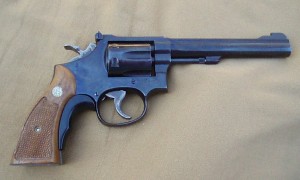
REVOLVERS are guns with cylinders that turn (clockwise or counter-clockwise depending on the manufacturer, model, and date issued) to allow a new bullet to present itself before the firing pin in its turn before the barrel. They are also called “Wheel” guns, and may or may not have an exposed hammer. Some hammers are shrouded so the hammer won’t get caught on clothing. They will hold from five to nine rounds depending on caliber and model. Revolvers do not usually have safeties. Not being cocked and/or not having the trigger pulled back is the revolver’s sole safety method. Older guns may be fired if the hammer is struck by force and the firing pin hits the shell’s primer. That is why most cowboys carried the cylinder under the hammer empty. Modern revolvers have a block between the pin and the primer unless the trigger depressed when the hammer falls. There are two types of revolver: the DA, for double action and the SA, for single action. With an SA you have to cock the hammer to move the cylinder (think cowboy gun) or the DA, whose cylinder turns as you squeeze the trigger, or when you cock the hammer.
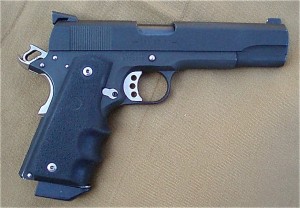
A SEMI-AUTOMATIC handgun has no cylinder, but is fed cartridges (bullets are the nose of a cartridge) from a magazine (housed in the handle), which holds the cartridges in a stack under pressure from the spring. As each bullet is fired, the receiver slides back from the pressure of the explosion and the extractor grabs the rim of the casing to pull it from the chamber, and flip it out to the right. (There are a few left-handed 1911s whose casings flip to the left). The receiver then moves forward under spring tension and, as it goes, it pushes the next cartridge in the magazine into the chamber and leaves the hammer (or striker assembly in the Glock) cocked for the next trigger pull.
All handguns have some safety mechanism. Some have magazine disconnects (won’t fire without at least an empty clip in place) or some firing pin block (to prevent firing when dropped) is usually incorporated. Most semi-automatics have one or more safeties, and some have none to speak of except a lack of trigger pull. A Colt 1911 (They come in several calibers including .45 ACP, .38 Super. 9MM, and .22 LR) has several including a thumb safety, a grip-strap safety, and on some a half-cock, and one that involves pushing back the receiver a fraction of an inch to prevent it from firing. The latter would be a last ditch to keep the gun from going off, and if you miscalculate and the gunman is lucky, the bullet will pass through your palm. When semi’s last bullet is fired and its case ejected, the receiver locks open to let the user know the weapon is out of ammunition. Slap in a mag, release the receiver, and there’s a new round in the chamber.
You will hear over and over that “Glocks do not have safeties.” But they do. Glocks do not have “external” safeties, but they have the two-part “safe-trigger” which actually is a safety. On a Glock the “Striker” (no internal hammer) is half cocked by the first 1/4″ of slide retraction while chambering a cartridge. The other “half-cocking” of the striker is the first stage take up of the trigger pull. On a Glock you get ONE SNAP, then you have to jack the slide resetting the half cock on the striker to have another snap. With some practice you can only pull the slide back just enough to reset the action without ejecting the “dud” round for another try. Interesting isn’t it? There may be exceptions to what I’ve written, but I think it is accurate enough to get a writer around in a shootout. And probably more than most of you want to know.
A cartridge is made up of four parts: Casing, Bullet, Primer, and Gunpowder. The bullet is the projectile that is seated in the casing, but the cartridge is never accurately called a bullet. A shotgun round is referred to as a shell. A shotgun shell (or round) that has been fired is often called a hull. A shotgun shell holds either pellets or a single slug.
A magazine can hold as many rounds as its length and width accommodates. Some mags hold bullets in a straight line and some are wider to allow staggered rounds. Low capacity factory magazines hold from six to eight rounds. You can keep one on the chamber to add an additional round to the gun’s capacity. Hi-capacity magazines hold more shells than a standard mag. I have had fifteen round mags, and some handgun magazines hold twenty or even thirty rounds. Some handgun drum magazines hold more …a lot more.
A magazine can be called a clip. In the military a rifle or machine gun has a Magazine, handguns can have clips. People rarely say clip any more but it was once common to call any magazine a clip. There are clips that hold .45 ACPs in a half moon for use in .45 LC revolvers, and to shoot 9MM rounds in a 38, but they are rare enough that an author shouldn’t need to concern themselves with those.
There’s lots more to know like available calibers, shotgun gauges, How a barrel length’s effects powder burn and velocity, range, knock-down values, recoil, and trajectory. There are enough bullet types and weights to fill several books. And every author who writes weapons should buy a copy of Gun Digest so they can read about and look at the weapons they write about. Write it off as reference material. Get the latest one you can find because they add new gun models yearly, but anything in the past ten years is plenty for most applications. Any bookseller has them and EBay has lots of them used. Here’s the link:
You can study guns for the rest of your life, but the truth is, authors don’t need to know very much to keep from writing someone shoving a clip into a revolver, playing Russian Roulette with a Glock, or just writing convincingly about what a character has in their hand, handbag, or holster, or how that gun works.
Taming POV: Think Camera Placement
Taming point of view is a critical step toward taming a story.
A couple of times a year, I teach daylong seminars on writing suspense fiction. In one of my favorite writing exercises, I prompt students to picture the image of a 14-year-old boy stepping out the back door of a bar at 11:00 pm and lighting a cigarette. Then we spitball ideas as to the kid’s motivation for being there and doing that. It turns out that there are any number of reasons why a kid would be lighting a cigarette behind a bar, not the least of which is that he needs a cigarette. Sometimes a cigarette is just a cigarette, right?
To develop the exercise even further, though, for illustrative purposes, I tell students to assume that the kid is signaling another person. It could be that the coast is clear, or that he has the ransom or that the bartender is dead. Or something else. Just for grins and giggles, let’s say that he’s signaling that he’s successfully robbed the place, and that the accomplice can move on to the next step.
That scene could be described from any number of points of view:
- The kid’s POV;
- The POV of the guy who’s awaiting the signal;
- The POV of a passerby; or
- A combination of all of the above.
[Note to JSB: Those semicolons are for you, my friend, because I know how much you love them. :-)]
Once the point of view has been selected, everything else in the scene should flow through the POV character’s worldview. Remember, we’re showing, not telling.
From the kid’s point of view, does the smoke burn his throat and chest and make him cough, or does it calm him? Each of those choices develops the character differently. Are his hands shaking or are they steady? Is he frightened, excited, happy or sad? What does he see through the darkness? What does he hear?
From the accomplice/bad guy’s point of view, does he think of the kid in admiring terms or in deprecating ones? There’s a world of difference between,
That’s it, he thought. Tommy came through. Maybe this nightmare was about to end, and
It’s about time, he thought. The kid took his sweet damn time, but he finally grew enough smarts to do what was good for him.
What would a passerby think of this scene? Appalled, maybe, that a kid was at a bar to begin with, not to mention being out this late and smoking a cigarette. Suppose the passerby is his teacher. Is she disgusted to see him, or is she terrified that he might see her?
The students in my class make their own choices on motivation and POV and then I give them five minutes to write a scene. I am always amazed by how many words they can commit to paper in so short a time. Those who are willing to share what they’ve written are given an opportunity to read aloud. In one particularly memorable example, one of the students—a woman of a certain age—assumed the point of view of the kid’s teacher, and the essay went into detail of just how much she wanted him naked in bed with her. And it was well written. When she was done, it was as if she’d drawn a vacuum on the room. Silence. Yes, her piece made everyone squirm, but I give her credit for originality.
Think camera placement.
In my thriller series, Jonathan Grave is a badass weapons expert and saver of lives. Because he is the star of most of the scenes in which he appears, sentences like these work just fine:
Of the five bad guys who swarmed through the gate, three carried AR15 clones. That was plenty enough firepower to ruin his day, but Jonathan was far more concerned by the two goons on the flanks who toted M14s. When the balloon went up, they needed to die first.
The gun porn is important to a lot of my readers, but it will be glossed over by others. Either way, every reader will understand that Jonathan is keenly aware of his surroundings. At the very least, readers will understand that two guys’ rifles are more powerful than the other three.
Now let’s take that same action and write it from the point of view of a ten-year-old hostage who’s watching from a window.
Billy knew that he was supposed to be hiding, but he couldn’t help himself. Leaning in from the side, and pushing the drapes away just a little, he could see the expanse of the yard while exposing only one eye. His heartrate tripled. There were five of them. They all carried rifles—long, black, ugly things—and they all looked angry.
Billy’s POV has nothing to do with weaponry or tactics, and everything to do with his emotions. In either point of view, the reader would still know that there were five bad guys and that they were all well-armed.
The same scene written from the POV of the approaching bad guys might go something like this:
Parker would have sold his soul for a little cover. He tried to keep his team separated and therefore make a more complicated target, but there’s something about human nature that makes people want to stay close when they’re scared. And if these boys weren’t scared now, then they just didn’t understand the peril they were in. For the fifth time in the last minute, Parker ran his right thumb along his M4’s selector switch to make sure that it was still set to full-auto.
Either of these approaches would advance the story toward the same point, but by choosing the appropriate point of view, you choose which character will be more developed in the reader’s mind. Jonathan can’t know how frightened Billy is, nor can he know about Parker’s frustration with his team. Billy would be too scared to worry about anyone other than himself. For maximum impact in a scene like this, I would likely break the action into parts and tell the story from all points of view, with a physical space break between POV changes.
The approach that never works is one that goes something like this: Parker’s team worried that they were wandering into a trap . . . Teams don’t think in unison. Individuals within the team think unique thoughts which may or may not be similar to others’ but there’d be no way for them to know without talking about it. That’s where dialogue comes in.
And I’ll talk about that in a couple of weeks.
When Literature Got Its Groove On, In The Desert
It’s not every night you get to see a Nobel Laureate rock the stage in the middle of the California desert. But I was lucky enough to be in the audience of 75,000 last week when Bob Dylan, who had just won the Nobel Prize for Literature, performed at Desert Trip II.
Dylan, ever the iconoclast, didn’t make reference to his new award while he was on stage–in fact, he’s been so quiet about the whole thing that the Swedish Academy has “given up knockin’ on Dylan’s door” to find out whether he’ll attend the award ceremonies in Stockholm later this year.
My favorite moment of the three-day music festival took place the next night, when Neil
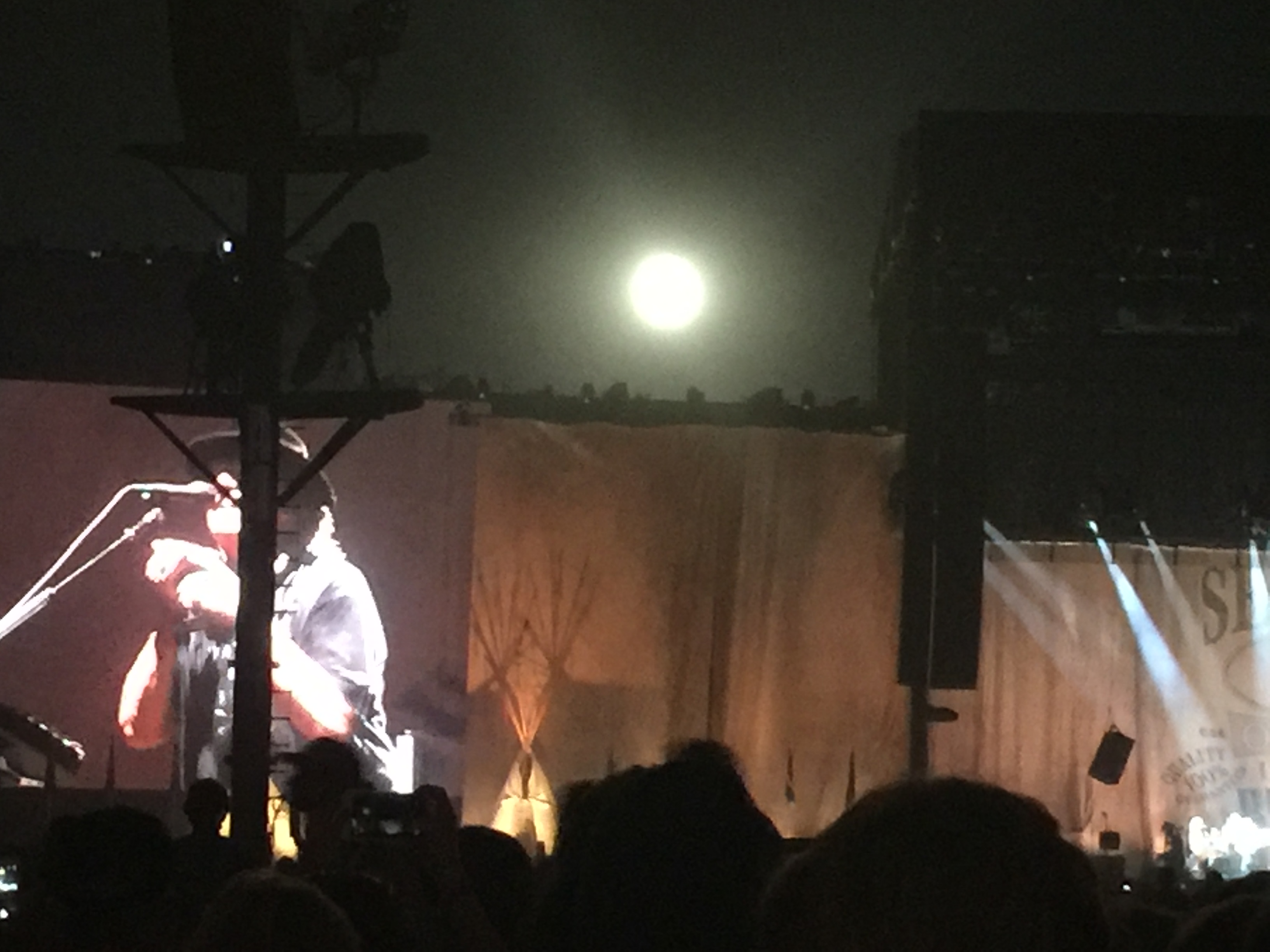 Young sang “Harvest Moon” just as a full moon rose over the stage.
Paul McCartney, the Rolling Stones, The Who, and several other iconic bands and singers rounded out the three day festival in Indio, California.
I was interested to learn that there was some nattering nabobing about the fact that Dylan, a song man, is being given the world’s highest prize in literature. I’m not even a huge music aficionado (I listened to Karen Carpenter and Neil Diamond when I was a young, not the “cool” bands, I admit), but I love the fact that Dylan won the award. What do you think of the fact that the Nobel Prize for Literature went to a song man this year, and to Dylan in particular? Was this a good call by the Swedish Academy?