READER FRIDAY: Confession Time: I have never…(finish it).

Call it overly sensitive, but I don’t like to see any movie where humans ARE FOOD. Gives me the shivers. My confession?

I have never…SEEN JAWS.

I have never…seen the Grand Canyon. (I hope to remedy this in 2020.)

As 2019 comes to an end, it’s time to come clean with your TKZ family. Share something you have NEVER DONE that we might find surprising.

Keys Ways to Begin A Story – First Page Critique: The Young Lieutenant’s Dog

Jordan Dane
@JordanDane
National Archives and Records Administration [Public domain]

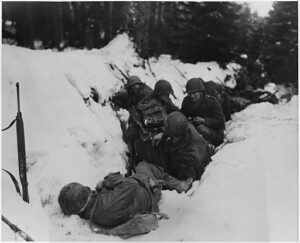
One of my last First Page Critiques for 2019 and of course it is about a dog. Please enjoy this anonymous submission for your consideration – The Young Lieutenant’s Dog. My feedback will be on the flip side, after my thoughts on book introductions.

***

The history of humanity is held in the fragile palm of our stories. When they are lost, a part of us leaves with them. Perhaps that is why, even as a young child, I treasured the stories my father told us. Although a born raconteur he was, however, oddly reticent to discuss the most dramatic story of his life: his role in WWII.

With an older brother and sister on the cusp of adolescence and I still engrossed in childhood, we were too young to understand the brutality of war. Thus intrigued and naive, we cajoled him mercilessly to tell us about his life in the army during those years, especially when the tales spoke of life-and-death adventures.

Unlike his other stories, which were invariably charismatic and often humorous, those from the war were meant to serve, like Aesop’s Fables, as a moral lesson for his children to learn. I didn’t grasp this until many years later when it was too late and my father was gone, felled by a heart attack. By then, the stories he’d told were either forgotten or punctured with holes, the remaining threads barely clinging to our fragile childhood memories. But one remains, fixed with absolute clarity as if it had been related just moments ago.

I always assumed that I remembered this one because it was about a dog. But, of course, it was much more than that.

In light of the horrendous events of WWII, many have forgotten that in the early years of the war, the United States stood staunchly isolationist. Our country was still struggling to recover from WWI and a cascading depression. On September 3, 1939, Great Britain declared war on Germany. Our President, Franklin Delano Roosevelt, and his staff, watched with mounting concern the steady onslaught of Hitler’s armies and knew that it was not a question of “if” the United States would enter the war, but “when.”

***

Keys Ways to Begin a Story

There are many techniques to begin a novel – from an intriguing first line that triggers questions in the reader’s mind, to the paragraphs that draw the reader into a mystery or suspenseful action or a compelling story.

A good hook gets to the point quickly to raise a question or shock the reader into reading on. If a story begins in the voice of a narrator, that voice must be intriguing from the start. Successful openings raise unanswered questions or they describe intriguing actions/events or they highlight odd or troubling scenarios of intrigue or suspense.

Here’s a few types of intriguing opening lines:

1.) Teaser Line:

“I was born twice: first, as a baby girl, on a remarkably smogless Detroit day in January of 1960; and then again, as a teenage boy in an emergency room near Petoskey, Michigan, in August of 1974.” Jeffrey Eugenides – Middlesex

2.) Autobiography

“Whether I turn out to be the hero of my own life, or whether that station will be held by anybody else, these pages must show.” Charles Dickens – David Copperfield

3.) Dialogue

“‘Where’s papa going with that ax?’ said Fern to her mother as they were setting the table for breakfast.” E. B. White – Charlotte’s Web

4.) Announcer/Omniscient POV

“The year 1866 was signalized by a remarkable incident, a mysterious and inexplicable phenomenon, which doubtless no one has yet forgotten.” Jules Verne – Twenty Thousand Leagues Under the Sea

5.) Scene Setting

“It was a queer, sultry summer, the summer they electrocuted the Rosenbergs, and I didn’t know what I was doing in New York.” Sylvia Plath – The Bell Jar

The Next Paragraphs – Following a solid first line or a quick and compelling intro, the next paragraphs must draw the reader deeper into the story with more questions. This is where storytelling comes in and patience. Make the reader ask, “Who? What? When? Where? Why?” Think about an interesting, seemingly unimportant detail of a character or setting that can become symbolic to your story’s larger themes. In the case of our story for submission, that detail is brilliantly the dog.

No matter how great the first line is, if the paragraphs that follow don’t draw the reader deeper into the story, that great opening is deflated and reads like a gimmick.

Below is an example of an intriguing opening line from Paula Hawkins – The Girl on the Train, followed by paragraphs that draw a reader into the story as questions are raised by the author.

Excerpt

She’s buried beneath a silver birch tree, down towards the old train tracks, her grave marked with a cairn. Not more than a little pile of stones, really. I didn’t want to draw attention to her resting place, but I couldn’t leave her without remembrance. She’ll sleep peacefully there, no one to disturb her, no sounds but birdsong and the rumble of passing trains.

#

One for sorrow, two for joy, three for a girl . . . Three for a girl. I’m stuck on three, I just can’t get any further. My head is thick with sounds, my mouth thick with blood. Three for a girl. I can hear the magpies—they’re laughing, mocking me, a raucous cackling. A tiding. Bad tidings. I can see them now, black against the sun. Not the birds, something else. Someone’s coming. Someone is speaking to me. Now look. Look what you made me do.

This introduction leads into a morning where the reader meets the narrator – Rachel. It’s a short intro written with patience that raises lots of questions and paints a mystery in the reader’s mind. There are ominous visuals like a secret grave, the disturbing rumble of passing trains, the muddled mind of the narrator, and the bad tidings of magpies. There’s no real action, but since the intro is short and very much to the point, without diversions into backstory, this opening works well.

FEEDBACK

My notion of critiquing is to provide feedback that’s in keeping with the essence of the story the author submitted. I don’t want to rewrite lines as much as I want to give a 30,000 ft view of the overall beginning and analyze it for impact.

I liked what the author submitted. It was well-written and unfolded a story I would be curious to read, but I wanted to provide an alternative way to take the essence of this story and reorganize it to tell a tighter narrative. I truly want to know about this man and his dog story. I also like the title. It hints at the mystery of the story. Who doesn’t love a dog in wartime story? There are so many ways to parallel the innocence of a dog with the horrors of war and the potential for the redemption of humanity through the eyes of man’s best friend.

My thoughts, without knowing where this story is going, is to intrigue the reader’s mind with questions about the mystery. I also love stories that start in the present, but delve into the past for answers to a mystery. Hence, the ending that implies a grown child had been intrigued enough to dig into his father’s most memorable story to uncover the truth. That definitely would hook me. Why is the dog story the one this narrator couldn’t forget? How will the mystery unfold? Whose life will be changed by the reveal? What’s the journey of this book? The author has teased us with a wonderful mystery with lots of promise. Kudos.

Tighter Narrative for Mystery Setup

Although a born raconteur, my father was oddly reticent to discuss the most dramatic story of his life: his role in WWII. His tales of life-and-death adventures in the army became an enticing mystery for my brother, sister and I, as curious children. His stories from the war held even more significance after he died of a heart attack years later. After we realized his stories were meant to serve as moral life lessons for his children to learn–like Aesop’s fables–they became a message from the grave that kept him alive in our minds.

One treasured story remained, fixed with absolute clarity as if it had been related moments ago. I never forgot it and always assumed that I remembered this one because it was about a dog. But, of course, it became much more than that–after I uncovered the truth.

As rewritten, this rearranges the original submission to a first line I thought held a particular mystery to pique the attention of any reader. It focused on a story-telling father who played a particular role in WWII that he held back. Why? What role?

I then picked out a tighter narrative with a flow that is more direct and leads quickly to the point of the introduction – to set up the mystery of the dog. I added my own interpretation of the narrator uncovering a truth about the story so the reader gets hooked faster. I also chose to leave out the history lesson in the last paragraph. After the author has the reader focused on a mystery about a dog during wartime, the back story deflates the mystery and slows the pace. That morsel could be saved for later, along with the character development of the surviving children.

As written, this story may leap back into the war to tell the story of a young Lieutenant’s dog. That’s fine too, but if that’s true, why begin with a child’s memory and a son as a narrator? I made an assumption that this story will be woven between the past and the present. I don’t have enough to go on with the first 400 words, but my intention is to show an alternative intro that perhaps is more complicated by weaving in a mystery that straddles the line between past and present.

This story could be like Bridges of Madison County where surviving children uncover a mystery in the life of a deceased parent and the story unravels that truth. That’s my assumption.

The rewrite is similar to the Paula Hawkins excerpt for The Girl on the Train. It’s laser focused on the essence of the story and creates questions in the reader’s mind, before it starts telling the actual story through the eyes of the storyteller.

DISCUSSION:

Please provide your constructive criticism of this compelling submission, TKZers. How do you see this story unfolding?


 

I Hate Being Caught Being Wrong

By John Gilstrap

I’m writing this on Monday evening, December 2, 2019.  This morning, I submitted my copy edited manuscript back to my publisher, having endured my annual pity party centered around the theme, “If you know so much, write your own damn book.”  It’s the constant picking at the niggling details that make me crazy.  Yeah, I get that “which” vs. “that” is a real thing, as is “farther” vs. “further”.  And, as I discussed last time in my epistle about my comma conundrum, I’ve accepted that I’ll never get certain things right.

But come on.  “We can’t take this argument any further/farther.”  They both make sense.

Copy editors make me think too hard, that’s the problem.  (See that friggin’ comma splice?  Boy, did we hammer on comma splices at my last critique group meeting!)  Even I–the passionate purveyor of the principle that there are no rules in writing–admit that there are rules to grammar, and I try very hard to stay out of the way of those who understand these things.  But then there are the stylistic choices.  Such as . . .

In my original draft, I wrote, “Sid asked for a Maker’s-rocks”.  (By the way, that comma is properly positioned.  You know, in case someone asks.)  The copy editor changed it to “. . . Maker’s Mark Bourbon on the rocks”.  My first instinct was to ignore the comment, but then I wondered if maybe I was unclear.  Sid is in a bar, for crying out loud. Doesn’t the context fill in whatever blanks there might be?  The word, Bourbon, was a non-starter, but should it be Maker’s Mark on the rocks?  On the first pass, I accepted that part of the change, but on the second pass, I switched it back to my original.  That sounded best to my ear.

Shouldn’t “God-forsaken” be capitalized?  The copy editor lower-cased it, and for the life of me, I don’t understand why.

And then I stumbled upon The Big One.  The.  Big.  One.  How I missed this in my own editing passes is beyond me, but miss it I did: A nighttime shootout sandwiched between two daylight scenes.  Wait.  What?  Holy crap!

My stories are all told on a pretty tight timeline, with the events of one scene having ripple effects through other subsequent scenes.  The shootout couldn’t be moved from its slot in the story, and the results of said shootout have a massive impact on the next 250 pages of story.  Have I said holy crap yet?  Well, here it is again: Holy crap!

So, I had to re-engineer the shootout to happen in the daytime.  From a tactical perspective, that changes everything.  Different gun sights, different approach to the building.  Different everything.  But I fixed it.  I made it work, and I think I was able to stitch the downrange damage back together.  I think.

Actually I’m sure.  Well, pretty sure.  Damn.

It looks like I’ll be reading the page proofs more carefully than usual in a couple of months.

Meanwhile, here it is for the record: Thank you, Mr. Copy Editor for catching The Big One while there was still time to fix it.

I hate being caught being wrong.

What Is This Historic Mystery Stone?

By Sue Coletta

One of my recent research trips led me to the New Hampshire Historical Society and Museum. I went there to copy two diaries — one from 1880, another from 1881 — written by a close family friend of the victims and female serial killer, a man who gave a fascinating firsthand account of daily life before, during, and after the murders. Reading the handwriting is a challenge that I’m still working on.

Quick research tip: if you ever find yourself in a similar situation, it helps to photograph the handwritten pages so you can enlarge the chicken-scratch at home.

After I finished photographing the diaries, my husband and I toured the museum, and we stumbled across an intriguing unsolved mystery.

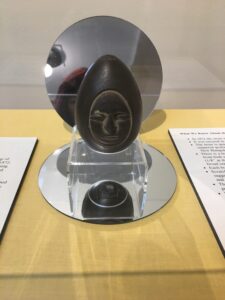
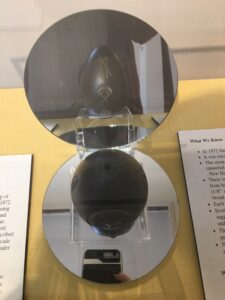
In 1872 construction workers unearthed a suspicious lump of clay near the shore of Lake Winnipesaukee (also in New Hampshire). The clay casing hid an egg-shaped stone with nine carvings, depicting a face, a teepee, and an ear of corn, along with strange geometric designs.


Amateur and professional archaeologists have speculated about the “mystery stone” ever since. At the time, the American Naturalist described it as “a remarkable Indian relic.” In the 1880s and early 1890s, sources claimed, “this stone has attracted the wonder of the scientific world, European savants having vainly tried to obtain it.”

A geological study of the stone conducted in the 1990s found it to be made of quartzite or mylonite, material not known to be otherwise present in New Hampshire. The “mystery stone” is perfectly shaped and unblemished by any distortions or markings other than the pictogram carvings. Recent examinations with a microscope suggest that the hole bored through the stone may actually have been drilled by a machine. Whether carved by hand or power tools, the stone’s manufacture indicates it lands somewhere in the mid to late 19th century. But does it?

The stone quickly gained public attention, with the New Hampshire Patriot and State Gazette, the leading newspaper in the Granite State at the time, running a piece on July 17, 1872, announcing the stone’s discovery.

With such publicity, word of the stone reached far and wide, even to European scientists, who could not discern any more about the stone’s history than the Americans. In succeeding years, newspaper stories about the stone popped up at random intervals. In 1895, the Manchester Union reported that “the strange relic has attracted much attention,” even from the likes of the Smithsonian Institute in Washington, DC. A geological survey conducted by the State of New Hampshire in 1994 failed to shed much light on the stone, either.

To this day, amateur and professional archaeologists have speculated about the Mystery Stone’s origins.

NH Historical Society writes…

The most prevalent explanation has been that the Mystery Stone is a prehistoric Native American artifact. The discovery of an unusual Indian relic was not unprecedented at the time, encouraged by a highly romanticized view of America’s native heritage developed in the mid-19th century, especially in the East where fears of Anglo-Indian conflict were generations in the past.

An increasing reverence for the power of nature combined with nostalgia for a pre-industrial America combined to elevate Native Americans to the role of “noble savages” for many Americans. Indians’ perceived ability to commune with a pristine and unspoiled environment lent an air of mystery to the natural world, suggesting that natives could somehow unlock the secrets of the universe in a way that “civilized” men and women were no longer able to do, bound as they were by an overreliance on logic and reason and wholly cut off from their more intuitive and emotional natures by the standards of society.

The anomaly of the stone’s alleged “machine-made carvings” and the fact that it was composed of a rock type not found in New Hampshire could never be explained, nor does it support the idea that the stone is of Native American origin. The native culture depicted on the stone bear no resemblance to the Abenaki, New Hampshire’s native people. The face on the stone likens more to Eskimo or Aztec culture, and the carved teepee leans more toward natives in the American West.

Some Mystery Stone enthusiasts have suggested that the stone has spiritual significance for a prehistoric native culture that once covered most of North America. If that’s true, the stone may depict the forging of a treaty between two different tribes, or it may have been part of a ritual that accompanied a water burial for a native figure of importance in New Hampshire.

Over the years, other theories as to the stone’s origin have been posited. In 1931 a letter-writer suggested to the president of the New Hampshire Historical Society that the Mystery Stone was actually a thunderstone (rocks that fall from the sky during lightening storms), calling it “the most perfectly worked thunder-stone ever discovered.”

Another more recent theory argues that it is a lodestone, a natural magnetized mineral used for navigational purposes in the 16th century as an alternative to a compass. Other theories link the Mystery Stone to numerology, aliens, massive planetary shifts, or a worldwide apocalypse.

Facts 

We know the stone was found encased in clay in 1872 at Lake Winnepasaukee. The stone is either quartzite or mylonite, neither rock type found in New Hampshire. There is a hole bored through both ends, done with different sized bits — 1/8″ at the narrow end, 3/8″ at the broad end. Each bore is straight, not tapered. Scratches on the stone’s lower bore suggests it was placed on a metal shaft and removed several times (which might make sense if it’s lodestone and was used as a compass). There’s a notch or divot in the bore. Perhaps it’s some sort of “key” for mounting the stone?

The mystery…

Who made the stone?

Who carved the stone?

For what purpose was the stone made?

How old is it?

How was the stone carved, by hand or machine?

No one else has ever reported finding another stone like this anywhere in the United States. The one thing that most Mystery Stone interpreters can agree on is that it’s an “out-of-place artifact.” Meaning, it should never have been discovered in New Hampshire.

Any guesses what the Mystery Stone might be?


Learning From the Movies: The King’s Speech

by James Scott Bell
@jamesscottbell

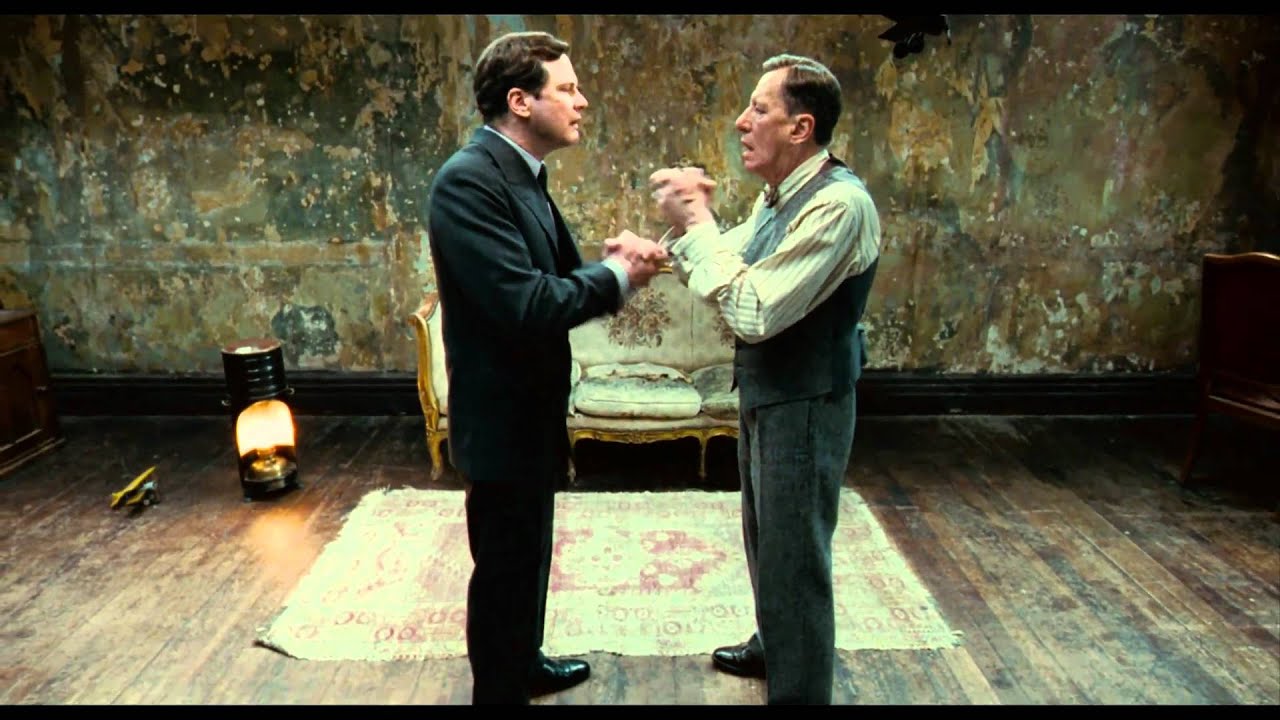
Colin Firth and Geoffrey Rush in The King’s Speech

Imagine a hungry young screenwriter getting invited to a pitch session on a studio lot.

“What’ve you got for me, kid?” the producer says.

“Okay,” the screenwriter says, “we have this guy, see, he’s a king, see, and he’s got to make a speech. Only the guy stutters.”

“What’s the rest of it?”

“The rest of what?”

“The movie!”

“That’s it. That’s the movie! And at the end, see, he makes the speech.”

“Security!”

And yet The King’s Speech (2010) won Oscars for Best Picture, Actor, Director, and Screenwriter. How did they pull that off?

Through the power of character bonding and the magic of story structure. You can do just about anything with your novel so long as you have a reader intensely and emotionally invested in your Lead and put him through the beats of a well-crafted tale.

Let’s talk about emotional investment first. In Plot & Structure I discuss various ways a writer can join reader and character in the bonds of holy storytelling. One of the strongest bonding agents is hardship—at the beginning we are introduced to a character who faces a physical or emotional challenge.

In The King’s Speech, the hardship is both physical and psychological. Prince Albert, the Duke of York (Colin Firth) has a severe stammer which not only prevents him from delivering a simple speech; it also keeps him locked in a prison of self-doubt.

As the movie opens we see Albert nervously stepping up to a microphone to speak to a crowd. His stuttering talk bombs. People look embarrassed and disappointed. Prince Albert’s hardship has caused him massive public humiliation.

We’ve all been embarrassed, though not on so grand a scale. So we have immediate sympathy.

But that’s not all. There’s another powerful bonding agent I call the Care Package. This is a relationship in place before the story begins, showing that the Lead is not merely self interested. If we see someone who cares about someone else, it gives us hope for his ultimate redemption.

Early in Act 1 there is a lovely scene that gets me every time. Prince Albert, all done up in a tux, comes to say good-night to his two daughters. They want a story! “Can’t I be a penguin instead?” he asks. Clearly, he doubts even his ability to tell his children a simple bedtime tale. But they insist!

And so, out of love and fatherly duty, he makes the attempt. He tells a story about two princesses whose papa was changed by a witch into a penguin. This made him sad, for a penguin does not have arms to embrace his children. Not only that, the witch banished him to the South Pole. It’s obvious he is talking, metaphorically, about himself. The story ends with a restored father hugging his daughters. We can’t help but wonder if Albert will be healed, too. By now we hope so, because we are firmly invested in him.

The Duchess (Helena Bonham Carter) arranges a meeting for Albert with an eccentric speech therapist named Lionel Logue (Geoffrey Rush). Here we get another structural beat: The Argument Against Transformation. Unconvinced Lionel can help him, Albert is about to leave when Lionel asks him to try something. He puts headphones on the prince and plays classical music while having the prince read the famous soliloquy from Hamlet. After a minute or so Albert rips off the headphones and shouts, “Hopeless!” Then: “Thank you, Doctor. I don’t…feel this is for me.”

This sets up the arc of transformation that pays off at the end. (In Casablanca, Rick argues against his ultimate transformation by saying, “I stick my neck out for nobody.” At the end, of course, he does that very thing.)

The First Doorway of No Return

In a movie we need to get into the death stakes of Act 2 by the 25% mark (for novels, I advise 20% at the latest). That happens when the Lead is forced—either physically or emotionally—through a doorway that slams shut behind him (meaning he can never go back to his ordinary world). In The Wizard of Oz and Gone With the Wind, it’s physical (a tornado and the start of the Civil War, respectively). In Casablanca, it’s emotional (the arrival of Rick’s lost love, Ilsa).

In The King’s Speech, Albert is emotionally thrust through the doorway by his domineering father, King George V. Sitting his son down in front of microphones he says, “With your older brother shirking his duties, you’re going to have to do a lot more of this.”

Albert tries, but can’t get started. “Do it!” the king demands.

Later, in emotional torment over what he must be—and firmly believes he can never be—Albert puts on the recording Lionel made. And to his astonishment he’s read the soliloquy perfectly. Now he must place his trust in Lionel or “die” inside by letting down his entire country.

Mirror Moment

In the dead center of great stories the Lead is forced to look at himself, as if in a mirror (usually metaphorical, but it’s amazing how often there’s a physical mirror involved). Sometimes this is caused by another character forcing the issue.

That’s what happens in the middle of The King’s Speech. Albert is terrified at the prospect of being king (which will happen soon, for his brother is going to marry a divorcee). Lionel knows this fear is what’s holding Albert back as a speaker, a royal, and a person.

Lionel: I’m trying to get you to realize you needn’t be governed by fear.

Albert: I’ve had enough of this.

Lionel: What are you so afraid of?

Albert: Your poisonous words!

Lionel: Why did you come to me? You’re not some middle-class banker who wants elocution lessons so you can chitchat.

Albert: Don’t attempt to instruct me on my duties! I am the son of a … king.

And the brother of a king.

Albert: You’re the disappointing son of a brewer. A jumped-up jackeroo from the outback. You’re a nobody!

That last line is a knife through Lionel’s heart. In Casablanca, the same thing happens when Rick basically calls Ilsa a whore. Both Rick and Albert must now “look at themselves” and wonder, “Is this who I have become? Is this who I will always be?” (In film, these thoughts are rendered visually; in a novel, you can also use interior monologue.)

The Second Doorway

To get into Act 3, where the final battle takes place, we need another doorway. It’s going to be a clue or discovery, or a major crisis or setback—something that makes the ending possible and/or inevitable.

In The King’s Speech it’s a major crisis: Hitler invades Poland. A state of war exists. And Albert has just been crowned King George VI! Now it is his duty to address his kingdom, and in such a way as to inspire iron resolve for what is coming.

No pressure.

The Q Factor

Just before the climax, the Lead takes inspiration from an emotional jolt, giving him the courage to fight. I call this The Q Factor (named after the Bond character who sets up in Act 1 the gadgets Bond will need to escape in Act 3). In story structure, it’s an emotional connection that pays off by providing the last bit of courage the Lead needs. In Star Wars, for example, Luke hears the voice of his beloved mentor, Obi-Wan Kenobe, reminding him to “use The Force.”

In The King’s Speech, just as Albert steps to the microphone, Lionel tells him, “Say it to me, as a friend.” Not simply a teacher, a friend! That trust which began in Act 1 now enables the victory as Albert delivers an inspirational speech. The movie ends by proving the transformation: Albert—King George VI—steps out on the balcony with his wife and daughters and confidently waves to the adoring crowd.

Character bonding, the right structural beats (and great acting!)—that’s how a movie about a man who stutters became a huge, award-winning hit. (I discuss the fourteen super structure beats in my book of the same name. End of commercial!)

You can think about these beats before you write; you will develop a solid outline that way. Or you can think about them during revision as you try to figure out why your editor or beta readers aren’t as enthusiastic about your story as you are.

Either way, they are here to help. Because, after all, story and structure absolutely love each other!

Giving and Receiving

Photo courtesy of Gregor McEwan on unsplash.com

I hope you had a wonderful Thanksgiving. The following took place in the weeks leading up to it. You will please note that I am still sorting it all out. 

I received on Thursday, November 7 an invitation to an email casting call for extras to be used in a feature film. The invitation requested a headshot, a full-length photo, my name, telephone number, height, and weight. I was advised that if I were chosen I would receive an email on Monday, November 11, with instructions for the time and location of the scene shoot on November 12 and 13. 

I didn’t receive an email. That’s okay. It wasn’t my first rodeo. Anyone who has ever been involved in the arts in any capacity either gets used to receiving rejections or finds something else to do. Life goes on. 

Flash forward a week or so. It was a cold and rainy day, the type where Churchill’s black dog runs off its leash. I was coming out of my local supermarket of choice and walking to my car when I saw a guy sitting forlornly on one of those motorized shopping carts which was stopped by a car, parked in a handicapped spot, with its trunk open. The shopping cart contained, among other things, a fifty-pound bag of dog food. Folks were hurrying by in both directions with their heads down. I couldn’t blame them. We’re all in a hurry even on the best of days and that day wasn’t one of them. There was also something about the tableau that was a little off. I’m still not sure what it was. But. But. I walked over anyway and asked the gent if he needed some help. “I sure could,” he said. The guy was disheveled. He looked like he’d been living rough. He also had a speech impediment which made him difficult to understand. I picked up the bag and put it into his trunk, placing his other smaller purchases in there for good measure. He got off the cart seat, took a couple of steps, and hugged me. Closely, cheek to cheek.  I hadn’t really signed up for gratitude, particularly of this nature,  but I kind of hugged him back and started to politely disengage. Just before he let go he whispered in my ear — no speech impediment present — and said, “What you wanted will be yours. Thank you.” I nodded and smiled — the type of smile you give to a stranger who you are attempting to politely leave behind — before walking to my own car and driving home.

I spent the remainder of the day working. UPS did not deliver a five-pound box of money. Sandra Bullock did not call to ask me to drive down to New Orleans and keep her company. A soon-to-be-published, world-wide best seller-to-be did not materialize on my computer in “Joe’s Manuscripts.” The phone, however, did ring at 10:20 PM. It was a representative of the talent agency which had sent me the email on November 7. They had another shoot scheduled for the same film-in-progress on November 27 and they wondered if I would be available. 

I told the representative “no.”

I’m kidding of course. I told him “yea, yea, and yea again” and found myself on the day appointed driving to Cleveland at 3:30 AM so that I could demonstrate my acting skills by pretending for several hours to act cold, wet, and forlorn on a suburban Cleveland street corner on a rainy and windy day. And yeah. What I wanted was mine. 

I believe in coincidences in the sense that a coincidence is a higher power acting anonymously. Maybe it was a coincidence. Maybe not. My younger brother told me that it was nothing more or less than me helping a stranger on the same day that the agency decided it needed what my brother called “an affable fat f**k” for the scene in question. A very wise friend of mine, however,  said with all of the assurance in the world that I had been tested by an angel. That conclusion is above my pay grade but he may be right. Or not. 

I have the foregoing — and so much more — to be thankful for this week and every week. As always I am thankful for friends like you and for family. I couldn’t ask for any more than that at this stage of the journey.

That’s all I have today. Thanks for dropping by. Enjoy your weekend. And don’t be surprised if you’re tested as well. 

Reader Friday: Writer or Reader Gifts

What’s the best writerly gift you’ve ever received? Why was it so helpful?
Are you hoping for a writerly gift this year? If so, what?

Bonus Questions:

What’s the best gift you’ve received from an author? What made it so special?

Do you include reader gifts in your holiday promotions? Care to share where you create/buy your promotional gifts?

True Crime Thanksgiving


by Debbie Burke

@burke_writer

!

Happy Thanksgiving! 

For True Crime Thursday, I dug up a few Thanksgiving stories about fowl play–go ahead and groan, you won’t hurt my feelings.

The fight against retail theft leads to new technology at self-checkout stations. Would-be turkey-nappers leave the bird in the basket without scanning it; or they place the turkey on the scale but enter a code for a cheaper item, e.g. 59 cent/pound bananas. Here’s a link.

Thanksgiving in Canada was October 14. This video caught a woman in Ontario who thought she could stuff the bird under her shirt and masquerade as pregnant. No report if she suffered frostbitten belly.

Thieves stole 85 turkeys and pheasants from Gary and Val Ertman’s Thumb Egg Ranch in Unionville, Michigan.

According to the Saginaw/Bay City News: “The farm produces birds for purchase as babies, egg layers, and meat for a variety of customers. The farm raises ducks, geese, pheasants, quail, peacocks, chickens, and turkeys. The Ertmans also sell young birds to 4-H kids for their poultry projects.”

Normally, the Ertmans butcher turkeys on the Monday before Thanksgiving for customers who want a fresh bird. Unfortunately this year, there’s no time to raise stock to replace the stolen poultry.

“If somebody is hungry, we would feed them…but don’t steal that many,” said Gary Ertman.

Last but not least, here’s tidbit of North Dakota history. In 1925, “grand theft turkey” was a felony punishable by up to five years in the penitentiary. The law was passed after a rash of thefts from farms. The most notable case involved nine stolen birds and a high-speed (50 mph) automobile chase where neighbors pursued rowdy young locals. Thieves released the birds but were caught with two feathered kidnapping victims still in the trunk of their getaway car.

~~~

Today, among many blessings, I especially give thanks for my husband, reasonably good health, and the opportunity to pursue writing surrounded by wonderful friends including TKZ readers.

Wishing you a bountiful Thanksgiving! Hope the worst crime you experience is that darn brother-in-law who steals the drumstick you had your eye on.

First Page Critique: Neander: A Time Travel Adventure

GoDaddy stock photo

Greetings, fellow readers! It’s time for a peek at some work from one of our brave authors. Please read my comments, then add your own.

Neander: A Time Travel Adventure

I didn’t like caves.

Fears of getting stuck had often swamped my dreams. To find myself now working in one—and fighting off the panic sweats—was certainly ironic. But that’s where the best archeological evidence tended to be. I’d learned to live with it.

After rechecking the photo equipment and my to-do list again, I headed back to the entrance. Time to breathe. And call Carolyn.

I rested against the rim of Meredith’s Cave, pulled out my phone, and took in the sight of the whole Mediterranean spread out in front of me. The late morning sun danced and sparkled on the surface of the sea that surrounded Gibraltar. Gulls squawked and wheeled overhead hoping for a handout.

I spotted the whale-watching boat in the distance and pressed Carolyn’s face icon on the phone. She picked up on the second ring.

“Hey, future Dad,” she said.

“Is it great out there?” I asked, hoping—wishing—she wasn’t too upset about my sending her off on another excursion by herself. This was supposed to be a fun, together-trip to southern Spain. She was nearing the seven-month mark of her pregnancy, and this was her last opportunity to travel for a while.

“It’s amazing. We’ve already seen two pilot whales and a pod of dolphins. And Africa’s right there. I can almost touch it!”

Good. She sounded happy.

“How’s it going in the cave?” she asked.

“Fine,” I lied. “They’ve worked down another centimeter.”

The reality was, the tension was thick. And that was apart from the claustrophobia.

My assignment was to document the excavation’s progress for Science Alive, but my pushing to get it right with the lighting and the camera angles was annoying everyone. I knew that. But what were a few more minutes of attention to detail with a Neanderthal fossil that had been in the ground for tens of thousands of years?

I reached into my pants pocket and fingered the small, velvet ring box. I would propose to my beautifully pregnant Carolyn at dinner tonight. A thought that made me both nervous and excited.

I wanted this family so much.

“You’re not being too anal with them, are you?” she asked.

“Who me?” She was one of the few who understood my need for order, for perfection.

“Oh, there’s another whale! Gotta go.” The phone beeped and the call was gone.

Till tonight, I mouthed.

_____________________

Here we go:

I didn’t like caves.

Does this excerpt make you feel uncomfortable right off the bat? The opening line sets the tone: Our narrator is facing both mental and physical danger.

Good job, Brave Author. First lines are important.

A  possible red flag I can see is the use of past tense, which is important because we already know this will be a “time travel” story. It’s apparent that the narrator survives—at least in some place and time—to tell their story about the cave. You’ve missed an opportunity to create immediate suspense in the mind of the reader.

Fears of getting stuck had often swamped my dreams. To find myself now working in one—and fighting off the panic sweats—was certainly ironic. But that’s where the best archeological evidence tended to be. I’d learned to live with it.

This is a very calm, cool, expository explanation of the narrator’s intense reaction to a situation that certainly feels dangerous and untenable. So let’s have some true immediacy. Instead, let us feel his (I assume) hand shaking as he rechecks the photographic equipment, and his short, panicked breath, as he quickly heads outside to collapse against the entrance. Then you can note the irony of the situation, and have him be grateful for the calm of the sea.

“How’s it going in the cave?” she asked.

“Fine,” I lied. “They’ve worked down another centimeter.”

The reality was, the tension was thick. And that was apart from the claustrophobia.

I spotted the whale-watching boat in the distance and pressed Carolyn’s face icon on the phone. She picked up on the second ring.

“Hey, future Dad,” she said.

Should Carolyn’s whale watching boat be conveniently in the near distance? It feels coincidental. Does Carolyn have a satellite phone? Maybe I don’t know enough about these things, but such an easy cell connection seems unlikely. And “Hey, future Dad.” is confusing, as we 1) don’t yet know she’s pregnant, and 2) the time travel idea intrudes but isn’t clear.

“Is it great out there?” I asked, hoping—wishing—she wasn’t too upset about my sending her off on another excursion by herself. This was supposed to be a fun, together-trip to southern Spain. She was nearing the seven-month mark of her pregnancy, and this was her last opportunity to travel for a while.

“It’s amazing. We’ve already seen two pilot whales and a pod of dolphins. And Africa’s right there. I can almost touch it!” 

Good. She sounded happy.

This section is a well-timed mix of exposition and current action. We get a good view of Carolyn’s compassionate personality, and her state of pregnancy. The narrator sounds slightly less stiff.

“How’s it going in the cave?” she asked.

“Fine,” I lied. “They’ve worked down another centimeter.

The reality was, the tension was thick. And that was apart from the claustrophobia. 

This works. It would be a good place to add a detail about who else is down there contributing to the claustrophobic atmosphere. And be more specific about the narrator’s physical reaction to the claustrophobia. Let him own it, and continue on about how his need for order conflicts with the physical situation.

My assignment was to document the excavation’s progress for Science Alive, but my pushing to get it right with the lighting and the camera angles was annoying everyone. I knew that. But what were a few more minutes of attention to detail with a Neanderthal fossil that had been in the ground for tens of thousands of years?

See above. Let the emphasis here be on the assignment and the surprising discovery.

I reached into my pants pocket and fingered the small, velvet ring box. I would propose to my beautifully pregnant Carolyn at dinner tonight. A thought that made me both nervous and excited. 

I wanted this family so much.

“You’re not being too anal with them, are you?” she asked.

“Who me?” She was one of the few who understood my need for order, for perfection.

“Oh, there’s another whale! Gotta go.” The phone beeped and the call was gone.

Till tonight, I mouthed.

The proposal makes a really nice contrast to the tension and claustrophobia. Make sure to highlight the change in the narrator’s mood and feelings when he thinks about the proposal.

The “Till tonight,” I mouthed, is extremely awkward. Just have him say it to the empty phone line. The mouthing mention comes off as unnecessarily ominous.

Think about some alternate titles. Perhaps some TKZers will have ideas. This one has a pulp feel that the story doesn’t reflect.

Overall the action of this selection is fine. Always strive to make the story more visceral and immediate. You’ll connect better with your readers.

TKZers! Please share your thoughts with us. And Happy Almost Thanksgiving!