by Debbie Burke
One hundred years ago today, my father-in-law, Arthur Burke, was born.
I’ve been kicking around the idea of writing historical fiction. Arthur’s life contains a wealth of dramatic raw material on which a novel could be based. My imagination itches to step back in time and write about that era.
Grinding poverty defined Arthur’s childhood. His father, Daniel, was a violent Irish drunkard. Periodically, he would abscond with Arthur and his brother, then leave them in Catholic orphanages in various states. Their mother, Naomi, had to track down and recover her two young sons.
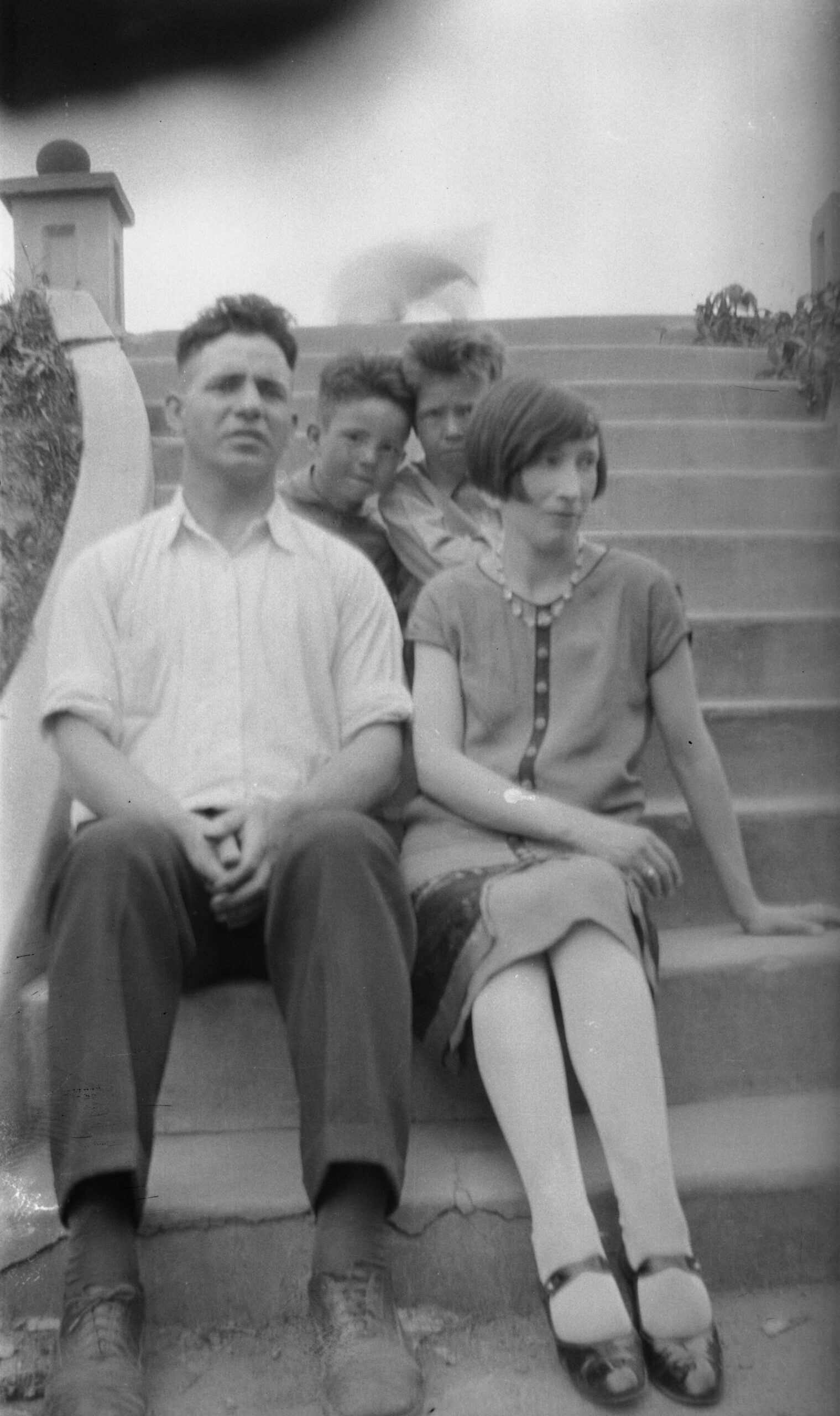
Daniel Burke with his sons and second wife

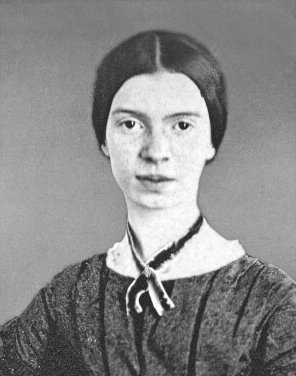
Naomi
Naomi’s death in 1978 opened up a mystery. Among her papers, my husband and I found three different birth certificates in three different names with three different birth dates. The woman we’d known as “Naomi” had hidden lives.
Today, identities are indelibly recorded in databases. Not so in the late 1800s and early 1900s, when adopting a new name was common practice for people who wanted to leave problems behind. Reinventing one’s identity was as simple as providing a handwritten statement signed by a relative or friend. One of Naomi’s birth certificates was a sworn statement by an uncle, dated years after her supposed birth date.
On another certificate, her name was Ida Mae Dalton, listing her father as Frank Dalton, a deputy marshal related to the notorious Dalton Gang. In a sad reflection of that era, Ida Mae’s mother was not even given the respect of a name on that document but was identified only as “an Indian squaw or breed thereof.”
Who was Naomi really? Did she adopt aliases to hide from the abusive Daniel? Questions linger that can never be answered.
Naomi worked as a waitress to support the family. They were already poor enough that they hardly noticed the Great Depression. For heat, Arthur scavenged bits of coal that fell from train cars. He told about being so hungry, he ate grass.
In 1933, his life took a turn for the better when Naomi married Leonard Bloodsworth, a Navy chief who was the Pacific Fleet heavyweight boxing champion. Daniel no longer represented a threat since Len could knock the brutal father into next week.
But growing up in San Pedro, California during the Depression was still difficult.
Stepfather Len became Arthur’s best role model and champion. He would sneak the hungry boy onto his ship for chow. Thanks to Len, Arthur saw a doctor and dentist for the first time in his life.
The gangly, red-headed, freckle-faced Arthur had a brush with Hollywood when he appeared in the pilot film for a short comedy. He played a character named Alfalfa in the Little Rascals and was paid 50 cents, a fortune to a poor Bowery kid. What a different direction his life might have taken if another boy, Carl Switzer, hadn’t wound up playing the memorable, enduring role.
~~~
In high school, Arthur showed extraordinary inventiveness when he built a radar set for a science project. The FBI confiscated the set because the U.S. would soon be involved in World War II and wanted to keep advanced experimental technology a secret from enemy powers.
Despite Arthur’s genius, college seemed an unattainable dream because of poverty.
Then came a stroke of luck.
Appointments to prestigious military academies like West Point and Annapolis were granted by members of Congress, usually as political favors to wealthy constituents. However, one honest politician opened the opportunity to competitive exam, allowing any young man in his district to apply.
On a lark, Arthur accompanied a friend to take the exam for the Naval Academy. His friend was accepted and Arthur made the cut as an alternate. When his buddy had to withdraw, Arthur took his slot.
After a cross-country train trip, he reported for duty in Annapolis, Maryland with cardboard liners as soles for his worn-out shoes. His classmates, mostly sons of wealthy, influential families, looked down their patrician noses at the lanky, malnourished kid from the Bowery.
Nevertheless, his scientific brilliance earned him a place in the top 10% of his class.
The attack on Pearl Harbor on December 7, 1941 forced the U.S. into World War II and, only days afterward, led to early graduation for Arthur’s Class of 1942.
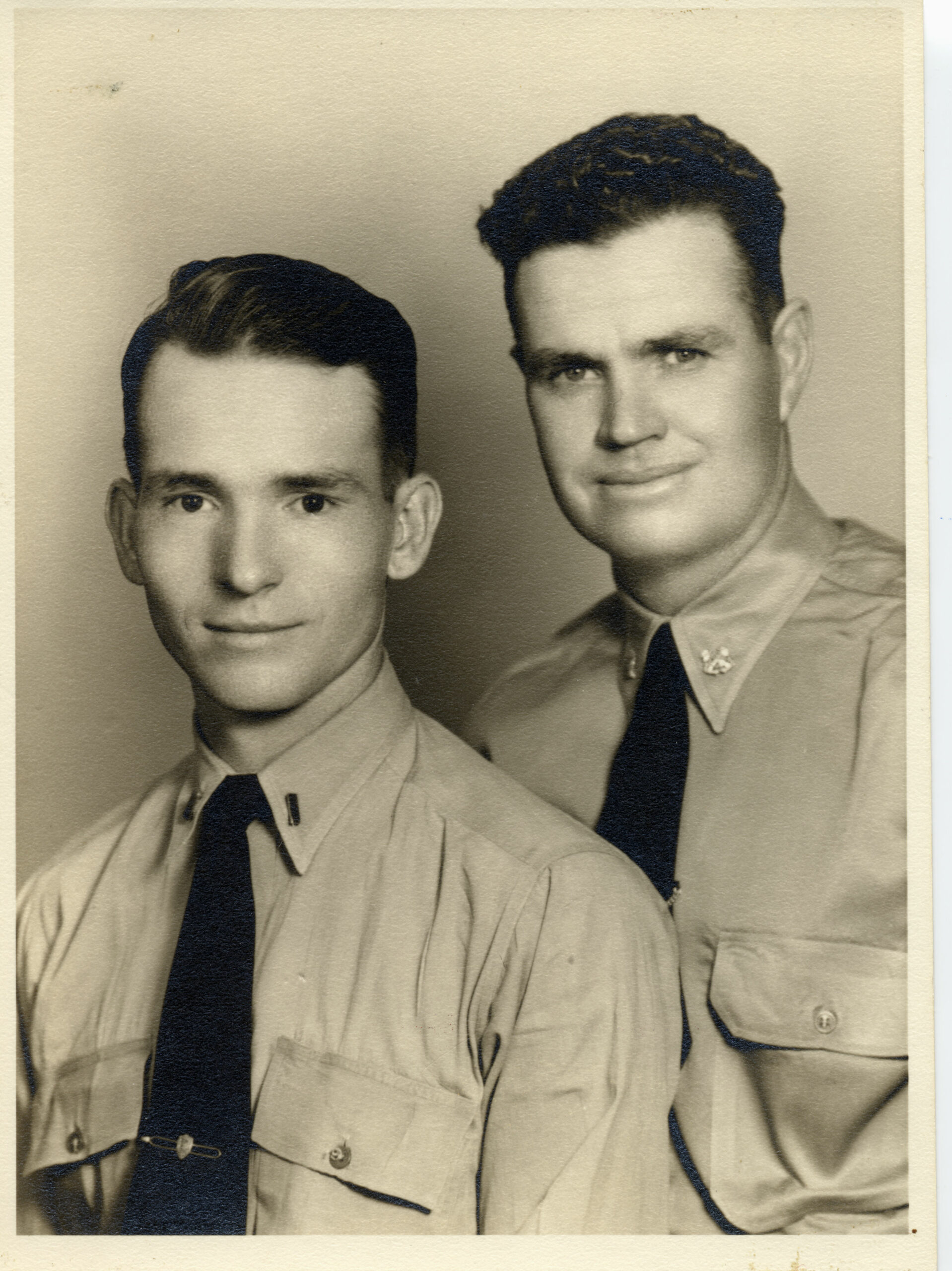
Arthur Burke and stepfather Leonard Bloodsworth
During that devastating attack, his stepfather Len was serving aboard the USS Tennessee. Eight battleships, including the Tennessee, were moored together in a group on Battleship Row in Pearl Harbor. Japanese bombs and torpedoes destroyed or disabled the most powerful ships in the U.S. fleet.
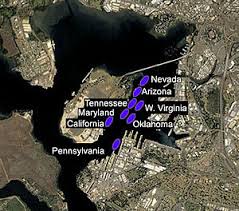
Battleship Row
As injured shipmates were pulled from fires below decks, Len threw sailors over the side of the ship into the water to save them from the onboard inferno. When the nearby Arizona exploded, searing powder and shrapnel horribly burned Len’s back. He spent a year in a hospital before returning to duty to finish out the war.
The Pearl Harbor attack left the U.S. badly outnumbered and outgunned. A battered handful of surviving ships, including the aircraft carrier USS Enterprise CV-6, represented the only defense against the advancing Japanese fleet and probable invasion of the U.S. west coast.
Arthur served on the Enterprise which became the most decorated ship of World War II.
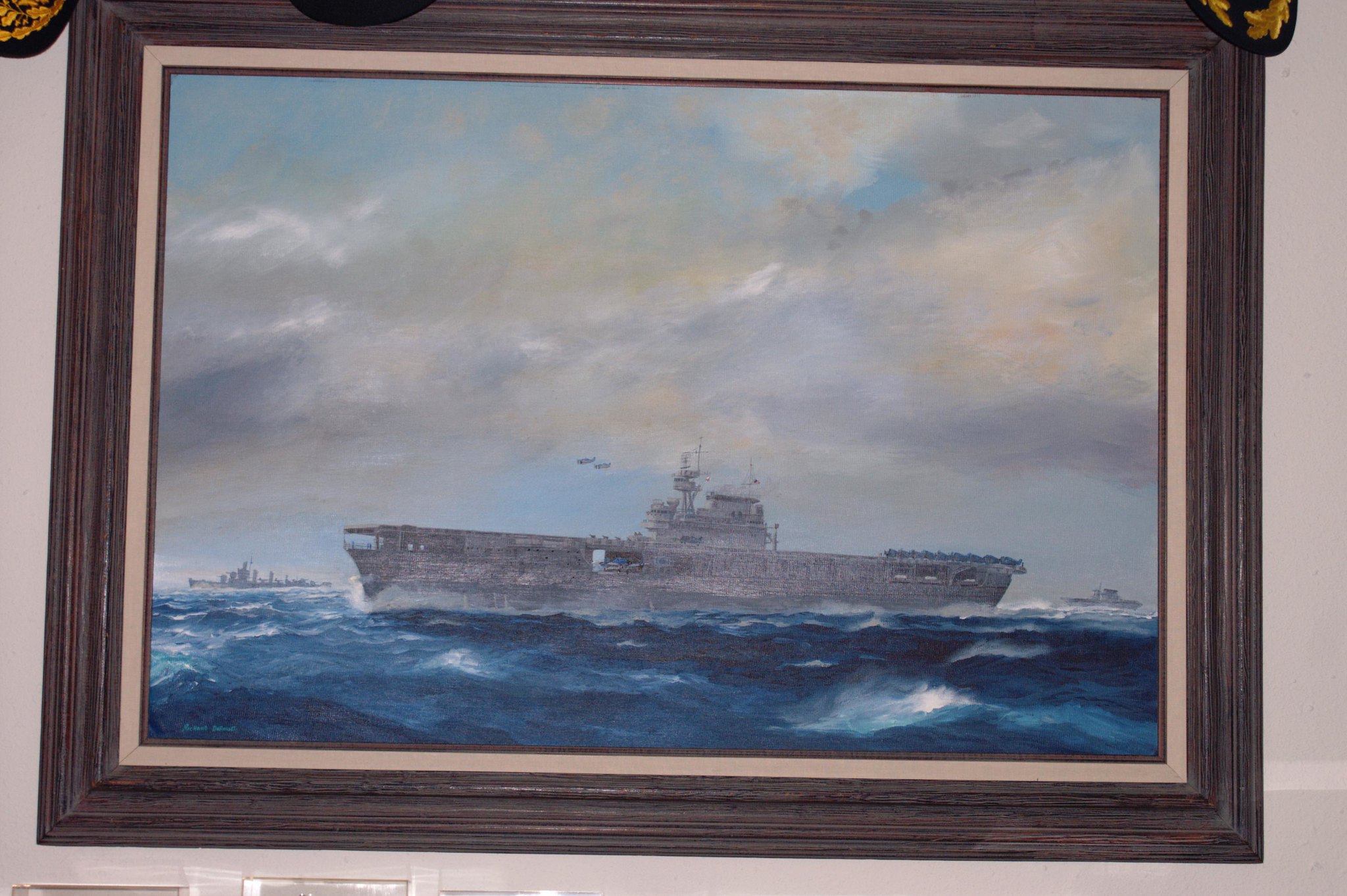
Painting of USS Enterprise by Richard DeRosset
He described the feeling of being totally alone, desperate, and vulnerable in the vast Pacific Ocean while being hunted by the enemy. Before radar and other detection systems were commonplace, ships operated under strict blackout rules because the tiniest light could reveal the ship’s position to a patrolling submarine or plane.
One night while on watch, Arthur had a run-in with an admiral who decided to fire up his pipe on the flag bridge, a place of high visibility on the carrier. Arthur was a lowly lieutenant junior grade but he took his responsibility seriously. He told the admiral to put out the light because it was endangering the ship. The admiral refused. Arthur stood his ground and ordered the superior officer to his quarters. Fortunately the enemy didn’t spot the light.
The petty admiral never forgot and the episode dogged the rest of Arthur’s naval career, despite his stellar scientific achievements.
Arthur survived the pivotal battles of Midway and Coral Sea. During one attack, a bomb exploded in his quarters. Because he had traded duty stations with another officer, he was not in his bunk at that time and escaped death.
But, in the confusion, he was mistakenly listed as killed in action and his footlocker was shipped home. Naomi, who supported the war effort as an air raid warden, endured many grief-stricken months before she learned her son was still alive.
Arthur rose quickly through the ranks because of his scientific ability. He developed instrumental new uses for radar that played a major role in Allied victory.
Later, he returned to Annapolis to teach—not a bad achievement for a hungry kid who arrived on the Naval Academy campus with cardboard soles in his shoes.
Will Arthur’s experiences become my first historical novel? Time will tell.
Meanwhile, Happy 100th Birthday, Pop!
~~~
TKZers: What books based on real-life experiences had a big impact on you?
Have family stories inspired your own writing?





 “Larry Brooks has done it again!!! In Great Stories Don’t Write Themselves, Brooks delivers a clear, concise, easily digestible roadmap to make our stories work.