First Page Critique: A Hike
That Might Be A Journey?

The trail head at St. Bees Head on the Irish Sea

By PJ Parrish

I don’t know about you, but I am really ready for a good writer to take me away from it all. And I am always up for a bracing hike. So today, come along on our First Page Critique, as our submitting writer takes us to the wilds of northern England across the Coast to Coast Trail. I hope we’re in for some good mischief along the way.

A Lethal Walk in Lakeland 

Chapter One

I settled myself on a weathered oak bench and began securing the laces of my leather walking boots. This was the start of a long-anticipated week’s walk in England’s fabled Lake District, but I was apprehensive. Before me angry waves were hammering the shore, each shaking the ground as if a bomb had exploded. Strong gusts of wind from the north were slashing against us.

“We’re supposed to walk into that?” said the woman beside me, a small grey-haired wisp of a creature named Billie, as she surveyed the roiling waters of the Irish Sea. She should have been wearing a waterproof jacket, but instead had on one of her thick self-knitted sweaters displaying a pattern of squirrels and acorns. The outfit had been fine when we were in the town center–protected from the wind by cliffs to the north–but no longer. It was hard to believe that a few hundred yards could make such a difference.

“We just have to stick in our boots in the water,” I said. “If we do it quickly enough we should be all right.”

Around us our fellow walkers, eight of them, were also eyeing the sea with the trepidation. Yet this ‘christening of the boots’ was a time-honored ritual for anyone about to tackle England’s famed Coast to Coast path, which traverses the Lake District, Yorkshire Dales and North York Moors to Robin Hood’s Bay on the North Sea.

“Everyone ready?” asked Charlie Cross, our white-haired tour guide. Beaming a broad grin, he didn’t seem fazed by the heavy surf. The group followed him down to the water.

“Are you sure it’s safe?” asked Fiona, a beautiful brown-haired woman whom, I learned, was one of the six members of the Upton family from Texas in our group.

______________________

I wish I were going along. I’ve hiked in a couple foreign countries, and one of my dreams has been to hike the Appalachian Trail. I hadn’t heard of the Lake Country’s Coast to Coast path. Something new to put on my bucket list. So, as you can guess, I am predisposed to liking this submission on the location alone. But as much as setting is vital to a good story, it isn’t enough. Does the story itself hold up?

I think this is a pretty darn good start. The writer has chosen to put us literally at the beginning of the action. I love the tradition of dipping the boots into the sea before venturing out. I almost wish the writer had given us just a few more graphs so we could see if this ritual works as a foreshadowing of something dire to come. (I hope it is!)

I like that the writer didn’t start earlier, say with the group meeting in the village with a clearing-the-throat introduction of the whole party getting acquainted. (The writer chose instead to just reference the village in passing). We should learn about the hikers (possible suspects?) as we meander on, not in a group-grope info-dump.

I suspect we are working in a cozy genre here, but I could be wrong. The tone registers on the lighter side, which is fine. As I understand it, the hike takes about a week which is plenty of time for something nefarious to happen.

I don’t know if this was the writer’s intent, but we are almost in the classic Agatha Christie “closed parlor room” genre here: A group of strangers is about to be cloistered on an adventure and I would guess someone will die and whoever our protagonist is will be charged with solving the on-the-road crime. Perhaps the murder takes place in hostel out in the wilds.

Likewise, it is good that the writer mentions only a couple named characters. I trust the writer will find a graceful way to tell us the name (and a little background) of our first-person point-of-view narrator soon.

Notes on craft: The writer is on solid ground here, I think. The dialogue is handled correctly, the paragraphing and syntax fine. But with such an assured hand, I’d like to see the writer work a little harder. I’m always a little tougher on the better submissions,

For starters, I’d like to see the writer work harder at more original description. This is such a stunning setting; it deserves more eloquence than surf that “explodes like a bomb.”  That’s a cliche, dear writer, it doesn’t come from you.  Find something more bracing. Likewise, don’t rely on lazy words like “beautiful” for Fiona. Ditto for Charlie. “White-haired” isn’t vivid enough.

Description is hard. You have to dig deep into your own experience to find the right words or metaphors and then filter it through your protag’s consciousness. I like what you did, for example, with Billie — by telling me, in one line, that she chose to wear an acorn/squirrel sweater instead of something more practical, you sketched an immediately sharp portrait of her.

But in general, I enjoyed this. It is a measured, leisurely beginning and that is okay. Just be aware, writer, that we need some injection of tension in your first chapter, a hint of bad things to come.  Even with a soft opening like this you have to have a portent of ominous things on the path ahead — the literal one the hikers will travel, and the metaphoric one you take your reader on.

Let’s do some line editing:

I settled myself on a weathered oak bench and began securing the laces of my leather walking boots. This was the start of a long-anticipated week’s walk in England’s fabled Lake District, but I was apprehensive. Not a bad first graph but this is an example of telling instead of showing. Instead of telling us she is apprehensive, find a way to showing it via her thoughts or dialogue or actions. Just an example here:

I finished lacing my walking boots and looked up at the roiling green sea. With each crash of the waves, I could feel the wooden bench shake beneath me. I pulled in a deep breath and blew onto my cold hands. A sharp wind was surging in from the north, penetrating the nylon of my coat.

I should have worn gloves, I thought. I should have packed that extra sweater. I should have told someone where I was going. But I hadn’t wanted anyone to know. For once in my life, I wanted to be alone. And I wanted to be brave.

That is corny, but I am trying to make the point that you need to find ways to inject drama and something personal about your protag’s METAPHORIC JOURNEY as early in the story as you can. Make us care about her and attach to her (or is it a him?) as quickly as you can.  And never let a chance go by to layer in her personality.

Before me angry waves were hammering the shore, each shaking the ground as if a bomb had exploded. Strong gusts of wind from the north were slashing against us. Nice verb there. But you could be more active: The angry waves hammered; the wind slashed. 

“We’re supposed to walk into that?” said the woman beside me, a small grey-haired wisp of a creature I rather like that named Billie, as she surveyed the roiling waters of the Irish Sea. Good way to slip in the geography She should have been wearing a waterproof jacket, but instead had on one of her thick self-knitted sweaters displaying a pattern of squirrels and acorns. The outfit had been fine when we were in the town center–protected from the wind by cliffs to the north–but no longer. It was hard to believe that a few hundred yards could make such a difference.

“We just have to stick in our boots in the water,” I said. “If we do it quickly enough we should be all right.”

Around us our fellow walkers, eight of them, were also eyeing the sea with the trepidation. Yet this ‘christening of the boots’ was a time-honored ritual for anyone about to tackle England’s famed Coast to Coast path, which traverses the Lake District, Yorkshire Dales and North York Moors to Robin Hood’s Bay on the North Sea. This sounds a little dry. I know you need to convey this info, but find away to make it sound like it comes from your protag and not Fodors. You can also use it, again, to tell us something about your protag. Example:

I wasn’t from this area of northern England. I had been born and raised in London so a long hike for me was to the tube station. But I had always wanted to do this week-long trip that stretched from the the whatever, crossed the whaterever, and ended wherever.

See what that does? It makes the info personal and lets the reader get to know your protag.

“Everyone ready?” asked Charlie Cross, our white-haired tour guide. Beaming a broad grin, he didn’t seem fazed by the heavy surf. The group followed him down to the water.

“Are you sure it’s safe?” asked Fiona, a beautiful brown-haired woman whom, I learned, was one of the six members of the Upton family from Texas in our group. Would be a nice place to slip in a thought from your protag. How does she feel about the make-up of her group? I went on a hiking trip in Provence once, and the first day I met my motley group — the people I would live with for the next two weeks — I was intensely curious about where they had come from. This is important if someone in this group will be murdered AND if someone is the killer.  Start laying your bread-crumb trail of clues as early as possible.

As I said, I think we’re off to a grand start here, but I know this writer has the chops to dig deeper and do better. Oh, speaking of which, as you go on your writing journey, dear submitter, be on the lookout for a better title. (Good titles often don’t reveal themselves until you’re done with the book). I don’t think this one does your setting and set-up justice. For starters, Americans like me will think of Lakeland, Florida. And “A Lethal Walk” is a touch too spot-on.  Look for something more metaphoric that captures the wild scenery and says something about the journey. One of my favorite quotes about hiking is from the naturalist John Muir: “In every walk with nature, one receives more than he seeks.”  Maybe that’s what your protagonist is after? Find something that speaks to the soul of your story.

Thanks for the submission and letting us share it.
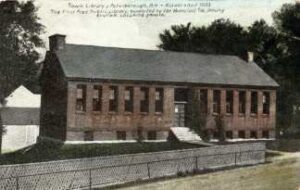
 

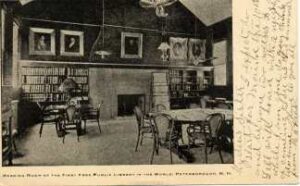
World’s First Free Public Library Supported by Taxation

By Sue Coletta

Photo credit: http://www.libraryhistorybuff.com/

Our local TV station runs a short segment during WMUR’s Chronicle with Fritz Wetherbee, an old-timer who’s a brilliant historian. Every night Fritz shares fascinating stories about New Hampshire. I love learning about the statues, landmarks, buildings, rivers and lakes in my state.

The other night he shared a story about a Unitarian minister who founded the world’s first free public library supported by taxation.

Literary-minded Reverend Abiel Abbot (December 14, 1765 – January 31, 1859) moved from Wilton, NH to Peterborough, NH in 1827 and immediately set up a youth library in his home. He also founded the Peterborough Library Company, supported by membership dues. In proposing the creation of the town library, he described “a central collection of books that would be owned by the people and free to all of those that lived in the town.”

The library website offers the following…

“Inspired by the result, the New Hampshire State Legislature passed a law authorizing towns across the state to raise money for libraries in 1849. Britain wouldn’t pass its Public Libraries Act until 1850, and America’s first large public library—the Boston Public Library—was founded in 1852.”

Photo credit: http://www.libraryhistorybuff.com/

During a town meeting at Peterborough in 1833, Abbot proposed that a portion of the State Literary Fund be used for the purchase of books to establish a library, free to all the citizens of the town. Books purchased by Reverend Abbot and a board of trustees were made available for public use.

Reverend Abbot housed the original Peterborough Town Library in a general store that doubled as the post office, with the postmaster acting as librarian until 1854. After a short stint at town hall, a permanent home was finally built in 1893 to house a book collection that had grown into the thousands.

In a thesis published in 1947, Sidney Ditzion commented on the Peterborough Public Library.

“The account of the establishment of a town library at Peterborough, New Hampshire, is unique in that here we have an instance of what appears to be the spontaneous generation of an entirely new form.  Here, without the stimulus of private donation, without the permission of state legislation, without the semblance of a model in the mother country, a tax-supported town library was born.

The circumstances surrounding the creation of this institution raise an interesting historical question involving local circumstance and group motivation to which no answer has yet been offered.  In January of 1833 a group of farmers and small manufacturers under the leadership of the Rev. Abiel Abbot formed a social library whose shares sold at two dollars and whose annual membership fee was fifty cents. 

On April 9 of the same year the town, apparently under the inspiration of the same Rev. Abbot voted to set aside for the purchase of books a portion of the state bank tax which was distributed among New Hampshire towns for library purposes.  This was the way the first American town library to be continuously supported over a period of years was begun.”

Reverend Abbot founded several other libraries, too, including the Juvenile Library and the Library Company of Peterborough. In 1965, on the bicentennial of Abbot’s birth, New Hampshire State Legislature passed a resolution to recognize Abbot’s role in founding the “first free public library in the world supported by taxation.” This resolution also requested that the President of the United States and the Postmaster General issue a postage stamp to commemorate the bicentennial of Abbot’s birth.

Today, Peterborough Public Library remains the oldest public library in the world. Pretty cool, eh?

For discussion, please share one historical fact about your town or state. Does your local news have a guy like Fritz Wetherbee? The name kills me. He looks exactly how you picture him.

Quick update to my previous post: I’m still keeping the raven alive 19 long, emotional days, but it’ll be worth it if she flies again. One day I couldn’t find her, and I thought for sure a night predator found her. The next day, she strutted back into the yard for breakfast. What a will to live! Here’s a quick video of Rave chowing down. See the wing?

More later. I’m hoping this story has a happy ending.

My Last Pre-Pandemic Novel

by James Scott Bell
@jamesscottbell

Ventura, CA, May 24, 2020

It was oh so nice to be out on the beach last weekend with my wife and daughter, strolling the shoreline, listening to the waves, taking in lots of fresh ocean air. We were in our favorite beach community, Ventura, and everybody was in a good mood—including law enforcement. Our first encounter as we walked toward the water was with a deputy sheriff on a dune buggy. She said, “How you all doing?” I raised my hands in a victory gesture. “I feel the same way!” she replied.

There were kids and babies and hipsters and oldsters. Everyone was respectful of distance, and smiles and nods were plentiful (face coverings outdoors are not mandated in Ventura County). Still, there were restrictions. No sitting on blankets, no lollygagging on dry sand.

Which leads one to wonder what form the post-pandemic society will take. That thought is ever on my mind as I hereby announce my last pre-pandemic novel.*

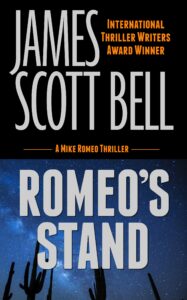
My fifth Mike Romeo thriller, Romeo’s Stand, has just been published. If this is your first foray into Romeo territory, know that you can read the books in any order, so now’s as good a time as any to jump in.

Yes, this is the last time I write a contemporary setting without reflecting the beliefs and practices that will emerge after lockdowns cease. Some weeks ago I wrote about how fiction will change in the coming years. This is especially true in my town, Los Angeles. Our heads are spinning out here over new rules and regs regarding churches and beaches and dining inside once again. (I’ve really missed Musso & Frank Grill, a Los Angeles institution since 1919, and a favorite spot of famous movie stars and L.A. writers ever since. Ditto Langer’s Deli and their #19, the best hot pastrami sandwich in the world—which includes New York—since 1947).

I can’t imagine a contemporary American novel published in 1946 or ’47 that didn’t even mention things like returning GIs and the post-war economy. We don’t have to make post-pandemia the centerpiece of our novels, but our scenes, to be authentic, will have to include little details like the waitstaff at a restaurant wearing masks and gloves…and perhaps mannequins made up to look like customers! Distancing rules will be enforced at large gatherings, at least for the foreseeable future (speaking of which, I miss a packed Hollywood Bowl and Dodger Stadium).

So what about this latest Romeo, published in the midst of our herky-jerky re-emergence? Your clever author has taken care of that with this opening:

We were an hour from Las Vegas when the plane began to shake.

It was a few weeks before the word pandemic became ubiquitous on our collective lips and America closed up shop with a massive case of the heebie-jeebies. The people on the plane were blithely breathing each other’s air and coughing into their fists. The tourists and players in Vegas were bumping shoulders and sharing dice at the craps tables, unaware that their favorite playground would soon be as empty as a politician’s promise.

We move on to an emergency landing in the desert, a small town with secrets and a nasty sheriff. Then things turn ugly. Which is the wrong way to turn things on Mike Romeo.

You can pre-order the Kindle ebook here. (I sometimes get emails from sad Nook and Kobo readers, and remind them that they can download a free Kindle app for their phone or tablet.) A print version will soon follow.

*However, I reserve the right to write historical fiction—perhaps adding to my Kit Shannon series. I may even try something speculative. One thing I’ve found during this lockdown is that, for short and flash fiction at least, my inner Ray Bradbury/Rod Serling keeps wanting to come out and play. One of the formative books on my writerly journey was The Illustrated Man, which I read in junior high school. And one of my favorite TV shows growing up was The Twilight Zone.

[Rod Serling voice] “Picture if you will a writer, confined to his hovel and wondering what to write next. In a moment he will decide to try something unlike anything he’s written before. But when he submits the book he won’t be hearing from an editor. He’ll be getting a long and detailed message directly from … The Twilight Zone.”

So let’s make this the question for today: Have you thought about writing in a different genre? If so, which one?

Knowing When to Be Quiet

Photo by designecologist on unspalsh.com

I am writing this on Thursday, May 28, after writing and rejecting two posts over the past week. You might or might not see them at some point in the future. One is about a couple of stories by Ray Bradbury that use climate in very different ways. The other is about the application to writing of the subject matter of what was once a regularly published newspaper cartoon whose author’s name has entered our lexicon.

You are not seeing either one of them now because I couldn’t hit the bullseye with either post. Both of them in my opinion had some great turns of phrase, were entertaining in places, and utilized multi-media presentations. They were ultimately, however, bowls of air that looked nice but were leaking badly, perhaps fatally so. If I wasn’t happy with them I didn’t think that you would be either.

The common denominator was me. I decided that at the core of each post I was being too clever and talking too much about things which really weren’t all that interesting to anyone outside of my own life at the moment. There wasn’t a fix, either. Pulling anything out caused the entire post in each case to collapse under its own weight. 

The major problem that a writer has — this writer anyway — is filling that white space with black letters. Resolving that problem isn’t enough.  Miles Davis used to say that in jazz knowing what not to play was as important as knowing what to play. The same is true in writing, whether it’s a post for your blog or your character’s interior dialog in your breakthrough novel or something in between. Sometimes it works. At other times you have to be quiet, walk away, and start somewhere else entirely. 

That’s what I am doing. Have a great weekend.

But wait, there’s more. Please permit me, in lieu of our regularly scheduled programming, to introduce to you a handy little tool called a “title case converter.” There are only a few rules to remember when properly capitalizing the words in a title but this is a quick and dirty way to check yourself to make sure that you have it right. Enjoy!

Reader Friday: Writing Goals

What are your writing goals for 2020? Are you on track to achieve those goals? 

We all know writing is a marathon, not a sprint. For many, the pandemic demolished their writing goals for the year, or at least set them back.

I don’t want to push you if you’re not ready — we all cope differently and on our own timeline — but setting goals can help steer your writing dreams back onto the track. 🙂

Name one writing goal you hope to achieve this year. What about in 5 years? 10 years? 

True Crime Thursday – Armed and Dangerous

by

Debbie Burke

@burke_writer

Photo credit – Pixabay

Montanans are no strangers to bear encounters. Most times, it’s hard to tell who’s running away faster—the bear or the human. But when bears are hungry, not much stands in their way. They push through fences to eat calves, bust into chicken coops, knock down bird feeders, and pillage unattended campgrounds.

If bears become aggressive, pepper spray is recommended. However, if that’s not handy, you might have to improvise.

In 2010, near Huson in Missoula County, a woman let her three dogs out around midnight, not realizing a bear was a short distance away, snacking in an apple orchard. Two dogs started out into the yard. A third dog, a 12-year-old collie, remained with the owner in the patio. The two dogs sensed the bear and ran back into the house.

Before the owner could react, the 200-pound bear was at the door, mauling the collie. The woman screamed and kicked the bear but it persisted, scratching her leg through her jeans.

When she tried to close the door, the bear shoved in, blocking the door open with its head and paw.

Fortunately, the woman had a ready weapon. While holding back the bear with the door, she grabbed a fourteen-inch-long zucchini she’d harvested earlier that day from her garden. She threw it at the bear, bouncing it off its head.

Wikimediaimages – Pixabay

The bear turned tail and fled.

The collie recovered from injuries and the brave woman only needed a tetanus shot.

The bear escaped and is still at large.

~~~

TKZers: Have you heard stories about someone who used an unusual weapon to ward off an attack?

~~~


Debbie Burke’s new thriller, Dead Man’s Bluff, is now available for pre-order at this link. If you order now, the special price is $.99. Dead Man’s Bluff will be delivered to your device on June 23.

Ask Yourself Why

Ask Yourself Why

Terry Odell

Ask yourself why

Image by Anand Kumar from Pixabay

Everyone, I’m sure, has heard of using the “What if?” question to start a story, and to help move things along throughout. But for me, there’s an even more helpful question for me while I’m writing. WHY?

Disclaimer. I’m not a Plotter. Not a true Pantser. More of a Planster.

In one of his workshops, James Scott Bell has an exercise designed to help you understand your characters. There, he sets up a scene of a gorgeous room with a huge picture window overlooking a pastoral view and your character picks up a chair and throws it, breaking the window. He asks Why he or she would do that.

While that can be helpful when it comes to characterization, my question relates to the story. Even though we write fiction, it has to come across as reality. One technique I use to make sure things seem “real” is to ask myself Why a character would do or say something.

If the answer is “Because I need it for tension/conflict/humor/plot advancement,” it’s probably wrong. When I was writing Danger in Deer Ridge, the first major ‘error’ I spotted in my opening draft was having the hero appear while the heroine was looking in her car’s trunk for her tool kit.

  • Why didn’t she hear him drive up?
  • Why did he park the truck there?
  • Why did he come down without a toolkit of his own?

All these Why questions require answers. Answering them drives the story forward for me. My thought processes might not end up on the page, (and this is most prevalent in the early chapters, while things are taking shape) but the results do.

So, where it ended up: She didn’t hear him drive up because he parked at the top of the drive. Why?

He parked the car there because his son is asleep in the truck. It’s a quiet rural area, one he knows well, and he’s not concerned that someone will come by and Do a Bad Thing.

That’s still weak, so I added a dog who would take the head off of anyone who tried anything. (Note to self: don’t forget you’ve now saddled yourself with yet another ‘character’ to keep track of.)

More Why questions.

Why not go all the way down the drive? It’s steep, curves, and riddled with potholes, and he doesn’t want to wake the kid.

Weak. What if he’s not an experienced father? Why not? Because his wife left him, took the kid and remarried, and he hasn’t seen the kid since he was an infant.

Why does he have the kid now? Because the ex-wife and the boy’s stepfather were killed in a Tragic Accident? Works for now. (Note to self: revisit this before Grinch has to tell anyone about it.) Also, having him a new and inexperienced father allows for more conflict between hero and the Very Caring Mother who is our heroine.

More notes: Why doesn’t the hero work for Blackthorne, Inc. when the book opens, since the other books in the series open with a scene of a Blackthorne op. Why does he live conveniently near the heroine’s new digs?

By the time I’d written the scene, answers to my Why questions gave me more insight into my characters. I realized that the hero’s friendly demeanor and magnetic grin weren’t consistent with a man who’s worried about leaving a young child asleep in his truck. I ended up tweaking that scene, which added to the tension, because the heroine sees someone who’s in a rush, who keeps looking over his shoulder. She extrapolates from her own secret-keeping life, and it seems logical for her to worry that this guy might be out to get her.

If you don’t want your story to seem contrived, try asking yourself “Why?”

What other questions help you move forward in your writing?


Terry Odell is an award-winning author of Mystery and Romantic Suspense, although she prefers to think of them all as “Mysteries with Relationships.” Follow her on Facebook and Twitter.

First Page Critique – The Lies of Murder

by Debbie Burke

@burke_writer

PublicDomainPicures-Pixabay

Today we welcome another brave anonymous author with a first page entitled:

The Lies of Murder

Merli Whitmore hadn’t stepped foot in her childhood home in ten years. She expected tension entering unannounced. Tension with her step-mother, not the heart-pounded tension of a bloody chef’s knife stabbed into the wood cutting board. Someone had left her a note on lined white paper dotted with drops of blood.

NO BETTER WAY TO START YOUR RETURN TO HAVEN HILL THAN FOR ME TO KILL HER FOR YOU. WELCOME HOME, MERLI.

From behind, Merli heard a familiar voice. “Hands up and turn around slowly.”

She obeyed the command, turning to face two police officers pointing guns in her direction. “Hello, Ian. Been a long time.”

“Merli?” She was the last person he imagined seeing. “What are you doing here?”

“You know her?” Officer Urbane asked.

“Cuff her.”

While Officer Urbane spouted the Miranda warning and cuffed her hands behind her back, Ian read the note under the bloody knife. Merli sat on a kitchen chair.

Ian pulled out a second chair and sat three feet away. “You didn’t answer my question. What are you doing here?”

Because I always follow my premonition dreams is what she wanted to say. Only her father and Aunt Cordelia knew about her dreams. “I haven’t been able to reach my father in three days. I finally jumped on a plane to find out why.”

“What did Vivian tell you?”

“My feelings toward Vivian haven’t changed.”

“What’s that supposed to mean?” Officer Urbane took a step forward, hands placed on his hips.

“You look familiar. What’s your name?”

“You’re not in a position to ask questions.”

Ian chimed in. “Zane Urbane. Xander’s younger brother.”

“She knows my brother?”

“Merli grew up in this house. Xander was in our class. Vivian’s her step-mom. Why don’t you find out what’s happening at the other scene?”

“Yeah, sure.”

Once Officer Urbane left the house, Ian returned his focus to Merli. “When was the last time you spoke to Vivian?”

“I don’t know. Probably a couple weeks ago. She has an unpleasant habit of interjecting herself when I’m face-timing with my dad.”

“And you came home because you couldn’t reach your dad?”

“He always returns my calls within a couple hours. I even tried texts and emails and no response for three days. If you know something, tell me.”

Ian leaned forward. “Where were you between six and nine this evening?”

~~~

This submission races out of the gate. Congratulations to the Brave Author for starting with action and a major crime. Merli Whitmore enters her childhood home for the first time in years and immediately finds a blood-spattered note fastened to a wood cutting board with a bloody knife. The message is a real punch in the gut—the note writer claims to have killed an unnamed woman for Merli. That’s some homecoming!

Then two cops pull guns on her and she knows one of them.

Merli has obvious, ongoing conflict with her step-mother and there’s a strong suggestion Vivian has been murdered, making Merli a suspect. Additionally, Merli’s premonition dream hints that her father is also at risk.

This page definitely grabs the reader’s attention early and piles lots of complications on the main character. Well done!

There is also potentially interesting backstory between Merli and Ian who know each other from school days. The author gives intriguing hints without an information dump. Her old classmate orders his partner to immediately handcuff her. Whoa! The reader wonders why–she’s cooperating and is not armed or combative. The author establishes things have already gone terribly wrong for Merli and only promise to get worse. Excellent!

Several plausibility problems jump out but are easily fixable.

  1. The cops appear only a few seconds after Merli enters the house and finds the note. If they were that close, wouldn’t she have seen their car before she goes into the house? Or hear sirens as they arrive?
  2. If a murder had already been reported, the house would be a cordoned-off crime scene and Merli couldn’t just walk in.
  3. As Jim Bell often reminds us, police do not immediately deliver Miranda rights. They gather background and hope the suspect will reveal information before requesting an attorney.
  4. Although putting Merli in handcuffs right away is an attention grabber, it seems excessive if the author wants to portray police procedure realistically. After all, they didn’t catch her standing over the body with a bloody knife in her hand.

However, if, as part of the plot, you want to establish these officers are overly aggressive or Ian is paying back an old grudge, then it does work to slap the cuffs on her as an intimidation tactic.

Merli’s character seems cool and confident, especially with guns pointed at her. She gives short, coherent answers but also shoots questions back at the cops. The reader roots for her because she doesn’t cave in to their heavy-handed tactics.

She has premonition dreams that predict the future—her dreams can be her curse but also her power. That makes for a complex, interesting character the reader wants to learn more about. Well done.

Some small suggestions:

Merli Whitmore hadn’t stepped foot in her childhood home in ten years. She expected tension entering unannounced. Tension with her step-mother, not the heart-pounded tension of a bloody chef’s knife stabbed into the wood cutting board.

Short, simple sentences might work better to convey the startling event.

Merli Whitmore hadn’t stepped foot in her childhood home in ten years. She expected tension for entering unannounced. She expected tension from her stepmother Vivian.

She didn’t expect the sight that made her heart pound: a bloody chef’s knife stabbed into the wood cutting board.


She was the last person he imagined seeing. This is a point of view inconsistency because it briefly goes inside Ian’s head:

Maybe instead: His startled expression said she was the last person he imagined seeing.


Weak gerunds: there are three verbs that end in -ing in three lines—turning, pointing, seeing. For stronger verbs, here are a couple of suggestions:

turning to see two police officers who pointed guns at her.

the last person he expected to see.


“You know her?” Officer Urbane asked. How does Merli know his name? Does she see a nametag? A few paragraphs later, she asks his name even though it has been used several times.


Attributions: Even though there aren’t many attributions, the dialog generally makes it clear who is talking. However, this passage was a little confusing:

“You look familiar. What’s your name?”

“You’re not in a position to ask questions.”

Ian chimed in. “Zane Urbane. Xander’s younger brother.”

“She knows my brother?”

Clarify who’s talking with a few action tags:

Merli faced the cop who’d cuffed her. “You look familiar. What’s your name?”

“You’re not in a position to ask questions.”

Ian chimed in, “Zane Urbane. Xander’s younger brother.”

Urbane’s face screwed into a frown. “She knows my brother?”


The author does a quick, efficient job of explaining the relationships without an info dump: “Merli grew up in this house. Xander was in our class. Vivian’s her step-mom.”


Ian leaned forward. “Where were you between six and nine this evening?”

Obviously, a crime happened between six and nine this evening. But would a responding officer ask about her whereabouts/alibi? That sounds more like an interrogation by a detective.

Also, where did the crime occur? There’s a reference to the other scene,” perhaps where the bloody knife was used. However, if the murder weapon is found inside this house, it would also be cordoned off. Ian would not disturb a crime scene by sitting and having Merli sit. He would take her outside and call for officers to secure the scene.

If the crime happened elsewhere, what caused the police to respond to this location?

I’m raising these questions because they will occur to a reader and will need to be answered within a few pages.

There is virtually no description or scene setting in this first page. The Brave Author might consider slowing down to include a few words to establish what the kitchen looks like (aside from the chopping block and bloody knife, which are great!) as well as the physical appearance of the officers, especially Ian since he appears to be an important character.

The time is this evening sometime after nine p.m., meaning it’s dark outside. Maybe include that detail: She expected tension entering unannounced at ten-thirty at night.

Merli displays almost no reaction to startling events that would normally provoke strong emotional responses—a bloody knife, a note confessing to a murder, cops who pull guns on her, being cuffed. While I admire her cool confidence, maybe include more reaction from her—the shock of cold, hard metal biting her wrists, a brief worry that her premonition dream about her dad is coming true. Let the reader inside Merli’s head to bond with her as she faces these frightening circumstances.

This submission features action, conflict, strong writing, and effective dialog that keeps the story barreling forward. The main character has a gift/curse of dream premonitions that offers great potential for present and future complications. Excellent work, Brave Author.

~~~

TKZers: Would you turn the page? What suggestions or comments can you offer this Brave Author?

~~~


Debbie Burke’s new thriller, Dead Man’s Bluff, is now available for pre-order at this link. If you order now, the special price is $.99. Dead Man’s Bluff will be delivered to your device on June 23.

The Ballad of Prequels and Origin Stories

Hope you are all enjoying a safe and healthy Memorial Day Monday.

We actually got some snow in the mountains this long weekend which gave me a great excuse to read (yay!), and I am about halfway through Suzanne Collins’ The Ballad of Songbirds and Snakes which is both a prequel to the Hunger Games trilogy and an origin story of sorts for President Snow. Despite being a huge fan of hers (her middle grade Gregor of the Overland series is actually my favorite) I confess to being a bit underwhelmed and I wonder if it is due to what I call ‘prequel fatigue’. It seems like a bit of a thing at the moment where highly successful franchises look to origin stories or prequels as a kind of brand life extension. There’s Philip Pullman’s The Book of Dust (a prequel to His Dark Materials trilogy) which was then followed by The Secret Commonwealth (which is confusingly actually a sequel to the trilogy) – not to mention the Fantastic Beasts films that are essentially prequels to the Harry Potter saga. While in both these circumstances I enjoyed returning to the worlds that both Pullman and Rowling so masterfully created, I did find myself constantly looking for (and finding!) plot and character inconsistencies that diminished my overall enjoyment. With the Ballad of Songbirds and Snakes, I started wondering about the whole purpose of these sorts of prequels. Did I really need to read an origin story for President Snow? (not really…) Do I want to feel empathy for him as a future villain? (again…not really…)

The experience has got me wondering about the whole ‘origin story’ issue when it comes to villains. Maybe I just prefer a well-developed albeit enigmatic villain figure, but sometimes getting too much information about a character (particularly a powerful, evil one!) can actually diminish their impact – like peeking behind the Wizard of Oz curtain only to discover the criminal mastermind is actually just a sad-sack with a tragic family history…

In terms of the Hunger Games, I feel that this prequel doesn’t really add much to my understanding of the world Katniss came to inhabit, and I also feel a little cheated that the author didn’t come up with something more intriguing than a story about Coriolanus Snow. Is that mean spirited of me? (probably) but I wanted to be as blown away by this new novel as I did by the original first Hunger Games book (sigh).

So TKZers, what is your feeling about the whole ‘prequel’ thing? Have you read a series that successfully extended the brand by doing this in a way that didn’t feel merely derivative? Do you think origin stories like this for villains can be successful? If so, how??


The Dangers of Detail Derailment

by James Scott Bell
@jamesscottbell

Okay, kids, we have a first page to discuss. Let’s read it and chat on the other side.

Shadow of Xiom-Thogg

Barbarians clashed on the road to Heliopolis. Three were stout, blue-bearded Sherdens, one of the tribes of sea-folk that sailed forth to harry faltering Egypt. They wielded long, leaf-bladed swords and were protected by horned helmets and bronze-banded corselets, augmented by round shields emblazoned with bulls heads.  One of their number already lay dying, a spear tangled in his guts. She who cast that spear was as alien to the land of the Pharaohs as the Sherden, though she came by a longer and more circuitous route. A green-eyed giantess, pale of flesh and tawny-haired, standing a good head taller than her sea-faring opponents. She was incongruously clad in the manner of a Persian soldier, with a bronze-scaled cuirass over a linen tunic and trousers thrust into soft leather boots. Like a lioness cornered by jackals she battled her tormentors, lashing out from behind a tall wicker shield with a sagaris, the deadly battle-axe of the Persians.

A Sherden made a bold thrust, seeking her vitals, but his blade transfixed the wicker shield instead, narrowly missing the woman’s sinewy forearm. She twisted to one side, tangling the sword in the wreckage of the shield. Unwilling to release his weapon, he was upended and tumbled to the ground. She let the ruined shield fall with the hapless swordsman, and his comrade, seeing an opening, lunged recklessly in an attempt to decapitate the tawny-haired she-devil. Moving with preternatural speed she sidestepped his powerful blow. As the momentum from the spent attack sent him stumbling past her, she brought down the axe, shearing through his horned helmet and splitting his skull in a welter of blood and brains. He fell, sprawling in the dust that thirstily sucked up his flowing blood.  

***

JSB: Ah, nothing like blood and brains to get us going this fine Sunday. Let me say some good things up front. I like this writer’s imagination. There is a vivid “other world” here, and the potential is bubbling in the pot.

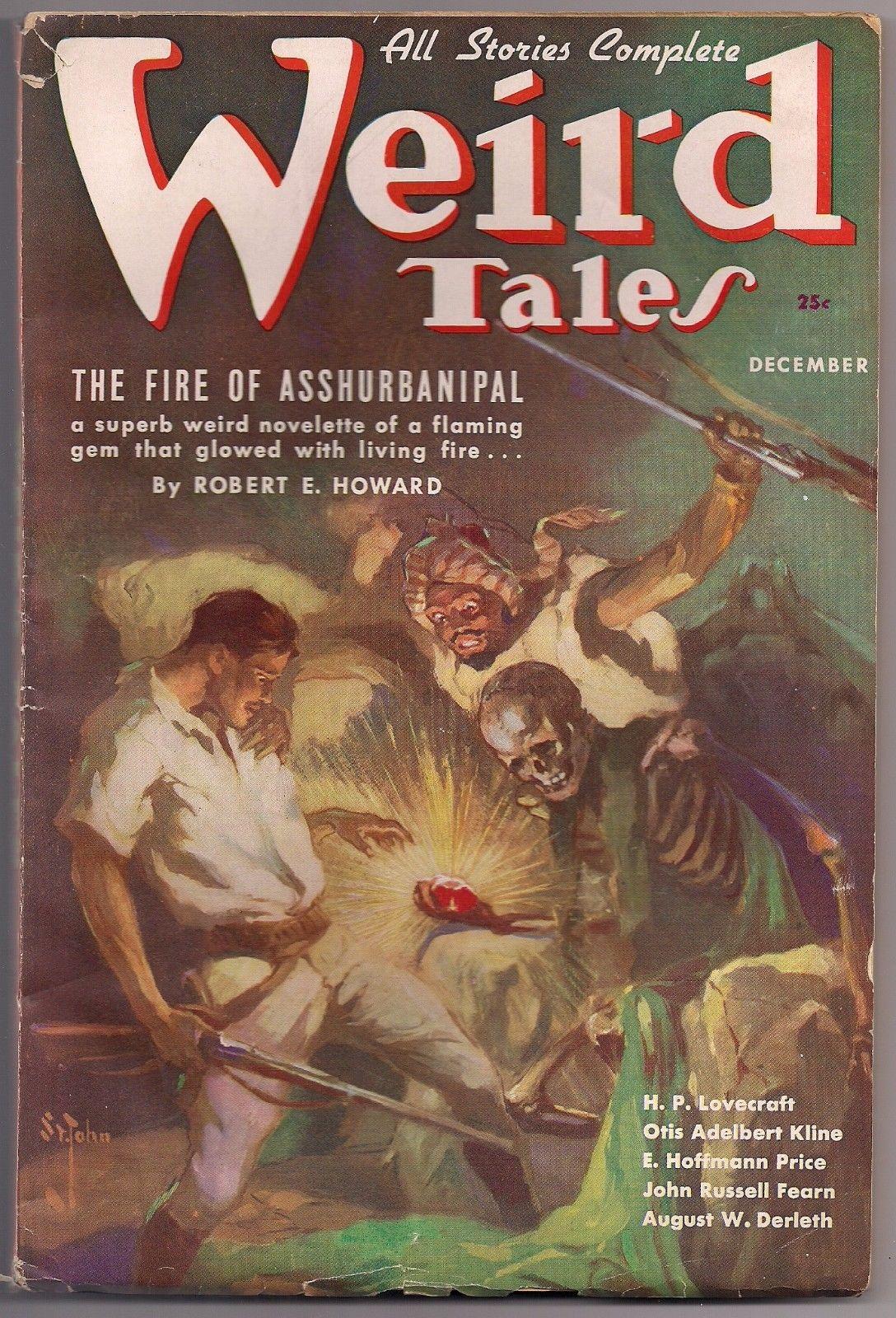
In some ways it reminds of the great Robert E. Howard, and the many stories he did for Weird Tales back in the 30s. He could build a world and clash the swords unlike anyone before or since. This author has similar raw material; we just have to chisel it so it makes for gripping fiction.

First off, a tip about readability these days. No one likes big, blocky text. This entry is made up of two Brobdingnagian paragraphs. A browser opening up this book might take a look at the page and think, “Why bother?”

True, readers of epic fantasy are perhaps more tolerant of blocky graphs. But not all, so why turn off a significant percentage of readers when it’s so unnecessary? No one is going to complain that your first page isn’t hard enough to read. So break up the blocks! This page could easily be four to eight paragraphs. (Which reminds me of when Yogi Berra was asked if he’d like his pizza cut into four or eight slices: “Better make it four,” he said. “I don’t think I can eat eight.”)

Now to the heart of it. World building in any kind of speculative genre is a crucial part of the program. But the trick is to do it without overlarding us with details. Our brains (those that aren’t split by an axe, that is) cannot adequately process or appreciate too many unique details coming at us in a rat-a-tat fashion. We will either have to slow down and re-read, which ruins the flow; or we’ll set the book aside, which ruins the chances of selling the next book in the series.

In the first paragraph alone, I count at least sixteen unique details, all demanding to be a picture in my head, and two stopping me cold and sending me to the dictionary (cuirass, sagaris):

  • stout, blue-bearded
  • long, leaf-bladed swords
  • horned helmets
  • bronze-banded corselets
  • round shields
  • bulls heads
  • green-eyed
  • pale of flesh
  • tawny-haired
  • bronze-scaled
  • cuirass
  • linen tunic
  • trousers
  • soft leather boots
  • tall wicker shield
  • sagaris

The point is there’s an exciting fight going on, but my head is swimming with all these details. There are just too many.

So how many should there be? Ah, there’s the skill part of the equation. The answer is: just enough.

Thanks for stopping by.

Okay, let’s put it another way. Don’t let details derail the action. You, author, will have to develop a sense about this. It may be that you’ll require outside eyes to look at your pages: beta readers who are familiar with the genre, crit partners, perhaps a freelance editor.

What you want is an action scene with essential details. Pick a few that best set the stage and flow them in naturally with the action. In fact, that may be a good rule of thumb (though many writers bristle at rules, and use their thumbs primarily on the space bar): allow yourself only 2 – 5 unique details per page in the opening chapter. Everything else should be action.

One more crucial craft point will help you in this quest: pick a point of view! This passage is in Omniscient, which tempts the author to put in all the things they see in their imaginary world.

If, on the other hand, you filtered this action through the POV of a character, you would naturally become more selective in the detail work; plus, readers will be more fully engaged because it is through character that readers bond with the material. A twofer!

Right now you’ve got three Sherdens and one “she-devil.” We have no way of knowing who, if any of these, will be a main character. Maybe this is a prologue and no one here will end up being the MC.

No matter. You still should choose one of these characters to be the viewpoint. When you do that, the action of the scene will automatically take precedence over the details. And that’s what we’re after. [Note: Third Person POV is usually the better choice, but even in Omniscient POV you can select a viewpoint character. See the excerpt below.]

For laughs I looked up a Robert E. Howard story from the January 1934 edition of Weird Tales. Here’s the opening paragraph from “Rogues in the House,” a tale featuring our favorite barbarian, Conan:

At a court festival, Nabonidus, the Red Priest, who was the real ruler of the city, touched Murilo, the young aristocrat, courteously on the arm. Murilo turned to met the priest’s enigmatic gaze, and to wonder at the hidden meaning therein. No words passed between them, but Nabonidus bowed and handed Murilo a small gold cask. The young nobleman, knowing the Nabonidus did nothing without reason, excused himself at the first opportunity and returned hastily to his chamber. There he opened the cask and found within a human ear, which he recognized by a peculiar scar upon it. He broke into a profuse sweat, and was no longer in doubt about the meaning in the Red Priest’s glance.

Notice that we start with action and two named characters. How many unique details does Howard give us? One: small gold cask. No derailment here. We are caught up in the mysterious exchange (an ear? Really?) and what it could possibly mean. Nothing distracts us from the action, which is a hallmark any Howard story.

Thus, my advice:

  1. pick a viewpoint character
  2. give him a name (or her, if it turns out to be the she-devil)
  3. rewrite these 288 words using only 2-5 unique details
  4. with the action established, use 2-5 details per page until the scene ends
  5. from that point forward be strategic in your use of details. Utilize what you need for world building, but never let the details get so thick they interrupt the flow of the story

Others may have some advice, too, so let’s hear it. Help our anonymous writer out.