Have Shocking Coffee With Your Lead Character

by James Scott Bell
@jamesscottbell

In my one-day workshops I do an exercise called “Shocking Coffee.” You, the author, imagine you are seated with your main character over a cup of coffee. She tells you she doesn’t think you’ve quite captured her. That surprises you a bit. I mean, after all, you created her.

So you ask, “In what way?” And your character tells you something that shocks you. What is it? (I have the students write for one minute.)

Then I say: You’ve spit out your coffee. Your character hands you a napkin and then tells you something even more shocking! (Write for one minute.)

I was conducting this at a recent conference, and while the students were writing a voice said, “Wow!”

Another voice chimed in. “Exactly!”

And everyone laughed. When we were done I asked a few people to share what they’d come up with. One woman said this clarified the entire novel for her. Another said this offered a whole new direction she’d never thought of.

But one student, a middle-aged man, seemed troubled. He had explained earlier in the workshop that his story was about a man carrying around a load of guilt because he’d accidentally killed his brother years ago. He fears that if his secret ever gets out it will hurt a number of people.

Now he said, “The more shocking thing he told me was that he intended to kill his brother, because he was jealous.”

There were audible oohs and ahhs throughout the room.

“But,” the man protested, “this would make him totally unsympathetic.”

The oohs and ahhs turned to No! and You’re wrong! 

I asked the students, “Who is more interested in this book now?”

All the hands shot up.

The author still seemed confused.

I told him it doesn’t matter where the character has come from, or what he’s done, so long as he’s got the capacity to change and the will to try. We will follow a character like that, hoping for his redemption. Indeed, it’s one of the most powerful engines of fiction.

What had just happened was that the author, by way of a simple exercise, had gone deeper into his material than ever before. Before, he’d stopped at a “safe place.” Now he had pushed past that, and it scared him a little.

Which, I told him, is a good thing, because that’s where originality comes from. (For more on this, see my post here.)

To push through the safe places, try these exercises:

  1. Have a cup of shocking coffee with your Lead. Shocking and more shocking.
  2. Chair through the window: Imagine your character in a nice room with a big, bay window. She picks up a chair and throws it through the glass. Why would she do that? Come up with a reason. Next, write a crazy reason she’d do that. What is this telling you about your Lead?
  3. Closet search: What does your character have hidden in her closet that she doesn’t want anyone—anyone—to find?

More material like this can be found in my course, Writing a Novel They Can’t Put Down.

So when was the last time one of your characters surprised you? Did you go with it or resist it? What techniques do you use to deepen characters in your fiction? 
A Miss That Should Have Been a Hit

I submit to you that a personal recommendation from a friend with respect to a book, movie, or film is gold. I’ve been fortunate to have had a number of folks who know my eclectic and yes, flat-out bizarre tastes in the various arts and who keep me from becoming staid in my reading, viewing and listening. Chief amongst these good, long-suffering folks is a gent who I have known for well over a half-century. My friend possesses an encyclopedic knowledge of literature and films which runs long and deep. He recently recommended a movie to me that is almost a quarter-century old but is still in some ways ahead of its time.

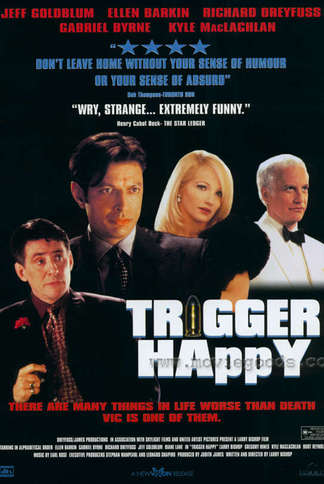
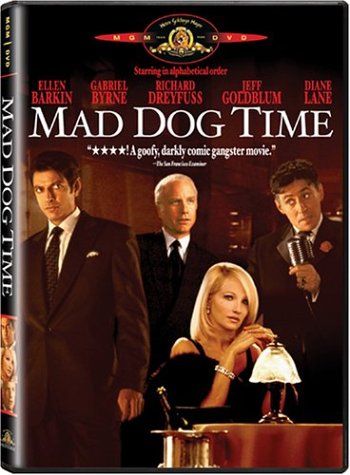
The movie is Mad Dog Time.  It is worth viewing and studying for a number of reasons, chief among them being the manner in which it adheres to its puzzling yet addicting voice and pace from beginning to end.  You say you’ve never heard of it? Maybe you know it by its other name, Trigger Happy. Still doesn’t ring a bell? I’m not surprised. I had never heard of it either until last week, in spite of it having a stellar cast (Richard Dreyfuss and Jeff Goldblum, among others). It suffered from poor reviews. Actually, that’s not right. The reviews were vicious.  It topped at least one “worst movie of the year” list. Rotten Tomatoes? As I write this Mad Dog Time has a critics’ score of 17 percent based on six reviews against an audience score of 47 percent. It grossed six figures and cost seven to make, proving that you can make a small fortune in the arts if you start with a large one. 

I’m leading with all of the bad stuff about Mad Dog Time because that was the way it was introduced to me before I bit the hook. The sharp end of that is that Mad Dog Time is a gangster/caper film that defies several conventions. 

The opening moments of Mad Dog Time consist of what is kind of a poor man’s Star Wars trailer which informs the viewer that what they are about to see takes place in an alternate reality. Yeah. That’s about right. The plot is right out of the late 1940s. A mob boss named Vic (played by Dreyfuss) who owns a popular nightclub is being released from a mental health facility after several weeks of treatment for what we would now call anger management. A rival mobster who has been plotting to take over Vic’s empire is bringing in hitmen to get the job done, given that Vic has a reputation for engaging in homicidal violence with minimal provocation.  Mickey Holliday (Jeff Goldblum) is Vic’s enforcer and finds himself standing between Vic and the power grab. Mickey, however, has in Vic’s absence been keeping company with Vic’s girlfriend while also seeing her sister, unbeknownst to either of the siblings. Other things are going on, including frequent duels by firearm that take place in the basement offices of Vic’s club. There are other shootouts, as well as fights, double-crosses, and the like, right up to almost the very end of the film.

If all of the above was presented in a straightforward manner then Mad Dog Time might not have gotten the awful critical reception it received. The film has its quirks, however. Mad Dog Time was written and directed by Larry Bishop, the son of comedian Joey Bishop, who was part of what was known as the “Rat Pack” with Frank Sinatra, Dean Martin, and Sammy Davis, Jr., among others. There are a number of not-so-subtle references to that lineage, including a brief appearance by Joey Bishop. What is more interesting, however, is that the entire film looks like a period piece for which the director never attempted to acquire time-appropriate props. It is accordingly is a 1940s story that looks like it was filmed in the 1990s — which is when it was filmed — and which somehow doesn’t look dated in 2020. That doesn’t make sense, but it is entirely accurate. Bishop also repeatedly uses a plot device that is unsettling and which violates a rule of commercial filmmaking. I’m not going to tell you what it is, but you’ll see it when you watch the film and start saying “What the (heck)” every ten minutes.  I kept thinking, “Wait a minute! He can’t do that!” That isn’t quite accurate, of course. Maybe Bishop shouldn’t have done it, but he could do it, and he did. The result is that the viewer never knows what is going to happen next.

At least one of your favorite old school actors, regardless of who it might be, is more than lkely in Mad Dog Time. What was interesting for me is that it features an actor I can’t stand — Jeff Goldblum — leading the cast. And you know what? Goldblum gives the performance of his life. I never would have pictured Jeff Goldblum as a believably deadly mob enforcer who is also studly enough to be balancing relationships with two women to the extent that neither is the side-piece (or maybe they both are). I almost didn’t watch the movie when I found out that he was in it, but I’m glad I did. He hasn’t looked this good since he played “Freak #1” in the original (Charles Bronson) version of Deathwish. Goldblum is so good in this film that I actually missed him when he wasn’t on screen. 

There’s also an intangible element existing in Mad Dog Time. The entire movie is just a bit off-kilter, which is possibly where the alternate universe thing comes in.  My friend likened it to the manner in which Billie Holliday often sang just a beat or two behind the music. It’s a perfect comparison, so much so that I wonder if Larry Bishop was giving his audience a hint of it with the name of Goldblum’s character. 

You won’t find Mad Dog Time/Trigger Happy on any of the streaming services. There is a print that is accessible on YouTube but the video is totally out of sync with the audio and it is thus unwatchable. You should, however, be able to find it in DVD format (which is excellent, by the way) at your local library though you might have to hunt for it. You should do so. 

Let me give you two more quick suggestions before I leave you to your day: 

In books, Andy Davidson’s newly published The Boatman’s Daughter is the perfect Southern Gothic horror novel and may be the perfect novel, period. If you read it and you like it you will want to read his first book, In the Valley of the Sun, which concerns a pair of vampires on the loose in Texas during the fall of 1980. Fun stuff.

As far as music is concerned, I have recently been listening to a band named 16 Horsepower. They are no longer together. The creative force behind their music, however, is a gentleman named David Eugene Edwards who currently helms a band called Wovenhand. Edwards is considered to be the father (almost, after Johnny Cash) of a music subgenre known as “gothic Americana.” The songs in both bands are darkly religious with a heavy emphasis on the failings of human beings, who will be judged by the angry and vengeful God of the Old Testament. Not surprisingly, Edwards’ music has been rejected by secularists for its religious overtones and by the Christian rock community for hewing too close to fundamentalist beliefs. What’s left? Well, Edwards has a huge following among atheists, believe it or not, especially in Europe. If nothing else, please have a listen to 16 Horsepower’s “Black Soul Choir.”

I hope that you enjoy all of the above and have a terrific and entertaining weekend. And please, feel free to offer some obscure recommendations of your own.


True Crime Thursday – Slogans that Hit…or Miss

by Debbie Burke

@burke_writer

Today’s True Crime Thursday offers a collection of catchy slogans meant to raise public awareness of various crimes. Some advertising campaigns address crime in general:

 “If you don’t have money for bail you should stay out of jail.”

Wikimedia CC license


Or specifically, in anti-drunk driving mottos:

“You booze, you cruise, you lose!”

“Drive Hammered. Get Slammered.”


Crimes of violence:  “Let’s cut out knife crime.”

Photo credit: fbi.gov


Human trafficking:

“Slavery. Still happening today.”


Sexual assault:  “No consent + Sex = Rape”

The war on drugs spawned perhaps more slogans than any other crime. Samples include:

“Just Say No.”

“Drugs cost you more than just money.”

“No drug user grows old; because they die young.”

“Smoke fast and die young.”

“Don’t Meth Around.”

Last November, South Dakota proudly unveiled a new campaign against methamphetamine that cost nearly a half-million dollars:

“METH – WE’RE ON IT!”

The message caused an uproar…of laughter, probably not the effect the promoters hoped for.

Some slogans work. Others, ahh, not so much.


TKZers: What crime slogan sticks in your memory? The best? The worst?

Who’s the New Kid?

Who’s the New “Kid”?
Terry Odell

Terry Odell LogoWhen I opened the email inviting me to become a contributing member of The Kill Zone Blog, I was honored. I’ve been reading the blog for years, making comments, but move to the other side of the page? Scary. The other contributors have set a high bar. But I accepted the invitation, so here I am.

Who am I?

I’m someone who did not start out with aspirations of becoming a writer. I did not write my first story in crayon. The one time I thought about putting a story idea onto “paper” (we were well into the word processor age by then), the tedium of getting dialogue punctuated correctly put a halt to that project.

You could say I became a writer by mistake, through a chance introduction to the Highlander television series. You can read that whole misadventure here. I’ll wait.

Back? I’ll continue.

Eventually, punctuating dialogue became automatic, I joined a local writing group (The Pregnant Pigs, and that’s another story), and I looked forward to sitting down to play with my characters. Honestly, I was having fun, and had more of an If someone knocks on the door and asks if I have a manuscript, I’ll say yes mentality. But my fellow Piggies pushed. I found an agent, which meant my rejections came faster and were worded more politely.

My road to publication started with e-publishers back in the day when people were reading on their computers or PDAs. I had some romance short stories published by The Wild Rose Press (I was their first contracted author), and some romantic suspense novels published by the now defunct Cerridwen Press. I had a trio of books published in hard cover by Five Star, which targeted the library market. When my first Five Star book was remaindered and I got the rights back, the Kindle had just come into being, and with it, indie-publishing. I figured I had nothing to lose, and ventured down that road.

And, that’s where I am now. A purely indie-author, and happy to be one. I have 22 novels, 3 novellas, 2 short story collections, plus some bundled works out there. (I had to check.)

What do I write?

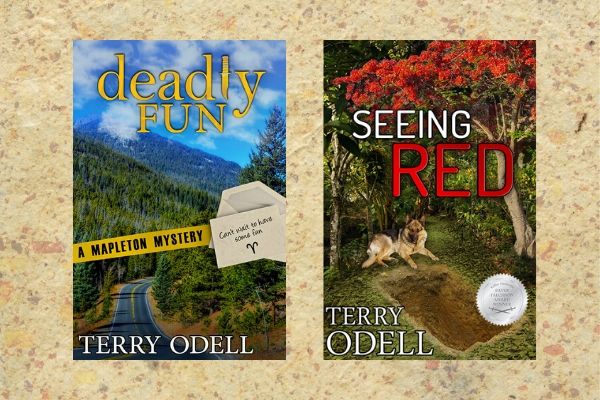
Odell booksThis blog is focused on mysteries, and I have a mystery series (Mapleton Mysteries) with 5 novels (the 5th, Deadly Fun, drops on February 24th) as well as three novellas. My collection of mystery short stories, Seeing Red, happened to win the Silver Falchion Award in 2015. (There’s a story there, too, but that’s for another time.)

However, despite thinking I was writing a mystery, my first manuscript, according to my daughters, was a romance. Given I’d never read a romance, that came as quite a shock. I realized that when I read mysteries, I was just as interested in what went on in the “off duty” lives of the characters as I was in solving the crime. Thus, I call all my books “Mysteries With Relationships” even though three of my four series would be classified as romantic suspense, or mystery romance.

My series: the Mapleton Mysteries, Pine Hills Police, Blackthorne, Inc., and the Triple-D Ranch series. Most of them are also available as audiobooks.

That’s the writing side of me.

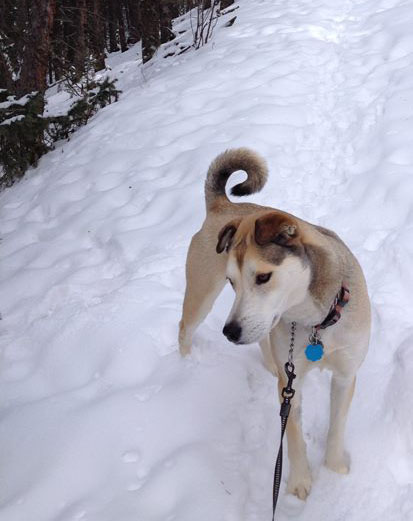
FeebieThe personal side: I grew up in Los Angeles, graduated from UCLA, taught junior high, moved to Florida, raised a family, and now I live in the Colorado Rockies with my husband and rescue dog, FBI SAC Odell, but we call her Feebie.


Terry Odell is an award-winning author of Mystery and Romantic Suspense, although she prefers to think of them all as “Mysteries with Relationships.” Follow her on Facebook and Twitter.


Rising Star

Hubble Sees the Force Awakening in a Newborn Star-NASA Goddard photo

Fair warning: today’s post is the unabashed crowing of a proud surrogate mom whose “kid” is one of only 20 people on the planet chosen this year to give a TED talk. If you’d rather not listen to me sniffle, skip this.

Here’s how our story started:

My writing group, Authors of the Flathead, sponsors an annual student writing contest. The judging is blind—we don’t know the identities, grade level, or which school.

About 20 years ago, a short fiction entry about the underground railroad blew us judges away with its beautiful writing, realistic characters, compelling tension, and important theme. It was the hands-down winner out of 100+ entries.

The author was a 16-year-old high school junior named Sarah Rugheimer. We invited her to a meeting to read her story and receive her cash prize. Afterward, she and I chatted. She was bright, capable, energetic, determined, and enthusiastic. When she asked if I would mentor her, I couldn’t say Yes! fast enough.

We worked on her writing through high school and her first year of college. Sarah pushed herself hard and excelled in science, Irish dancing, and writing. We spent hours hiking in the Montana mountains or sitting at my dining room table to brainstorm story concepts, characters, and plot lines full of twists and surprises.

Her discipline and drive pushed her up the ranks in Irish dance competitions. My kitchen became a studio where she practiced difficult steps. She also entered and won more writing contests.

Our face-to-face meetings unfortunately dwindled when she moved to the University of Calgary to study physics and Irish dance.

Thank goodness for email. She would send me essays and papers. The subject matter was way over my head. Exoplanets? Biosignatures? Brown dwarf habitability? Chirality? The only words I recognized were one syllable: the, and, is. At that point, the little help I could offer was to insert missing commas.

“When you win the Nobel Prize, I’ll be sitting in the audience,” I often told her, only half joking. It didn’t take a rocket scientist to recognize this young woman was going places.

Then came time for grad school. Her goal: a PhD in astronomy or astrophysics.

On a lark, she decided to apply to Harvard. Despite her brilliant academic record, she suffered from a bad case of imposter syndrome and was positive she would never be accepted.

She even tried to talk herself out of applying, protesting, “The fee is $90. I could buy three nice dinners for that.”

“You’re going to be accepted,” I predicted.

“No way,” she insisted.

“Yes, you will.”

We worked over her essay answers and polished them to a high gloss.

I knew that the judges and scholars who reviewed her application would recognize the drive, focus, discipline, and imagination I saw in her.

Was she accepted?

Of course.

She was amazed.

I wasn’t.

For the next 6 ½ years, she worked her butt off. Despite a full scholarship, her road was not easy. Her father, a retired physics professor at Montana State University, was in declining health. He lived with her in Cambridge while she juggling study with caring for him.

His death, although expected, was still a body blow to Sarah. Other major personal crises piled on top of her and she had to take more than a year off from classes.

But she persevered and was named one of only eight Harvard Horizons Scholars in 2014.

She also took up mountain climbing. We’re talking serious mountains—Kilimanjaro, Aconcagua, Chimborazo. At elevations of more than 20,000 feet, she was climbing closer to the planets and stars she wanted to explore.

In January 2015, she defended her thesis.

I flew to Boston for that momentous event. Sitting in a hallowed hall at Harvard with 60 of her colleagues and professors, I listened to her talk about searching for life on distant planets and her aspirations to explore the universe.

As she was pronounced Doctor Sarah Rugheimer, I used up a package of Kleenex.

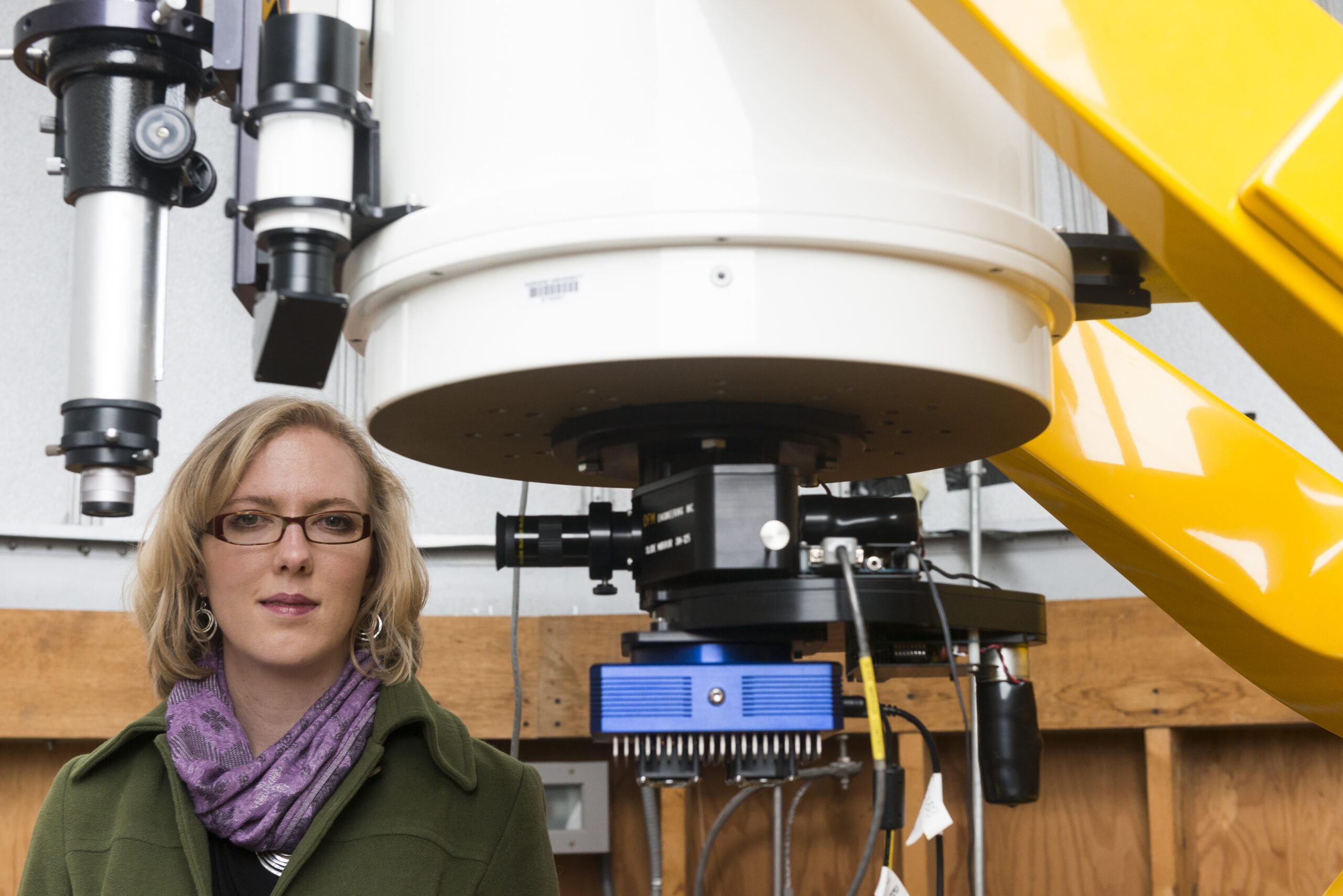
Dr. Sarah Rugheimer – photo credit: Ben Gebo

Her post-doctoral proposals and applications for various fellowships contained ever-more-obscure vocabulary. How was I supposed to critique a paper entitled “Quantifying Activity Induced Variability in Spectra of Exoplanets”? At that point, when I edited her articles, I wasn’t even sure where to put the commas!

She also developed a love of teaching and has the rare gift of translating complicated concepts into terms even regular people—like me—can understand. Her students love her.

A couple of years ago, one student she had mentored achieved publication in a prestigious journal. Sarah was button-busting proud.

I told her, “Now you know how I feel.”

In her spare time, she continues to write creatively. We spend hours on the phone, brainstorming plots and building relatable characters for her ambitious sci-fi novels. Writing remains her great love. My crystal ball predicts a Nebula award in her future. 

Two summers ago, she returned to our hometown to give the commencement address at the local college graduation. “Don’t limit yourselves,” she counseled. “Don’t let fear keep you from applying to Harvard or wherever your dreams lead you.”

Where is she now? Teaching and pursuing research at Oxford, another pinnacle of academic achievement. Here’s her website.

A few weeks ago, she called me from England. “Don’t tell anyone yet but I was chosen as a TED scholar for 2020. I’m going to give a TED talk.” That puts her among only 20 people so honored each year.

I was thrilled but, again, not surprised.

Our friendship started with a high school writing contest.

Now I’m standing on the ground, watching a brilliant star rise into the heavens. [Sniffles.]

~~~

Others mentored me. I mentored Sarah. Now she’s mentoring a new generation.

TKZers, whose shoulders did you stand on? Who’s standing on your shoulders?

Are the 1980s ‘history’ yet?

Thanks to Jordan for posting for me while I had to go unexpectedly to Australia (sadly, it was for a family funeral). I have to admit it feels a little strange to be back on the blog even though it’s only a few weeks…Somehow 2020 seems to have started on a bit of an emotional roller-coaster so I think I might need to re-celebrate the new year sometime in March!

Traveling to Australia can be a surreal experience – not only do you clock in at about 28 hours door to door, but going there you literally lose a day and coming back you often arrive before you left…both of which can play havoc on the body’s internal clock. Luckily, I didn’t suffer too much from jet lag this time – though I did experience what I like to call ‘time lag’. Isn’t it funny how going back to the place you grew up often puts you in a bit of a time warp, especially when (in parts of Australia at least) it’s like nothing’s actually changed in the 25 years since you left!

I’ve never written a book set in Australia but this time round a story which has been swirling around in my sub-conscious began to take form. In fact there are two stories circling in my brain – one of which has a definite historical context, the other that would take place (and least partly) in the mid 1980s. As a historical writer who likes to use a particular time and place to ground my stories I’ve been grappling with the question of whether the 1980s can really be considered ‘history’ yet. My memories of that time period are still clear (I’m not that old yet!) but I think I would still have to do research much like I would do for any historical period. If I was setting my story in the 1960s or 1970s I don’t think I’d even ask the question – but the 1980s…hmmm…I’m not so sure.

When I was in Australia, I was struck by how little it had really changed and how easy it would be to mentally transport myself back to my teenage years. But I was also challenged by the prospect of using the recent past as a historical backdrop – especially given how many recent successful franchises have already started to play on this kind of nostalgia (Stranger Things and The Americans anyone?!)…so I’d have to tread very carefully if I was to ensure authenticity and also avoid the usual 1980s cliches.

In some respects it doesn’t even matter (a good story is a good story no matter how you classify it) but it’s funny how in my own head I identify as a historical fiction writer and (if I’m honest) don’t feel all that confident that I could pull off writing ‘contemporary’ fiction (ah, the joys of the angst-filled writer’s mind!). Approaching the 1980s as a historical era would (perhaps) give me the crutch I need to move forward, but then I wonder, if that’s true…then what really is ‘history’ anymore??

So TKZers, what do you think? How do you classify ‘historical fiction? Do the 1980s even qualify???

Mastering the Basics: Point of View and Dialogue

by James Scott Bell
@jamesscottbell

We have another first page for critique today. See you on the other side.

THE OIL PATCH PROJECT

1. Slinging Pebbles at Goliath

Southwest National Laboratory
Albuquerque, New Mexico
A Monday in October

Engineering geologist Jim Checkers pushed open the door labeled “GEOCHEMISTRY LAB,” strode across the room to a workbench, and picked up a bulging old briefcase that was sitting among tools, a voltmeter, and a jar of vacuum grease. The place smelled like acetone.

Mattie Hawkins, geochemist at Southwest National Laboratory, locked into Jim’s eyes. “You’ve been spending a lot of vacation time at those oil meetings. Doesn’t your wife care?”

“I suppose, but she’s occupied with her own business.”

“Jim, did it ever occur to you that you can’t save the world?” He stopped to listen. It was pleasant to be around Mattie, the lovely tech who analyzed his samples and generated the data.

“No,” he said, as though answering a question about the weather. “I’ve got the facts … it will force change. I can’t let them continue dumping salt on the land.”

Stuffing another paper into his briefcase, Checkers reached for the old dinner jacket and tie he kept behind the door in case the lab’s brass brought official visitors from the Department of Energy.

“You can’t take on the entire oil industry, Jim.”

“Well, I’ll have to. I registered as a technical witness this time.” He brushed a stray hair from his eyes.

“Jim, you’re playing Don Quixote. The oilmen play for keeps.”

“I’m David facing Goliath, not Quixote fighting a windmill.”

She watched him hurry out and shook her head. “They’ll kill you,” she said to the closing door. “I should know. I grew up in the oil patch.” She wished she hadn’t mentioned his wife.

***

JSB: All right, let’s roll up the ol’ sleeves. I am assuming this is going to be a thriller. Thus, the first thing that needs to change is the title. The Oil Patch Project sounds like a chapter from the annual report of a city council’s energy committee … or a children’s story featuring bunnies. Maybe it’s the world Patch (e.g., Sour Patch Kids). Anyway, it isn’t a compelling thriller title, so I suggest you review this post and come up with alternatives.

I don’t like the chapter title, either. This could be the subject of a whole post, but outside of juvenile lit I’m not a fan of giving titles to chapters. In any event, “Slinging Pebbles at Goliath” is confusing. David grabbed five smooth stones from a stream, suitable for killing. So if your hero is taking on the David role in this book, why is he only using pebbles? You may have an ironic meaning in mind, but it tripped me up. Do you really need it?

Then we come to the location/day stamp (we’ll get to the actual content soon, I promise!) I’m not against these, but I do think you need to be more specific. “A Monday in October” has me thinking, Wait, aren’tyou the author? How come you don’t know the date? I’d thus use “Monday, October 13” or just cut it and indicate the month in the text (if necessary).

We’re writing a thriller here, right? Titles and character names are crucially important. Don’t use the name Checkers. It sounds funny. A clown or a dog (see, e.g., Richard Nixon) might be named Checkers, but not the hero of a thriller.

Okay, let’s get to the content. I want to concentrate on two big areas. We can nitpick sentences here and there, but I’d rater you get your craft in order on these two items before you do anything else.

First is the dialogue. It’s expository. Review my post on the subject. You have the characters saying things not so much to each other as to the reader. In a few short paragraphs you’ve told us all about the high stakes. We need to see them, feel them, as they unfold for the main character. Don’t be in such a rush to tell us everything about a scene. Readers are patient if there is some real action and tension happening.

Don’t confuse the reader with wrong pronoun placement. You have:

“Jim, did it ever occur to you that you can’t save the world?” He stopped to listen.

That is Mattie’s line of dialogue, but you have Jim’s pronoun immediately following. No, no, never, never. It should be:

“Jim, did it ever occur to you that you can’t save the world?”

He stopped to listen.

Also, you have Mattie using Jim’s name three different times in this short segment. Once is enough.

Now on to the second problem—Point of View. The first two paragraphs are omniscient, with the author telling us about each of the characters in the scene:

Engineering geologist Jim Checkers…

Mattie Hawkins, geochemist at Southwest National Laboratory…

Then we drop into Jim’s POV:

It was pleasant to be around Mattie...

But at the end, we switch to Mattie’s POV:

She watched him hurry out…

This is called “head hopping.” The effect on the reader is subtle confusion. Who am I supposed to care about? Whose story is it?

So here’s what I want you to do, author.

  1. Study Point of View

Don’t worry. Many, if not most, new writers struggle with POV. But once you get the hang of it, you’ll find it makes an almost magical difference in your writing. You can begin your studies right here at TKZ. Emeritus blogger Jodie Renner did a great series on POV a few years ago:

POV 101 – Get into Your Protagonist’s Head and Stay There 

POV 102 – How to Avoid Head-Hopping 

POV 103 – Engage Your Readers with Deep Point of View 

  1. Study Dialogue

Get a few novels by dialogue masters and see how they do it. Notice how tight their dialogue is, how there’s no rush to give out information, how it is consistent with their characters, and how it contains tension or conflict. Let me suggest Elmore Leonard and Robert B. Parker (1980s and 90s Parker) as exemplars. Perhaps others will have suggestions in the comments.

And for the definitive text on the craft of dialogue, I humbly suggest this one.

Don’t let this discourage you, author. Craft improvement is hard work. But the rewards are great. Study, write, get feedback, write some more. Do this for the rest of your life. You’re a writer, after all.

First Page Critique: A Thousand Cuts

By Elaine Viets

Have I got a first-page critique for you, TKZers – a biker, a strip club, serious money and the age-old struggle between mother and daughter. A winning combination in my book. Here, take a look. Then I’ll make my comments.
***

“Juliana, it’s time to grow up and stop being foolish.”

My mother and I had been locked in this loop for the last four days. Every morning, she descended from her five-hundred-a-day vacation perch on the lake and made her way to the trailer park to harangue me about my life choices. Of course, I had an open invitation to stay with her and partake in the luxury. After one night, I decided the natural stone hot tub wasn’t worth it. Being in her lair gave her more time to go on about all my failures.

“I’m going to be thirty-seven in a few weeks. I think I’m as grown as I’m going to get. I do not want to move to Houston,” I said with the flat monotone of a phrase well-rehearsed and often-repeated.

Rachel María del Carmen Delgado Martin could easily pass for ten years younger than sixty. She wore her vintage designer suit and cat-eye makeup like a queen. In contrast, my black jeans and tank top, still stained from work behind the bar at the Biloxi strip club, marked me as a refugee from a biker rally.

Evidently, my mother agreed. She pulled one of my wild curls straight and let it spring back. I hadn’t cut it since the FBI shut down the family law firm, and the jumbled mass was almost to my waist.

I grabbed her hand before she could start finger-combing my hair. “Stop it. I’m not five. I don’t need you to spit on a hankie and wash my face.”

“Well, you need something. A half-million dollar education and you’re living out here in that box with wheels. You’re better than this. Come to Houston. The co-op board needs a new lawyer. One word from me and it’s yours. You don’t even have to live with me, although you didn’t seem to mind after your surgery. There’s a nice two-bedroom unit on the tenth floor of the south tower, and,” she paused as if her next words hurt, “It’s yours.”

I choked back the sarcasm bubbling to my lips. For my mother to even think about giving away a couple of million in real estate; she was speaking from her heart. I wasn’t going to gain anything by being a bitch.

“Mom.”

My contrition was cut short by the rumble of a motorcycle pulling into my driveway.

***

I thought our Brave Author did a fine job of setting the scene: We know Juliana is 37 and her mother is 60. Mom has plenty of bucks and is staying at a $500 a night vacation place. She wants her daughter, who is 37, to leave the trailer park and her life as a bartender in a strip joint, and tries to bribe her with a job and a high-end condo in Houston.
As an editor, I would make some tweaks:

(1) The first sentence – “Juliana, it’s time to grow up and stop being foolish” – doesn’t have a tag. It’s obvious who is talking, Juliana’s mother, Rachel Martin. But just so readers don’t get lost, I’d recast it this way:

“Juliana, it’s time to grow up and stop being foolish,” my mother said. Again.
My mother and I had been locked in this loop for the last four days. Every morning, she . . .
That tag, or something similar, ties the first paragraph into the second.

(2) The next tweak is punctuation:
There’s a nice two-bedroom unit on the tenth floor of the south tower, and,” she paused as if her next words hurt, “It’s yours.”

It should read:
There’s a nice two-bedroom unit on the tenth floor of the south tower, and,” she paused as if her next words hurt, “it’s yours.” (It’s is lower case.)

(3) The parts of this sentence do not belong together:
For my mother to even think about giving away a couple of million in real estate; she was speaking from her heart.

Consider recasting it this way:
My mother must be speaking from her heart to even think about giving away a couple of million in real estate.

Finally, I’m not sure what kind of book this is. There are plenty of elements – the daughter’s wild life, Mom’s money, and the “FBI shutting down the family law firm” – that could make for a good mystery. On the other hand, it could be modern women’s fiction, examining the relationship between two headstrong women.
However, I believe the author throws too much at us too soon: What we really have here is the opening to a short story or other form of short fiction. For this to work as a novel, and avoid having the women become stereotypes (defiant rebel daughter vs. controlling mother), the author needs to introduce the characters a little more slowly, and build sympathy for both of them. We need to meet them a little at a time.

Congratulations, Brave Author. I’m intrigued.
How about you, TKZers? What do you think?
*****************************************
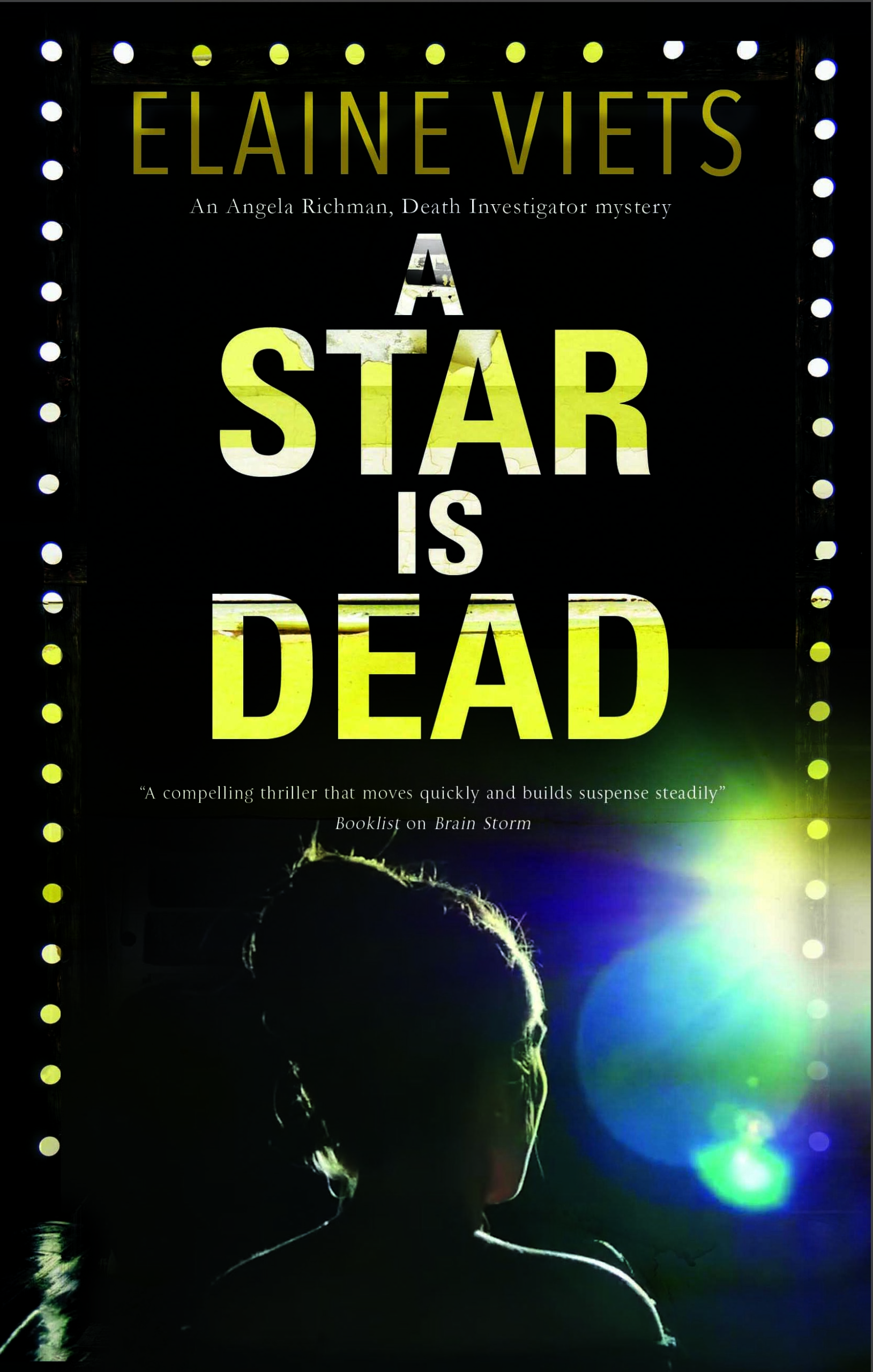
A STAR IS DEAD, Elaine’s new Angela Richman, Death Investigator mystery, debuts in April. Publishers Weekly says it has “witty dialogue and well-defined characters.” Pre-order it here: https://tinyurl.com/uwj27lv