How Story Arcs Can Add Depth to Your Plot

JordanDane
@JordanDane

Close-up of kissing lips

Yesterday, Joe Moore had an excellent post “Tips for Pacing Your Novel.” It made me think of subplots and story arcs that are other tools to punch up a story line with pace while the main plot enjoys a much needed rest for character development.

In a story arc, whether it is the arc of a romantic relationship or the personal journey of your main character, it might help you think of the arc using these key points:

5 Key Movements in a Story Arc:
1. Present State
2. Something Happens
3. Stakes Escalate
4. Moment of Truth
5. Resolve

Present State –  Set the stage with the character or the relationship at the start of the story. This can also include a teaser of the conflict ahead or the characters’ problems that will be tested. If this is a thriller with a faster pace, you can start with a scene that I call a Defining Scene, where you show the reader who your character is in one defining moment of introduction. The reader can see who this character is by what he or she does in that enticing opener. Don’t tell the reader by the character’s introspection (internal monologue). Set the stage by his or her actions. These scenes take thought to pull together but they are worth it. Imagine how Capt. Jack Sparrow of Pirates of the Caribbean first steps onto the big screen. He wouldn’t simply walk on and deliver a line. He’d make a splash that would give insight into who he is and will be.

Something Happens – An instigating incident forces a change in direction and a point of no return. Your character and/or relationship often will move into uncharted territory that will test their resolve. Sometimes you can set up a series of nudges for the character to reject, but in the end, something must happen to shove him or her over the edge and into the main plot.

Stakes Escalate – in a series of events, test the characters’ problem or the relationship in a way that forces a conflict where a tough choice must be made. Make your character/couple earn the right to play a starring role in your novel. Don’t forget that this is not simply the main action of the plot or a conflict with the bad guys. This can also mean escalating the stakes of the relationship by forcing them into uncomfortable territory.

Moment of Truth – When push comes to shove, give your character or couple a moment of truth. Do they choose redemption or stay the course of their lives? When the stakes are the highest, what will your character do? I often think of this moment as a type of “death.” The character must decide whether to let the past die or a part of their nature die in order to move on. Do they do what’s safe or do they take a leap into something new?

Resolve – Conclude the journey or foreshadow what the future holds to bring the story full circle. I love it when there is a sense of a character coming through a long dark tunnel where they step into the light. A character or couple don’t have to be the same or restored in the end. Make the journey realistic. If a character survives, they are more than likely changed forever. What would than mean for your character? How will they be changed?

Apply this arc structure to individual characters or to a romantic love interest between two characters. These arcs are woven into the tapestry of your overall plot. The plot can be full of action and have its own arc, but don’t forget to add depth and layering to your story by making the characters have their own personal journeys.

Characters have external plot involvements (ie the action of the story), but they can also have their internal conflicts that often make the story more memorable. As an example of this, in the Die Hard movies, we may forget the similar plots to the individual movies, but what make the films more memorable is the personal stories of John McClain and his family. These personal arcs are important and need a structured journey through the story line. They can ebb and flow to affect pace. Escalate a personal relationship during a time when the main plot is slowing down. Make readers turn the pages because they care what happens to your characters.

For Discussion:
Share your current WIP, TKZers. How do you integrate your main character’s personal journey into the overall plot? Share a bit of your character and how his or her “issues” play into your story line.
Tips on Pacing your Novel

By Joe Moore
@JoeMoore_writer

The story in most novels takes place over a period of time. Some are condensed to a few hours while many epic tales span generations and perhaps hundreds of years. But no matter what the timeframe is in your story, you control the pacing. You can construct a scene that contains a great amount of detail with time broken down into each minute or pacecareven second. The next scene might be used to move the story forward days, weeks or months in a single pass. If you choose to change-up your pacing for a particular scene, make sure you’re doing it for a solid reason such as to slow the story down or speed it up. Remember that as the author, you’re in charge of the pacing. And the way to do it is in a transparent fashion that maintains the reader’s interest. Here are a couple of methods and reasons for changing the pace of your story.

Slow things down when you want to place emphasis on a particular event. In doing so, the reader naturally senses that the slower pace means there’s a great deal of importance in the information being imparted. And in many respects, the character(s) should sense it, too.

Another reason to slow the pacing is to give your readers a chance to catch their breath after an action or dramatic chapter or scene. Even on a real rollercoaster ride, there are moments when the car must climb to a higher level in order to take the thrill seeker back down the next exciting portion of the attraction. You may want to slow the pacing after a dramatic event so the reader has a break and the plot can start the process of building to the next peak of excitement or emotion. After all, an amusement ride that only goes up or down, or worse, stays level, would be either boring or frantic. The same goes for your story.

Another reason to slow the pace is to deal with emotions. Perhaps it’s a romantic love scene or one of deep internal reflection. Neither one would be appropriate if written with the same rapid-fire pacing of a car chase or shootout.

You might also want to slow the pacing during scenes of extreme drama. In real life, we often hear of a witness or victim of an accident describing it as if time slowed to a crawl and everything seemed to move in slow motion. The same technique can be used to describe a dramatic event in your book. Slow down and concentrate on each detail to enhance the drama.

What you want to avoid is to slow the scene beyond reason. One mistake new writers make is to slow the pacing of a dramatic scene, then somewhere in the middle throw in a flashback or a recalling of a previous event in the character’s life. In the middle of a head-on collision, no one stops to ponder a memory from childhood. Slow things down for a reason. The best reason is to enhance the drama.

A big element in controlling pacing is narration. Narrative always slows things down. It can be used quite effectively to do so or it can become boring and cumbersome. The former is always the choice.

When you intentionally slow the pace of your story, it doesn’t mean that you want to stretch out every action in every scene. It means that you want to take the time to embrace each detail and make it move the story forward. This involves skill, instinct and craft. Leave in the important stuff and delete the rest.

There will always be stretches of long, desolate road in every story. By that I figuratively mean mundane stretches of time or distance where nothing really happens. Control your pacing by transitioning past these quickly. If there’s nothing there to build character or forward the plot, get past it with some sort of transition. Never bore the reader or cause them to skip over portions of the story. Remember that every word must mean something to the tale. The reader assumes that every word in your book must be important or you wouldn’t have written it.

We’ve talked about slowing the pacing. How about when to speed it up?

Unlike narration, dialog can be used to speed things up. It gives the feeling that the pace is moving quickly. And the leaner the dialog is written, the quicker the pacing appears.

Action scenes usually call for a quicker pace. Short sentences and paragraphs with crisp clean prose will make the reader’s eyes fly across the page. That equates to fast pacing in the reader’s mind. Action verbs that have a hard edge help move the pace along. Also using sentence fragments will accelerate pacing.

Short chapters give the feeling of fast pacing whereas chapters filled with lengthy blocks of prose will slow the eye and the pace. Make sure you write it that way for a reason.

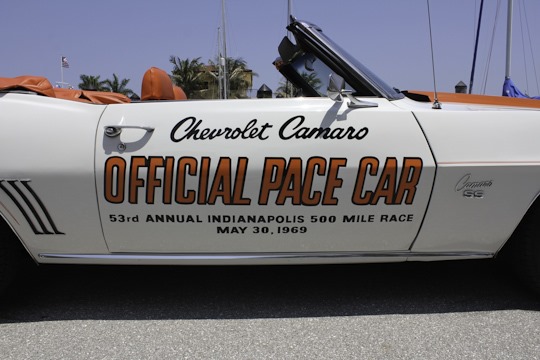
Just like the pace car at the Indianapolis 500 sets the pace for the start of the race and dramatic changes during the event such as yellow and red flags, you control the pace of your story. Tools such as dialog versus narration, short staccato sentences versus thick, wordy paragraphs, and the treatment of action versus emotion puts you in control of how fast or slow the reader moves through your story. And just like the colors on a painter’s pallet, you should make use of all your pacing pallet tools to transparently control how fast or slow the reader moves through your story.

How about you Zoners? Got any hot tips on pacing?                                           

Freshening Up Your Scooby Doo Ending


Scooby doo 3


True story: some college students were touring a county coroner’s office. The tour included visit to an autopsy room, where a coroner and a diener were in the process of examining the body of a deceased unfortunate. The diener, with the students looking on, turned the corpse over and exclaimed, “Rut row!” The reason for this utterance was that the corpse had a tattoo of Scooby Doo inked into one cheek of his posterior. Gallows humor, indeed.

Scooby Doo is firmly ensconced in the American culture. The plot of each cartoon episode is very similar, with a crime occurring, Scooby and his pals investigating, and the villain of the piece being unmasked, literally, at the end. I think that I scooby doo2scooby doo1       first heard this type of climax referenced as a “Scooby Doo” ending during the second of the three climaxes to the film Bill & Ted’s Excellent Adventure. It has been a vehicle used in mystery novels long before that. There’s nothing wrong with it at all, except that 1) it sometimes doesn’t work and 2) sometimes it needs a little work. I ran across an example of the former several months ago while reading a thriller that was one of the many nephews to The Da Vinci Code wherein the protagonist’s adversary was running around killing people while wearing a tribal mask and attempting to obtain an instrument of antiquity which would permit him to destroy the universe. The protagonist got the mask off of the evildoer near the end and the book ended. “Rut row!” The book was okay, but the ending was a total disappointment.

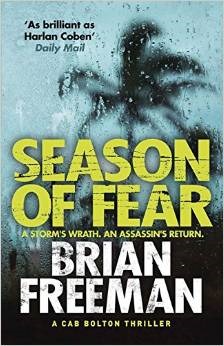
season of fearThat brings us to a book I read this week in which the author uses the Scooby Doo ending to great effect by taking the story a step or two beyond it. The author is the morbidly underappreciated Brian Freeman and the book is Season of Fear, the second and latest of the Cab Bolton novels. (Please note: it’s not quite a spoiler, but there’s a general revelation ahead. Read the book regardless). The premise is fairly straightforward. Ten years ago a Florida gubernatorial candidate was assassinated by a masked gunman, throwing the election into chaos. A suspect was identified, tried, convicted, and jailed. In the present, the candidate’s widow is running for the same seat when she receives a threatening note which purports to be from the same assassin. Indeed, he eventually turns up, and his identity is ultimately revealed in a grand unmasking. But wait. Freeman, after giving the reader enough action to fill two books and expertly presenting a complex but easy to follow plot, gives the reader more to chew on. Things don’t end with the revelation of the identity of the doer; instead, Freeman moves us a couple of more steps forward, revealing a potential unexpected mover and shaker who was a couple of steps ahead of everyone, including Bolton. This has the double-barreled effect of making the climax much more interesting and setting up a potential adversarial setting for Cab Bolton in a future novel. Nice work.

Again, Scooby Doo endings are okay. They’re fine. But if your particular novel in waiting has one, and seems to lack pizazz, don’t just take the doer’s mask off, or reveal their identity, or whatever. Take things a step further just as the curtain is going down, and reveal who is pulling the cord, and perhaps yanking the chain. It may be a character that was present throughout your book, or someone entirely new, or…well, you might even want to create a character and work your way backwards with them. But stay with the mask, and go beyond it.

So what say you? Have you read anything recently where the ending really surprised you, unmasking revelations or otherwise notwithstanding? Do you like Scooby Doo endings, in your own work or the work of others? Or can you do without them?

Oh, lest I forget… SCOOBY-DOO and all related characters and elements are trademarks of and © Hanna-Barbera. Rowwrr!

Create a Fascinating, Believable Antagonist

villainJodie Renner, editor & author  @JodieRennerEd

For a riveting story, be sure to challenge your hero – or heroine – to the max. Readers need to be constantly worrying about him. Which means his life is in upheaval and he’s struggling, dealing with increasing conflict in the form of serious opposition or threats. One or more forces of opposition should threaten the protagonist or stand in the way of his goals.

Challenges don’t need to be in the form of an actual character. They can be some other kind of opposing force or idea, like a fear, phobia, prejudice, or handicap that is preventing the character from reaching her goals.

The main threat in fiction usually comes in the form of an antagonistic character, who isn’t necessarily a murderous villain. Other determined opponents include romantic rivals, “mean girls,” schoolyard bullies, competing colleagues, or sports rivals.

Antagonists can also fall into a gray zone of opposition characters who aren’t really evil, just at odds with the protagonist we’re rooting for. They can be fascinating too, as we don’t know if they’re going to change sides, so they’re often unpredictable. A few examples include the Tommy Lee Jones character chasing Harrison Ford’s character in the movie The Fugitive and Sheriff Teasle in First Blood, who is after our hero, John Rambo. Or how about Han Solo from Star Wars? Not a villain, but not a good guy, either. He sparks things up though, doesn’t he? We wonder whether these somewhat likeable or understandable bad guys could switch sides at any time.

To pose a credible, significant threat and cause readers to worry, your antagonist should be as clever, powerful, and determined as your protagonist. Challenges and troubles are what make your main character intriguing, compel her to be the best she can be. They force her to draw on resources she never knew she had in order to survive, defeat evil, or attain her goals.

For today’s post, we’ll assume your antagonist is a villain – a mean, even despicable, destructive character we definitely don’t want to root for. He needs to be a formidable obstacle to the protagonist’s goals or a menace to the hero’s loved ones or other innocents. And thrillers, fantasy, and horror require really frightening, nasty villains.

Most of the bad guys in movies and books want the same thing: power. Or maybe revenge or riches. And they don’t care who gets hurt along the way. Or worse, they enjoy causing pain, even torturing their victims.

The antagonist needs to be powerful, a game-changer. As Chuck Wendig says in his excellent blog post “25 Things You Should Know About Antagonists,” “The antagonist is there to push and pull the sequence of events into an arrangement that pleases him. He makes trouble for the protagonist. He is the one upping the stakes. He is the one changing the game and making it harder.”

The protagonist and antagonist have clashing motivations. Their needs, values, and desires are at odds. The antagonist and protagonist could have completely opposite backgrounds and personalities for contrast – or be uncomfortably similar, to show how close the protagonist came or could come to passing over to the dark side.

Most readers are no longer intrigued by “mwoo-ha-ha,” all-evil antagonists, like Captain Hook in Peter Pan. Unless you’re writing middle-grade fiction, be sure your villain isn’t unexplainably horrid, evil for the sake of evil. Today’s sophisticated readers are looking for an antagonist who’s more complex, realistic, and believable.

Chuck Wendig suggests antagonists should be depicted as real people with real problems: “People with wants, needs, fears, motivations. People with families and friends and their own enemies. They’re full-blooded, full-bodied characters. They’re not single-minded villains twirling greasy mustaches.”

For a believable, fascinating antagonist or villain, try to create a unique, memorable bad guy of a type that hasn’t been done to death. Try to give him or her an original background and voice.

Remember that the antagonist is the hero of his own story. He thinks he’s right. He justifies his actions somehow, whether it’s revenge, a thirst for power, ridding society of undesirables, or payback. He may even feel he has a noble or just goal, as in the serial killer of prostitutes.

To create a worthy opponent for the protagonist and a realistic, believable, complex antagonist, get into his mind-set. Ask yourself these questions:

  • What does the antagonist want or need?
  • Why is he determined to go after it?
  • What drives the antagonist? Greed? Revenge? Hatred? Anger? Hurt?
  • What is his biggest motivation? To avenge past wrongs? To gain ultimate power?
  • Who does he want to suffer or lose out? Why?
  • How does he justify his actions? What does he tell himself?

Now create a backstory for your antagonist. Most of it will not show up in your story, but you need to get a handle on what makes him tick to ensure he acts in ways that are in keeping with his background.

Develop his voice. As you do for the protagonist, you can write a free-form rant, where he goes on and on about why he hates someone or something, wants to get revenge, needs to find and kill certain people, and so on.

Show his justification for his goals and actions. Why does he think he’s right and justified in his actions? This will create a more believable, more determined bad guy.

Perhaps identify at some point in your narrative a flashback or allusion to an experience that shows the antagonist as a victim – abused or neglected, treated cruelly by family or others in power. This can create a spark of sympathy while also potentially foreshadowing a particularly nasty incident. (Thanks to thriller author Tom Combs for this suggestion.)

Write some scenes purely from the antagonist’s point of view, away from the protagonist, so readers can find out what makes him tick and how twisted he is. This also creates reader concern for the protagonist, which is always a good thing.

Make him scary, a force to be reckoned with, but not all-powerful, as that’s unrealistic. Give him a few weaknesses, too.

And for added complexity and dimension, take it one step further by showing a human side of the antagonist, something readers can actually relate to, might be afraid they could also fall into. That amps up the tension and reader involvement.

So to create a fascinating, believable antagonist or villain, try to make him or her unique. Delve into their background, find out the goals and motivations that drive them forward. Get into their mind and try to understand them. How do they justify their actions?

Give us a complex villain we love to hate – or a gray antagonist who makes us squirm!

TKZers – Who are some powerful villains who made you shiver in novels or films?

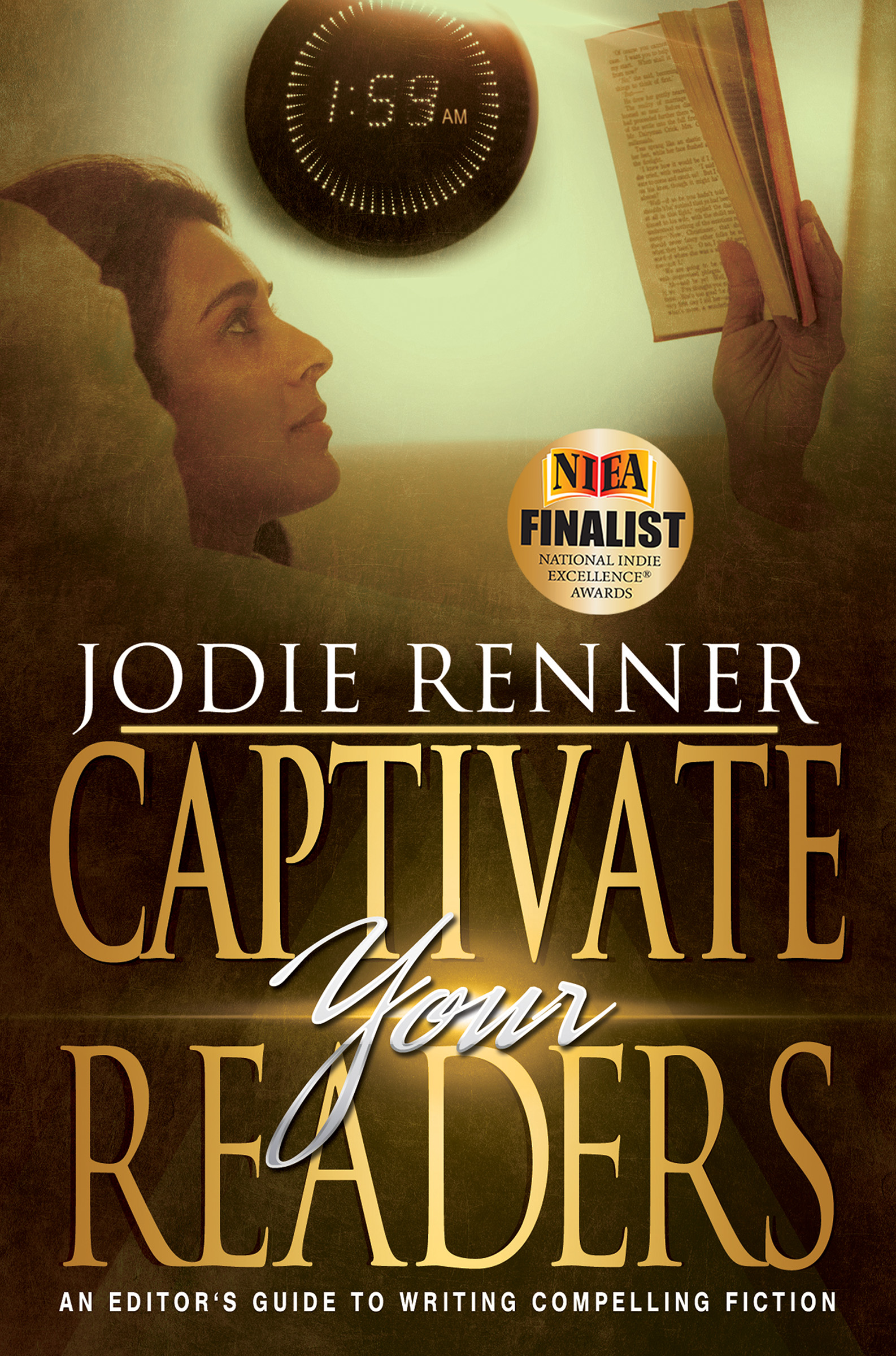
Captivate Your Readers_med– And what about your favorite “gray” antagonists or anti-heroes?

And for a future article, what do you think about all the gray protagonists or anti-heroes cropping up in novels, movies, and TV shows, like Nick in Gone Girl and Walter in Breaking Bad? Do you welcome that trend toward a flawed, unlikeable protagonist? Or do you yearn for more admirable, ethical, heroic heroes to root for?

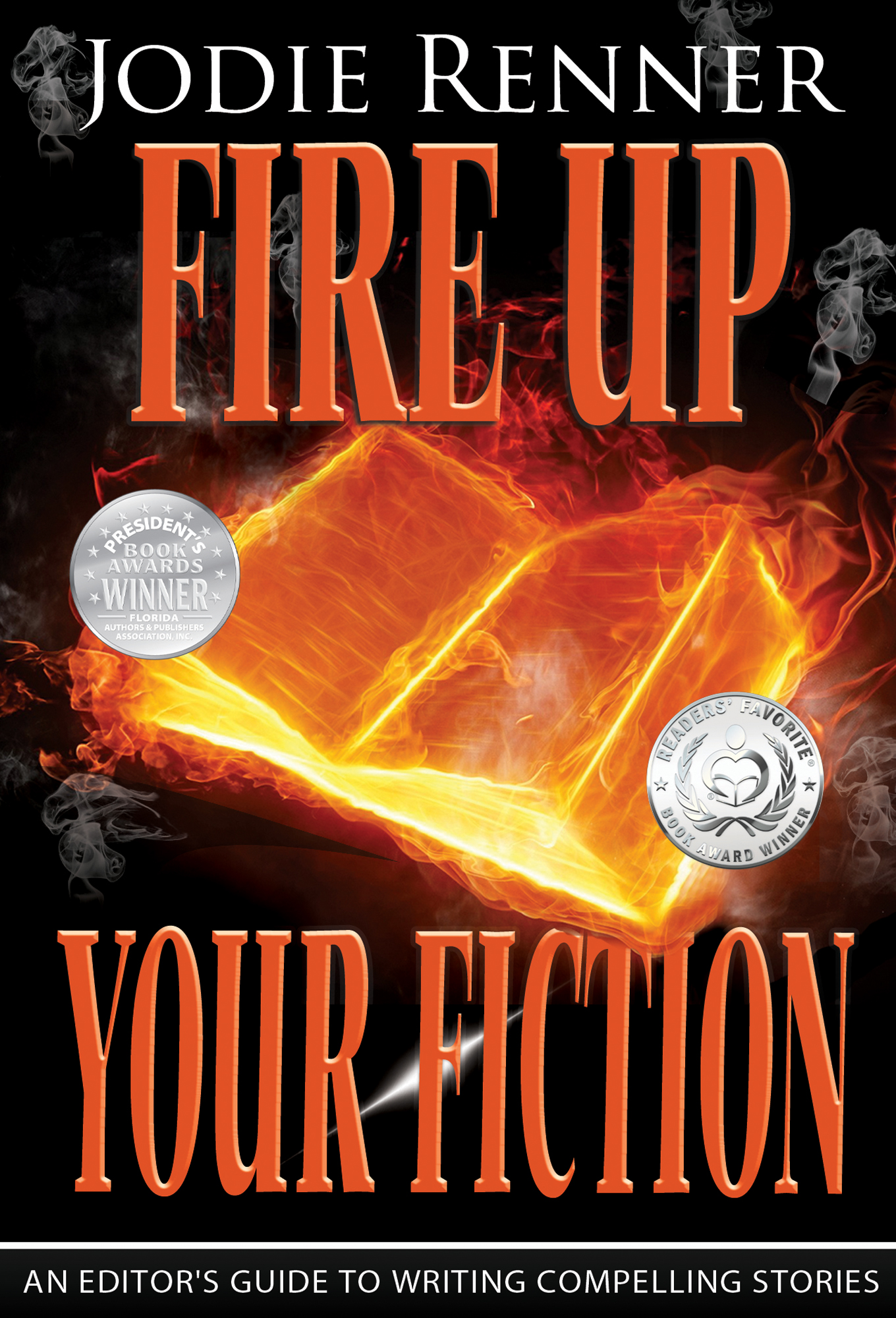
Jodie Renner is a freelance editor and the award-winning author of three craft-of-writing guides in her series An Editor’s Guide to Writing Compelling Fiction: Fire up Your Fiction, Writing a Killer Thriller, and Captivate Your Readers.

Do your Research!

imagesToday I leave for a very exciting trip to India – not only am I excited because it’s a place that’s been on my (long) ‘must see’ list for ages but also because it gives me a chance to do some ‘on the ground’ research. I’m lucky that my love of travel and history can be combined in this way, but I also understand that I have an obligation to future readers to get the details of any story I write as accurate as possible. Although ‘on site’ research isn’t always possible, few things compare to actually breathing in the air of the place you plan to write about or to feel, smell, hear and touch the very things your characters will experience.  The immediacy of this kind of research will (I hope) translate into a more visceral sensory experience for the reader as well.

Following Jim’s theme from yesterday’s blog post – I also feel strongly that one of the top things guaranteed to make a writer fail is a failure to do research. This research includes critical information about the publishing and writing industry as well as everything pertinent to the book a writer is hoping to complete. And when I say everything – I mean everything. Readers today demand a compelling and accurate story – and be assured, if you fail to research something properly there will be an army of readers out there eager to tell you so!

This research can usually be done at the desk top – with the internet offering a wealth of information that was never as readily accessible as it is today. I can read antiquarian books that have been electronically scanned, view newspaper columns from a past era – even look up the weather reports for a particular date I have in mind. As a historical writer, I feel an obligation to get the facts right as much as possible and I have been known to spend way too many hours researching furnishings, paintings, and books that will comprise less than a few sentences of background in my novels (what can I say, I love my job!). Still – nothing quite compares to the thrill of actually being in the place you want to write about.

So today I go armed with notebooks, computer and camera as well as all my (aging) senses – hoping to capture the essence of place and history for India that I want to capture in my future story. My travels will include Delhi, Agra, Hyderabad and Udaipur, and, I know I will find the experience overwhelming and confronting at times, as I witness the juxtaposition of modernity and history, poverty and riches first hand.

Unfortunately, I may not be able to view this post or comment as much as I’d like (as I’ll be flying part of the day), but I would like to hear from my fellow TKzers on a place that they would like to visit as research for an possible book they’d love to write.

So what country or place is on your ‘must see’ list for a possible future book? Have you ever given up on a book after realizing the writer failed to do their research?


Make Sure Your Characters Act in Character!

Captivate_full_w_decalby Jodie Renner, editor & author @JodieRennerEd

DO YOUR CHARACTERS’ DECISIONS AND ACTIONS SEEM REALISTIC AND AUTHENTIC?

Have you ever been reading a story when suddenly the protagonist does or says something that makes you think, “Oh come on! Why would he do that?” or “This is crazy. Why doesn’t she…?” or “But I thought he…!” or “I didn’t know he/she could [insert extraordinary ability].” The character seems to be acting illogically, to be making decisions with little motivation or contrary to his personality, abilities, or values

I see this problem a lot in fiction manuscripts I edit. The author needs something to happen for the sake of the plot they’ve planned out in advance, so they force a supposedly intelligent character to do something contrary to common sense and their best interests, like recklessly putting themselves in danger.

For example, I once edited a book where the highly educated, intelligent heroine rose from her bed in the middle of the night and, without telling her husband where she was going or even leaving a note, drove to a remote warehouse to find some incriminating evidence, knowing the killer was likely to return – which of course he did, and attempted to kill her. It made for an exciting scene, but unfortunately, the otherwise savvy character came off looking like a foolhardy, impulsive airhead. I couldn’t help wondering, why wouldn’t she tell her husband? Better yet, call the police and let them handle it.  Even police, who are trained for these situations, usually get backup.

Moving your characters around like pawns to suit the plot, if it doesn’t make sense for who they are, could have your readers scratching their heads in disbelief or, worse, throwing your book across the room, then writing a scathing one-star review of it.

Don’t force your characters, kicking and screaming, into actions they just wouldn’t do.

Readers won’t suspend their disbelief and bond with the character if they don’t “buy” what the character is doing and why. An engrossing story needs realistic characters dealing with adversity in bold but realistic and plausible ways.

To make a character’s decisions and actions convincing, take care when creating their background, character, abilities, and motivations.

Background, character, and personality

Of course, you don’t want to make your hero or heroine ordinary, timid, or passive, with few daring decisions, because that would make for a ho-hum book most readers wouldn’t bother finishing. But on the other hand, if you’re going to have them perform daredevil feats, be sure to build that into their makeup.

First, get to know your main characters well. Take some time to develop their background, character, and personality. Are they athletic or more cerebral? Risk-takers or cautious? Do they embrace change, enjoy challenge, love to learn new things? Or do they prefer to stay within their comfort zone? To plumb their depths, do some free-form journaling in which they express their strongest desires, fears, hopes, secrets, regrets, and gripes.

Are they physically capable of what you want them to do?

Abilities

If, for a riveting plot, you need your hero to do something heroic, almost superhuman, make sure he has the determination, strength, flexibility, and endurance to do that. Although it’s amazing what people are able to do under duress with the adrenaline flowing, it’s more credible if your character is already at least somewhat fit. Does he work out a lot to maintain muscle mass, agility, and endurance? How? Also, he’ll need to be intelligent, skilled, and resourceful.

If he needs special skills, show earlier on that he possesses them and how it all makes sense, given his overall makeup. In one novel I edited, the sedentary, slightly overweight, middle-aged protagonist fought off a strong attacker with quick, expert martial arts moves. This was an “Oh, come on!” moment, given his lifestyle, age, and paunch.

In The Hunger Games, we learn early on that Katniss is an expert at archery, which is a huge factor in her survival later. A nerdy banker probably doesn’t do kickboxing on the side, so you may need to make him less desk-bound and more athletic for it to work. Or give him another profession.

If you’re writing fantasy, of course you have more leeway with unusual characters and situations, but if you’re writing a realistic genre, with no supernatural or paranormal elements, make sure the character’s actions are realistic and make sense.

Motivations

Is your hero sufficiently motivated to put his life on the line? Do those motivations fit with his belief system, background, and immediate needs? If you want or need a character to do something dangerous, go back and give him some burning reasons for choosing that course of action.

Perhaps he finds himself in a life-and-death situation for himself or someone he loves, or innocent people are in grave danger. His love, concern, and determination will make him more selfless and daring, bringing out courage he never knew he had.

As Steven James advises in Story Trumps Structure, as you’re writing your story, ask yourself , “What would this character naturally do in this situation? Is he properly motivated to take this action?”

Causality

Be sure your narrative is also shaped by the logic of cause and effect. For your story to be believable, character decisions and reactions need to plausibly follow the original stimulus or actions. If your character overreacts or underreacts to what has just happened, they won’t seem “in character” or real.

Be sure every decision and action makes sense with what preceded it. As James suggests, as you go along, continually ask yourself, “What would naturally happen next?”

So don’t force your characters to act in uncharacteristic ways because your plot needs them to. Readers will pick up on that. Rather than insisting certain events or actions happen as you had planned, instead allow the natural sequence of events and logical reactions to shape your plotline.

Go through your story to make sure your characters are acting and reacting in ways that are authentic to who they are and where they’ve come from, and that they’re sufficiently motivated to take risks. Also, do their reactions fit with the stimulus? Is that a logical response to what happened?

Ask yourself, as you’re writing, “Is there a way to accomplish this that fits with the character’s values and personality?” If not, I suggest you either change the plot (have them make a different decision and rewrite where that leads them) or go back and change some of the character’s basic attributes, values, and skills. Or add in incidents in their past that have shaped them in ways that will justify their current actions.

That way your plot will flow seamlessly and your characters will seem real. There will be no bumps, no hiccups where readers will be suddenly jolted out of the story.

As William Faulkner advised one of his fiction-writing classes,

“…get the character in your mind. Once he is in your mind, and he is right, and he’s true, then he does the work himself. All you need to do then is to trot along behind him and put down what he does and what he says.”

So don’t impose your preconceived ideas on the character – you risk making him do things he just wouldn’t do. Know your characters really well and the rest will naturally follow.

Fire up Your Fiction_ebook_2 silversJodie Renner is a freelance fiction editor and the award-winning author of three craft-of-writing guides in her series An Editor’s Guide to Writing Compelling Fiction: Captivate Your Readers, Fire up Your Fiction, and Writing a Killer Thriller. She has also published two clickable time-saving e-resources to date: Quick Clicks: Spelling List and Quick Clicks: Word Usage. You can find Jodie at www.JodieRenner.com, www.JodieRennerEditing.com, her blog, http://jodierennerediting.blogspot.com/, and on Facebook, Twitter, and Google+.

Tips for researching your story

By Joe Moore
@JoeMoore_writer

My co-author, Lynn Sholes, and I write globe-hopping thrillers that always deal with some form of futuristic technology—human cloning, quantum computing and mechanics, string theory, human cell regeneration, faster-than-light propulsion, and many other yet-to-be-developed science. We spend a great deal of time before and during the drafting of our manuscript researching or story. Often, we call upon experts to help us formulate our fictionalized theories. For instance, we contacted a famous geneticist and asked: “We know you can’t regenerate an entire human body from just a sample of DNA, but if you could, how would it be done.” The result was the science in THE PHOENIX APOSTLES.

I find researching for our novels to be as much fun as writing them. It’s the excitement of uncovering those tidbits and morsels of fact that add seasoning and spice to the story. I believe that research adds layers to a story. It keeps the story from becoming thin and two-dimensional. With the right amount of research, we can round out character’s lives, locations, settings, and atmosphere. Each layer helps transport our readers into a more fascinating and realistic story-world. Some genres demand more research than others—science fiction, medical, legal, criminal, and historical to name a few. But all books can benefit from in-depth research.

The general rule in researching for a manuscript is: more is better during the collecting stage but less is better during the writing stage. Here are some tips to help find the right balance.

When we research, we collect a great deal of material, almost always more than we need. We come across a lengthy article on a topic and highlight a dozen of those tasty info tidbits. The skill to researching is to choose one or two that will enhance the reader’s experience without bogging down the tale or turning our writing into a dry college lecture or travel guide. If you have a number of research items available for a particular scene, pick the one that helps put a little bit more icing on the story cake. Ask yourself which one helps develop the character or move the story forward the best. That’s the one to use. Keep the others in mind in case they’re needed later. Also remember that choosing the right research data will help lend authenticity to our writer’s voice.

Another tip is to never talk down to the reader by using information from our research that they might not understand. Never confuse the reader or push them out of the story by making them feel they’re not as smart as the writer. It’s really easy to put a book down and move to another out of frustration. Keep it simple—but not too simple. There are a number of ways to talk down to the reader. Avoid them all by not talking over their heads or dumbing down the information as if you were explaining it to a child. Even if the readers may not totally understand a fact or word, use it in such a way that they can mostly grasp the meaning from the context of the scene.

Avoid throwing in facts from your research just to prove you know how to look stuff up. Again, use your research only if it helps build your characters or advances your plot. Showing off your knowledge is not why the reader enjoys reading.

Lastly, avoid the dreaded info dump. Spread out your research information in just the right amounts to keep the reader from skimming over pages or skipping ahead. Your novel can educate readers and take them to places they’ve never been, but don’t forget that first and foremost, the reader wants to be entertained, not go back to school. Sprinkle in your research like spices and seasoning in a gourmet dish. Too little creates a bland taste, too much creates heartburn.

Zoners, any other researching tips and experiences to share?
—————————-

tomb-cover-small“Vengeance can be earth-shattering.”
Max is back! Coming in July, Maxine Decker returns in THE TOMB, book #3 in the Decker series. This time around, the former OSI agent risks her life to stop the elimination of an entire branch of the U.S. Government.

Fun Tip of the Day: Google Authorship

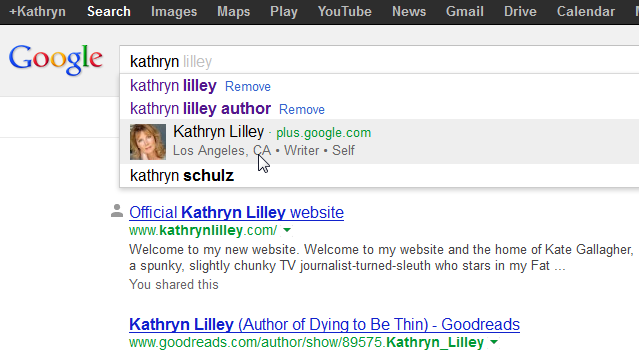
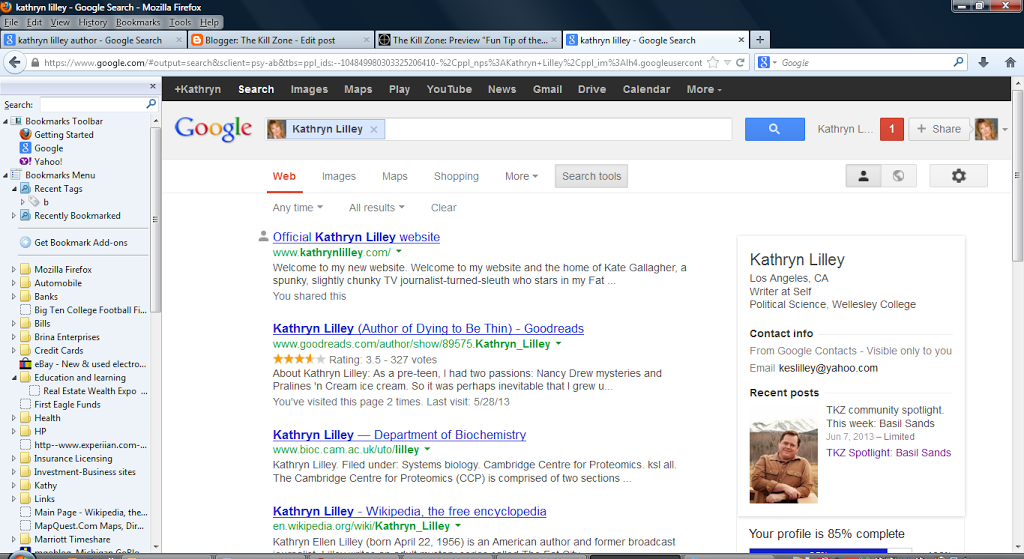
Have we talked about Google Authorship here before? I just enabled this neat little feature, which causes Google to display your picture and a profile box during searches on your name.

Here’s a screenshot of doing a search with my Google Authorship profile enabled. When I begin typing my name in Google’s search box, my picture appears along with the various search result options.

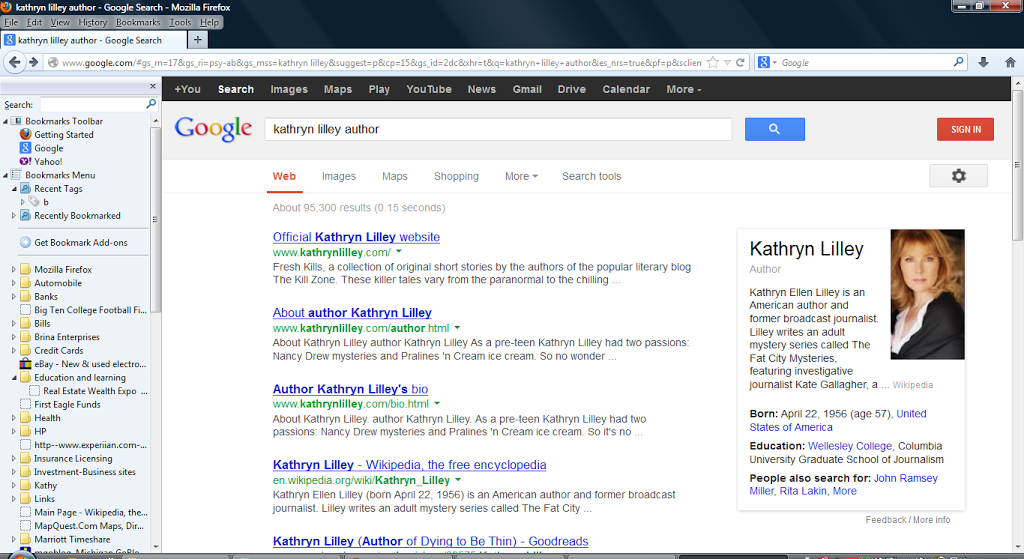
And here’s a picture of the search results. A box highlights my profile information, including a photo.

It’s hard to get everything on one screen to show you, but my Google Plus profile information also appears in a box with a photo. The example below shows Basil Sands’ picture instead of mine. Why, I’m not sure. Basil’s an IT guy, so maybe he can tell us, lol.

I just did a random sampling of searches on the TKZ bloggers’ names. The results indicate that most of us, but not all, have already set up a Google Authorship profile. Google Authorship is an incentive to get more familiar with Google Plus, which is much less popular as an outreach tool among authors compared to, say, Facebook.

So, have you been using Google Authorship as part of your Google Plus identity? Do you have any user tips or best practices you can share?

When writers don’t play nice in real life, do readers care?

For the most part, writers are the nicest group of people you’ll ever meet. When I went to my first writer’s

conference back in 2006 as a newbie without a publishing contract, I was expecting to be dismissed by the “real” authors there. Instead, I found myself surrounded by the most welcoming, supportive professional community I’d ever met.

Of course. there are always exceptions. I’ve become more aware of those exceptions recently because of Facebook. People who are active on Facebook eventually reveal themselves, personality warts and all. For writers, sometimes too much revealing of self ignites blowback from readers.

Last week, a well-known author posted a Facebook rant about a political topic. Her comments were followed by vocal disappointment from some of her readers; all of the commenters expressed disappointment in the author. A few vowed never to buy her books again. Ouch.

We’ve even been taken to task occasionally here at TKZ. Whenever a blogger has made an ill considered, controversial or tactless remark, it’s “Katie, bar the door.” You guys always let us know when we’ve fumbled the courtesy ball. And for that, we thank you. 🙂

But it occurs to me that most people don’t want to buy “nice” books. Few people want to read about the Village of Nice, Happy People. We want conflict, emotion, and tension from our stories. But we don’t want that from our real-life writers.

I grew up surrounded by high-achieving, volatile personalities, so I guess I expect my artists to be a bit raw in person. But I’m wondering–have you ever encountered a writer who was rude or obnoxious in real life, and did that experience make you less likely to buy his or her book? 

I’ll leave you with Jack Nicholson from As Good As It Gets, in which he offends an ardent fan.