1.) What comes easy to you in the writing process?
2.) What are your biggest challenges?

By SUE COLETTA
It’s no secret that the writing biz requires patience. Sometimes, though, waiting can be agonizing. Recently, an exciting opportunity came my way. In order to make this dream come true, I had two weeks (two weeks!) to produce something I’ve never done before. Sorry for being so cryptic, but I don’t want to jinx it.
Now that I made my deadline, all that’s left to do is wait. And wait. And wait. Even with a new release, my mind keeps wandering back to this secret project … and the wait.
That got me thinking, I wonder how or if waiting affects the brain.
Turns out, researchers recently asked the same question. For the first time, a research team at McGill University clearly identified the specific parts of the brain involved in decisions that call for delayed gratification.
Here’s how it works …
The hippocampus (associated with memory) and the nucleus accumbens (associated with pleasure) work together to make critical decisions where time plays a role. For example, suppose you send a query to a literary agent or publisher. You’re making a decision that requires you to wait for the outcome, thereby triggering both the hippocampus and nucleus accumbens.
Still with me? Okay, cool. Let’s look at exactly what these researchers did to prove or disprove their theory …
The researchers used rats trained to make choices between stimuli that resulted in rewards. Some rewards were delivered instantly, some meant delayed gratification. The rats had a choice between two identical visual shapes on a touchscreen (similar to an iPad). In exchange for sugar pellets, the rats had the choice to press their noses against the shape that delivered one sugar pellet immediately or the shape that would deliver four sugar pellets if they waited to receive the reward.
Over time, the rats learned to negotiate a trade-off between the smaller, instant gratification and a windfall, even if it meant waiting for a short period. Researchers argue that most people will also wait for a decision to pay off, if the reward is worth it.
Do you agree? she asks a community of writers whose dreams stand at the intersection of hurry up and wait.
Now, what do you think happened when the researchers disrupted the circuit from the rats’ hippocampus and nucleus accumbens? You guessed it. The rats became impatient and irritable, unwilling to wait even for a few seconds.
Why?
Our brains weigh the pros and cons of thousands of situations every day without conscious thought. The nucleus accumbens is made up of a group of tiny cells deep within our brains, and those cells are responsible for the release of dopamine. The amount of dopamine released depends on the size of the reward.
Is it any wonder why we hate waiting? Our bodies crave dopamine! Hence, why exercise is so important for good mental health.
What can we do to help with waiting for news? You guessed it. Get your body to pump dopamine. Which is why today (Saturday) I jumped on my husband’s tractor and mowed the lawn before writing this post. 😉
Yeah, he couldn’t believe it either. I’m not what anyone would describe as a manual labor type of chick. I like my fingernails too much to break them. But I needed a way to switch off my brain before I drove myself crazy by checking and rechecking my email. When I saw my husband on the tractor, it looked like fun.
You know what? I had a blast! Who knew mowing the lawn could double as an exercise in creativity? As my husband cringed, I sailed around the yard creating animal shapes with the blades. Always keep ‘em guessing, ladies!
Men, you can stop groaning now. You’ll be pleased to know I fixed the grass afterward by riding back and forth in military straight lines, but it was nowhere near as fun.
In other study, researchers at the University of Texas measured what occurs inside the brain during a long wait vs. a short wait. For the experiment they used two different tones. The first tone meant a 15-20 second waiting period, the second equaled wait times of 65-75 seconds. Both tones signaled the same reward. The only difference was the length of delay. What they discovered was the nucleus accumbens released more dopamine when the short wait tone sounded. Which means, we’re willing to wait for a reward if the wait doesn’t take too long.
Makes sense, right?
So, if you’re waiting for something to happen as a result of a decision you made, do yourself a favor and get outside, or hit the gym … anything that might help to release dopamine. If you follow this advice, the wait won’t feel as long.
Are you in the wait zone? Care to share what you’re waiting for? What are some ways that have helped you to wait?
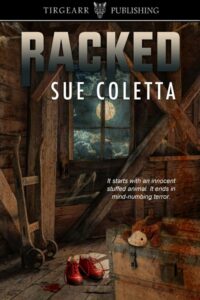
It starts with an innocent stuffed animal. It ends with mind-numbing terror.
RACKED, Grafton County, Book 4, is now available for pre-order! Only 99c.
 Real life offers inspiration when we least expect it. That moment can also be awkward, especially if you forget to mention one crucial distinction between you and a psychopath: the word writer.
A service person comes to your home. While you’re watching her — yes, a woman — do her job, a brainstorm strikes you out of nowhere; it rounds first base, second, and third, and charges at full speed for home plate. But you need more information to flesh out the idea, mentally draft the story from beginning to end to see if the premise has merit.
So, you drill her with questions, lots of questions, dark probing questions, and then you feel like you have to explain, but you’re so focused on the story — the story is all that matters — you blurt out, “It’s for a murder.” But you don’t expand, so now, this woman who’s working in a male-dominant field starts to twitch, flinch, her eyes pleading with your husband to stop you if things take a turn for the worse, her protective posture praying to God that you won’t snap right here, right now. Or maybe, she’s contemplating whether or not to call the police.
Whatever. You’ve been down this road before. At the same time, you’re not oblivious to the woman’s discomfort. After all, you’re not a monster. You just need facts, and she’s the perfect person to give them to you.
Ah, well, it’s not the first time your enthusiasm for murder and body disposal made a stranger squirm. Probably won’t be the last, either. No biggie. It’s all good.
You continue. “So, in your professional opinion, how long would it take for the flesh to fall off the bones? Oh, wait.” You mull over the possibilities. The hook of your story emerges like a phoenix from the deep recesses of your mind, and you try to control the smirk that threatens to expose your dark, grisly thoughts. “Would the bones also disintegrate?”
“Err … umm …” Her work boots shuffle backward a few feet. Nervous laughter takes hold — you know the type, that “he-he,” pause, “he-he,” pause, followed by a visual gulp. “Do you have somebody specific in mind?”
What a strange thing to say. Obviously, she’s never read your books. Bitch. “I’m still workin’ out the details.” Meh. You write it off to can’t-please-everyone and move on. “So, about that flesh, what’s your best guesstimate for a time-frame?”
“Ah … well, I worked with a guy once who had to be airlifted to Boston after his skin made contact with … third-degree burns all over his body … it took about five hours.”
“Five hours? Hmm, what if I added lye or sulfuric acid?” You weren’t really asking, more thinking aloud.
In a tone unfit for human ears, she says, “I’m not sure what that is.”
As your eyebrows arch in disbelief, your husband steps in to explain. “If she adds lye or sulfuric acid, the mixture should dissolve the flesh, skull, and whatnot a lot quicker.” Something must occur to him, because he whirls toward you. “Babe, wouldn’t you need to heat the sulfuric acid?”
That draws your full attention. “Not necessarily. If we didn’t kill her first, it’d definitely prolong the torture, but maybe that’s a good thing.”
He laughs.
You laugh, too. Perhaps a bit harder than you should.
The service woman’s stone-cold expression snaps toward your husband and then you, her gaze shifting back and forth before refusing eye contact with either of you.
To break the awkward silence, you say, “Really appreciate you comin’ out on a Saturday. You’re doin’ a great job.”
“Thanks.” Her rigid shoulders relax a bit. “This was my father’s business. After he passed, I left it up to my ex-husband to handle the day-to-day operation, but he screwed me over. So, now, I’m juggling this job with my day job.”
Half-tuning her out, this news doesn’t surprise you. It’s the reason you gave her the work in the first place; you’re a sucker for the underdog. To avoid being rude, you pretend that you’re unfamiliar with the story. As she rambles on and on about her ex, you retreat to fictionland where you create plot points and milestones for the new premise that has you all fired-up. You can’t afford to lose focus. If you do, the plot could slip away. Nothing can get in your way, not now, not while the creative juices are flowing like Niagara Falls.
“Yeah, what a shame.” To not appear unsympathetic, you wait a quick beat. “So, what about teeth?”
She startles. “Excuse me?”
“Y’know, the murder. Enamel reacts differently than bone.”
“Gee, I … I …” Another nervous giggle escapes her lips as she swivels to face your husband, who loves it when your writer brain takes over. “Aren’t you the least bit worried?” On the sly, she jabs a chin in your direction.
You catch the insinuation, and roll your lips. “Please. Don’t let the innocent face fool you. He’s just as bad as I am when it comes to driving aimlessly, searching for the perfect place to dump a body.”
More ideas skip past the concept, premise, plot points, and milestones. “Hey, you must know the area really well.” Your gaze slides to your husband, and he nods in solidarity. “A desolate area, a deserted farmhouse, a dirt trail that doesn’t seem to lead anywhere, a particularly eerie swamp, maybe woodlands that no one dares to enter due to a savage attack-slash-murder that happened decades ago … do ya get what I’m sayin’?”
Silent, her jaw slacks.
Some people, eh? Figures you get stuck with the weirdo. In an attempt to clarify, you rephrase. “What I mean is, have you ever had a call from a homeowner that lived in a Buffalo Bill-style house? Y’know, something remote, or a property that exuded evil, a place where as soon as you pulled on to the long dirt driveway all your tiny body hairs stood on end.”
She smacks her gloves together. “Well, I’m about done here. If you give me a minute, I’ll get you a receipt.”
“But–”
Your husband gives you the slow eye-close, signaling you to let her leave.
“Okay, thanks for your help.”
“Hey,” she hesitates, “you were kidding about killing somebody, right?”
“Not at all.” With no further explanation, you turn and strut back into the house. And your poor husband is left to relay the one piece of information that separates you from a psychopath: you’re a writer. Did you forget to mention that?
This scenario really happened to me. True story.
Can you relate? Care to share a funny miscommunication? Let’s start the week with laughter.
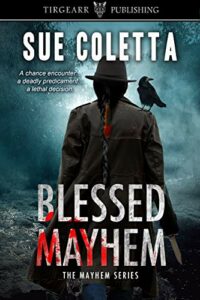 Winner of Readers’ Choice Award in Mystery/Thriller
When Shawnee Daniels–cat burglar extraordinaire and forensic hacker for the police–meets Mr. Mayhem in the dark, she piques his curiosity. Sadly for her, she leaves behind an item best left undiscovered. Or is it serendipity by design?
*All books in the Mayhem Series can stand alone.
Available as ebook or paperback on Amazon.
Other retailers listed on my Tirgearr Publishing page.
By SUE COLETTA
My husband and I recently watched an excellent documentary on Netflix entitled The Creative Brain. “Neuroscientist David Eagleman taps into the creative process of various innovators while exploring brain-bending, risk-taking ways to spark creativity.”
I’ve written about creativity and the brain before, so I didn’t want to write another post on the same subject. Nonetheless, all creatives should find the show fascinating. But — yes, there’s a but — the narrator claims only humans possess the ability to create. I disagree. Creativity surrounds us. We just need to remain open to it.
I think we can all agree that dancing is a creative form of expression. So, if dance is part of the arts, then the Birds of Paradise are creative geniuses …
Now, let me ask you, do you think this little guy is creative or working only on instinct?
Side note: ladies, how cool would it be if men had to woo women in the same way? 😉
Let’s dive into the ocean. In South Carolina lives one pod of bottlenose dolphins whose creativity gains great rewards.
Think about this … If they’re working strictly on instinct, then why aren’t other dolphins hunting in the same way? This “beaching” activity can only be seen in this one pod.
Check out these creative thinkers …
What if an elephant painted a self-portrait, would it then mean she’s using her creativity?
Meet Suda …
If you’re short on time, jump ahead to 10:45 to see what she painted.
This Australian Satin Bower selectively steals from humans. The female he’s courting has a fondness for blue. Only blue. Another color might ruin the design.
This post wouldn’t be complete without mentioning my beloved crows. Crow nest building is serious business, but creativity also plays a role. Made of interlocking twigs gathered from surrounding trees and shrubs, they weave these twigs with metallic wire to strengthen the nest. Some crows even incorporate knotted lengths of thick plastic. But it’s their love of shiny objects that really speaks to their individuality and creativity.
How ‘bout an entire nest made of coat hangers? This magpie’s nest may not look very comfortable, but it’s creative!
That concludes the fun half of the post. Now here’s why creativity is good for you.
6 Ways Creativity Improves Health and Wellness
1) Increased Happiness
When you’re completely absorbed in a project, psychologists call this state Flow. Writers often refer to it as The Zone. For those unfamiliar with either term, have you ever been working on a project and completely lost all sense of time? That’s Flow. And Flow reduces anxiety, boosts your mood, and even slows your heartrate.
2) Reduces Dementia
Studies show that creative engagement not only reduces depression and isolation, but can also help dementia patients tap back in to their personalities and sharpen their senses.
3) Improves Mental Health
The average person has about 60,000 thoughts a day and 95% are exactly the same. A creative act such as writing helps focus the mind. Some compare creative engagement to meditation due to its calming effects on the brain and body. Even just gardening or sewing releases dopamine, a natural anti-depressant.
Creativity reduces anxiety, depression, stress, and can also help process trauma. Writing in particular helps to manage negative emotions in a productive way. Creating something through art (painting or drawing) can help people to express traumatic experiences that are too difficult to put in to words.
4) Boosts Immune System
Studies show, people who keep a daily journal have stronger immune systems than those who don’t. Experts don’t know why it works, but writing increases your CD4+ lymphocyte count — the key to your immune system.
Listening to music can also rejuvenate function in your immune system. Music affects our brains in complex ways, stimulating the limbic system and moderating our response to stressful stimuli.
5) Increases Intelligence
Studies show that people who play instruments have better connectivity between their left and right brains. The left brain is responsible for motor functions, the right brain focuses on melody. When the two hemispheres communicate, our cognitive function improves.
Writers use both hemispheres of the brain, as well. Muse on the right, the critic on the left.
6) Decreases Chronic Pain
People dealing with certain medical conditions that result in chronic pain showed improved pain control after expressing their feelings through the written word. Over a nine-week period, the test subjects also showed an overall decline in pain severity.
According to Medical News Today, “music may help to restore effective functioning in the immune system partly via the actions of the amygdala and hypothalamus. These brain regions are implicated in mood regulation and hormonal processes, as well as in the body’s inflammatory response.”
The world needs creatives.
Let’s nurture creativity rather than force our youth into professions they’re not passionate about. We’re not born creative. It’s a skill learned over time. As such, parents and/or mentors need to encourage creativity and allow our children and young adults to excel in the arts.
Need more motivation? No problem …
Now, go forth and create something amazing!
I came across some great resource links over the years and thought I would share some with my TKZ family. I’ll group them in no particular order.
MEDICAL:
This first link is to a site in Australia, but when I couldn’t find a similar one for the U.S., this serves the purpose. It gives writers a good visual as a reminder of what an Intensive Care Unit in a hospital looks like and the terminology: What’s in an ICU?
The Encyclopedia of Death and Dying – Wonder what’s in there? Plenty of weird topics alphabetized.
BioMed Search – Medical Resources – This has tons of medical resources on all sorts of illnesses, procedures, case reports, treatments for illnesses, surgical procedures, etc.
EMedicine: Medscape – Want to see what blunt force trauma does to the head and skull? This site is not for the squeamish. Various medical specialties are listed with slide show pictures. There’s also extensive resources on surgical procedures, pediatrics and general disease conditions.
FORENSICS:
This link has many resources, especially when you look under Forensic Resources Tab: American Academy of Forensic Sciences AAFS
Computer Forensics at SANS – Digital Forensics
CRIME SCENE:
This link has resources for writers to research crime scene cases and chat in forums to ask questions and get advice from detectives. Writers can research old cases and they even have an online store for fun purchases. Crime Scene
Crime Scene Investigator Network – This link gives writers plenty of resources on crime scene procedures and evidence gathering, with photos, forum to ask questions, videos, and case files.
Crimes & Clues: The Art & Science of Criminal Investigation – Ever wonder what a CSI job demands and the pay? This site has that and more. Profiling articles from top FBI agents, interrogation techniques and cases, courtroom testimony, various studies on forensic science, death investigation with pathology and entomology.
MISCELLANEOUS:
Police One – A solid resources for all things police: uniforms, gear, police cars, radios, body armor, body cams, police procedure, etc.
Botanical: Modern Herbal – A solid research source for herbs and poisons
Firearms Tutorial – This is a resource for firearms with basic terminology, Lab procedures, examination of gun shot residue (GSR), and a study of ballistics, among other things. But since we have a resident expert in John Gilstrap, I would encourage anyone to start with John’s posts on guns here at TKZ – links below:
GENERAL WRITERS RESOURCES:
Internet Resources for Writers – Tons of resources on all topics for writers from networking resources, craft, research and business links.
The Internet Writing Journal: Research Resources for Mystery and Crime Writers – Lots of links on crime research, police procedure, forensics, government sites, and types of crimes.
CHARACTERS:
Building Fictional Characters – Lots of helpful links to resources on the topic of crafting characters with recommended instructional books. But I would be remiss if I didn’t also include our own TKZ resources on author craft through James Scott Bell (his list of books on writing are HERE) and Larry Brooks. Larry’s craft resources are listed HERE.
I hope you’ll find these links new and interesting.
FOR DISCUSSION:
What writers’ resource links have you found useful? Any topic from business/promotion to craft and research.
Have you ever dreamed about one of your books or your series becoming a movie? Dream big or go home, I say. Share your thoughts and why you think your book(s) would make a good film.
Or maybe you have a favorite book that you would like to see on the big or small screen. Tell us about that book and why you think it would be a great film.
This can be a big topic. I had several stages and amazing feelings when my books first sold and when I saw them on a book shelf at stores all over town and online. My first autograph.
But the one I will share with you today is when I received my first cover flats from HarperCollins. I had them sitting on my coffee table. As I stared down at them, still stunned to see them for the first time, my husband walked in on me. He picked them up and grew very quiet. You could hear a pin drop. I didn’t know what he would say or if he knew what they were (the format is not like a real book), but I didn’t want to put words in his mouth.
He finally looked at me and with tears in his eyes, he said, “My God, you’re going to be in a library.” That simple realization hadn’t dawned on me. I usually tried downplaying the events because I was in it for the long haul and wanted a writing career, but my best friend husband always knew how to draw emotions out of me. He hugged me and I finally broke down and cried–my first real celebration since I’d sold. I had put so much passion and hard work into achieving this moment and he knew it. He’d been there with me.
My advice now is to celebrate every step of the way. You’ll never get that moment back and you’ve earned it.
Please share what you felt or did when you first were published. We can all use good news stories.
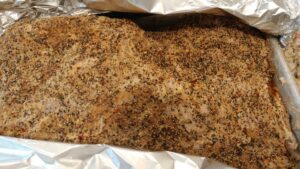
When this post is released on TKZ in the wee hours of the morning, my brisket will be cooking low and slow all night and waiting to be swaddled in heavy foil. I’m praying for a crispy thick bark, an elusive phenomenon for me. My house is filled with an incredible aroma. Someone should bottle it.
There is a genuine art form to making a perfect Texas-style smoked brisket and I already know I will never be worthy, but I’m giving it a go. My older brother is a God when it comes to being a pit master. He’s given me tips and I am sticking to them…as much as my headstrong mind will allow me. I am my mother’s ‘let’s wing every recipe’ daughter.
I will be posting pictures and recipe tips on my Instagram account where I focus on my low carb ketogenic diet and other interests.
Just like a good, tried and true recipe is for brisket, we pick up new tips but keep what works. The same goes for writing. There are ways we all use to build upon our craft methods of writing a novel. We try new things to see what works. We discard other methods that we’ve outgrown as we evolve.
Below are some questions I’d like for you to answer if you see anything that fits you. Feel free to add what you’ve learned about writing in your comments. I am a sponge for picking up new stuff.
1.) Are you still finding time to read? Do you read outside the genre you write? Even when life gets busy, reading can be a comfort, but it can also open your eyes to new techniques or interesting POVs or genres. Always be a student when it comes to your writing craft. You will keep growing.
2.) Do you cherish the time you write, where you write and make sure you don’t get interrupted? Life, family/friends and your day job can pile on to add stress in your life. Is your writing the first thing to go? I hope not. Even if you only finish a page a day, that’s progress. I find that once I establish a routine, my body can react in a bad way if I stray from my writing schedule. I can physically get the shakes. Even when I had my day job, I made sure to write every evening and on weekends. It wasn’t easy but it paid off.
3.) How do you capture those big ideas that can spring on you any time of day or night? Do you keep notebooks all over the house or a voice recorder? I get lots of ideas while I’m driving. The best ones, I pull over and reach for my purse where I keep a small notepad and pens. Or better yet, get someone to drive you so your genius is unfettered. Is there a place where you consistently get your big ideas? No pictures if you tell me “the shower.”
4.) Do you have personal rules/discipline when it comes to unplugging from social media and the internet while you are writing? My usual day is writing 9:00 am until 3:00 pm with short breaks to care for my dogs and grab a snack. I try to get up every 3 hours to stretch and walk and replenish the well for a quick change of scenery but I don’t get to emails or social media until after I’ve achieved my word count goal. YES, I have a daily goal. I generally shoot for 1500-2000 words per day and do rolling edits to keep my progress going on the overall project. But social media and emails are a time drain. No sneak peaking as a diversion when you hit a wall. Pick another way to shake out the cobwebs.
5.) Do you read your work aloud? After all these years, I still read my edits aloud. It’s a great way to insure you have a natural cadence to your dialogue and prose. Even if you don’t do this every day, I recommend doing it for important passages/proposals or as one of your final draft processes. This is the best way to find words you’ve left out.
6.) Do you use the first third to a quarter of your book to set up your world building and character introductions? An editor with a large publishing house said something at a writer’s conference about expecting to read the basic set up with characters and conflict within the first 3 chapters. Now it may not be 3 chapters exactly, as I see it now, but he wasn’t wrong about how to establish your world for the reader. Even if you don’t plot ahead of time, expect that readers and editors and agents will expect you to set that foundation for your story and include your cast of characters and their conflicts in the first part of the book.
7.) Do you plan the ending of your book while you’re working on your plot idea or are you willing to let it happen when you get there? If you’re like me, each book can be different. Sometimes I get up in the middle of the night with a new character telling me the ending to his/her story. True. That doesn’t happen with each book, but when it’s that strong that it wakes me, I listen. On the other hand, I am flexible enough to see new ways to add twists. I want to be open to new character motivations too. More times than not, I have found better books by staying open to my endings. How rigid are you? Have you ever been pleasantly surprised with an ending you never expected, just because you followed a rabbit trail or discovered something new about your main character?
8.) How open are you to criticism? Does it matter who gives it? I used to be more prickly when anyone criticized my masterpiece, but after having many good editors from the publishing houses I’ve worked with and solid beta readers, I’ve grown very open to their suggestions. I think of their criticism as a collaboration to make the book better. I may not always take every suggestion. Only the author should decide what makes sense for the world they are building, but pick your battles. Generally, if someone is confused or something isn’t working for them (even if they can’t describe it exactly), I pay attention and try to find a solution. I’ve never regretted that approach. For anyone taking the time to give a critique, take what they say and make changes where it’s appropriate, even if you have to come back to their feedback later. Keep an open mind.
FOR DISCUSSION:
1.) Share your answers to any of the questions I’ve mentioned above–the questions that resonated with you the most.
2.) Add any new questions or tips that you have found a must to your process. What are your core “must dos” and what have you discarded?
3.) Any brisket tips? I promise I will listen, even if you’re not from Texas.
By SUE COLETTA
 When we first begin our writing journey, our dreams often overshadow the realities of working as a professional writer.
Which publishing path we chose (self-publishing or traditional) doesn’t make a difference. The products we produce do.
For those of you who are at the early stages of your career, let’s take a look at 7 Hard Truths of Working as a Professional Writer.
For the professional writers in our TKZ family, please add your truths.
Truth #1:
Writing consumes us. We decline more offers for lunch than we accept. We could analyze one sentence ad nauseum, and still not be happy with it. To an outsider, at times we may look like we’re staring into space, but our mind is whirling with ten different scenarios after a character did something unexpected or our storyline banged a hard right instead of a left, even though we’d planned the milestones in advance.
Truth #2:
When you work from home, friends and family assume you have time to chitchat. No matter how many times you mention your deadline, book launch, or any “author” subject, many will breeze right over it with, “Yeah, so, anyway …”
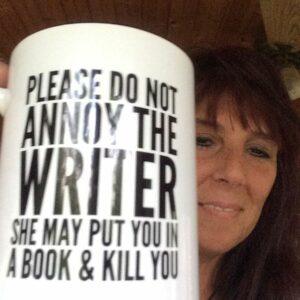
I’ve tried using signs or mugs as a clear signal not to interrupt me (see above pic), but there are those who still barge right in, whether by phone, text, or (gasp!) in person. Not in a callous way; it’s because they don’t understand the amount of brain-power required to plot and successfully execute a novel.
Writers always have multiple balls in the air at once. Yet, from the intruder’s perspective, they think there’s no harm in breaking our concentration for a minute or two (or five or ten), that we can simply return to where we left off as though the disruption never took place.
Easy-peasy, right? Wrong. Interrupting a writer should be punishable by death! At least fictionally. 😉
Truth #3:
Writers spend hours alone in our fictional worlds, and we like it that way. To write professionally, we must be comfortable behind the keyboard. Buy a nice comfy chair; you’re gonna need it. Many professional writers work six or seven days per week, and some hold down full-time day jobs as well. Not everyone has a supportive spouse or makes enough money to write full-time yet.
Truth #4:
Our writing process won’t make sense to anyone but other writers. Don’t even try to explain how a certain song transports you to fictional place or why you have two tiny squares (no more, no less) of chocolate every day as your reward while you read your new favorite thriller.
Writers, did you know daily chocolate* is good for your health? It certainly is, and here’s why:
*I’m referring to a small amount of daily chocolate. Everything in moderation. Too much of anything is never a good idea.
Truth #5:
Our debut is just that, a starting point. It’s where our publishing journey begins. For the first time, the public will read our words, and it’s a terrifying experience akin to standing naked for all to judge. I’d love to say it gets easier, but it doesn’t. I’m as nervous for my thirteenth book to release as I was for my debut. Maybe more so, because the dream of becoming the next “overnight success” isn’t still obscuring reality.
Truth #6:
Many professional writers have health problems. Our bodies weren’t meant to hunch over a keyboard all day, every day. This position can lead to slipped discs, narrowing of nerves in the neck and back, joint issues, carpel tunnel … the list goes on and on.
Remember to take good of yourself! Buy the proper tools of the trade, like an ergonomic chair, a keyboard and/or mouse with wrist support, a sit/stand desk or have the option of switching from the desktop computer to a laptop. Exercise breaks help, too.
Truth #7:
Write for love, not money. The sad truth is, until we build a backlist, writers can’t survive on royalties alone. We can supplement our income in a variety of ways. Some writers coach, some appear on panels or do guest speaking, others offer online courses or webinars. My favorite is mingling with readers at book signings. I make most of my income from May to December. Memorial Day through Labor Day are my busiest time of year, with book signings every weekend.
By studying my area, which is a hotspot for vacationers, I’ve learned where I should appear and when. Year after year, I return to the same venues around the same date. Gone are days of sitting around an empty library, hoping for reader to approach my table, but it took time, consistency, and patience.
There are no shortcuts. Anyone who claims otherwise is lying to you.
***
I haven’t even broached the subject of marketing, piracy, or endless “buy my book!” emails from total strangers who expect you to promote “the book that’ll change the world!” to your audience. You might be surprised by how many new writers believe that, and I seem to attract all of them.
All that said, I love this profession. There’s nothing else I’d rather do.
What are some other hard truths of working as a professional writer? If you’re beginning your writing journey, is there something you’ve wondered about but never had the chance to ask? Now’s the time.