First Page Critique – The Wildfire Pathogen

Jordan Dane
@JordanDane

I am posting my first page critique to assist Clare who is in Australia with personal family business. My first critique in 2020, I hope you’ll enjoy THE WILDFIRE PATHOGEN. Very timely with the Coronavirus out of China. Let’s sanitize our hands and read on. My comments will be on the flip side.

The Wildfire Pathogen

Even through six inches of solid acrylic, Conrad Jurek could see the monsters moving inside the box.

They were no more than grainy mists inside individual test tubes. Those mists swirled with each jolt of the plane as it powered through pockets of turbulence. Almost as if the bumpy ride irked them.

Jurek reached into his sage-colored flight suit, pulled out a pen, and began to jot notes on his clipboard. The acrylic box was a four-by-six foot transparent crate mounted on a hardwood dolly. A locking mechanism the size and weight of a manhole cover sat on top. He’d seen the same tamper-proof device protecting the innards of nuclear warheads.

The monsters inside could do far worse than mere firecrackers.

Six tubes hung suspended below the locking device like bullets chambered in a revolver. Each finger-length container held twenty grams of orthohantavirus, a solid mass of viral matter dried into particles as white and delicate as baby powder.

Yet each cylinder of glittering borosilicate glass held enough pathogenic material to kill several million men, women, and children.

A beefy hand came down on Jurek’s shoulder. He suppressed his instincts and allowed the hand to turn him around. A man wearing a black uniform with the word SECURITY stenciled across the front scowled at him before growling two words.

“Back off.”

Jurek held up the clipboard. “I’m supposed to do a load check mid-flight.”

“No one’s supposed to come close to the package.” The guard’s eyes flicked to the name tag at the chest pocket. “If I were you, Corporal Witkowski, I’d leave. Now.”

Two more security men stepped into view on the opposite side of the box. Jurek considered them for a moment. Under his flight jacket, a 9mm Beretta Nano hung snugly in a holster. The weapon was still warm from when he’d shot Witkowski and taken the airman’s uniform off the hanger.

No, he thought to himself. Stick to the plan.

Jurek turned away and went up to the cockpit. He locked the door and took the empty co-pilot’s chair. The pilot glanced over with a raised eyebrow. His uniform’s tag also bore the name of a man murdered in the last two hours.

“I’m familiar with the outer locking mechanism,” Jurek confirmed. “We go forward as planned, Doctor Isenhoff.”

“Good,” came the reply. “Get your oxygen mask ready.”

With that, Isenhoff reached out and flicked a single switch on the flight panel.

FEEDBACK

SUMMARY – Great place to start. This time it’s not SNAKES ON A PLANE. It’s monsters in a vial. We are already in the middle of the action with plenty of mystery and intrigue to keep turning the pages. The author sticks with the action without slowing the pace with backstory. There’s time for explanation once the reader is pulled in. At the end of the 3rd paragraph, the author draws the reader in tighter in describing the tamper proof canister and compares it to the protection on a nuclear warhead. Nicely done. And it got my attention when the author described a nuke to “firecrackers” compared to the monsters on the plane.

I also liked that the author had patience to let the reader discover that Jurek committed murder to get on the plane, wearing a dead man’s uniform. At this point, we aren’t sure if Jurek is trying to stop a deadly pathogen attack by hijacking the material from villains or if he plans to steal the deadly virus to commit his own attack. Great set up with plenty of mystery to unravel.

I especially like how the author had Jurek accosted by security and he had to restrain his instincts to fight the man off. He’s got more up his sleeve (a plan) and that’s when we find out that Jurek killed to board the plane. Nice touch, author.

Then a stroke of genius to have Jurek working with the pilot – a doctor presumably familiar with the pathogen – who is also a pilot. Jurek and Dr Isenhoff are in it together. And there’s a hint that there’s a reason Jurek went to check out the dangerous cargo, to determine if he knew how to break into the canister. Something bad is about to happen that involves oxygen masks. At this point, we don’t know who the protagonist is, but we have a great start.

TITLE – I like the reference to “wildfire.” We all know what that could mean in terms of spreading fast and the word “pathogen” is timely and medical. Only the author knows if there are other titles that could establish the critical danger in a better way, but I would be happy taking this title to a publisher. It’s more than a working title, in my opinion.

NIT PICKY – At the start of paragraph 3, I spotted a pet peeve of mine. I like a strong sentence with tight wording. The words “began to” are unnecessary. It would be better to say “…and pulled out a pen to jot notes on his clipboard.”

Jurek reached into his sage-colored flight suit, pulled out a pen, and began to jot notes on his clipboard. 

Great job, anonymous author. There’s action and I’m intrigued. I would definitely keep reading. Okay TKZers, please leave your comments and provide feedback to this brave author. (Safe travels, Clare. We missed you.)

The Curse She Wore – Coming Feb 10, 2010. On presale now.

Trespassing on Fate’s turf comes with a price for two broken people–one they will never see coming.

Just Breathe… You’ve Got This

By Sue Coletta

Writers wear many hats… wife/husband, mother/father, sister/brother, friend, marketer, editor, (some add) publisher, (some add) cover designer, (some add) audiobook narrator, (some add) speaker, (some add) coach, housekeeper, bookkeeper, blogger, social media user/expert, tax preparer, holiday host, baker, cook, etc., etc., etc.

Under the best of circumstances, it’s a lot to juggle. During the holiday season, forget about it. Feeling overwhelmed is the new normal, especially if you’re hosting a holiday event.

First, breathe. You’ve got this.

When chaos starts shaking the to-do list in my face, I close my eyes, lean back, and breathe… It’s amazing what a few deep breaths can do. There’s a running joke in my family that I’m so chill, I’m practically a corpse. It’s true! My blood pressure rarely, if ever, rises above 110/60, even under stressful conditions. And you know why? Because I take advantage of the most powerful and the most basic gift we have — the ability to breathe.

It may not sound like much of a superpower, but controlled breathing improves overall health. Controlled breaths can calm the brain, regulate blood pressure, improve memory, feed the emotional region of the brain, boost the immune system, and increase energy and metabolism levels.

The Brain’s Breathing Pacemaker

A 2016 study accidently discovered a neural circuit in the brainstem that plays a pivotal role in the breathing-brain control connection. This circuit is called “the brain’s breathing pacemaker,” because it can be adjusted by alternating breathing rhythm, which influences our emotional state. Slow, controlled breathing decreases activity in the circuit while fast, erratic breathing increases activity. Why this occurs is still largely unknown, but knowing this circuit exists is a huge step closer to figuring it out.

Breathing Decreases Pain 

Specifically, diaphragmatic breathing exercises. Ever watch an infant sleep? Their little tummy expands on the inhale and depletes on the exhale. They’re breathing through their diaphragm. We’re born breathing this way. It’s only as we grow older that we start depending on our lungs to do all the work.

Singers and athletes take advantage of diaphragmatic breathing techniques. Why not writers? If you find yourself hunched over the keyboard for too long, take a few moments to lay flat and concentrate on inflating your belly as you inhale through your nostrils. Then exhale while pulling your belly button toward your core. It takes a little practice to master the technique. Once you do, you can diaphragmatically breathe in any position. The best part is, it works!

Count Breaths for Emotional Well-Being

In 2018, another scientific study found that the mere act of counting breaths influenced “neuronal oscillations throughout the brain” in regions related to emotion. When participants counted correctly, brain activity showed a more organized pattern in the regions related to emotion, memory, and awareness, verse participants who breathed normally (without counting).

Controlled Breathing Boosts Memory

The rhythm of our breathing generates electrical activity in the brain that affects how well we remember. Scientists linked inhaling to a greater recall of fearful faces, but only when the participants breathed through their nose. They were also able to remember certain objects in greater detail while inhaling. Thus, researchers believe nasal inhalation triggers more electrical activity in the amygdala (brain’s emotional center). Inhaling also seems key to greater activity in the hippocampus, “the seat of memory,” according to Forbes.

Relaxation Response

The “Relaxation Response” (RR) is a physiological and psychological state opposite to the fight-or-flight response. RR therapy includes meditation, yoga, and repetitive prayer, and has been practiced for thousands of years. These stress-reducing practices counteract the adverse clinical effect of stress in disorders like hypertension, anxiety, insomnia, and aging.

Yet, research on the underlying molecular mechanisms of why it works remained undetermined until a 2017 study unearthed a fascinating discovery. Both short-term and long-term practitioners of meditation, yoga, and repetitive prayer showed “enhanced expression of genes associated with energy metabolism, mitochondrial function…” and more efficient insulin secretion, which helps with blood sugar management. Relaxation Response also reduces the expression of genes linked to inflammatory responses and stress-related pathways. In simpler terms, controlled breathing helps boost the immune system and improve energy metabolism.

Creativity

This probably goes without saying, but I’m mentioning it anyway. Good brain health increases creativity. Creativity helps inspiration. And inspiration ups word counts.

With all the rushing around for the holidays, combined with writing deadlines — either self-imposed or contracted — please take the time to breathe. Your body and your muse will thank you later. 🙂

Happy Holidays, my beloved TKZers! May all your writer dreams come true in 2020.


READER FRIDAY: Confession Time: I have never…(finish it).

Call it overly sensitive, but I don’t like to see any movie where humans ARE FOOD. Gives me the shivers. My confession?

I have never…SEEN JAWS.

I have never…seen the Grand Canyon. (I hope to remedy this in 2020.)

As 2019 comes to an end, it’s time to come clean with your TKZ family. Share something you have NEVER DONE that we might find surprising.

Welcome to Murder 101: PG Halloween Edition

With Halloween arriving next week, murder is in the air. It might be the only time of year when “normal” people can fully relate to crime writers and readers. So, ladies and gents, grab your favorite beverage and kick back for a little Murder 101, complete with visual aids.

Let’s say your male character is cheating on your protagonist.

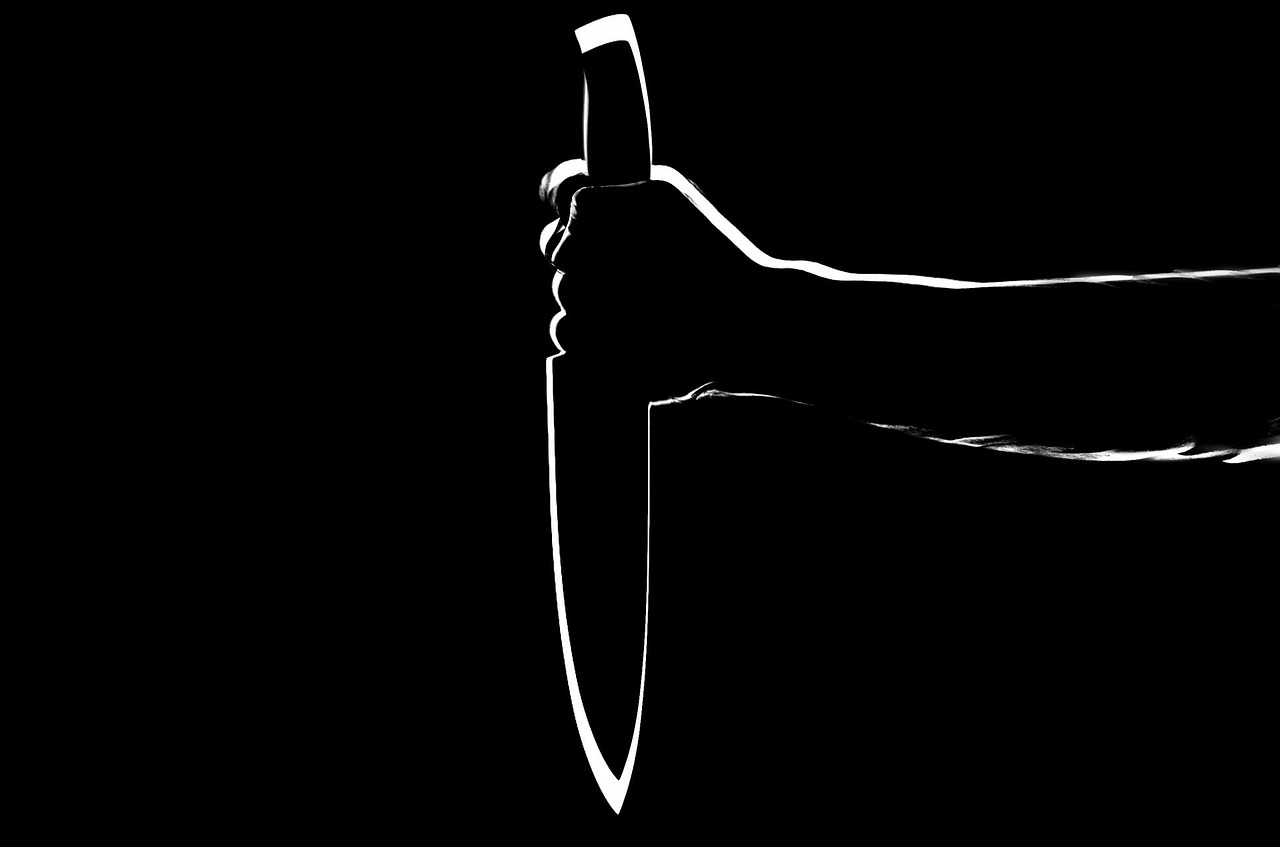
During the confrontation — we can’t ignore that type of behavior, now can we? — take the homewrecker by surprise with one well-placed stab to the carotid artery. Don’t forget to withdraw the hunting knife! We wouldn’t want it to act as a plug.

Notice how the kitty is priming the carotid artery? The subject is nice and relaxed. More importantly, he doesn’t suspect a thing.

There are two carotid arteries in the neck, one on the left side and one on the right. Each carotid artery branches into two divisions:
• Internal carotid artery supplies blood to the brain
• External carotid artery supplies blood to the face and neck

If it were me, I’d aim for the internal carotid, but it’s a personal preference. If you’d rather watch the blood drain from the subject’s face and neck, then shoot for the external. Both will get the job done.

A quiet execution is an effective way to murder…

If you choose this murder method, be sure to use a fast-acting poison. No need to act psychopathic by dragging out your subject’s agony. Unless, of course, that’s what you’re into. No judgments!

May I make a suggestion? Try using Tetrodotoxin, which is a complex biochemical found in two marine creatures, the blue-ringed octopus and the puffer fish. It’s also in slugs, but on a much smaller scale. Garry Rodgers wrote a fantastic article about this deadly poison.

Whether Tetrodotoxin is injected via octopus bite — how might you explain a pet octopus? — or ingested by way of food or drink, the poison will kill the subject within a few minutes, depending on the character’s size vs. the amount of poison administered. Tetrodotoxin first blocks nerve responses and then paralyzes the victim, which prevents the victim from breathing. Finally, it stops the heart. As little as 1 milligram is all you need to accomplish your goal.

Some people prefer a good ol’ fashioned murder method, complete with sound effects.

Ladies, please don’t close your eyes while firing a weapon. I know murder isn’t easy, but if you’re determined to see this through, you may as well do it right. For information on the correct ammunition to use, John Gilstrap, wrote a post about what works best. Hint: hollow points are your friend.

Manual suffocation adds an up-close-and-personal touch.

This method is fairly straightforward. Notice how the sloth covers the kitty’s nose and mouth with one smooth motion? Perfect execution! Only use this murder method on humans please. We’re not savages, after all. ?

Sometimes, you just gotta let loose — and that’s okay.

Nothing screams you’re on the edge of sanity quite like an ax. Don’t you agree? You may want to act this one out at his place to avoid a lengthy crime scene clean up. Notice the plastic coveralls? Get yourself an identical suit but wear the hood. You wouldn’t want to leave hairs behind for the crime scene unit.

I swear, Your Honor, I had nothing to do with it. He tripped.

Do NOT harm the family dog. Please note how Miss White effortlessly pushes her lover down the stairs. So graceful, so ladylike, a little flick of the wrist and her problem is resolved.

Unless, of course, his neck doesn’t snap. Yeah, that could happen. Then what do you do? No problem. Finish him off with a quick slash to the neck like this …

Time is running out, folks. By November 1st some people may not “appreciate” a crime writer/reader’s passion to help others. Before then, it’s perfectly acceptable to say…

I’ll leave you with one final word of wisdom…

For those participating in NaNoWriMo this year, remember that. Happy hunting! I mean… writing. 😉


Can Writers Lose Their Fingerprints?

By Sue Coletta

In a recent chat with Jordan, she mentioned that when she went for her TSA pre-check ID for her upcoming trip, they couldn’t detect her digital fingerprints.

They said since she spent so much time at a computer keyboard as a writer, she’s deteriorated her ridge detail.

Could this be true of all professional writers?

As you might have guessed, this question sent me down a rabbit hole of research, because I’ve had trouble with my iPhone’s digital fingerprint scan. It only recognizes my thumbprint, not any other finger. Which I figured was just a glitch with the phone. Now, I’m not so sure.

Before we can prove or disprove TSA’s conclusion, we first need to know the basics.

What is a fingerprint?

A fingerprint is a pattern of friction ridge details, comprised of ridges and valleys. A ridge is a high point, a valley is a depression or low point. Friction ridges are also found on our palms, feet, and toes. “Pattern” equals the unique characteristics of the ridges and valleys that make up the print, defined by the spatial relationship of multiple lines, their beginning and terminating points, and the unique pattern they create.

Each ridge contains tiny pores connected to sweat glands beneath the skin. When we touch an object, sweat and oils release from these pores and leave behind a print, latent or visible. The genes from our parents determine the general characteristics of the pattern.


Fun fact: Like human fingerprints, a dog’s nose has a unique identifiable pattern. In fact, many dog clubs now keep nose prints on file.

If you’d like to learn how to print your dog’s nose, see this post. 🙂


Sir Francis Galton was the first person to classify fingerprints into different types based on the three basic features: loops, arches, and whorls. Learn more about points, types, and classifications HERE.

Fingerprints form before birth and remain unchanged until the body decomposes after death.

There are two exceptions to “remain unchanged”…

If, say, someone sliced the tip of their finger with a knife, it may leave behind a scar. But then, their fingerprint would be even more distinguishable because of that scar.

Along similar lines, severe burns can also damage the deep layers of skin and obliterate the ridge detail. However, much like the knife injury, the scars that form would become the injured party’s unique identifiers.

The other exception has to do with the elderly. As we age, we lose skin elasticity, which may affect ridge detail. The fingerprints become wider; the spaces between the ridges narrower. Even though the fingerprint still exists, fingerprint technology may find it more difficult to detect.

Can someone be born without fingerprints?

In a few rare cases, yes. One condition called adermatoglyphia — also known as “immigration delay disease” — can result in a child being born without fingerprints. In some cases, these infants have almost no other health issues. In other cases, this condition could cause skin abnormalities, including tiny white bumps on the face, blistering of the skin, and/or a lack of sweat glands. Adermatoglyphia has only been documented in four families worldwide.

Naegeli Syndrome is another rare condition that halts the production of fingerprints in utero. Said syndrome is characterized by reticular skin pigmentation (meaning, mottled, purplish, and lace-like splotches), diminished function of the sweat glands, and the absence of teeth. Individuals with Naegeli Syndrome have sweat gland abnormalities. Not only do they lack fingerprints but they also suffer from heat intolerance due to a decrease or total inability to sweat.

Do Twins Have the Same Fingerprints?

No. Twins do not have identical fingerprints. Our prints are as unique as snowflakes. Actually, we have a 1 in 64 billion chance of having the same fingerprints as someone else.

Sci-fi writers could potentially take advantage of these odds, but it’s such a longshot that it’d be tricky to pull off.

Who’s most at risk for losing their fingerprints?

Patients undergoing chemotherapy — such as capecitabine (Xeloda), for example — are most at risk. With prolonged use of this medication, the finger-pad skin can become inflamed, swollen, and damaged to the point of erasing the ridge detail, according to DP Lyle, MD, author of Forensics for Dummies. Chemotherapy may also cause severe peeling of the palms and soles of the feet. The medical term for this condition is called Hand-Foot Syndrome.

Skin diseases like scleroderma, psoriasis, and eczema also have the potential to obliterate the ridge pattern.

Which professions cause the most damage to fingerprints?

Bricklayers and other heavy manual laborers can wear down their fingerprint ridges to the point where no pattern is visible. Secretaries and file clerks who handle paper all day can have a similar thing occur. Typists (Writers!) and piano players can suffer the same alterations. Hairstylists, dry cleaning workers, and those who work with lime (calcium oxide) are often exposed to chemicals that dissolve the upper layers of the skin, thereby flattening the ridge detail.

So, to answer our initial question, was TSA correct?

Yes! Pounding on the keyboard can wear away a writer’s fingerprints.

How might the lack of fingerprints cause problems?

Losing one’s prints can cause issues with crossing international borders and even logging on to certain computer systems.

Fortunately, fingerprint technology is always evolving and improving.

As more and more careers require hours of keyboard time, someday retinal scanners, facial recognition, and voice prints will replace the current technology.

Have you ever been told you have no digital fingerprints? Have you experienced any problems with fingerprint technology?

Travel Replenishes the Writer’s Soul

Jordan Dane
@JordanDane

I have my first real vacation coming up in October. It’s been a long time since I’ve traveled to another country. When my husband was alive, he had his passport but never wanted to travel outside the U.S. I wanted him to see some of the countries I visited after high school but he never had the curiosity for international travel. It’s a shame. I would’ve liked to experience another adventure with him. I lost him in 2014 and have missed him every day. It’s been a process of redefining who I am without him, but with every day that passes, I feel stronger and more hopeful.

I didn’t write for two years after he died. I was in a fog for a long time. Faced with selling my large home and an extra car and downsizing was a daunting task, but I had lots of support. After a friend contacted me to write for her Amazon Kindleworlds, I finally got back into writing and that helped me deal with my grief. I wrote about it. In the many characters I developed in my Amazon novellas and in the novels I’ve written after my husband died, I explored my emotional frailties through the eyes of my characters. Writing helped me heal. I will never be whole again, but through hardships, you develop strength and you see how important friends and family can be. In many ways, I’ve been blessed.

This trip is more than exploring the world and meeting new people. It’s an awakening for me. It’s as exciting as it is frightening but I can’t wait to get the first stamp in my passport and I have more trips planned over the next two years.

This year, my travel plans will be to the Lakes District of northern Italy and Milan. The area is nestled into the Swiss Alps, on the border with Italy, and covers beautiful lakes (Lake Como, Bellagio and Maggiore) with quaint villages, shopping and restaurants on glistening waters. It’s picture post card scenery when you see the idyllic images of this beautiful part of the world.

I will also visit Milan, the fashion district of Italy, and there are other daily excursions to different islands using a ferry system. A rail system can also get me into Switzerland on my free time, between organized day trips.

I’m looking forward to seeing the LAST SUPPER by Leonardo da Vinci (housed in the refectory of the Convent of Santa Maria delle Grazie in Milan) and the iconic La Scala Theatre and its Opera museum.

I’m traveling as a solo traveler with a small 28-person tour organized by the Traveling Aggies (an association of former A&M students, but you don’t have to be alumni to travel with them) through AHI Travel. It may be a little intimidating to travel solo, but I am looking forward to meeting the group under the guidance of an established travel guide and Texas hosts.

This is my first adventure, but I have friends and family lined up as travel companions for trips in 2020-2021. I’m planning a river cruise with some dear friends in 2020 into Europe and have a Germany trip in the planning stages with my older brother and his wife for July 2020.

I feel very unprepared for travel these days, but would like to ask help from you seasoned travelers.

I’ve learned that I can get TSA pre-check for US domestic flights–to avoid the longer security checks by obtaining an early background check for ease of travel–or I can also get something more global. GlobalEntry.Gov is geared more for international travel, but also covers domestic flights. For those unfamiliar, the GlobalEntry.Gov application costs $100 but also pays for TSA Precheck on domestic flights. I had already paid $85 for TSA precheck when I could have paid $100 for the Global Entry and gotten both clearances for worldwide travel. Live and learn.

I purchased Rick Steves’ book on Milan and the Lakes District and he has a video on Youtube. Lots of tips. Steves suggested I acquire a credit card that doesn’t charge for currency conversion with charges. I did my research and have done that. In addition, Italy is part of the European Union so EU currency is what I’ll need.

I’m also acquiring travel accessories, like electrical outlet converters for Europe, neck support & eye mask for sleeping on the plane, money belt with RFID protection, and I’m considering the purchase of a good theft-resistant backpack for the day trips.

Other things I have done to prepare ( in no particular order):

1.) Notify my credit card company of my travel dates, so my transactions aren’t flagged or stopped.

2.) Notify my bank of those dates, in case I need a wire or expect an ATM transaction.

3.) Expand my cell service for international coverage.

4.) Check health warnings for the country I’m traveling to, if any. Get any vaccinations I may need.

5.) Set up email alerts for my country of travel through Smart Traveler Enrollment Program – STEP.com to get State Department advisories via email.

6.) Purchase trip cancellation insurance.

7.) Verify that my present health insurance covers foreign travel. Will I need more?

8.) Set up Mobile Passport in advance, the app for U.S. Customs and Immigration to make my border crossings run smoothly.

9.) Make copies of all my important documents & emergency contact information (keeping them in a separate & safe location – ie locked in my hotel safe) for reference if they are stolen and I need to report it.

10.) Send out my travel itinerary to family (with contact information) for emergencies.

11.) Record emergency contact phone numbers in my cell phone contact list with a hard copy backup if my phone is stolen (ie embassy info, hotel phone number and instructions on how to make a long distance international call).

DISCUSSION:

Any tips that I’ve missed? I would appreciate advice from you more seasoned travelers.

Should I get local currency (Euros) before I leave? How much should I bring? I plan to see my bank this week.

Has anyone been to the northern Lakes District of Italy & Milan? Any recommendations for restaurants or fun places to see?

One Writer’s Strange Encounter with a Reader

By SUE COLETTA

Joe’s Saturday post inspired me to share a strange encounter I had with a reader last week. I loaded up the SUV for my annual trip north to appear at a 5-star library in New Hampshire (rated by Library Journal). I’ve all but given up on libraries for book signings, but this library has the coolest librarian/director I’ve ever met. She’s a walking contradiction! Inside the library, she’s quiet, polite, and super helpful. When she locks the library doors, however, she really lets her hair down, hops into her supped-up Mustang convertible and races down the streets—a quick streak of blue and white whizzing by. I adore this woman! Every signing, successful or not, ends with a hug. Which keeps me coming back year after year.

Sometimes my timing is perfect. Other times, not so much.

Last week, the local priest decided to hold his retirement party across the street from the library on the same night as my book event. Needless to say, it wasn’t my most successful signing ever. Didn’t matter. Whether we’re speaking to a packed room or only three or four readers trickle in, we still need to put on the same show. Sometimes a more intimate setting is really nice, as it gives us the opportunity to chitchat with the folks who read our books.

Unless you get an angry-looking woman in the front row who does nothing but glare at you.

All she wanted was for me to keep reading excerpts, one after another. It was strangest thing. Every time I stopped she’d point to another book and ask me to read the opening chapter. No one else objected, so I gave her what she wanted. After I read about four, I was beginning to feel like a puppet on a string. So, I asked her why she’d rather hear me read than chat with me.

Her response? “I don’t even think about the writer when I read. I don’t care about the research. I don’t care about the story behind the story. All I want is the next book.”

“Wow,” was all I managed before the librarian jolted to her feet.

“I care,” she said, “I care very deeply for writers.”

The others in the room agreed.

Still, I couldn’t help thinking, how sad. Here this woman sat surrounded by books lining every wall, every partition. Decades, if not centuries, of writers who’d worked endless hours, alone, pecking the keyboard or typewriter or writing longhand by candlelight, their joys, their sorrows, their laughter and pain spilled across the pages, and this poor woman was incapable of seeing any of it. Didn’t care to, either, apparently. But even if she continued to disrespect writers, I wasn’t about to stoop to her level and spout an equally snarky comeback. I’m a big believer in karma. So, I gave her a free signed paperback and thanked her for coming to the event.

If you haven’t done book signings yet, let me put your mind at ease. For every one clueless reader, there are thousands of others who cherish every word. Readers who sit our books on a shelf of honor because they loved it so much. Our characters become their best friends, sometimes their only friends. When these devoted readers finally get the chance to meet the writer who brought their beloved characters to life, they shower us with love. Some might even mistake the writer for one of their characters. You know what? That’s okay, too… unless she’s a Delores Claiborne type. 😉 It means our words, our stories, touched their lives in some way.

Isn’t that why we write?

Please excuse me while I share my love for those who read my books. I’ve been blessed with an amazing, generous, thoughtful, kind, funny, loving, and downright nutty audience. It’s no secret that I adore crows, right? I’m so enamored with these birds that I’ve set out to change the public perception that crows are pests. Nothing could be farther from the truth. Spotting one in the yard does NOT equate to a bad omen. These amazing creatures—the smartest of the bird world, by the way, along with their cousin, the raven—do NOT bring death and destruction. They’ve been saddled with an unjustified bad reputation for no apparent reason. It’s time to stop judging birds by the color of their plumage.

Ahem. Excuse me. I get a little carried away when it comes to breed profiling. 🙂

Anyway, since I share my love for Poe (my crow who lives free, yet comes when called) along with Edgar, Allan, Thoreau, Shakespeare, and the rest of my black beauties (some of which I’ve turned into characters for my Mayhem Series) readers are now decorating my office with crows. Here are a few I received this summer…


Over to you, TKZ family. Have you ever heard a similar remark as the woman in the library? If so, how’d you handle it? Tell us about your strangest — or best! — encounter with a reader?

*I’m on the road today, researching, so I may be late responding to comments.

Why Waiting is Difficult

By SUE COLETTA

It’s no secret that the writing biz requires patience. Sometimes, though, waiting can be agonizing. Recently, an exciting opportunity came my way. In order to make this dream come true, I had two weeks (two weeks!) to produce something I’ve never done before. Sorry for being so cryptic, but I don’t want to jinx it.

Now that I made my deadline, all that’s left to do is wait. And wait. And wait. Even with a new release, my mind keeps wandering back to this secret project … and the wait.

via GIPHY

That got me thinking, I wonder how or if waiting affects the brain.

Turns out, researchers recently asked the same question. For the first time, a research team at McGill University clearly identified the specific parts of the brain involved in decisions that call for delayed gratification.

Here’s how it works …

The hippocampus (associated with memory) and the nucleus accumbens (associated with pleasure) work together to make critical decisions where time plays a role. For example, suppose you send a query to a literary agent or publisher. You’re making a decision that requires you to wait for the outcome, thereby triggering both the hippocampus and nucleus accumbens.

Still with me? Okay, cool. Let’s look at exactly what these researchers did to prove or disprove their theory …

The researchers used rats trained to make choices between stimuli that resulted in rewards. Some rewards were delivered instantly, some meant delayed gratification. The rats had a choice between two identical visual shapes on a touchscreen (similar to an iPad). In exchange for sugar pellets, the rats had the choice to press their noses against the shape that delivered one sugar pellet immediately or the shape that would deliver four sugar pellets if they waited to receive the reward.

Over time, the rats learned to negotiate a trade-off between the smaller, instant gratification and a windfall, even if it meant waiting for a short period. Researchers argue that most people will also wait for a decision to pay off, if the reward is worth it.

Do you agree? she asks a community of writers whose dreams stand at the intersection of hurry up and wait.

Now, what do you think happened when the researchers disrupted the circuit from the rats’ hippocampus and nucleus accumbens? You guessed it. The rats became impatient and irritable, unwilling to wait even for a few seconds.

Why?

Our brains weigh the pros and cons of thousands of situations every day without conscious thought. The nucleus accumbens is made up of a group of tiny cells deep within our brains, and those cells are responsible for the release of dopamine. The amount of dopamine released depends on the size of the reward.

Is it any wonder why we hate waiting? Our bodies crave dopamine! Hence, why exercise is so important for good mental health.

What can we do to help with waiting for news? You guessed it. Get your body to pump dopamine. Which is why today (Saturday) I jumped on my husband’s tractor and mowed the lawn before writing this post. 😉

Yeah, he couldn’t believe it either. I’m not what anyone would describe as a manual labor type of chick. I like my fingernails too much to break them. But I needed a way to switch off my brain before I drove myself crazy by checking and rechecking my email. When I saw my husband on the tractor, it looked like fun.

You know what? I had a blast! Who knew mowing the lawn could double as an exercise in creativity? As my husband cringed, I sailed around the yard creating animal shapes with the blades. Always keep ‘em guessing, ladies!

Men, you can stop groaning now. You’ll be pleased to know I fixed the grass afterward by riding back and forth in military straight lines, but it was nowhere near as fun.

In other study, researchers at the University of Texas measured what occurs inside the brain during a long wait vs. a short wait. For the experiment they used two different tones. The first tone meant a 15-20 second waiting period, the second equaled wait times of 65-75 seconds. Both tones signaled the same reward. The only difference was the length of delay. What they discovered was the nucleus accumbens released more dopamine when the short wait tone sounded. Which means, we’re willing to wait for a reward if the wait doesn’t take too long.

Makes sense, right?

So, if you’re waiting for something to happen as a result of a decision you made, do yourself a favor and get outside, or hit the gym … anything that might help to release dopamine. If you follow this advice, the wait won’t feel as long.

Are you in the wait zone? Care to share what you’re waiting for? What are some ways that have helped you to wait?


It starts with an innocent stuffed animal. It ends with mind-numbing terror. 

RACKED, Grafton County, Book 4, is now available for pre-order! Only 99c.